

★★★★ 4.4/5 — A republic lasts by returning to the move that made it, not by reciting the founding speech.
Best for: Founders, leads, and civic operators who feel the shop getting polite, slow, and proud of its process
Reading time: ~12 hrs for the Chicago Mansfield/Tarcov paperback (424 pages) · ~20 min for this guide
Difficulty to apply: The Roman examples are thick; the drill is one founding rule you will redo this week
Discourses on Livy in one minute
Discourses on Livy is a durability manual disguised as a reading of Rome. Niccolò Machiavelli, the same Florentine secretary who wrote The Prince, spent his exile asking a colder question than how one man holds a week: how does an order outlive the founder? Republics last when one, few, and many all have a real office. They stay awake through tumulti — conflict that has a legal home, not a hallway. They keep arms that answer to them. And they periodically return to the beginning: not the speech on the wall, the act that made the shop real. If your team is polite, process-heavy, and proud of how little it fights, this is the book.
Key takeaways
- Return to beginnings: Durable orders redo the founding move. Reciting the origin story is weaker.
- Mix the offices: One closer, a few who argue, a many who can push back. Any leg alone rots.
- Tumulti are a signal: The clash between people and great keeps a republic awake. Silence is often already corruption.
- Give the fight an office: Rome’s tribunes made the miss legal. A hallway campaign is calumny.
- Necessity before sermons: Men do good when the setup requires it. Design the constraint.
- Own the arms: Capability that answers to you. Vendors and a single hero are not a foundation.
- Good arms, good laws: Process without capability is etiquette. Capability without a rule is a raid.
- Time-box the emergency: A dictator with an expiry can save a week. A dictator with a new identity becomes the week.
- Accuse in the open: Name the miss in the room that can fix it. Whispers rot the mixed order.
- The founder is a method: After the first person leaves, the beginning has to be repeatable.
What is Discourses on Livy about?
Discourses on Livy is Machiavelli’s 1531 treatise on how republics last. Reading Livy’s early Rome, it argues for mixed offices, legal conflict, owned arms, and a periodic return to the founding move so an order outlives one gifted person.
About the author
Niccolò Machiavelli (1469–1527) was a Florentine diplomat whose classroom was a republic that failed. He served Florence from 1498 to 1512, then lost the job when the Medici came back. In exile he wrote two books that still get mashed into one nickname. The Prince is the short handbook of one-man virtù. The Discourses on Livy is the longer republican companion: how a people, a senate, and a named office last when the gifted man is gone. The Chicago Mansfield and Tarcov translation is the English we use here. Operators still need him because most modern “culture” fails the same way — a speech about values after the founding act has stopped happening. Explore all Niccolò Machiavelli book summaries →
Key concepts at a glance
| Concept | What it means | Use it when |
|---|---|---|
| Return to beginnings | Redo the act that made the order real, not the speech about it. | The origin story is framed and the bar has slipped. |
| Mixed order | One, few, and many each hold a real office. | One hero, a quiet senate, or a decorative all-hands. |
| Tumulti | Legal conflict between people and great; a feature, not a scandal. | You are proud of how little the shop fights. |
| Tribunes | An office that lets the floor stop a miss without a coup. | The only path up is a hallway or a resignation. |
| Necessity | People do good when the setup requires it. | You are adding posters instead of constraints. |
| Own arms | Capability that answers to you. | A vendor, a platform, or one irreplaceable person is the plan. |
| Dictatorship | Time-boxed emergency authority with an expiry. | A crisis title is becoming the new org chart. |
| Accusation vs calumny | Name the miss in the open versus whisper it sideways. | The real review happens after the meeting. |
Part 1: What a republic actually is — people, great, and a fight with an office
Machiavelli opens by refusing the civics-class story. Rome did not become free because it was nice. It became free because the nobles and the plebs kept colliding, and those collisions produced offices. The tribunes of the plebs gave the people a legal door. In Mansfield’s English the point is blunt: those who condemn the tumults between nobles and plebs condemn the things that were the first cause of keeping Rome free. The fight was not a bug in the constitution. It was how the constitution stayed awake.
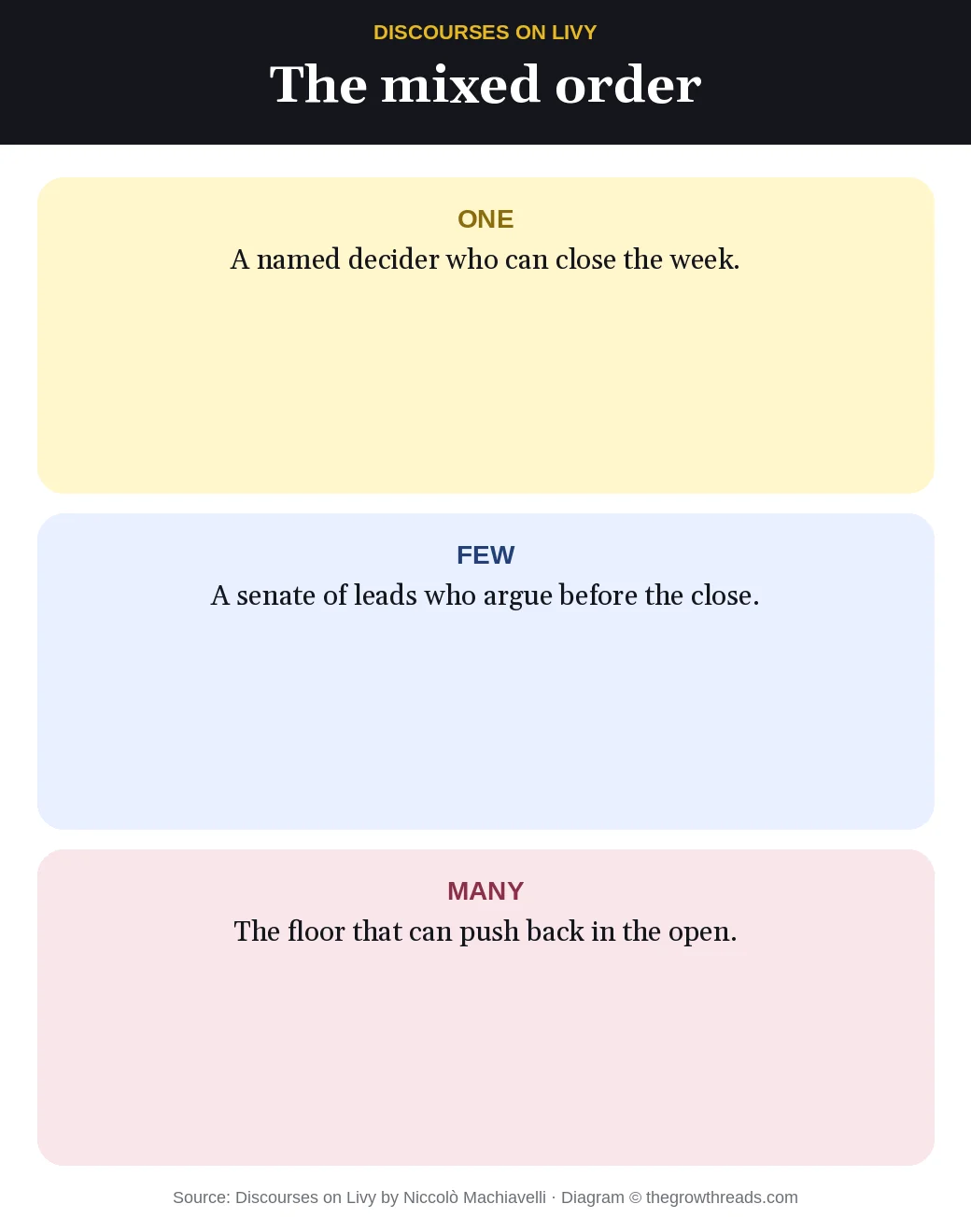
Translate the cast. The “great” want to command. The people want not to be commanded. A mixed order keeps a named closer (the consular “one”), a senate of leads who argue before the close (the few), and a floor that can raise a miss without staging a resignation (the many). If your all-hands cannot change a decision, you do not have a people. You have an audience. If your lead meeting cannot disagree, you do not have a senate. You have a briefing.
He is not romantic about human material. Book I assumes men are ungrateful, fickle, and good when necessity requires it. That is a design brief. If the weekly only works when everyone is well-slept and high-trust, you do not have a weekly. You have a weather report. Build the office so a tired Tuesday still produces a named close and an open miss. Necessity is the constraint that makes skill show up. Sermons are what you add after you refused to design the constraint.
TGR Note: The shorter companion is The Prince — one-man virtù for a week you have to hold. Discourses is what you read when the week is fine and the institution is getting polite. Pair them.
Part 2: Tumulti, accusations, and the silence that looks like culture
The most usable argument in Book I is also the one modern teams flinch at. Machiavelli likes tumults: the public, recurring collision between people who want more room and people who want more command. Rome’s greatness, he says, came from that noise. The tribunes did not abolish the fight. They housed it. A fight without an office becomes a conspiracy. An office without a fight becomes etiquette.
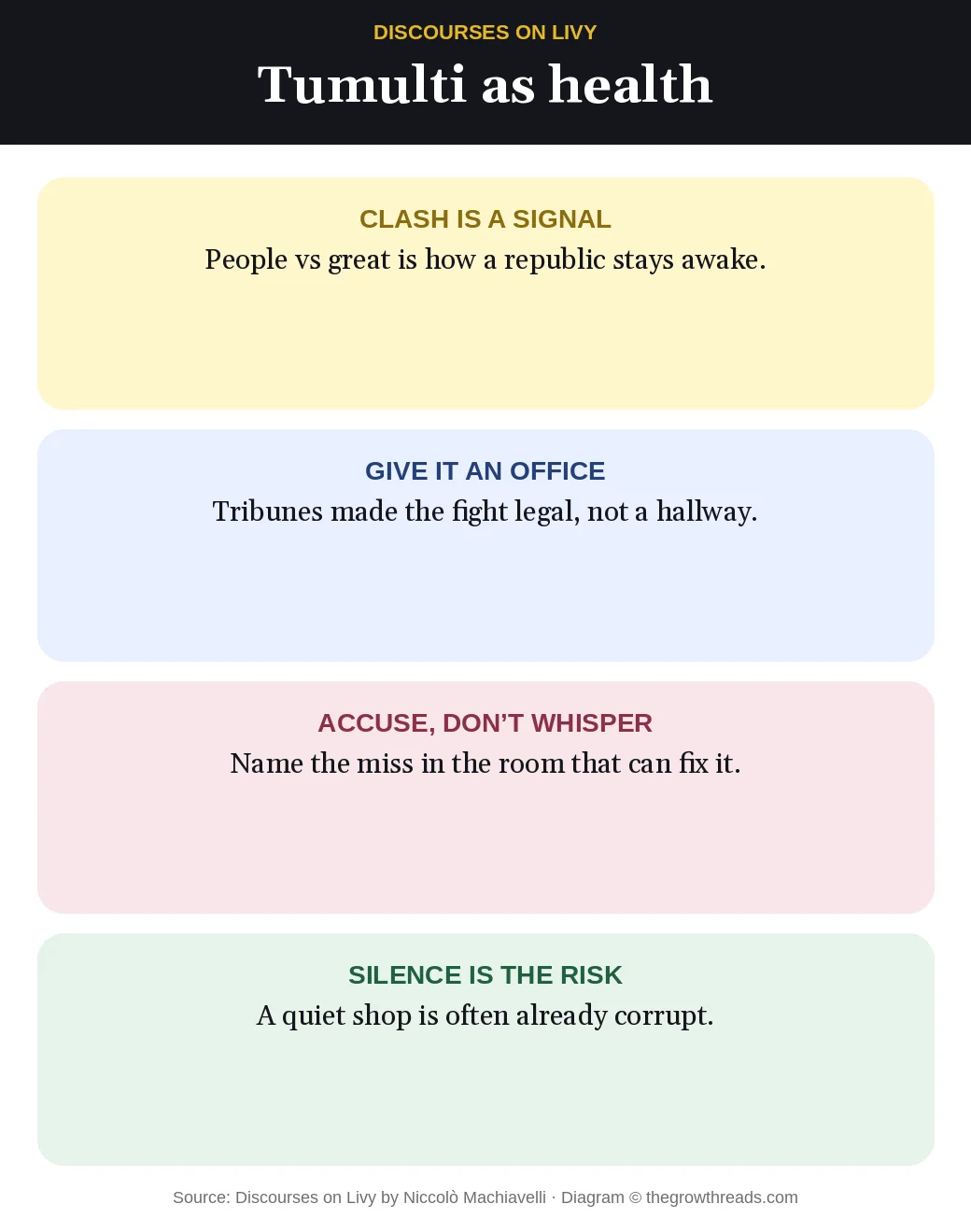
He splits accusation from calumny. Accusation is a named miss in a room that can repair it. Calumny is the hallway version: a story with no defendant and no close. Republics rot when calumny is cheaper than accusation. If the real review of a launch happens in a side chat, you have already left the mixed order. The modern move is one sentence in the room that owns the work: what slipped, who holds it, what changes Tuesday. Your version of Rome’s restored fear of the laws is a restored consequence — a hiring bar, a ship rule, a stop — applied in the open.
Religion, in the Numa chapters, is civic glue. Numa used rites to make a ferocious people capable of law. The operator translation is shared forms that make necessity visible — the same weekly, the same definition of done, the same way a miss is named. Forms without teeth are branding. Teeth without forms are a mood.
TGR Note: Willink in Extreme Ownership wants the miss owned in the open. Machiavelli wants that miss to have an office so ownership is not a personality stunt. Holiday in Ego Is the Enemy clears the self out of the way; Discourses tells you what the self was blocking.
Part 3: Arms, laws, and the capability that answers to you
Book II is the expansion book. Machiavelli is obsessive about arms that are yours. Money is not the sinew of war; good soldiers are. Fortresses often advertise that you do not trust the people around you. The Prince already said there cannot be good laws where there are not good arms. The Discourses keeps proving it with Rome’s colonies and its refusals to outsource the fight.
In a modern shop, “arms” are the capability that still works when a vendor is late and a hero is on leave. If your launch depends on one irreplaceable engineer, you have mercenaries with equity. If your process is a deck no one can execute, you have laws without arms. You cannot culture your way into a capability you do not practice. Good arms make good laws possible because people who can do the work will demand a rule that is not a decoration. Good laws make good arms last because the rule outlives the campaign.
Expansion, for him, is how a republic stays in virtù. Idle peace is how it goes soft. That is not “always be growing.” An order that never meets a new necessity starts performing its old one. You need a live contest that still requires the founding move — a quality bar, a customer, a ship date that is not theater.
TGR Note: Sun Tzu in The Art of War wants terrain before the flourish. Clausewitz in On War wants the political object before the spend. Machiavelli wants the arms to be yours before either speech.
Part 4: Founding, dictatorship, and the return that is an act
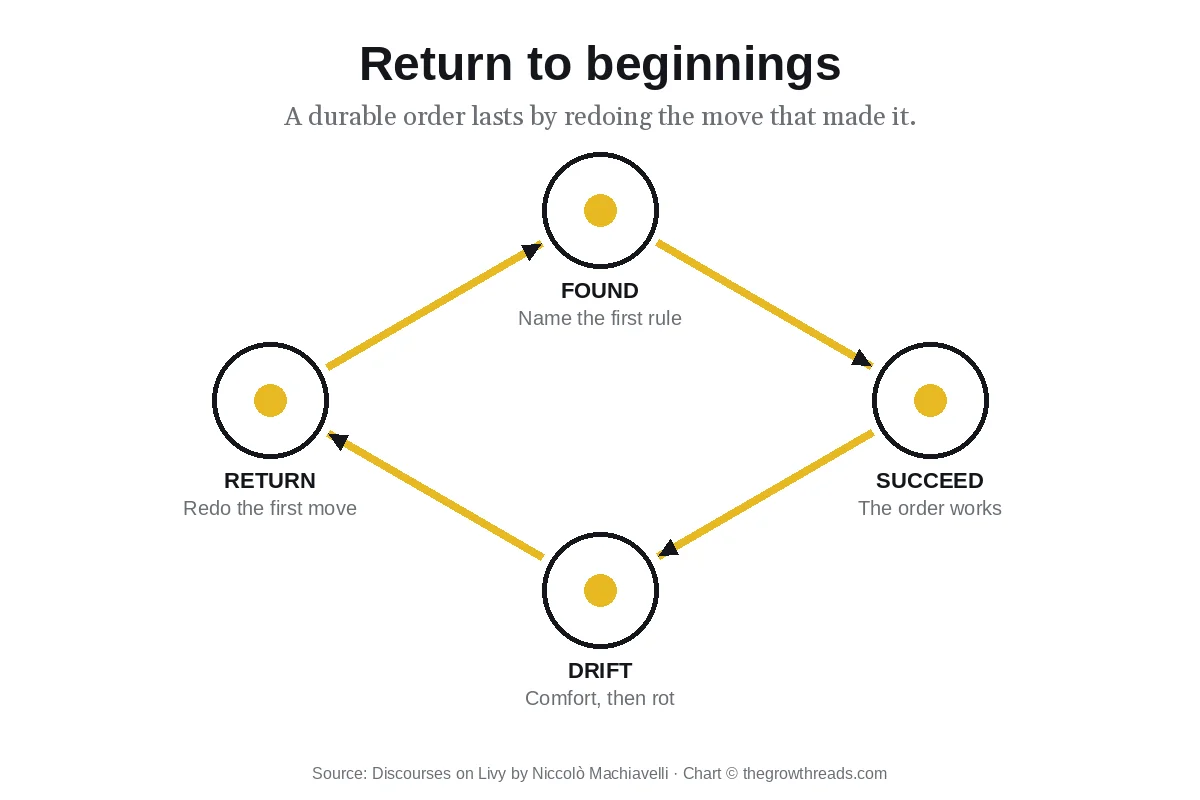
Book III is where the title of this review lives. Republics, Machiavelli says, must often be brought back toward their beginnings. Rome did it by a named shock that restored fear of the laws, or by men who behaved like founders again. The point is not cruelty as a brand. Beginnings are acts. They expire when they become interior decoration. A “we ship quality” plaque is not a beginning. A blocked release because the bar was missed is a beginning, redone.
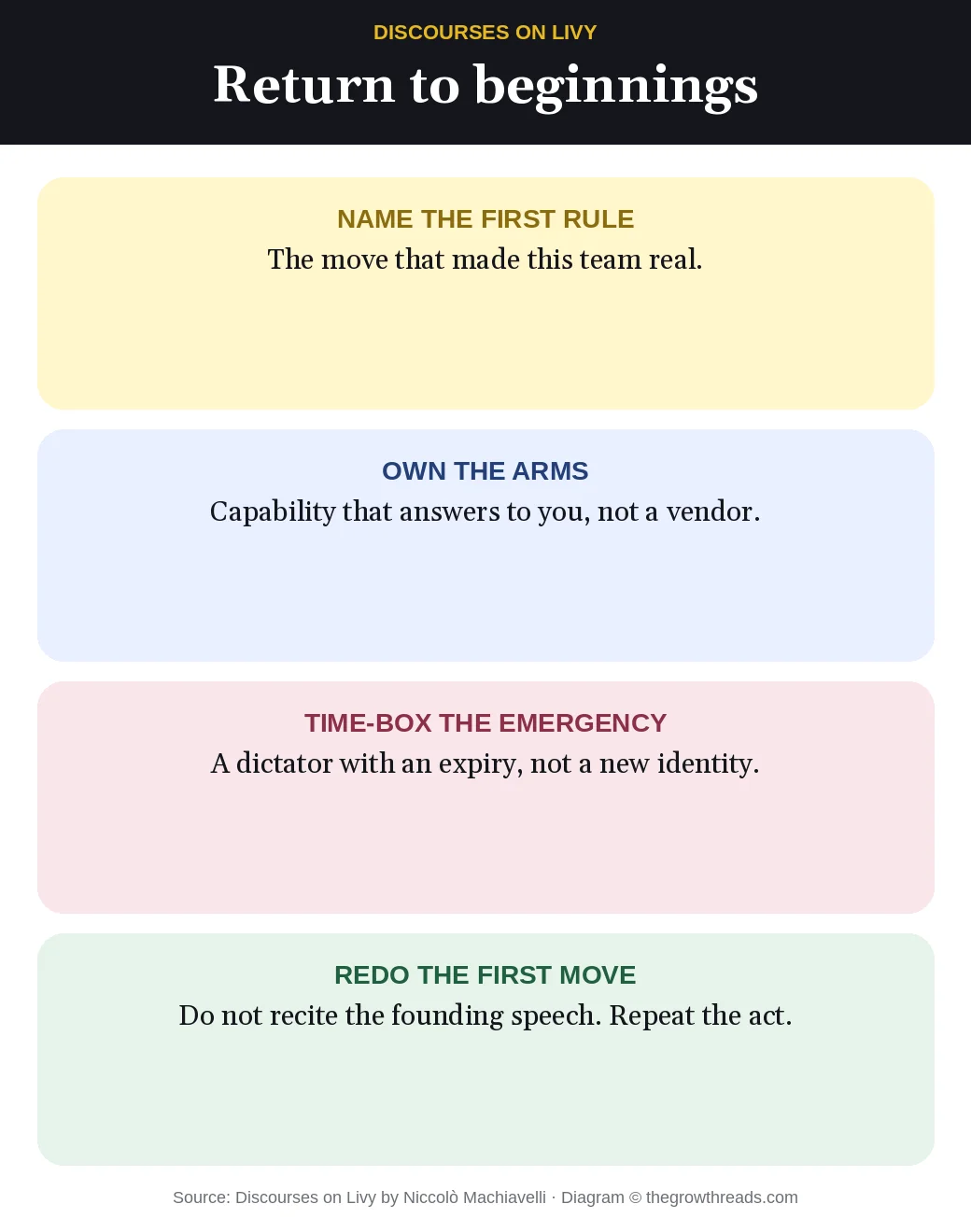
Dictatorship, in this book, is not a coup. It is a legal, time-boxed office for a named emergency: one person, extraordinary authority, a clock. Rome survived because the office ended. Modern teams invent a crisis title with no expiry — a tiger team that becomes the new org. If you need a dictator this sprint, write the expiry on the same page as the object. If you cannot write the expiry, you are changing the regime and hoping nobody names it.
The founder, finally, is a method. Machiavelli cares less about the statue than about whether later people can repeat the move. After you leave, can someone still name the first rule and apply it in the open? If not, you built a following. The Discourses tells you to be slightly less impressive and much more repeatable. One short line from Book I is enough to keep: men never do good unless necessity drives them to it. Build the necessity. Then redo the first act before comfort writes a new constitution in the hallway.
TGR Note: Musashi’s The Book of Five Rings and Yamamoto’s Hagakure train the body that still moves. Machiavelli trains the order those bodies serve.
Who is Discourses on Livy best for — and who should read something else first?
Best for: founders, civic-minded leads, and senior ICs who already have a shop and can feel it getting polite. If you can name a founding rule that has slipped, you get the vocabulary.
Read something else first: The Prince for one-man virtù. Extreme Ownership for a modern loop. High Output Management for a carpenter’s OS. Start With Why before an order. The Art of War for terrain this week. Discourses assumes you already have something to keep.
Questions to reflect on
- What is the founding move of this team — the act, not the speech — and when did we last do it in the open?
- Which leg of the mixed order is decorative: the one, the few, or the many?
- What fight am I calling “drama” that is actually a tumult without an office?
- Where are our arms rented — a vendor, a platform, or one person we cannot lose?
- What emergency title currently has no expiry, and what beginning would we return to if it ended on Friday?
🔥 Ready to redo the move that made the shop real?
Get Discourses on Livy and start treating durability as a return, not a speech.
How to apply Discourses on Livy (7-day plan)
- Day 1 — Write the founding rule. One sentence: the act that made this team real. Put it where you spend.
- Day 2 — Map one / few / many. Name the closer, the senate that argues, and the floor that can push back. Circle the decorative leg.
- Day 3 — Name a useful tumult. Write the fight you have been smoothing into a hallway. Give it a slot in the weekly.
- Day 4 — Arms audit. List capability that answers to you versus vendors and irreplaceable heroes. Practice one rented arm.
- Day 5 — Time-box one emergency. If a crisis title exists, write its expiry on the same page as the object.
- Day 6 — Accuse, do not whisper. Put one miss in the room that can fix it. One sentence.
- Day 7 — Redo the beginning. Perform the Day 1 act in the open. If you only talked about it, you recited. Schedule next week’s redo before you sleep.
Frequently asked questions
What is Discourses on Livy about?
Discourses on Livy is Niccolò Machiavelli’s treatise on how republics last, written around 1517 and printed in 1531. It reads Livy’s early Rome and pulls out a usable political science: mixed offices, conflict that has a legal home, arms you actually own, and a periodic return to the founding move. It is the companion to The Prince. Where that handbook asks how one person holds a state, this one asks how an order outlives the founder. The Chicago Mansfield and Tarcov translation is the English we rate here. Use it to name the first rule of your shop and redo it before comfort turns into drift.
How is Discourses on Livy different from The Prince?
The Prince is a short book about one person’s virtù — skill, nerve, and adaptability under pressure. Discourses on Livy is the longer book about an order that does not depend on one hero. Machiavelli wrote them in the same years of exile. Read The Prince when you need to hold a week. Read the Discourses when the week is fine and the institution is getting polite. They compound. A founder who only knows The Prince will over-personalize every miss. A lead who only knows the Discourses will hide behind process. Pair them: one-man virtù to start, mixed offices and return-to-beginnings to last.
What does Machiavelli mean by returning to beginnings?
In Book III he says republics last when they periodically move back toward their beginning — not by nostalgia, by re-enacting the act that made the order real. Rome did it with a named consequence that restored fear of the laws, or with a founder-like figure who redid the first discipline. In a modern shop that is repeating the hiring bar, the weekly, or the “we do not ship without X” move that existed when the team was still sharp. Reciting the founding speech is cheaper and weaker. Redo the act. If you cannot name the act, you do not have a beginning to return to.
Who was Niccolò Machiavelli?
Niccolò Machiavelli (1469–1527) was a Florentine diplomat and political writer. He served the Florentine Republic from 1498 to 1512, then wrote in exile after the Medici returned. The Prince made his name a byword for hard-edged statecraft. The Discourses on Livy is the republican companion he was writing in the same years: how a people, a senate, and a named office last longer than one gifted man. He is not a cartoon villain. He is a secretary who watched republics fail when they got comfortable, and who tried to write the arts of founding so someone else could use them. That is why operators still read him.
What is a mixed constitution in the Discourses?
Machiavelli, reading Polybius through Rome, wants one, few, and many in the same order: a consular closer, a senate that argues, and a people that can push back. Each form alone rots — monarchy into tyranny, aristocracy into oligarchy, popular rule into license. Rome lasted because the tumults between nobles and plebs produced offices (the tribunes) that made the fight legal. In a company: a named decider, a lead group that can disagree before the close, and a floor that can raise a miss without a hallway campaign. If any leg is decorative, you do not have a mixed order. You have a poster.
Which Discourses on Livy translation should I read?
The edition we rate here is the University of Chicago Press paperback translated by Harvey C. Mansfield and Nathan Tarcov (ISBN 9780226500362, ASIN 0226500365) — 424 pages, issued in this form in 1996. It is the English standard for readers who will actually use the vocabulary. Oxford’s Bondanella World’s Classics is a cleaner first pass if you want notes aimed at students. Penguin’s Discourses is the same work under a shorter title. Do not treat a quotation site as the book. The usable work is the argument about mixed offices, tumulti, own arms, and the return to beginnings — not a single tattoo line about necessity.
How do I apply Discourses on Livy at work?
Pick a live order: a team, a weekly, a hiring bar. Write the founding rule in one sentence — the move that made this shop real. Map one (who closes), few (who argues), many (who can push back). Name one useful conflict you have been smoothing into a hallway. Audit arms: what capability answers to you, and what is a vendor or a hero? Time-box one emergency office with an expiry. Put one miss in the room that can fix it. Then redo the founding move this week. That is the whole method. You do not need a forum. You need a beginning you are willing to repeat.
Related summaries
- The Prince — hold the week; do not confuse love with the ability to act.
- On War — name the political object before you spend force.
- The Art of War — terrain before the flourish.
- Extreme Ownership — own the miss in the open.
Browse every title in our Best Leadership Books pillar page.
How we analyze books: our summaries are built from a full read of the source text, cross-referenced against the author’s published interviews and research where relevant, and structured around practical application rather than critique. We disclose our editorial process and affiliate relationships in full. Read our full methodology.