Leadership
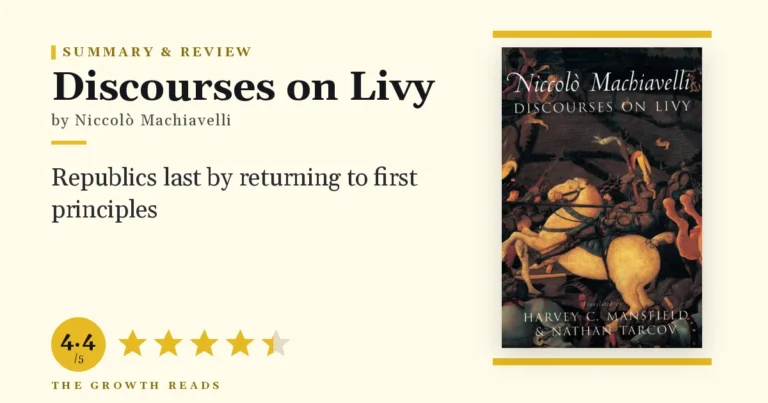
Discourses on Livy Summary & Review: Republics That Renew Themselves
Discourses on Livy summary: Machiavelli’s guide to republics that last — mixed orders, useful conflict, and a weekly return to first principles.
Read Summary →
"It is better to be feared than loved, if you cannot be both."
Niccolò Machiavelli (1469–1527) was a Florentine diplomat and political writer whose handbook The Prince made his name a byword for hard-edged statecraft. He served the Florentine Republic from 1498 to 1512, then wrote in exile after the Medici returned.
Our in-depth summaries and reviews of his work
Discourses on Livy summary: Machiavelli’s guide to republics that last — mixed orders, useful conflict, and a weekly return to first principles.
Read Summary →
The Prince summary: Machiavelli’s 1513 handbook on holding power — virtù, fortune, fear without hatred, and a 7-day plan to apply it…
Read Summary →Skill, nerve, and adaptability under pressure — not moral virtue.
Predictable standards hold; seizing livelihood or dignity ends you.
Capability that answers to you. Mercenaries and auxiliaries are not a foundation.
Orders last when they redo the founding move — not when they recite the origin speech.
The clash between people and great is how a republic stays awake.
One closer, a few who argue, a many who can push back. Any leg alone rots.
"It is better to be feared than loved, if you cannot be both."— The Prince
"A prince must learn how not to be good, and to use that knowledge or not as necessity requires."— The Prince
"Men never do good unless necessity drives them to it."— Discourses on Livy
Discourses on Livy summary: Machiavelli’s guide to republics that last — mixed orders, useful conflict, and a weekly return to first principles.
The Prince summary: Machiavelli’s 1513 handbook on holding power — virtù, fortune, fear without hatred, and a 7-day plan to apply it at work. Rated 4.6/5.