

★★★★½ 4.5/5 — the field manual for talks a hallway can still repeat.
Best for: Operators, founders, and specialists who present ideas and still dump a slide novel
Reading time: ~6 hours (288 pages) · this guide ~12 min
Difficulty to apply: Medium — the ideas are simple; rehearsal is the work
Talk Like TED in one minute
If they cannot repeat your point in a sentence, you did not give a talk. You gave a tour. Carmine Gallo’s Talk Like TED summary in one line is that: inspiration is a craft. After studying hundreds of TED talks, he boils the craft down to three jobs the brain actually does — feel something, learn something new, and keep it. Passion is not a mood you wait for. Story is not garnish. Eighteen minutes is the length at which a room can still hold one idea. This book is how the next all-hands, pitch, or Friday demo stops being a slide novel.
Key takeaways
- Inspiration is a craft: famous talks share habits you can rehearse, not a birthday personality.
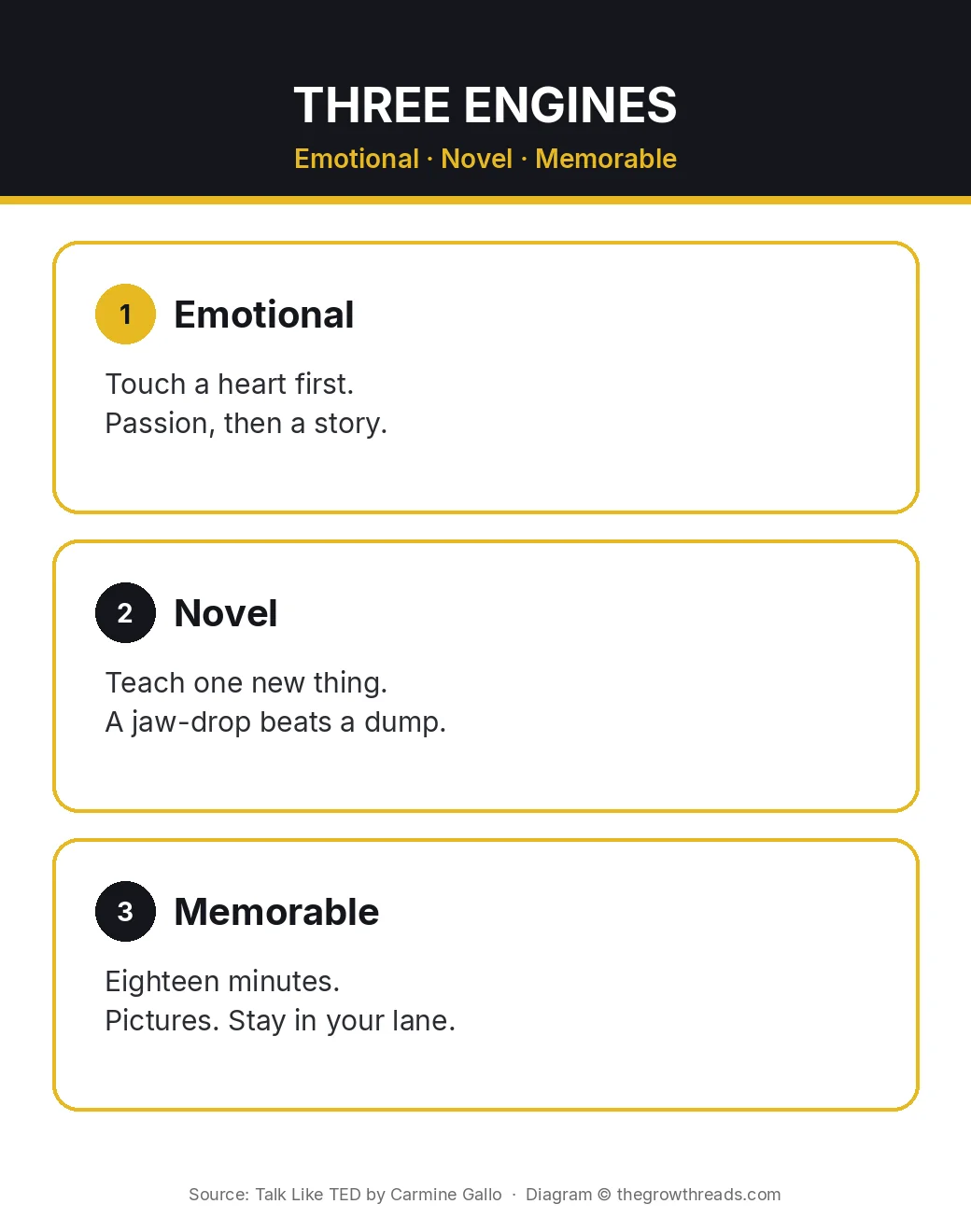
- Three engines: emotional, novel, memorable — feel, learn, keep.
- Passion first: you cannot move a room with an idea that does not move you.
- Story beats slides: a lived moment travels; a bullet list dies in the hallway.
- Sound like a conversation: practice until the script disappears from the voice.
- Teach one new thing: novelty is the hook; a dump is not teaching.
- One jaw-drop: a prop, a number, a demo — one emotionally charged beat.
- Eighteen minutes: long enough to be serious, short enough to hold.
- Pictures and props: the brain keeps what it can see, not only what it hears.
- Stay in your lane: copy structure, not someone else’s persona.
What is Talk Like TED about?
Talk Like TED is Carmine Gallo’s 2014 guide to talks that stick: nine public-speaking habits, grouped as emotional, novel, and memorable, so a room can feel something, learn one new thing, and still repeat the idea after eighteen minutes.
About the author
Carmine Gallo is a former journalist and news anchor who got tired of watching smart people flatten good ideas into slide tours. He now coaches executives, writes on communication for Forbes, and runs Gallo Communications Group from Pleasanton, California. The Presentation Secrets of Steve Jobs came first. Talk Like TED is the wider field manual: not one company’s keynote style, but the habits shared by hundreds of talks that actually moved people. The through-line is reverse-engineering, not mystique. You may love the topic in private. On stage, or on a Zoom tile, you are a craftsman with a clock, a story, and one sentence the hallway should still be able to say. Explore all Carmine Gallo book summaries →
Key concepts at a glance
| Concept | What it means | Use it when |
|---|---|---|
| Emotional engine | The room has to feel something before it will store anything | You open on a table of contents |
| Novel engine | One new thing the brain has not filed yet | The talk is a recap of last quarter’s deck |
| Memorable engine | Length, pictures, and a voice that sounds like you | They nod in the room and cannot repeat you later |
| Passion | You are visibly for this idea, not reciting it | You would not give this talk if it were unpaid |
| Story | A specific person in a specific moment | Every slide is a claim with no human in it |
| 18-minute rule | One idea, then sit down while they still want more | You have 40 slides “just in case” |
| Jaw-drop | One emotionally charged beat — demo, number, prop | The middle of the talk is a plateau |
| Stay in your lane | Your expertise and cadence, not a copied persona | You are imitating a TED favorite instead of your work |
Part 1: Emotional — passion, story, conversation
Gallo’s first claim is rude to slide culture. Information is not scarce. Attention is. A room will not store a framework it did not first feel. That is why the book opens on passion rather than structure. You cannot borrow intensity. If the idea does not occupy you on a Tuesday when nobody is watching, it will not occupy them on a Thursday when the calendar says “update.” Start with the part of the topic that still has a pulse — not with the org chart of the talk.
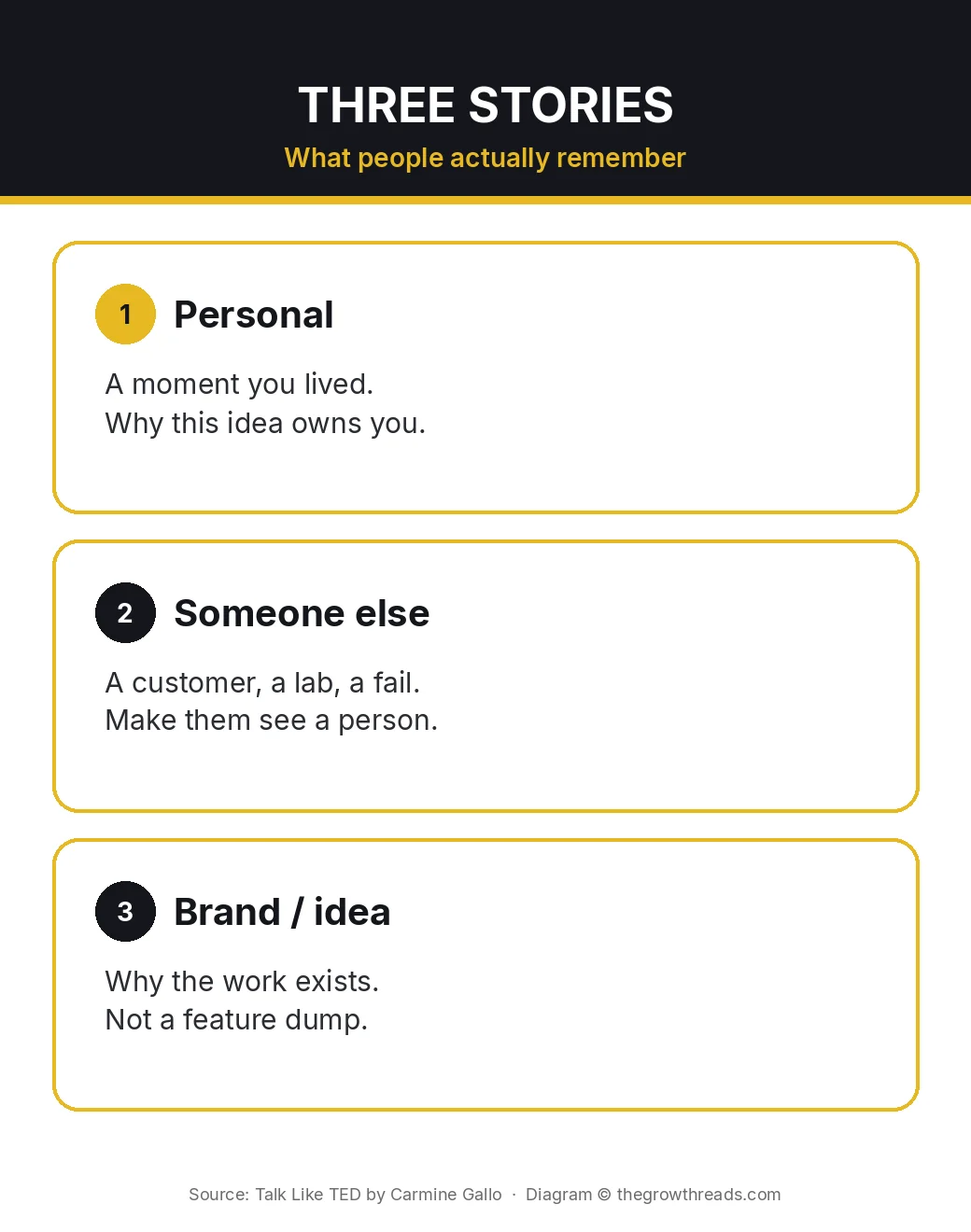
Story is how that pulse becomes shareable. Gallo keeps returning to talks that put a person in a moment: a failure, a patient, a kitchen, a number that landed in a body. Abstract claims bounce. A scene sticks. You need one episode you actually lived or witnessed, told in the past tense, with enough sensory junk that they can see it. Then you name the point. The story is not a warm-up you skip when you are “short on time.” The story is the time.
The third emotional habit is delivery that sounds like a conversation. Recited talks leak. The audience can hear the page. Gallo’s fix is ordinary: practice out loud until you could tell it to one person at a table. Record yourself. Slow down. Know the idea well enough that the sentences can flex without losing the spine. “You cannot inspire unless you are inspired,” Gallo writes — and inspiration, here, includes the hours nobody claps for.
TGR Note: If the missing layer is the state of your body in the first ten seconds, our The Charisma Myth summary is the companion — presence, power, and warmth before a single slide. Gallo assumes you will open your mouth. Cabane is how the room decides you are here. For the sentence you want them to carry, use Made to Stick. Do not collect all three as a way to delay writing the ninety-second story.
Part 2: Novel — teach something new, then make them gasp
The brain is a novelty hunter. If they already know this, you are not teaching, you are filing. A status update dressed as a keynote is still a status update. The test is a headline. Can you say the new thing in a line they could text? If it needs a paragraph, you have a topic, not a new thing. Cut until there is a surprise — a comparison, a reframe, a number that should not be that size — and put it where a bored brain would check out.
Jaw-dropping moments are how novelty becomes a memory. Gallo’s examples are physical: a demo, a prop, a statistic that lands like a punch. You do not need mosquitoes in a jar. You need one beat the room did not see coming, placed after they trust you and before they glaze. A talk with five “amazing” moments has none. Plan the gasp the way you plan the close. If you cannot name it in rehearsal, it will not appear by accident.
Humor is the permission slip. Gallo is not asking you to become a comic. A smile, a dry aside, a confession that you also used to make the mistake — those are pressure valves. If every sentence is a pronouncement, they stop listening in self-defense. Let them breathe, then hit the new thing.
TGR Note: If the idea has to travel after the meeting — into Slack, a forward, a customer call — our Contagious summary is the STEPPS layer. Gallo gets the idea into a mouth. Berger gets it into other mouths. For selling without a pitch deck as the whole personality, To Sell Is Human is the service frame. None of them replace the one new thing. If you cannot name it, do not add a story about virality.
Part 3: Memorable — eighteen minutes, pictures, your lane
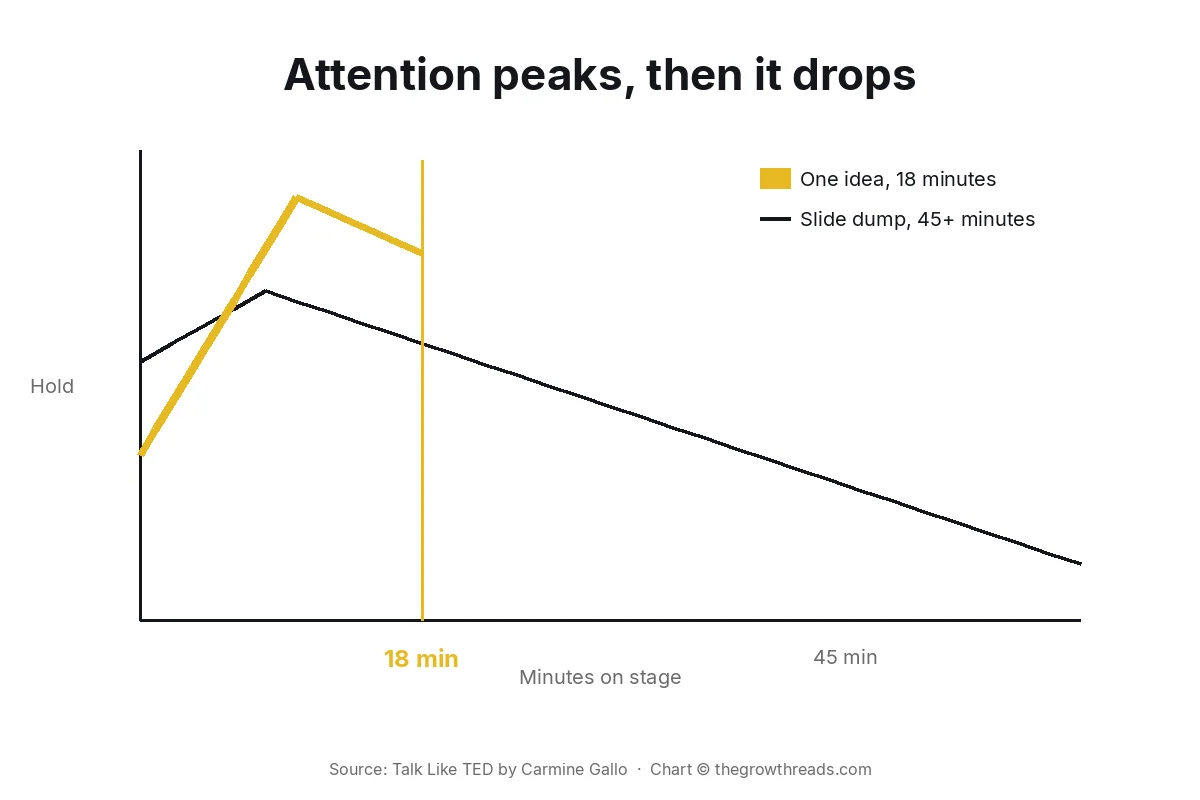
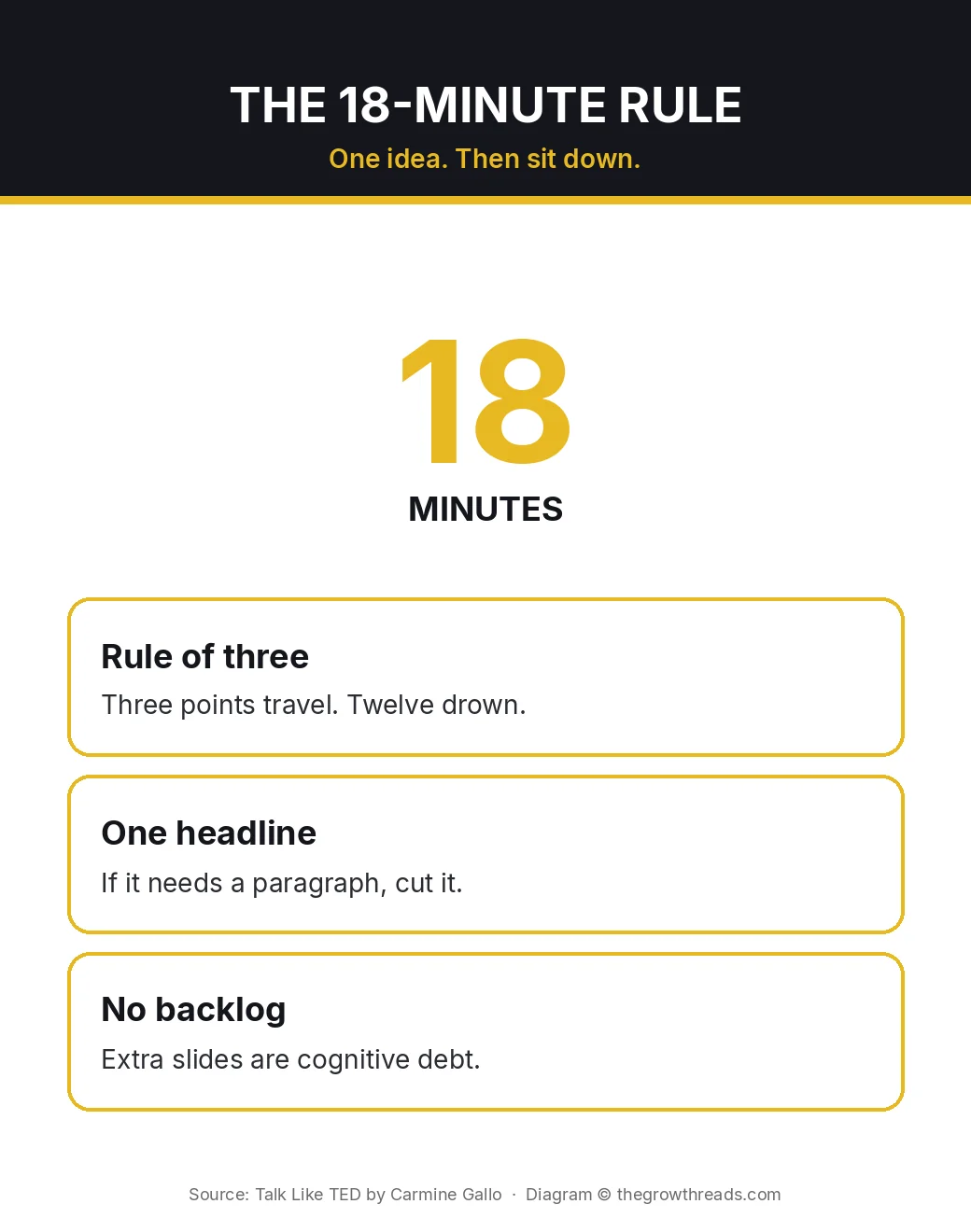
TED’s clock is the part everyone quotes and almost nobody obeys at work. Eighteen minutes is a bet about working memory. Past that, you are stacking ideas on a table that is already full. Gallo pairs the clock with the rule of three: three points a stranger can recap; twelve points only you can recap. Extra slides feel like insurance. They are how the one idea dies of crowding. If you truly need forty-five minutes, you probably have three talks. Give one.
Multisensory is the second memory trick. Words go in one door. A picture, a prop, a sketch on a whiteboard go in another. If a slide is a paragraph, it is a speaker note you accidentally projected. If it is an image they can still see on the subway, you gave them a handle. Gallo is not arguing for decoration. He is arguing against audio-only ideas in a species that remembers what it saw.
Stay in your lane is operational, not a poster. The room can detect a borrowed persona in seconds — the fake TED cadence, the copied joke, the expertise you do not have. Copy Gallo’s structure. Do not copy someone else’s life. Your lane is the work only you could explain with scars. If you leave it, the pulse leaves with it.
TGR Note: If the sentences themselves are the clutter, our On Writing Well summary is the cut. Zinsser on the page is Gallo at the lectern: fewer words, more picture. For a network that has to carry the idea after you sit down, Never Eat Alone is the table, not the talk. Use them after you have one headline. A cleaner paragraph still fails if it is the fourteenth point.
Part 4: Rehearsal — the unglamorous half of the book
Readers remember the 18-minute rule and forget the hours. Gallo’s speakers ran the talk until the conversation could survive a skipped slide. Write the one sentence. Time a draft. Cut until you are near eighteen, or near the slot you actually own. Then say it out loud, not to become theatrical, but to find the sentences that still need the page.
Ask one person what they would repeat. If they repeat a side story, you buried the point. Do not ask “was I good?” That is a compliment trap. Ask what they will tell a colleague. Then change the talk, not your personality. The loop is one page: headline, story, cut, rehearse, sit down.
Internal talks count. A product review, a postmortem, a hiring pitch — those rooms are where most of us actually speak. TED is the lab. Your calendar is the product. Steal the cut this week on a meeting you cannot postpone.
Who is Talk Like TED best for — and who should read something else first?
Best for people whose week already includes a room that has to leave with an idea: founders, PMs, researchers, teachers, anyone who currently narrates a deck. If you keep finishing talks exhausted and unquoted, this is the clinic. It transfers to Zoom, a board update, and a ten-minute demo. You do not need a red carpet. You need a headline and a story with a clock.
Read something else first if the sentences on the page are still a mess — start with On Writing Well. If you freeze before you speak, The Charisma Myth is the body. If the idea itself is mush, Made to Stick is the message design. A negotiation manual or a full media-training OS is the wrong shelf. Gallo is the talk habit you run inside those systems.
Questions to reflect on
- What is the one sentence I want the hallway to repeat after my next talk?
- Where am I still opening on an agenda instead of a pulse?
- Which story from my actual week belongs near the front — and which slides are hiding it?
- If I had eighteen minutes, what would I cut without mercy?
- Whose persona am I borrowing, and what would my lane sound like instead?
🔥 Ready to sit down while they still want more?
Get Talk Like TED, then use the 7-day plan to cut one real talk to a headline, a story, and a clock.
How to apply Talk Like TED (7-day plan)
- Day 1 — Write the hallway sentence. For a talk you already have this week, write the one line they should repeat. If you need two lines, you have two talks.
- Day 2 — Find the pulse. Circle the part of the topic you would still explain at dinner. Start the outline there. Park the org-chart open.
- Day 3 — Ninety-second story. A moment you lived or witnessed. Past tense. Then the point. Put it in the first third.
- Day 4 — Cut to the clock. Time a draft. Cut slides until you are near eighteen minutes or near the slot you actually own. Three points maximum.
- Day 5 — One jaw-drop. Add one demo, prop, or number they will still see on the subway. Only one.
- Day 6 — Out loud. Record a full pass. Listen for recital. Say it again until it sounds like a conversation.
- Day 7 — Give the talk and sit down. Ask one person what they would repeat. Change the talk, not your personality.
Frequently asked questions
What is Talk Like TED about in one paragraph?
Talk Like TED is Carmine Gallo’s 2014 field manual for talks that a room can actually keep — the book people mean when they search for a Talk Like TED summary. After studying hundreds of TED talks, he argues inspiration is a craft with three jobs: make people feel something, teach them one new thing, and make it stick. Passion, story, novelty, a jaw-drop, humor, eighteen minutes, pictures, and staying in your lane are the tools. This TGR guide turns that into engines, a length rule, a story menu, and a seven-day plan you can run on a meeting already on the calendar.
What are the 9 secrets in Talk Like TED?
Gallo groups nine habits under three engines. Emotional: unleash the passion you actually have, tell a story, and speak like a conversation instead of a recital. Novel: teach something new, deliver one jaw-dropping moment, and lighten up so the room can breathe. Memorable: stay near eighteen minutes, paint pictures with more than words, and stay in your lane so the talk sounds like you. You do not need a TED stage. You need one idea, one story, and the discipline to sit down before the backlog starts. The nine labels are a checklist, not a personality transplant.
Why does Talk Like TED insist on 18 minutes?
Eighteen minutes is long enough to be serious and short enough that working memory can still hold one idea. TED made it a house rule because longer talks leak: the extra slides feel thorough to you and like fog to them. Gallo pairs the clock with the rule of three — three points travel; twelve drown. The practical move is not a stopwatch fetish. Write the one sentence they should repeat in the hallway, cut until the talk serves that sentence, and end. If you need forty-five minutes, you probably have three talks. Give one. Save the rest for questions or a later meeting.
Who is Carmine Gallo and why listen to him on presentations?
Carmine Gallo is a former journalist and news anchor who now coaches executives and writes on communication for Forbes. He runs Gallo Communications Group from Pleasanton, California, and wrote The Presentation Secrets of Steve Jobs before Talk Like TED. The method is reverse-engineering: he watched a huge TED corpus, talked to speakers, and named habits the famous talks share. He is not selling a personality. He is selling a checklist you can rehearse. Use him when the next room has to carry an idea, not when you want a biography of the TED conference itself.
Is Talk Like TED only useful if I will never give a TED talk?
Yes — that is most of the value. All-hands, a demo, a board update, and a hiring pitch fail the same way: too many points, no story, a voice that sounds like a PDF. Gallo’s engines still apply when the stage is a Zoom tile. You will not get a red circle. You will get eighteen minutes of attention if you earn it. Skip the book only if you never have to move an idea through other people. If your week already has a room, this Talk Like TED summary is a clinic for that room.
How is Talk Like TED different from Made to Stick or The Charisma Myth?
Made to Stick is the idea on the page: simple, unexpected, concrete, credible, emotional, stories. Talk Like TED is the idea in a mouth, under a clock. Heath and Heath help you design the message; Gallo helps you deliver it without drowning the room. The Charisma Myth is the state before you speak — presence, power, warmth — so the first ten seconds do not leak. Stack them. Cabane for the body, Heath for the sticky sentence, Gallo for eighteen minutes and a story. Do not read all three as a way to delay writing the one headline.
What is the one idea to steal from Talk Like TED this week?
Steal the eighteen-minute cut, not a new identity as a keynote speaker. Take one talk you already have this week. Write the one sentence they should repeat. Cut the deck until it serves that sentence. Put a ninety-second story near the front — a moment you lived, not a feature list. Practice out loud until it sounds like a conversation. Then sit down while they still want more. Gallo’s whole argument is that inspiration is a craft you can rehearse. The room does not need your archive. It needs one idea it can carry into the hallway.
Related summaries
- The Charisma Myth by Olivia Fox Cabane
- Made to Stick by Chip Heath & Dan Heath
- Contagious by Jonah Berger
- On Writing Well by William Zinsser
- Best productivity books
How we analyze books: every book on The Growth Reads is read cover to cover, summarized in thousands of words of original analysis, and rated against our five-criteria rubric (lasting impact, evidence quality, practical application, writing & originality, external consensus). Read our full methodology.