

★★★★☆ 4.4/5 — A shipping system for people whose idea pile is already too full.
Best for: makers, operators, and side-project people who generate faster than they finish.
Reading time: ~4 hours (256 pages) · this guide ~12 min
Difficulty to apply: Medium. Name one next action. Do not rebuild your whole stack.
Making Ideas Happen in one minute
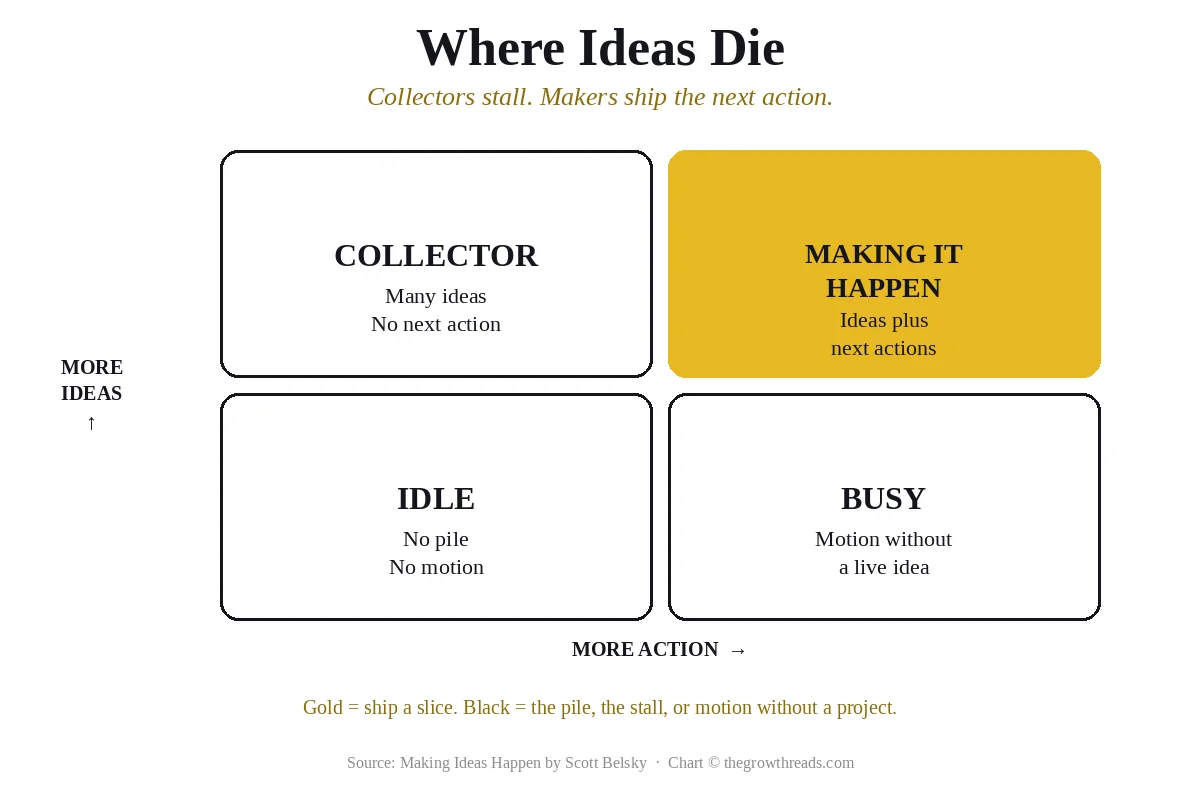
Ideas are cheap. The scarce skill is the next action. Scott Belsky built Behance after watching creative teams collect more sparks than they shipped. Making Ideas Happen (Portfolio, 2010; this paperback 2012) is the field notebook from that watch: execution is not a personality type. It is organization, community, and leadership practiced on purpose. The Action Method is the capture piece — every open loop is an action step, a reference, or a backburner item. References feel like work. They are not. The backburner saves the spark without derailing the live project. Community is the pushback you invite before the draft is pretty. Leadership is energy through the plateau, when novelty dies and the real project begins. Steal the verb. Leave the idea journal on the shelf.
Tonight, pick one live project. Dump it into the three buckets. Write tomorrow’s next action before you close. That is the whole entry fee.
Key takeaways
- Execution is trainable: Shipping is a capacity you build, not a muse you wait for.
- Action steps are the only movers: Verb plus owner. Everything else is storage.
- References are not work: Notes and links belong in a park, not on today’s calendar.
- Backburner protects the live project: Capture later-ideas so they stop stealing the week.
- Reduce until you can ship: Three live projects beat twelve half-open ones.
- Meetings end with named actions: Discussion without a verb did not happen.
- Share before it is pretty: The passionate few catch what isolation cannot.
- Insecurity work hides: Inbox and polish feel productive. The scary action is the work.
- The plateau is the job: Novelty fades. That is when makers stay and collectors start a new pile.
What is Making Ideas Happen about?
Making Ideas Happen is Scott Belsky’s playbook for turning creative work into shipped work. Ideas are common. The scarce skill is organization, community, and self-leadership — especially the Action Method that splits every project into next actions, references, and a backburner. Read it when the notebook is already full.
About the author
Scott Belsky (born 1980) is an American entrepreneur and product leader. He founded Behance in 2006 as a network and operating system for creative professionals, then sold it to Adobe in 2012. He later served in senior product roles at Adobe, including chief product officer. The 99U conference and the Action Method grew out of the same question: why do talented people stall between vision and a shipped thing? Making Ideas Happen (Portfolio) is the first long answer. He later wrote The Messy Middle about the long slog after the spark. The voice is operator, not guru. Case studies from studios and product teams. Read him when you already have ideas and the remaining leak is a pile that never becomes a send. Explore all Scott Belsky book summaries →
Key concepts at a glance
| Concept | What it means | Use it when |
|---|---|---|
| Action Method | Every loop is an action, a reference, or backburner. | Your notes app is full and nothing ships. |
| Action step | A verb plus an owner. The only mover. | Tasks read like topics, not moves. |
| Reference | Useful information that is not work. | Research is pretending to be progress. |
| Backburner | Later, not now. Captured so it cannot derail. | New sparks keep hijacking the live project. |
| Reduce to ship | Fewer live projects. A next action on each. | Twelve half-open efforts, zero sends. |
| Insecurity work | Polish and inbox that feel safe. | You were busy and the scary task did not move. |
| Passionate few | The small circle that will actually push back. | You hide drafts until they are “ready.” |
| The plateau | Novelty dies. Real work begins. | You start a new idea instead of finishing. |
Part 1: The gap — ideas are common, shipping is rare
Belsky’s opening is not a pep talk about creativity. It is a diagnosis. Studios, product teams, and solo makers already have more ideas than calendar. The failure mode is not an empty notebook. It is a notebook that never becomes a send. He watched that gap while building Behance: talented people, live projects, and a culture that rewards the spark more than the last mile. Edison’s 1 percent inspiration is the folklore. The book is about the other 99 as a practice you can install. Organization is not the enemy of creative work. It is how creative work survives contact with Tuesday.
Desk translation is blunt. If Steal Like an Artist is permission to collect, this chapter is permission to stop collecting as a personality. If The War of Art names resistance, Belsky names the pile resistance hides in. You do not need a new idea tonight. You need one live project and a next action that would still make sense if the muse did not show up.
TGR Note: If the remaining leak is capture and next-action hygiene for any life, start with Getting Things Done. If the remaining leak is where notes live, Building a Second Brain and The PARA Method are the filing layer. Stay here when filing has become a prettier way not to ship.
Part 2: Organization — the Action Method
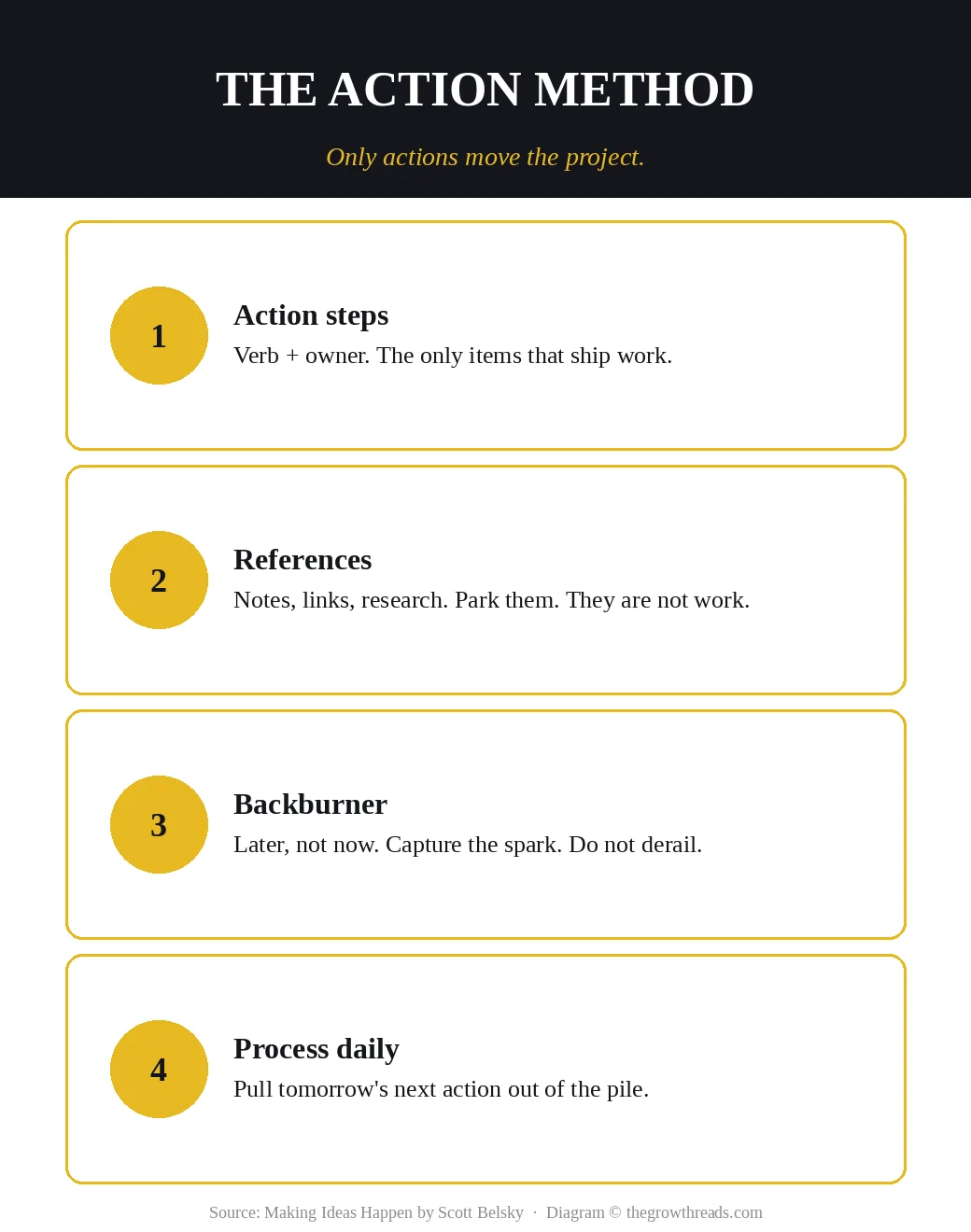
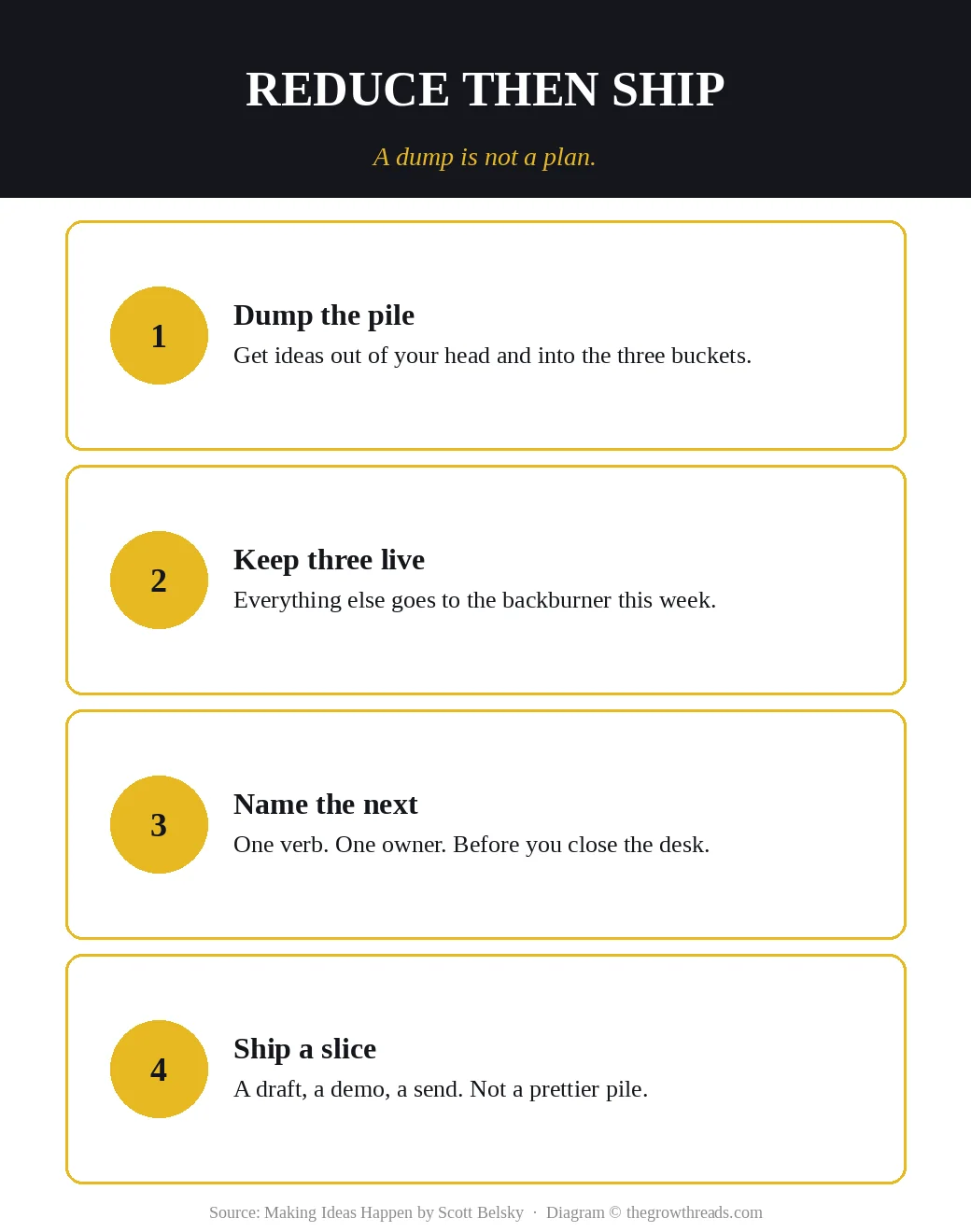
The Action Method is the book’s most stolen tool because it is small. Every open loop is one of three things. Action steps move: a verb, an owner, a next move you could do without another meeting. References wait: research, screenshots, quotes, the PDF you will need later. The backburner holds later-ideas so they stop auditioning for this week. Belsky’s warning is that creative people drown in references and call it progress. A full notes app is not a shipped draft. Process the pile so tomorrow already has a named action. Meetings end with verbs or they were theater. Reduce live projects until each one can actually move. Twelve half-open efforts is how a year disappears.
Steal the buckets, not a new app. Paper works. A single list with three headers works. If PARA is where files go, this chapter is which line gets a calendar square. If Sprint is a week-long force function, the Action Method is the daily version: one next action before you close. Insecurity work — inbox, tweaking, re-coloring the deck — feels like the job because it cannot fail in public. Put the scary verb first. The polish can ride along after the send exists.
TGR Note: If the remaining leak is never crossing the last mile, Finish is the emotional companion. If the remaining leak is a missing deep-work door, close it with Deep Work — a named action still needs a room the inbox cannot enter.
Part 3: Community — don’t finish it alone
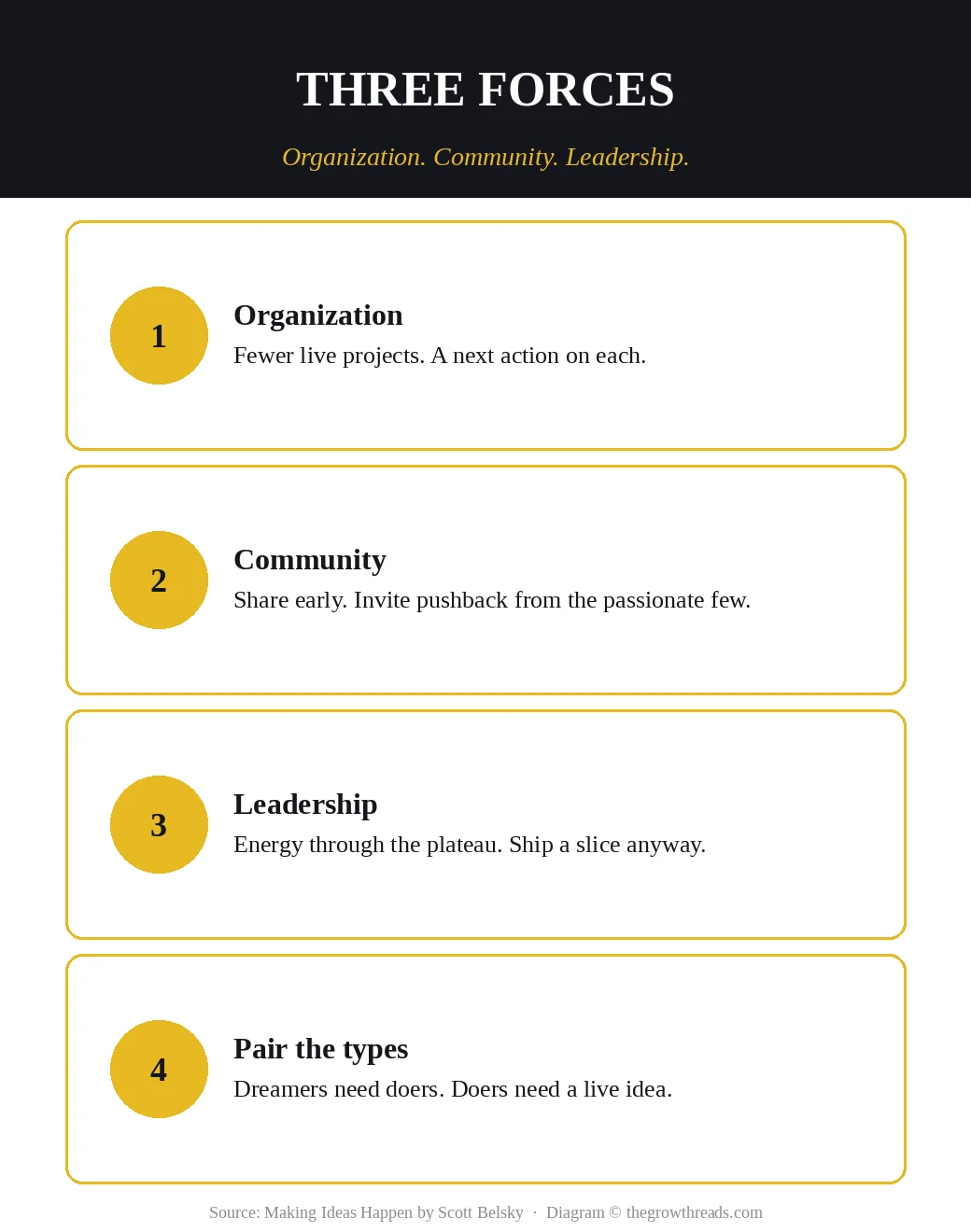
Belsky’s second force is other people, used early. Isolation feels like craft. It is often delay. Share a slice with a small circle that will actually push back — the passionate few, not a broadcast to everyone. Invite disagreement while the draft can still change. Seek a little competition so the project has a clock that is not only yours. Healthy fighting inside a team is cheaper than a silent shipwreck. The point is not networking as collecting. The point is a force that will not let the backburner become a graveyard. Creative Confidence gives permission to make. This chapter gives the draft a witness.
Steal one witness this week. One person. One ugly slice. If Show Your Work is sharing as a practice, Belsky is sharing as a shipping tool. If Keep Going is stay with the verb, community is how the verb survives a Tuesday you would rather start a new pile. Do not wait for the draft to be ready. Ready is how collectors stall.
TGR Note: If you need permission to make messy work, start with Creative Confidence or The Creative Habit. If you need a daily show-up rule more than a capture system, The Practice is Godin’s door. Come back to Belsky when the remaining leak is a private pile.
Part 4: Leadership — energy, endurance, and the plateau
The last movement is self-leadership, then team leadership. Novelty dies. That plateau is not a bug. It is the job. Collectors start a new idea when the current one stops being exciting. Makers stay. Manage energy, not just hours: some work and some people refill you, and some drain the week while looking like productivity. Pair dreamers with doers instead of asking one person to be both forever. Celebrate incremental sends so the nervous system learns that shipping is safe. Constraints help. A smaller slice ships. A leader — including you, alone at a desk — creates a climate where the next action is normal and the pile is not a personality.
Steal the ending. Finish this week with a slice in the world and next week’s verb on a card. If Finish is crossing the line, this chapter is staying after the line stopped being fun. If The Motivation Myth is start-first, Belsky is continue-after-the-spark. You do not graduate from the Action Method. You run one next action again on a smaller field.
TGR Note: If after the plateau you still wait to feel ready, stay with The Motivation Myth. If you need identity through a tiny cue, stay with Atomic Habits. Making Ideas Happen is the shipping layer those two books can hang on when the notebook is already full.
Who is Making Ideas Happen best for — and who should read something else first?
Best for people whose idea pile is already too full: designers, founders, writers, operators, anyone who can narrate a vision and still lacks a next action. If you want the capture OS for any life, go to Getting Things Done. If you want notes as a second brain, go to Building a Second Brain. If you want permission to share ugly work, go to Show Your Work.
Read something else first if you need a tiny start or a cue. Begin with Mini Habits or Atomic Habits. If you never finish because you chase perfect, start with Finish. If you need a deep-work door, start with Deep Work. Come to Making Ideas Happen when you can already start and the remaining failure mode is too many live ideas and no named next action.
Questions to reflect on
- How many of your “tasks” are actually references wearing a verb costume?
- What is the one live project that would still matter if you backburnered the rest this week?
- Who is the one person who would push back on an ugly slice by Friday?
- Where did insecurity work hide yesterday — inbox, polish, or a new spark?
- When novelty died on your last project, did you stay or start a new pile?
🔥 Ready to ship the next action?
Three buckets. One verb. A slice in the world this week.
How to apply Making Ideas Happen (7-day plan)
- Day 1 — Three buckets, one project. Pick one live project. Sort every open loop into action, reference, or backburner.
- Day 2 — Name tomorrow’s verb. Before you close, write one next action with a verb and an owner — you.
- Day 3 — Meetings end with actions. Any conversation today ends with a named next step, or it did not happen.
- Day 4 — Cut the live list. Move extra projects to the backburner. Keep three live. A dump is not a plan.
- Day 5 — Share an ugly slice. Send a draft to one person who will push back. Community is a force, not a reward.
- Day 6 — Audit insecurity work. Tally time on tweaking and inbox versus the scary action. Do the scary one first.
- Day 7 — Ship a slice. A send, a demo, a published paragraph. Not a prettier pile. Then name next week’s verb.
Frequently asked questions
What is Making Ideas Happen about?
Making Ideas Happen is Scott Belsky’s field guide for people who collect ideas and stall on the last mile. He founded Behance after watching creative teams generate more than they shipped. Execution, he argues, is a trainable capacity: organization (the Action Method that splits work into actions, references, and a backburner), community (share early, invite pushback), and leadership (energy through the plateau). Read it as a shipping system for creative work, not as another idea journal. The scarce skill is the next action, not the spark.
How long does it take to read Making Ideas Happen?
The Portfolio paperback is about 256 pages. Most readers finish in four hours. This summary is a twelve-minute pass: the execution gap, the Action Method, the three forces, and a seven-day plan that names one next action. If you only have lunch, pick one live project, dump it into action / reference / backburner, and write tomorrow’s verb before you close the desk. Come back to the Behance stories once that verb exists. The book is a shipping manual, not a new personality by Friday.
What is the Action Method in Making Ideas Happen?
The Action Method is Belsky’s three-bucket capture system from Behance. Action steps are the only items that move a project: a verb, an owner, a next move. References are notes, links, and research — useful, not work. The backburner holds sparks that are later, not now, so they stop derailing the live project. Process the pile daily so tomorrow already has a named action. It is cousin to Getting Things Done’s next-action thinking, aimed at creative teams who drown in references and call that progress. A dump is not a plan until a verb is on the calendar.
Is Making Ideas Happen only for designers and creatives?
The case studies are studios, product teams, and founders. The mechanism is not. Anyone who generates faster than they ship — operators, writers, researchers, side-project people — can steal the three buckets and the rule that meetings end with named actions. If you want a general capture system without the creative-team color, Getting Things Done is the broader map. If you want a second brain for notes, Building a Second Brain stores the references. Come here when the leak is a beautiful pile and no next action. You do not need a studio. You need a verb.
How is Making Ideas Happen different from Getting Things Done or Building a Second Brain?
Getting Things Done is the capture-and-next-action operating system for any life. Building a Second Brain and PARA are where references live so your head is not the archive. Making Ideas Happen is the creative-team layer on top: reduce live projects, share drafts before they are pretty, and lead yourself through the plateau when novelty dies. Finish is the emotional last mile. The War of Art names resistance. Belsky names the buckets and the community that keep resistance from winning by default. Use GTD or PARA for the filing. Use this book when filing has become a hiding place.
Who should read something else before Making Ideas Happen?
If you still need a two-minute start, begin with Mini Habits. If you need a cue and an identity, begin with Atomic Habits. If the leak is a missing deep-work door, Deep Work closes it without a new capture system. If you never finish because you chase perfect, start with Finish. If you need permission to share ugly work, start with Show Your Work. Come to Making Ideas Happen when you can already start and the remaining failure mode is too many live ideas and no named next action. Steal Like an Artist collects. This book ships.
What should I do on day one with Making Ideas Happen?
Do not redesign your life. Pick one live project. Dump every open loop into three buckets: action steps, references, backburner. Circle one action that starts with a verb and put it on tomorrow’s calendar before you close the desk. That is the whole entry fee. The Behance stories can wait. The 99U talks can wait. A prettier notes app can wait. If the project still has no owner and no verb by tonight, it is still an idea. Ideas are cheap. The next action is the work.
Related summaries
- Getting Things Done — the broader next-action OS; Belsky is the creative-team layer.
- Finish — the emotional last mile when perfect is the stall.
- Show Your Work — sharing as a practice; Belsky uses sharing to ship.
- Creative Confidence — permission to make; this book is permission to finish.
- Best productivity books — the full Productivity silo.
How we analyze books: every book on The Growth Reads is read cover to cover, summarized in thousands of words of original analysis, and rated against our five-criteria rubric (lasting impact, evidence quality, practical application, writing & originality, external consensus). Read our full methodology.