

★★★★★ 4.7/5 — A peacetime field manual: die to hesitation, serve the house, and decide before fear gets a vote.
Best for: Operators and leads who keep dressing delay as diligence while the window is already moving
Reading time: ~6 hrs for Bennett’s complete Tuttle edition (285 pages with notes) · ~18 min for this guide
Difficulty to apply: Easy to quote; the hard part is letting the mission outrank your reputation
Hagakure in one minute
Hagakure is a drill for people who freeze while calling it thought. Yamamoto Tsunetomo, a Saga Domain retainer, spent 1709–1716 telling a younger samurai how to live when the wars were over and the real risk was a soft, self-protecting life. The line everyone knows — in Wilson’s English, “The Way of the Samurai is found in death” — is not a suicide slogan. It is an instruction to stop bargaining. If the worst case is already accepted, you can tell the truth, take the meeting, and cut the plan that only exists to make you look careful. Translate lord as mission and house as the team you are scored on. Leave the self as the point, and the book is only calligraphy.
Key takeaways
- Die in the morning, die in the evening: Rehearse the loss you are flinching from, then do the next loyal act. The drill is daily, not cinematic.
- The Way is found in death: Accept the worst case so reputation stops steering the decision. Freedom here means a clean move, not a dramatic exit.
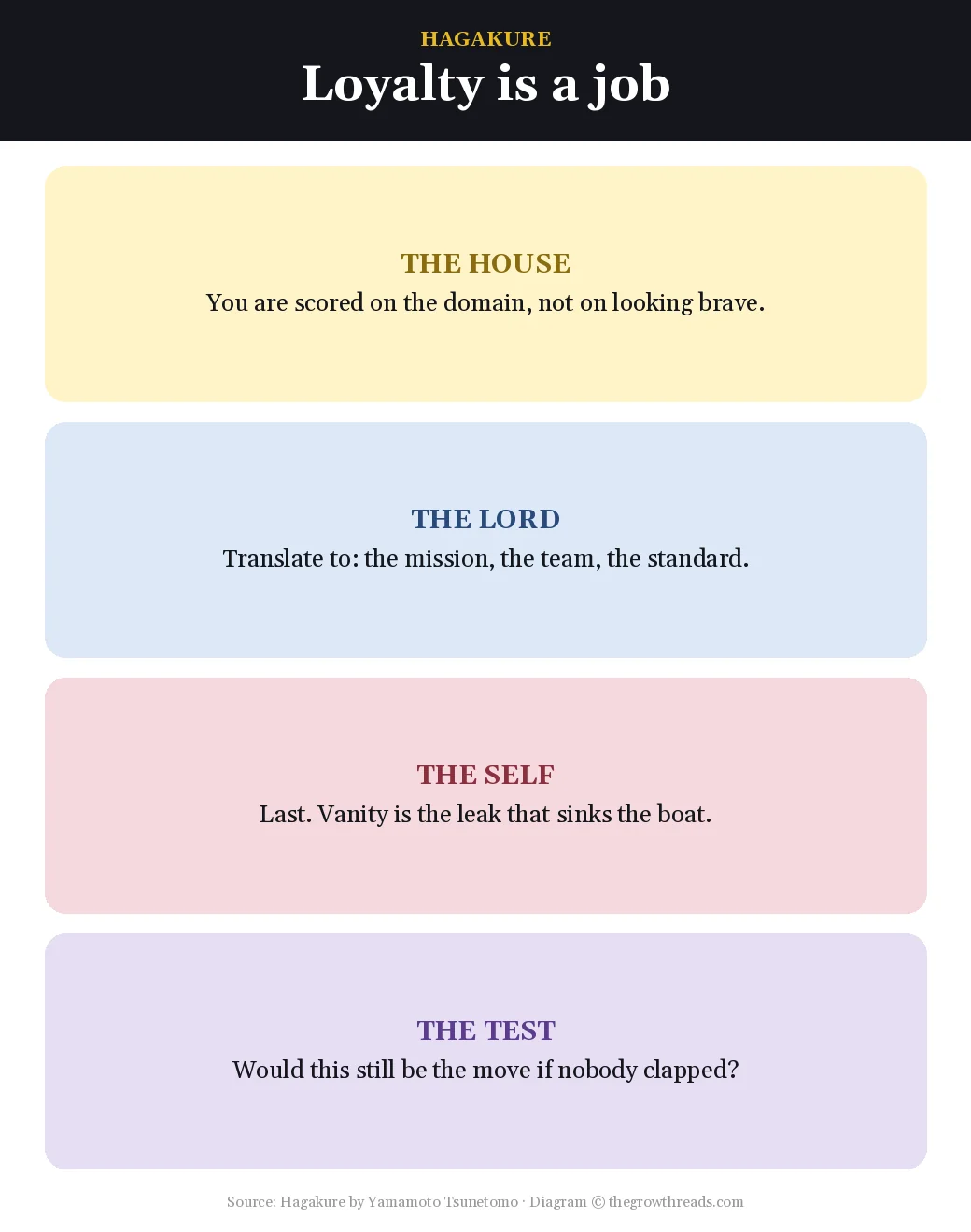
- Loyalty is a job: You are scored on the house, not on looking brave. Vanity is the leak.
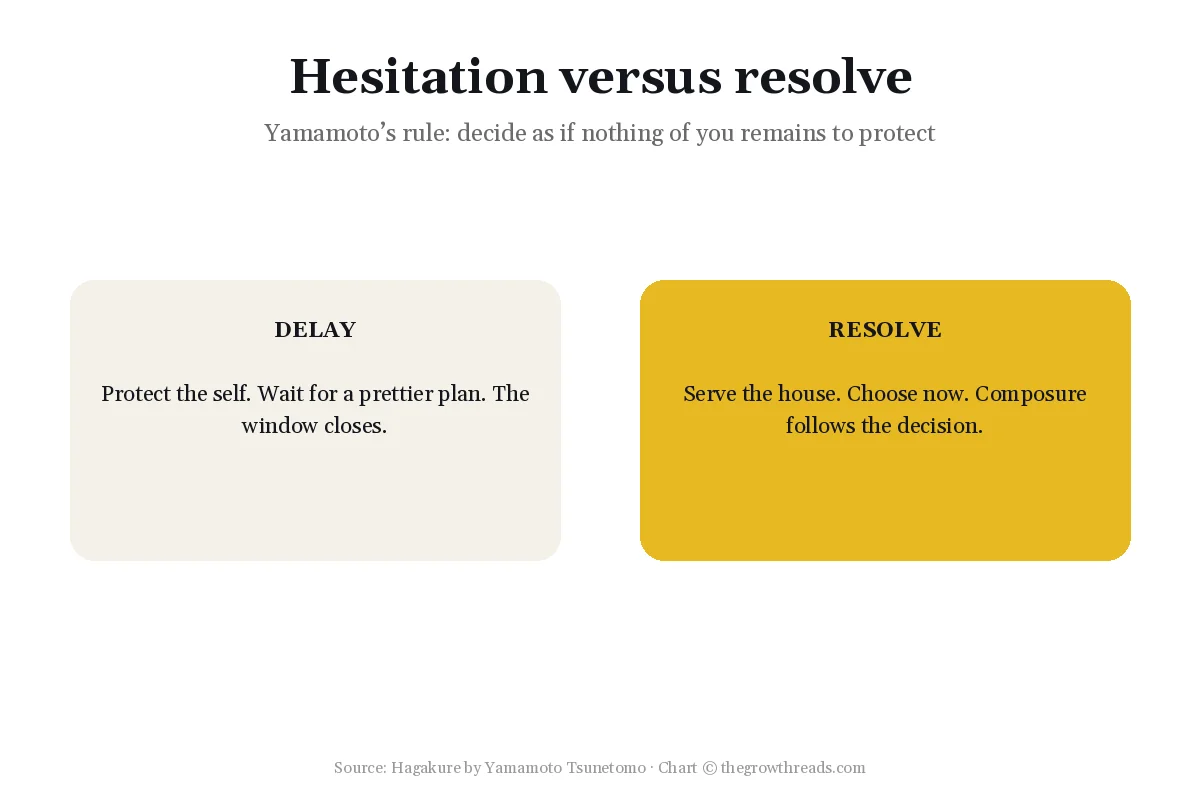
- Immediate action beats a prettier delay: A perfect plan that arrives after the window is still late. Yamamoto’s caution about the Forty-seven Rōnin is about timing, not about romance.
- Peacetime is the dangerous season: Softness, clever speech, and over-preparation grow when nothing is on fire. Train while it is quiet.
- Speech and appearance are the work: How you show up is a tell. Careless dress and protective talk are already a decision.
- Shame is a compass, not a performance: Use it to notice where you protected yourself. Do not use it to put on a show of severity.
- The second thought is often ego: The first loyal move is usually obvious. The extra hour is for a story that keeps you intact.
- Serve a house you can name: Without a mission that outranks your brand, “resolve” is just mood. Pick the domain you are actually scored on.
What is Hagakure about?
Hagakure is Yamamoto Tsunetomo’s peacetime code for Saga retainers, compiled from talks with Tashiro Tsuramoto between 1709 and 1716. It teaches resolve as a daily death to hesitation: serve the house, keep your bearing, and act while the window is open. The complete Bennett translation runs eleven books of anecdotes, not a single slogan.
About the author
Yamamoto Tsunetomo (1659–1719), monastic name Jōchō, was a samurai of Saga Domain under Nabeshima Mitsushige. He was a late, sickly son his father nearly gave to a salt merchant, a page at nine, and a student of Zen and Confucian letters who served as a scribe in Edo and Kyoto. When Mitsushige died in 1700, Yamamoto wanted to follow him in death. The shogunate had banned the rite. He became a priest with his wife, lived in a mountain hermitage, and years later dictated the conversations that became Hagakure. He is not a duelist-philosopher in the Musashi mold. He is a retainer who missed the war and spent the peace trying to keep a house from going soft. That is why operators still need him: most modern leadership failure is peacetime failure — delay, vanity, and a self that will not get out of the way. Explore all Yamamoto Tsunetomo book summaries →
Key concepts at a glance
| Concept | What it means | Use it when |
|---|---|---|
| Way found in death | Accept the worst case so the self stops steering. | You are stalling to protect a reputation. |
| Morning / evening death | A daily resolve rehearsal, not a crisis mood. | The calendar is full and the loyal act is still unstarted. |
| The house | The domain you are scored on — team, product, standard. | You cannot name who the work is for. |
| Immediate action | A good move now beats a perfect move late. | The plan is getting prettier and the window is not. |
| Peacetime training | Rehearse bearing while nothing is on fire. | Quiet weeks are making you sloppy. |
| Speech and dress | How you show up is already a decision. | The tell is careless talk or costume-leadership. |
| Forty-seven caution | A late perfect reply can still miss the lord. | You are waiting for a cinematic moment. |
| Shame as compass | Notice where you protected yourself; then correct. | You feel the flinch and start performing severity instead. |
Part 1: The Way of Dying — live as if the self were already gone
Yamamoto’s opening move is easy to misread because English makes “death” sound like a poster. In the house reading it is a constraint. If you have already accepted that you can lose the meeting, the title, or the round, you stop spending the first hour building a shelter for your name. His retainers are in a long Tokugawa peace, a worse classroom for resolve because nothing explodes when you hesitate. Softness looks like professionalism. Delay looks like diligence.
The morning and evening drill is the whole method. In the morning you picture the loss — not as rumination, as clearance — then do the next loyal act: the call, the page, the cut. In the evening you die again, which means you close the loop on whatever you still postponed in order to look intact. Operators who already run after-action reviews will recognize the shape. The missing piece is the first half: you cannot review a move you refused to make.
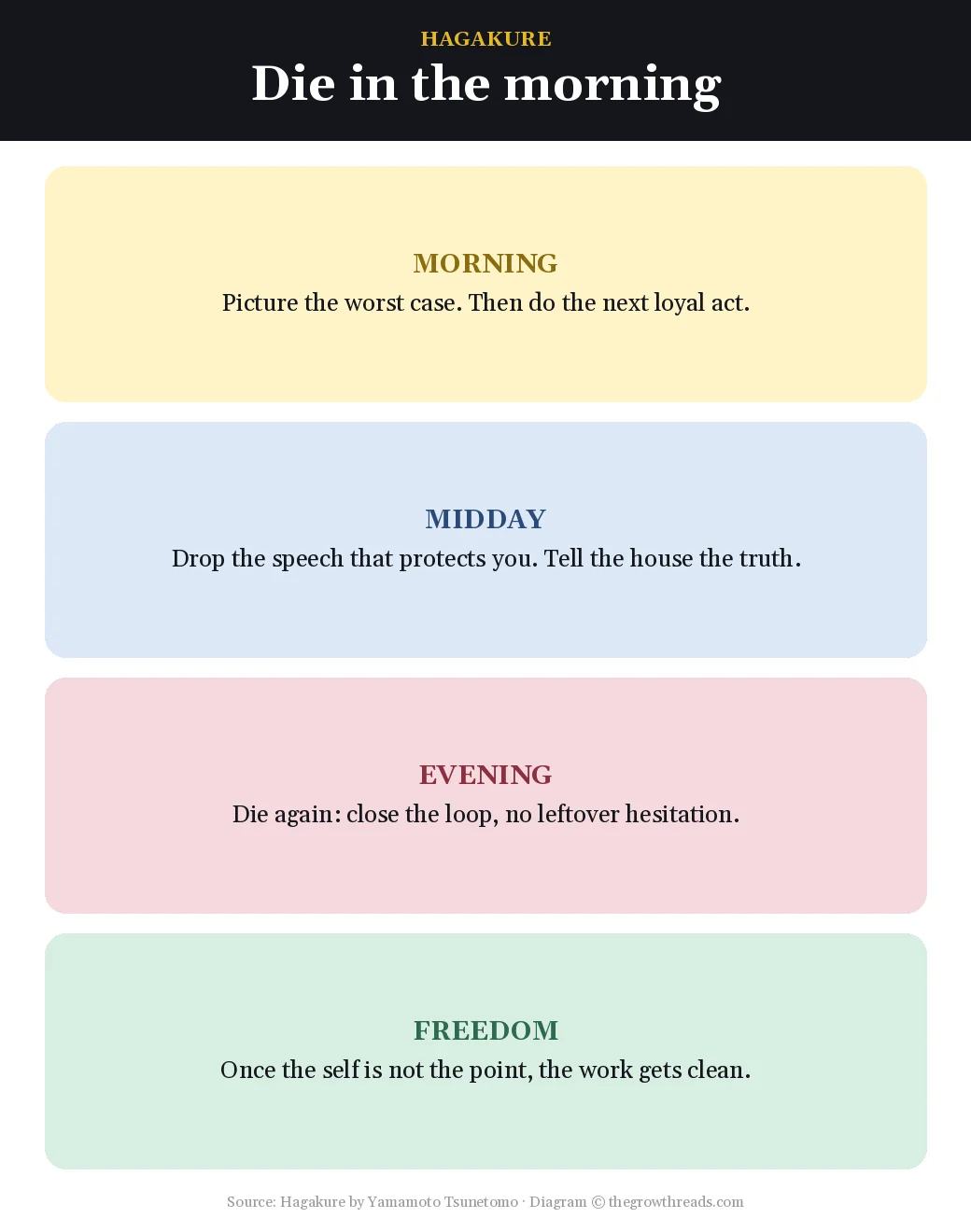
A useful test: would this still be the move if nobody clapped? If the answer depends on an audience, the self is still the point. Hagakure’s “already dead” state is attention without a hostage, not numbness. People who have practiced it look calm in ugly rooms because they are not also fighting a second war about how they will be seen leaving.
TGR Note: The inner move is the same job as Holiday in Ego Is the Enemy and as Marcus Aurelius in Meditations: get the self out of the steering wheel. Hagakure is less gentle. It does not ask you to journal the ego. It asks you to act as if the ego already lost.
Part 2: Loyalty is a job, not a feeling
Hagakure is a house book. Yamamoto’s lord is Nabeshima Mitsushige; the grandfathers’ stories are the curriculum. Loyalty is not a mood. It is a craft: keep the domain intact, do not make the lord look foolish, and do not use service as a stage. The anecdotes keep returning to small tells — corridor speech, lateness, dress. In a court those tells are strategy. In a company they still are. A lead who is always slightly unprepared is already voting.
Translate the nouns with a hard rule: the lord is the mission you are scored on, the house is the team that has to live with the result, and the self comes last. If you cannot name the house, the book is cosplay. If you can — a product crew, a shift, a family standard — every meeting gets a filter. Does this sentence serve the house, or the story of you as the careful one? Theatrical loyalty that needs an audience is already leaking.
People hear “loyalty” and think silence. Hagakure’s better reading is the opposite of flattery. A retainer who will not tell the house the truth because it might cost him is protecting himself. The loyal move is often the uncomfortable sentence. The disloyal move is the pretty sentence that keeps you employed in a dying plan.
TGR Note: Sinek’s Leaders Eat Last and Willink’s Extreme Ownership are the modern house manuals: the crew eats, the lead owns the miss. Hagakure is the older cousin. It adds the test those books assume — you cannot own the miss if you are still the point.
Part 3: Daily bearing — speech, appearance, composure
Because Yamamoto is writing in peacetime, he spends real energy on how a person talks and looks. That is not etiquette for its own sake. A sloppy mouth starts rumors; a sloppy coat tells the domain the standard has slipped. Bearing is how the house knows whether you are still in the job. Hedge-speech trains everyone to wait. A costume of intensity — late-night hero, messy genius — trains them to confuse strain with service.
Composure is the same drill from the inside. Anger, flashy courage, and clever irony put the self back on stage. The retainer he wants can receive bad news without making the room about his feelings. Severity and compassion travel together: kind without using kindness as a dodge, blunt without using bluntness as a brand. The tell is whether the other person leaves clearer about the house, or merely impressed by you.
Training in quiet weeks is the third piece. Peacetime is when you rehearse the small forms: the morning death, the honest sentence, the on-time arrival, the neglected skill. If your only intensity is a crisis, you will build a career that requires crises. The house cannot afford that hobby.
TGR Note: Musashi’s The Book of Five Rings is the craft twin: train the neglected hand until you have no favorite technique. Hagakure is the ethics twin: train the neglected loyalty until you have no favorite story about yourself. Read them as one week, not as rival posters.
Part 4: Immediate action — the cost of waiting for a prettier plan
Yamamoto’s most famous historical poke is at the Forty-seven Rōnin. The popular story loves the long, perfect revenge. His worry is colder: wait that long and the target might die of illness, and the duty evaporates into a legend you never complete. The operator lesson is clean. A cinematic plan that needs time and a flawless reveal is often a way to avoid today’s move. Teams do this with reorgs and “when we have the data.” The data is usually sufficient. The self is not ready.
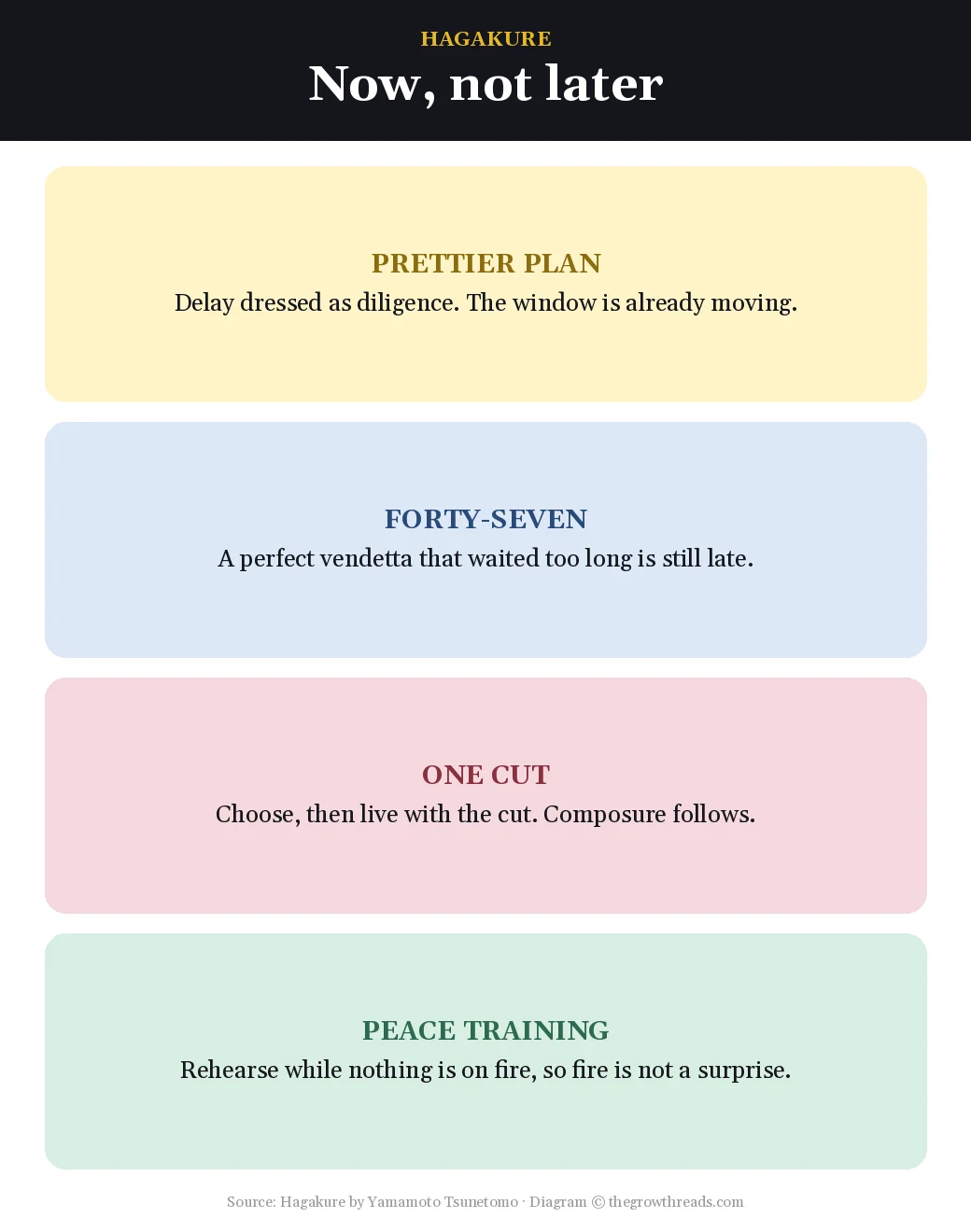
Immediate action is not frenzy. Stop using extra analysis as anesthesia. Make the cut you already know is loyal, then live with the cut. Composure follows the decision more often than it precedes it. People wait to “feel ready.” Yamamoto’s claim is that readiness arrives after you have accepted the loss. Without that, speed is panic and slowness is vanity with a spreadsheet. The quieter cost: other people live in your indecision. A lead who will not ship forces the crew to perform busyness. Immediate action returns time to the house.
TGR Note: Sun Tzu in The Art of War wants terrain before the flourish. Willink’s The Dichotomy of Leadership wants the balance between aggressive and cautious. Hagakure’s contribution is the clock. Terrain and balance still fail if you use them to postpone the hour you already have.
Who is Hagakure best for — and who should read something else first?
Best for: leads, founders, officers, and senior ICs who already know the work and still stall; people whose delay is identity, not information. If you can name a house you are scored on, you get a daily drill instead of a slogan.
Read something else first: a modern team system — High Output Management or Extreme Ownership. Craft and timing — The Book of Five Rings. A map of the contest — The Art of War. Power without a death ethic — The Prince. A why before a house — Start With Why. Hagakure assumes you already have a mission and are using thought to hide from it.
Questions to reflect on
- What loss am I actually flinching from this week — and what loyal act becomes obvious if I treat that loss as already true?
- Which house am I scored on? If I cannot name it in one sentence, what am I serving instead?
- Where did I dress delay as diligence in the last ten days?
- What sentence would I say in the room if my reputation were already gone?
- What peacetime drill am I skipping — speech, dress, a neglected skill, a closed loop at night — because nothing is currently on fire?
🔥 Ready to kill the hesitation?
Get Hagakure and start serving the house like the self is not the point.
How to apply Hagakure (7-day plan)
- Day 1 — Name the house. Write one sentence: the domain you are scored on this month. Put it where you see it when you stall.
- Day 2 — Morning death. Spend five minutes picturing the specific loss you are protecting against. Then start a ten-minute loyal act before inbox.
- Day 3 — The uncomfortable sentence. In one live conversation, say the true thing you have been dressing up. No extra speech after it.
- Day 4 — Bearing audit. Check one tell: arrival time, dress, or default hedge-words. Change only that tell for the day.
- Day 5 — Cut the prettier plan. Pick one delayed decision. Make the loyal cut with the information you already have. Write down what you are accepting.
- Day 6 — Peacetime reps. Practice a neglected skill for thirty minutes while nothing is on fire — the other hand, the other report, the other conversation type.
- Day 7 — Evening death. Close the week: where did you still postpone to look careful? Schedule tomorrow’s first loyal act before you sleep.
Frequently asked questions
What is Hagakure about?
Hagakure is a set of conversations from 1709 to 1716 in which retired Saga retainer Yamamoto Tsunetomo tells a younger samurai how to live when the wars are over and the job is still lethal in slower ways. The thesis is practical, not theatrical: treat the self as already spent so you can serve the house without bargaining. Loyalty, composure, speech, appearance, and speed of decision are the daily drills. Alexander Bennett’s complete Tuttle edition restores the eleven books of anecdotes; most English readers meet a shorter Wilson cut. Either way the usable sentence is the same. Die to hesitation. Then do the next loyal act.
What does “the Way of the Samurai is found in death” mean?
In William Scott Wilson’s widely quoted English, Yamamoto says the Way is found in death. He is not asking a manager to seek a dramatic exit. He is asking you to stop spending the morning protecting a self-image. If the worst case is already accepted, you can tell the truth, take the meeting, and fire the plan that only exists to make you look careful. The freedom he wants is operational: a person who is not bargaining for extra years of reputation moves cleanly. Read it as a resolve drill. Picture the loss. Then serve the mission that is actually in front of you.
Who was Yamamoto Tsunetomo?
Yamamoto Tsunetomo (1659–1719) was a page, scribe, and retainer to Nabeshima Mitsushige of Saga Domain. He was a sickly younger son who was not supposed to live past twenty. He studied Zen with Tannen and Confucian letters with Ishida Ittei, served in Edo and Kyoto, and wanted to follow his lord in death in 1700. The shogunate had banned that rite. He became a priest instead, then spent years in a hermitage dictating Hagakure to Tashiro Tsuramoto. He is not Musashi. He did not write a dueling manual. He wrote a peacetime ethics of service for people whose danger was softness, delay, and vanity.
Is Hagakure a good leadership book for modern managers?
Yes, if you translate lord as mission and house as the team you are scored on. The book is blunt about speech, dress, and showing up on time because those are the peacetime tells. It is less useful as a 2026 org-design playbook: it will not teach you one-on-ones, hiring loops, or OKRs. Pair it with High Output Management for the carpenter’s house and Extreme Ownership for the modern after-action. Use Hagakure for the inner move those books assume: you stop protecting yourself long enough to do the loyal thing while the window is still open.
How is Hagakure different from The Book of Five Rings and The Art of War?
Musashi’s Five Rings is a technician’s book: timing, no favorite weapon, the same geometry in every contest. Sun Tzu’s Art of War is terrain and preparation before the flourish. Hagakure is the ethics underneath both. It asks whether you are still the point. If you are, you will wait for a prettier plan and call it diligence. If you are not, you can take Musashi’s initiative and Sun Tzu’s ground without using them to look brilliant. Read Five Rings for craft. Read Art of War for the map. Read Hagakure when craft and map are fine and the freeze is you.
Which Hagakure translation should I read?
If you want the complete eleven-book text with notes that fill the cultural gaps, Alexander Bennett’s 2014 Tuttle edition — Hagakure: The Secret Wisdom of the Samurai — is the edition we rate here (ISBN 9784805311981). William Scott Wilson’s shorter Book of the Samurai is the line most people have already heard, including the death sentence in English. Bennett is the better first complete read for operators who want context. Wilson is the better pocket cut. Do not treat a quotation site as the book. The value is the anecdotes, not a single tattoo line.
How do I apply Hagakure without a feudal lord?
Pick a house you are actually scored on: a product, a crew, a family standard. Each morning name the loss you are flinching from — a missed number, a hard conversation, a public miss. Accept it as already true, then do the next loyal act in under ten minutes. At night close the loop: what did you still postpone to look careful? That is the only metric. You do not need a castle. You need a mission that is allowed to outrank your brand, and a daily death to the speech that protects you. Seven days of that is the whole method.
Related summaries
- The Book of Five Rings — craft, timing, and no favorite weapon.
- The Art of War — terrain before the flourish.
- Extreme Ownership — own the miss, not the method you prefer.
- Ego Is the Enemy — the identity that needs to look skilled.
Browse every title in our Best Leadership Books pillar page.
How we analyze books: our summaries are built from a full read of the source text, cross-referenced against the author’s published interviews and research where relevant, and structured around practical application rather than critique. We disclose our editorial process and affiliate relationships in full. Read our full methodology.