

⭐ 4.9/5 — Written in private by a Roman emperor during wartime and plague, Meditations is the most enduring personal journal in history — and one of the most practical guides to leadership, resilience, and the well-lived life ever produced.
Best for: Leaders, executives, coaches, and anyone facing adversity who wants a philosophical framework for unshakeable equanimity.
Reading time: ~4 hrs book · ~5 hrs audiobook
Difficulty to apply: Moderate — the ideas are simple; internalising them under pressure is the lifelong practice.
Meditations in one minute
The most powerful leader in the ancient world kept a private journal to remind himself how to be a decent human being. Marcus Aurelius ruled the Roman Empire from 161 to 180 AD — a period of plague, military crisis, and political betrayal. He had every incentive to abuse his power and every reason to despair. Instead, he wrote to himself, daily, in Greek, practising the discipline of a Stoic mind. The notes he left behind were never meant to be read by anyone else. They are, twenty centuries later, the most-read work of practical philosophy in the Western world.
Meditations offers no system, no steps, no clever frameworks. What it offers is a model: of someone who knew, as well as anyone in history, that external circumstance cannot determine internal state. That the only empire worth governing is the one between your ears. That obstacles are not interruptions to the good life — they are the good life. Translated here in the acclaimed Gregory Hays edition, Meditations remains as urgent and usable in 2026 as the morning it was written.
Key takeaways
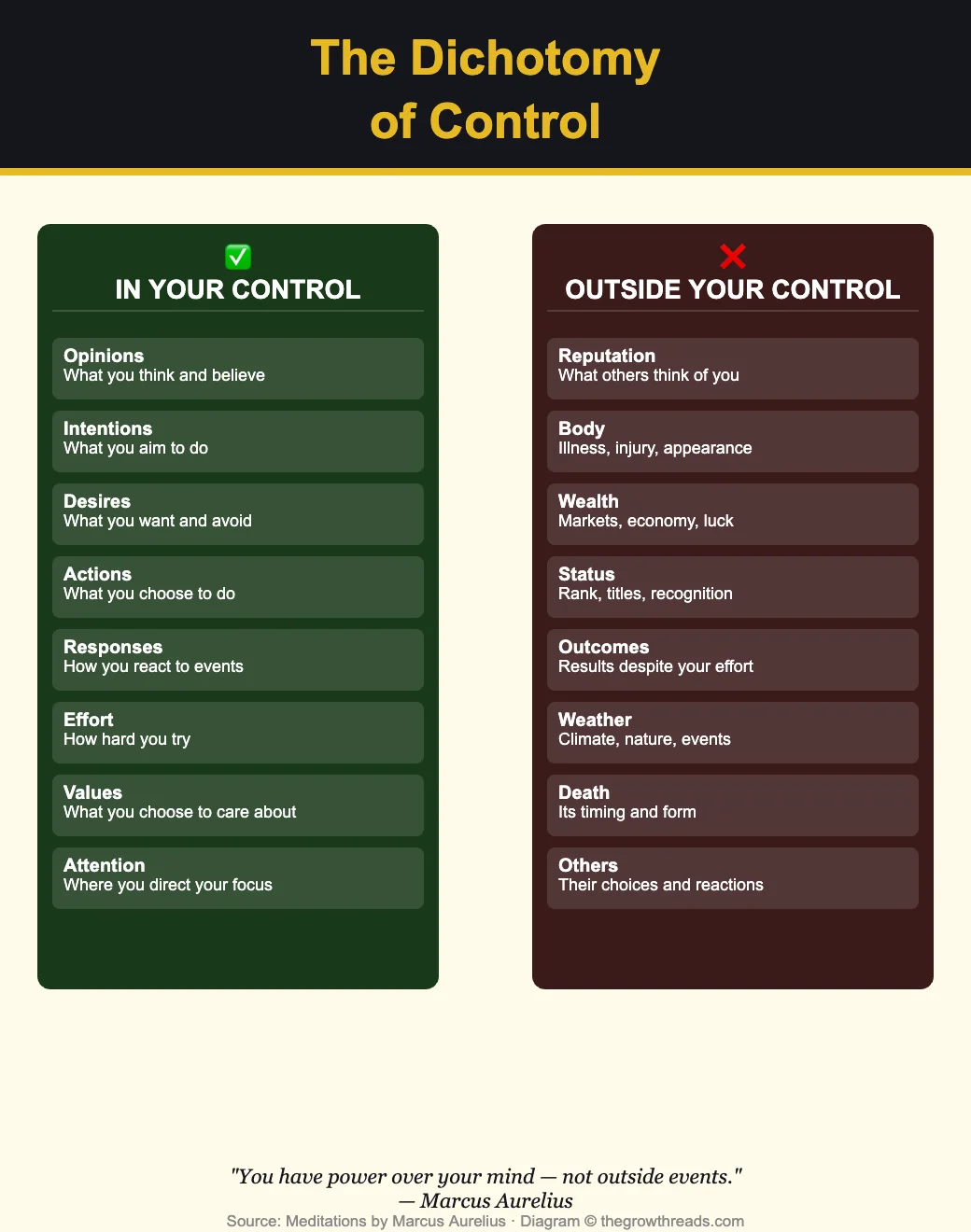
- You control only your response: External events, other people’s actions, and physical fortune are beyond your reach. Your judgments, intentions, and reactions are entirely within it. This distinction is the foundation of everything.
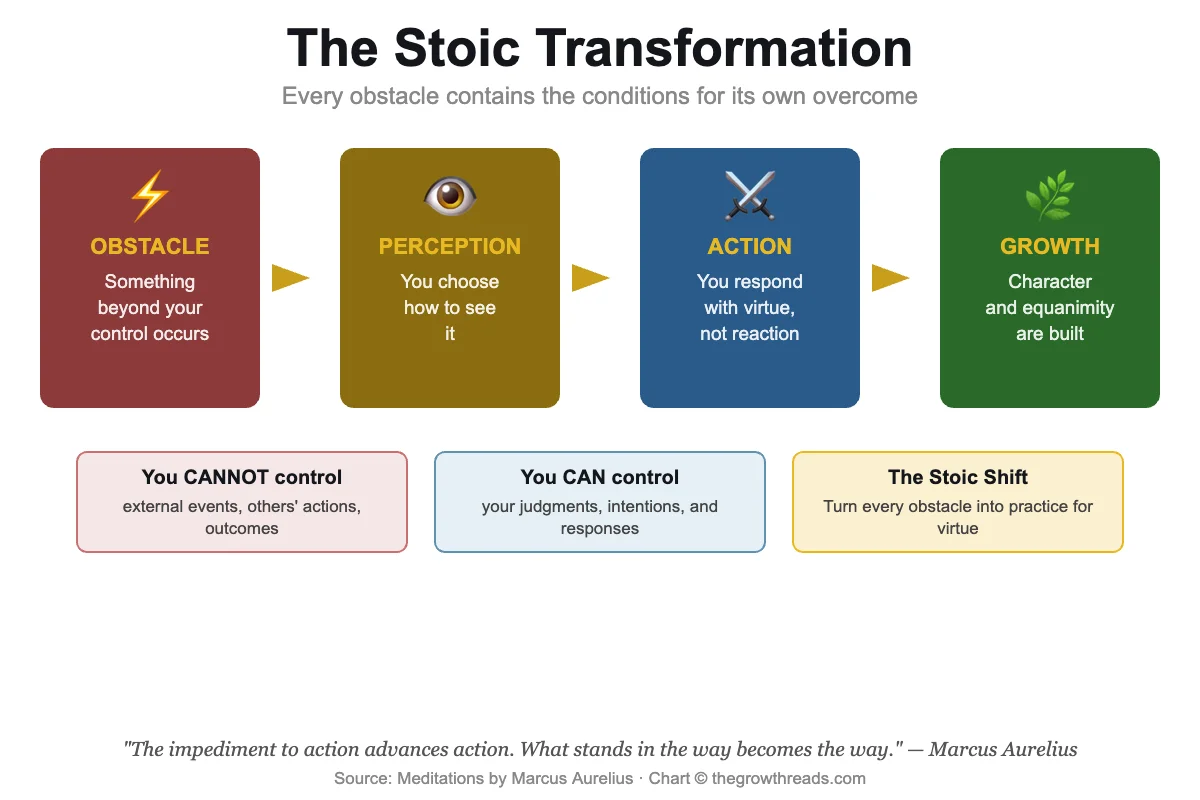
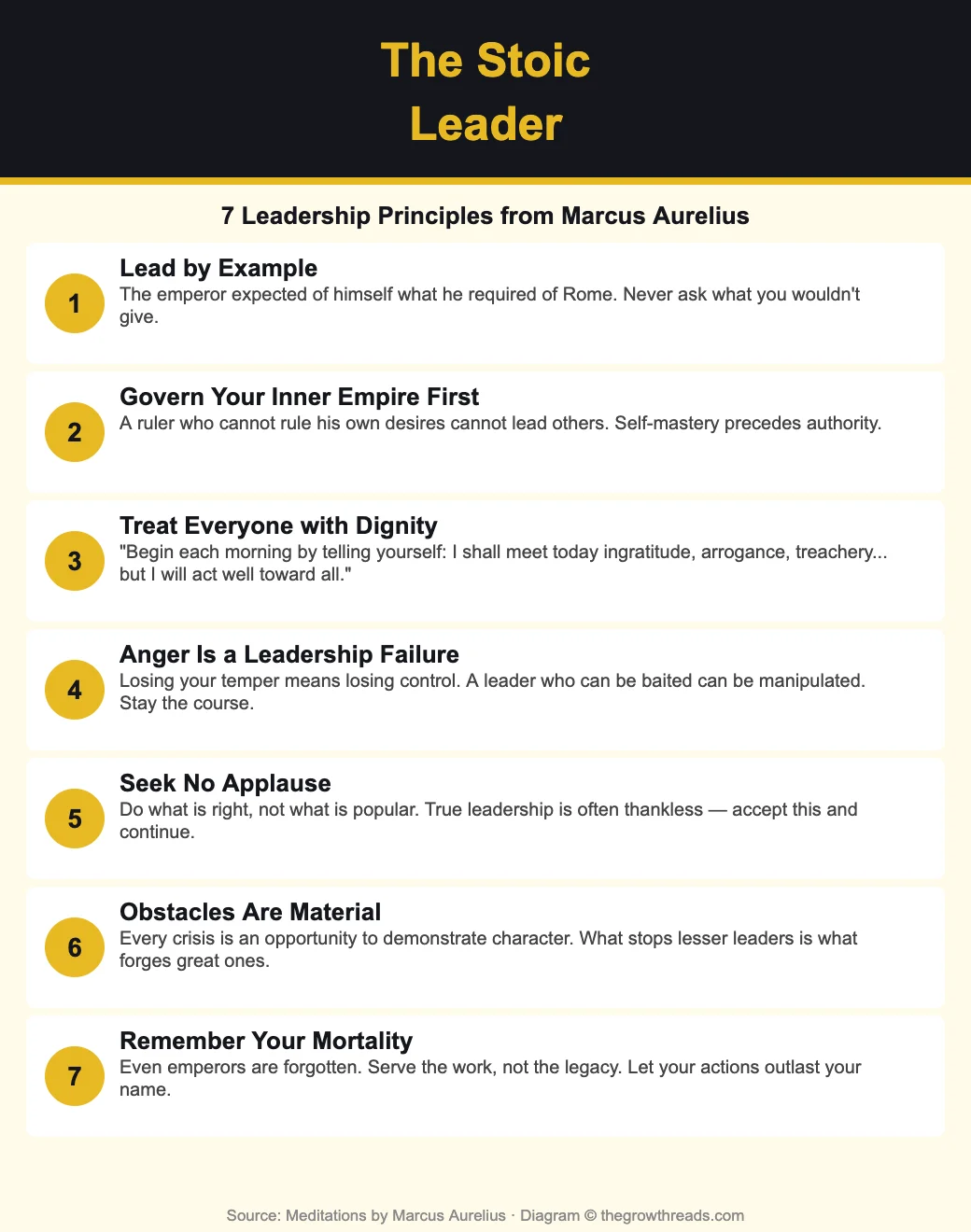
- Obstacles are the way: Every impediment to action can be transformed into a vehicle for it. What blocks the lesser leader becomes the practice ground for the greater one. Nothing is wasted if you choose to use it.
- Contemplate your mortality daily: Memento mori is not morbidity — it is clarity. Remembering that your time is finite cuts through triviality and orients every hour toward what genuinely matters.
- Your thoughts become your character: The mind shapes experience. Dwell on injury and you suffer twice. Interpret difficulty as practice and you grow stronger. The same event, perceived differently, becomes entirely different.
- Serve without needing recognition: True leadership means contributing to the common good and accepting that gratitude rarely follows. Act well because action is within your power; whether it is appreciated is not.
- Anger is always a choice — and always wrong: The Stoic does not suppress emotion but recognises that acting from rage is always a failure of reason. Passion should inform; it must not drive.
- Treat every person with dignity: Marcus expected to encounter ingratitude, arrogance, and treachery every morning — and chose to respond with patience anyway. This is not weakness; it is the highest form of strength.
- The present moment is all you have: Neither regret for the past nor anxiety about the future is available to you — only this breath, this choice, this action. Practice returning to it.
- Zoom out for perspective: The “view from above” — imagining your problem from cosmic scale — dissolves most urgency. Emperors are forgotten; your quarterly results are less important still.
- A good life is made, not found: Meaning does not arise from circumstances. It is built through repeated acts of virtue, attention, and service. Meditations is Marcus building that life, one entry at a time.
What is Meditations about?
Meditations is a collection of personal notes written by Roman Emperor Marcus Aurelius around 170-180 AD, never intended for publication. Drawing on Stoic philosophy — particularly the ideas of Epictetus — it is a private practice of self-examination, exploring how to maintain rational virtue, equanimity, and service to others in the face of power, adversity, and mortality. The Gregory Hays translation (2002) is widely considered the definitive modern edition.
About the author
Marcus Aurelius (121-180 AD) was Roman Emperor from 161 to 180 AD — the last of the Five Good Emperors and arguably the most philosophically serious ruler in history. Born into Roman aristocracy and adopted by Emperor Antoninus Pius, he was educated in Stoic philosophy from boyhood, studying under the most eminent teachers of his era. His reign was marked by the devastating Antonine Plague, the Marcomannic Wars, and persistent threats at every frontier of the Empire. Explore all Marcus Aurelius book summaries →
Despite — or because of — these pressures, he wrote his personal reflections in Greek throughout his military campaigns, entirely as a self-directed spiritual discipline. He had no intention of publication. Rediscovered and copied by Byzantine scholars, the text survived into the medieval period and has never gone out of print since its first modern publication in 1558. Marcus Aurelius died at age 58 during a military campaign on the Danube frontier. His son Commodus succeeded him — and dismantled much of what his father built.
Key concepts at a glance
| Concept | What it means | Use it when |
|---|---|---|
| Dichotomy of Control | Dividing all things into what is “up to us” and what is not — and attending only to the former | Deciding where to invest energy and worry |
| Memento Mori | Daily contemplation of mortality to clarify priorities and cut through triviality | Feeling stuck on minor problems or distractions |
| Amor Fati | Active love of one’s fate — embracing not just accepting what happens | Processing setbacks, losses, or unwanted change |
| Premeditatio Malorum | Pre-visualising potential losses and hardships to reduce their power to destabilise | Planning for high-stakes events or decisions |
| The View from Above | Imagining yourself high above your situation, watching it in the context of human history and cosmic scale | Breaking anxiety spirals or regaining perspective |
| Logos | The rational principle governing all things; aligning with it means acting in accordance with nature and reason | Ethical decision-making under pressure |
| Sympatheia | The Stoic doctrine of universal interconnectedness — all things belong to a single, interdependent whole | Cultivating patience and compassion for others |
| Autotelic Leadership | Leading not for reward, recognition, or legacy but because service is intrinsically the right action | Sustaining motivation through thankless work |
Part 1: The Stoic Framework — You Control Only Your Response
The conceptual heart of Meditations is what Stoics call the dichotomy of control, and Marcus returns to it in nearly every book of the text. The premise is deceptively simple: divide everything that happens to you into two categories. Some things are “up to us” — our judgments, intentions, desires, aversions, and choices. Everything else — illness, reputation, wealth, others’ actions, the weather, death — is not up to us. Stoic philosophy, and the entirety of Marcus’s self-improvement project, rests on a single injunction: spend your psychic energy only on the first category.
This is not passivity or resignation. Marcus was Emperor of Rome. He fought wars, administered justice, and managed crises. What he refused to do was mistake those external activities for the substance of his life. The substance was always interior: the quality of attention he brought to each moment, the virtue he embodied regardless of outcome. You can see this distinctly in the way he writes about his enemies and critics — not with contempt or wounded pride, but with patient curiosity. They are acting according to their nature, which is also not “up to him.” What is up to him is his response.
Marcus grounds this framework in Stoic physics: the universe is governed by a rational principle (Logos) that is simultaneously the source of all order and the fabric of all things. Humans are unique in possessing reason — the capacity to align their will with this universal order. When we act from reason, aligned with nature, we experience what Stoics call virtue. When we act from passion, ego, or fear — in conflict with nature — we experience what they call vice. The dichotomy of control is, at its root, a daily practice of remembering which part of life is actually ours to shape.
Part 2: Meditations on Death, Time, and What Matters
If the first movement of Meditations is about control, the second is about time — specifically, how much you waste by failing to notice that you have almost none of it. Marcus returns obsessively to mortality. He lists the names of the great — philosophers, generals, emperors — and notes that they are all equally forgotten. He meditates on the brevity of human life against the backdrop of geological and cosmic time. He writes, in Book 4, that “time is a river of vanishing moments” and everything in it will be swept away. This is not depression; it is therapy.
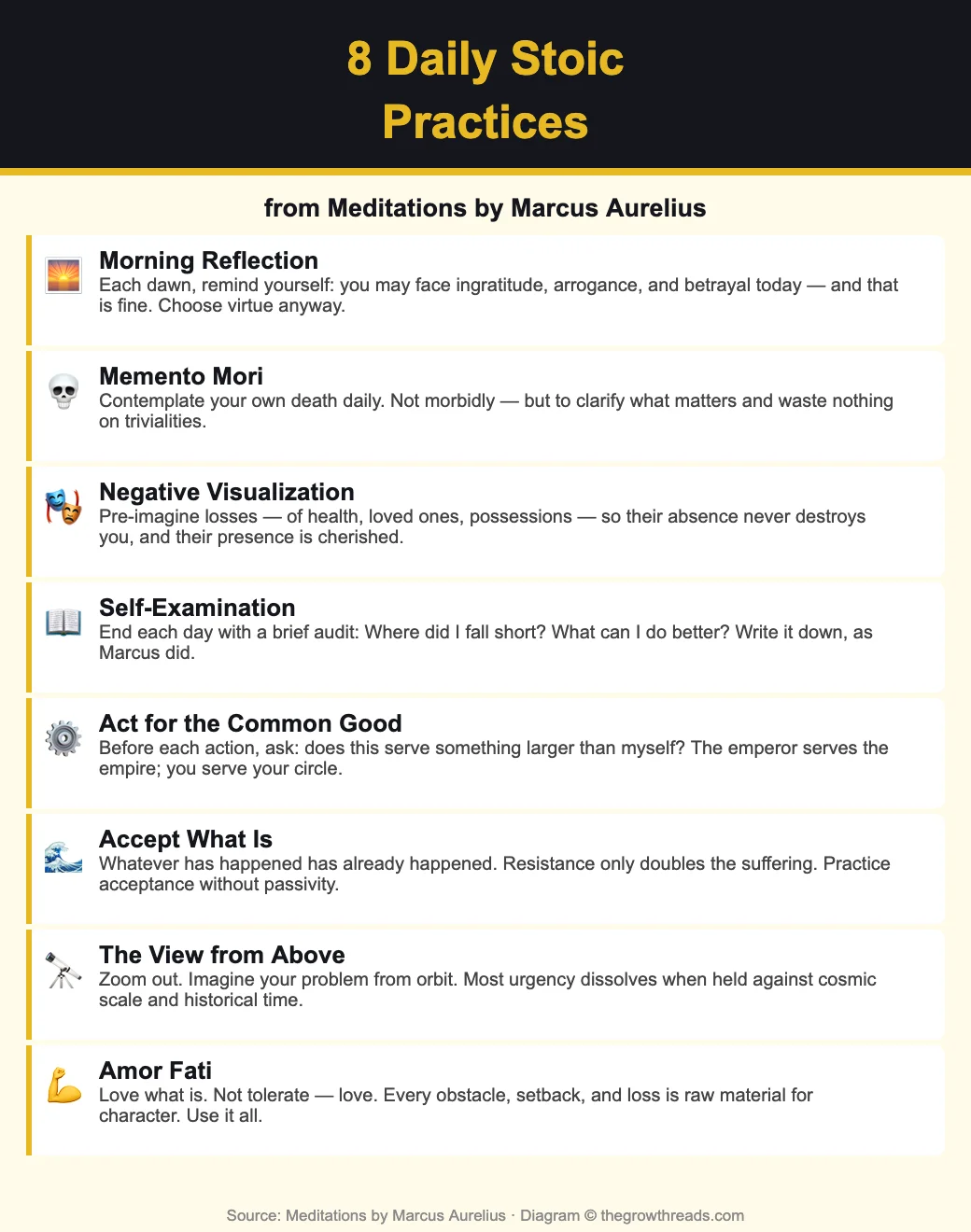
The Stoic practice of memento mori — remember that you will die — is designed precisely to break the spell of triviality. When you genuinely feel the finitude of your time, most of what normally claims your attention simply stops mattering. The slight from a colleague, the delayed project, the quarter’s revenue shortfall — seen against the scale of a life, or a century, or an empire — these events lose their gravitational pull. What remains is the question Marcus keeps returning to: given that this moment is all I have, what is the most excellent use of it?
This is connected to a related Stoic practice: premeditatio malorum, or pre-visualisation of possible losses. Marcus doesn’t just contemplate death abstractly — he mentally rehearses the loss of his health, his loved ones, his position. Not to indulge anxiety, but to neutralise it. The Stoic argument is that the suffering of imagined loss comes not from the event itself but from our attachment to the idea that we deserve its opposite. Pre-meditate loss and you strip it of its power to destroy you when it arrives. You also, incidentally, learn to love more honestly what you currently have.
Part 3: The Inner Life of a Leader
What makes Meditations extraordinary is its context. Marcus is not a monk meditating in a cell. He is the most powerful person on earth, managing an empire of tens of millions, besieged by war and pandemic, surrounded by flatterers and betrayers. And yet the text is almost entirely concerned with how he must govern himself. The external power barely appears. The internal work is everything.
He is relentlessly self-critical — but never self-pitying. Book 1 opens with a long list of what he has learned from people he admires: patience from his grandfather, modesty from his father, self-control from his teacher, philosophical discipline from Rusticus. He never claims to have achieved these qualities. He is practising. Each entry is a note to himself to try again tomorrow.
His model of leadership is essentially what we would now call servant leadership — but stripped of sentimentality. He is not kind because it feels good; he is kind because kindness is the rational response to human folly, which he expects and forgives as routinely as he expects rain. He does not need his subjects’ love, his courtiers’ approval, or history’s verdict. These are all outside his control. What is inside his control is the quality of his service — and that, he insists, must be given fully, regardless of return.
The most striking entries are those where Marcus is clearly angry, wounded, or exhausted — and talks himself back from the edge. He reminds himself that the person who insulted him is driven by ignorance, not malice. He asks himself whether his anger is serving any rational purpose. He notes that even the most powerful emotion is just a thought — and thoughts can be redirected. This is not the voice of someone who found equanimity easy. It is the voice of someone who fought for it every single day of his reign.
Part 4: Amor Fati — The Art of Loving What Is
The final and deepest movement of Meditations is the concept that Nietzsche would later call amor fati — love of fate. For Marcus, equanimity is not merely accepting what happens. It is actively embracing it, finding in every turn of fortune the material for something greater. This is the Stoic transformation: adversity does not happen to you; it happens for you, if you are willing to treat it as instruction.
This is most vivid in the famous lines from Book 5: “The impediment to action advances action. What stands in the way becomes the way.” This is not motivational rhetoric. Marcus wrote it in the middle of a plague that would kill five million people, during military campaigns he did not ask for, surrounded by political enemies he could not entirely trust. He wrote it as a daily reminder to himself. The obstacle is not a delay between you and the life you want. The obstacle is already the life — if you are willing to work with it.
Meditations ends without resolution. There is no climax, no final wisdom, no conclusion. It cannot end because it was never meant to be a finished document. It is a practice — ongoing, imperfect, and private. Marcus never claimed to have mastered Stoicism. He was, like the rest of us, trying to remember what he already knew, and failing often enough that he needed to write it down again. In that humility, across twenty centuries, he reaches us still.
Who is Meditations best for — and who should read something else first?
Meditations rewards leaders, executives, coaches, parents, and anyone navigating sustained pressure, loss, or responsibility without obvious support structures. It is particularly powerful for people who are publicly composed and privately struggling — Marcus is that person, writing himself back to equilibrium. The Gregory Hays translation is strongly recommended over older versions; his Introduction alone is worth the price.
If you want a more systematic introduction to Stoicism before diving in, start with Ryan Holiday’s modern Stoic trilogy. If you want ancient Stoicism more directly, Epictetus’s Enchiridion is shorter and more structured. If Meditations feels too aphoristic, try The Daily Stoic — also by Holiday — which repackages Stoic wisdom in a daily-entry format that serves as an excellent companion text.
Questions to reflect on
- What is currently occupying your attention that is, in fact, outside your control? What would it look like to genuinely release it?
- Where in your leadership are you acting for recognition or approval rather than because the action itself is right? What would change if you removed the audience?
- Think of a current obstacle. How would Marcus Aurelius reframe it — not as something happening to him, but as material he was given to work with?
- If you knew this was your last full year of work, what would you stop spending energy on, and what would you double down on?
- In what recurring situation do you lose your composure? What would a Stoic response look like — and what would it cost you to practise it?
🔥 Ready to lead with Stoic clarity?
Pick up Meditations and begin the practice Marcus Aurelius returned to every day — ruling yourself first.
How to apply Meditations (7-day plan)
- Day 1 — The morning Stoic audit: Before leaving bed, identify three things you’re likely to encounter today that are outside your control. Note them, then consciously set them aside. Decide in advance how you will respond if they go badly.
- Day 2 — The dichotomy in practice: For one full day, when frustration arises, pause and ask: is this in my control? If not, redirect attention to your response. Keep a tally. Notice how often frustration attaches to things you cannot change.
- Day 3 — Memento mori: Write a single sentence: “I will die. Given this, what is worth doing today?” Read it at noon and before bed. Notice how it reshapes what feels important.
- Day 4 — Negative visualisation: Spend five minutes imagining the loss of something you currently rely on — a relationship, your health, your income. Then go about your day with the full weight of its value restored. This is the Stoic paradox: imagining loss generates gratitude.
- Day 5 — The view from above: When a problem feels consuming, spend two minutes literally imagining it from orbit. Then from the scale of a century. Write one sentence on how it appears from that altitude.
- Day 6 — Amor fati: Identify something difficult that is currently happening to you. Write one paragraph on how it could be material for growth — what skill, character quality, or insight might it develop if you engaged it fully rather than resisting it?
- Day 7 — The private journal: Write as Marcus did: to yourself, honestly, about where you fell short this week and what virtue you are trying to cultivate. No performance, no audience — just the practice.
Frequently asked questions
What is Meditations about, in simple terms?
Meditations is a private journal written by the Roman Emperor Marcus Aurelius around 170-180 AD during military campaigns. It was never intended for publication. Drawing on Stoic philosophy — especially the ideas of the philosopher Epictetus — it is a daily practice of self-examination: reminders Marcus wrote to himself about how to remain rational, virtuous, and of service to others in the face of power, adversity, and mortality. It has no narrative or argument — it is a practice, not a treatise, and its power lies in its cumulative honesty.
Was Meditations really written for Marcus Aurelius’s eyes only?
Almost certainly yes. The text bears no dedication and shows no signs of preparation for an outside audience. Marcus refers to himself in the second person (“you”) throughout, which is the voice of self-directed instruction, not public address. The title “Meditations” was given later by scholars — Marcus himself called his notes something closer to “things to himself” in Greek. The text was preserved by Byzantine scribes centuries after his death and first published in modern form in 1558 by Wilhelm Xylander. That it survived at all is a function of the respect later emperors and scholars had for Marcus’s memory — not his own intention to endure.
Which translation of Meditations is the best?
Gregory Hays’s translation (Modern Library, 2002) is widely considered the best for modern readers. His introduction is illuminating, his prose is vivid and contemporary without being casual, and he captures the spare, sometimes terse quality of Marcus’s Greek more faithfully than older Victorian-era translations. The Penguin Classics translation by Martin Hammond is also excellent and more literal. For beginners, Hays is the stronger starting point. Older translations — particularly George Long’s 19th-century version — feel archaic and can make Marcus seem more remote than he actually is.
Is Meditations difficult to read?
Not in the modern Hays translation — individual entries are typically a paragraph or two, often a single striking observation. The challenge is not comprehension but absorption: Meditations is the kind of book where reading 10 pages slowly is more valuable than reading 100 quickly. Because it has no plot or argument, there is nothing to follow — only to sit with. Many readers find the most useful approach is to read one or two entries each morning, slowly, and return to the same passages multiple times over weeks and months. It is more like a daily practice than a book to be finished.
What is Stoic philosophy and how does it appear in Meditations?
Stoicism was a school of Greek philosophy founded around 300 BC by Zeno of Citium and developed by Chrysippus, Seneca, Epictetus, and others. Its central claims are: (1) virtue is the only true good; (2) we control only our own judgments and intentions; (3) we should act in accordance with reason and nature; and (4) external events — health, wealth, reputation, death — are “indifferent,” meaning neither inherently good nor bad. In Meditations, Stoicism appears not as abstract doctrine but as applied practice: Marcus uses it to regulate his anger, check his ego, maintain compassion for those who wrong him, and remind himself that his role is service, not self-aggrandisement. He is the most compelling advertisement for Stoicism precisely because he was the most powerful man alive, and it is clear the philosophy was all that stood between him and the corruption of absolute power.
Why is Meditations considered a leadership book?
Because its author held the most consequential leadership role in the ancient world, and because the qualities it cultivates — equanimity under pressure, service without ego, rational decision-making, and consistency of character regardless of audience — are precisely the qualities that define exceptional leadership in any era. Modern business thinkers including Ryan Holiday, Tim Ferriss, and countless CEOs cite Meditations as the book that most shaped their approach to leadership. Its relevance is not historical; it is structural. The challenges Marcus faced — managing difficult people, governing under uncertainty, maintaining personal values while wielding institutional power — are the challenges every leader faces. His solutions are still among the best available.
What are the most famous quotes from Meditations?
Several passages have entered the broader culture. “The impediment to action advances action. What stands in the way becomes the way” (Book 5) is perhaps the most cited — Ryan Holiday built an entire book around it. “You have power over your mind, not outside events. Realise this, and you will find strength” appears in various forms across the text. “Confine yourself to the present” (Book 8) is a recurring Stoic instruction Marcus returns to repeatedly. “Accept the things to which fate binds you, and love the people with whom fate brings you together, and do so with all your heart” (Book 6) captures the Stoic ideal of amor fati. The cumulative effect of reading them in context — rather than as isolated quotes — is considerably more powerful than any single line suggests.
Related summaries
- Extreme Ownership by Jocko Willink — A modern military application of the same core principle: total ownership of your response, regardless of circumstances beyond your control.
- Leaders Eat Last by Simon Sinek — Explores leadership as service and sacrifice — the same model Marcus practised, from a contemporary neuroscience and business lens.
- Four Thousand Weeks by Oliver Burkeman — A modern reckoning with mortality and finite time that arrives at deeply Stoic conclusions: do fewer things, do them fully, and accept that you will never do everything.
- Best Leadership Books — Our full ranked list of the most impactful leadership books, from ancient wisdom to modern strategy.
How we analyse books at The Growth Reads: Every summary is built from a close reading of the full text, supplemented by author interviews, academic citations, and cross-referencing with related works in the field. We focus on practical application — what you can do with the ideas this week — rather than plot summary. Read our full methodology.