

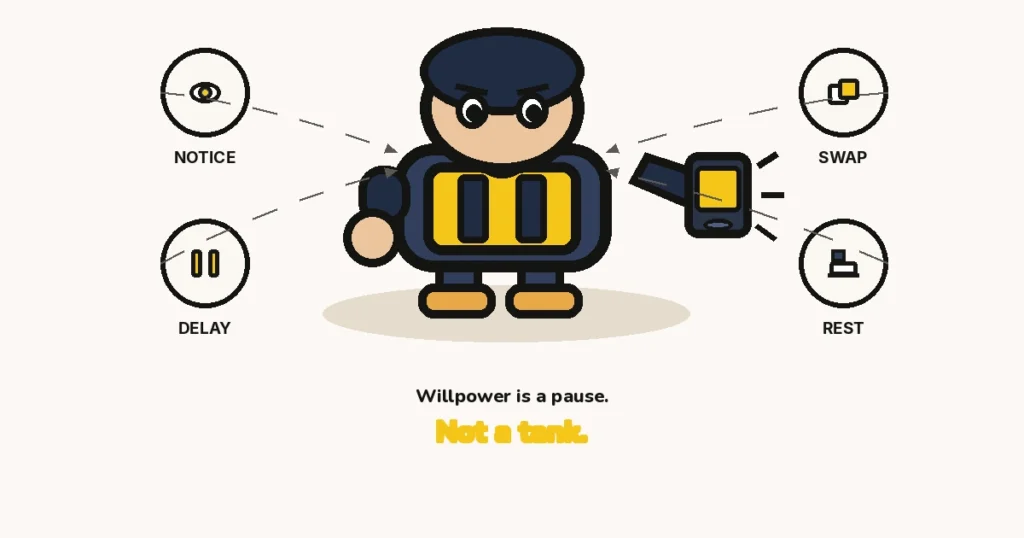
How to develop willpower is to name the urge, change the situation, write an if-then delay, swap a cheaper action, and rest the next block — a pause you install, not a tank you fill. Duckworth, Gendler and Gross (2016) rank situation change above white-knuckle resistance; Hagger et al. (2016) found the empty-tank effect indistinguishable from zero.
Key takeaways
- Duckworth, Gendler and Gross (2016) mapped self-control onto Gross’s process model: situation selection and modification sit above last-ditch response modulation, which is the white-knuckle move most people mean by willpower.
- Hagger et al. (2016) ran a preregistered replication across 23 laboratories (N = 2,141) and found the ego-depletion effect indistinguishable from zero (d = 0.04, 95% CI crossed zero).
- Job, Dweck and Walton (2010) found that people who viewed willpower as nonlimited did not show the classic post-exertion drop, and a limited-resource theory itself predicted worse self-regulation during exams.
- Gollwitzer and Sheeran (2006) meta-analysed 94 tests (N = 8,461) and found if-then plans raised goal attainment with a medium-to-large effect (d = 0.65), which is the delay you write before the urge votes.
- de Ridder, Lensvelt-Mulders, Finkenauer, Stok and Baumeister (2012) meta-analysed 102 studies (N = 32,648) and found trait self-control related more strongly to automatic habits than to controlled, in-the-moment inhibition.
What developing willpower actually is (and what it isn’t)
How to develop willpower, on this page, is a pause method: name the urge, change the situation before it peaks, attach an if-then delay, swap in a cheaper action that still counts, and rest the next block so a limited-resource story does not run the afternoon. It is not a personality transplant. It is not a glucose protocol. It is not a diagnosis. Willpower here is a lagging name for a setup you can see. The pause comes first; the feeling of being “disciplined” is optional.
That job is narrower than “have more grit.” The parent, how to build discipline, already owns the system that does not wait on a willpower tank. The sister, how to improve self control, owns the room change as a play page without a HowTo ladder. Ryan Holiday’s Ego Is the Enemy is the book for the identity stall: ego treats willpower as a person you either are, which is how one miss becomes a binge. Related reading on productivity systems and summaries sits under the same roof. This page ends when the next urge has a pause and a cheaper action.
How is this different from self-control, motivation, or discipline?
This page trains a pause; how to improve self control owns the room change without the step ladder; how to get motivated owns the start when the story is a missing mood; self motivation owns what the engine is; mental discipline owns staying put once you have begun. Five jobs. Five pages. If the problem is delay despite intending, that is how to beat procrastination — the delay equation, not a missing inner muscle. If the problem is a cue you keep restacking, that is habit stacking or how to break bad habits. This page ends at the installed pause, not at a values speech and not at a glucose snack.
Why the tank story fails
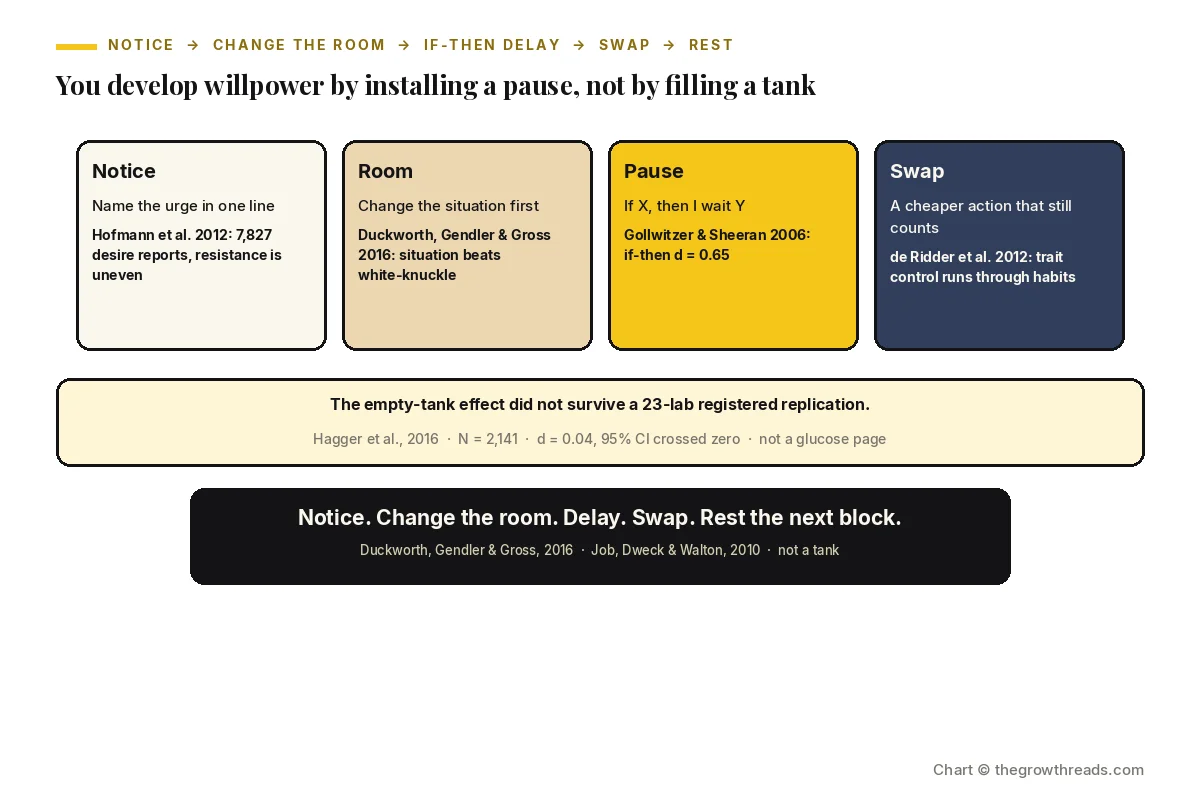
The tank story fails because the empty-tank effect did not survive a registered replication, because a limited-resource belief itself predicts the drop, and because the people who look high in self-control are mostly running habits, not heroic inhibition. Hagger et al. (2016) is the first motor. Twenty-three laboratories ran a standardised sequential-task protocol (N = 2,141). The pooled ego-depletion effect was d = 0.04, and the 95% confidence interval crossed zero. That is not “willpower does not exist.” It is “the muscle-that-empties after one hard task is not a finding you should build a Tuesday around.” Do not drink a sugary drink to refill a tank the replication did not find.
The second motor is the story you tell about the tank. Job, Dweck and Walton (2010) measured and then manipulated implicit theories of willpower. People who viewed the capacity as nonlimited did not show the classic post-exertion drop. In a longitudinal field study during exams, a limited-resource theory predicted worse eating, more procrastination, and weaker goal striving. The belief is not a pep talk. It is a switch that decides whether a hard morning licenses an unmanaged afternoon.
The third motor is where trait self-control actually lives. de Ridder et al. (2012) meta-analysed 102 studies (N = 32,648). Self-control related similarly to doing wanted behaviours and inhibiting unwanted ones, but the associations were stronger for automatic behaviour than for controlled behaviour. The person who “has willpower” is often the person whose Tuesday no longer requires a debate. That is a habit, which is why habit stacking and temptation bundling sit next to this page rather than underneath it.
The fourth motor is the wrong lever. Duckworth, Gendler and Gross (2016) mapped self-control onto Gross’s process model: situation selection and modification come first; response modulation — resisting an urge already in the hand — is last and most expensive. “Just try harder” starts at the end of that list.
The four triggers, in the order you can actually pull them
Pull the named urge first, then the room, then the if-then, then the swap — because a speech about grit with the phone still on the desk has nowhere to land. Hofmann, Baumeister, Förster and Vohs (2012) sampled everyday desire from 205 adults (7,827 reports). Conflicted desires elicited resistance with uneven success; situations shaped later stages more than personality. That is why the room move comes before the inner speech. Mischel, Shoda and Rodriguez (1989) is the child-scale version: the preschoolers who waited longer used strategies (looking away, treating the reward as a picture) rather than staring at the treat and enduring.
Why white-knuckling costs more than it feels like
White-knuckling costs a hidden tax: the cue stays in the room, the if-then never installs, and the only evidence you collect is that you are the kind of person who eventually folds. Duckworth, Gendler and Gross (2016) is the cost sheet for starting at response modulation: every minute spent arguing with an urge already in your hand is a minute you did not spend moving the cue. Hofmann et al. (2012) is the cost sheet for the day — later stages bent to who was already doing the thing, and to alcohol. A “I have great willpower” identity does not travel well into that room. Job, Dweck and Walton (2010) is the cost sheet for the story: after a hard block, a limited-resource theory licenses the next lapse. Hagger et al. (2016) is why you should not treat that licence as a finding. Treating the morning as proof you are spent is a belief with consequences, not a measurement of a fluid.
The four stalls — and the fix for each
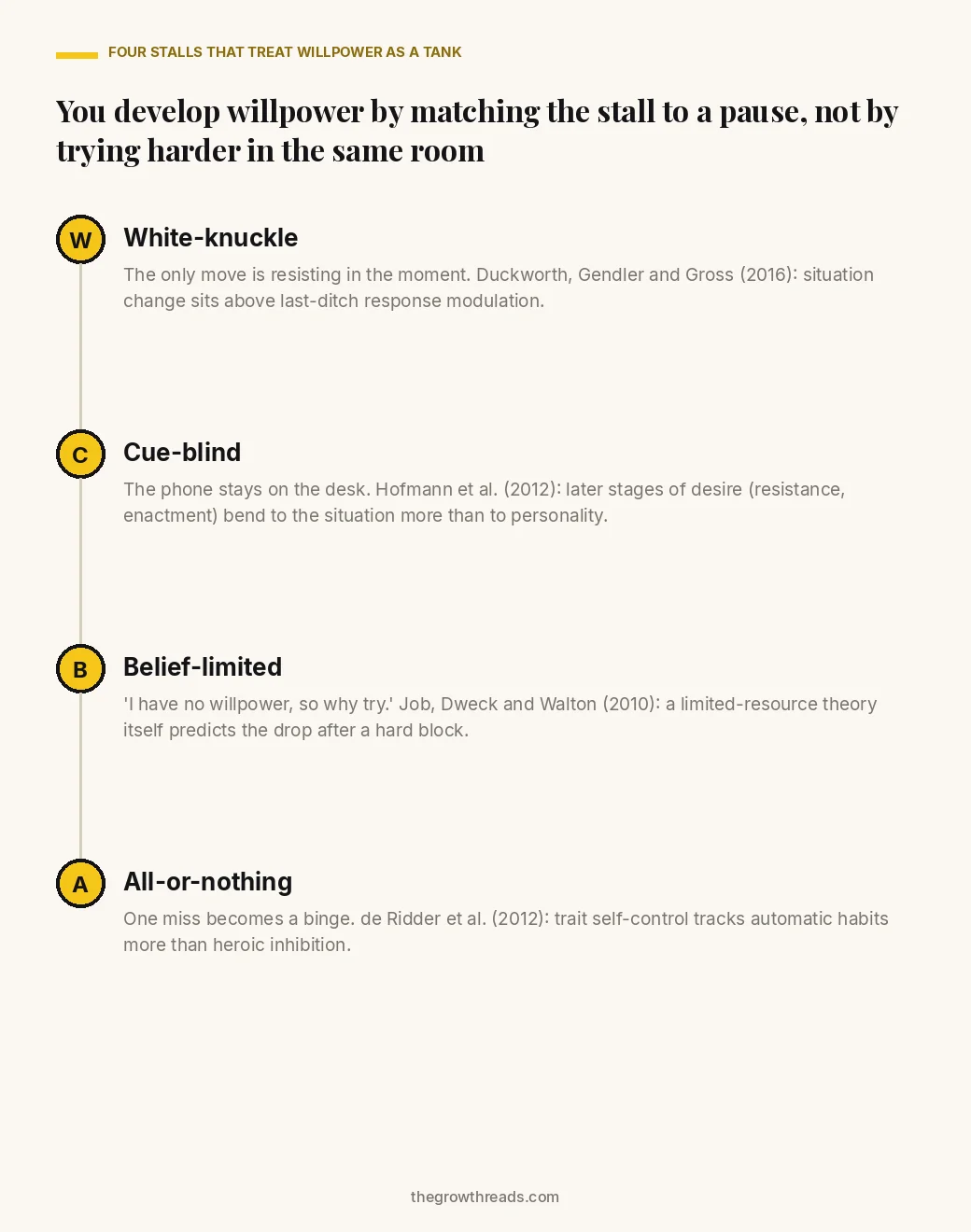
Most “I have no willpower” stories are one of four stalls: white-knuckling in the same room, leaving the cue in reach, believing the tank is empty, or turning one miss into a binge. Name the stall. Pull the matching lever. Do not collect a fifth quote about grit.
| Stall | What it looks like | The tell | The fix on this page |
|---|---|---|---|
| White-knuckle | The snack is open, the tab is loaded, the argument with yourself is the whole plan. | You are at response modulation. Duckworth, Gendler and Gross 2016 put that last. | Steps 1–2: name the urge, then change the room before the next peak. |
| Cue-blind | The phone stays on the desk “just in case.” The biscuit tin stays at arm’s length because moving it would be dramatic. | The situation is untreated. Hofmann et al. 2012 is why later stages bend to the room. | Step 2, then the sister page: how to improve self control owns the room change in more detail. |
| Belief-limited | “I used up my willpower in the morning meeting, so the afternoon does not count.” | A limited-resource theory is doing the work. Job, Dweck and Walton 2010 named the switch. | Step 6: treat the next block as available, then take a real break from the have-to. Do not add a glucose ritual. |
| All-or-nothing | One biscuit becomes the tin. One missed session becomes “I am not a disciplined person.” | Identity is doing the work that a habit should do. de Ridder et al. 2012 is the mismatch. Ego, in Holiday’s Ego Is the Enemy, is this stall with a nicer coat. | Step 5: swap a cheaper action that still counts. The miss is data. It is not a verdict. |
If two stalls are running, start with the room plus the if-then. A speech about identity with the cue still in reach is mental discipline theatre, not a pause. A playlist is not a plan.
How to develop willpower: the 6-step system
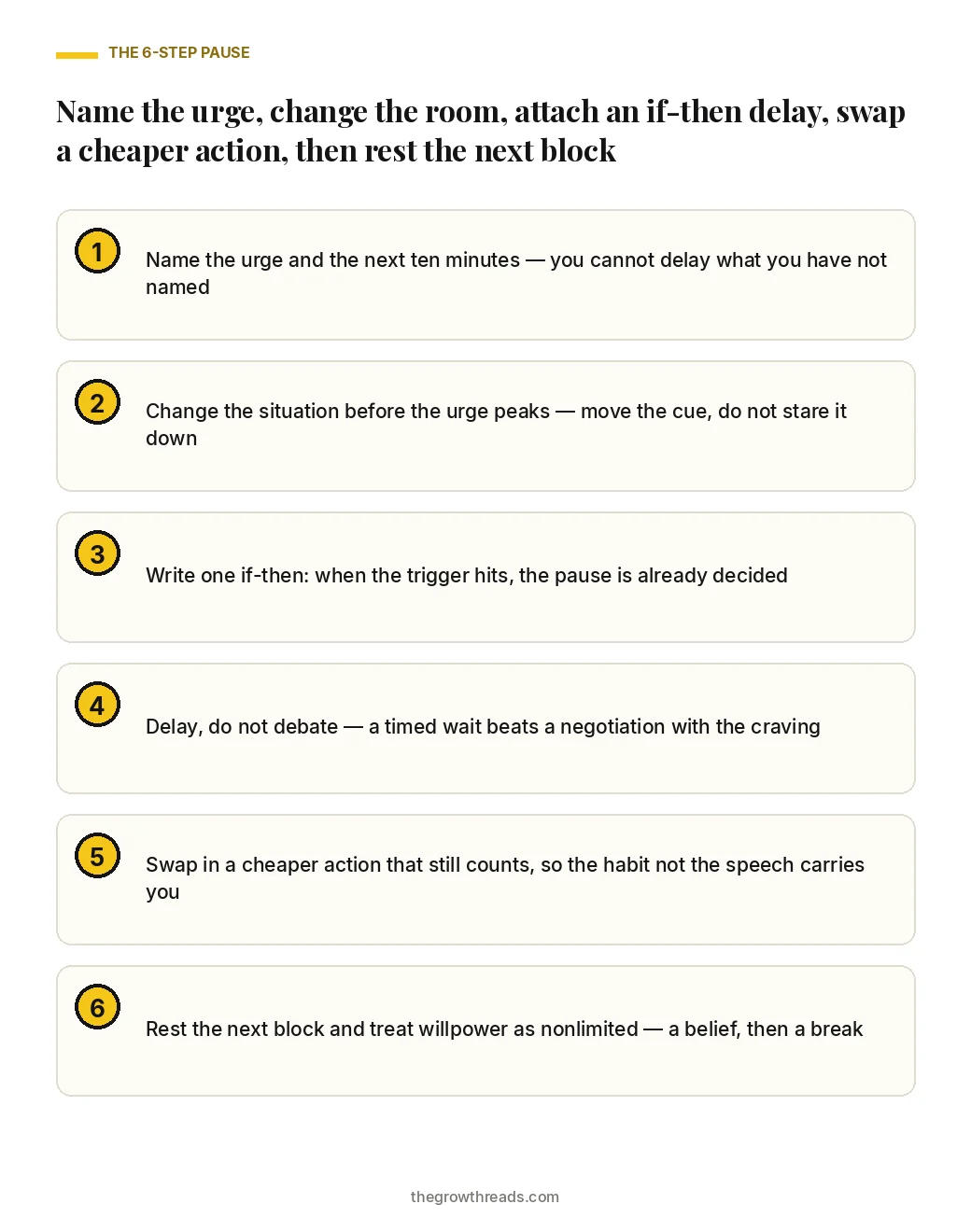
The system is a pause you can repeat: one named urge, one changed situation, one if-then delay, a timed wait, a cheaper action that still counts, and a rest that does not licence a binge. It copies Duckworth, Gendler and Gross (2016) for the lever order, Gollwitzer and Sheeran (2006) for the cue, Mischel, Shoda and Rodriguez (1989) for delay-as-strategy, de Ridder et al. (2012) for the habit swap, and Job, Dweck and Walton (2010) for the nonlimited next block. Do not swallow a 5 a.m. identity. Do not install a glucose snack. Hagger et al. (2016) is permission to skip the tank, not the pause.
Step 1 — Name the urge and the next ten minutes
Write the desire in one line a camera could film: open the social app, take the biscuit, refresh the inbox. Then write the next ten minutes of the actual job: stay in the draft, keep walking, leave the tin shut. Hofmann et al. (2012) is why the name exists. You cannot delay an unnamed weather system. If you cannot point at the thing your hands will do, you have a mood, not an urge to train. Put the object in the sentence.
Step 2 — Change the situation before the urge peaks
Move the cue while it is still cheap: phone in another bag, tin on a high shelf, chair faced away from the television. Duckworth, Gendler and Gross (2016) put situation modification above staring the urge down. Hofmann et al. (2012) is why the room is not a side quest: later stages bent to who was already doing the thing more than to a personality score. If the only plan is “I will be stronger in the same room,” you have skipped the cheapest step. The sister page, how to improve self control, is the longer version of this move.
Step 3 — Write an if-then for the trigger
Write one line: If the 3 p.m. slump hits at the desk, then I put the phone in the drawer and wait ten minutes. Gollwitzer and Sheeran (2006) is the lift: 94 tests, 8,461 people, d = 0.65 for implementation intentions versus a mere goal. The cue has to be a real time, place, or object you already occupy, not a feeling (“if I feel weak”). Feelings do not fire if-thens. Clocks, drawers, and closed tins do. One cue. One pause. Do not write a branching flowchart, and do not write “if I have willpower, then I will be good.” That is the tank talking.
Step 4 — Delay, do not debate
When the if-then fires, wait a named interval — ten minutes is enough to start — without negotiating the content of the urge. Mischel, Shoda and Rodriguez (1989) is the strategy, not the later-life SAT myth: the children who waited longer looked away and recoded the treat. They did not win by staring harder. A debate (“I deserve this / I am weak if I take it”) is response modulation with extra plot. Set a timer. Leave the object. Do not reopen the case at minute two. If ten minutes still feels theatrical, the situation in Step 2 is still too close. Move the cue farther, then wait.
Step 5 — Swap in a cheaper action that still counts
Replace the urge with a move that is allowed and small: water instead of the third coffee, a stretch instead of the app, one paragraph instead of the inbox. de Ridder et al. (2012) is why the swap exists: trait self-control tracked automatic behaviour more than heroic inhibition. A cheaper action you can repeat is how the Tuesday stops being a character test. The miss is not a verdict that you “have no willpower” — that verdict is the all-or-nothing stall, and the ego move in Ego Is the Enemy. Keep the cheaper action. Do not build a sticker chart that replaces the pause.
Step 6 — Rest the next block, and treat willpower as nonlimited
After a hard have-to, take a real break that is not the banned cue — a walk, water, a shut laptop for ten minutes — and do not narrate the morning as proof the tank is empty. Job, Dweck and Walton (2010) is the switch: a nonlimited theory predicted better self-regulation when demands were high. Inzlicht, Schmeichel and Macrae (2014) is the matching process model: after have-to work, people shift toward want-to. The rest is how you meet that shift without handing it the tin. Hagger et al. (2016) is why the rest is not a glucose refill. Run the same if-then at the next cue.
What to do when you already slipped
If the afternoon already dissolved into the banned cue, do not hunt a two-hour hero block — name the next ten minutes, move the object you can still move, and run a two-minute if-then now. A day of delay despite intending is how to beat procrastination, not a personality verdict. A missing start is how to get motivated. A missing engine as a definition is self motivation. This page’s job on a blown afternoon is damage control: no third podcast about grit, no “I will start the program tomorrow,” and no identity funeral over one biscuit. Close the tin. Ten minutes. One cheaper action. Resume Step 1 at the next cue you can actually keep.
Night shifts and days the calendar owns are not this protocol. Protect the next cue you do control. A discipline system still needs a named pause. If the problem is getting started at all, that is how to overcome a lack of motivation — still a work page, still not a diagnosis.
Common mistakes
- Treating willpower as a tank you refill with food. Hagger et al. (2016) did not recover a reliable empty-tank effect. Skip the glucose ritual.
- Starting at white-knuckle. Duckworth, Gendler and Gross (2016) put response modulation last. Move the cue first.
- Leaving the situation untreated. Hofmann et al. (2012) is why the room is not optional. The sister self-control page exists for this miss.
- A limited-resource story after a hard morning. Job, Dweck and Walton (2010) showed the story itself predicts the drop. Rest. Do not licence a binge.
- One miss as a verdict. de Ridder et al. (2012) is why a habit beats an identity. Swap the cheaper action. Do not hold a funeral.
- Debating the urge instead of delaying it. Mischel, Shoda and Rodriguez (1989) waited by looking away, not by staring harder. Set a timer.
- Confusing this with the start, or with the delay equation. A missing mood is the motivation page. Delay despite intending is the procrastination page. This URL is the pause.
When it is more than a habit
This is a work-and-habits page for an urge you can still pause with a named action and a room change — it is not a diagnosis, not addiction medicine, not a depression page, and not a clinical scale. If nothing holds interest for weeks, if sleep and appetite have fallen apart alongside the stalls, if substances or gambling have stopped answering to a ten-minute wait, stop treating it as a missing if-then and speak to a clinician. Do not self-label an impulse-control disorder from a blog. Do not start a stimulant, a crash diet, or a 4 a.m. identity from this URL. A pause is a work habit. It is not treatment. Bare willpower as a book title is not this page; this URL is the method.
The evidence behind this system
The method sits on a process-model review of self-control, a registered replication that failed to recover ego depletion, an implicit-theories set, an if-then meta-analysis, an experience-sampling study of everyday desire, a trait-self-control meta-analysis, a delay-of-gratification strategy paper, and a process model of the have-to to want-to shift. Observational rows are labelled. Nothing here is causal proof that developing willpower raises income, and nothing here is a glucose trial.
| Study | Design and size | Finding | What we used it for |
|---|---|---|---|
| Duckworth, Gendler and Gross, 2016, Perspectives on Psychological Science | Theoretical review mapping self-control onto Gross’s process model | Situation selection and modification are earlier, cheaper strategies than in-the-moment response modulation | Step 2: change the room before white-knuckling |
| Hagger et al., 2016, Perspectives on Psychological Science | Preregistered multilab replication; k = 23 laboratories; N = 2,141 | Ego-depletion effect d = 0.04, 95% CI crossed zero (indistinguishable from a null on that protocol) | The honest limit: do not build a Tuesday around an empty tank |
| Job, Dweck and Walton, 2010, Psychological Science | Three laboratory experiments plus a longitudinal field study during exams | A nonlimited theory of willpower eliminated the post-exertion drop; a limited theory predicted worse self-regulation when demands were high | Step 6: treat the next block as available |
| Gollwitzer and Sheeran, 2006, Advances in Experimental Social Psychology | Meta-analysis; 94 independent tests; N = 8,461 | Implementation intentions raised goal attainment, d = 0.65, versus mere goal intention | Step 3: the if-then delay |
| Hofmann, Baumeister, Förster and Vohs, 2012, Journal of Personality and Social Psychology | Experience sampling; 205 adults; 7,827 desire reports over one week | Desires were frequent; conflicted desires elicited resistance with uneven success; situations shaped later stages more than personality | Steps 1–2: name the urge; change the room |
| de Ridder, Lensvelt-Mulders, Finkenauer, Stok and Baumeister, 2012, Personality and Social Psychology Review | Meta-analysis; 102 studies; N = 32,648 | Trait self-control related more strongly to automatic than to controlled behaviour | Step 5: swap a cheaper action that can become a habit |
| Mischel, Shoda and Rodriguez, 1989, Science | Developmental experiments on delay of gratification in children | Longer waiting tracked attentional and cognitive strategies (looking away, recoding the reward), not raw endurance of the treat | Step 4: delay, do not debate |
| Inzlicht, Schmeichel and Macrae, 2014, Trends in Cognitive Sciences | Process-model review of self-control (not a glucose-tank account) | After have-to work, people shift toward want-to goals; the “empty tank” is often a priority shift | Step 6: rest the next block without licensing the banned cue |
Frequently asked questions
How do you develop willpower if you feel you have none?
You name the next urge, move the cue while it is still cheap, and run a ten-minute if-then instead of hunting a new personality. Duckworth, Gendler and Gross (2016) put situation change above white-knuckle resistance. Gollwitzer and Sheeran (2006) found if-then plans lift attainment (d = 0.65, 94 tests). Job, Dweck and Walton (2010) is why the “I have none” sentence matters: a limited-resource theory predicted worse self-regulation when demands were high. Write the pause. Change the room. Let the identity catch up, or not — the cheaper action still counts.
Is willpower a limited resource that gets used up?
Not on the evidence this page will stand on. Hagger et al. (2016) ran 23 laboratories and 2,141 people on a standardised sequential-task protocol; the pooled effect was d = 0.04 and the confidence interval crossed zero. Job, Dweck and Walton (2010) showed that a limited-resource belief itself predicted the drop. Inzlicht, Schmeichel and Macrae (2014) argued the afternoon slump is often a shift from have-to to want-to, not a drained fluid. Rest the next block. Do not install a glucose ritual, and do not treat a hard morning as a scientific licence to binge.
Should I just try harder in the moment?
No. Trying harder in the moment is response modulation, the last and most expensive strategy on Duckworth, Gendler and Gross’s (2016) list. Move the cue first. Hofmann et al. (2012), in 7,827 desire reports from 205 adults, found later stages of desire bent to the situation — who was already doing the thing, whether alcohol was in play — more than to a personality score. A debate with an open tin is the expensive version of a job a closed cupboard would have finished. Change the room. Then wait ten minutes. Then swap.
How is this different from improving self-control?
Self-control, on the sister play page, is the room change without a HowTo ladder: you rearrange cues so the urge is weaker when it arrives. Developing willpower, here, is the six-step pause you run when the urge still arrives — name it, change what you can, if-then, delay, swap, rest. The tools overlap on Step 2, which is why that sister is the sideways link. If you only need the environment, use how to improve self control. If you need a repeatable pause once the cue is in the room, stay on this URL. Do not merge them into a third page about grit speeches.
How is this different from getting motivated or building discipline?
Motivation, on yesterday’s sister, is generating a start when the story is “I do not feel like it.” Discipline, on the parent, is the system that does not wait on a tank. Willpower, here, is the pause between an urge and a banned action. The tools overlap (an if-then helps all three), but the job is different. If you never named a first move, use how to get motivated. If you need the week to run without a feeling, use how to build discipline. If the biscuit is already in your hand, stay here and delay.
Does delay of gratification mean staring at the temptation?
No. Mischel, Shoda and Rodriguez (1989) is usually quoted as a grit parable. In the actual experiments, the children who waited longer used strategies: looking away, recoding the reward as a picture, turning the wait into a game. Staring at the treat and enduring was the losing move. That is Step 4 on this page. Set a timer. Put the object out of sight. Do not reopen the case at minute two. Later-life SAT claims from that paradigm are not this article’s job, and they are not a reason to white-knuckle a biscuit tin at 3 p.m.
Can a habit replace willpower?
A habit can take the job that white-knuckle willpower was failing at, which is the more useful sentence. de Ridder et al. (2012), across 102 studies and 32,648 people, found trait self-control related more strongly to automatic behaviour than to controlled inhibition. That is Step 5: swap a cheaper action that can repeat until the Tuesday is no longer a debate. Habit stacking and how to break bad habits own the longer versions. This page ends when the swap exists. It does not end when you have a new identity.
What if I still keep slipping after a week of this?
First check whether you actually named the urge, moved the cue, used a real if-then, waited without debating, and swapped a cheaper action. If those were sloppy, run the bundle again before you change the story. If they were honest and nothing holds, stop. This is not a diagnosis page. Weeks of interest collapse, with sleep and appetite falling apart, or a substance that no longer answers to a ten-minute wait, belongs with a clinician, not with another pause. Match the first hard block to a room you can keep, which is also what the parent how to build discipline argues with a different lever.
Related reading on The Growth Reads
Books. Ryan Holiday’s Ego Is the Enemy treats identity as the thing that turns one miss into a verdict — steal the “you are not your streak” move, not a stoic costume.
Articles. The parent and sister are linked above. For the start, how to get motivated. For the engine, what self motivation actually is. For staying put, mental discipline. For delay despite intending, how to beat procrastination.
Hub. All of this sits under productivity and the Discipline parent, not a seventh silo.
Sources
- Duckworth, A. L., Gendler, T. S., & Gross, J. J. (2016). Situational strategies for self-control. Perspectives on Psychological Science, 11(1), 35–55. https://doi.org/10.1177/1745691615623247
- Hagger, M. S., Chatzisarantis, N. L. D., Alberts, H., Anggono, C. O., Batailler, C., Birt, A. R., … Zwienenberg, M. (2016). A multilab preregistered replication of the ego-depletion effect. Perspectives on Psychological Science, 11(4), 546–573. https://doi.org/10.1177/1745691616652873
- Job, V., Dweck, C. S., & Walton, G. M. (2010). Ego depletion—Is it all in your head? Implicit theories about willpower affect self-regulation. Psychological Science, 21(11), 1686–1693. https://doi.org/10.1177/0956797610384745
- Gollwitzer, P. M., & Sheeran, P. (2006). Implementation intentions and goal achievement: A meta-analysis of effects and processes. Advances in Experimental Social Psychology, 38, 69–119. https://doi.org/10.1016/S0065-2601(06)38002-1
- Hofmann, W., Baumeister, R. F., Förster, G., & Vohs, K. D. (2012). Everyday temptations: An experience sampling study of desire, conflict, and self-control. Journal of Personality and Social Psychology, 102(6), 1318–1335. https://doi.org/10.1037/a0026545
- de Ridder, D. T. D., Lensvelt-Mulders, G., Finkenauer, C., Stok, F. M., & Baumeister, R. F. (2012). Taking stock of self-control: A meta-analysis of how trait self-control relates to a wide range of behaviors. Personality and Social Psychology Review, 16(1), 76–99. https://doi.org/10.1177/1088868311418749
- Mischel, W., Shoda, Y., & Rodriguez, M. L. (1989). Delay of gratification in children. Science, 244(4907), 933–938. https://doi.org/10.1126/science.2658056
- Inzlicht, M., Schmeichel, B. J., & Macrae, C. N. (2014). Why self-control seems (but may not be) limited. Trends in Cognitive Sciences, 18(3), 127–133. https://doi.org/10.1016/j.tics.2013.12.009
How this article was researched
We read the primary papers listed above, including Hagger et al. (2016) for the registered-replication numbers (23 labs, N = 2,141, d = 0.04), Duckworth, Gendler and Gross (2016) for the strategy hierarchy, and Job, Dweck and Walton (2010) for implicit theories. Numbers were taken from those papers rather than from press releases. This page does not diagnose impulse-control disorders, prescribe stimulants, or recommend glucose.
Method: eight academic sources, one unused review down-link, four required body links (Discipline parent, self-control sister, Ego Is the Enemy, productivity hub). Last checked against the live site on 20 September 2026.