

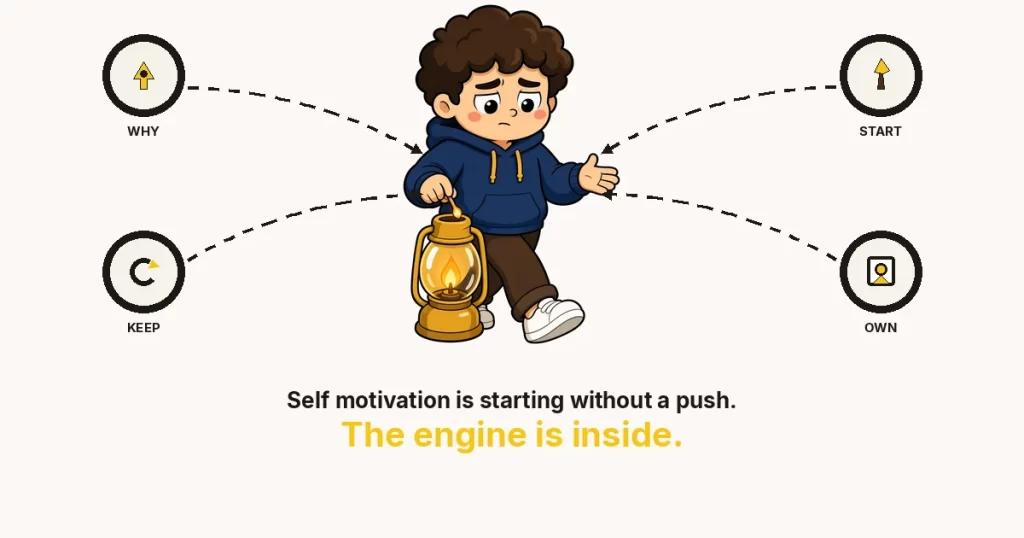
Self motivation is starting and continuing from a reason you own, without waiting for a push or a mood. It is not a talent, and it is not the same as enjoying the work. Ryan and Deci (2000) treat self-motivation as need-supported self-regulation: autonomy, competence, relatedness. The feeling usually follows the first move, not the other way round.
Key takeaways
- Ryan and Deci (2000) treat self-motivation as what happens when autonomy, competence, and relatedness are supported — not as a personality trait some people were issued.
- Sheldon and Elliot (1999) found people put more sustained effort into self-concordant goals — goals that match developing interests and core values — and get more well-being from attaining them.
- Cerasoli, Nicklin and Ford (2014) found intrinsic motivation predicted performance at ρ = .21–.45 across 183 samples (N = 212,468), especially quality of work.
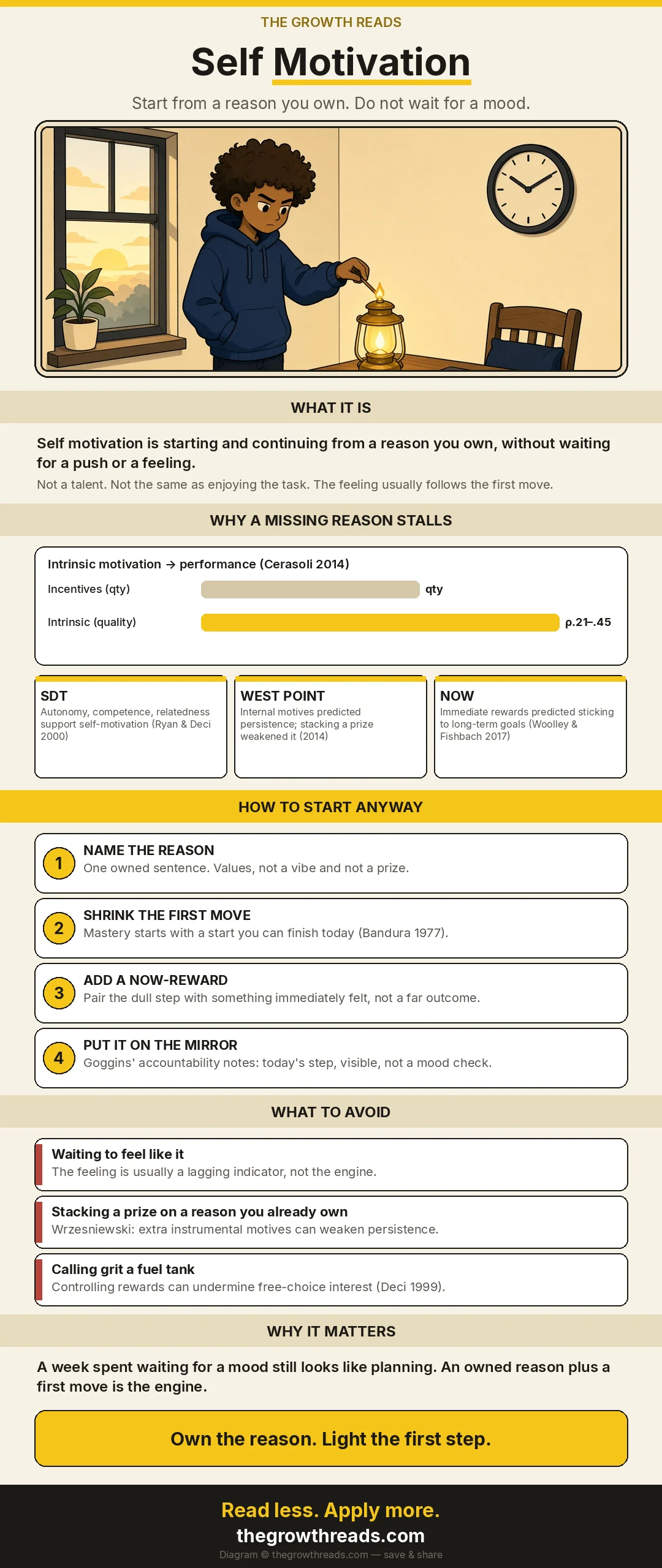
- Wrzesniewski and colleagues (2014) found West Point cadets with stronger internal motives were more likely to persist; adding strong instrumental motives weakened that relationship.
- Woolley and Fishbach (2017) found immediate rewards predicted persistence on long-term goals more strongly than delayed rewards — the feeling in the session, not the far outcome.
What self motivation actually is
Self motivation is the capacity to initiate and persist from a reason that belongs to you, rather than from a boss, a prize, or a feeling that has not arrived yet. The useful picture is not a fuel tank. It is a reason you could still name on a Tuesday when nobody is watching, plus a first move small enough that mastery can actually start.
Richard Ryan and Edward Deci’s 2000 review in American Psychologist is the clean break from the poster version. Human beings, they wrote, can be proactive and engaged or passive and alienated largely as a function of social conditions. Self-determination theory then names three innate psychological needs — competence, autonomy, and relatedness — which, when satisfied, yield enhanced self-motivation and well-being, and when thwarted lead to diminished motivation. Self-motivation on that page is not a character reference. It is what regulation looks like when those needs are not being sat on.
That is also why this article sits under how to build discipline rather than under a mood-management silo. Discipline is the system that keeps a practice after it exists. Self motivation is the owned reason that lets the practice begin without an external shove. The rest of The Growth Reads productivity hub is full of tools that only work once that reason exists. A nightly six, a time box, a stacked cue — none of them invent the why.
How is self motivation different from intrinsic motivation?
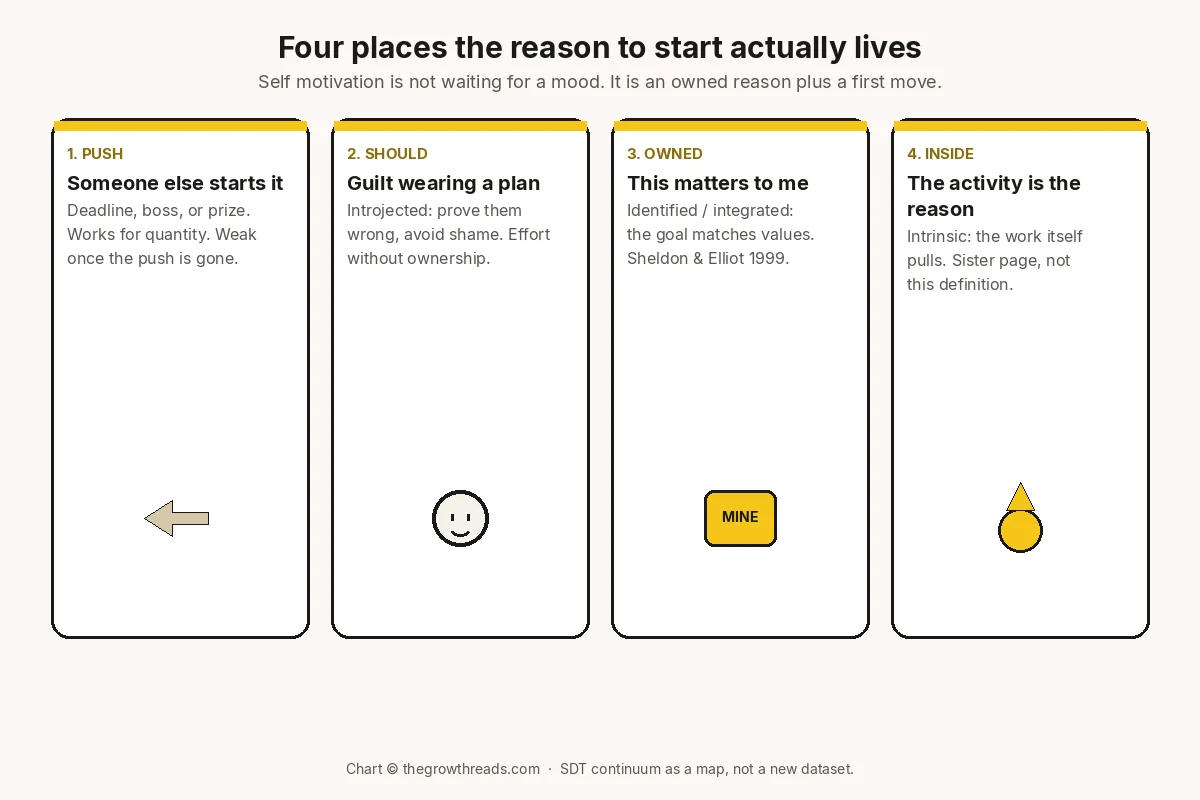
Intrinsic motivation is doing the activity because the activity itself is interesting. Self motivation is broader: it includes that pull, and it also includes owned “this matters to me” reasons for work that is not fun. Self-determination theory’s continuum is the map. External regulation is a deadline or a bonus. Introjected regulation is guilt, pride, or “prove them wrong.” Identified and integrated regulation are still extrinsic in the technical sense — the work is a means — but the reason has been taken in as yours. Intrinsic is the far end, where the activity is the reason.
The sister page what is intrinsic motivation owns the activity-is-the-reason definition. Intrinsic vs extrinsic motivation is the comparison. This page is the engine question people actually type: why can I not start unless someone is watching, and what would “starting from the inside” even mean. The answer is not “learn to enjoy spreadsheets.” It is: name a reason you endorse, then take a first move that can succeed. Enjoyment is a bonus when it shows up. It is a poor gate.
Why starting stalls without a push
Starting stalls when the only available reasons are someone else’s, or when the first move is so large that you cannot believe it will work. Waiting for a mood is the folk theory. The research picture is colder and more useful.
Albert Bandura’s 1977 paper in Psychological Review is a theory, not a field trial, and it should be read that way. The claim that still earns its keep: expectations of personal efficacy — “can I do this?” — influence whether coping behaviour is initiated, how much effort is spent, and how long it is sustained. The most dependable source of those expectations, Bandura argued, is performance accomplishments: a start you actually finish. Vicarious examples and pep talks are weaker. That is why “get motivated” as a feeling-first strategy fails. The mood is being asked to do the job that a completed first move is supposed to do.
There is a second stall that looks like high standards and is actually an unowned goal. Kennon Sheldon and Andrew Elliot’s 1999 self-concordance model, tested on three longitudinal datasets, found that goals consistent with developing interests and core values attracted more sustained effort and were more likely to be attained — and that attaining those goals produced more well-being, mediated by daily experiences of autonomy, competence, and relatedness. A goal you borrowed from a parent, a LinkedIn template, or a January poster can be specific and still fail to generate effort, because concordance is about whose goal it is, not how tidy the wording is.
The four places the engine actually fails
- No owned why. “I should” is introjected regulation. It can produce a burst. It is a poor engine for a dull week. If you cannot say the reason in a sentence you would still endorse with the door closed, you do not have a self-motivation problem yet. You have a goal-ownership problem.
- A first move that cannot succeed today. Bandura’s performance-accomplishment path needs a start small enough to complete. “Write the report” is not that. “Open the file and write the title” is. This is adjacent to task paralysis — shrinking the first action on work you have already chosen — not a different personality.
- A reason parked entirely in the future. Kaitlin Woolley and Ayelet Fishbach (2017) found that immediate rewards — enjoyment, interest, a felt payoff in the session — predicted persistence on New Year’s resolutions, studying, and exercise more strongly than delayed rewards, even when people said they were pursuing the activity for the far outcome. A goal that only pays in six months has nothing to feed today’s start.
- An extra prize stacked on a reason you already had. Amy Wrzesniewski, Barry Schwartz and colleagues followed 11,320 West Point cadets. Stronger internal motives for attending predicted commissioning, longer service, and early promotion. Holding strong instrumental motives at the same time weakened those relationships. More reasons are not automatically more engine. Sometimes the prize talks over the reason you came for.
Why a missing reason costs more than it feels like
A week spent waiting to feel like it still looks like planning. The bill is a calendar full of intention and a body of work that never started. The honest cost is not one dramatic percentage. It is a stack of documented ones.
Cerasoli, Nicklin and Ford’s 2014 meta-analysis (k = 183, N = 212,468) found intrinsic motivation was a medium-to-strong predictor of performance (ρ = .21–.45) and that this relationship remained whether incentives were present. In meta-analytic regression, intrinsic motivation predicted more unique variance in quality of performance; incentives were the better predictor of quantity. That is not a sermon against pay. It is a description of what an owned reason is doing when the work has to be good, not merely done. A missing internal reason does not always stop output. It shows up as thin quality, short persistence, and a need for a louder push next time.
Deci, Koestner and Ryan’s 1999 meta-analysis of 128 studies is the other half of that bill, and it needs its limit named in the same breath. Expected tangible rewards that were engagement-contingent, completion-contingent, or performance-contingent undermined free-choice intrinsic motivation (d = −0.40, −0.36, and −0.28). Positive feedback enhanced it. The finding is about interesting tasks and controlling rewards, not a law that money always ruins work. Cameron and Pierce have argued the other side of that literature for years. Treat Deci 1999 as: if the only reason left is the prize, do not be surprised when the prize is removed and the start disappears. Do not treat it as “never pay anyone.”
Two honest caveats. Wrzesniewski’s West Point result is one academy, observational over a decade, not a randomised experiment — cadets were not assigned motives. And Cerasoli 2014 is the named counter-case to a crude “incentives kill motivation” line: incentives and intrinsic motivation jointly predicted performance, with quality leaning internal and quantity leaning on the prize. This page is not an anti-pay pamphlet.
What you can say without theatre: a missing owned reason makes every start a negotiation with a feeling. Feelings are late. The work that needed Tuesday’s morning gets Thursday’s leftover, or nothing. That is also why discipline as a skill cannot substitute here. You can train showing up. You still need a why that is yours, or showing up becomes theatre for an audience that is not in the room.
Nearby ideas that are not this definition
Self motivation is not willpower, not discipline, and not intrinsic motivation — though all four get used as synonyms in search. Mixing them is how a useful page turns into a poster.
| Idea | Starts from | Stopping failure | Best for |
|---|---|---|---|
| Self motivation | An owned reason plus a first move you can finish | Waiting for a mood; an unowned “should” | Dull-but-valued work, practice you endorse, anything with no boss in the room |
| Intrinsic motivation | The activity itself is interesting | Treating enjoyment as the only honest reason | Craft, play, deep work you already like — see the sister definition page |
| Willpower | Inhibiting an impulse in the moment | Treating it as a tank you refill with grit speeches | A brief no. Not a week of starts. Ego-depletion is not a settled fuel model |
| Discipline | Showing up after the start exists | Using it as a substitute for a why | Keeping a practice. Parent page: how to build discipline |
David Goggins’ Can’t Hurt Me is this row’s down-link because it is a manual for starting when the feeling has not arrived, not because suffering is the theory. The accountability mirror — Post-its of insecurities, dreams, and the next small step, stuck to the glass you cannot avoid — is a visibility tool. The cookie jar is a written inventory of past wins and obstacles already survived, used when you want to quit. Those are owned reasons made visible. They are not a diagnosis, and the book’s “40% rule” is a personal claim, not a laboratory finding. Read the TGR summary of Can’t Hurt Me for the challenges as written. This page only needs the starting-point swap: the mirror does not wait for a mood. It names today’s step.
Mental discipline is staying put after the start. Self-discipline examples are the next small choice against a temptation. Temptation bundling is one way to add a now-reward to a dull step. None of those is the definition of self motivation. They are what you run once the reason is yours.
How to start without waiting for a mood
Name the owned reason, shrink the first move, attach a now-reward, and put the step where you cannot not see it. None of those is a numbered HowTo on this page, because a play-slot article does not ship a step ladder. They are four checks you can run in one sitting on an ordinary reversible piece of work.
Name the owned reason in one sentence you would still endorse with the door closed. “Because I said I would” is introjected. “Because this is the kind of work I want my weeks to contain” is identified. Sheldon and Elliot’s self-concordance is that sentence, not a vision board. If the sentence only works when someone is watching, it is not yours yet. Borrowed goals are allowed to be rewritten. That is not failure. That is the point of concordance.
Shrink the first move until Bandura’s mastery path can fire. Efficacy expectations rise after a completed start, not after a pep talk. Open the document. Write the ugly first paragraph. Put on the shoes. The implementation intention form — if it is 9:10, then I open the file — is the cue version of the same idea: the start is specified, so it does not have to be invented in the moment you least want it. Task paralysis, again, is the sister stall when the work is already chosen and the first action is still too big.
Attach something immediately felt to the dull step. Woolley and Fishbach’s finding is not “bribe yourself with cake until the novel is done.” It is that delayed rewards predicted setting the goal and did a worse job of predicting sticking to the session. Pair the first twenty minutes with a playlist, a location you like, or a bundling of a wanted activity with the one you keep postponing. Temptation bundling is the named method. The far outcome can stay on the wall. It should not be the only food in the room.
Make today’s step visible. Goggins’ accountability mirror is a stack of notes you have to look at. Personal dashboards that live in a closed tab are not a mirror. Personal accountability is the sister idea when the witness is another person; the mirror is the version that still works when you are the only one in the kitchen. Write the next action, not the identity slogan. “Draft section two before lunch” is a step. “Be a writer” is a fog.
Common mistakes
- Waiting to feel like it. The feeling is usually a lagging indicator. Bandura’s most dependable source of efficacy is a finished start, not a better mood.
- Calling a “should” an owned reason. Introjected regulation can look like a plan and still be shame in a spreadsheet. Concordance is whose goal it is.
- Stacking a prize on a reason you already had. Wrzesniewski’s cadets did not get extra persistence from adding instrumental motives to internal ones. Sometimes they got less.
- Treating willpower as the engine. A brief no is not a week of starts. Do not build a self-motivation page on a contested fuel-tank model.
- Using Goggins as a diagnostic. The mirror and the cookie jar are tools. The 40% rule is not a lab result. Harsh self-talk is introjected; it is not the same as identified regulation, even when it produces a run.
- Confusing this stall with burnout. Burnout vs laziness is depletion versus a missing start. If the tank is empty across the board, a better why will not refill it.
- Borrowing discipline before you have a why. Showing up is the parent skill. It still needs a sentence you endorse, or the showing up is for an audience that is not there.
When it is more than a missing reason
Self motivation, as this page uses it, is a work-and-habits mechanism: an owned why, a first move, a now-reward, a visible next step. It is the wrong tool when the stall is not about a reason at all.
A one-way professional door — a career you do not endorse, a role whose only remaining reason is the salary — is a job-design problem, not a character problem. SDT would predict that controlling contexts shrink self-motivation. Changing the sentence on the mirror will not fix a job that offers no autonomy, no competence, and no relatedness. That is a different article, and sometimes a different conversation with a manager or a search.
A freeze that shows up across every domain, with sleep, mood, or health changing underneath it, sits outside what an owned-reason page can fix. Seek the right kind of help for that. This is not a diagnosis, not a symptom list, and not a clinical ADHD page. If the stall is “I already chose and I cannot start,” shrink the first action. If it is “I will not pick,” that is a decision process, not this engine.
The evidence behind this
| Study | Design and size | Finding | What this page used it for |
|---|---|---|---|
| Ryan & Deci (2000) | Theory review; American Psychologist 55(1) | Autonomy, competence, and relatedness, when supported, yield enhanced self-motivation | Definition: self-motivation is need-supported regulation, not a trait |
| Sheldon & Elliot (1999) | Self-concordance model; 3 longitudinal datasets | Self-concordant goals attracted more effort and attainment, and more well-being via need satisfaction | Owned reasons persist; borrowed goals often do not |
| Cerasoli, Nicklin & Ford (2014) | Meta-analysis, k = 183, N = 212,468 | Intrinsic motivation predicted performance ρ = .21–.45; quality leaned internal, quantity leaned incentives | What an owned reason is doing for quality; named counter-case to “never pay” |
| Wrzesniewski et al. (2014) | Longitudinal; 11,320 West Point cadets | Internal motives predicted commissioning and persistence; instrumental motives weakened that | More reasons are not automatically more engine |
| Woolley & Fishbach (2017) | Five studies of resolutions, study, and exercise | Immediate rewards predicted persistence more strongly than delayed rewards | Why a far outcome is a weak start-food |
| Deci, Koestner & Ryan (1999) | Meta-analysis, 128 studies | Expected tangible contingent rewards undermined free-choice intrinsic motivation (d ≈ −0.28 to −0.40) | Controlling prizes can leave no reason once the prize is gone |
| Bandura (1977) | Theoretical framework; Psychological Review 84(2) | Efficacy expectations influence whether coping is initiated; performance accomplishments are the strongest source | Why the first finished move beats a pep talk |
| Goggins (2018), as method not data | Memoir and challenge book | Accountability mirror and cookie jar: visible next steps and recalled wins | A practical start tool; 40% rule treated as anecdote, not a finding |
Frequently asked questions
What is self motivation?
Self motivation is starting and continuing from a reason you own, without waiting for a push or a mood. Ryan and Deci (2000) treat it as need-supported self-regulation: autonomy, competence, and relatedness, when supported, yield enhanced self-motivation. It is not a talent, and it is not the same as enjoying the task. Intrinsic motivation is the activity itself being interesting. Self motivation also includes identified reasons — “this matters to me” — for work that is dull. The feeling usually follows a first move you can finish, not the other way round.
Is self motivation the same as intrinsic motivation?
No. Intrinsic motivation is doing the activity because the activity itself is interesting. Self motivation is the engine: an owned reason plus a start, which can be intrinsic or identified. Self-determination theory’s continuum keeps them distinct. External is a deadline. Introjected is guilt. Identified and integrated are still technically extrinsic, but the reason has been taken in as yours. The sister page on intrinsic motivation owns the activity-is-the-reason definition. This page answers why starting stalls when nobody is watching, including on work you do not love.
How do you build self motivation?
You do not wait for a mood. You name a reason you would still endorse with the door closed, shrink the first move until you can finish it today, attach something immediately felt to the session, and put that step where you cannot not see it. Sheldon and Elliot’s self-concordance is the owned sentence. Bandura’s 1977 framework is why a completed start raises the chance of the next one. Woolley and Fishbach found immediate rewards predicted persistence better than delayed ones. Goggins’ accountability mirror is the visibility tool. None of that is a numbered HowTo on this play-slot page — it is four checks, not a ladder.
Why do I have no self motivation?
On this page, a missing start is usually one of four stalls: no owned why, a first move too large to succeed today, a reason parked entirely in the future, or a prize talking over a reason you already had. Wrzesniewski’s West Point study is the last of those — extra instrumental motives did not multiply persistence. This is a work-and-habits mechanism, not a diagnosis. If the stall is across every domain, with sleep or mood changing underneath it, that sits outside what an owned-reason page can fix. Seek the right kind of help for that. Do not turn this article into a symptom list.
Can you have self motivation without enjoying the work?
Yes. That is the point of identified regulation. You can endorse a reason — this is the kind of week I want, this is the skill I am building — and still find the next hour dull. Intrinsic motivation is a bonus when the activity itself pulls. It is a poor gate for adult work. Cerasoli’s meta-analysis found intrinsic motivation especially predictive of quality; it did not say quality work only happens when the task is fun. Pair the dull step with a now-reward so today’s session has something to eat. Keep the far outcome on the wall. Do not make enjoyment the permission slip.
Does rewarding yourself kill self motivation?
It can, when the reward is expected, tangible, and controlling, on a task that was interesting to begin with. Deci, Koestner and Ryan (1999) found engagement-, completion-, and performance-contingent rewards undermined free-choice intrinsic motivation. Positive feedback did the opposite. Cerasoli, Nicklin and Ford (2014) then showed incentives and intrinsic motivation jointly predict performance, with quantity leaning on the prize and quality leaning internal. So: a now-reward that makes the session itself more worth doing is not the same as a controlling bonus that becomes the only reason. Do not cite Deci 1999 as “never pay people.”
What is the accountability mirror in self motivation?
In David Goggins’ Can’t Hurt Me, the accountability mirror is a literal mirror tagged with Post-its: insecurities, dreams, and the next small steps, faced daily. It is a visibility tool, not a mood check. You write today’s action small enough to complete, and you cannot shave or leave without seeing it. The cookie jar is the companion inventory of past wins and obstacles already survived, used when you want to quit. Those methods belong on this page because they start without waiting for a feeling. The book’s 40% rule is a personal claim, not a study. Harsh self-talk is introjected; treat the notes as the method, not the insults.
Is self motivation a skill or a personality trait?
On the evidence this page uses, it behaves like a skill sitting on top of conditions. Ryan and Deci (2000) locate self-motivation in need support, not in a fixed type. Sheldon and Elliot show effort tracks concordance of the current goal, independent of several personality-adjacent controls they tested. Bandura treats initiation as an efficacy expectation that rises after mastery experiences. You can get better at naming an owned why and shrinking the first move. That is not the same as promising that every context will generate self-motivation. A job that offers no autonomy can starve the engine no matter how tidy the mirror is.
Sources
- Ryan, R. M., & Deci, E. L. (2000). Self-determination theory and the facilitation of intrinsic motivation, social development, and well-being. American Psychologist, 55(1), 68–78. https://doi.org/10.1037/0003-066X.55.1.68
- Sheldon, K. M., & Elliot, A. J. (1999). Goal striving, need satisfaction, and longitudinal well-being: The self-concordance model. Journal of Personality and Social Psychology, 76(3), 482–497. https://doi.org/10.1037/0022-3514.76.3.482
- Cerasoli, C. P., Nicklin, J. M., & Ford, M. T. (2014). Intrinsic motivation and extrinsic incentives jointly predict performance: A 40-year meta-analysis. Psychological Bulletin, 140(4), 980–1008. https://doi.org/10.1037/a0035661
- Wrzesniewski, A., Schwartz, B., Cong, X., Kane, M., Omar, A., & Kolditz, T. (2014). Multiple types of motives don’t multiply the motivation of West Point cadets. Proceedings of the National Academy of Sciences, 111(30), 10990–10995. https://doi.org/10.1073/pnas.1405298111
- Woolley, K., & Fishbach, A. (2017). Immediate rewards predict adherence to long-term goals. Personality and Social Psychology Bulletin, 43(2), 151–162. https://doi.org/10.1177/0146167216676480
- Deci, E. L., Koestner, R., & Ryan, R. M. (1999). A meta-analytic review of experiments examining the effects of extrinsic rewards on intrinsic motivation. Psychological Bulletin, 125(6), 627–668. https://doi.org/10.1037/0033-2909.125.6.627
- Bandura, A. (1977). Self-efficacy: Toward a unifying theory of behavioral change. Psychological Review, 84(2), 191–215. https://doi.org/10.1037/0033-295X.84.2.191
- Goggins, D. (2018). Can’t Hurt Me. Lioncrest. Method source for the accountability mirror and cookie jar; not a peer-reviewed finding. TGR review: Can’t Hurt Me summary.
Related reading on The Growth Reads
Books. Can’t Hurt Me is the unused review for this row — start without waiting for a mood, via a visible next step and a recalled win. That is the practical half of this page, not a licence to treat suffering as the theory.
Articles. Up to the cluster parent how to build discipline. Across to what is intrinsic motivation when the question is the activity itself. Intrinsic vs extrinsic is the comparison sister. Implementation intentions specify the start. Task paralysis is shrinking the first action on work already chosen.
Hub. All of this sits under productivity on The Growth Reads.
How this article was researched
The argument is built from seven peer-reviewed sources with years, designs, and DOIs, plus one book whose TGR review was unused in the live article graph at the 10 September 2026 crawl: Goggins’ Can’t Hurt Me. Self-determination theory is presented as a continuum, so this page does not steal the intrinsic-motivation sister’s definition. Wrzesniewski is named as observational. Deci’s undermining effect is paired with Cerasoli’s joint-prediction result. Bandura 1977 is treated as a framework, not a field n. This is a work-and-habits page: no diagnosis and no symptom list.
Method: read the primary papers and meta-analyses cited above, checked each DOI before naming a finding, and refused to treat contested models or memoir rules as laboratory results. Limits: no new experiment; West Point is one academy; Bandura 1977 is theory; the 40% rule is anecdote; self-concordance datasets are not a workplace randomised trial.