

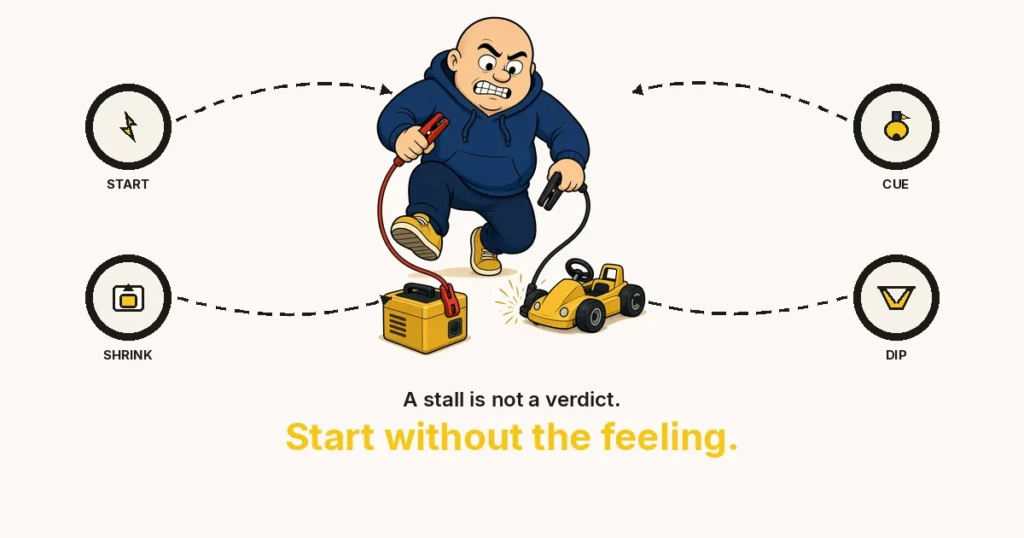
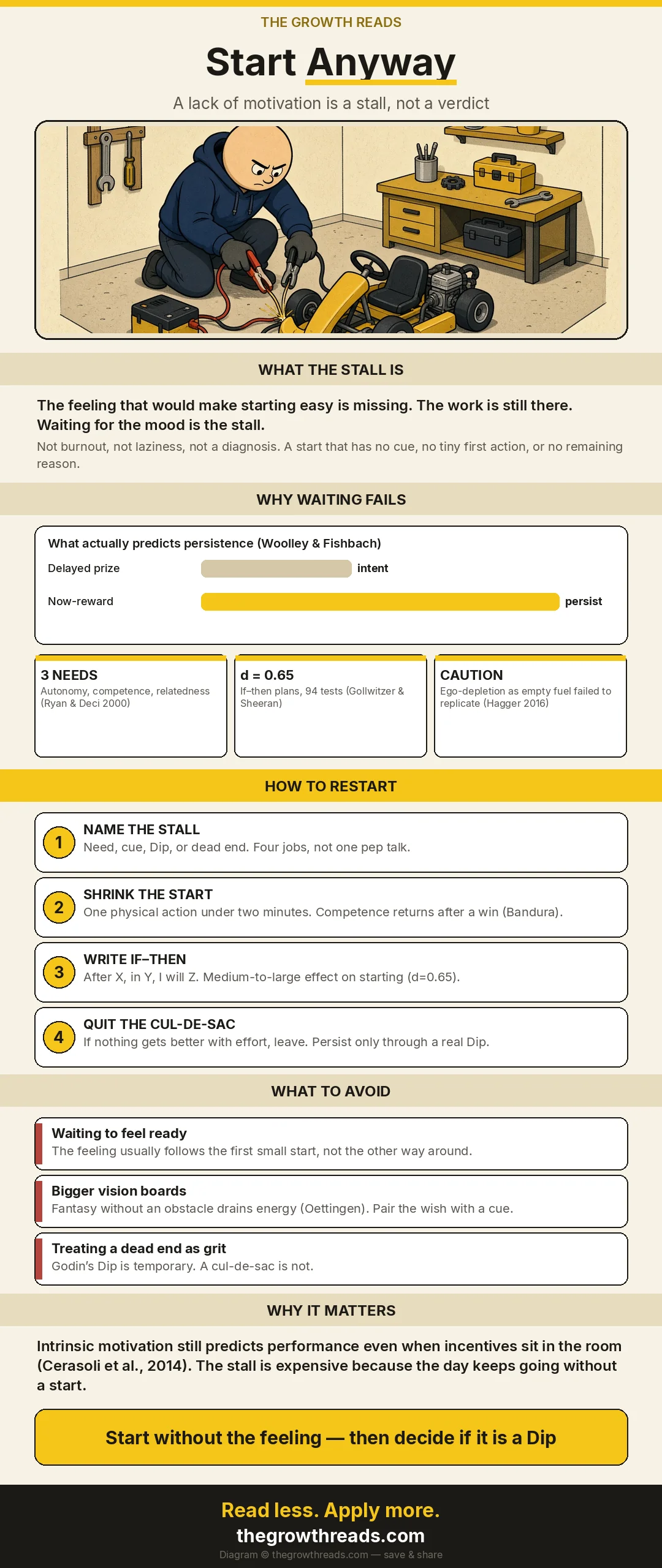
A lack of motivation is a stall before the start, not proof you are lazy. Overcome it by shrinking the first action, restoring autonomy, competence or relatedness, and telling a worthwhile Dip from a dead-end project. The feeling usually follows the first small start rather than arriving first.
Key takeaways
- Ryan and Deci (2000) describe three psychological needs — autonomy, competence and relatedness — that, when thwarted, diminish self-motivation rather than proving a character flaw.
- Across 183 samples and 212,468 people, intrinsic motivation predicted performance at ρ = .21–.45 even when extrinsic incentives were present (Cerasoli, Nicklin & Ford, 2014).
- Written if–then plans raised goal attainment by d = 0.65 across 94 tests (Gollwitzer & Sheeran, 2006), which is a start you can write tonight without waiting to feel ready.
- Immediate rewards predicted persistence at long-term goals more strongly than delayed prizes did (Woolley & Fishbach, 2017).
- Some stalls are dead ends: Seth Godin’s Dip is a temporary hard stretch worth pushing, and a cul-de-sac is not.
What a lack of motivation actually is
A lack of motivation is the gap between a job you still endorse and a body that will not take the first step. You can name the outcome. You may even want it in the abstract. What is missing is the felt push that would make opening the file, putting on shoes, or sending the email feel cheap. The work did not vanish. The start did.
That is different from not having a goal. It is also different from self motivation as a standing capacity — the inner reason that keeps a person moving when nobody is watching. This page is the stall: the afternoon when that reason is quiet and the task is still on the list. The sister definition lives on that page. The six-step “get motivated” system lives on how to get motivated. This one is narrower: what to do in the stall without turning it into a diagnosis, a pep talk, or a second copy of those two articles.
The honest version is mechanical. Richard Ryan and Edward Deci, writing in American Psychologist in 2000, argued that people are proactive or passive largely as a function of whether three needs are fed: autonomy (the action feels chosen), competence (the action feels doable), and relatedness (the action connects you to someone or something that matters). When those needs are thwarted, self-motivation drops. That is a social-psychological claim about conditions, not a verdict about character. Daniel Pink’s Drive later popularised the same three as autonomy, mastery and purpose for a work audience. The research names are autonomy, competence and relatedness; the practical test is the same: which of the three went quiet?
What a lack of motivation is not
A lack of motivation is not laziness, not burnout, and not a clinical label. Laziness, in ordinary speech, is a moral story: you could start and you will not. A stall is often the opposite — you want the outcome and cannot find an entry point small enough to begin. Our burnout vs laziness page is the depletion-versus-unwillingness split; this page does not re-litigate it. Burnout is a longer emptying of energy and meaning around work you have already been doing. A motivation stall can show up on a project you have barely touched.
It is also not a request for a health page. Nothing here diagnoses ADHD, depression, or an “amotivation disorder.” If the stall is new, global, and paired with sleep, appetite, or hope collapsing across every part of life, that is outside what a productivity article can settle — and it is not what the studies below measured. The studies measured students, workers and exercisers in ordinary goal pursuit. Stay in that lane.
Why the feeling goes quiet
Motivation goes quiet when the start has no cue, no tiny win, or no remaining reason — not because a fuel tank hit empty. The popular story is a battery: you spent your willpower on email, so the real work has none left. That story is tidy and, on the best evidence we have, too tidy. A 23-lab registered replication of the classic ego-depletion protocol (Hagger and colleagues, 2016, N = 2,141) found an effect of d = 0.04 whose confidence interval crossed zero. “I ran out of motivation” is a feeling. It is not a well-replicated resource law.
What does replicate is more local. Albert Bandura’s 1977 self-efficacy paper argued that whether a coping action even begins depends on the belief that you can produce it, and that the strongest source of that belief is a performance accomplishment — a win you have already had, not a speech. A stall is often a competence stall dressed as a mood: the first step looks larger than any recent proof you can do it, so the body refuses to start. Shrink the step until a win is available this afternoon, and the feeling has something to attach to.
Wendy Wood and David Neal (2007) add the other half: as behaviour repeats in a stable context, control moves from a goal in the head to cues in the room. A person who “used to be motivated” on weekday mornings often had a kettle, a desk, and a time. Remove the cue and the mood has to do a job the environment used to do. That is why a holiday, a new job, or a moved desk can look like a personality change. It is a missing trigger.
The three needs that go quiet
When autonomy, competence or relatedness is blocked, the stall is specific, and the restart has to match it. Autonomy fails when the task is someone else’s script — a report format you did not choose, a goal you inherited, a method you resent. Competence fails when the next action is vague or oversized (“write the strategy,” “get fit”). Relatedness fails when the work has no audience, teammate, or person it is for. Ryan and Deci’s 2000 review is explicit that thwarting those needs yields diminished motivation; it is not a claim that every quiet Tuesday is a need failure, and it is not causal proof that restoring one need will restore a career. It is a diagnostic prompt: which of the three is actually missing in this stall?
There is a fourth stall that is not a need at all. Seth Godin’s The Dip (2007) names the long, unglamorous stretch between beginner excitement and scarce mastery. The feeling dies there on purpose: everyone who will quit has a reason to. Winners, in Godin’s framing, quit the cul-de-sacs fast and spend their persistence on Dips that still have an exit. A lack of motivation in week six of a project might be the Dip. It might also be information that the project has no Dip, only a wall. The feeling does not tell you which. A stopping rule does.
Why waiting costs more than it feels like
Waiting for the feeling spends the day on a start that never happens, while the evidence says the feeling is a weak predictor of persistence anyway. Kaitlin Woolley and Ayelet Fishbach (2017) asked people about long-term goals such as exercise and studying. Delayed rewards — health, grades, the future self — were what people said they were chasing. Immediate rewards — the session being even slightly enjoyable or satisfying now — were what actually predicted whether they persisted. Delayed prizes help you set the goal. They do a worse job of getting you through today’s first five minutes.
That cost compounds. Christopher Cerasoli, Jessica Nicklin and Michael Ford’s 2014 meta-analysis (k = 183, N = 212,468) found intrinsic motivation was a medium-to-strong predictor of performance (ρ = .21–.45) even when incentives were in the room. Incentives predicted quantity better; intrinsic motivation predicted quality better. The practical reading is not “never pay people.” It is that a stall in the inner reason is not free just because a deadline or a bonus is still present. Quantity can limp along. Quality is what quietly drops, and quality is usually the work you actually cared about.
Deci, Koestner and Ryan (1999) had already shown, across 128 experiments, that expected tangible rewards can undermine free-choice intrinsic motivation (engagement-contingent d = −0.40). Positive verbal feedback went the other way (d = 0.33 on free-choice behaviour). So the common rescue — “I’ll just bribe myself through this” — can buy a session and cheapen the reason you wanted the work. Use a now-reward that is part of the work (a better playlist, a nicer chair, a shorter first block), not a prize that makes the task itself feel like the thing you get paid to endure.
Counter-case, stated plainly. None of this is a licence to grind a dead project. Godin’s whole point is that some quiet feelings are accurate: you are in a cul-de-sac, not a Dip. And Cerasoli’s numbers are meta-analytic correlations, not a guarantee that restoring one need will raise your output this week. Waiting is expensive. So is persisting in the wrong thing. The stall is a prompt to classify, not a command to push.
The other silent cost is identity. A week of unstarted work is easy to narrate as “I’m not a disciplined person,” which then becomes the next stall’s evidence. How to build discipline is the parent page for that story: discipline is a repeatable start under friction, not a mood you wait to inherit. A single shrunken start is cheaper than a new personality.
Stall vs burnout vs willpower vs a dead end
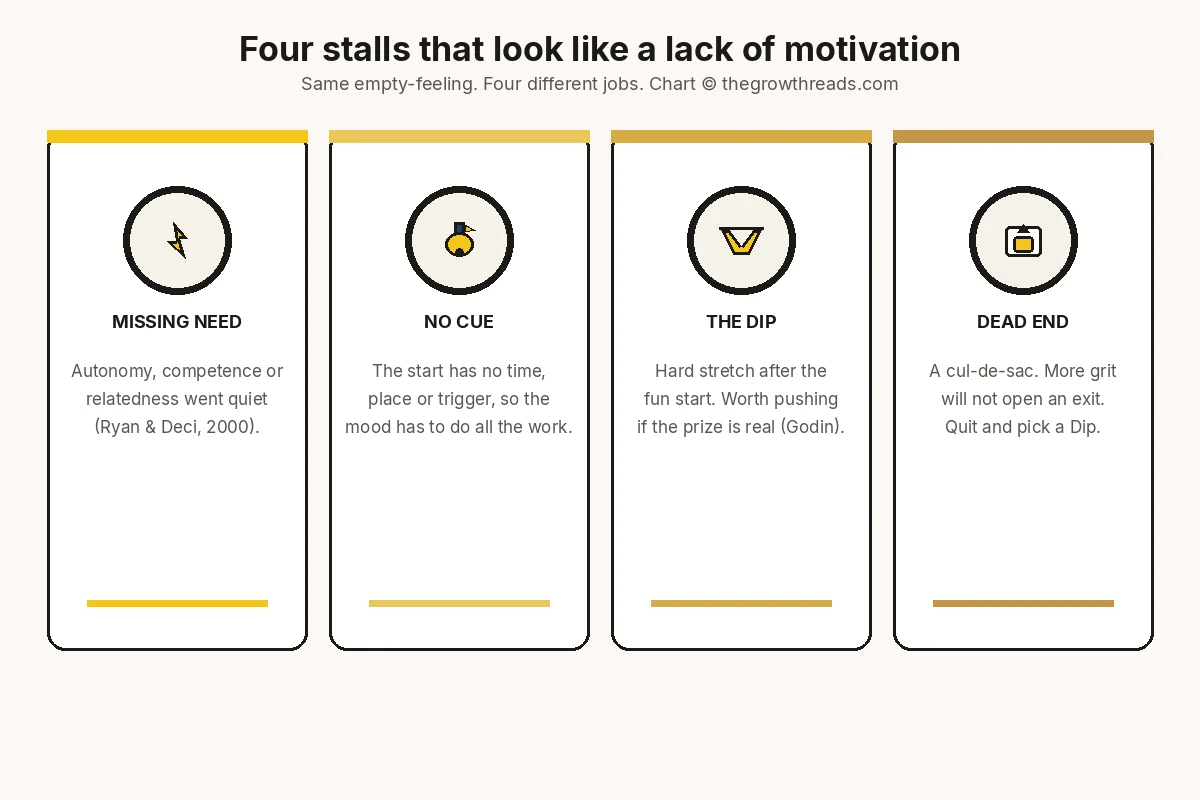
Treat the stall as a classification problem, not a types-of-person problem. The same empty-feeling can be a missing need, a missing cue, a Dip, or a project that should be dropped. Mixing those up is how people either quit too early or stay too long.
| What it looks like | What is actually missing | What does not help | What to try first |
|---|---|---|---|
| Mood stall | No immediate reason the first five minutes are worth it (Woolley & Fishbach, 2017) | A bigger future prize, a vision board, a longer pep talk | Attach a now-reward to the start, or shrink the start until it is almost boring |
| Need stall | Autonomy, competence or relatedness is blocked (Ryan & Deci, 2000) | More pressure from the same script | Change who chose it, how small the first win is, or who it is for |
| Cue stall | The old trigger is gone; the goal is still in your head (Wood & Neal, 2007) | Waiting to “feel like yourself again” | Rebuild one time–place–action link and write it as an if–then |
| Dip | The fun beginner stretch ended; mastery is still on the other side (Godin, 2007) | Quitting because it stopped feeling new | Keep the shrunken start and judge the project by the prize, not the mood |
| Dead end | More effort will not open an exit — a cul-de-sac | Grit speeches, bigger calendars, “just one more month” | Quit on purpose and spend the persistence on a Dip that still has a door |
Willpower sits next to this table, not inside it. Veronika Job, Carol Dweck and Gregory Walton (2010) found that people who believed willpower was a limited resource showed more depletion after a demanding task; people who did not hold that theory did not. That is not proof that willpower is infinite. It is proof that “I have no motivation left” can be, in part, a theory you are running. Pair it with Hagger’s 2016 replication: do not build a restart plan that assumes a tank you can fill with a snack and a TED Talk. Build a restart plan that assumes a start.
If the stall is specifically an impulse problem — the later goal losing to a smaller now — that is how to improve self-control, not this page. Self-control is the late fight. A motivation stall is often an early one: you never entered the fight because you never began.
How people actually restart
People restart a lack of motivation by classifying the stall, shrinking the first action, and writing the start so it does not depend on a mood. There is no six-step ladder on this page on purpose — that format belongs to the how-to slot, and how to get motivated already runs it. What follows is the play-slot version: four moves you can use in one afternoon, in prose, without pretending they are a protocol.
First, name the stall out loud in one sentence: missing need, missing cue, Dip, or dead end. If you cannot tell Dip from dead end, ask a narrower question: if I keep this exact effort for 30 more days, is there a mechanism by which the work gets better, rarer, or more useful? If the honest answer is no, you are not unmotivated. You are done. Godin’s book is short because that distinction is the whole plot.
Second, shrink until a competence win is available today. Bandura’s strongest source of efficacy is a performance accomplishment. “Draft the strategy” is not an accomplishment you can have by 4 p.m. “Open the doc and write the ugly headline” is. Two minutes is a useful cap because it is too small to require a feeling. You are not lowering the ambition of the project. You are lowering the price of entry so the project can start collecting proof.
Third, write the start as an if–then. Peter Gollwitzer and Paschal Sheeran’s 2006 meta-analysis (94 tests) found implementation intentions had a medium-to-large effect on goal attainment (d = 0.65), including the initiation of striving. The form is boring on purpose: After I put the mug down on the desk, I will open the file and write one ugly sentence. The live method page is implementation intentions. Use it here as a jump-start, not as a new identity.
Fourth, restore the need that actually went quiet, not a generic “why.” Autonomy: change the method even if the deadline is fixed. Competence: make the first block trivially completable. Relatedness: text the person the work is for, or sit next to someone who is also starting. Pink’s Drive is useful here as a translation layer, not as a fourth theory. If you want the inner-reason definition rather than the stall, what is intrinsic motivation is the sibling.
David Goggins’ Can’t Hurt Me is the opposite texture — calloused mind, take-the-first-step-anyway — and it is easy to misread as “ignore the Dip test.” Use it as a start cue, not as a reason to stay in a cul-de-sac. The Growth Reads cluster this sits in is productivity: work you can repeat, not a toughness contest.
Common mistakes
Most restarts fail because they treat a classification problem as a feeling problem. These are the usual ways that happens.
- Waiting to feel ready. Woolley and Fishbach’s persistence data point at the session, not the speech. The feeling is a lagging indicator.
- Inflating the vision. Gabriele Oettingen’s programme of research on mental contrasting (reviewed in 2012) finds that indulging in a positive future without naming the obstacle can sap energy for the work. A vision board without a cue is a daydream with better stationery.
- Bribing a task you already liked. Deci, Koestner and Ryan (1999) is the warning label on expected tangible rewards. A now-reward inside the work is different from a prize that makes the work the price.
- Calling a cul-de-sac a Dip. More calendar time will not open a door that is not there. Godin’s quit is a decision, not a mood.
- Calling a Dip laziness. Hard and unglamorous is what a real Dip feels like. That is why most people leave.
- Rebuilding a whole personality. You do not need a new identity to open a file. You need a smaller first action and a cue. Mental discipline is staying put after the start; this page is getting to the start.
- Stacking a new habit system on an unstarted task. Keystone habits are for after you have a behaviour to stack. A stall is earlier than that.
The evidence behind this
The stall is better explained by needs, cues, and initiation plans than by an empty willpower tank. The table below is the working set. Observational and self-report studies are marked as such; they are not causal proof.
| Study | Design and size | Finding | What we used it for |
|---|---|---|---|
| Ryan & Deci, 2000 | Theory review, American Psychologist | Autonomy, competence and relatedness, when thwarted, diminish self-motivation | The need-stall diagnosis — not a character verdict |
| Cerasoli, Nicklin & Ford, 2014 | Meta-analysis, k = 183, N = 212,468 | Intrinsic motivation predicted performance at ρ = .21–.45; quality more than quantity | Why a quiet inner reason is expensive even with incentives present |
| Gollwitzer & Sheeran, 2006 | Meta-analysis, 94 tests | Implementation intentions, d = 0.65 on goal attainment, including initiation | Write the start so it does not wait on a mood |
| Woolley & Fishbach, 2017 | Five studies plus internal meta-analysis, PSPB | Immediate rewards predicted persistence more strongly than delayed rewards | Put a now-reason on the first five minutes |
| Bandura, 1977 | Theory paper, Psychological Review | Self-efficacy from mastery experiences governs whether coping is even initiated | Shrink until a win is available today |
| Lally et al., 2010 | 96 volunteers, 82 analysable, 84 days | Median 66 days to 95% of automaticity asymptote (range 18–254); one miss was not fatal | Do not expect the stall to vanish because you started twice |
| Hagger et al., 2016 | 23 labs, N = 2,141, registered replication | Ego-depletion effect d = 0.04, 95% CI [−0.07, 0.15] | Do not plan as if motivation were a tank that hit empty |
| Job, Dweck & Walton, 2010 | Lab experiments plus a field study | Limited-willpower beliefs moderated depletion; nonlimited theories did not show the drop | “I have nothing left” can be a theory you are running |
| Deci, Koestner & Ryan, 1999 | Meta-analysis, 128 experiments | Expected tangible rewards undermined free-choice intrinsic motivation; positive feedback helped | Bribes can buy a session and cheapen the reason |
| Wood & Neal, 2007 | Theory review, Psychological Review | Repeated context shifts control from goals to cues | A missing trigger can look like a missing personality |
Lally and colleagues (2010) is here as a patience check, not as a 66-day promise. Automaticity took a median of 66 days in the people whose curves fitted, with a range from 18 to 254, and missing one day did not wreck the process. A restart that lasts a week is not a failed transformation. It is how a cue starts doing some of the mood’s old job.
Frequently asked questions
What is a lack of motivation?
A lack of motivation is a stall before the start: you still endorse the outcome, and the first action will not fire. It is not the absence of a goal, and it is not a moral verdict. Ryan and Deci’s (2000) frame is useful here — autonomy, competence or relatedness may have gone quiet — and so is a simpler one: the start has no cue, no tiny win, or no remaining reason. Classify those before you reach for a pep talk. A stall you can name is a stall you can shrink.
How do you overcome a lack of motivation without waiting to feel ready?
Shrink the first action until it is almost boring, write it as an if–then, and attach a now-reason to the first five minutes. Gollwitzer and Sheeran (2006) found implementation intentions raised goal attainment by d = 0.65 across 94 tests, including initiation. Woolley and Fishbach (2017) found immediate rewards predicted persistence better than delayed prizes. The feeling you are waiting for is often a lagging indicator of a start you have not taken, not a fuel you can summon in a chair.
Is a lack of motivation the same as laziness?
No. Laziness, in ordinary speech, is “I could start and I will not.” A motivation stall is often “I want the outcome and I cannot find an entry point small enough to begin.” Treat the two as different jobs. If the honest sentence is that you do not care about the outcome, that is a values problem or a dead-end project, not a restart problem. If you do care and still cannot start, shrink the step and restore a need or a cue. Do not use laziness as a personality diagnosis for a missing first action.
Is a lack of motivation the same as burnout?
No. Burnout is a longer emptying around work you have already been doing — meaning, energy, and recovery all thinning together. A motivation stall can show up on a project you have barely touched. Our burnout vs laziness page covers the depletion-versus-unwillingness split; this page stays on the stall before a start. If everything in life has gone flat, not just one task, a productivity article is the wrong instrument. Stay with the task-sized stall this evidence actually speaks to.
How is this different from “how to get motivated”?
How to get motivated is the full method article: types, a six-step system, and a how-to schema node. This page is the play-slot stall — why the feeling goes quiet and how to restart without a step ladder. Self motivation is the definition of the inner reason; intrinsic motivation is the “because it is interesting” slice of that reason. Use this URL when the search is specifically a lack of motivation. Use the how-to when you want the longer method. They should not cannibalise each other if each stays in its job.
What if I start and still feel nothing?
That is common, and it is not proof the start failed. Bandura’s claim is that mastery experiences build the belief that the next start is possible, not that mood will flip in one session. Lally and colleagues (2010) watched automaticity climb over weeks, not hours, and a missed day did not erase the curve. If ten shrunken starts still produce nothing, and there is no mechanism by which more effort would help, you may be in a cul-de-sac. That is a quit decision, not a motivation hack you have not found yet.
Should I quit when motivation dies?
Sometimes. Godin’s Dip is a temporary hard stretch on the way to scarce mastery; a cul-de-sac is a project that does not get better with effort. Motivation dying is expected in both, which is why the feeling is a bad classifier. Ask whether 30 more days of this exact effort has a mechanism — skill, audience, distribution, a real prize — or only a hope that the mood will return. Quit the second on purpose. Persist in the first with a shrunken start, not with a grit speech.
Does willpower run out like a battery?
Not on the best-registered evidence we have. Hagger and colleagues (2016) ran a 23-lab replication of the ego-depletion protocol and found d = 0.04, with a confidence interval that included zero. Job, Dweck and Walton (2010) found that believing willpower is limited predicted a depletion-like drop that nonlimited theories did not show. Treat “I have no motivation left” as a prompt to shrink the start and check the need, not as a fuel gauge you can fill with sugar and a motivational video.
Related reading on The Growth Reads
Books. The Dip is the down-link for this row — quit the cul-de-sac, spend persistence on a real Dip. Drive translates the three needs into work language. Can’t Hurt Me is the take-the-first-step texture; use it to start, not to stay in a dead end.
Articles. Up to how to build discipline. Across to self motivation, plus how to get motivated, what is intrinsic motivation, how to improve self-control, implementation intentions, and temptation bundling if you need a now-reward that is actually part of the work.
Hub. Back to the productivity hub. Discipline is one of six parents on The Growth Reads; this page is a child of that cluster, not a seventh silo.
Sources
- Ryan, R. M., & Deci, E. L. (2000). Self-determination theory and the facilitation of intrinsic motivation, social development, and well-being. American Psychologist, 55(1), 68–78. https://doi.org/10.1037/0003-066X.55.1.68
- Cerasoli, C. P., Nicklin, J. M., & Ford, M. T. (2014). Intrinsic motivation and extrinsic incentives jointly predict performance: A 40-year meta-analysis. Psychological Bulletin, 140(4), 980–1008. https://doi.org/10.1037/a0035661
- Gollwitzer, P. M., & Sheeran, P. (2006). Implementation intentions and goal achievement: A meta-analysis of effects and processes. Advances in Experimental Social Psychology, 38, 69–119. https://doi.org/10.1016/S0065-2601(06)38002-1
- Woolley, K., & Fishbach, A. (2017). Immediate rewards predict adherence to long-term goals. Personality and Social Psychology Bulletin, 43(2), 151–162. https://doi.org/10.1177/0146167216676480
- Bandura, A. (1977). Self-efficacy: Toward a unifying theory of behavioral change. Psychological Review, 84(2), 191–215. https://doi.org/10.1037/0033-295X.84.2.191
- Lally, P., van Jaarsveld, C. H. M., Potts, H. W. W., & Wardle, J. (2010). How are habits formed: Modelling habit formation in the real world. European Journal of Social Psychology, 40(6), 998–1009. https://doi.org/10.1002/ejsp.674
- Hagger, M. S., Chatzisarantis, N. L. D., Alberts, H., Anggono, C. O., Batailler, C., Birt, A. R., … Zwienenberg, M. (2016). A multilab preregistered replication of the ego-depletion effect. Perspectives on Psychological Science, 11(4), 546–573. https://doi.org/10.1177/1745691616652873
- Job, V., Dweck, C. S., & Walton, G. M. (2010). Ego depletion—Is it all in your head? Implicit theories about willpower affect self-regulation. Psychological Science, 21(11), 1686–1693. https://doi.org/10.1177/0956797610384745
- Deci, E. L., Koestner, R., & Ryan, R. M. (1999). A meta-analytic review of experiments examining the effects of extrinsic rewards on intrinsic motivation. Psychological Bulletin, 125(6), 627–668. https://doi.org/10.1037/0033-2909.125.6.627
- Wood, W., & Neal, D. T. (2007). A new look at habits and the habit-goal interface. Psychological Review, 114(4), 843–863. https://doi.org/10.1037/0033-295X.114.4.843
- Oettingen, G. (2012). Future thought and behaviour change. European Review of Social Psychology, 23(1), 1–63. https://doi.org/10.1080/10463283.2011.643698
- Godin, S. (2007). The Dip: A little book that teaches you when to quit (and when to stick). Portfolio.
How this article was researched
Primary sources were the papers above, checked by title, journal, year, page range and DOI before a number was used in the body. The Dip is used as a classification metaphor (Dip versus cul-de-sac), not as a trial. Drive is cited as a popular translation of self-determination theory, not as a substitute for Ryan and Deci. Limits: several findings are correlational or meta-analytic; Hagger (2016) is included specifically because the “empty tank” story failed to replicate. This is a work-and-habits page. It does not diagnose, treat, or list clinical symptoms.
Method: peer-reviewed motivation, goal-pursuit and habit papers plus one short strategy book used as a quit-versus-persist frame. Last reviewed 20 September 2026.