

★★★★☆ 4.5/5 — A punchy, urgent call to reclaim technology for human bonds, not against them.
Best for: Anyone who senses social media is making us lonelier and more combative, and wants language and small actions to push back.
Reading time: ~4 hrs (256 pages, 100 short entries — easy to read in short sessions)
Difficulty to apply: Easy — most ideas translate into small daily and community choices, not systemic overhauls.
Team Human in one minute
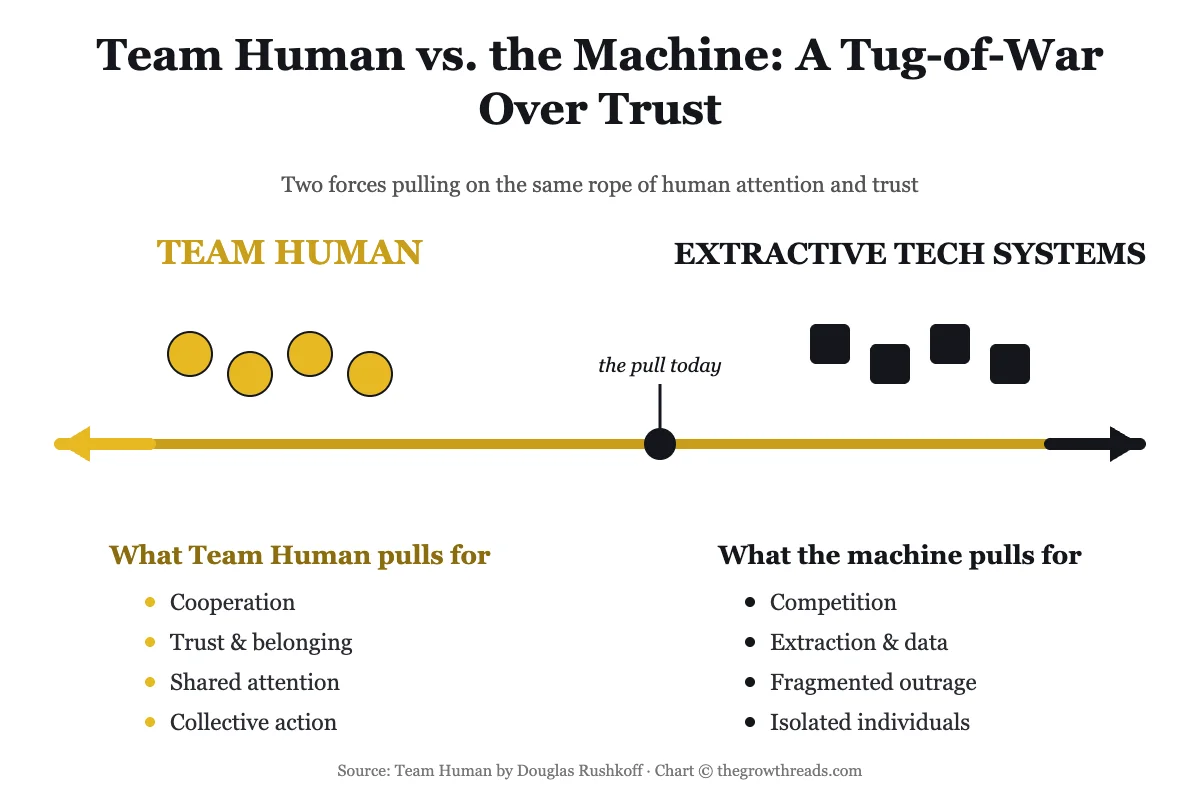
Rushkoff’s core claim: the more our tools, markets, and platforms optimize for individual engagement, the more they quietly starve the cooperative instincts that actually make us human. Written as 100 short, connected statements rather than one long argument, Team Human traces how media, money, and now algorithmic feeds have been engineered — not accidentally, but by design — to treat people as isolated units to be captured, ranked, and monetized rather than as members of a community. Rushkoff’s response is not to reject technology outright but to insist it be redesigned, and used, in service of human connection instead of against it. The title is a rallying cry: pick a side, and the side worth picking is each other.
Key takeaways
- Technology is not neutral: every platform encodes the incentives of whoever built it, and today that usually means engagement and growth, not your wellbeing.
- Competition is a story, not a law of nature: humans evolved as an intensely cooperative species; the “survival of the fittest individual” framing was borrowed from economics, not biology.
- Attention capture is step one, not the whole game: the deeper prize is your trust — in institutions, neighbors, and eventually each other.
- Outrage is a business model: feeds that reward division keep you scrolling longer than feeds that reward agreement.
- Markets can isolate as easily as they can connect: gig work and platform “sharing” often strip out the human relationships that used to come with commerce.
- Digital abstraction erodes empathy: screens and metrics make it easier to treat other people as data points rather than neighbors.
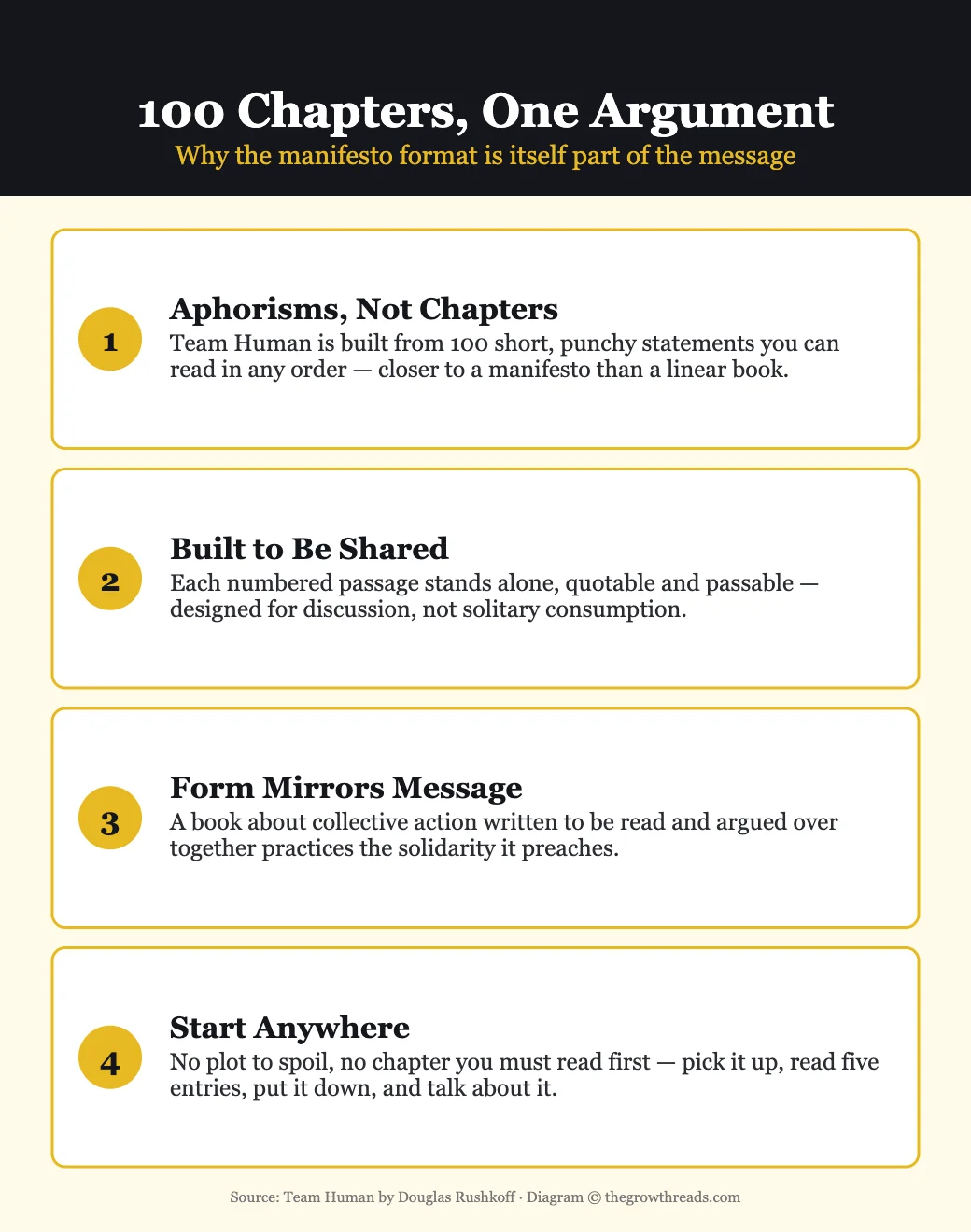
- The manifesto format is deliberate: 100 shareable, arguable statements are built for group discussion, not solitary consumption.
- “Team Human” is a choice, not a default: solidarity has to be actively chosen and practiced, especially where technology makes isolation the path of least resistance.
- Local and civic action matters more than it feels like it does: small, real-world cooperative acts rebuild the muscle that platforms atrophy.
What is Team Human about?
Team Human argues that media, markets, and digital platforms have been engineered to pit people against each other for profit, eroding the cooperation that makes us human — and calls readers to deliberately choose solidarity over machine-driven isolation.
About the author
Douglas Rushkoff is an American media theorist, author, and professor who has spent three decades tracking how technology reshapes society, dating back to his early writing on cyberculture in the 1990s. He teaches media theory and digital economics at CUNY Queens College and hosts the Team Human podcast, which grew out of the same ideas as this book. Rushkoff has written nearly twenty books, including Present Shock and Program or Be Programmed, consistently arguing that technology should be shaped to serve human values rather than the reverse. Team Human distills decades of that thinking into a single, urgent, shareable manifesto — less an academic argument than a rallying call meant to be read, quoted, and discussed in groups rather than absorbed alone. Explore all Douglas Rushkoff book summaries →
Key concepts at a glance
| Concept | What it means | Use it when |
|---|---|---|
| Team Human | A deliberate stance choosing collective human interest over machine-optimized individualism. | Deciding whether a new tool or habit serves your relationships or just your metrics. |
| Digiphrenia | The fractured, multi-tasked self created by always-on devices demanding attention in parallel. | Noticing you feel scattered across too many notifications and threads at once. |
| Trust extraction | Platforms profiting by converting social trust and relationships into data and engagement. | Evaluating why an app rewards outrage or comparison over calm connection. |
| Manufactured scarcity | Likes, followers, and rankings turning inherently abundant social bonds into a zero-sum contest. | Feeling competitive about something that used to be simply relational, like friendship. |
| The manifesto format | 100 short, shareable statements designed for group discussion, not solitary reading. | Wanting a book that sparks conversation rather than delivers a single linear argument. |
| Renaissance vs. reset | Rushkoff’s framing of past crises as chances to renew human values, not just reboot systems. | Thinking about how a community or organization responds to disruption. |
| Civic solidarity | Practical, local, often low-tech acts of cooperation that rebuild social trust. | Looking for concrete ways to counter digital isolation in daily life. |
Part 1: The Machines Aren’t Neutral
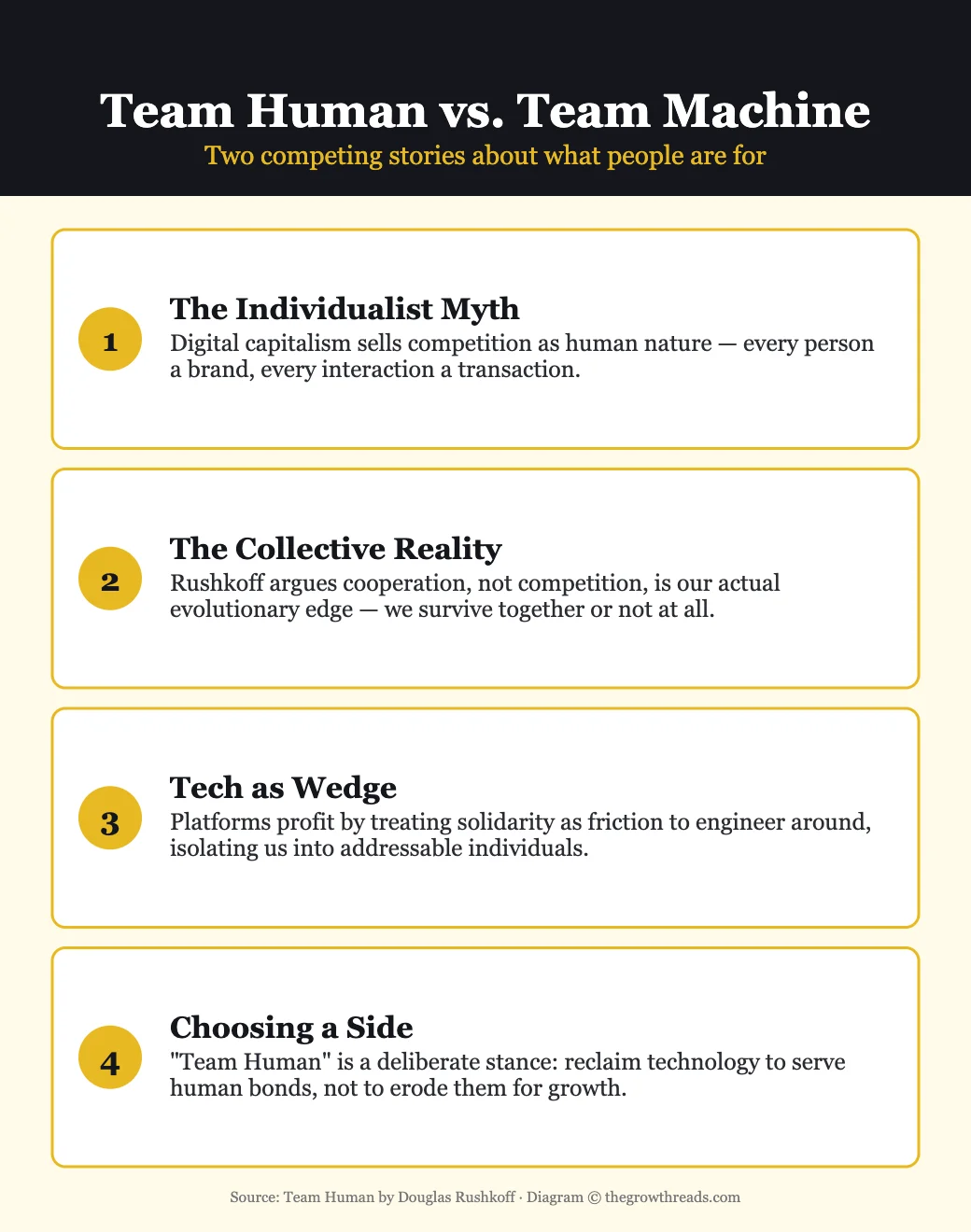
Rushkoff opens by dismantling a comfortable myth: that technology is a neutral tool, and any harm it causes is simply misuse. He traces a throughline from early mass media through the modern feed, arguing each new medium has been shaped by whoever pays for it — advertisers, investors, platforms chasing growth — and those incentives rarely align with the wellbeing of the people using it. Television optimized for eyeballs delivered to advertisers. Social platforms optimized for engagement deliver something closer to compulsion. Along the way, he revisits the economic story that competition and self-interest are simply “human nature,” tracing it back to a selective reading of Darwin filtered through industrial-era economics rather than to how humans actually evolved. Evolutionary biologists studying early human bands find groups that shared food, defended each other, and raised children collectively outcompeted more purely individualistic rivals — cooperation, not ruthless competition, was the actual survival strategy. That inverted story matters because it is now baked into the design of the tools we use every day: a newsfeed built on the assumption that people are combative individuals chasing status will, unsurprisingly, make its users more combative and status-obsessed. Rushkoff’s point isn’t that any single company is uniquely villainous; it’s that a whole generation of platforms converged on the same playbook because the underlying economic logic — extract value from people’s attention as efficiently as possible — points to the same place regardless of who is holding the wheel.
TGR Note: This is a direct extension of the argument in The Attention Merchants, where Tim Wu traces the same commercial logic back through radio and television. Rushkoff’s addition is the “who benefits” question: it’s not enough to reclaim your attention individually — the underlying system still profits from everyone else’s.
Part 2: What Platforms Are Really Extracting
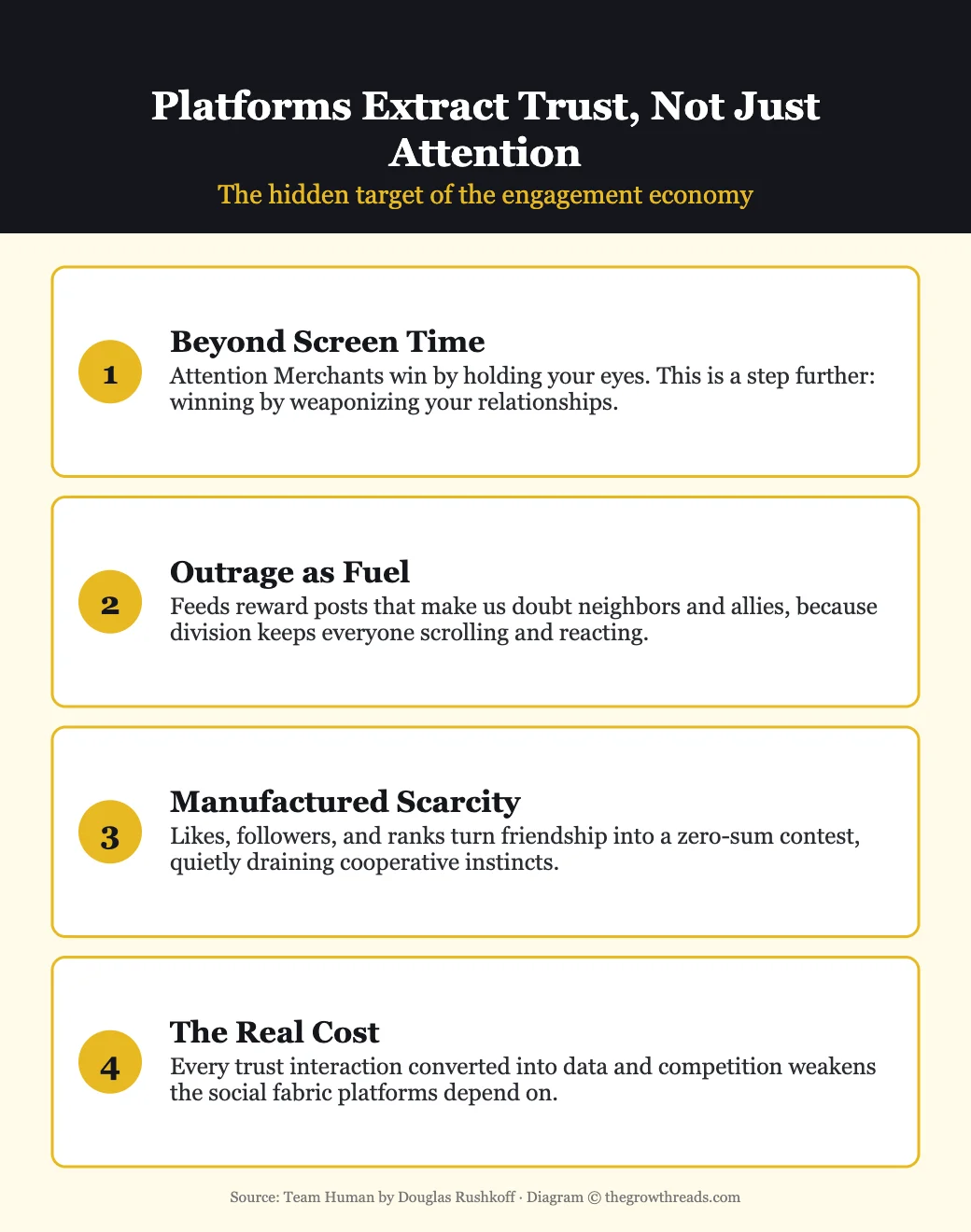
The book’s sharpest turn is its claim that attention was never the final prize — trust is. Rushkoff argues that once a platform has your attention, its real business is converting the social bonds you bring with you — your relationships, your sense of who to believe, your willingness to cooperate with strangers — into data and engagement. A feed doesn’t just want you scrolling; it wants you doubting your neighbor’s politics, competing for social proof through likes and followers, and outsourcing your judgment about who’s trustworthy to an algorithm optimized for something else entirely. This is a meaningfully different diagnosis than “social media makes us addicted to our phones.” Addiction is a personal, individual harm. Trust extraction is a collective one: every polarizing post that “works” leaves the wider social fabric a little thinner, because outrage and suspicion travel faster and stickier than agreement and cooperation. Rushkoff points to how manufactured scarcity — follower counts, ranked feeds, algorithmic visibility — turns friendship itself into something zero-sum, a resource to be accumulated and displayed rather than simply enjoyed. He’s careful to note this isn’t a conspiracy in the cartoonish sense; no engineer sat down intending to erode democratic trust. It’s an emergent property of optimizing purely for engagement at scale, which makes it harder to fix with better intentions alone and more urgent to fix with better design.
TGR Note: Readers who want the data-and-surveillance side of this same argument should pair Team Human with The Age of Surveillance Capitalism. Shoshana Zuboff documents the business model in forensic detail; Rushkoff is explicitly answering the “so what do we do” question her book leaves open.
Part 3: A Manifesto Built to Be Shared, Not Just Read
Team Human’s structure is unusual enough to be worth its own section: 100 numbered entries, most just a page or two, some barely a paragraph, arranged more like aphorisms than chapters. There is no single plot to follow or argument that builds strictly in sequence — you could start at entry 47 and lose nothing essential. Rushkoff has said this format grew directly out of his podcast and public talks, where a single sharp statement tends to travel further and spark more conversation than a fully developed essay. That’s not a stylistic accident; it’s the book practicing what it preaches. A text designed to be quoted, excerpted, and argued about in a group chat or a book club is, structurally, a small act of resistance against the solitary, algorithm-mediated reading habits the book itself criticizes. Some entries read as short essays, others as provocations or reframes of a familiar idea — “the network is not the same as the tribe,” for instance, or “efficiency is not a human value.” Read alone, any given entry is a decent thought. Read as a whole, the cumulative effect is closer to a drumbeat: dozens of independent confirmations of the same underlying claim, each arriving from a different angle. For readers used to a traditional page-turner arc, this can initially feel disjointed; approached instead as a book meant to be dipped into, highlighted, and passed along, it works exactly as designed.
TGR Note: If the manifesto format appeals to you, Rushkoff’s own Team Human podcast extends the same discussion-first approach into long-form conversation — a natural next step once you finish the book and want to keep the argument going with others.
Part 4: Choosing Team Human, in Practice
The final stretch of the book turns from diagnosis to action, and Rushkoff is careful to keep the suggestions grounded rather than utopian. He does not call for abandoning technology, deleting every app, or waiting for regulators to fix platform incentives before doing anything yourself. Instead, he frames “Team Human” as a series of small, repeatable choices: favoring communication that builds relationships over communication that performs for an audience, supporting local and cooperative institutions that don’t depend on extraction to survive, and treating any tool’s design — not just its marketing — as the real signal of whose interests it serves. A recurring theme is that civic and community-level solidarity is more resilient than any individual habit change, because it doesn’t depend on willpower alone; showing up for a neighborhood group, a mutual-aid effort, or even a genuinely reciprocal group chat creates structures that keep pulling you back toward cooperation even on days your own discipline slips. He’s also explicit that this is generational and cultural work, not a weekend project — the same forces that took decades to normalize extraction-first design will take sustained, collective effort to counter. The book closes without a tidy five-step plan, which is consistent with its whole approach: Team Human isn’t a program to follow, it’s a stance to keep choosing, entry by entry, day by day.
Who is Team Human best for — and who should read something else first?
Team Human suits readers who already sense something is off about how digital life feels — more isolating, more combative, more exhausting than the promise of “connection” ever suggested — and want a short, energizing book that names the problem clearly and points toward practical, collective responses. It’s especially good for community organizers, educators, and anyone leading a team or group who wants language for why healthy culture matters more than clever tools. If you want the deep data-and-mechanism case for how surveillance-driven business models work, start with The Age of Surveillance Capitalism instead. If you want the media-history version of the same argument, The Attention Merchants is the better starting point. Readers hoping for a step-by-step productivity system or a purely individual “digital detox” plan may find Team Human’s collective framing less immediately actionable — its answers are civic and relational, not personal-optimization tactics.
Questions to reflect on
- Which apps or platforms in your life reward you for competing with people rather than cooperating with them?
- Where has a “convenient” digital tool quietly replaced a relationship that used to require real coordination with another person?
- What is one local or community group you could show up for consistently, rather than just support online?
- When did you last change your mind about someone after a real conversation, rather than a feed-mediated impression?
- If you designed your most-used app to serve solidarity instead of engagement, what would you change first?
🔥 Ready to choose Team Human?
Get the book that turns “technology is making us worse to each other” into a plan for pulling back together.
How to apply Team Human (7-day plan)
- Day 1: Pick one app you use daily and write down, honestly, what it’s optimized for — your wellbeing, or your engagement.
- Day 2: Have one real conversation (voice or in person) with someone whose views on a hot-button issue you’d normally only see filtered through a feed.
- Day 3: Turn off algorithmic ranking on one feed if the option exists, or switch it to chronological, and notice how the content changes.
- Day 4: Do one small favor for a neighbor or coworker that requires no app — a ride, a borrowed tool, a shared meal.
- Day 5: Read five entries from Team Human out loud with someone else and talk about which one landed hardest.
- Day 6: Identify one local or community organization aligned with something you care about, and commit to one concrete action for it.
- Day 7: Write down one platform habit you’ll change permanently, and one collective or civic commitment you’ll keep making after this week ends.
Frequently asked questions
What does “Team Human” actually mean?
It’s Rushkoff’s shorthand for choosing solidarity with other people over optimizing for a platform, a market, or a machine. He argues most digital tools were built to extract value from human connection rather than support it, so “playing for Team Human” means noticing when a system is turning people against each other and consciously choosing cooperation instead. It’s less a technology stance than a values stance: people over metrics, relationships over reach, community over convenience — applied in small, repeatable choices rather than one big dramatic opt-out.
Is Team Human anti-technology?
No, and Rushkoff is explicit about this. He’s used and taught digital media for decades. The target isn’t computers or phones themselves but the incentives baked into how many platforms are built — engagement metrics, growth targets, and algorithms that profit when people compete rather than connect. He wants readers to use technology on purpose, for human ends, rather than let a platform’s business model quietly set the terms of their attention and relationships.
Do I need to read the 100 chapters in order?
No. The book is written as 100 short, numbered statements meant to be read in any order, shared individually, or dipped into a few at a time. Rushkoff designed the manifesto format deliberately so a single chapter could stand alone and travel on its own. Reading start to finish works fine too, but treating it as a reference you return to — rereading a chapter that’s relevant to something happening that week — is a legitimate and arguably intended way to use it.
How is this different from The Attention Merchants or The Age of Surveillance Capitalism?
All three describe how digital business models shape behavior, but the focus shifts. The Attention Merchants traces the history of how attention became a commodity sold to advertisers. The Age of Surveillance Capitalism examines the data-extraction economics behind that system in deep analytical detail. Team Human is shorter, more polemical, and prescriptive — it spends less time on the mechanics of how we got here and more on what an individual or community can actually do about it right now.
Who is Douglas Rushkoff and why should I trust his take?
Rushkoff is a media theorist and professor who has written about digital culture since the early days of cyberspace, including early work on media viruses and open-source thinking. He’s spent decades inside conversations with technologists, marketers, and educators about how media shapes society, which gives Team Human its practitioner’s edge — it reads like someone who has sat in the rooms where these platforms get designed, not just someone theorizing from the outside.
What’s one small way to start applying the book’s ideas today?
Pick one daily habit that routes through a platform — checking a feed, texting in a group chat, joining a video call — and notice whether it’s pulling you toward a real connection or toward more scrolling. Rushkoff’s practical suggestion is to favor synchronous, human-paced interaction (a call, a face-to-face conversation, a walk) over asynchronous engagement loops whenever you have the choice. Small substitutions like this are the book’s actual unit of change, not sweeping lifestyle overhauls.
Is Team Human worth reading if I already work in tech?
Often more useful for people inside the industry than outside it. Rushkoff writes from firsthand exposure to how growth targets and engagement metrics get set, so the book gives tech workers and founders a vocabulary for naming design trade-offs they may already sense but haven’t articulated. It’s a manifesto meant to be argued with, not just agreed with, so it works well as a discussion-starter for product, growth, or design teams thinking about their own incentives.
Related summaries
- The Attention Merchants — the history of how human attention became the product platforms sell to advertisers.
- The Age of Surveillance Capitalism — a deeper economic account of the data-extraction machinery behind those same platforms.
- Machines of Loving Grace — a counterpoint on how AI could be built to support human agency rather than erode it.
- Best AI & technology books — the full Technology reading list on The Growth Reads.
Related Technology Summaries
Co-Intelligence Summary & Review: How to Actually Work With AI
Genius Makers Summary & Review: The Human Story Behind the AI Boom
Our Final Invention Summary & Review: Is Superintelligent AI a Genuine Threat?
Rise of the Robots Summary & Review: Why Automation Now Threatens Cognitive Jobs Too
The Shallows Summary & Review: How the Internet Is Rewiring Your Brain