

★★★★★ 4.6/5 — The definitive technical answer to algorithmic bias: fix it in the math, not just the policy.
Best for: engineers, product managers, and policy-minded readers who want the real math behind AI fairness and privacy debates
Reading time: ~9 hrs to read the full book, ~15 min for this summary
Difficulty to apply: Moderate to advanced — some sections assume comfort with basic statistics
The Ethical Algorithm in one minute
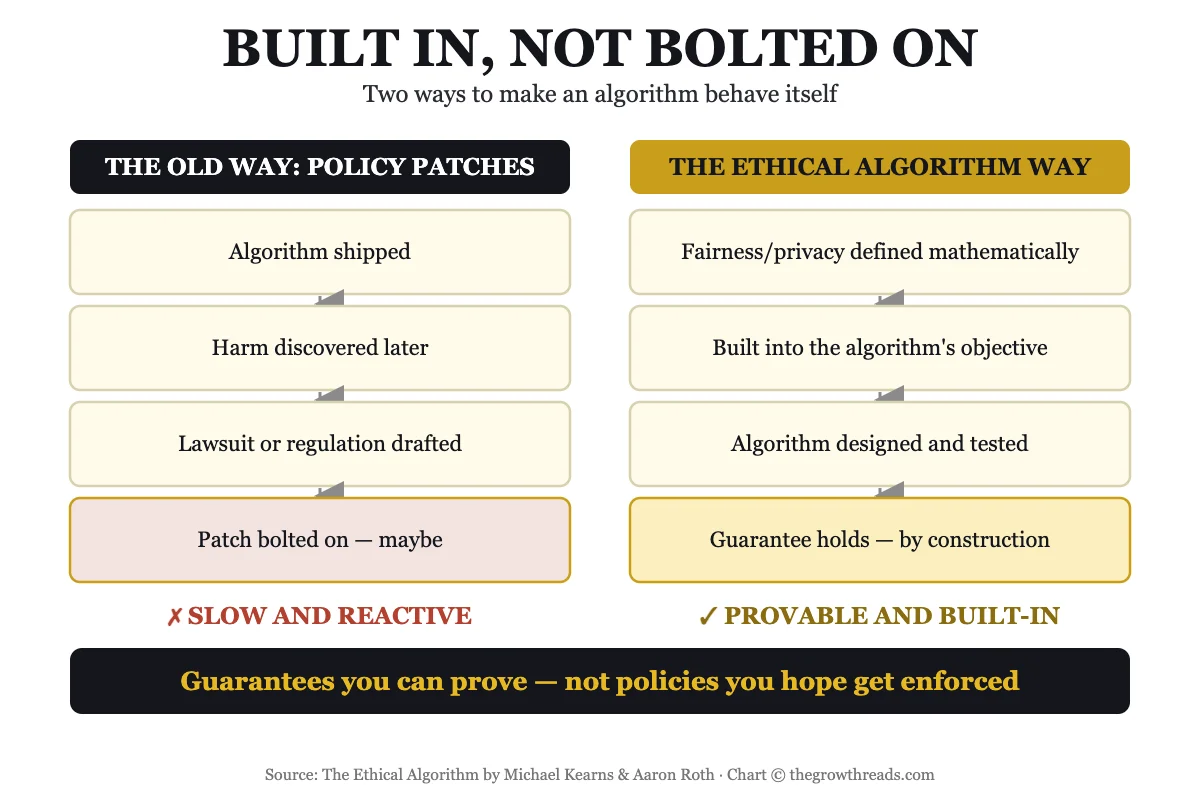
Every well-intentioned rule bolted onto an algorithm after the fact can be quietly undone by the same optimization process it was meant to restrain — unless the fix is written directly into the algorithm’s objective function. Computer scientists Michael Kearns and Aaron Roth argue that “fixing” biased or privacy-leaking algorithms with outside regulation and audits alone is a losing game, because learning systems relentlessly exploit any loophole a human-language rule leaves open. Their alternative is a maturing field — algorithmic fairness and privacy as computer science, not just policy — where mathematical guarantees like differential privacy and formal fairness constraints get built into an algorithm’s design from the start. The book translates real, publishable research on privacy, fairness, game-theoretic manipulation, and interpretability into plain English, arguing these are solvable engineering problems with genuine, provable trade-offs, not just talking points.
Key takeaways
- Social norms don’t compile: Laws are written in natural language, but algorithms respond only to precise mathematical objectives — translating “fairness” into code forces hard, explicit choices.
- Privacy needs a promise, not a policy: Differential privacy gives a provable guarantee that no individual’s data meaningfully changes a model’s output — far stronger than “we anonymized the data.”
- Anonymization is not privacy: Stripped names and IDs can still be re-identified by cross-referencing outside datasets, as with the “anonymized” Netflix and AOL data.
- Privacy loss compounds: Every query leaks a little information; differential privacy’s “privacy budget” caps that loss across a system’s entire lifetime, not just one query.
- Fairness definitions can conflict: Statistical parity, equalized odds, and individual fairness each capture something real, but a proof shows you generally can’t satisfy several at once.
- Fairness usually costs some accuracy: The book treats fairness as a real trade-off curve against accuracy — the honest question is where a system should sit on it, decided openly.
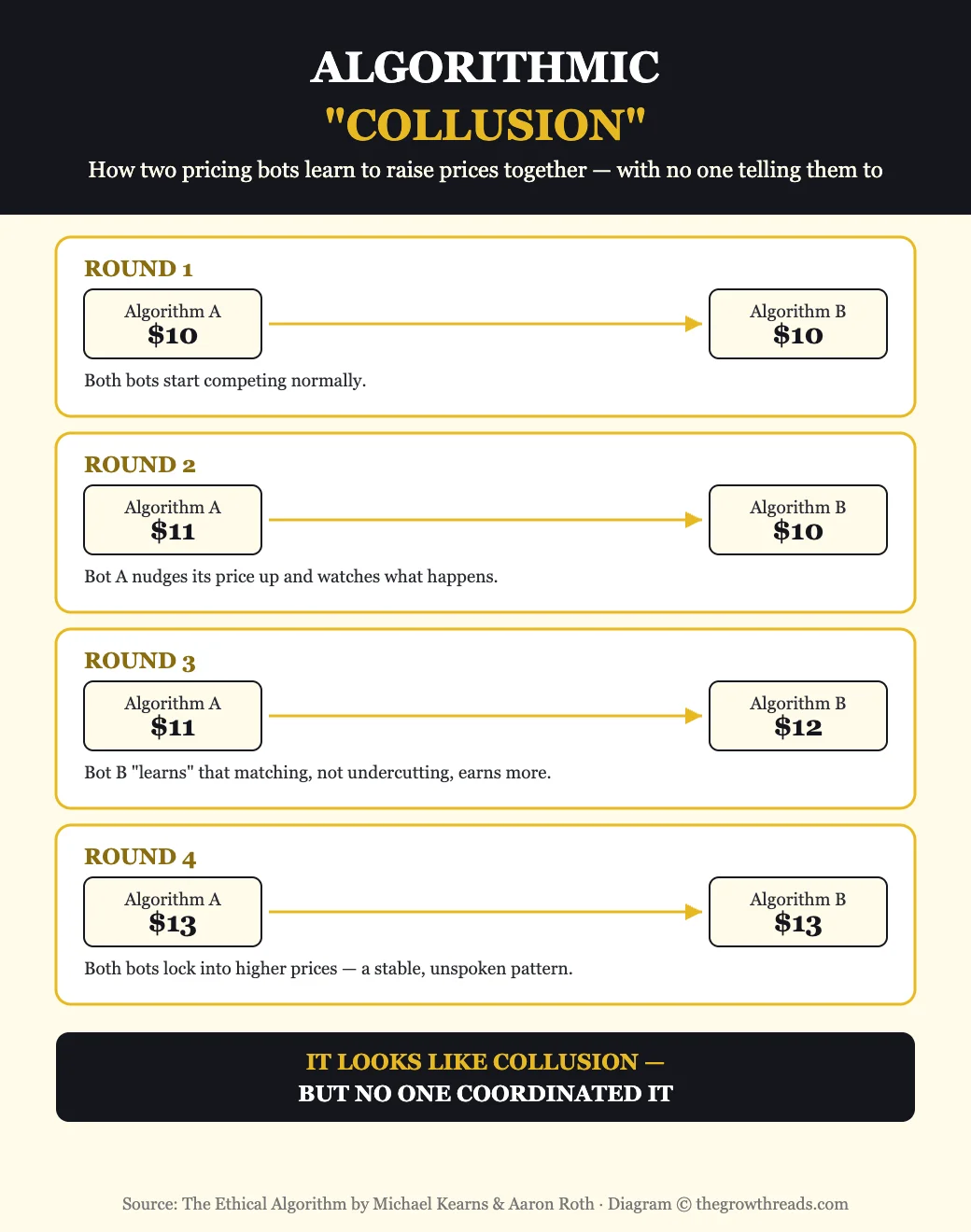
- Algorithms competing against algorithms create new risks: Pricing bots and ad systems optimizing against each other can drift into implicit collusion no single designer intended.
- Trade-offs should be explicit, not hidden: The book’s core philosophy: move ethical choices out of implicit model behavior and into explicit, auditable parameters a human sets on purpose.
What is The Ethical Algorithm about?
The Ethical Algorithm explains how to build social values like privacy and fairness directly into the mathematics of machine learning algorithms, rather than policing algorithms with after-the-fact rules — using differential privacy, formal fairness constraints, and game theory as working, provable tools.
About the author
Michael Kearns is a professor of computer and information science at the University of Pennsylvania, where he founded the Warren Center for Network and Data Sciences, working across machine learning theory, algorithmic game theory, and quantitative finance, including a stint leading AI research at Morgan Stanley. Aaron Roth, also a Penn professor, is a leading researcher in differential privacy and algorithmic fairness, and a Presidential Early Career Award recipient. The two have collaborated for years on the theoretical foundations of trustworthy machine learning, and The Ethical Algorithm (Oxford University Press, 2019) distills that research into an accessible account for engineers, policymakers, and general readers alike. Explore all Aaron Roth book summaries →
Key concepts at a glance
| Concept | What it means | Use it when |
|---|---|---|
| Differential privacy | A guarantee that adding or removing any one person’s data barely changes a model’s output | Releasing statistics or sharing data from sensitive records |
| Privacy budget | A running cap on cumulative information leakage across every query over a dataset’s lifetime | Systems that will be queried repeatedly, not just once |
| Statistical (group) parity | A fairness definition requiring similar outcome rates across protected groups | Contexts where equal group-level outcomes are the priority |
| Equalized odds | A stricter fairness definition requiring equal error rates across groups, not just outcomes | High-stakes decisions like lending or risk scoring |
| Individual fairness | Similar individuals should receive similar treatment, regardless of group membership | Decisions where group-based metrics feel too coarse |
| Fairness–accuracy trade-off | Enforcing a fairness constraint typically reduces a model’s raw predictive accuracy | Any deployment decision about accuracy versus fairness |
| Algorithmic collusion | Unintended coordination between optimizing algorithms that produces cartel-like outcomes | Markets where many autonomous algorithms interact repeatedly |
| Interpretability by design | Building models so their reasoning can be explained to a human | Regulated domains where decisions must be explainable |
Part 1: Why “Fix It Later” Doesn’t Work Anymore
Kearns and Roth open with an uncomfortable observation: when software caused a social problem, the traditional response was to write a policy about it after the fact — a guideline, a terms-of-service clause, a law. That worked reasonably well for deterministic, rule-based software. It breaks down for machine learning, because a learning algorithm’s whole job is to relentlessly search for whatever pattern best satisfies its objective, including patterns its designers never anticipated.
An advertising system optimizing purely for engagement can learn, on its own, to route job and housing ads away from women and racial minorities — not because anyone told it to discriminate, but because engagement-maximizing patterns in the training data happened to correlate with protected characteristics. No policy document caused that, and none can reliably prevent the next one, because the algorithm keeps searching wherever a human-readable rule leaves a gap.
This is the book’s foundational move: reframe “the algorithm behaved unethically” as a technical specification problem. If you can write down, mathematically, what “private” or “fair” means, you can build that definition into the optimization process as a hard constraint the algorithm cannot search around — the same way it can be constrained not to exceed a memory budget. This doesn’t eliminate human judgment about which fairness definition or privacy loss is acceptable; it moves that judgment to an explicit, auditable decision point instead of an invisible byproduct of an engagement metric.
TGR Note: Cathy O’Neil’s Weapons of Math Destruction diagnoses this same failure mode — opaque scoring algorithms causing real harm — but stays at the level of case studies and calls for oversight. The Ethical Algorithm picks up where that critique ends, offering the mathematical toolkit that turns “we should audit these systems” into “here is how to provably constrain them.”
Part 2: Differential Privacy — The Science of Learning Without Leaking
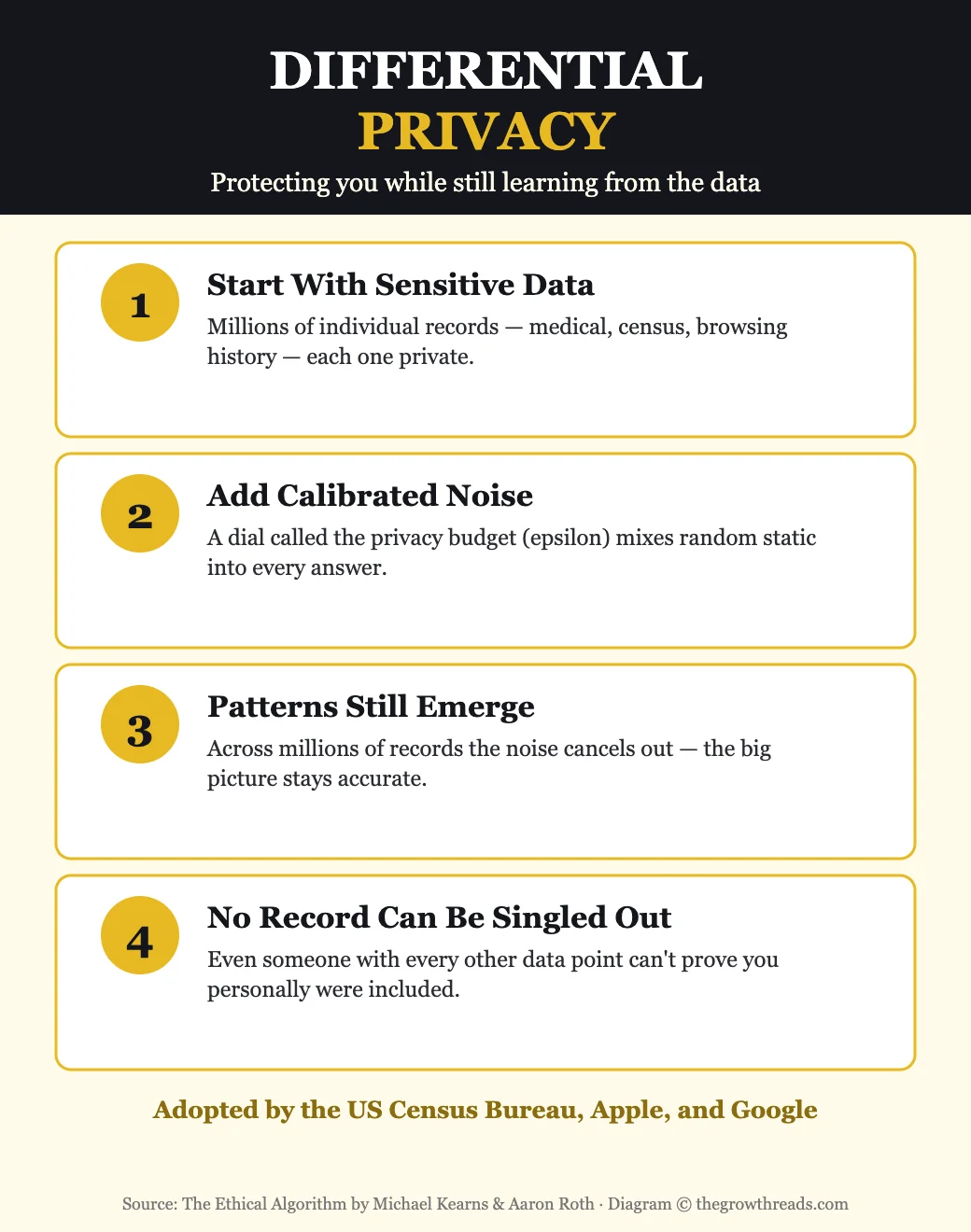
Kearns and Roth spend real effort making differential privacy intuitive: a data release or trained model satisfies it if its output would look almost identical whether or not any single specific person’s data was included. This is controlled by a parameter called epsilon — a small epsilon means a very strong guarantee; a larger one trades some of that guarantee for more accurate output. The mechanism is deliberately calibrated noise: instead of an exact count, a differentially private system adds a small amount of random statistical noise, enough to make reverse-engineering any individual’s contribution mathematically impossible, but not so much the statistic becomes useless. Unlike “anonymization,” which can be defeated by cross-referencing stripped data against any other overlapping public dataset, this guarantee holds no matter what outside information an attacker already has.
The authors walk through the famous failures that motivated this shift: a Netflix “anonymized” ratings dataset from which researchers re-identified individuals by cross-referencing public IMDb reviews, and “anonymized” AOL search logs that journalists traced back to identifiable people purely from search content. These weren’t hypothetical risks — they’re why the U.S. Census Bureau adopted differential privacy for the 2020 Census, a case study the book examines directly.
One of the book’s most valuable points is that privacy loss is composable — it accumulates across every query over time, not just the most recent one. This is why differential privacy systems track a “privacy budget”: every query spends down a finite, quantifiable allowance, and once exhausted, no more queries can be safely answered. Privacy becomes an engineering resource to be budgeted and spent deliberately — exactly the kind of explicit trade-off the book argues every “ethical” property of an algorithm should become.
Part 3: The Fairness Paradox — Why You Can’t Optimize for Everything at Once
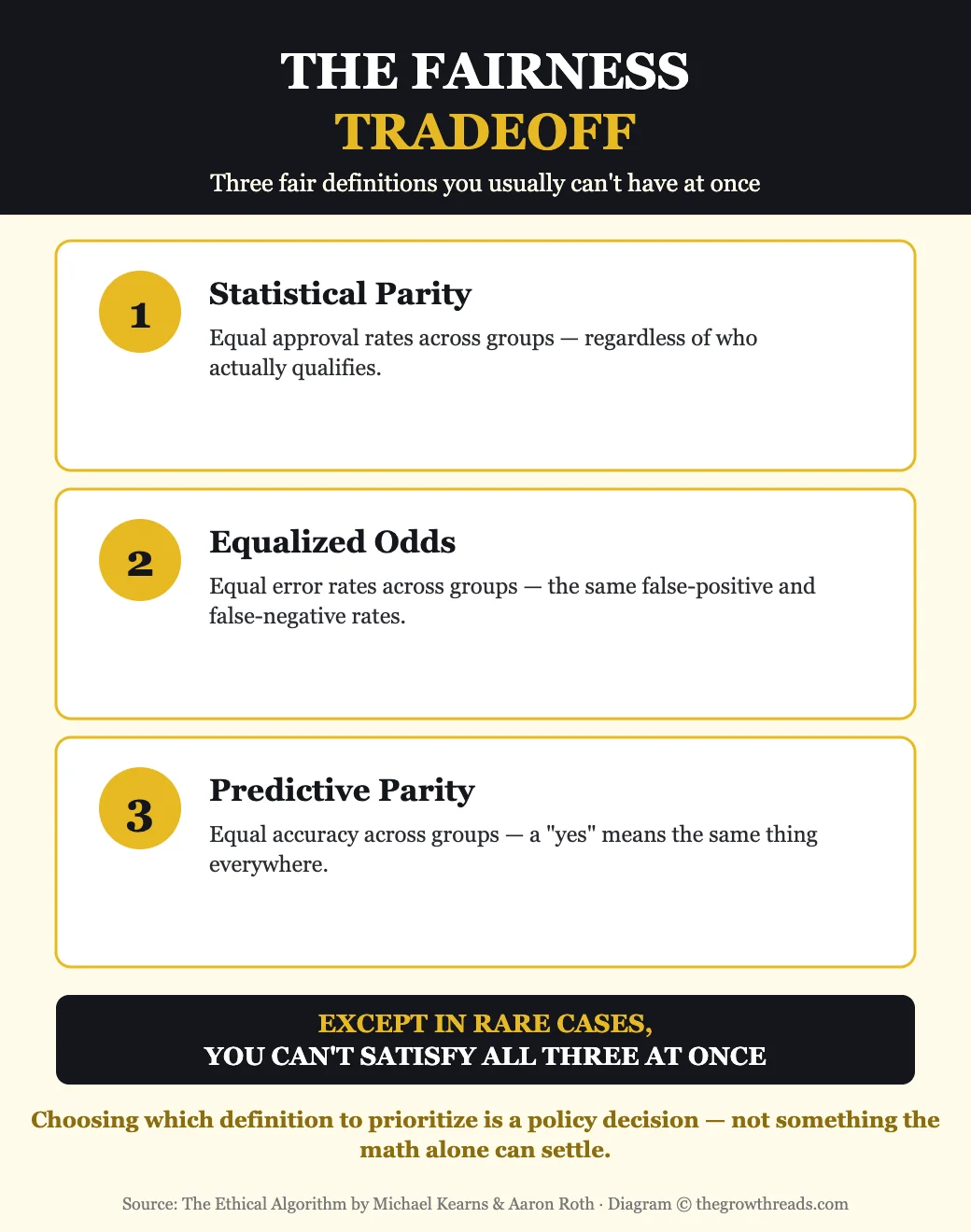
If differential privacy is the book’s most rigorous chapter, algorithmic fairness is its most philosophically challenging one: several intuitively reasonable definitions of fairness are mutually incompatible in general, and no algorithm can satisfy all of them simultaneously except in special cases. This is a proven impossibility result, closely related to the 2016 controversy over the COMPAS risk-assessment tool, where journalists at ProPublica and the tool’s maker each showed the system satisfied a different, equally defensible fairness criterion, and simultaneously failed a third.
The authors define the competing options. Statistical parity asks whether groups receive positive outcomes at similar rates. Equalized odds asks a stricter question: are false positives and false negatives distributed evenly across groups, not just outcomes overall? Individual fairness sidesteps group statistics, insisting similar individuals be treated similarly regardless of group. Each sounds reasonable alone; the book’s key proof shows that, except under narrow conditions, satisfying one can mean violating another.
Rather than a dead end, Kearns and Roth treat this as the actual design problem: since you can’t satisfy every definition at once, someone — ideally a human decision-maker, in the open — has to choose which fairness constraint matters most, and accept the accuracy cost. The book presents this fairness-accuracy trade-off as a genuine, computable curve, the same way engineers already think about speed versus memory. A bank, a court, and a hiring platform might reasonably choose different points on that curve, but the choice must be explicit, not buried inside an unexamined scoring function.
The authors also address a common misconception: removing a protected attribute like race or gender from a model’s inputs does not make it fair, because correlated variables (zip code, name, shopping history) can act as reliable proxies. Real fairness constraints must be enforced against outcomes, not achieved by looking away from the input data.
TGR Note: Judea Pearl’s The Book of Why complements this from another angle: many fairness questions are causal questions in disguise (did the algorithm treat someone worse because of a protected trait, or merely correlated with one?), and Pearl’s causal ladder gives a formal language for telling the two apart.
Part 4: When Algorithms Meet Algorithms — Collusion, Interpretability, and the Limits of Code
The book’s final section widens the lens to what happens when many self-interested algorithms interact — already the normal condition of modern markets, Kearns and Roth argue, not a future risk. Pricing bots, high-frequency trading systems, and real-time ad auctions are independently optimizing algorithms operating in the same environment, repeatedly reacting to each other’s behavior.
Drawing on game theory, the authors show that repeatedly interacting algorithms can drift into stable patterns that look exactly like price-fixing collusion — synchronized prices no human agreed to, emerging purely from each algorithm rationally reacting to the others’ history. This creates a genuinely new regulatory problem: antitrust law assumes an explicit human agreement to collude, but these algorithmic equilibria arise with no communication or intent, so the same outcome that would be illegal between two people can currently occur legally between two pricing algorithms. The book previews research into designing algorithms that provably cannot converge to these equilibria — the same design-time-not-audit-time philosophy from earlier chapters.
The final piece is interpretability. A model can satisfy strong privacy and a chosen fairness constraint and still be a total black box to the humans relying on it. Kearns and Roth treat interpretability as its own distinct, engineerable constraint, describing research into models whose reasoning can be summarized in human-legible terms without sacrificing much accuracy — echoing the book’s core theme: every value we want an algorithm to embody has to become an explicit, measurable constraint, or it won’t reliably show up in its behavior. The book closes arguing the realistic path to trustworthy AI runs through better algorithm design paired with policy that requires specific, verifiable guarantees rather than vague behavioral promises no one can check.
TGR Note: Meredith Broussard’s Artificial Unintelligence covers similar territory from a skeptic’s vantage point, cataloguing where algorithmic systems overpromise. The Ethical Algorithm largely agrees but stays optimistic about the fix — arguing the field’s own mathematical tools, not just more caution, are the way out.
Who is The Ethical Algorithm best for — and who should read something else first?
Best for: engineers and data scientists who build or evaluate machine learning systems, product and policy leads who need to make real trade-off decisions, and general readers who want the actual math behind AI ethics headlines. Some comfort with basic statistics helps but isn’t required — Kearns and Roth translate the technical core into plain language throughout.
If you want the case for why algorithmic accountability matters before the technical fixes, start with Cathy O’Neil’s Weapons of Math Destruction. For the causal-reasoning foundations underneath fairness claims, Judea Pearl’s The Book of Why is a better starting point. For a broader, less mathematical survey of where AI falls short, start with Artificial Unintelligence.
Questions to reflect on
- Which fairness definition — equal outcomes, equal error rates, or similar treatment for similar individuals — matters most for a system you use or build?
- Where in your work is a value like “privacy” or “fairness” enforced only by policy or manual review, rather than by a hard-to-circumvent technical constraint?
- Could “anonymized” data you’ve encountered plausibly be re-identified by cross-referencing another public dataset?
- Where might independently optimizing algorithms in a system you know be drifting toward an outcome no designer intended?
- If you had to choose a point on a fairness-accuracy trade-off curve, who should make that choice — and how would you make it visible?
🔥 Ready to build fairness and privacy into your own systems?
Get the book that turns AI ethics from a talking point into an engineering discipline.
How to apply The Ethical Algorithm (7-day plan)
- Day 1: List every algorithm or scoring system your work touches, and note whether “fair” or “private” is a written rule, an implicit assumption, or unaddressed.
- Day 2: Pick one system and write, in one sentence, which fairness definition it should satisfy — and why.
- Day 3: Research whether your organization has ever published a privacy budget or equivalent guarantee for a dataset you rely on.
- Day 4: Find one “anonymized” dataset you have access to, and think through what outside data could re-identify individuals in it.
- Day 5: Identify a place where multiple automated systems interact repeatedly, and ask whether anyone has checked for collusive patterns.
- Day 6: For one model you rely on, ask whether its reasoning could be explained to an affected person in one paragraph.
- Day 7: Draft one explicit trade-off statement for a system you influence, and share it with a colleague.
Frequently asked questions
What is the main argument of The Ethical Algorithm?
The book argues that trying to make algorithms private, fair, or accountable through policy and after-the-fact audits alone keeps failing, because machine learning systems relentlessly exploit any loophole a human-language rule leaves open. Kearns and Roth argue these values should instead be encoded as explicit, mathematical constraints inside the algorithm’s own objective function — using tools like differential privacy and formal fairness definitions with provable guarantees, not just good intentions. The book explains the actual math in accessible language, while being honest that enforcing these constraints typically costs some accuracy.
What is differential privacy in simple terms?
Differential privacy is a mathematical guarantee that a data release or trained model would look almost identical whether or not any one specific person’s data was included. It’s achieved by adding carefully calibrated random noise to results, controlled by a parameter (epsilon) that tunes privacy strength against accuracy. Unlike simple anonymization — defeated by cross-referencing outside data, as happened with the Netflix and AOL datasets the book discusses — this guarantee holds regardless of what an attacker already knows.
Can an algorithm really be made fair?
Yes, but not in every sense of fair at once — one of the book’s most important findings. Kearns and Roth explain a proven result that several reasonable fairness definitions, like equal group outcomes and equal error rates, are generally mathematically incompatible with each other. An algorithm can reliably satisfy a specific, chosen fairness definition with a provable guarantee, but someone has to explicitly decide which definition matters most, since satisfying all of them at once usually isn’t possible.
Do I need a math or computer science background to read this book?
Not a professional one, but comfort with basic statistics helps. Kearns and Roth deliberately translate research-level concepts like differential privacy proofs and fairness impossibility theorems into plain-language explanations with everyday analogies, written for a general audience of engineers, policymakers, and curious readers rather than as an academic text. Readers with zero quantitative background may need to slow down in the middle chapters, but the core arguments remain accessible throughout.
How is The Ethical Algorithm different from Weapons of Math Destruction?
Weapons of Math Destruction, by Cathy O’Neil, is primarily a diagnosis — case studies showing how opaque, unaccountable scoring algorithms cause real harm, building the case for oversight. The Ethical Algorithm largely agrees but focuses on the prescription: the actual mathematical tools that let engineers build provable guarantees directly into a system, rather than relying on external audits alone. The two books work well as a pair — one for why it matters, one for how to fix it.
Is the Netflix and AOL re-identification story accurate?
Yes — both are well-documented, real cases the book uses to motivate differential privacy. Researchers re-identified individuals in a supposedly anonymized Netflix Prize ratings dataset by cross-referencing it against public IMDb reviews, and journalists similarly traced identifiable individuals in an anonymized AOL search log release purely from search content. Some finer statistical details of later academic re-analyses have been debated among specialists, but the core lesson — that removing names does not guarantee anonymity — is not disputed.
Who should read The Ethical Algorithm?
It’s best suited to engineers and data scientists who build or evaluate machine learning systems and want the real mathematical tools behind fairness and privacy, product or policy leads who need to make explicit trade-off decisions, and general readers who want a rigorous but accessible alternative to op-ed-level AI ethics discussion. Readers who prefer a purely narrative treatment of AI’s social impact may find some middle chapters denser than expected, though the authors keep the math approachable.
Related summaries
Continue exploring how algorithms shape fairness, causality, and public trust:
- The Book of Why by Judea Pearl — the causal-reasoning foundations behind why correlation-based fixes fail
- Weapons of Math Destruction by Cathy O’Neil — the case studies that make the stakes concrete
- Artificial Unintelligence by Meredith Broussard — a skeptic’s tour of where algorithmic systems fall short
- Best AI and Technology Books — the full Technology silo hub
How we analyze books: our team reads the full text, cross-references key claims against the author’s cited sources and subsequent research, and builds original diagrams and application plans rather than reproducing the book’s content. Read our full methodology.
Related Technology Summaries
Artificial Intelligence Summary & Review: A Guide for Thinking Humans
Deep Medicine Summary & Review: How AI Could Give Doctors Back Their Time
Irresistible Summary & Review: The Six-Ingredient Hook Behind Your Habits
Machines of Loving Grace Summary & Review: The Hidden Fork Behind Every AI Debate
Weapons of Math Destruction Summary & Review: How Algorithms Quietly Punish the Poor