

★★★★☆ 4.2/5 — A data scientist’s insider case for why “the math said so” is not an excuse, told through vivid, damning real-world examples.
Best for: Anyone who wants to understand how algorithms can quietly encode and scale inequality, and what to do about it.
Reading time: ~7 hours to read cover to cover · ~35 min for this guide
Difficulty to apply: Moderate — the WMD framework gives you a concrete lens for spotting harmful algorithms in your own life and work.
Weapons of Math Destruction in one minute
Not every algorithm that scores, ranks, or predicts is dangerous — but the ones that are opaque, operate at scale, and cause real damage deserve a name, and Cathy O’Neil gives them one: Weapons of Math Destruction. A former Wall Street quant turned data scientist and mathematician, O’Neil examines how mathematical models used in credit scoring, hiring, teacher evaluation, insurance, and policing can encode existing bias into cold, seemingly objective numbers — then scale that bias to affect millions of people at once.
Her argument isn’t that math or algorithms are inherently bad. It’s that a specific, recognizable category of models — ones nobody can question, that affect huge numbers of people, and that create harmful feedback loops — deserve far more scrutiny than they currently get, precisely because their mathematical veneer makes them look neutral when they’re often anything but.
Key takeaways
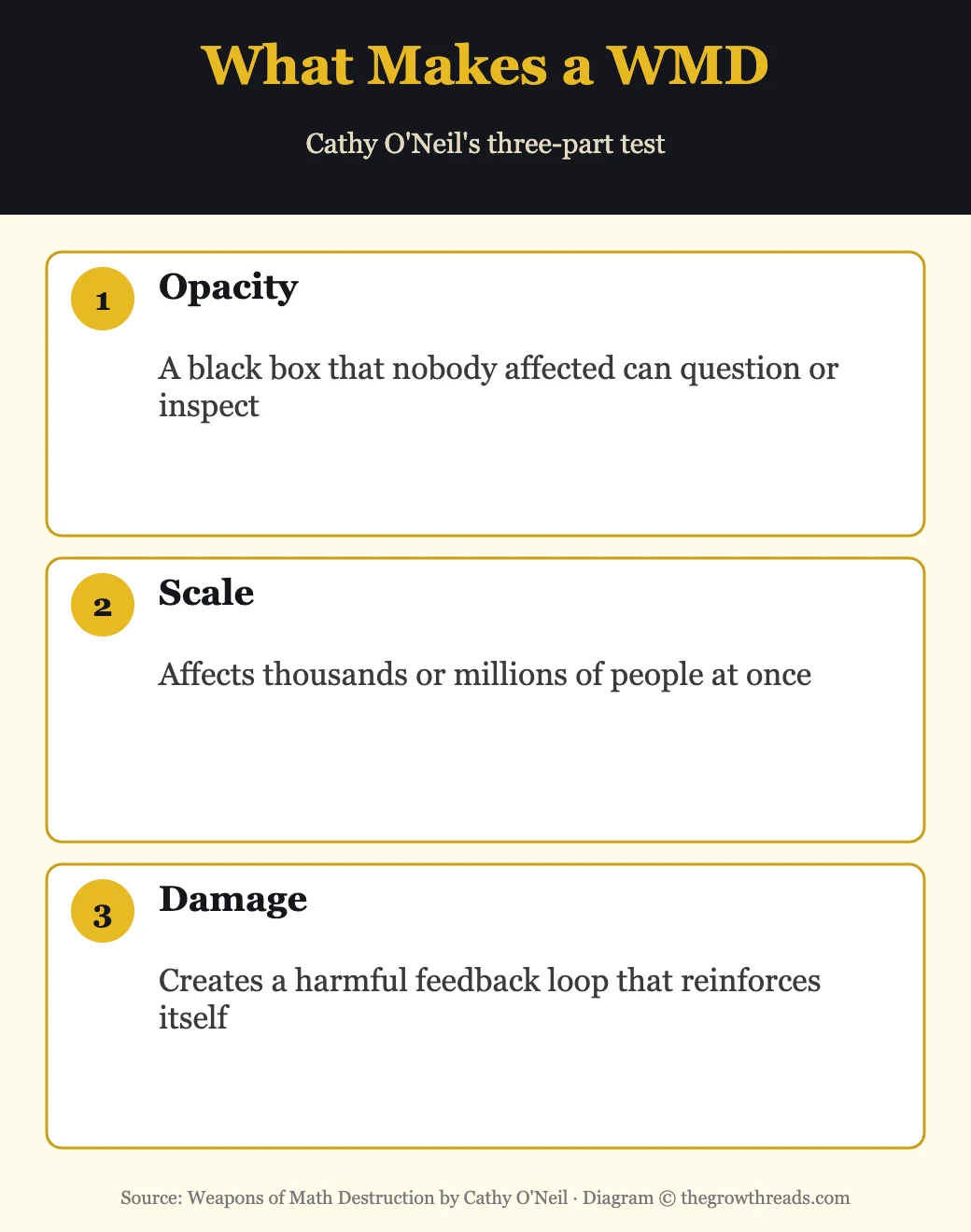
- WMDs share three traits: opacity (a black box), scale (affects many people), and damage (a harmful feedback loop).
- Historical bias becomes future bias: models trained on biased past data quietly reproduce and amplify that bias.
- Precision can be a false signal: a specific-looking risk score can mask deeply unreliable underlying data.
- The poor are more exposed to WMDs: automated scoring systems disproportionately affect people with less power to contest them.
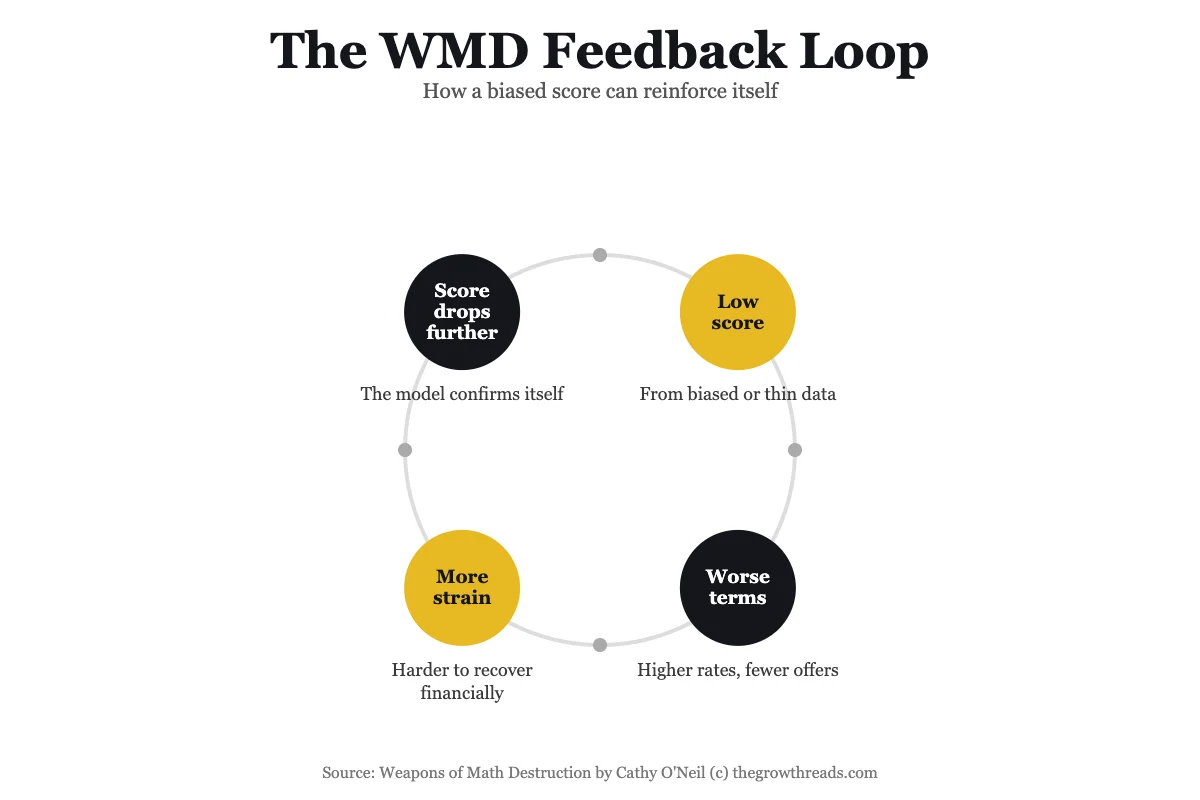
- Feedback loops make problems self-confirming: a low score can trigger worse treatment that produces evidence “justifying” the low score.
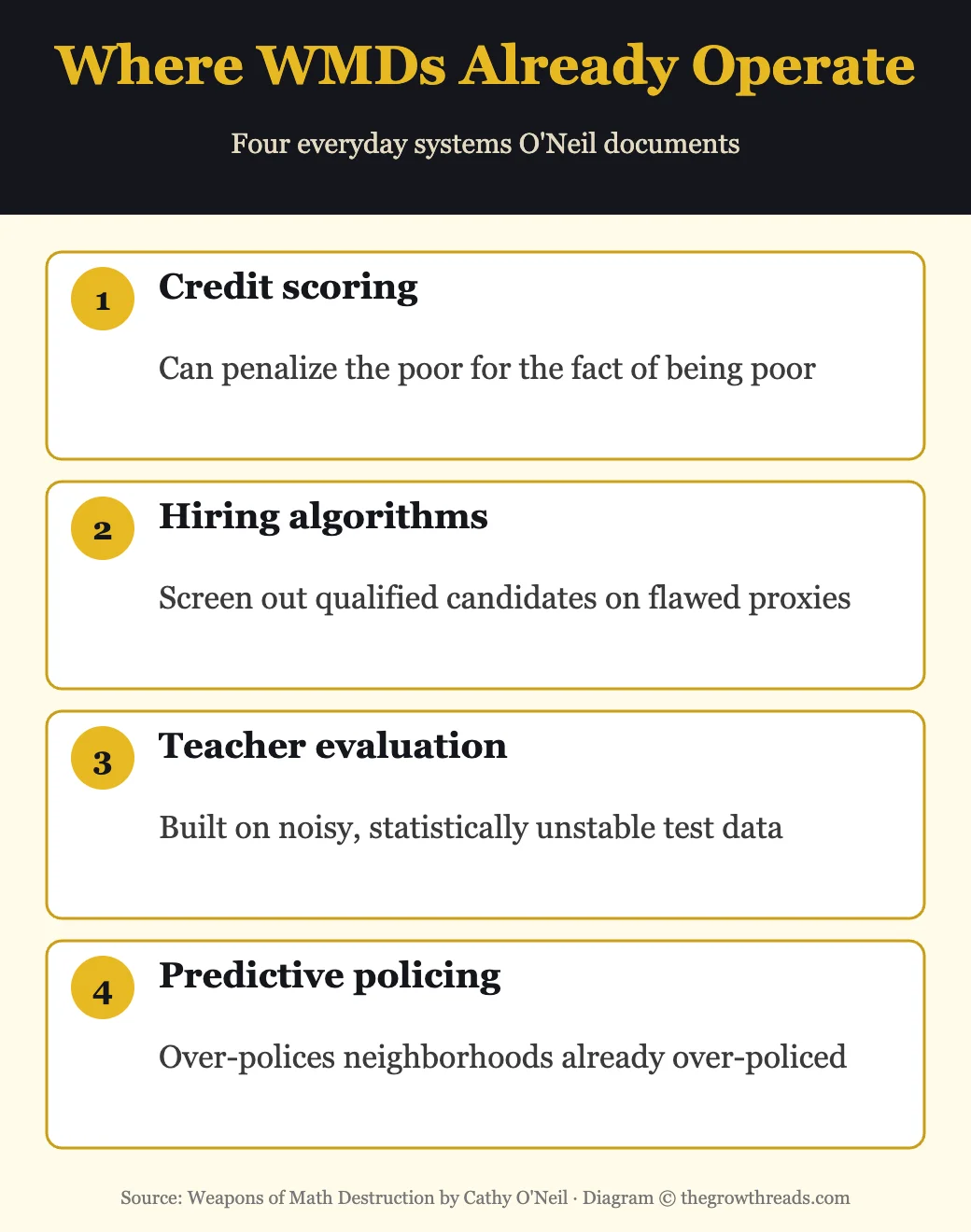
- Credit scoring can penalize poverty itself: proxies correlated with being poor get treated as evidence of risk.
- Hiring algorithms can screen out good candidates: flawed proxies for “fit” can systematically exclude qualified people.
- Teacher evaluation models can be statistically unstable: small sample sizes and noisy data can produce wildly inconsistent scores.
- Predictive policing can create its own evidence: more patrols in a flagged area generate more arrests, “confirming” the original prediction.
- The fix is accountability, not abandonment: O’Neil argues for auditable, contestable, regulated models — not rejecting data-driven tools altogether.
What is Weapons of Math Destruction about?
Weapons of Math Destruction identifies a category of harmful algorithms — opaque, large-scale, and damaging — that quietly encode bias into decisions about credit, jobs, education, and policing. Cathy O’Neil, a mathematician and former Wall Street quant, argues these “WMDs” need real accountability: auditability, the right to contest a score, and regulation.
About the author
Cathy O’Neil earned a PhD in mathematics from Harvard and taught at Barnard College before crossing into finance, where she worked as a quantitative analyst at the hedge fund D.E. Shaw through the 2008 financial crisis. Watching mathematical models help trigger a global meltdown, and later watching the same kind of opaque scoring systems spread into hiring, lending, and policing, convinced her that mathematics had become a tool for laundering bias into unaccountable authority. Explore all Cathy O'Neil book summaries →
She left finance to work as a data scientist, then became a prominent critic of algorithmic overreach through her blog mathbabe.org and her Occupy-movement-adjacent writing. Weapons of Math Destruction, published in 2016, distilled her insider critique into a mainstream warning and made her one of the most credible voices in the growing field of algorithmic accountability.
Key concepts at a glance
| Concept | What it means | Use it when |
|---|---|---|
| Weapon of Math Destruction (WMD) | An algorithm that is opaque, operates at scale, and causes real damage | Evaluating any automated scoring or ranking system |
| Opacity | The model’s inner workings are hidden from the people it judges | Asking whether a decision can be explained or appealed |
| Scale | The model applies the same flawed logic to thousands or millions of people at once | Assessing how much damage an error can multiply |
| Damage | The model’s output meaningfully harms someone’s opportunities | Distinguishing a genuine WMD from a merely imperfect model |
| Feedback loop | A model’s own outputs generate the data that reinforces its future outputs | Explaining why biased systems get worse, not better, over time |
| Proxy variable | A stand-in measure (like zip code) used because the real trait is hard to measure | Spotting hidden discrimination inside a “neutral” model |
Part 1: What makes a model a Weapon of Math Destruction
O’Neil opens with a simple observation: not every algorithm is dangerous. A model that predicts your commute time or recommends a movie is opaque and operates at scale, but if it’s wrong, the cost is trivial and you can usually see the mistake. What turns a model into a Weapon of Math Destruction is the combination of three traits working together, and it’s the combination, not any single trait, that does the damage.
The first is opacity: the people being scored can’t see the formula, can’t challenge a bad input, and often don’t even know a model was used. The second is scale: instead of one biased manager making one bad call, a single flawed model can process an entire industry’s hiring decisions, credit applications, or teacher evaluations in one pass. The third is damage: the model’s verdict genuinely closes doors, whether that means a denied loan, a rejected application, or a lost job. A model missing any one of these traits is merely imperfect. A model with all three is a WMD, and O’Neil argues that’s exactly what makes it feel unaccountable to everyone but the people it hurts.
Part 2: Where WMDs already operate
The bulk of the book is a tour through real-world domains where these models were already running by 2016, often invisibly. In hiring, personality-test algorithms screened out applicants with mental health histories using proxy questions borrowed from clinical psychiatry, without any human ever reviewing the rejected pile. In lending and insurance, “e-scores” built from browsing habits and zip codes charged higher rates to people who looked, on paper, like past defaulters, even when their actual credit was fine.
Two case studies anchor the book’s most damning material. The first is teacher evaluation: Washington D.C.’s IMPACT system fired teachers based on value-added scores derived from student test results, scores so statistically noisy that a teacher rated poorly one year could be rated excellently the next with no change in performance, yet the firings stood. The second is predictive policing: software that sent patrols back to the same low-income neighborhoods based on historical arrest data, which increased arrests there, which fed back into the model as “proof” the neighborhood was dangerous, a feedback loop that had nothing to do with where crime actually occurred and everything to do with where police had already been told to look.
Part 3: Building fairer models
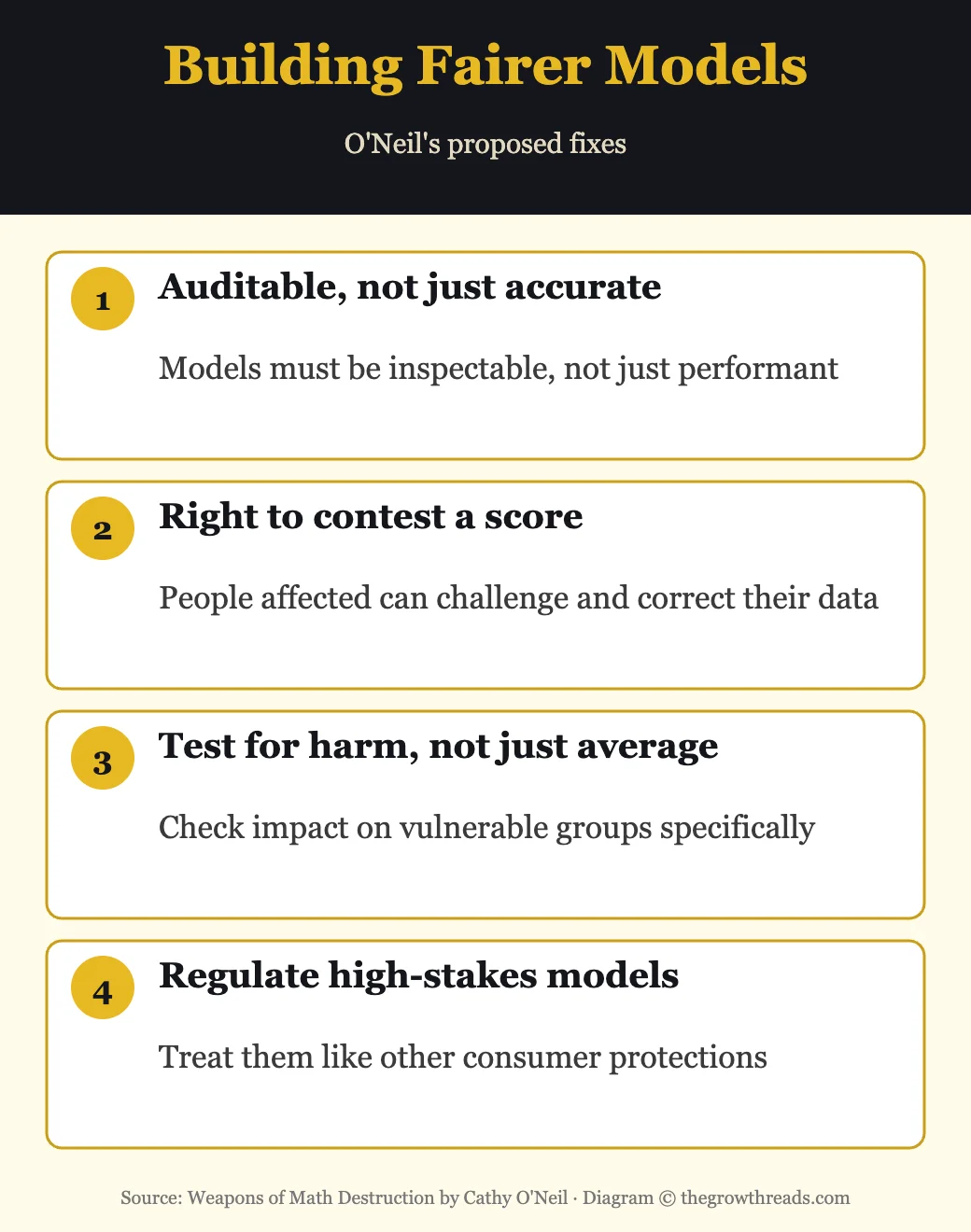
O’Neil is careful not to argue that algorithms should be abandoned; her point is that the same mathematical tools built the 2008 financial crisis models and could, with different incentives, be built to serve fairness instead of profit or efficiency alone. Her proposed fixes center on four practical shifts. Models should be auditable, not just accurate, meaning outside reviewers can inspect a model’s logic and its disparate impact on protected groups, not merely trust the company’s word that it works. People scored by a high-stakes model should have a genuine right to see their score and contest it, the same way credit reports can already be disputed.
Third, models should be tested for harm across subgroups, not just for average accuracy across a whole population, since a model can be 95% accurate overall while being badly, systematically wrong for one vulnerable group. Fourth, she calls for actual regulation of high-stakes algorithmic domains, comparing the current unregulated state of hiring and lending algorithms to finance before the SEC: a powerful, opaque system operating with no external check until it caused visible harm. She closes on a cautious note of hope, pointing to early efforts like algorithmic auditing firms and a “Hippocratic Oath” for data scientists as signs the field could still self-correct before regulation becomes mandatory.
Who is Weapons of Math Destruction best for — and who should read something else first?
This book is best for anyone who interacts with, builds, or is affected by automated scoring systems, which today means nearly everyone, but especially hiring managers, HR and lending professionals, policymakers, and parents navigating school algorithms. If you want the more technical, hands-on side of how models actually get built and audited, start with The Alignment Problem. If you’re more interested in who controls the handful of companies building today’s largest AI systems, The Big Nine is the better starting point.
Questions to reflect on
- What automated scores or algorithms currently affect your job, credit, insurance, or housing options, and do you know how they work?
- If a model made a decision about you today, could you find out why, and could you appeal it?
- Where in your own work might you be building or relying on a model whose accuracy you’ve never tested across different subgroups?
- What proxy variables (zip code, browsing history, name) might be quietly standing in for something the model isn’t allowed to ask directly?
- Which of O’Neil’s four fixes — auditability, right to contest, subgroup testing, or regulation — is missing from a system you rely on?
🔥 Ready to see through the algorithms shaping your life?
Grab a copy of Weapons of Math Destruction and start asking the right questions about the models that score you.
How to apply Weapons of Math Destruction (7-day plan)
- Day 1: List every algorithm you know touches your life — credit score, insurance premium, job application filters, social media feed, streaming recommendations.
- Day 2: Pick one from that list and research whether the company discloses how it works or offers any appeal process.
- Day 3: Pull your own credit report and check it for errors, since it’s one of the few scoring systems you have a legal right to contest.
- Day 4: If you’re a hiring manager or work in HR, ask whether any screening tools your company uses have been audited for disparate impact.
- Day 5: Practice O’Neil’s three-question test (opacity, scale, damage) on a news story about an algorithm you encounter this week.
- Day 6: If you build or manage models professionally, write down one subgroup your current model has never been tested against.
- Day 7: Share one thing you learned with a colleague or friend who makes decisions using automated tools, and ask how their team checks for fairness.
Frequently asked questions
What is a Weapon of Math Destruction, in simple terms?
A Weapon of Math Destruction, or WMD, is Cathy O’Neil’s term for an algorithm that combines three traits: it’s opaque so the people it judges can’t see how it works, it operates at scale so it affects large numbers of people at once, and it causes real damage such as a lost job or denied loan. A model missing any of these three traits is simply imperfect rather than dangerous; it’s the combination that makes a WMD hard to challenge and easy to hide behind.
Is Weapons of Math Destruction still relevant, since it was published in 2016?
Yes — if anything more relevant, since the scale of automated decision-making in hiring, lending, insurance, and now generative AI has grown substantially since publication. The specific companies and tools O’Neil names have changed, but the underlying pattern she diagnoses, opaque scale-driven models causing unaccountable harm, has become more common, not less, making her diagnostic framework more useful today than when it was written.
Does the book argue that algorithms should never be used?
No. O’Neil is explicit that she isn’t anti-algorithm; she spent years building models herself. Her argument is that the same mathematical techniques that caused harm could be redirected toward fairness with the right incentives, oversight, and testing. The book’s proposed fixes, like auditability and subgroup testing, assume algorithms will keep being used and focus on making that use accountable rather than eliminating it.
What’s the most famous example from the book?
The Washington D.C. teacher evaluation system (IMPACT) is probably the most cited example, because it shows a WMD’s mechanics clearly: a statistically noisy value-added score fired real teachers based on year-to-year fluctuations that had little to do with actual teaching quality, and the affected teachers had no meaningful way to see or contest the formula behind their firing.
How does this book relate to predictive policing controversies?
O’Neil devotes a chapter to predictive policing software that sent patrols back to neighborhoods with historically high arrest rates, which increased arrests there, which then fed back into the model as confirmation the neighborhood was high-crime. She uses this as her clearest example of a feedback loop, a WMD trait where the model’s own outputs generate the data that reinforces its future behavior, regardless of where crime is actually occurring.
Is this book technical, or accessible to a general reader?
It’s written for a general audience. O’Neil deliberately avoids equations and technical jargon, instead using narrative case studies and plain-language analogies drawn from her own Wall Street and data-science career. Some of the underlying statistical debates about specific studies have been challenged since publication, but the accessible, story-driven explanation of how flawed models spread remains widely regarded as sound and uncontroversial.
What should I read after this book?
For a more hands-on, technical look at fixing the problems O’Neil identifies, The Alignment Problem is a strong next step. If you want to understand who controls the largest AI systems shaping these algorithms, The Big Nine covers that ground well.
Related summaries
- The Alignment Problem by Brian Christian
- The Big Nine by Amy Webb
- Hello World by Hannah Fry
- Genius Makers by Cade Metz
See all Best Technology & AI Books →
Related Technology Summaries
Chip War Summary & Review: Why Silicon Chips Now Decide Global Power
Rise of the Robots Summary & Review: Why Automation Now Threatens Cognitive Jobs Too
Superminds Summary & Review: How People and AI Think Smarter Together
The Second Machine Age Summary & Review: The Bounty and the Spread of Digital Technology
Working with AI Summary & Review: What 29 Real Deployments Actually Prove