

★★★★☆ 4.4/5 — The clearest economic case for why digital technology is a bigger deal than most people realize.
Best for: Readers who want to understand AI and automation through an economics lens — growth, jobs, and inequality — rather than a purely technical one.
Reading time: ~7 hrs to read the full book · 11 min for this guide
Difficulty to apply: Moderate — the ideas are about strategy and policy as much as personal habits.
The Second Machine Age in one minute
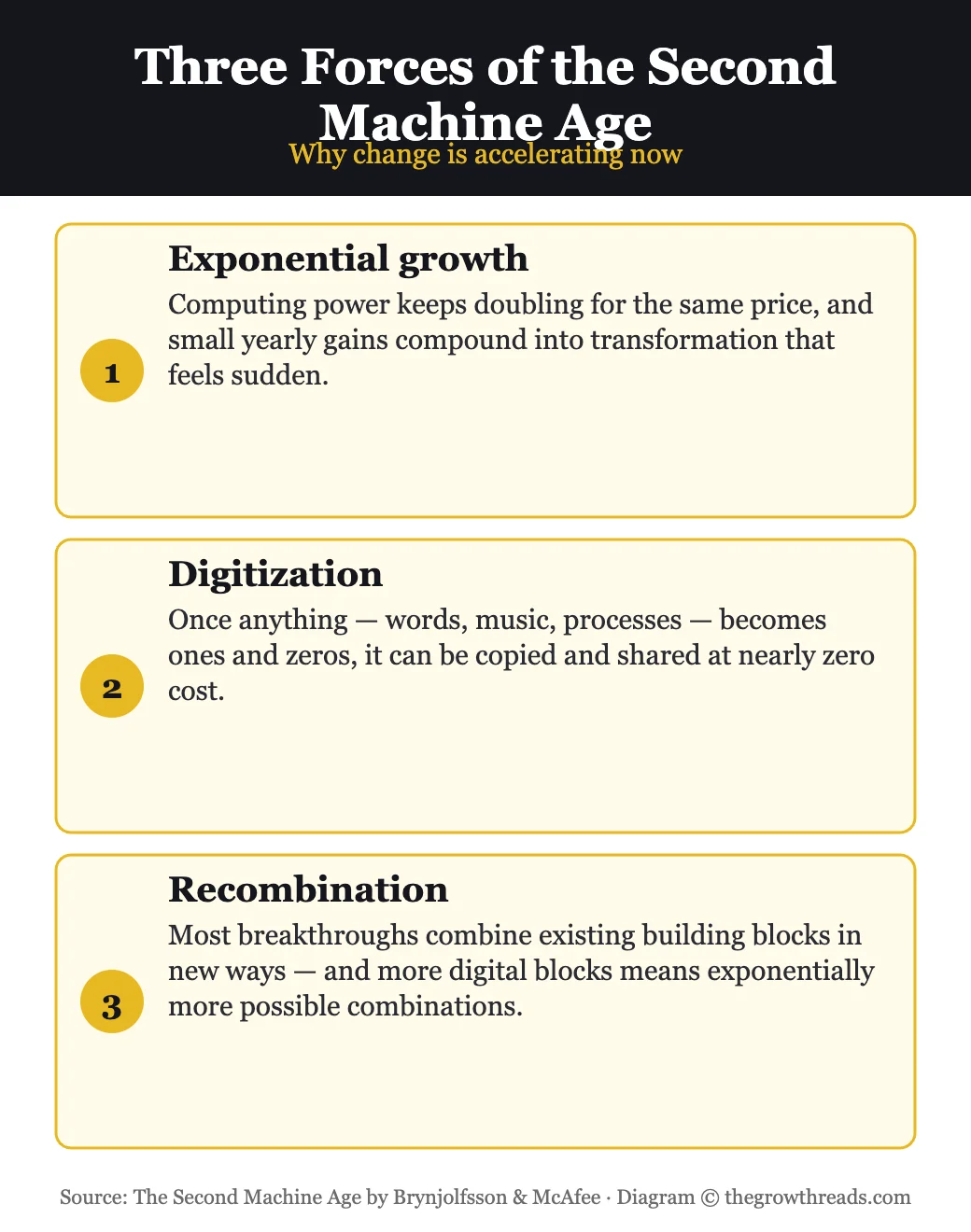
Digital technology is doing to mental work what the steam engine did to physical work — unleashing a wave of prosperity so large that the old economic playbook can’t fully explain it, while also concentrating the gains more narrowly than at any point in modern history. Erik Brynjolfsson and Andrew McAfee, both MIT researchers, make the case that we are living through a second great inflection point in economic history, driven by three forces: exponential growth in computing power, the digitization of nearly everything, and combinatorial innovation from recombining digital building blocks.
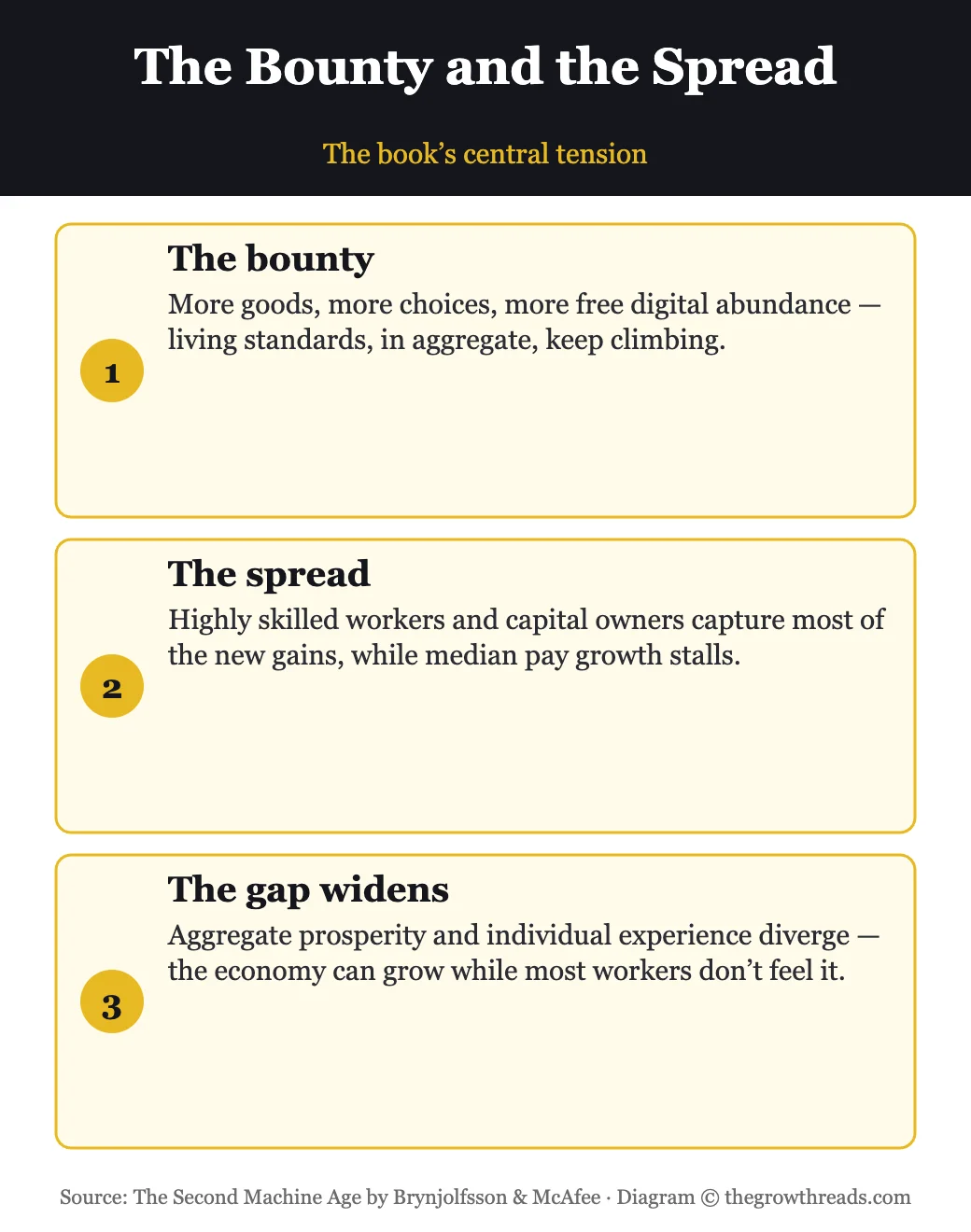
The book’s central, memorable framing is “the bounty and the spread” — technology is creating enormous aggregate abundance (the bounty) while distributing the gains increasingly unevenly (the spread). Written in 2014, it was one of the first mainstream books to seriously grapple with what automation and AI mean for jobs, wages, and inequality, and its core diagnosis has only become more relevant since.
Key takeaways
- We’re in a second machine age, not just a continuation of the first. The Industrial Revolution automated physical power; digital technology is now automating cognitive and routine mental work.
- Three forces are driving the acceleration: exponential growth in computing power, digitization of information, and recombinant innovation building on existing digital blocks.
- “The bounty” is real and enormous. Digital goods and services have created abundance and convenience unmatched in economic history, often at near-zero marginal cost.
- “The spread” is just as real. Gains increasingly flow to owners of capital and highly skilled workers, while median wages stagnate even as productivity climbs.
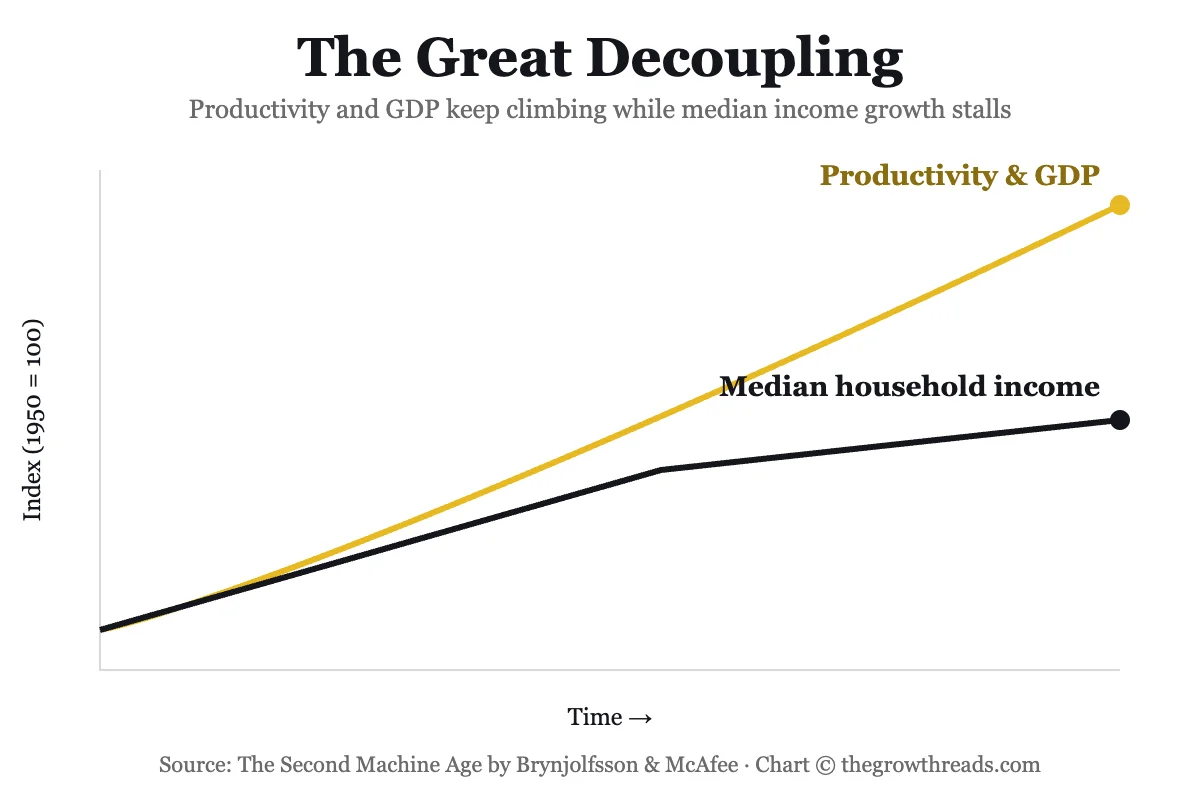
- GDP and productivity have “decoupled” from employment and median income. The economy can grow substantially while most workers don’t feel the benefit in their paychecks.
- Superstar economics reshapes many markets. Digital distribution lets the single best product or performer capture a market that used to support many local competitors.
- Racing with the machine beats racing against it. The winning strategy pairs human judgment and creativity with machine speed and computation, not competing head-to-head.
- Median wages growing well below productivity is a warning sign. The authors treat this as the central labor-market symptom of the second machine age.
- Policy matters as much as technology. The authors argue for reforms in education, entrepreneurship support, and infrastructure investment to spread the bounty more broadly.
- This is an early diagnosis, not a final verdict. Written years before generative AI, the book’s economic framework remains a useful lens for understanding today’s AI-driven disruption.
What is The Second Machine Age about?
The Second Machine Age argues that digital technology is triggering an economic transformation as significant as the Industrial Revolution, creating enormous prosperity (the bounty) while concentrating its gains unevenly (the spread). Erik Brynjolfsson and Andrew McAfee explain why productivity keeps rising even as median wages stagnate, and what individuals and policymakers can do about it.
About the authors
Erik Brynjolfsson and Andrew McAfee are both researchers at MIT, where they co-founded and co-directed the Initiative on the Digital Economy. Brynjolfsson holds a PhD from MIT and has spent his career studying the economics of information technology and productivity; McAfee, a principal research scientist at MIT Sloan, focuses on how digital technologies change business and the economy. The two have co-authored multiple books on technology and the economy, and The Second Machine Age was their first joint work aimed at a general audience — grounded in academic research on productivity, labor markets, and technological change, but written to be accessible well beyond economics circles.
| Concept | What it means | Use it when |
|---|---|---|
| The bounty | The aggregate abundance and prosperity created by digital technology | Explaining why living standards and choice keep expanding |
| The spread | The uneven distribution of technology’s gains across workers and capital owners | Understanding why growth doesn’t always reach everyone equally |
| The great decoupling | GDP and productivity rising while median income growth stalls | Diagnosing why “the economy is growing” doesn’t always feel true |
| Combinatorial innovation | New breakthroughs formed by recombining existing digital building blocks | Understanding why innovation is accelerating, not just individual technologies |
| Superstar economics | Digital distribution letting a single best product capture an entire market | Explaining winner-take-most dynamics in digital markets |
| Racing with the machine | Combining human judgment with machine computation instead of competing against it | Designing roles and workflows around automation, not just cutting them |
Part 1: Why this is a second machine age, not just more of the same
Brynjolfsson and McAfee open by drawing a direct parallel to the Industrial Revolution: steam power freed human progress from the limits of muscle power, and digital technology is now freeing it from the limits of individual brainpower. What makes this second transition different, they argue, is speed and scale — three forces compound on each other. Exponential growth means computing power for the same price keeps roughly doubling, so improvements that once took decades now take years. Digitization means anything reducible to information — music, writing, logistics, medical diagnoses — can be copied and distributed at near-zero marginal cost. And combinatorial innovation means most breakthroughs aren’t wholly new inventions, they’re novel combinations of existing digital building blocks, and more building blocks means an explosion of possible combinations.
Together, these forces explain why technological change can feel simultaneously gradual for years and then suddenly overwhelming — a smartphone in 2007 looks unremarkable compared to today’s devices, but the compounding underneath it was there the whole time. This framing gives readers a durable mental model for evaluating any new technology wave, including the generative-AI boom that arrived years after the book’s publication.
TGR Note: Mustafa Suleyman describes a similar compounding acceleration in The Coming Wave — Brynjolfsson and McAfee’s three forces are the economic mechanics underneath the wave Suleyman warns is approaching.
Part 2: The bounty and the spread
This is the book’s signature argument. The bounty is unambiguous: digital technology has produced more goods, more services, more free information, and more consumer choice than any prior era, often at costs approaching zero. Wikipedia alone replaced encyclopedias that once cost families hundreds of dollars. But the spread is just as real and far less discussed at the time the book was published: the gains from this abundance flow disproportionately to owners of capital, highly skilled workers, and superstar performers, while the median worker’s wages have grown far slower than overall productivity.
The authors illustrate this with what’s become known as “the great decoupling” — a chart showing GDP and productivity climbing steadily upward while median household income and employment growth flatten by comparison, a divergence that began around the 1980s and has continued since. This isn’t framed as an argument against technology; it’s framed as evidence that the benefits of technological progress don’t distribute themselves automatically, and that policy and institutional choices determine how widely the bounty is shared.
TGR Note: Kai-Fu Lee explores a related dynamic at the national level in AI Superpowers — where Brynjolfsson and McAfee look at the spread within an economy, Lee looks at the spread between economies competing for AI dominance.
Part 3: Racing with the machine
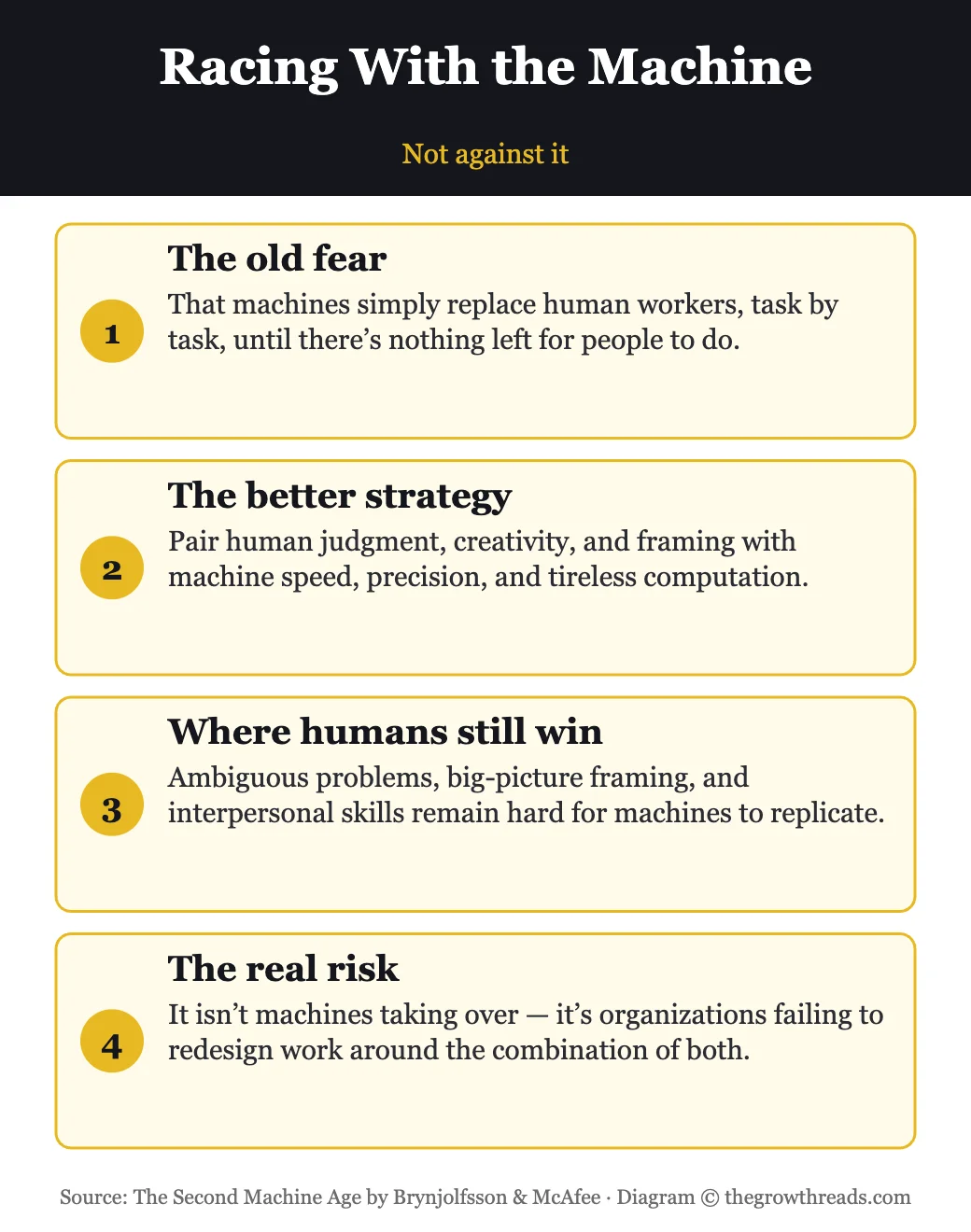
The book’s most practical section reframes a common fear: that automation is a zero-sum race between humans and machines, one that humans will inevitably lose as technology improves. Brynjolfsson and McAfee argue this framing is wrong on its own terms. The winning strategy across every domain they examine — from radiology to chess to logistics — is combination, not competition: pairing human judgment, creativity, and contextual understanding with machine speed, precision, and tireless pattern recognition.
They point to freestyle chess, where teams combining human strategists with chess engines consistently outperform either humans or engines alone, as the clearest proof of concept. The chapter’s real argument is organizational: the businesses and workers who thrive won’t be the ones trying to out-compute machines, they’ll be the ones who redesign roles and workflows around the combination. The risk isn’t that machines take over wholesale — it’s that organizations fail to make this redesign, wasting the bounty on jobs structured for a world that no longer exists.
TGR Note: Ethan Mollick’s central advice in Co-Intelligence — always invite AI to the table, but keep a human in charge — is the individual, day-to-day version of the “racing with the machine” strategy this book argues for at an economic scale.
Who is The Second Machine Age best for — and who should read something else first?
This book is ideal for readers who want to understand AI and automation through an economics and policy lens — how growth, wages, and inequality actually interact — rather than purely as a technology story. It rewards readers with some patience for data and graphs, though the writing stays accessible throughout.
If you want the more current, AI-specific version of “racing with the machine” for your own daily work, start with Co-Intelligence instead. If you want the geopolitical stakes of the AI race between nations, AI Superpowers is the better next step. And for a longer-horizon look at where the acceleration described here eventually leads, The Coming Wave picks up the thread.
Questions to reflect on
- Where in your own field is “the bounty” showing up most clearly — more abundance, lower costs, more choice?
- Where might “the spread” be affecting you or your colleagues — gains concentrating somewhere you don’t see?
- What would it look like to redesign your own role around combining your judgment with a machine’s speed?
- What skills feel most durable to you as automation keeps advancing, and why?
- If productivity keeps climbing in your industry, where should that value actually go?
🔥 Ready to understand the economics behind the AI era?
Get The Second Machine Age and see the bounty and the spread driving today’s technology debates.
How to apply The Second Machine Age (7-day plan)
- Day 1: List the digital “bounty” you personally benefit from daily — free tools, instant information, low-cost services — and notice how much of it barely existed a decade ago.
- Day 2: Identify one task in your work that’s purely routine and repeatable, and consider whether it’s a candidate for automation or AI assistance.
- Day 3: Identify one task that depends heavily on judgment, context, or relationships — a task where you’re confident a human edge remains durable.
- Day 4: Research how productivity and wages have moved in your specific industry over the past decade, and see if you can spot your own version of “the spread.”
- Day 5: Try “racing with the machine” deliberately: pair an AI tool with your own judgment on a real task, and note where the combination beats either alone.
- Day 6: Talk to a colleague about how your team’s roles might be redesigned around combining human and machine strengths, rather than just cutting headcount.
- Day 7: Write down one skill you want to invest in that seems durable against automation — creativity, judgment, complex communication — and one concrete next step to develop it.
Frequently asked questions
What does “the bounty and the spread” mean?
The bounty is the aggregate abundance created by digital technology — more goods, services, and choices, often at near-zero cost. The spread is the uneven distribution of those gains, with capital owners and highly skilled workers capturing disproportionately more than median workers. Brynjolfsson and McAfee argue both are simultaneously true and equally important to understand.
What is “the great decoupling”?
It’s the pattern, starting around the 1980s, where GDP and productivity kept climbing steadily while median household income and employment growth flattened by comparison. The authors use this as evidence that economic growth and individual prosperity have become disconnected in ways the old economic playbook doesn’t fully explain.
Is this book still relevant given how much AI has changed since 2014?
Yes — the book’s core economic framework (exponential growth, digitization, recombination, the bounty and the spread) remains a useful lens for understanding today’s AI boom, even though it predates generative AI specifically. The mechanics it describes have, if anything, accelerated since publication.
What does “racing with the machine” mean in practice?
It means combining human judgment, creativity, and contextual understanding with machine speed and computational power, rather than trying to compete directly against automation. The authors cite freestyle chess, where human-machine teams consistently outperform either humans or engines alone, as the clearest example.
Does the book predict mass unemployment from AI and automation?
No — the authors avoid both blanket optimism and doom predictions. They argue the challenge isn’t a shortage of jobs overall but a mismatch between how work is organized and what technology now makes possible, along with a genuine distributional problem in how the gains are shared.
What is superstar economics?
It’s the dynamic where digital distribution lets a single best product, platform, or performer capture a market that used to support many smaller, local competitors. Because digital goods can scale globally at near-zero marginal cost, small differences in quality can translate into enormous differences in market share.
What policy solutions does the book propose?
Brynjolfsson and McAfee focus on education reform, support for entrepreneurship, updated infrastructure, and tax and labor policies that don’t unintentionally discourage hiring. They frame these as ways to spread the bounty more broadly rather than as a single silver-bullet fix.
Related summaries
- Co-Intelligence by Ethan Mollick
- AI Superpowers by Kai-Fu Lee
- The Coming Wave by Mustafa Suleyman
- Browse all Technology book summaries
How we analyze books: We read the full text, cross-reference key claims against the author’s interviews and published research, and build original diagrams to make the core frameworks easier to apply. Read our full methodology.
Related Technology Summaries
Homo Deus: A Brief History of Tomorrow Summary & Review (2026)
Machines of Loving Grace Summary & Review: The Hidden Fork Behind Every AI Debate
The New Breed Summary & Review: What Animals Teach Us About Living with Robots
The Singularity Is Near Summary & Review: Why Kurzweil Thinks 2045 Changes Everything
Uncanny Valley Summary & Review: Silicon Valley’s Utopia, From the Inside