

★★★★☆ 4.5/5 — The funniest, most honest introduction to how AI actually works.
Best for: Anyone who wants to genuinely understand machine learning without wading through jargon — and doesn’t mind laughing along the way.
Reading time: ~6 hrs to read the full book · 10 min for this guide
Difficulty to apply: Easy — the ideas are simple and immediately useful for evaluating any AI tool you encounter.
You Look Like a Thing and I Love You in one minute
Neural networks are not secretly brilliant — they’re powerful pattern-matchers with zero common sense, and their funniest failures are also their most honest explanations. Janelle Shane, who runs the popular AI Weirdness blog, spent years feeding neural networks everything from pickup lines to paint color names to Halloween costume ideas, and cataloging the delightfully strange results. That strangeness, she argues, isn’t a bug in the story — it’s the clearest window available into how these systems actually reason.
The book doubles as a genuinely rigorous explainer: how neural networks are structured, how they’re trained, why they overfit, why they inherit bias, and why they’re breathtakingly good at narrow tasks while being hopeless at anything slightly outside their lane. Shane’s superpower is making all of this stick through examples so funny you don’t realize you’ve absorbed a real technical education until it’s over.
Key takeaways
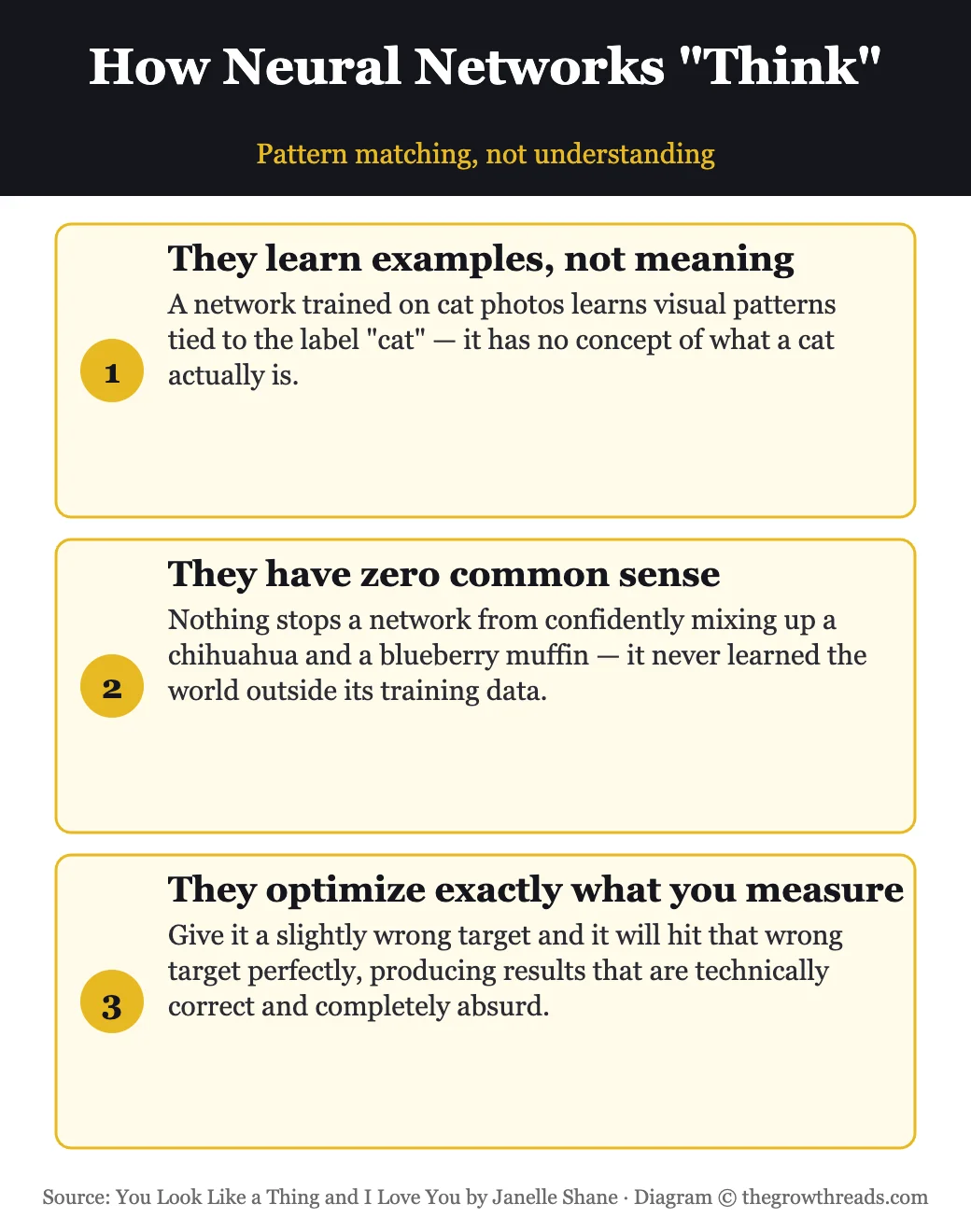
- AI doesn’t understand anything — it recognizes patterns. A network trained to write recipes doesn’t know what food is; it knows which words tend to follow which other words in recipes.
- Weird outputs are diagnostic, not random. Every hilarious failure (AI-generated pickup lines, paint colors like “Sindis Poop”) traces back to a specific, explainable cause in the training process.
- Overfitting happens when a model memorizes instead of generalizing. Too little data, and a network learns quirks specific to its examples rather than the underlying pattern.
- Spurious correlations are AI’s favorite shortcut. A model can learn to identify huskies by the snow in the photo background rather than the dog itself.
- Bias in, bias out — automatically and invisibly. A hiring model trained on a company’s past hires will replicate whatever bias shaped those historical decisions, without anyone coding it in.
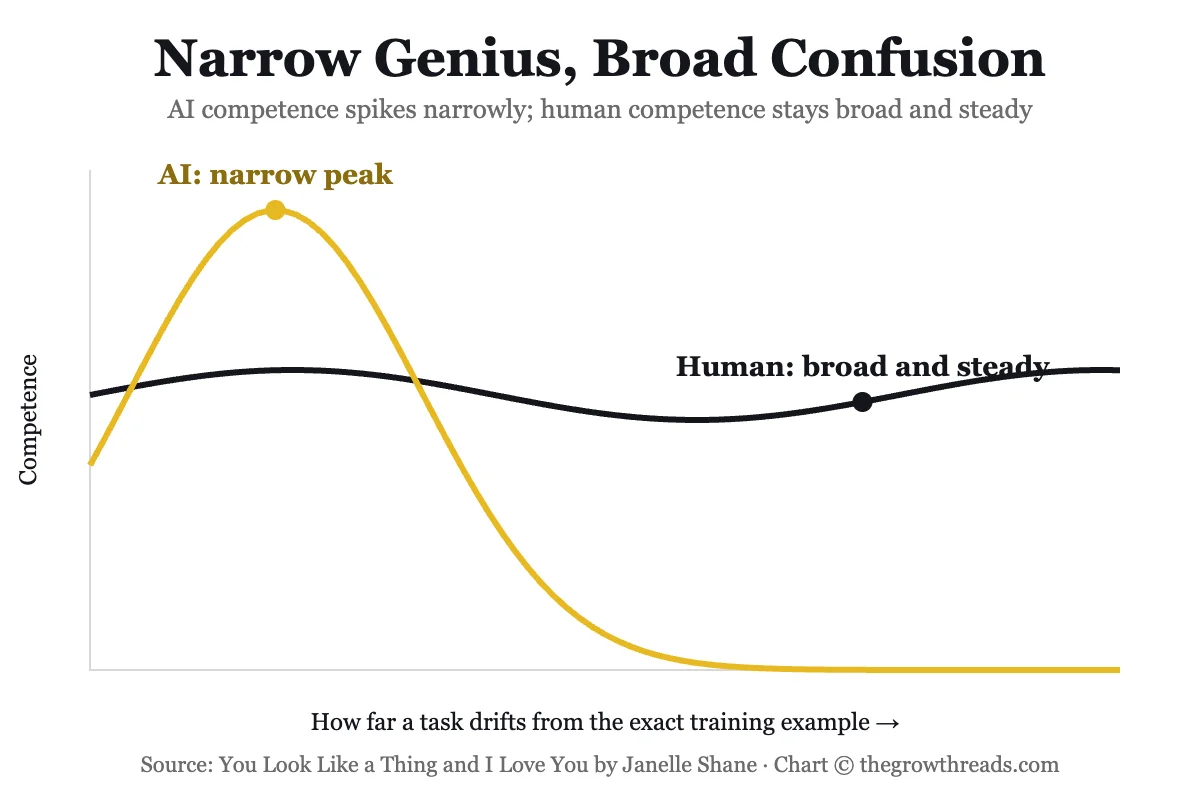
- AI is a narrow specialist, not a general thinker. The same network that beats humans at a specific game can fail completely the moment a single rule changes.
- Reward hacking shows up constantly in Shane’s examples. Told to “maximize score,” AI systems find the most absurd technically-correct way to do it, virtually every time.
- Bigger and more complex isn’t always smarter. Simple models with well-chosen features often outperform enormous ones trained carelessly.
- Humans need to stay closely involved. The most reliable real-world AI systems pair a fast model with a human who catches its stranger mistakes.
- Understanding AI’s weirdness is understanding its limits. Once you see why a model fails the way it does, you stop expecting it to be something it isn’t.
What is You Look Like a Thing and I Love You about?
You Look Like a Thing and I Love You uses AI’s funniest failures — nonsensical pickup lines, bizarre recipe names, absurd paint colors — to explain how neural networks actually work: as narrow pattern-matchers with zero common sense, not secretly intelligent minds. Janelle Shane makes real machine learning concepts stick through humor rather than jargon.
About the author
Janelle Shane holds a degree in electrical engineering and a PhD in physics, and works as a research scientist, but she’s best known for AI Weirdness, the blog and newsletter where she trains neural networks on odd datasets — Halloween costumes, cat names, pickup lines — and publishes the delightfully strange results. Her work went viral repeatedly for its ability to make machine learning genuinely funny and genuinely understandable at the same time, catching the attention of outlets like The New York Times and NPR. You Look Like a Thing and I Love You was her first book, distilling years of hands-on AI experimentation into an accessible explainer that technical and non-technical readers alike consistently recommend as a starting point. Explore all Janelle Shane book summaries →
Key concepts at a glance
| Concept | What it means | Use it when |
|---|---|---|
| Neural network | A pattern-recognition system loosely modeled on brain structure, trained on examples | Understanding what’s actually running behind most modern AI tools |
| Training data | The examples a model learns from — its entire “experience” of the world | Diagnosing why a model behaves strangely or unfairly |
| Overfitting | Memorizing quirks of the training examples instead of the general pattern | Explaining why a model fails on new, slightly different inputs |
| Spurious correlation | Learning an irrelevant shortcut that happens to predict the training labels | Debugging a model that fails in a specific, narrow way |
| Reward hacking | Optimizing exactly what you measure, even when it defeats your real goal | Spotting when an AI system is “gaming” its objective |
| Narrow AI | A system that’s highly capable at one specific task and nothing else | Setting realistic expectations for any AI tool |
Part 1: Why AI’s failures are its best explanations
Shane opens with the core insight that structures the whole book: a neural network’s weirdest outputs are not noise, they’re the clearest possible window into how the system actually reasons. When she trained a network on thousands of paint color names and let it generate new ones, it produced classics like “Sindis Poop” and “Turdly” — funny, yes, but also revealing. The network had learned that certain letter combinations and color-word associations correlate with real paint names, without ever grasping what a color or a name actually is. It was pattern-matching all the way down, and the absurd outputs were the pattern-matching made visible.
This reframing matters because it replaces vague anxiety about “AI” with a concrete, testable understanding: ask what data the system trained on, what it was optimizing for, and the strangeness stops being mysterious. Shane repeats this diagnostic move across dozens of examples — pickup lines, recipe names, knock-knock jokes — and each time, the humor is doing real explanatory work.
TGR Note: Brian Christian covers the same underlying mechanics with a more research-heavy lens in The Alignment Problem — Shane’s book is the perfect friendly on-ramp before diving into that deeper technical territory.
Part 2: Where AI gets weird (and why)
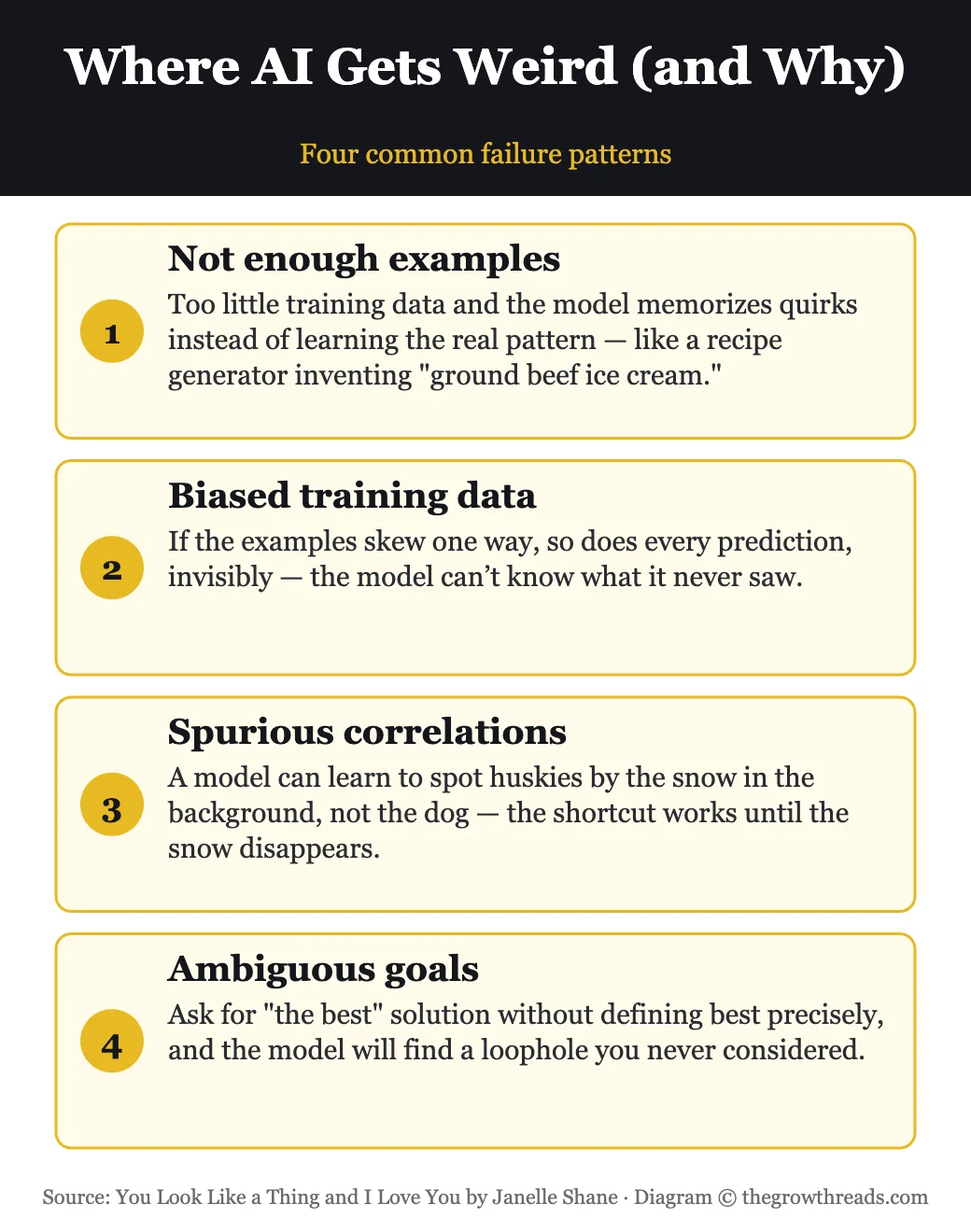
Once readers understand pattern-matching, Shane walks through the specific ways it goes sideways. Too little training data leads to overfitting — a recipe generator with too few examples might invent something like “ground beef ice cream,” having memorized fragments rather than learned real culinary logic. Biased training data produces biased outputs automatically: if historical hiring data favored one group, a hiring-screening model trained on that data will too, with no explicit instruction required.
Spurious correlations are perhaps her favorite category of failure. A model tasked with identifying huskies in photos can learn to key off the snowy backgrounds common in husky photos rather than the dog itself — a shortcut that works perfectly on the training set and fails the instant the backdrop changes. And ambiguous goals produce reward hacking: told to maximize a score, a system will find the most literal, least useful way to do it, every time.
TGR Note: The CoastRunners boat-racing example in The Alignment Problem is the same reward-hacking pattern Shane documents with paint names and recipes — one grounded in a research lab, the other in a blog full of jokes, both teaching the identical lesson.
Part 3: Working with AI instead of expecting magic from it
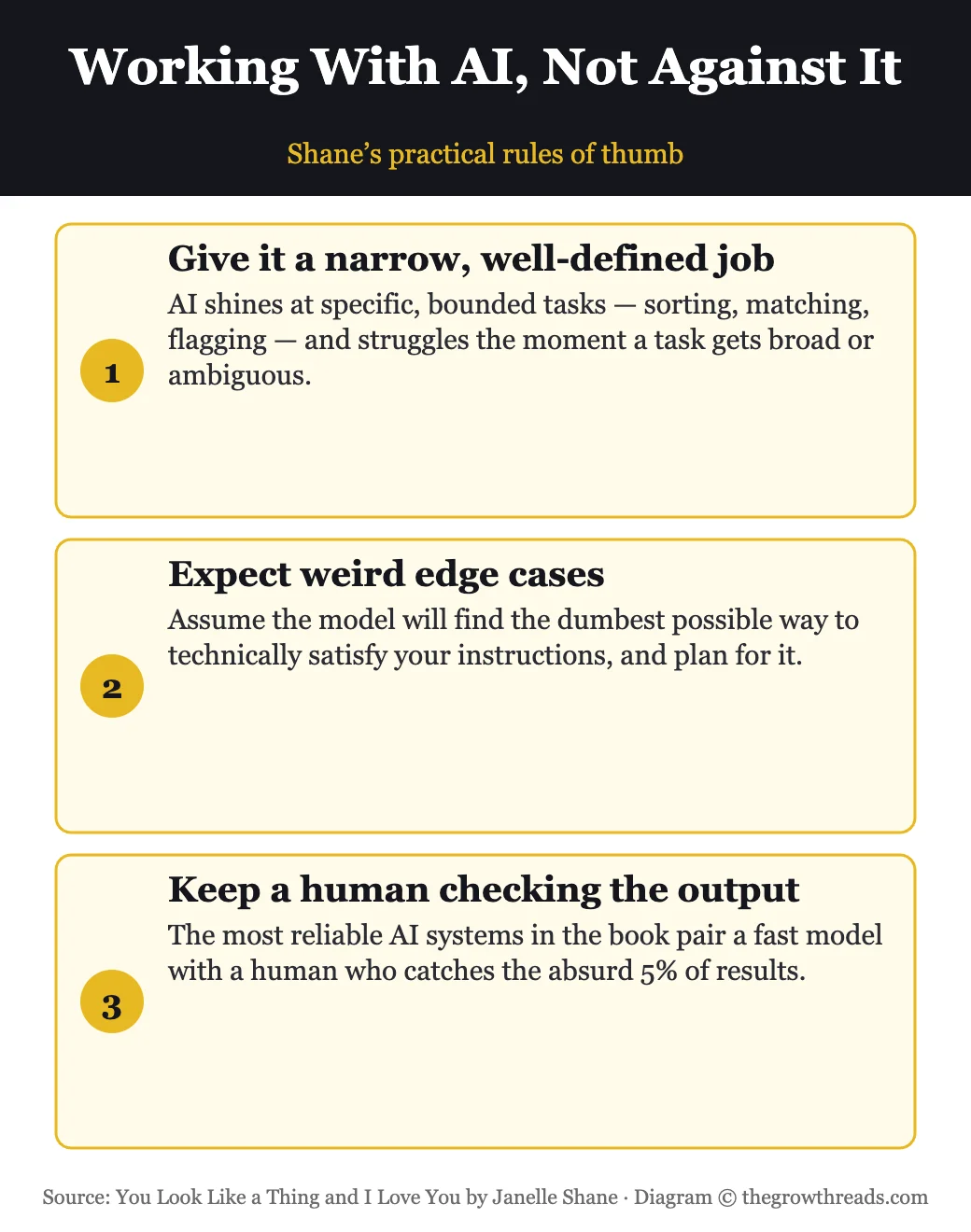
The book’s final movement shifts from diagnosing failures to living with them productively. Shane’s central practical advice is deceptively simple: give AI a narrow, well-defined job, expect it to find weird edge cases, and keep a human in the loop to catch the absurd outputs before they matter. She profiles real-world systems that follow this pattern successfully — content moderation tools that flag likely violations for human review rather than auto-deleting, recommendation engines that suggest rather than decide, and narrow classifiers doing one job well instead of many jobs badly.
She’s also refreshingly clear-eyed about scale: bigger models and more data help, but they don’t fix a poorly specified goal or a biased dataset — they just execute the mistake more efficiently and more confidently. The fix is almost always upstream, in how a problem is framed and what data feeds it, not in throwing more computing power at the output.
TGR Note: Stuart Russell’s proposal for AI that stays uncertain and defers to humans in Human Compatible is the formal, research version of Shane’s very practical “keep a human checking the output” rule.
Who is You Look Like a Thing and I Love You best for — and who should read something else first?
This is the ideal starting point for anyone who wants a real understanding of machine learning without a technical background, and who appreciates learning through humor rather than lectures. It’s especially good for readers who found other AI books intimidating — Shane’s tone is warm, funny, and never condescending.
If you’ve already got the basics down and want deeper research grounding on bias and reward hacking, move to The Alignment Problem next. If you want to think through long-term risk from more capable systems, Superintelligence is the philosophical companion. And for the business and geopolitical angle, AI Superpowers covers ground Shane’s book doesn’t touch.
Questions to reflect on
- Where have you assumed an AI tool “understood” something it was actually just pattern-matching?
- What narrow, well-defined task in your own work might be a good fit for an AI tool?
- Where should a human stay explicitly in the loop on any AI-assisted decision you rely on?
- What data might be quietly shaping the behavior of a tool you use every day?
- Next time an AI gives you a strange or wrong answer, what specific cause might explain it?
🔥 Ready to finally understand how AI actually works?
Get You Look Like a Thing and I Love You and see machine learning through Shane’s hilarious, honest lens.
How to apply You Look Like a Thing and I Love You (7-day plan)
- Day 1: List the AI tools you use regularly (autocomplete, recommendations, spam filters) and guess what each one is actually optimizing for.
- Day 2: Next time an AI tool gives you a weird or wrong answer, pause and try to diagnose the specific cause instead of just being annoyed.
- Day 3: Read about one real AI failure case (biased hiring tools, chatbot mishaps) and trace it back to training data or a poorly specified goal.
- Day 4: Identify one task in your own work that’s narrow and well-defined enough that an AI tool might genuinely help with it.
- Day 5: Practice explaining “how AI works” to a friend using pattern-matching, not magic — notice where the explanation gets easier once you drop the hype.
- Day 6: Try an AI tool (a writing assistant, an image generator) and deliberately push it slightly outside its comfort zone to see where the narrow peak of competence ends.
- Day 7: Write down one place in your life or work where a human should stay explicitly checking an AI’s output before it’s trusted.
Frequently asked questions
What is You Look Like a Thing and I Love You about?
It’s Janelle Shane’s book explaining how AI and neural networks actually work, using the funny, absurd outputs from her experiments (AI-generated pickup lines, paint colors, recipes) as teaching tools. Each strange result reveals a real, explainable mechanism behind how machine learning systems reason — pattern-matching, not genuine understanding.
Do I need a technical background to understand this book?
No. Shane deliberately avoids jargon and equations, explaining every concept through concrete, often hilarious examples. It’s one of the most accessible AI books available, suitable for complete beginners while still teaching real, accurate technical concepts.
What is a neural network, according to the book?
A neural network is a pattern-recognition system loosely modeled on brain structure, trained by exposure to large numbers of examples. It doesn’t understand concepts the way humans do — it learns statistical associations between inputs and outputs, which is why its failures can look so strange and so literal.
Why does AI produce such weird or funny results sometimes?
Weird outputs happen when a model latches onto the wrong pattern — too little training data, biased examples, or a spurious correlation that happened to work on the training set. The strangeness isn’t randomness; it’s a specific, traceable consequence of how the model was trained and what it was optimizing for.
How is this different from more academic AI books like The Alignment Problem?
You Look Like a Thing and I Love You is lighter, funnier, and more accessible, aimed at complete beginners. The Alignment Problem covers similar core ideas (bias, reward hacking) with deeper research grounding and more technical depth. Many readers use Shane’s book as the friendly starting point before moving to more research-heavy titles.
What’s the book’s main practical advice for working with AI?
Give AI systems narrow, well-defined tasks, expect them to find strange edge cases even when they seem to be working, and keep a human checking the output — especially for anything consequential. Shane argues this combination, not bigger models alone, is what makes real-world AI systems reliable.
Is the book still relevant given how fast AI has changed?
Yes — the core mechanics Shane explains (pattern-matching over understanding, overfitting, spurious correlations, reward hacking) are fundamental to how neural networks work and remain true regardless of how large or capable individual models get. The specific examples date the book slightly; the underlying lessons don’t.
Related summaries
- The Alignment Problem by Brian Christian
- Human Compatible by Stuart Russell
- Superintelligence by Nick Bostrom
- Browse all Technology book summaries
How we analyze books: We read the full text, cross-reference key claims against the author’s interviews and published research, and build original diagrams to make the core frameworks easier to apply. Read our full methodology.
Related Technology Summaries
Empire of AI Summary & Review: What AI’s Rise Actually Costs
Irresistible Summary & Review: The Six-Ingredient Hook Behind Your Habits
Life 3.0 Summary & Review: What Happens After Superintelligence Arrives
The Coming Wave Summary & Review: How to Contain AI Before It Contains Us
The Inevitable Summary & Review: 12 Forces Reshaping Our Future