

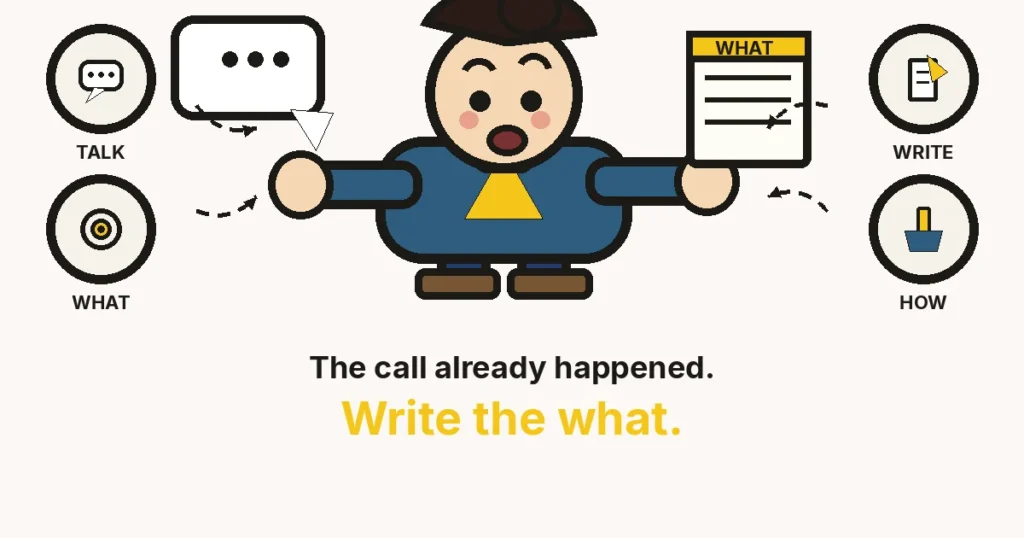
The direction never gets written when the important call stays in a chat or a hallway and no page states the what. Ben Horowitz’s training document, posted 15 June 2012, says good product managers do not give direction informally. Write the target, leave the how, and do not start from the conversation.
Key takeaways
- The direction never gets written when the important call lives in a chat, a hallway, or a call, and nobody can point to a page that states the what.
- Ben Horowitz, in the training document posted 15 June 2012, writes that good product managers do not give direction informally, and that they gather information informally.
- In that document he writes that they crisply define the target, the what as opposed to the how, and that they take a written position on an important issue.
- He writes that a bad product manager voices an opinion verbally, and that after a failure they point out they had predicted it.
- The one-page position on this page is The Growth Reads’ own script. His warning on the 14 May 2010 essay and the 15 June 2012 document says the document was written fifteen years earlier and is probably not a manual for today’s product managers.
What an unwritten direction is
The direction never gets written when the decision has already been spoken and the what still lives in one person’s memory. You are a solo founder. You told the contractor the change on a call. The thread has the greeting and a screenshot. On Thursday the build matches the screenshot and misses the sentence you thought was obvious. You say that is not what you meant. The what was never on a page. You are a new manager. You answered in the doorway between two meetings. On Monday two people are building two versions, and each can quote you. The call happened. The page did not.
A conversation can carry information. It becomes the direction when people are allowed to start from it. The fix is small and specific. One decision. One page. The target in one sentence. What this decision leaves out. Whether a strong effort can finish it. Do this, or do not. Nobody starts until that page exists. Talk after the page is for learning, for a fact you did not have, for a constraint they can see and you cannot. Talk before the page is how the what stays private.
Use the backbrief when a written job already exists and the work comes back as a different job. Use the meeting test when the gathering itself should have been a note. Use the five-line pause when a familiar send is missing a piece you already know. Use the three-way cut when the same kind of ask keeps returning. This page is the earlier failure: there is still no page, so there is nothing to brief, nothing to tick, and nothing to close.
What the pages actually say
The checked copy is two posts by Ben Horowitz, not a chapter. “Why Startups Should Train Their People” is posted 14 May 2010 and was read on 19 November 2026 through the warning he prints above the training document. “Good Product Manager/Bad Product Manager” is posted 15 June 2012 and was read in full the same day. HarperCollins lists The Hard Thing About Hard Things on sale 4 March 2014. Open Library’s record for ISBN 9780062273208 lists HarperBusiness, 2014, 289 pages, and a contents line titled “Why Startups Should Train Their People” under chapter 5. That chapter was not opened. No sentence on this page is taken from a numbered page. The ISBN did not render on the HarperCollins page this run could read. The ISBN above is the one on the Open Library record.
In the 2010 essay he writes that he was Director of Product Management at Netscape and was frustrated by how little value most product managers added. He names chapter 16 of Andy Grove’s High Output Management, “Why Training is The Boss’s Job,” as the chapter that changed his view of training. This page did not open Grove’s book. From that reading, Horowitz writes, he made a short document called Good Product Manager/Bad Product Manager and used it to train the team on his basic expectations. He says he includes it at the end of the post. On the page as read on 19 November 2026, what follows that heading is his warning. The sentences of the document are on the 15 June 2012 post.
He reports that he was shocked by what happened next. The performance of his team instantly improved. Product managers he had thought hopeless became effective. Soon he was managing the highest performing team in the company. That is his account of Netscape. The page gives no count of managers, no before-and-after measure, and no definition of highest performing. It is not a study, and it is not a result to expect from one page in your company.
He gives four reasons the investment in people should not stop at hiring: productivity, performance management, product quality, and retention. On retention he says that, after putting economics aside, the Netscape exit interviews he read showed two primary reasons people quit. They hated their manager, generally for a lack of guidance, career development, and feedback. They were not learning anything. Those interviews were not opened. The detail that belongs here is the lack of guidance. It is his reading of interviews this page did not see. It is not your attrition rate.
The rules this page uses are in the 2012 document, under a warning he also prints on the 2010 essay: “This document was written 15 years ago and is probably not relevant for today’s product managers. I present it here merely as an example of a useful training document.” Read the warning as a limit. The document is an old example of how to make expectations concrete. It is not a current manual for the product job.
Inside that limit, the lines that travel are plain. Good product managers crisply define the target, the “what” as opposed to the how, and manage the delivery of the what. Bad product managers feel best about themselves when they figure out the how. Good product managers communicate crisply in writing as well as verbally. They do not give direction informally. They gather information informally. They take written positions on important issues. He names the kinds of issues: competitive silver bullets, tough architectural choices, tough product decisions, and markets to attack or yield. Bad product managers voice their opinion verbally and lament that the “powers that be” will not let it happen. Once they fail, they point out that they predicted they would fail.
He also writes that good product managers define good products that can be executed with a strong effort. Bad ones define products that cannot be executed, or they let engineering build whatever they want, which he glosses as solving the hardest problem. Good product managers decompose problems. Bad ones combine all problems into one. Good product managers err on the side of clarity rather than explaining the obvious. Bad ones never explain the obvious. Good product managers focus the team on revenue and customers. Bad ones focus the team on how many features Microsoft is building. “Microsoft has 10 times as many engineers” appears on the page as an example of an excuse, beside not enough funding, an engineering manager he calls an idiot, being overworked, and not getting enough direction. He writes that Barksdale does not make those excuses, and neither should the person who owns the product. This page does not add a biography of Barksdale. The point he is making is that the owner of the result does not get a special list of excuses.
Several lines stay in his company and do not become your ritual. “A good product manager is the CEO of the product” is in the document. A solo founder who repeats it has put on a costume. You already own the result. The useful demand is the written what, not a second title. Press stories, sales collateral, weekly status reports, and a marketing counterpart to an engineering manager are the furniture of the team he was training. A founder with a contractor, or a new manager with three people, can leave that furniture on the page where he put it.
The one-page position
Pick one decision that is about to leave the room, and put five lines on a page before anyone starts. He did not try to train every behaviour in the company with one document. He trained one role on the expectations that were already slipping. You do the same. One decision. The change you described on the call. The priority you gave in the doorway. The feature you agreed to in the thread. If you cannot name it in one sentence, you have picked a department.
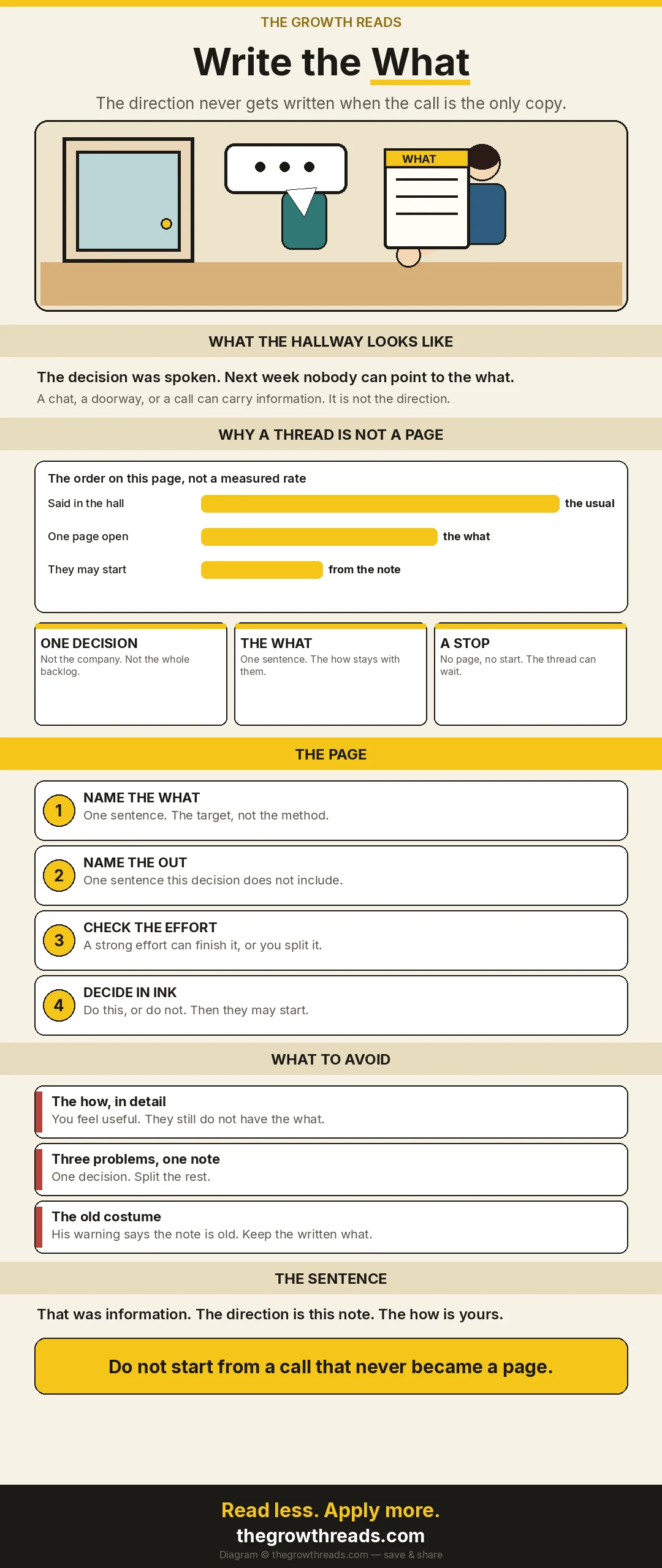
The five lines are this page’s script. They are not in the 2012 document. They are the minimum that turns his rules into a page a tired person can find: the what, the out, the effort, the decision, and the rule for starting.
The decision, in one sentence. One call. Not the company.
1. What. One sentence: the target. The how is not on this line.
2. Out. One sentence: what this decision does not include.
3. Effort. A strong effort can finish this, or the decision is split before anyone starts.
4. Decision. The words “do this,” or the words “do not do this.”
5. Start. People start from this page. The conversation gathers information. It does not add a direction.
Read the five lines with the thread still open. A blank line means the work stays unstarted.
Star the line you usually skip. That star is the direction that has been living in your mouth.
The what is one sentence a person can build toward without asking you what you meant. “Make it better” is a mood. “The invoice page shows the price we already agreed, and nothing else” is a target. The how — the library, the layout, the order of the commits — stays with the person doing the work. Horowitz’s bad product manager feels best when they figure out the how. If your page is a tutorial, you have written the comfortable line and skipped the target.
Out is one exclusion, so a friendly call does not become a second project. If everything they mentioned is included, write that on purpose. Silence is how the extra sounds included. Effort is his rule about a strong effort, applied to one decision. If the page describes a product that cannot be finished, or it hands them the hardest problem because it was interesting, it is not ready. Split it until one piece can be finished, or write “do not do this.” Combining three problems onto one page is the failure he names when he says bad product managers combine all problems into one.
The decision line is a position, in his sense of a written position, reduced to a yes or a no you will not re-argue from memory. “I’m a bit worried” is the verbal opinion. “Do not do this” is the position. A worry you can later claim you predicted is the ending he describes: they fail, and they point out that they predicted it. The start line is the stop. Until the page exists, the thread is information. People may ask questions. They may not treat a reply in the thread as a new direction. A new direction is a new page, or a line changed on this one.
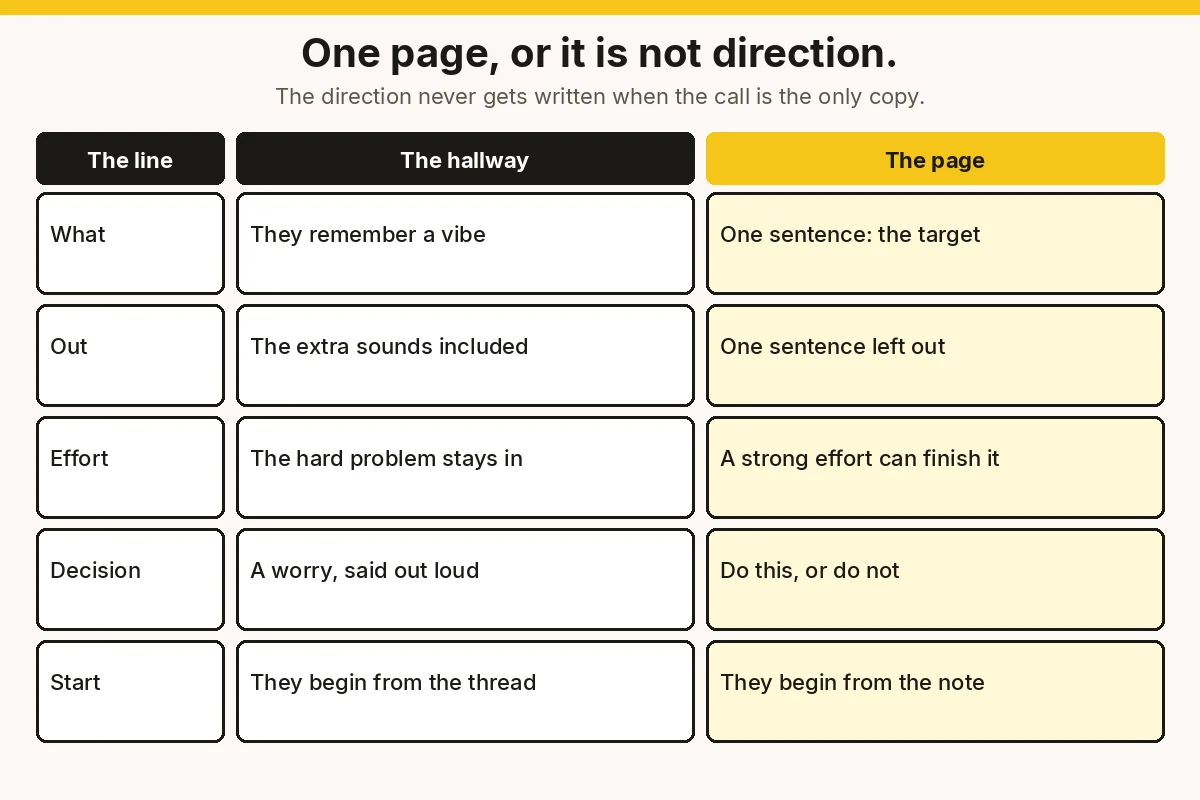
| The line | What the hallway looks like | What the page looks like |
|---|---|---|
| What | They can describe the mood of the call, and not the target. | One sentence states the target. The method is absent. |
| Out | The extra they mentioned now sounds included. | One sentence says what this decision leaves out. |
| Effort | The interesting hard problem is still in the pile. | A strong effort can finish the piece, or the piece is split. |
| Decision | A worry was spoken. Later it can be recalled as a prediction. | The page says do this, or it says do not. |
| Start | They began from the thread, then asked what you meant. | They begin from the note. The thread does not add a direction. |
The sentence that replaces the hallway
When someone is about to start from the conversation, send them back to the page in one sentence. The sentence is ours. It is the spoken form of the start line, short enough to paste into the thread where the call has been living.
“That was information. The direction is this note. The what is one sentence. The how is yours. Do not start the part this note leaves out.”
Use it when a contractor replies “as we said,” when a teammate has already opened a branch from a doorway answer, or when you catch yourself adding a second target in the thread. Paste the page under the sentence. If the page is still blank, the sentence waits and so does the work. Filling the page in the same hour is allowed. Starting while you “write it up later” is the hallway again.
If you are the only person, you still owe the page to the next version of you. Write the five lines before you open the tool. A note to yourself in the same thread where you had the idea is still informal direction. The page is a separate note with the five lines and a date. Tomorrow-you is the person who would otherwise quote a mood.
Gathering information stays allowed, and it stays informal, which is the half of his rule people drop. Ask what they tried, what constraint they can see, what the customer did last week. Those answers can change line 1 or line 2. They do not authorise a start. Answering before they finish is a different mistake: you give the advice before the question is done. Here you may listen for a long time. You still do not smuggle the direction out through the listening.
When the page is the wrong tool
A written what is the wrong tool when the decision is not the thing that is broken. If they already had a page and the work came back as a different job, the missing piece is their restatement before they start. That is the backbrief. If the room should not have been booked, write the note instead of inventing a position to justify the meeting. If the send is familiar and one known line is blank, use the five-line pause on that send. If the same kind of ask is back for the third time, choose whether to close this one, solve the category, or hand it to the person who owns that work. If the week has no priority, choose the three items before you write a position for all of them. If the build has no time budget, set the appetite before you describe a target that cannot fit the days.
If you have not decided, the page says “not decided” and names the date you will. A target typed so the box looks filled is a fake what. Horowitz’s clarity rule cuts the other way too. Err toward a clear “not decided.” A page of explanation with no decision is the bad pattern he names when he says bad product managers never explain the obvious and, separately, never quite take the position. Explanation without a do-this or a do-not is still a hallway. It is just a longer one.
Leave his press rules, his sales collateral, and the “CEO of the product” line in the document. They describe a product organisation with engineering, sales, and journalists. Copying them onto a one-person studio produces a costume and no page. The part that fits the studio is the part this script keeps: one target, in writing, before the start.
Common mistakes
- Writing the how because it feels like help. He says bad product managers feel best when they figure out the how. A tutorial is allowed as an appendix after the what is one sentence. It is not a substitute for the target.
- Putting three decisions on one page. He says bad product managers combine all problems into one, and good ones decompose them. One page, one decision. The second decision gets its own page or it waits.
- Counting the thread as the archive. A search box is not a position. The page is one note a tired person can open without reconstructing the call. Link the thread from the page if the facts are there. The direction stays on the page.
- Keeping the worry verbal so you can say you predicted it. That ending is in the document. If you believe the work should not proceed, line 4 says do not. A hinted worry is how you stay right either way.
- Aiming the team at a competitor’s feature list. He contrasts a focus on revenue and customers with a focus on how many features Microsoft is building. The what names the customer result. A matching list is a different document, and it is the one he treats as the bad focus.
- Letting two people own the start. The page names one person who may begin. A second person can gather information. Two owners is how the doorway answer becomes two builds.
- Using the page to avoid a price or a scope cut you have not made. If the target depends on a price, decide it on the pricing page or the change-of-scope page first. This page records the target. It does not invent the number.
What the source does and does not say
| Source | What was read | What this page uses | What this page does not use |
|---|---|---|---|
| Ben Horowitz, “Good Product Manager/Bad Product Manager,” posted 15 June 2012. | The full post, on 19 November 2026, including the warning. | Informal information, formal direction. The what as opposed to the how. Written positions. A strong effort. Decomposing problems. Clarity. His account of verbal opinions that later become “I predicted it.” | The “CEO of the product” line as a title for a solo founder. Press strategy. Sales collateral. Status-report discipline. Barksdale’s biography. Microsoft’s engineer count as a fact about your market. |
| Ben Horowitz, “Why Startups Should Train Their People,” posted 14 May 2010. | The essay through the warning, on 19 November 2026. He says the document is included at the end. The sentences of the document were read on the 2012 post. | The origin: Netscape, a short document used to set expectations, his account that the team improved. The same warning. The lack of guidance in his reading of exit interviews, as his account. | Grove’s chapter, which was not opened, and the training-leverage arithmetic Horowitz retells from it. The exit interviews themselves. Any claim that one page makes a team the highest performing. |
| HarperCollins product page, and Open Library edition OL25444822M. | The on-sale date on HarperCollins. The library record’s publisher, year, page count, ISBN, and contents line. | On sale 4 March 2014. HarperBusiness, 2014, 289 pages, ISBN 9780062273208. A contents line for the 2010 essay’s title under chapter 5. | The chapter text. Every sentence that may or may not be on page 105. The ISBN did not render on the HarperCollins page this run could read. |
He is writing about product managers inside a company that had engineering, sales, and press, and he is explicit that the document is old. A founder’s call with a contractor is close enough for the mechanism: the direction went out verbally, the what was never a page, and later everyone can remember a different version. It is not close enough for a claim about team performance, attrition, or the press. The five lines and the sentence are our application. They have not been tested the way he says his Netscape team responded, and that response was never given a measure on the page. If the starred line is still blank in two weeks, the page is not the place you decide. That is a fact about your calls. It is not a finding from the posts.
Frequently asked questions
What does it mean that the direction never gets written?
The direction never gets written when a real decision has already been spoken, in a chat, a doorway, or a call, and there is still no page that states the what. People start from what they remember. You correct them later, or you are the only person who can remember it. Ben Horowitz’s training document, posted 15 June 2012, says good product managers do not give direction informally. This page uses that rule for one decision a solo founder or a new manager is about to let leave the room. It does not measure how often your own calls drift.
What goes on the one-page position?
Five lines, and they are this page’s script, not a quotation. Name one decision. Write the what in one sentence, with the method left off. Write one sentence this decision does not include. Say whether a strong effort can finish it, and split it if a strong effort cannot. Write “do this” or “do not do this.” Then write that people start from the page, and that the conversation may gather information and may not add a direction. A blank line means the work stays unstarted. Star the line you usually skip. That star is the part that has been living only in the call.
Is a long Slack thread already a written position?
A thread can hold facts, screenshots, and questions. It is still the hallway if someone has to reconstruct the target by reading it upwards. Horowitz’s document separates a crisp written direction from information gathered informally. A position is one note with the five lines, dated, that a tired person can open. Link the thread from that note when the facts live there. A reply in the thread does not become a new direction. A new direction is a changed line on the page, or a second page for a second decision. Search is not a substitute for the sentence.
What is the difference between the what and the how?
The what is the target in one sentence: what is true when the work is done. The how is the method, the library, the order of the work. In the 15 June 2012 document, good product managers define the what, and bad product managers feel best when they figure out the how. On this page the how stays with the person doing the work. A short note on method is allowed after the target is one sentence. A tutorial with no target is the comfortable page, and it is the pattern he describes. If you are also the builder, write the what before you open the tool.
What do you say when someone starts from the hallway?
Say: “That was information. The direction is this note. The what is one sentence. The how is yours. Do not start the part this note leaves out.” Paste the page under it. Use it when a contractor writes “as we said,” when a teammate opened a branch from a doorway answer, or when you are about to add a second target in the thread. If the page is blank, the work waits. You may fill the page in the same hour. Starting on a promise to write it up later puts the direction back in the call. The sentence is ours. It is not a line from the 2012 post.
What if you work alone?
You still write the page, because tomorrow-you will quote a mood. Put the five lines in a note separate from the thread where the idea appeared, and date it. Then start. A message to yourself in that same thread is still informal direction, which is the failure the document names. The how can be yours the same afternoon. It does not replace line 1. If line 3 says a strong effort cannot finish the piece, split it before you open the tool. Working alone removes the second person. It does not remove the page.
Does this replace a backbrief, a checklist, or a priority cut?
It sits earlier than those. The backbrief is their written reply before they start, once a job exists. The five-line pause checks a familiar send for a piece you already know. Monday’s cut chooses what you will start this week. The three-way cut is for an ask that keeps coming back. This page is for the moment before any of that, when the decision has been spoken and the what is still unwritten. If a page already exists, use the tool that matches the new failure. If the decision is not made, write “not decided” and a date. A fake target still means the work waits.
Did this page open The Hard Thing About Hard Things?
No. The text read on 19 November 2026 is the 14 May 2010 essay, through the warning, and the 15 June 2012 training document in full. HarperCollins lists the book on sale 4 March 2014. Open Library’s record for ISBN 9780062273208 lists HarperBusiness, 2014, 289 pages, and a contents line for “Why Startups Should Train Their People” under chapter 5. That chapter was not opened, so no sentence is taken from a numbered page. His warning says the document is old and probably not a manual for today’s product managers. The five lines and the hallway sentence are our application.
Sources
- Horowitz, B. “Good Product Manager/Bad Product Manager.” Andreessen Horowitz, posted 15 June 2012. Read in full on 19 November 2026 at a16z.com/good-product-manager-bad-product-manager. Used for the warning, the split between informal information and written direction, the what as opposed to the how, written positions, the strong-effort rule, decomposing problems, the clarity line, and the account of a verbal opinion that later becomes “I predicted it.” The “CEO of the product” sentence, the press rules, and the sales-collateral rules stay in the document. They are not instructions on this page. “Microsoft has 10 times as many engineers” is quoted only as an excuse he lists, not as a market fact.
- Horowitz, B. “Why Startups Should Train Their People.” Andreessen Horowitz, posted 14 May 2010. Read on 19 November 2026 through the warning, at a16z.com/why-startups-should-train-their-people. Used for the origin of the document at Netscape, his unmeasured account that the team improved, the same warning, and his account of exit interviews in which a lack of guidance was one of two reasons people quit. Those interviews were not opened. Andy Grove’s High Output Management, chapter 16, is named on the page and was not opened. The training-leverage arithmetic he retells from that chapter is not used here.
- HarperCollins product page for The Hard Thing About Hard Things, by Ben Horowitz, read 19 November 2026. It lists the book on sale 4 March 2014. An ISBN did not render in the text this run could read. Open Library edition OL25444822M, read the same day, lists publisher HarperBusiness, publish date 2014, 289 pages, ISBN 9780062273208, and a table-of-contents line titled “Why Startups Should Train Their People” under chapter 5, “Take Care of the People, the Products, and the Profits — In That Order.” The chapter was not opened. No sentence is taken from a numbered page. The one-page position and the sentence “That was information. The direction is this note. The what is one sentence. The how is yours. Do not start the part this note leaves out.” are not in the pages that were read.
Related reading on The Growth Reads
- They nodded, and the work came back — their words before they start, once a written job exists
- The meeting should have been a note — whether the room should have been booked
- One step still gets skipped — a known line missing from a familiar send
- The same kind of ask comes back — close it, solve the category, or hand it on
- You answer before they finish — advice that leaves before the question does
- Two people own the same task — one name on the start
- The build has no appetite — the days the work is worth, before the target spreads
- Productivity — the cluster this article sits in
- How we review — what a checked source is, and what an unread chapter is not
How this was checked
Who it is for. A solo founder or a new manager whose important call has already happened, and whose what is still unwritten.
What was read. Horowitz’s 14 May 2010 essay, through the warning, and his 15 June 2012 training document in full, both on 19 November 2026. HarperCollins’ on-sale date. Open Library’s record for ISBN 9780062273208, including the contents line.
What was not read. The book’s chapters. Grove’s High Output Management. The Netscape exit interviews. Any numbered page of the book.
Limit. The five lines and the sentence are our application. His warning stands: the document is old, and it is an example of a training note, not a current product manual. His account of a team improving has no measure on the page.
How we work: every article on The Growth Reads is built from books we have read and from primary accounts we can check, and it is date-stamped when those sources change. Read our methodology.