


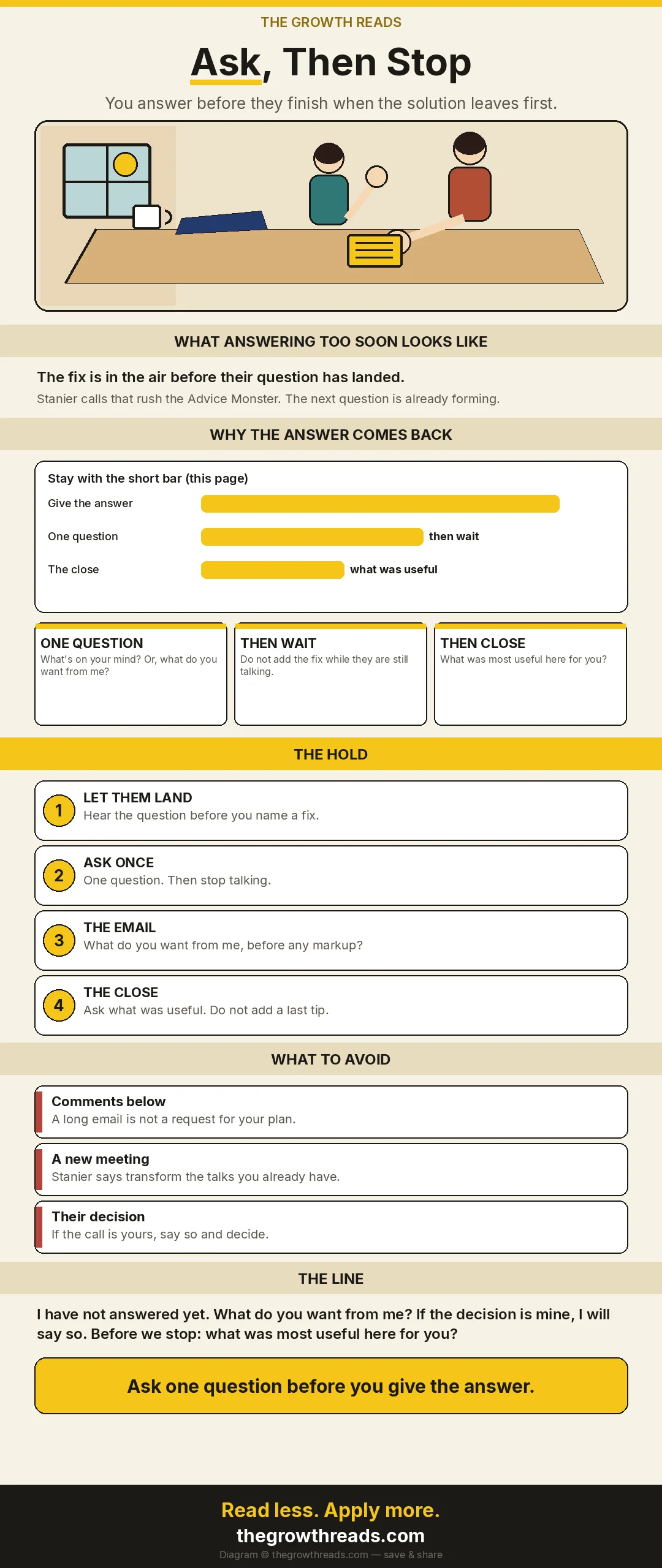
You answer before they finish when the solution leaves your mouth before their question has landed. Michael Bungay Stanier, in a 2016 manifesto drawn from The Coaching Habit, calls that rush the Advice Monster. Ask one question, use one line on the long email, and close by asking what was useful.
Key takeaways
- You answer before they finish when the fix is already in the air and the other person has not landed the question, so the next question is already forming.
- Michael Bungay Stanier, in ChangeThis manifesto 139.06, created on 16 March 2016 and drawn from The Coaching Habit, names that rush the Advice Monster.
- Stanier writes that the default of giving advice builds an overdependent team and leaves you doing your work and their work too.
- The fast-start question in the manifesto is “What’s on your mind?” The blunter line for a long email is “What do you want from me?”
- The close is his learning question, “What was most useful here for you?” The founder’s shorter email on this page is our application. It is not a measured claim about how often people then decide alone.
What answering before they finish is
You answer before they finish when the fix leaves you before the question has a shape. You are a solo founder. A contractor types, “The homepage hero isn’t working.” You are already in the reply with three layouts, a headline, and a note about the button. They had a second sentence. You will not see it, because your answer is already in the thread. You are a new manager. Someone stops in the doorway and says, “The client wants the date moved.” You say, “Tell them Thursday,” before you hear what was already promised. The person nods. Thursday is now your sentence, and the next stuck date will come back to you the same way.
The missing move is not a longer meeting and not a speech about ownership. The 1:1 that is a status recital is a bad agenda. You can fix the agenda and still supply the plan in the first minute. The bottleneck is the queue of decisions that wait on you after you have already decided to hand the work off. This page is the earlier second: they are still forming the question, and your answer trains them to bring the next one unfinished.
Stanier’s name for the rush is the Advice Monster. In the manifesto he writes that the default of offering insights, answers, and solutions “often generates two of the vicious cycles of the modern manager: an overdependent team, and a deep sense of overwhelm from having too much to do (your work and their work, too).” A founder with one contractor is that cycle at the smallest size. You are fast. They are waiting. Next week’s hero problem arrives the same way, because the last one was solved in your keyboard.
What the manifesto actually says
The checked copy is a short manifesto, not the print book. Michael Bungay Stanier wrote ChangeThis number 139.06, “Fast Coaching for Busy People: How to Coach in 10 Minutes or Less.” The file says it was created on 16 March 2016, that the copyright belongs to the author, and that readers can buy The Coaching Habit. It is the text read for this page. Google Books, consulted the same day, lists that book as The Coaching Habit: Say Less, Ask More & Change the Way You Lead Forever, Box of Crayons Press, 29 February 2016, and shows ISBN 9780978440749. Those are the listing’s facts. The print pages were not opened, so no page number is given.
He gives three principles for a manager who does not have a free hour. Keep coaching to 10 minutes or less. If you cannot, he writes, you do not have time for coaching. Keep it simple: “Seven good questions and the discipline to make asking them a habit is all you need.” Strive for drip irrigation, not an occasional flash flood. Make it a regular act by changing the interactions you already have, rather than adding a session to the week.
The manifesto says there are seven questions. It spells out three. The fast start is “What’s on your mind?” He also offers “Where should we start?” and “What’s most useful for us to look at first?” The question he calls lazy, for the moment you would otherwise take the work, is “How can I help?” The blunter version is “What do you want from me?” The close is “What was most useful here for you?” He also offers “What was most valuable for you?”, “What do you know now that you didn’t know before?”, and “What should we do differently next time?”
The Google Books description names the other four as the AWE question, the Strategic question, the Focus question, and the Foundation question. It does not give their wording on the page that was opened. This article does not invent that wording. A contents line on the same listing is titled “Ask One Question at a Time.” That page was not opened. The “one question, then stop” note below is this page’s script. It matches the manifesto’s email, which asks one thing. It is not a quotation from an unread page.
He is plain that advice still has a place. “No doubt there’s a time and place for good advice. But it’s not nearly as often as you think (nor is your advice as good as you hope).” He tells you to notice how quickly you trade curiosity for the answer. He does not give a stopwatch result for that trade. A comparison he makes with doctors who interrupt their patients is in the manifesto as an allusion. The study behind it was not opened, and the number is not used here. The same limit covers a sidebar percentage and a line about who is in the workforce. They are in his opening. They are not findings this page checked.
The question before the answer
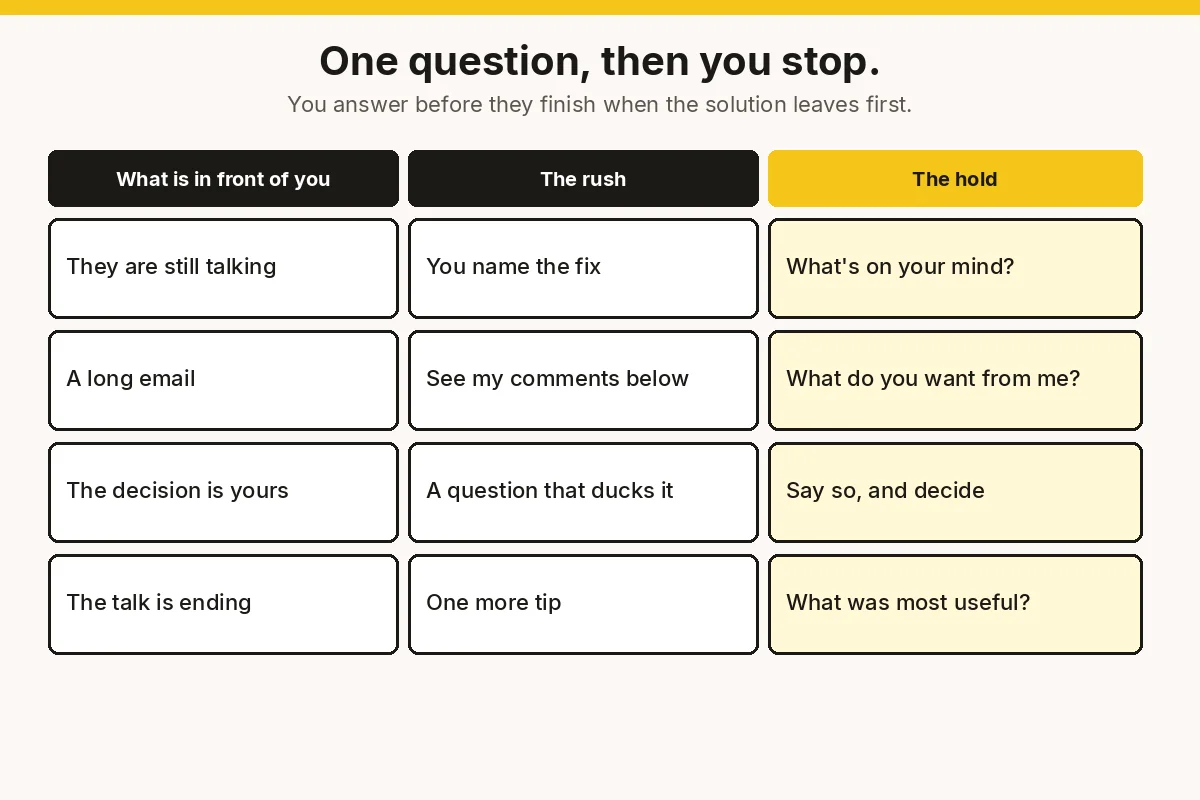
Ask one question, then stop talking, unless the decision is still yours. Stanier’s fast start is for a conversation that has not found its point. “What’s on your mind?” is his favourite because it is open and already aimed at what is worrying the other person, rather than at small talk or at a pile of updates. He says a weekly check-in often becomes two people “reporting out,” and that the same question spends the time on what matters. If your 1:1 is already a status recital, fix the agenda on that page. Use this question when they bring a stuck problem, including in the doorway, and you can feel the answer forming.
Use the blunter question when they have already named the topic and you are about to solve it. “What do you want from me?” is the line in his email. In the room it does the same job. It forces the request into a shape: a decision, a correction, or a go-ahead. Many “what should I do?” sentences are one of those three, and you cannot tell which until you ask.
They start. You do not answer yet.
If the topic is still fog: “What’s on your mind?”
If the topic is already clear: “What do you want from me?”
Then you stop. One question. Their answer. Then either you decide, because it is yours, or you stop again.
The four lines are ours. The two questions are his. He also says the habit is drip, not a flood: change the conversations you already have. Do not put a 45-minute coaching block on Tuesday. His test is 10 minutes or less. For a founder, the useful cut is shorter than that. One question, their answer, and either your decision or your silence. If it needs a workshop, it is a different meeting, and it is probably the meeting that should have been a note.
He quotes Sir John Whitmore’s definition of the purpose of coaching: “unlocking a person’s potential … helping them learn rather than teaching them.” Whitmore’s book was not opened. The sentence is used here only as Stanier’s reason for asking instead of teaching. It is not a method this page teaches beyond the three questions whose words are in the manifesto.
The line for a long email
A long email is not a request for your plan until they say what they want. Stanier describes the message you have to read twice, the one where you are not sure what they are asking, and the reply that starts “see my comments below” and then hands out suggestions. His replacement is one question. This is his script, from the manifesto:
Hi [name]. Thanks for the email—looks like there’s a lot going on. Out of curiosity, what do you want from me here?
Yours, etc.
His line under that script is “Less advice. More curiosity.” A founder can send his words as they stand. The shorter line below is ours, for a contractor or a first hire who already knows you are busy. It names the three things they might actually want, so “thoughts?” cannot hide a request that you rewrite the work.
I read this. Before I mark it up: what do you want from me — a decision, a correction, or a go-ahead?
Do not attach the markup “just in case.” The markup is the answer. If they say they want a decision, and the decision is the price, the date you promised a client, or money leaving the account, you make it. You do not coach them into a call that is still yours. If they say they want a go-ahead on a path they have already described, “Go” is a complete reply. If they say they want a correction, correct the one thing they named. Do not redesign the rest of the file while you are in there.
This is a different gate from a nod that came back as a different job. That page checks their words against the job before they start. This page is what you send when the work is in motion and the message is a request for your brain. Ask what they want. Then match the reply to that request. A backbrief will not help an email you have already answered with a new homepage.
The close
End by asking what was useful, and do not add a last tip. Stanier’s reason is his own, and this page does not treat it as a brain study. He writes that people do not really learn when you tell them something, and do not even really learn when they do something. They start learning, he says, “only when they have a chance to recall and reflect on what just happened.” The phrase he uses about new neural pathways is his metaphor. No study of that claim was opened.
The question he wants at the end is “What was most useful here for you?” He says it does three things at once. They have to find the value, which they might have missed. You hear what did and did not help, so the next conversation can be shorter. And you mark the exchange as useful, which is how a short conversation earns the next one. He says to add it to team meetings, talks with your own boss, and calls with vendors, not only to a session you have labelled coaching.
The failure at the close is the extra sentence. You asked. They told you what helped. You then add, “Also, change the button.” That sentence is the Advice Monster arriving late. If the button truly has to change, it belongs in the decision you already made, not as a souvenir on the way out. Stop after their answer. If they have nothing, “Nothing yet” is an allowed reply. You still do not fill the silence with a tip.
Before we stop: what was most useful here for you?
Then you stop.
When you still give the answer
You still give the answer when the call is yours, or when they cannot see the risk. Stanier writes that there is a time and place for good advice, and that the time is rarer than it feels. These are the cases where this page’s question would be a dodge. The list is ours. The manifesto does not sort a founder’s week into these boxes.
- The price, the promise, or the payment. A discount, a date you already gave a client, and money leaving the account stay with you. “What do you want from me?” is fair. Coaching them to pick the discount is not. If the sentence they were about to send is “I intend to offer 15 percent,” the bottleneck page already tells you to stop that one. This page agrees. You decide, out loud, in one line.
- They cannot see the risk. Someone who has never sent this kind of client note does not get a pure question and a silence. Ask what they see, which is the closer direction on the bottleneck page, and keep the send. “What’s on your mind?” is the wrong tool when the risk is invisible to them. Curiosity does not replace a check they do not know how to make.
- You are the person they paid for the answer. A client who bought a homepage does not need to be coached out of the draft. Stanier is writing about people you lead, not about a buyer waiting on the work. If the long email is from the client, answer the job. If it is from the person doing the job for you, ask what they want before you rewrite it.
- There is no other person. If you are arguing with your own draft, this page has no recipient. Use Monday’s cut or the appetite on the build. A question you ask yourself can still be useful, and it is not this script.
Saying the decision is yours is not a failure of the habit. It is the line that keeps the habit from hiding the call. “The date stays Thursday. That one is mine. The layout is yours if you still want a go-ahead.” Two sentences. Then the close, if anything was actually discussed. Do not wrap a decision you were unwilling to make inside a coaching question.
Common mistakes
- Answering, then asking “does that make sense?” The answer already landed. The question afterwards is a quiz, not curiosity. Stanier’s order is the question first.
- Sending “see my comments below.” That is the reply his email script replaces. The comments are the Advice Monster in writing.
- Asking three questions before they have answered one. The manifesto’s email asks once. A pile of questions is another way of keeping the microphone. This page’s script is one question, then their answer.
- Adding a coaching hour. He says you do not have time to add it, and that if you cannot keep it to 10 minutes you do not have time for coaching. Change the doorway and the email you already have.
- Using the question to avoid your own decision. The price, the promise, and the payment are still yours. A question that hands those off is a duck, not a habit.
- Coaching the client who bought the work. The manifesto is about people you lead. The buyer is waiting on the job you sold.
- Replacing “I intend to” with a coaching question. The Turn the Ship Around line, on the bottleneck page, moves a decision you have already decided to hand off. This page is earlier. A person can answer “What’s on your mind?” and still need a clear handoff once the work is theirs.
- Treating feedback as this problem. Feedback that turns into a personality comment is about a behaviour you already saw. This page is about an unsolved question they brought you. Do not use “what was most useful?” as a substitute for a clear note on the behaviour.
- Filling the close. After they say what was useful, another tip reopens the answer. Stop.
What the source does and does not say
The manifesto gives you the rush, three worded questions, an email, and a close. It does not give you the founder’s shorter email, the four-line room script, or a result for a one-person shop. It names seven questions and writes three of them out. The print book was not opened. Google Books lists the publisher, the date, the ISBN, and the nicknames of the other four questions. That listing is not the chapter text.
| Source | What was read | What this page uses | What this page does not use |
|---|---|---|---|
| Michael Bungay Stanier, ChangeThis 139.06, “Fast Coaching for Busy People,” created 16 March 2016. The file points to The Coaching Habit. | The whole manifesto, on 17 November 2026. | Ten minutes or less. Drip, not a new session. The Advice Monster: overdependence and overwhelm. “What’s on your mind?” and the two variations. “How can I help?” and “What do you want from me?” His email script. The learning question and its three effects. His warning that advice has a place and is rarer than it feels. | Any wording for the four questions the manifesto does not spell out. The doctor-interruption allusion, the sidebar percentage, and the workforce line, because the studies behind them were not opened. The Whitmore sentence as anything beyond his quotation. “Neural pathways” as a finding. |
| Google Books listing for The Coaching Habit, consulted 17 November 2026. | The about page: publisher, date, ISBN, the marketing description, and the selected contents titles. | Box of Crayons Press, 29 February 2016. The title. ISBN 9780978440749 as the listing shows it. The fact that the description names seven questions. | The print pages. The “more than 10,000 managers” line in the marketing copy. Any neuroscience or behavioural-economics claim. Page numbers. The wording of questions that appear only as nicknames. |
He is writing for a time-crunched manager inside an organisation. A solo founder with a contractor is close enough for the email and the doorway, and not close enough for a claim about teams, climate, or the bottom line. He points at Daniel Goleman’s 2000 Harvard Business Review article for that picture. That article was not opened, and none of its findings are used here. The four-line note and the shorter email are our application. They are not a measured lift in how often a small shop decides without the founder.
Frequently asked questions
What does it mean that you answer before they finish?
You answer before they finish when the fix is already in the air and the other person has not landed the question. A contractor writes that the homepage hero is not working, and the reply already contains three layouts. A new manager hears “the client wants the date moved” and says “tell them Thursday” before hearing what was promised. Michael Bungay Stanier, in the 16 March 2016 ChangeThis manifesto drawn from The Coaching Habit, calls that rush the Advice Monster. The one question, the email line, and the close on this page are the hold. They are not a new meeting.
What is the Advice Monster?
The Advice Monster is Stanier’s name for the default of giving insights, answers, and solutions as soon as someone brings a problem. In the manifesto he writes that this default often builds two cycles: an overdependent team, and a manager overwhelmed because the work is now theirs and everyone else’s. He says there is still a time for advice, and that the time is rarer than it feels. He does not give a measured rate for how often the advice is wrong. This page uses the name for the doorway reply and the “see my comments below” email, not as a personality type.
What question do you ask before you give the answer?
Ask one question, then stop. If the topic is still fog, Stanier’s fast start is “What’s on your mind?” He also offers “Where should we start?” and “What’s most useful for us to look at first?” If they have already named the problem and you are about to solve it, use the blunter line from his email: “What do you want from me?” The manifesto says seven questions exist and writes three of them out. This page does not invent wording for the other four. One question is this page’s script, because his email asks once.
What do you send when the email is long?
Send one question before any markup. Stanier’s script thanks them, notices that a lot is going on, and asks, “Out of curiosity, what do you want from me here?” His summary is less advice and more curiosity. The shorter line on this page is ours: “Before I mark it up: what do you want from me — a decision, a correction, or a go-ahead?” Do not attach comments “just in case.” If they want a decision that is still yours, you decide. If they want a go-ahead on a path they have described, “Go” is enough.
How do you close the conversation?
Ask “What was most useful here for you?” and do not add a tip afterwards. Stanier says the question makes them find the value, tells you what helped, and marks the conversation as useful. He offers variations, including what they know now that they did not know before. His reason, that people learn when they reflect, is his. This page does not treat the line about neural pathways as a study. If they say “nothing yet,” leave it. The extra sentence on the way out is the answer arriving late. His test for the whole exchange is 10 minutes or less, not a new hour on the calendar.
When should you still give the answer?
Give the answer when the call is yours, or when they cannot see the risk. The price, a promise you already made to a client, and money leaving the account stay with you. A coaching question that hands those off is a way of not deciding. Someone who has never sent this kind of note should tell you what they see, which is the closer direction on the bottleneck page, and you keep the send. A client who bought the work is not the person Stanier is coaching. If there is no other person, this script has no recipient.
How is this different from a 1:1 agenda or from “I intend to”?
A 1:1 that is a status recital needs a different agenda, so the meeting ends in a decision and an owner. You can have that agenda and still answer before they finish. This page is the first reply, including a doorway and an email. “I intend to,” from Turn the Ship Around and from the bottleneck page, is the sentence after you have already handed the decision over. It is not a substitute for staying quiet while they land the question. Use the question first. Use the handoff sentence once the work is actually theirs. A person can intend, quite clearly, to do the thing you would have dictated.
Did this page open the print book?
No. The text read on 17 November 2026 is ChangeThis manifesto 139.06, “Fast Coaching for Busy People,” created 16 March 2016. The file says it is the author’s and points readers to The Coaching Habit. Google Books lists that book as Box of Crayons Press, 29 February 2016, and shows ISBN 9780978440749. The print pages were not opened, so no page number is given. The listing names seven questions. The manifesto writes out three. The founder’s shorter email and the four-line room note are our application. They are not a measured claim about small teams.
Sources
- Stanier, M. B. “Fast Coaching for Busy People: How to Coach in 10 Minutes or Less.” ChangeThis, manifesto 139.06. Created 16 March 2016. Read 17 November 2026 from the PDF at cdn.porchlightbooks.com. The document says the copyright belongs to the author and points readers to The Coaching Habit. Questions used in his wording: “What’s on your mind?”, “How can I help?”, “What do you want from me?”, and “What was most useful here for you?” The email script is his. The four-line room note and the shorter founder email are not in the manifesto.
- Google Books. Listing for Stanier, M. B. The Coaching Habit: Say Less, Ask More & Change the Way You Lead Forever. Consulted 17 November 2026. The about page lists Box of Crayons Press, 29 February 2016, and ISBN 9780978440749. Used for those bibliographic facts and for the names of the seven questions in the marketing description. The print book was not opened. No page was read. The “more than 10,000 managers” sentence in that description is not used.
Related reading on The Growth Reads
- You are the bottleneck — the handoff after you have stopped supplying the answer, including “I intend to”
- Turn the Ship Around summary — the book behind that handoff sentence, which is not the book on this page
- The 1:1 is a status recital — the agenda, which can still end with you writing their plan
- Feedback turns into a personality comment — a behaviour you already saw, not an unsolved question
- They nodded, and the work came back — their words against the job, before this email is the problem
- The meeting should have been a note — when the exchange wants a workshop instead of one question
- The build has no appetite — a time cap, which a coaching question does not set
- Productivity — the cluster this article sits in
- How we review — what a checked source is, and what an unread chapter is not
How this was checked
Who it is for. A solo founder or a new manager who gives the answer while the other person is still asking, so the next unfinished question is already on its way.
What was read. Michael Bungay Stanier’s ChangeThis manifesto 139.06, “Fast Coaching for Busy People,” created 16 March 2016, read in full on 17 November 2026. The Google Books about page for The Coaching Habit was opened the same day for the publisher, the date, the ISBN as listed, and the names of the seven questions in the marketing description.
What was not read. The print book. Any page number. The four questions whose wording is not in the manifesto. Goleman’s 2000 Harvard Business Review article. Whitmore’s book. The studies alluded to in the manifesto’s opening. The marketing claim about how many managers were trained.
Limit. The four-line note and the shorter email are our application for a founder or a new manager. They are not a measured lift in how often someone decides without you. Advice still has a place when the call is yours.
How we work: every article on The Growth Reads is built from books we have read and from primary accounts we can check, and it is date-stamped when those sources change. Read our methodology.