

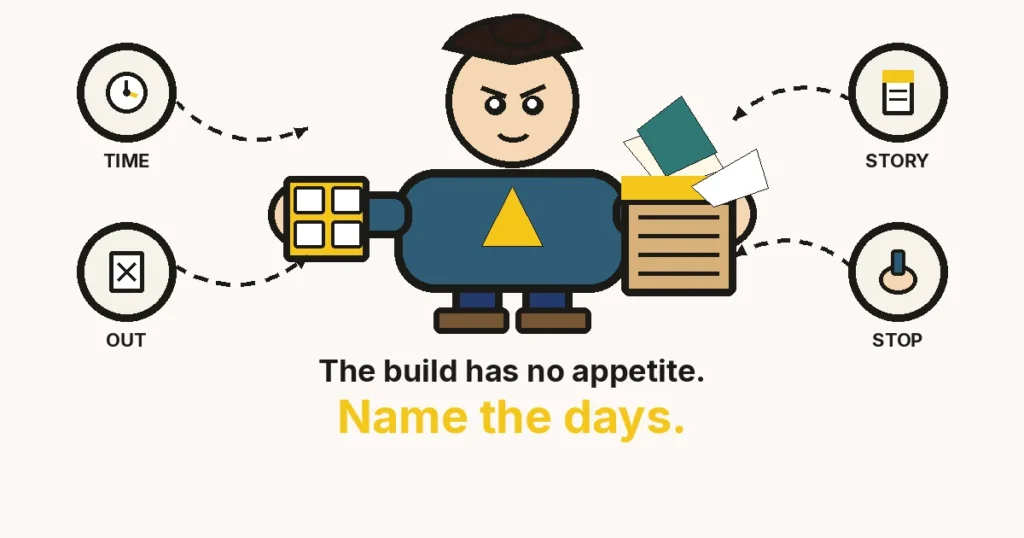
The build has no appetite when the design starts before anyone names how much time the work is worth. Ryan Singer, in Shape Up, calls that number an appetite: time first, then a design, the reverse of an estimate. Name the days, one story, what is out, and stop when the days are spent.
Key takeaways
- The build has no appetite when a file opens before anyone has named how many days the work is worth, so the build grows until the week is gone.
- Ryan Singer, in the online edition of Shape Up read on 16 November 2026, defines an appetite as the time you want to spend, and he writes that an estimate starts with a design and ends with a number.
- Singer writes that appetites start with a number and end with a design, and that “good” is relative to that time: a hot dog can be the right meal when a ten-course dinner is not the time you have.
- Singer’s default when a project does not ship inside the appetite is no extension. He calls that a circuit breaker, so one build cannot quietly spend two, three, or ten times the time it was worth.
- The note on this page — the days, one story, what is out, and the stop — is for a solo founder or a new manager. Singer says a team of two or three does not need his six-week cycle. No print year was on the pages read.
What a build with no appetite is
The build has no appetite when the file opens before anyone has named how many days the work is worth. You are a solo founder. On Monday you created a doc called “new onboarding.” It is Friday. The welcome email exists, and so do a dashboard, a settings page, and a second flow you thought of on Wednesday. Nothing has shipped. The week is gone. You are a new manager. You told two people, “Rebuild the client portal.” Three weeks later the portal is still a redesign. Every extra screen still feels responsible, because nobody named the time the rebuild was worth before the first screen was drawn.
The missing line is not another task on Monday’s list. Monday can already hold three outcomes, and one of them can still be “rebuild the portal” with no end. The missing line is a number that comes before the design. Without that number, every improvement looks like part of the job. With it, some of those improvements are a different job, and they wait.
That is a different problem from a week that was never cut. The piece on Monday with no priority chooses three outcomes and one item you will not start. An appetite is the time one of those outcomes is allowed to take. You can cut the list and still let the third item eat the week. It is also different from a price that already exists. The piece on work that changed after the price is the note when a sold result moves. A build with no appetite is work you have not yet bounded by a number of days, so the design is free to grow.
What an appetite is
Ryan Singer calls the appetite the amount of time you want to spend on a project, as opposed to an estimate. The line is his glossary, in the online edition of Shape Up: Stop Running in Circles and Ship Work that Matters. The copy read on 16 November 2026 is the PDF at basecamp.com/shapeup/shape-up.pdf. The chapter list on basecamp.com/shapeup matches that PDF. About the Author, on the last pages, names him and his years at Basecamp. It does not print a publication year. No ISBN was checked, so none is given.
In the chapter he titles Set Boundaries, he says you can think of the appetite as a time budget for a standard team size. His two sizes are not a costume for a solo founder. A small batch, in his shop, is a project a team of one designer and one or two programmers can build in one or two weeks, batched into a six-week cycle. A big batch takes that same-size team a full six weeks. If the idea is still bigger than six weeks, he tries to narrow the problem, and if it will not shrink he breaks off a part he can shape to a six-week appetite. Those team sizes are his. The move that transfers is the order: name how much of your time the subject deserves before you discuss solutions.
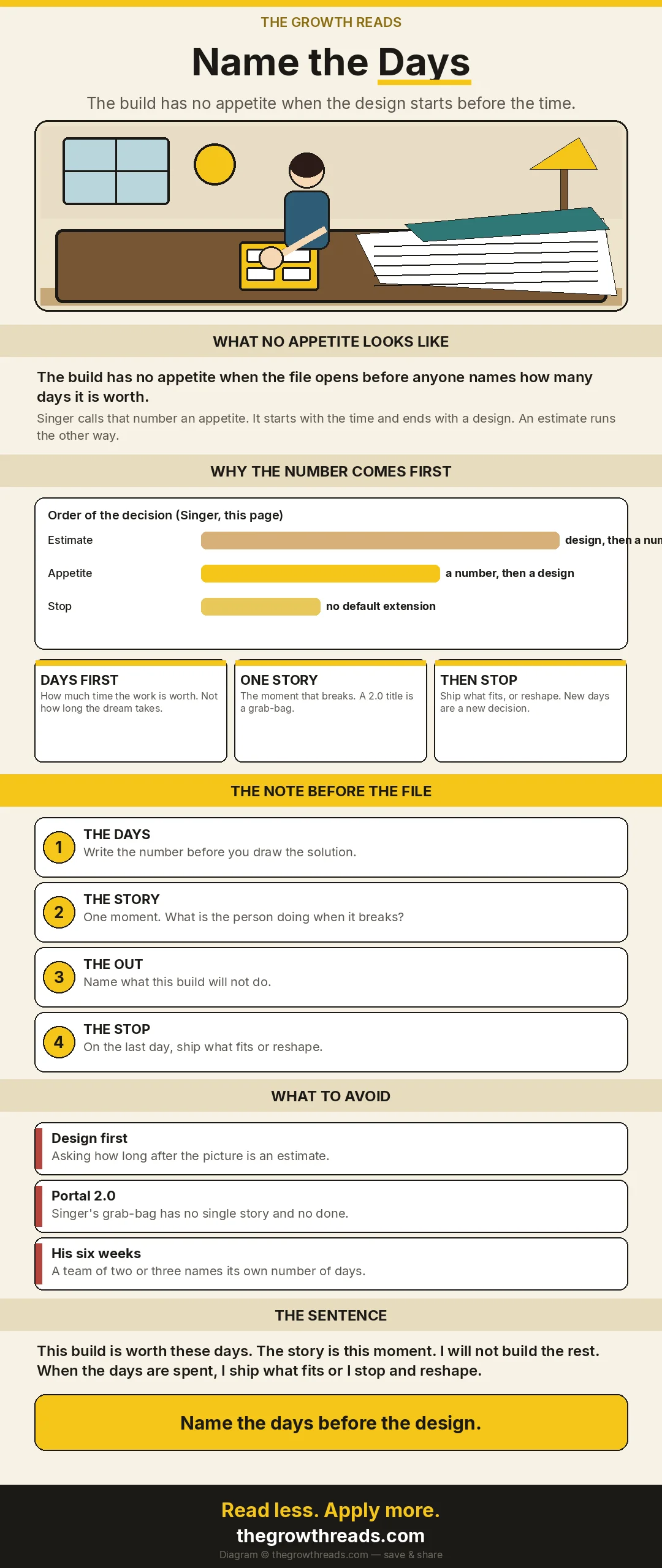
He separates that from an estimate in one pair of sentences. “Estimates start with a design and end with a number. Appetites start with a number and end with a design.” He calls the principle fixed time, variable scope. The appetite is a creative constraint on the design. Later, when the work is underway, the same fixed time pushes people to decide what is core and what is peripheral. A solo founder who draws the dream first and then asks “how long will this take?” is estimating. The number at the end of that question is not an appetite. It is a guess attached to a picture that was never asked to fit.
| What is in front of you | What it is | What you do |
|---|---|---|
| A picture, then a guess of the hours | An estimate | Stop. Name the days before you keep the picture |
| A number of days, then a smaller design | An appetite | Write the story, what is in, and what is out |
| “Redesign the portal,” or “Portal 2.0” | A grab-bag | Find the one moment that breaks, or do not start |
| A result a client already bought | A sold scope | Use the change note for a priced job, not a fresh appetite pasted over it |
Fixed time, and what “good” means
Singer’s test of a good solution is the time you are willing to spend, not an absolute best. He writes that there is no absolute definition of the best solution, because without a time limit there is always a better version. “The ultimate meal might be a ten course dinner. But when you’re hungry and in a hurry, a hot dog is perfect.” The version you are allowed to call good changes with the appetite. A whole set of database columns is one design. A flat text box is another. You can judge either one only against how much time you want to spend and how important the problem is.
He uses the book itself as the example of the trade. It is hard to ship a book when you can always add more, explain more, or improve what is there. With one week left he can fix typos or add a new section, not both. He would rather ship without the extra section than ship with embarrassing typos. Without the fixed deadline he would not make the trade. If the scope were not variable, he would have to include the section, and then there would be no time for the quality he actually cares about. Fixed time does not mean a sloppy ship. It means the leftover ambition is the thing that gets cut, so the part you are unwilling to ship broken still gets done.
His calendar story is the same trade on a product, and the numbers in it are his account of Basecamp, not a benchmark for anyone else. He writes that a proper calendar can easily take six months or more. Past versions of Basecamp had calendars, and only about 10 percent of customers used them. That is why he did not have the appetite to spend six months. He was open to something that could be done in one six-week cycle. With six weeks he says they could build about a tenth of what people mean by “calendar,” so the question became which tenth. The version they shaped showed a dot on a day and a list underneath. No dragging events between days, no spanning multi-day events, no color coding. He was comfortable with those cuts because the use case did not need them. Your 10 percent is not his 10 percent. Your six weeks are not required. The pattern is the refusal to build the whole category when the time you will spend is a slice.
The note you write before the design
Write four lines before the file opens. The lines are ours. The order is his: a number, then a design that fits, with the exclusions named. In the chapter Write the Pitch he lists five ingredients. The first is the problem. The second is the appetite, how much time you want to spend and how that constrains the solution. The third is the solution. Then rabbit holes, and no-gos: anything specifically excluded so the appetite still holds. He says stating the appetite prevents an unproductive argument, because there is always a better solution. The useful question is how this solution looks if you only care enough to spend a small amount of time now. He also says a problem with no solution is not ready to bet on. “We really need to make it easier” is not a shaped project. Problem, appetite, and solution have to be in the same note.
Send this before anyone opens the file.
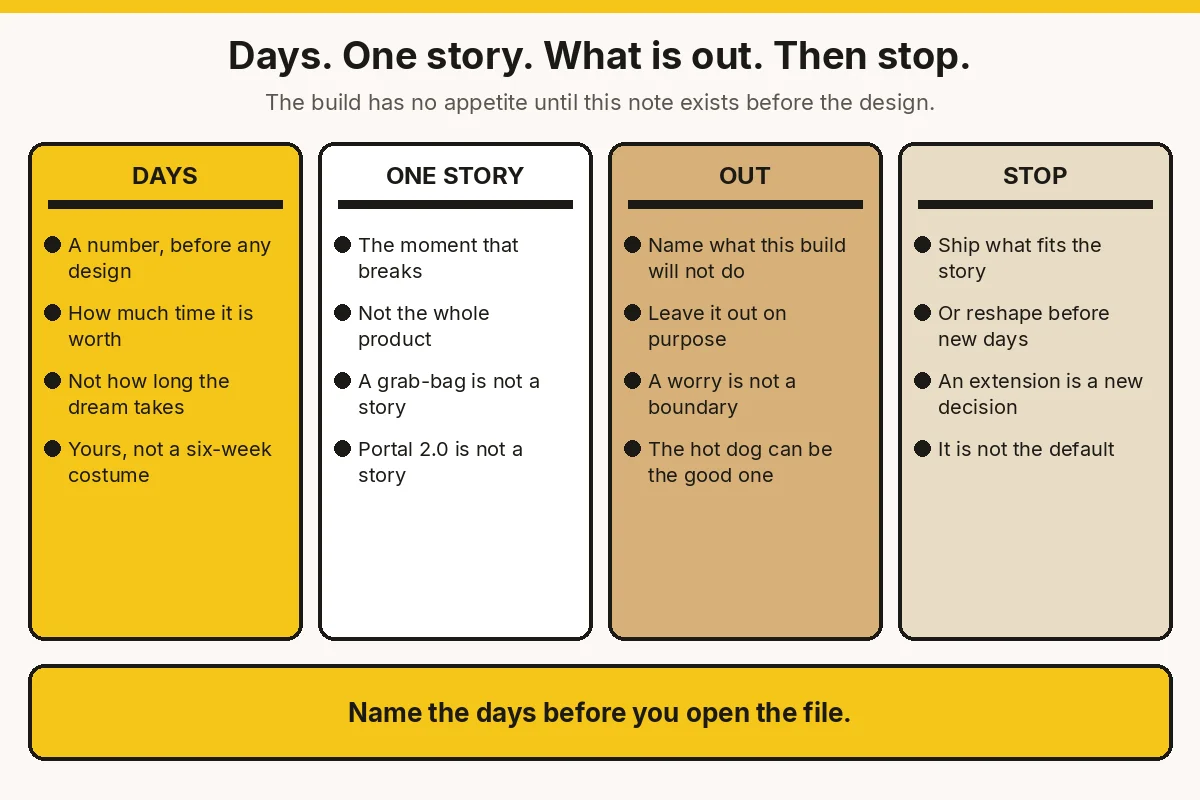
This build is worth: ____ days.
The story, one moment: when ____, ____ breaks.
Good enough inside those days: ____.
Out: ____.
On the last day I ship what fits, or I stop and reshape. I do not add days by default.
Read the number before you fall in love with the picture. “Five days. When a new client cannot tell where to send the file, the welcome email is the break. Good enough: one email and one link. Out: a dashboard, a settings page, a second flow. On day five I send the email, or I stop.” That is an appetite. “Rebuild onboarding, and we will see how long it takes” is an estimate wearing a project name. If you cannot fill the days, you are not ready to draw. Another hour in the file will not produce the missing number.
Keep “out” as a limit on the solution, not as a worry. Singer’s no-gos are use cases you are intentionally not covering so the problem stays tractable. “I will not build the dashboard” is a no-go. “I hope it feels polished” is a worry. “I will not miss Friday” is a second project unless Friday is the constraint and the dashboard is what gets left out. One thing is being optimized: a result that fits the days. Everything else is a candidate for “out.”
Narrow it to one story
If the title is a category, Singer says you do not have a project yet. You have a grab-bag. He names the worst offenders as redesigns or refactorings that are not driven by a single problem. “Redesign the Files section” is his example of a grab-bag. It is hard to know what it means, where it starts, and where it ends. His more productive start is a specific failure: sharing multiple files takes too many steps. Then you can ask what is not working, in what context, what can stay, and what has to change.
The tell he regrets is the “2.0” label. He describes kicking off a “Files 2.0” project without deciding what it meant. The team knew the Files feature had many problems and did not ask what, specifically, they were going to do. The project was a mess because they did not know what done looked like. They recovered by splitting it into smaller projects, “Better file previews” and “Custom folder colors,” each with an appetite and a clear expectation. A solo founder’s “Portal 2.0” fails the same way. Split it, or do not open it.
Narrowing is also how a request shrinks. A customer asked his team for more complex permission rules. Taken at face value, he says it could have been six weeks. They dug in. Someone had archived a file without knowing it would disappear for everyone else. The fix was a warning on the archive action, which he calls a one-day change instead of a six-week project. The calendar request narrowed the same way. They asked a customer when she wanted a calendar, not what it should look like. She was at home, a client wanted a meeting, and the free rooms lived on a chalkboard at the office. The insight was not “computerize the calendar.” It was “see free spaces,” which is a smaller problem than “do everything a calendar does.” He also says that if you cannot find a specific pain, the appetite tells you how much research is worthwhile. If it is not critical and you cannot get your hands around it, walk away and work on something else.
His default reply to a raw idea, before any of that shaping, is “Interesting. Maybe some day.” He calls it a soft no that leaves the options open. He does not put the idea in a backlog. It is too early to say yes or no on first contact, and a quick yes, he writes, produces a giant pile of work that only grows. Enthusiasm on contact sets an expectation you may not be able to keep once the idea sits next to everything else. For a founder, the raw idea is often your own. “Interesting. Maybe some day.” is allowed to be a sentence you say to yourself, before the four lines exist.
When the days are spent
When the days are spent, the default is to stop. An extension is a new decision, not the remainder of the old one. In the chapter on the betting table, Singer’s policy is that teams have to ship within the time that was bet. If they do not finish, by default the project does not get an extension. He thinks of it as a circuit breaker, so one project does not overload the system. The glossary line is blunt: cancel projects that do not ship in the cycle by default, instead of extending them by default. He writes that if the project was only worth six weeks, it would be foolish to spend two, three, or ten times that. Very few projects are of the “at all costs” type.
The second use of the breaker is diagnostic. If the work does not finish in the time, he says something was wrong in the shaping. The move is to reframe the problem, not to pour more time into the approach that failed. A new pitch has to change the odds before the work gets another block of time. The third use is ownership. People with a hard deadline and a real chance of not shipping are the ones who question which detail is blowing the scope. You cannot ship, he writes, without deciding where to stop, what to compromise, and what to leave out.
On the last day, one of these three.
Ship what fits the story. Stop.
The approach failed. Reshape before any new days. The next version needs a new story or a new “out,” not the same file with a longer date.
This is a crisis. The other work waits. Use this only in the sense he gives: data is being lost, the product is grinding to a halt, or a huge swath of customers are seeing the wrong thing.
He is explicit that a bug is not automatically a crisis. “There is nothing special about bugs that makes them automatically more important than everything else.” The mere fact that something is a bug is not a reason to interrupt the work. All software has bugs, he writes, and the question is how severe they are. Crises are rare. Most bugs can wait, and many do not need to be fixed. If you try to eliminate every bug, you never ship. For a founder, “it would be nicer” is not his crisis test. Neither is a client who would prefer the dashboard you already marked out. Ship the email. Reshape the dashboard as its own appetite, on a later day, if it is still the thing worth the days.
Silence on the last day is not the first reply. If you reach day five and simply keep typing, you have extended by default, which is the failure the circuit breaker exists to prevent. “Almost done” is also an extension unless the remaining piece is inside the story and inside the day. A dashboard is not “almost” a welcome email.
When you are two or three people
Singer tells a team of two or three to throw out most of the structure and keep the appetite. The appendix is titled Adjust to Your Size. He separates basic truths from specific practices. Shaping sets boundaries for whoever does the work, “whether that’s a separate team or just your future self.” If you do not make the trade-offs up front, he writes, the universe forces them later in a rush. Betting has the same consequence at any size: unclear or open-ended commitments cost you, even when six weeks is the wrong length. “Six weeks might not be the exact time frame for your team.” Cap the downside with a circuit breaker anyway.
Then he says what a tiny team can drop. When two or three people each wear many hats, it is hard to promise long uninterrupted stretches, and it is easy to change course in the same room. “You don’t need to work six weeks at a time. You don’t need a cool-down period, formal pitches or a betting table.” The same people alternate. Be deliberate about which hat you are wearing. “Set an appetite, shape what to do next, build it, then shape the next thing.” The bets can change size: “maybe two weeks here, three weeks there.” You are still shaping, betting, and building, without cycles. A solo founder is the case he leaves room for with “your future self.” Write the four lines to yourself. Then build. Then stop. Do not install a betting table you do not have the people to sit at.
He is equally plain about the other side of the size line, so you do not pretend you are still tiny when you are not. After more people are hired, the fluidity becomes a liability. Ad-hoc chat stops working, and that is when his six-week cycles, cool-downs, and a formal betting table start to earn their keep. He describes Basecamp at the time of that chapter as about 50 people in the company and roughly a dozen in the product team, with specialized groups so the people on a shaped project are not interrupted. If that is not your company, do not copy the calendar. Copy the question he says does not depend on size: how much time is this worth, and what will you leave out so it fits?
A contractor is not “no other person,” and a backbrief is still a different gate. The piece on the nod that came back as a different job checks that their words match the job. An appetite checks how long that job is allowed to run. Ask for the restatement, then put the days on it. Do not use “I intend to,” from the piece on being the bottleneck, as a substitute for the number. That sentence moves a decision. It does not cap a build. A person can intend, quite clearly, to spend three weeks on a portal that was worth five days.
Common mistakes
- Drawing first. Singer’s estimate starts with a design and ends with a number. If the picture exists and the days do not, you do not have an appetite yet.
- Saying yes on contact. His default for a raw idea is “Interesting. Maybe some day.” A quick yes is how the pile grows before the problem is narrow enough to shape.
- Titling it 2.0. His Files 2.0 story is a grab-bag: many problems, no definition of done. Split the title until one story remains, and give that story its own days.
- Chasing the ten-course version. He says the best solution is relative to the time. The hot dog is allowed to be the good ship when the days are short.
- Extending because you are close. The circuit breaker cancels the default extension. New days require a new decision, usually a reshaped story, not the same file with a longer date.
- Calling every bug a crisis. His crisis test is lost data, a product grinding to a halt, or a huge swath of customers seeing the wrong thing. “It would be nicer” fails that test.
- Wearing his six-week cycle. For two or three people he says you do not need the cycle, the cool-down, the formal pitch, or the betting table. You still set an appetite.
- Using Monday’s list as the cap. Three outcomes choose the week. They do not say how many days the third outcome may consume. A week where everything is urgent is a different cut again. Neither one names the time a single build is worth.
What the source does and does not say
The online edition gives you the appetite, the grab-bag, the circuit breaker, and a smaller structure for a tiny team. It does not give you the email, the three replies, or a result for a one-person studio. The PDF was read on 16 November 2026 for the chapters named below. The rest of the book was not used. The public contents page was opened the same day and lists those chapters. About the Author does not state a publication year. No ISBN was checked.
| Source | What was read | What this page uses | What this page does not use |
|---|---|---|---|
| Ryan Singer, Shape Up, online edition, PDF at basecamp.com/shapeup/shape-up.pdf | Chapter 2 from the Dot Grid case through “It’s bounded.” Chapter 3, Set Boundaries. Chapter 6 through the appetite ingredient and the no-gos. Chapter 8 on the circuit breaker and bugs. Adjust to Your Size through the two- or three-person section and the size note that follows. Glossary lines for appetite and circuit breaker. About the Author. | Appetite as time you want to spend. Estimates start with a design; appetites start with a number. Fixed time, variable scope. Good is relative, including the hot-dog line. The calendar and permission-rule narrowings. Grab-bags and Files 2.0. “Interesting. Maybe some day.” No default extension. The crisis test for bugs. A tiny team drops the six-week machinery and still sets an appetite. Shaping can be for your future self. | His six-week cycle as a requirement. His team size of one designer and one or two programmers. The “about 10 percent” figure as anything but his account of past Basecamp calendars. Breadboards, hill charts, and the betting table, which this page does not teach. Any claim that the method raises a completion rate. A print year or an ISBN, because neither was on the pages read. |
He is writing a guide to product development at Basecamp, a company he describes growing from a handful of people to about 50, with a product team of roughly a dozen. He says the basic truths apply at any size and the practices do not. That is as far as the transfer goes. The four-line note is our application for a solo founder or a new manager. It is not a measured lift in how often a small team ships.
Frequently asked questions
What does it mean that the build has no appetite?
The build has no appetite when the design starts before anyone names how much time the work is worth. A doc called “new onboarding” that grows a dashboard, a settings page, and a second flow in one week is the usual shape. Nothing ships, because every extra idea still counts as the job. Ryan Singer, in the online edition of Shape Up, calls the missing number an appetite: the time you want to spend, as opposed to an estimate. The days, one story, what is out, and the stop are this page’s note. They are not a form in the book.
What is an appetite in Shape Up?
An appetite, in Singer’s glossary, is the time you want to spend on a project, as opposed to an estimate. In Set Boundaries he calls it a time budget. His sizes are one or two weeks, or six weeks, for a team of one designer and one or two programmers. Those sizes are his shop’s. What transfers is the order: name the time before you design. If the idea is bigger than the time, he narrows it or breaks off a part that fits. A solo founder keeps that order and picks a different number of days.
How is an appetite different from an estimate?
Singer writes that estimates start with a design and end with a number, and appetites start with a number and end with a design. He calls this fixed time, variable scope. The number constrains the design, instead of the design producing a guess. Drawing the dream portal and then asking how long it will take is an estimate. Naming five days, then deciding those days buy one email and one link, is an appetite. He also says there is no absolute best. A hot dog can be the right ship when you lack time for a ten-course dinner. The leftover ambition is what gets cut.
What do you write before you design?
Write four lines, in this order. How many days the build is worth. The one story: the moment something breaks. What is good enough inside those days. What is out. On the last day you ship what fits, or you stop and reshape, and you do not add days by default. Singer’s pitch includes the problem, the appetite, the solution, and the no-gos, which are the exclusions that keep the work inside the time. The email itself is not in the book. If you cannot name the days, you are not ready to open the file. A picture without a number is still an estimate.
What is a grab-bag, and what happened with Files 2.0?
Singer calls “redesign the Files section” a grab-bag, not a project. It has no clear start and no clear end, because it is not one problem. The tell he names is a “2.0” label. His team kicked off Files 2.0 without deciding what it meant, and the work was a mess because nobody knew what done looked like. They split it into smaller projects, such as better file previews and custom folder colors, each with its own appetite. A permission request that looked like six weeks became a one-day warning once they found the moment that broke. “Portal 2.0” needs that split before anyone draws.
What happens when the days are spent?
The default is to stop. Singer’s circuit breaker says that if the work does not ship in the time that was bet, it does not get an extension by default. Spending two, three, or ten times the appetite is foolish, in his account, unless the project is “at all costs.” If the approach failed, reshape before you grant new days. Ship what still fits the story when the extra screens are the part that did not fit. A crisis, in his bug chapter, means lost data, a product grinding to a halt, or a huge swath of customers seeing the wrong thing. “It would be nicer” fails that test.
Do two or three people need a six-week cycle?
No. In Adjust to Your Size, Singer says two or three people can throw out most of the structure. You do not need six-week cycles, a cool-down, formal pitches, or a betting table. The same people alternate hats. Set an appetite, shape the next thing, build it, then shape again. Bets can be two weeks, then three. Shaping can be for your future self, which covers working alone. The circuit breaker still applies, so the commitment is not open-ended. His cycle is for a larger company, once ad-hoc chat starts to fail.
Did this page use a print year or an ISBN?
No. The book is Ryan Singer, Shape Up: Stop Running in Circles and Ship Work that Matters. The text read on 16 November 2026 is the online PDF at basecamp.com/shapeup/shape-up.pdf. The contents page at basecamp.com/shapeup was opened the same day. About the Author does not state a publication year, so none is given. No ISBN was checked. His “about 10 percent” line is his account of past Basecamp calendars, not a figure for other companies. The four-line note and the three last-day replies are our application. They are not a measured claim about how often a small team ships.
Sources
- Singer, R. Shape Up: Stop Running in Circles and Ship Work that Matters. Online edition. Read 16 November 2026 from the PDF at basecamp.com/shapeup/shape-up.pdf. The contents page, opened the same day, is basecamp.com/shapeup. Chapters used: 2 (Dot Grid through “It’s bounded”), 3 (Set Boundaries), 6 (pitch ingredients through appetite and no-gos), 8 (circuit breaker and bugs), and Adjust to Your Size through the two- or three-person section. Glossary entries used: appetite, circuit breaker. About the Author states no publication year. No ISBN was checked. The “about 10 percent” sentence is his account of Basecamp’s earlier calendars. The four-line note is not in the book.
Related reading on The Growth Reads
- Monday has no priority — three outcomes for the week, which still need a time budget each
- Everything is marked urgent — a different cut, when the week has no single commitment
- The work changed after the price — a sold result that moved, which is not an unbounded build
- They nodded, and the work came back — the restatement of the job, before the days go on it
- You are the bottleneck — the handoff for a decision, not the cap on a build
- Productivity — the cluster this article sits in
- How we review — what a checked source is, and what an unread chapter is not
How this was checked
Who it is for. A solo founder or a new manager whose build grows until the week is gone, because nobody named how many days it was worth before the design started.
What was read. Ryan Singer’s Shape Up, online PDF, on 16 November 2026: the Dot Grid case and the bounded-work section in chapter 2, chapter 3 in full, the pitch ingredients through appetite and no-gos in chapter 6, the circuit breaker and the bug section in chapter 8, Adjust to Your Size through the note for two or three people, and the glossary lines for appetite and circuit breaker. The contents page on basecamp.com/shapeup was opened the same day.
What was not read. No print edition. No ISBN database. No publication year, because About the Author does not state one. Breadboards, hill charts, and the betting-table ritual are in the book and are not taught here. His six-week cycle is described and then set aside for a tiny team, which is his own instruction.
Limit. The four-line note and the three last-day replies are our application. They are not a measured lift in how often a one-person or two-person shop ships. His 10 percent figure stays inside his account of Basecamp.
How we work: every article on The Growth Reads is built from books we have read and from primary accounts we can check, and it is date-stamped when those sources change. Read our methodology.