

★★★★☆ 4/5 — Use it when two people think they own the same task. Name one person, one of the two policies, and one checkup.
Best for: a new manager with two people on one next move, or a solo founder with a cofounder, a contractor, or a first hire.
Reading time: Amazon lists 137 pages for the 28 November 1989 William Morrow edition. The four rules used here are Blanchard’s 20 September 2010 restatement, not a timed reading of the chapters.
Difficulty to apply: moderate. The sentence is short. Not taking the next move back is the work.
The One Minute Manager Meets the Monkey in one minute
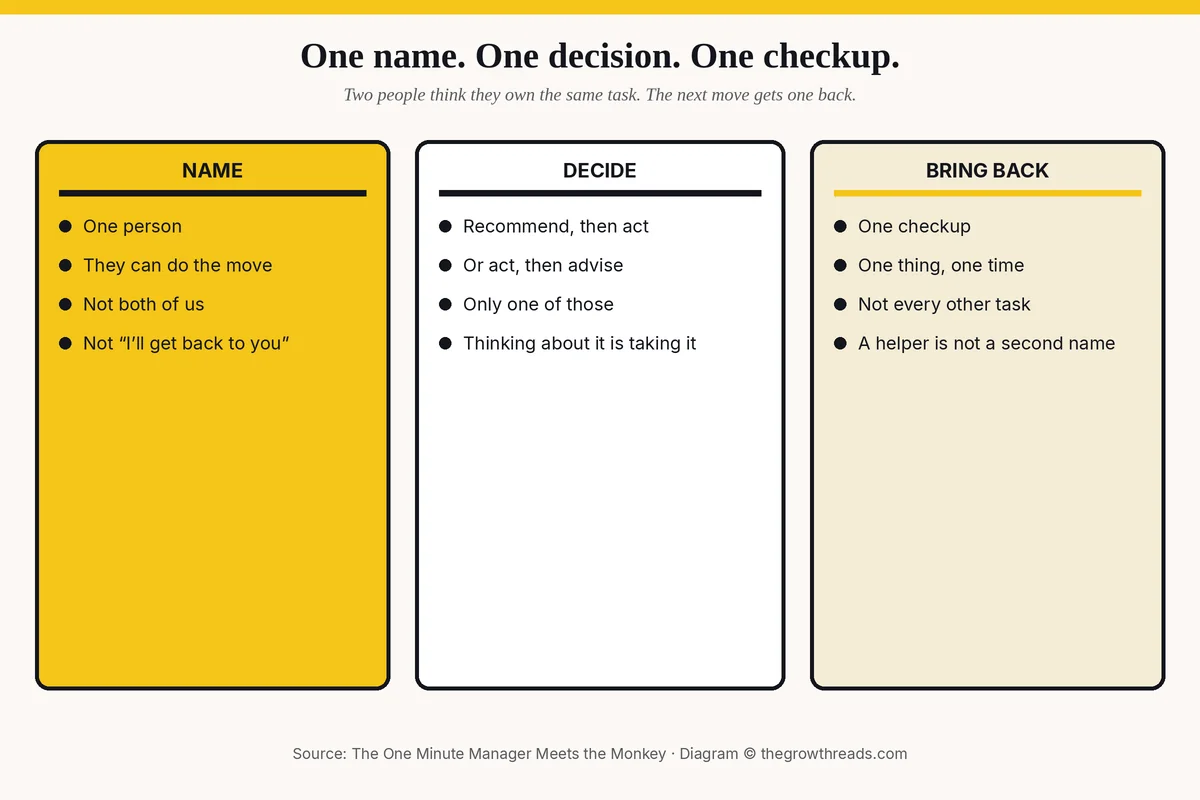
When two people meet, the next move needs one back, one policy, and one checkup. Kenneth Blanchard, William Oncken, Jr., and Hal Burrows published the book with William Morrow in 1989. On 20 September 2010 Blanchard restated the method and named the book. A monkey is the next move after two individuals meet. If you promise to think about it and get back to them, that move jumps onto you. The four rules he states are describe it, assign it to one person who can do it, cover it with one of two policies, and set a checkup. A helper is not a second name.
Key takeaways
- The monkey is the next move: Blanchard, on 20 September 2010, calls it the next move after two individuals meet. It is not the job title and not the whole project.
- The hallway has three positions: on their back, then a leg on each back, then on yours once you promise to get back to them.
- Describe it before you assign it: the dialogue is not over until the next moves are specified. “We are on it” is not a description.
- One name, at the lowest level that can do it: he states Oncken’s assign rule as all monkeys owned and handled at the lowest organizational level possible. Lowest possible is not the most junior person if they cannot do the move.
- Two policies, and only those two: recommend, then act, or act, then advise. Picking neither, and saying you will think about it, is you taking the move.
- The checkup is the bring-back: every monkey should have a checkup appointment. That is one thing at one time, not a tour of every other task.
- Taking their move teaches the wrong lesson: he writes that picking up their monkeys tells people they cannot care for the work, and everyone waits for the boss.
- Page counts disagree: Amazon and Open Library say 137 pages for the 1989 Morrow edition. Google Books lists 144 for the same ISBN. No page number is invented for the rules.
What is The One Minute Manager Meets the Monkey about?
It is the 1989 William Morrow book by Kenneth Blanchard, William Oncken, Jr., and Hal Burrows about who carries the next move after two people meet. Blanchard’s 2010 account says that move gets one owner, one of two policies, and a checkup.
About the author
Wikipedia describes Kenneth Hartley Blanchard as an American author, consultant, and speaker, and as the co-creator, with Paul Hersey, of Situational Leadership. This review does not repeat the sales figures on that page. William Oncken, Jr., and Hal Burrows are the coauthors named on the 1989 Morrow edition. Blanchard’s 20 September 2010 post says Oncken wrote, with Don Wass, the Harvard Business Review article he titles “Managing Management Time: Who’s Got the Monkey?” This review did not open that article. The catalog records list Hal Burrows with a date of 1937. No Wikipedia page turned up for either coauthor on 14 November 2026, so this review does not invent a photo. The start-here link on this site stays The One Minute Manager, a different book. Explore all Hal Burrows book summaries →
Key concepts at a glance
| Concept | What it means | Use it when |
|---|---|---|
| Monkey | The next move after two people meet. Blanchard’s 2010 definition. Not the whole job. | Two names are on one task and neither can say the next move. |
| Joint consideration | While you talk, the move has a leg on each back. Both of you are “on it.” | The conversation feels polite and the work is still stuck. |
| Describe | The talk is not over until the next moves are specified. His statement of the first rule. | You are about to say you will both keep an eye on it. |
| Assign | One owner, at the lowest level that can handle that move. His statement of Oncken’s rule. | You are about to put two names on the file, or the most junior name who cannot do it. |
| Recommend, then act | They bring the recommendation. You say yes or no. Then they do it. | You still need to approve this move, and only this move. |
| Act, then advise | They do it, then they tell you what they did. | They can proceed without a yes, and you still want the note. |
| Checkup | One appointment. One thing comes back. Not a progress report you owe them on their job. | The 1:1 is about to become a tour of every task. |
Describe the next move
The morning problem is two people who think they own the same task. Blanchard’s 20 September 2010 scene is a hallway. A staff member explains a problem. You know you will have to be involved, and you do not know enough to decide, so you promise to think about it and get back to them. Before the talk, the next move was on their back. While you talked, it had a leg on each back. That promise moves it onto yours, and he writes that they will stop in to ask how it is coming. The job was theirs. They are now supervising you.
A new manager hits the same split when two people both answer the client or both edit the deck. A solo founder hits it when a cofounder, a contractor, or a first hire is on the same file. The first rule, as he states it, is that the dialogue must not end until the next moves are specified. If you cannot say the next move in one sentence, you do not have an owner. You have the joint minute.
Put one name on it
The second rule is the name. Blanchard states Oncken’s line: all monkeys shall be owned and handled at the lowest organizational level possible. He writes that managers who pick up other people’s monkeys broadcast that those people lack the skills to care for the work, and everyone waits for the boss. He calls that a lose/lose. The four rules, he says, let you give the monkey back without buck-passing or abdication.
Lowest possible is not a dump. If the person cannot do the move, the level is wrong. If you are the only one who can make it, the name is yours. Two names, or “both of us,” leaves the leg on each back.
The Amazon product description for ISBN 9780688067670, read on 14 November 2026, puts the same idea in the blurb: do not take on a problem if it is not yours, and managers who accept every problem become bottlenecks. It names Oncken’s four rules. That is the product page, not a chapter. This review did not read the rules chapters, and it does not assign those sentences to a page number.
Pick one of the two policies
The third rule is the decision they can make. Blanchard says every monkey that leaves on someone else’s back is covered by one of two policies: recommend, then act, or act, then advise. There is no third policy in the post. They bring a recommendation and wait for a yes, or they do it and tell you after. A helper can be in the room. A helper is not a second name.
If both policies feel wrong, you have not described the move. “I’ll think about it” is not a policy. In his scene, that sentence is how the move changes backs.
A cofounder who is used to deciding together is still the joint minute. Pick one name and one policy. The other person can help. If the move is a decision only you can make, say that your name is the owner. Do not call the policy “we’ll see.”
Set the checkup, then stop
The fourth rule is what they bring back. Blanchard says every monkey should have a checkup appointment. Name the thing and the time in the same sentence as the owner. Recommend, then act brings a recommendation. Act, then advise brings a short note of what they did. Not a tour of every other task, and not a progress report you owe them on their job.
The sentence below is this review’s application. The 2010 post does not print it. The morning article uses the same shape. Leave the brackets. Do not add a second task.
When they can do the next move: [Name] owns the next move on [the task]. The next move is [one sentence]. You can [recommend, then act / act, then advise]. Bring back [the one thing] at [the checkup]. [Other name] can help. [Other name] does not own the next move. I am not taking this back to my desk.
When you were about to take it: I am not going to think about this and get back to you. The next move stays with [name]. Send me [the recommendation] by [time], or do it and tell me at [the checkup].
Then stop. A second line that keeps you close puts your name back on the move. His scene needs two people. A founder alone does not have a joint minute, and should not announce that a person they have not hired owns the work.
Who is The One Minute Manager Meets the Monkey best for — and who should read something else first?
Read this if two people can still change the same next move, and you need one name, one policy, and one checkup. A new manager uses it when two people on the team both answer the client. A solo founder uses it when a cofounder, a contractor, or a first hire is already in the work.
Read The Effective Manager first if the hour is a 1:1 with no decision and no owner. Read The New One Minute Manager if you need a goal, praise, and a redirect, and the owner of this move is already obvious. Read you are the bottleneck if the next move is a decision only you can make. If you are alone, this book will not invent a second back.
Questions to reflect on
- Which task has two names on the next move, and can you say that move in one sentence?
- Who is the lowest person who can actually do that move, and who were you about to add so nobody feels left out?
- Which of the two policies is true this time: they recommend and wait for a yes, or they act and tell you after?
- What one thing comes back, at what time, and what tour of other tasks are you tempted to add?
- If you are the only person in the work, which sentence will you not send?
🔥 Ready to put one name on the next move?
The Amazon button is the William Morrow edition, ISBN 9780688067670, listed as 137 pages on 28 November 1989. The Bookshop button is the shop, because the deep link did not open from here.
How to apply The One Minute Manager Meets the Monkey (7-day plan)
- Day 1 — Write the one task both of you are touching. If the list has five, you do not have a monkey yet. You have a pile.
- Day 2 — Write the next move in one sentence. If you cannot, the first rule says the talk is not over. Do not assign a mood.
- Day 3 — Write one name: the person who can do that move. If the only person is you, say so. If the name is “both of us,” you have not assigned it.
- Day 4 — Pick one policy. Recommend, then act, if you still need a yes. Act, then advise, if they can proceed and tell you after. Do not invent a third.
- Day 5 — Name the checkup: one thing, one time. Not a status of every other task.
- Day 6 — Send the sentence. The other person can help. They do not own the next move. Then stop typing.
- Day 7 — Do not take it back. If you were about to say you would think about it, send the second sentence instead. If there is no second person, do not send either sentence.
Frequently asked questions
What is the monkey on a shared task?
A monkey is the next move after two people meet. That is Ken Blanchard’s definition in his 20 September 2010 post about the 1989 book with William Oncken, Jr., and Hal Burrows. Before the talk, the move is on the other person’s back. While you talk, he says the matter is under joint consideration, one leg on each back. If you promise to think about it and get back to them, the next move jumps to you, and you have promised a progress report. Describe that move in one sentence before you assign a name. This review did not read a numbered page for the scene.
Who should own the next move?
One person, at the lowest level that can actually do that move. Blanchard’s statement of Oncken’s assign rule is that all monkeys shall be owned and handled at the lowest organizational level possible. If they cannot do the move, the level is wrong. Handing it down anyway is the abdication the post says the rules are meant to avoid. If you are the only one who can make the move, the name is yours. Two names, or both of us, leaves a leg on each back. A helper can stay. A helper is not a second name on the next move.
What decision can that person make?
One of two policies, and only those two. Blanchard’s 2010 post calls them insurance policies: recommend, then act, or act, then advise. Recommend, then act means they bring the recommendation, you say yes or no, and then they do it. Act, then advise means they do the move and then tell you what they did. The post does not list a third policy. Saying you will think about it is not a policy. In his scene, that sentence moves the next move onto the manager. If both policies feel wrong, the move is not described yet.
What do they bring back?
One checkup. Blanchard states the fourth rule as a checkup appointment for every monkey. Name the thing and the time in the same sentence as the owner. A recommendation, if the policy is recommend then act. A short note of what they did, if the policy is act then advise. They do not bring a tour of every other task, and you do not owe them a progress report on a move you refused to take. The 2010 post does not print the note in this review. The wording is the application. There is no page number, because the checkup chapter was not read.
What if both people can do the work?
Pick one name anyway. Two capable people is how the file gets both names and no next move. Blanchard’s assign rule still asks for one back, not a tie. The other capable person can help, and help is not ownership. Choose one policy for this move only. A later move can have a different policy and a different name. Leaving both names so nobody feels left out is the joint minute, one leg on each back. If you would both keep an eye on it, it is not owned.
Which edition is this review based on?
The buttons use the edition Amazon showed for ISBN 9780688067670 on 14 November 2026: William Morrow, 28 November 1989, 137 pages, ISBN-10 0688067670. The authors listed there are Kenneth Blanchard, William Oncken, Jr., and Hal Burrows. Open Library OL2211824M calls it the first edition, Morrow, New York, 1989, 137 pages. Google Books lists HarperCollins, 1989, and 144 pages for the same ISBN. The counts disagree. We did not reconcile them and we did not read a numbered page. The rules are the 2010 post.
Is this the same book as The One Minute Manager?
No. The New One Minute Manager already on this site is a different book about a goal, praise, and a redirect. Amazon lists Meets the Monkey as part of that series. The 1989 Morrow edition names three authors: Blanchard, Oncken, and Burrows. The method here is the next move after two people meet, from Blanchard’s 20 September 2010 post. Use the other summary when the owner is already clear. Use this one when two people think they own the same task. The author start-here on this site stays The One Minute Manager.
Related summaries
- The New One Minute Manager summary — goals, praise, and redirects, from the same lead author
- The Effective Manager summary — when the 1:1 itself has no decision
- The Great CEO Within summary — when the whole company still waits on you
- Two people think they own the same task — the morning problem this review supports
- Best leadership books