

★★★★½ 4.6/5 — Let people know you exist, on a schedule.
Best for: owners who can already deliver, and need strangers to raise a hand.
Reading time: about 5 hours for the book (278 pages); about 14 minutes for this guide.
Difficulty to apply: moderate. The math is simple. The daily volume is the work.
$100M Leads in one minute
A quiet pipeline is usually a contact problem. Alex Hormozi’s second Acquisition.com book says a lead is a person you can contact, and an engaged lead has already shown interest. The rest of the book shows how to create more of them.
He sorts the work into the Core Four: warm outreach to people who know you, free content until someone asks, cold outreach to fitting strangers, and paid ads that rent attention for a message that already earns replies. Customers, employees, agencies, and referral partners can run those same motions with you. Do more of what already gets a reply before you open a new channel. The list you can reach again is the asset.
Key takeaways
- Lead means reachable: if you cannot contact the person, you do not have a lead yet. A view, a room, or a like is attention until there is a way back.
- Engaged beats anonymous: interest shown in advance makes the sales conversation shorter, because the person already raised a hand.
- Warm is the first list: one hundred people who know you, contacted personally, beat a new logo and a hope that strangers wander in.
- Content has three jobs: call out who it is for, give them a reason to stay, and leave them with something they can use today.
- Cold is arithmetic: a lower yes-rate is fine when the list is real and the first line is about their situation, not your autobiography.
- Ads amplify a winner: pay to show a message that already earned replies. A silent free test gets louder when you fund it, not better.
- The magnet solves a slice: give away a complete fix for one narrow problem, and let that win reveal the problem you are paid to solve.
- Other people can do the Core Four: customers refer, employees run the motions, agencies execute, partners tell their own audience. You still own the offer and the list.
- More, then better, then new: increase volume on what works, sharpen it, and only then open another channel.
What is $100M Leads about?
$100M Leads is Alex Hormozi’s playbook for getting strangers to want what you sell before you ask them to pay. He defines a lead as a person you can contact, then lays out four ways to create those contacts and four kinds of people who can run that work with you.
About the author
Alex Hormozi built and sold service businesses, then with Leila Hormozi assembled a portfolio of companies under Acquisition.com. The public story is operational: gyms, licensing, and later a holding company that invests in businesses with a clear offer and a way to reach buyers. He published $100M Offers in 2021 as the field manual for the promise itself, and $100M Leads on 8 September 2023 as the companion on distribution. Explore all Alex Hormozi book summaries →
He writes as an operator who had to fill calendars. The ratios he keeps are plain: how many people you can contact, how many reply, and what a customer is worth once they do. That bias favors an owner who will send the notes.
Key concepts at a glance
| Concept | What it means | Use it when |
|---|---|---|
| Lead | A person you can contact. | You are counting views and calling them pipeline. |
| Engaged lead | A reachable person who already showed interest. | You want shorter sales conversations. |
| Core Four | Warm, content, cold, and paid. | You need a map of every way people hear about you. |
| Lead magnet | A complete solution to one narrow problem. | Strangers need a reason to trade a way to reply. |
| Give until they ask | Public value first. The offer waits for the raised hand. | Your posts talk about you and hear nothing back. |
| Lead getter | A customer, employee, agency, or partner who runs the Core Four. | Your own hours are the ceiling. |
| More, better, new | Volume, then quality, then a new placement. | You keep switching channels before one of them works. |
A lead is someone you can contact
Hormozi opens by separating attention from a lead. Attention is a person noticing you. A lead is a person you can contact again. An engaged lead has shown interest in the stuff you sell. The distinction sounds small until you audit a week. A post with thousands of impressions and twelve profile visits did not create twelve leads. It created twelve chances to become one, and only if you gave them a next step you can follow.
He treats advertising as the process of making known. The known thing is the offer. The known people are the market. If either side is fuzzy, more activity just makes the fuzz louder. That is why this book sits beside $100M Offers. The promise has to be something a sensible buyer can picture. Then the job is to put that promise in front of people who can say yes.
The asset he wants you to own is the list. A platform can show your work to strangers today and hide it tomorrow. A list of engaged leads is a file you can reopen without paying to be seen.
The Core Four ways people find out
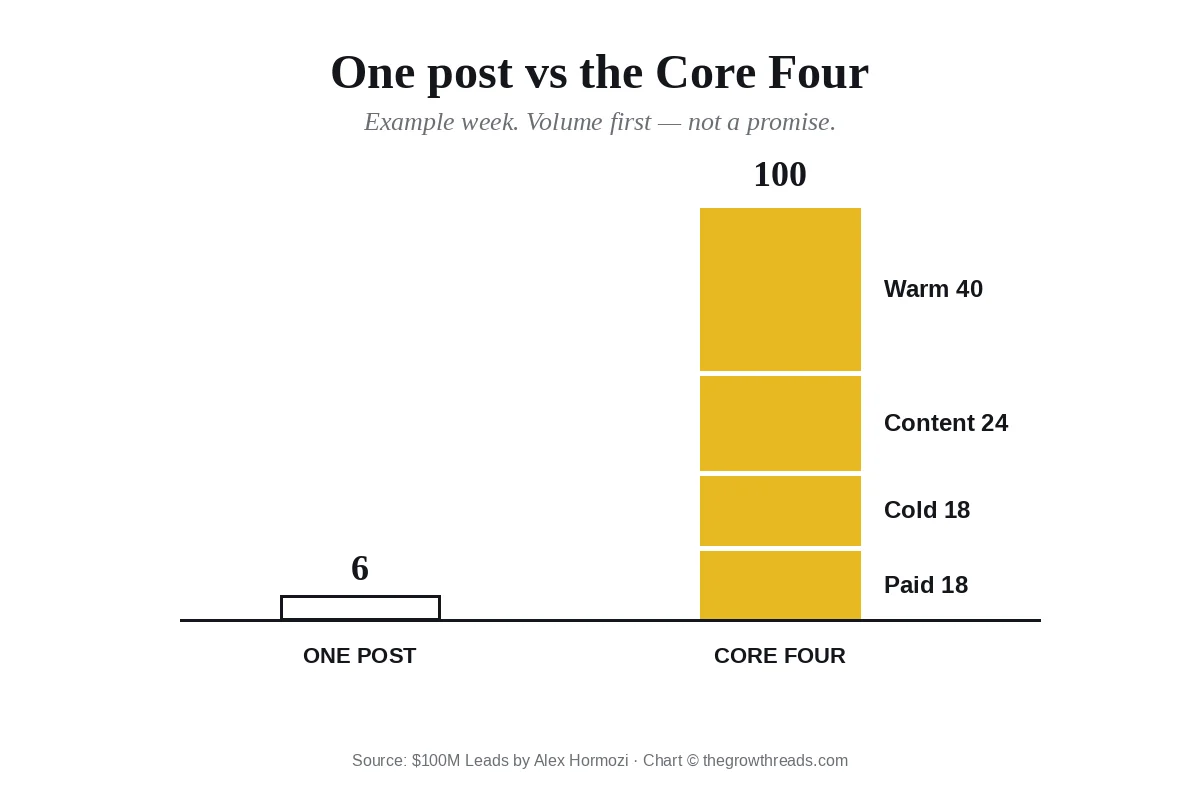
Warm outreach is the list of humans who would not be confused to hear from you. Past customers, old colleagues, friends of the work, people you have helped for free. Hormozi pushes volume here because the trust is already paid for. A short note with one specific context line and one clear question outperforms a newsletter blast. One hundred reaches at a modest reply rate is a week of conversations you would not have had by waiting.
Free content is warm outreach for people you have not met. The shape he repeats is hook, retain, reward. The hook names who the piece is for and what tension it will touch. The middle keeps a promise — a story, a list, a set of steps. The reward is something the reader can use without buying. Give in that rhythm until people ask how to work with you. Teaching until they ask associates your name with a result.
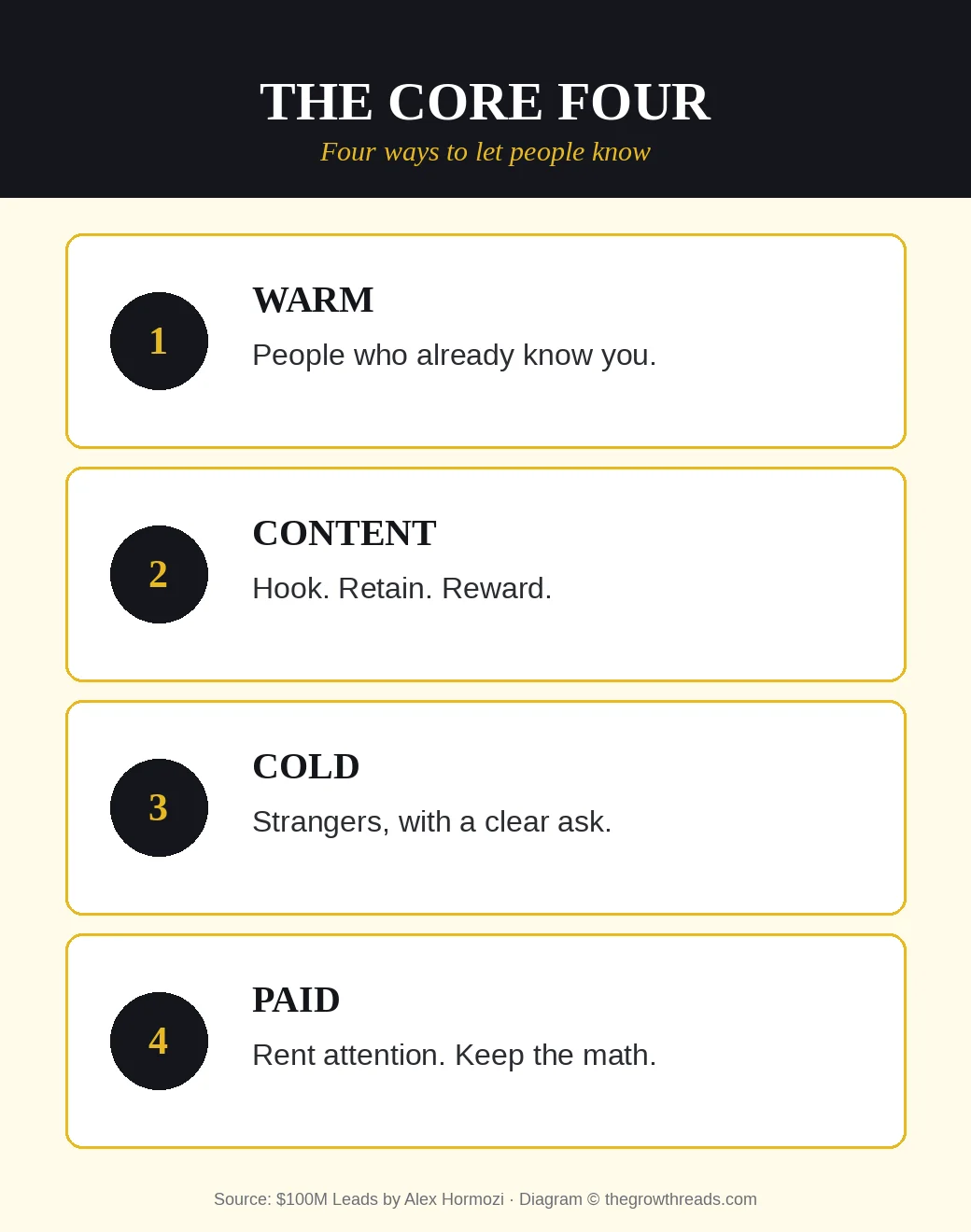
Cold outreach is the same motion aimed at strangers who match the buyer. The yes-rate drops. The list gets larger. The first line has to prove you looked at their world, and the ask has to be small enough to answer. A lower yes-rate is acceptable when the list is real. A week with no record is a week you cannot improve.
Paid ads come last in the learning order, even though they feel like the grown-up move. You are paying to put a warm-style note, a piece of content, or a cold opener in front of strangers. The book is blunt about the ratio. If a customer is worth less than the cost of getting one, the ad is a donation. Prove the message with warm notes and one public piece, then rent a little attention for the version that already worked. Keep the lead on a list you own.
Lead magnets that earn the ask
A lead magnet, in this book, is not a bribe for an email address. It is a complete solution to a narrow problem. Hormozi sorts the formats into tools, information, services, and physical goods. The format is secondary to the test. Would a reasonable stranger have paid a little for this slice, and does finishing it reveal a larger problem you solve for money?
Build it in four moves. Name one painful slice, not the whole business. Finish that slice so the person gets a result the same day. Show them how to use it without a scavenger hunt. Then let the win point at the next problem. A checklist that removes one onboarding mistake is a magnet. A PDF titled “ultimate guide” that repeats your homepage is a stall.
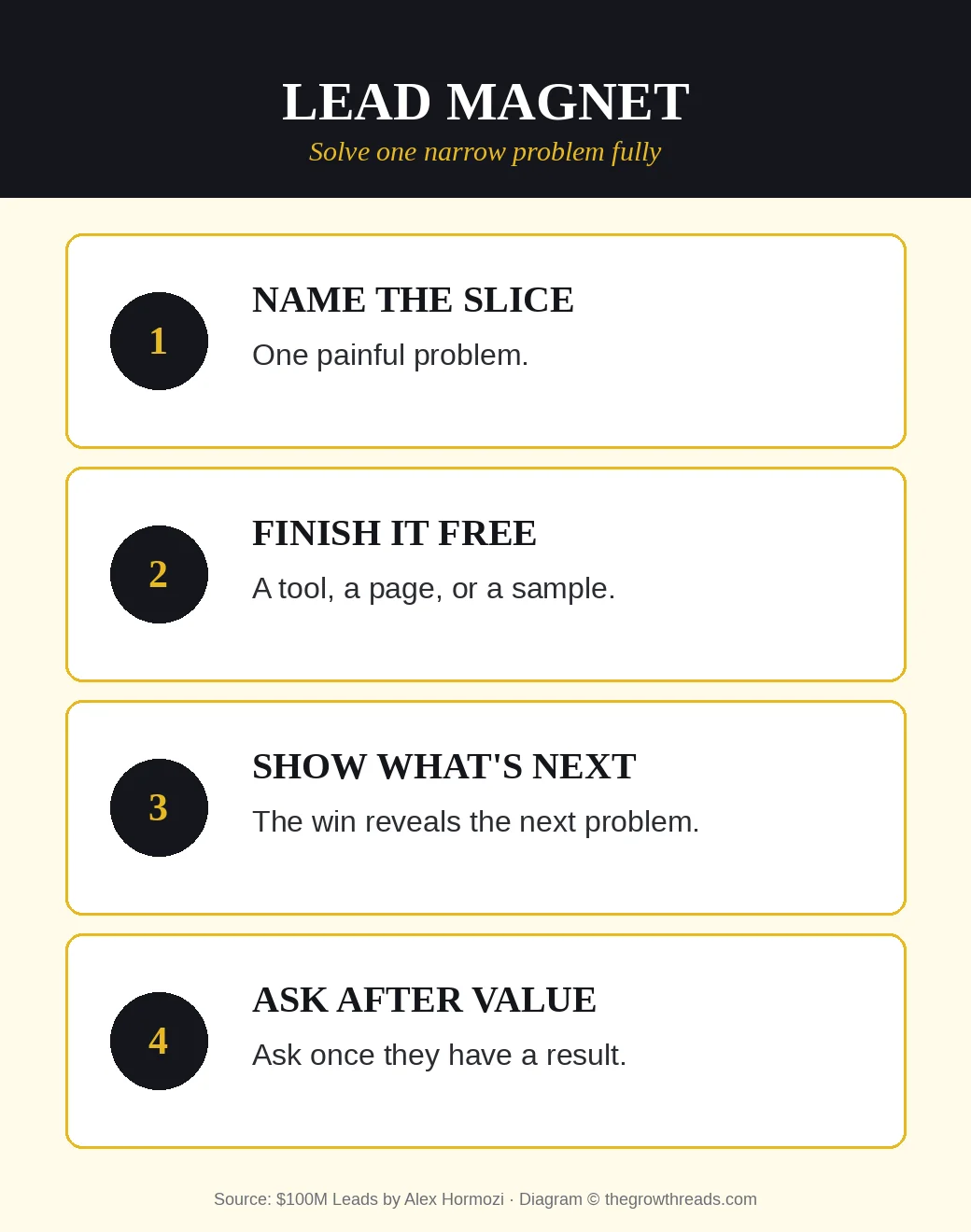
Place the magnet at the end of content that already helped. When someone uses it, you have an engaged lead: a person you can contact who traded attention for a result. Invite them to the next step you can actually deliver.
Lead getters, then more, better, new
Your own hours cap the Core Four. Hormozi’s second half is about lead getters: other people doing the same four motions. Customers refer when the result was obvious and you give them a sentence they can forward. Employees run warm notes, content, or cold lists as a job, with the same ratios you would hold yourself to. Agencies can execute once the message is proven, as long as the list and the offer stay yours. Referral partners tell an audience they already have, and they need a reason that makes them look good for doing it.
Install lead getters after a channel already turns contacts into conversations. Document the motion so someone else can run it. A referral of a confusing offer only creates a louder confused conversation.
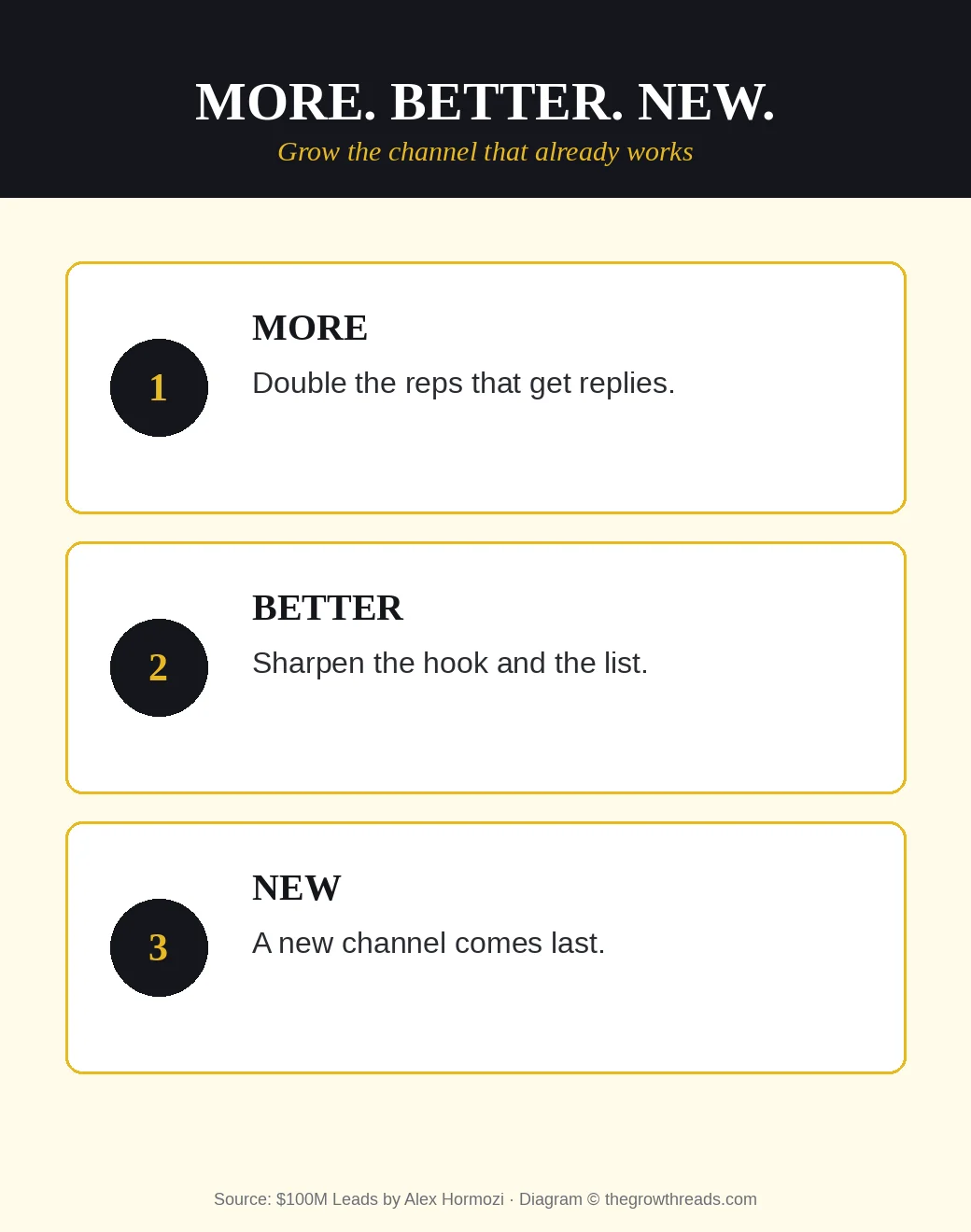
The rule that keeps the book honest is more, better, new. More means doubling the reps on the channel that already replies. Better means improving the hook, the list, the magnet, or the offer inside that channel. New means a different placement, and it comes last because a fresh channel throws away what you just learned. Ask once a week which motion got replies, and do more of that before you open another door.
Who is $100M Leads best for — and who should read something else first?
This book is for an owner or specialist who can already help a customer and is tired of waiting to be discovered. If conversations go well once someone is in the room, and the empty weeks are about too few rooms, the Core Four is the right manual.
Read something else first if the problem is still unknown. The Mom Test teaches you to hear what buyers actually struggle with before you announce a fix. Read $100M Offers first if warm contacts already hear from you and still stall — the promise needs work before the megaphone does. If you want the wider shelf of productivity books around this one, the best productivity books guide is the map.
Questions to reflect on
- Who are one hundred people that would recognize your name, and when did you last contact them with something useful?
- Which public piece this month gave a stranger a result they could feel the same day?
- What narrow problem could you solve completely on a single page, for free, this week?
- Which channel already gets replies, and what would doubling it look like before you open a new one?
- If a customer wanted to introduce you, what exact sentence would you want them to forward?
🔥 Ready to let the right strangers know you exist?
Start with the warm list, ship one useful magnet, and only then pay to show the message that already earned a reply.
How to apply $100M Leads (7-day plan)
- Day 1 — Name the reachable list. Write one hundred people who would recognize your name. Split them into past customers, peers, and friends of the work. This is the warm pool. Do not add strangers yet.
- Day 2 — Send twenty warm notes. One line of real context, one useful observation, one small question. Stop at twenty. Record who replies. The goal is a conversation, not a broadcast.
- Day 3 — Build one narrow magnet. Pick a problem you can solve on a page: a checklist, a short calculator, or a sample. Finish it so a stranger gets a result without booking you.
- Day 4 — Publish one piece. Hook for the right person, a middle that helps, the magnet at the end. Put it where your buyers already pay attention. Save every person who takes the magnet onto a list you own.
- Day 5 — Send ten cold openers. Choose people who match a buyer you have already served. Mention their situation in the first line. Ask for a reply, not a purchase.
- Day 6 — Do more of what replied. Count notes, replies, and conversations. Double the motion that worked. Leave the silent motion alone for one more week of reps before you judge it.
- Day 7 — Ask for one introduction. Thank a customer who got a clear result. Give them the exact sentence to forward and the name of the kind of person you can help next.
Frequently asked questions
What does Hormozi mean by an "engaged lead"?
A lead is simply a person you can contact. An engaged lead is a person you can contact who has already shown interest in the thing you sell. A name in a bought spreadsheet is a lead only if you are allowed to reach them. A stranger who watched a video and asked for the checklist is engaged, because they raised a hand. The book treats engaged leads as the real asset, since interest is what makes the later conversation short. Attention that never becomes a way to follow up stays rented. Write the definition on a card before you celebrate a view count, a room, or a viral afternoon.
What is the Core Four in $100M Leads?
The Core Four are the only ways Hormozi says you let people know you exist. Warm outreach means contacting people who already know you. Free content means posting in public with a hook, a reason to stay, and a useful payoff. Cold outreach means contacting strangers who fit the buyer, with more volume and a lower yes-rate. Paid ads means paying to put one of those messages in front of people who do not know you yet. Start with warm, because the list is small and the trust is already there. Add the others once you can describe the reply you want.
What makes a lead magnet worth giving away?
A lead magnet is a complete solution to a narrow problem. It can be a checklist, a short tool, a done-for-you sample, or a physical item. The test is simple: a stranger would have paid a small amount for that slice, and using it reveals the next problem you are paid to solve. A vague newsletter signup fails the test. A one-page fix for a single painful mistake passes it. Put the magnet where the content ends, and make the consumption obvious, so the person gets a result the same day. The ask comes after that result, not before it.
Should a small business buy ads first?
Buy ads after a free version of the message already earns replies. Ads rent attention. They do not invent a reason for someone to care. Hormozi’s math is plain: advertising works when what a customer is worth stays above what it costs to get one. If warm notes and one public post produce silence, a bigger budget amplifies the silence. Spend a week on the warm list and one piece of content. Record who replies. Then put a small paid test behind the message that already worked. Keep the list you own. The platform can change its prices. Your follow-up file should not.
How is $100M Leads different from $100M Offers?
Offers is about what you sell. Leads is about who finds out. The earlier book builds an offer people feel unreasonable saying no to: a clear outcome, reasons to believe, less delay, and less effort. This book assumes that offer exists and asks how strangers ever hear about it. Read Offers first if people who already know you still hesitate. Read Leads if the offer lands when someone sits down with you, and the empty week is a contact problem. The two books share one sequence. Make the promise strong, then let more of the right people see it. Neither book replaces a delivery you can actually keep.
How much time does the Core Four take in a week?
The book is a volume argument, not a four-hour fantasy. A practical first week is a list of one hundred warm names, twenty personal notes, one public piece with a magnet, and ten cold openers to people who match the buyer. That fits beside delivery if you batch it. The hard part is repeating it after the novelty fades. Hormozi’s rule is more, then better, then new. Double the channel that already gets replies before you open a fifth tactic. Track three numbers: notes sent, replies, and conversations booked. If those numbers are blank, the strategy is still a mood.
Who should read $100M Leads, and who should wait?
Read it if you can already help a customer and your quiet weeks come from too few people knowing. Owners, consultants, and specialists with a real offer get the most from the Core Four, because every reply has somewhere honest to go. Wait if you are still guessing what the buyer wants. The Mom Test will teach you to hear the problem before you scale the announcement. Wait if the people who already trust you keep stalling. $100M Offers is the companion for that stall. The lead system is a megaphone. Point it at a promise you can keep.
Related summaries
- $100M Offers Summary — build the promise people feel unreasonable declining, before you scale who hears it.
- The Mom Test Summary — learn the buyer’s real problem before you write the announcement.
- Building a StoryBrand Summary — make the customer the hero of the public message.
- Fanatical Prospecting Summary — keep the daily outreach rhythm when delivery gets loud.
- Best productivity books — the full shelf this summary sits on.
How we analyze books: we read for the models you can use, check the edition, and write an application plan around the author’s own frameworks. Read our full methodology.