

★★★★★ 4.7/5 — Prepare the child for the road, not the road for the child.
Best for: Parents, teachers, managers, and anyone who keeps treating discomfort as danger
Reading time: ~9 hrs for the Penguin paperback · ~12 min for this guide
Difficulty to apply: Medium — you have to leave a small stress in place, not just agree with the thesis
The Coddling of the American Mind in one minute
Kids do not get stronger when every pebble is swept off the path. Greg Lukianoff and Jonathan Haidt’s 2018 book names three untruths well-meaning adults taught a generation: what doesn’t kill you makes you weaker; always trust your feelings; life is a battle between good people and evil people. Those ideas show up as safetyism — a sacred veto on discomfort — at home, on campus, and in teams that would rather hunt a villain than argue an idea. The steal for Tuesday is not a culture-war costume. Name the untruth in one sentence you actually used. Practise a small stress instead of removing it.
Key takeaways
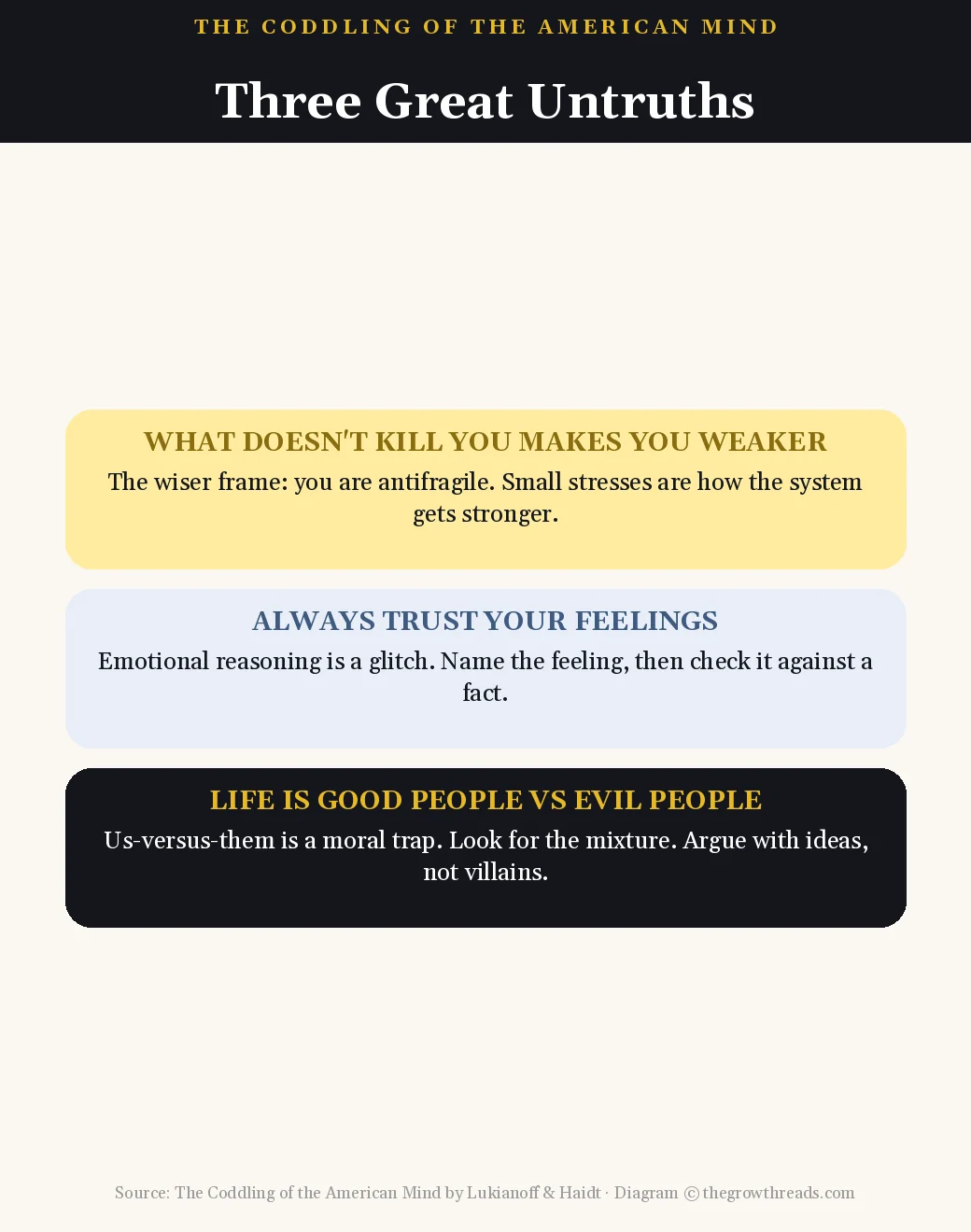
- Three untruths, one week: weaker / feelings / villains. You do not need all six hundred campus footnotes to steal the map.
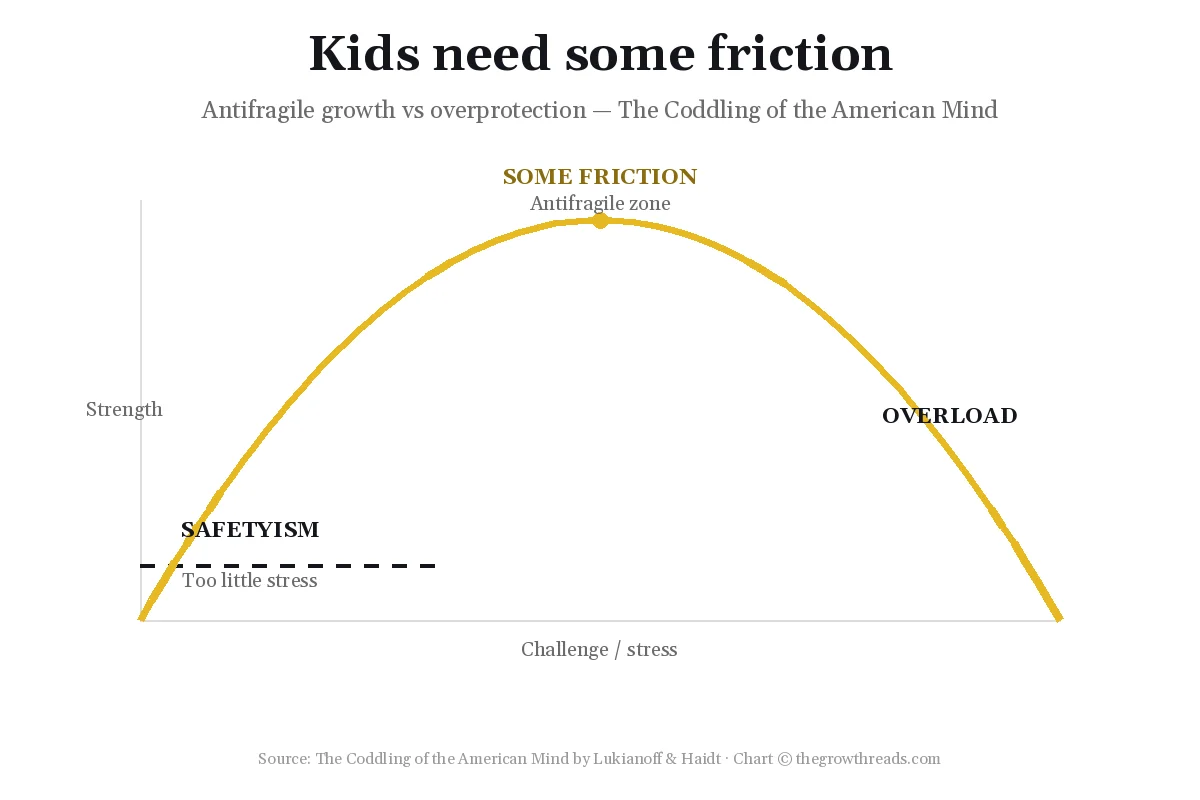
- Antifragile beats cotton wool: some load is how muscles, immune systems, and children get stronger. Overprotection trains fragility.
- Emotional reasoning is a glitch: “I feel it, therefore it is true” is a CBT distortion, not a moral faculty. Check the feeling against a fact.
- Us-versus-them is a trap: common-humanity is slower and less thrilling. It is also how you stay in the argument.
- Safetyism stretches “harm”: once words count as violence, the adult job becomes removing the stimulus, not preparing the person.
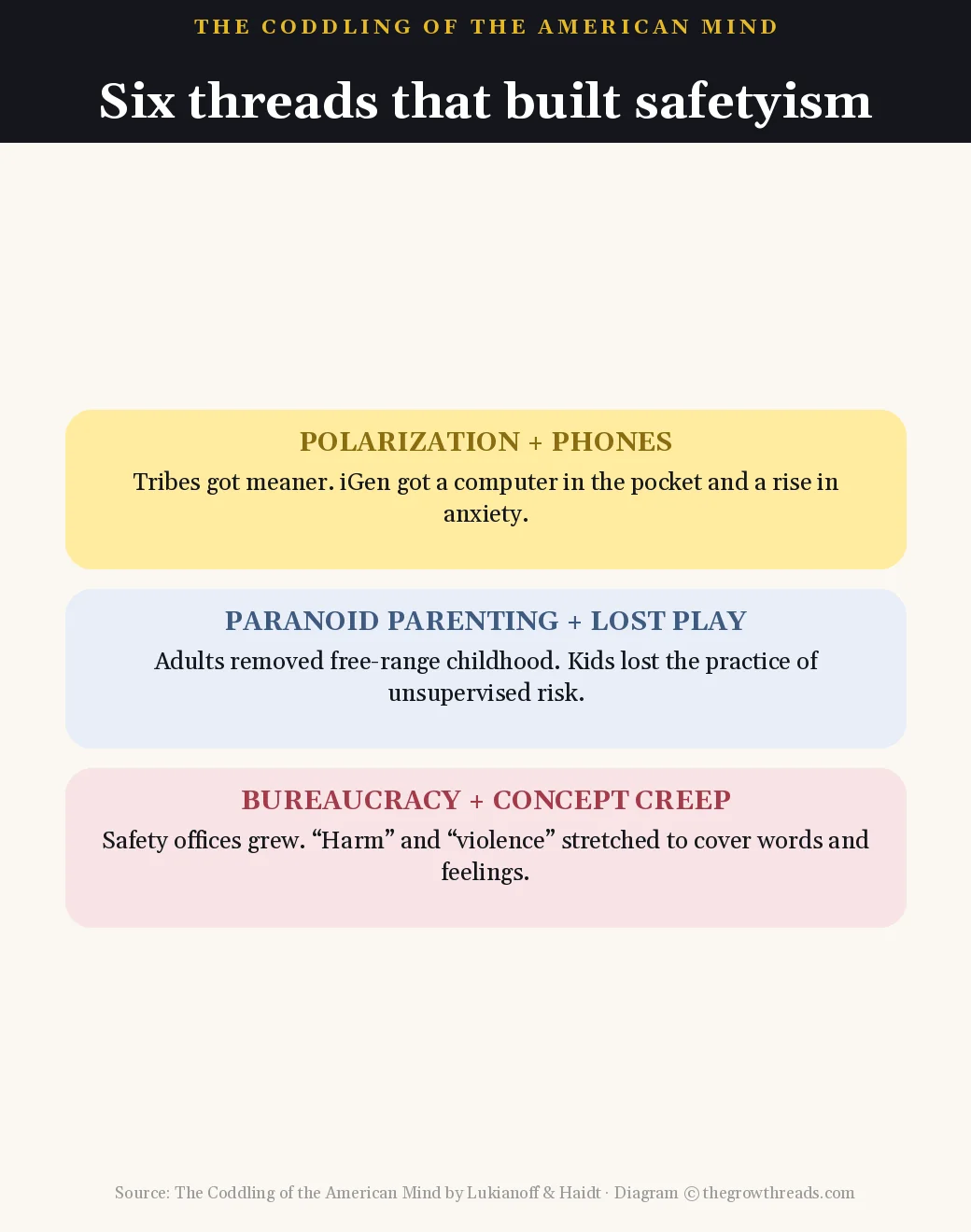
- Six threads braided the problem: polarization, phones and anxiety, paranoid parenting, lost play, bureaucracy, and concept creep.
- Play is the gym: unsupervised practice is how kids learn conflict without an adult script. Rescuing every dispute deletes the reps.
- CBT is a tool, not a vibe: catch the thought, write a wiser one, run a small behavioural experiment. Lukianoff used it on depression first.
- The steal is friction: one unsupervised hour, one dissenting view, one hard conversation you do not interrupt.
What is The Coddling of the American Mind about?
The Coddling of the American Mind is Greg Lukianoff and Jonathan Haidt’s 2018 account of how three untruths — fragility, emotional reasoning, and us-versus-them — taught a generation to treat discomfort as danger, and how parents, campuses, and institutions can put some friction back without cruelty.
About the author
Greg Lukianoff is a First Amendment lawyer and president of the Foundation for Individual Rights and Expression (FIRE). After a severe depression in the 2000s he used cognitive behavioral therapy, then noticed the same distortions — catastrophizing, mind-reading, emotional reasoning — showing up in campus speech fights. Jonathan Haidt is a social psychologist at NYU Stern whose Moral Foundations work in The Happiness Hypothesis and The Righteous Mind maps why good people divide. They expanded a 2015 Atlantic essay into this 2018 book. The steal is not a tribe costume: name the untruth in one sentence you actually used, then practise a small stress instead of removing it. Explore all Greg Lukianoff book summaries →
Key concepts at a glance
| Concept | What it means | Use it when |
|---|---|---|
| Three Great Untruths | Weaker / always trust feelings / good vs evil people | You hear a slogan that treats discomfort as injury |
| Antifragility | Some systems get stronger because of stress, not despite it | You are about to remove a load a competent person could use |
| Safetyism | Emotional safety treated as a sacred value that trumps other goods | “Harm” now includes a hard book or a dissenting view |
| Emotional reasoning | A feeling used as proof of a fact | You say “I feel unsafe, therefore this is violence” |
| Concept creep | Words like trauma, violence, and bullying stretch to cover smaller events | A disagreement is being prosecuted as an assault |
| iGen / phone childhood | A cohort that got smartphones early and play late | Anxiety rose while unsupervised outdoor time fell |
| Viewpoint diversity | Serious disagreement kept in the room on purpose | The team only hires people who already share the moral taste |
| Prepare the child | Train the person for the road; do not pave every pebble | You are rewriting the environment instead of building skill |
Part 1: Three untruths that make you fragile
The book opens with a cognitive map, not a riot. Lukianoff had been watching universities punish speech and call it care. Haidt had been watching people feel first and reason later. Together they named three ideas that sound like kindness and train weakness. The first is the anti-Nietzsche slogan: what does not kill you makes you weaker. Taleb’s antifragile frame is the correction. Bones, immunity, and skill adapt to load. Remove every pebble and the system never gets the signal. A child who never loses a playground argument does not become safer. They become unpractised.
The second untruth is “always trust your feelings.” CBT treats that as a distortion. A feeling is information, not a court. Emotional reasoning turns “I am anxious” into “therefore this speaker is dangerous.” Name the feeling, then ask what fact would change your mind. The third untruth is the most thrilling: life is a battle between good people and evil people. Once the other side is evil, curiosity dies. The Tuesday steal is to catch which untruth you used in the last hard conversation — not to win a culture war in the comments.
TGR Note: Antifragile is Taleb’s full curve — this book is the parenting and campus version of that load. If the live glitch is the thought itself, Feeling Good is Burns’s CBT drill: catch the sentence, write a wiser one, run a small experiment.
Part 2: When the untruths go to work
Part two is the case file. Yale’s Halloween email, Middlebury, Evergreen — Lukianoff’s FIRE docket — are the untruths with a budget and a crowd. A faculty note asking students to think before they police costumes became “violence.” A scheduled talk became a referendum on whether the other side deserved to exist. Administrators trained to keep the peace often rewarded the most catastrophic story in the room. That is safetyism as an institution, not as a feeling.
You do not need every 2015 headline to steal the sequence: stretch harm, treat the feeling as proof, locate a villain, demand the stimulus be removed. A team that cannot hear a dissenting forecast will ship the comfortable story. A household that treats every raised voice as abuse will never practise repair. Real harassment is real. If every discomfort is an emergency, you have no language left for the actual emergency. Keep “violence” for violence. Keep “trauma” for trauma. Then you can still tell the truth about a rude email.
TGR Note: If you want the darker cousin — how ordinary people do harm when the barrel is set wrong — The Lucifer Effect is Zimbardo’s situational map. Coddling is the preventive version: do not build a barrel that rewards catastrophizing. For the moral-team problem inside the shout-down, The Righteous Mind is Haidt’s earlier book on why good people divide.
Part 3: Six threads that built the road
How did a rich, safe generation get more anxious and more certain it was unsafe? Six threads braid. Polarization made the other side look like an infection. Smartphones handed iGen a reputation market in the pocket; anxiety rose as unsupervised outdoor time fell — a thread Haidt later tightened in The Anxious Generation. Paranoid parenting and the collapse of free play removed the gym where kids practised risk. University bureaucracy grew a class of people whose job is comfort. Concept creep stretched trauma and violence until a hard book could be filed as an assault.
None of those threads is a morality play by itself. Phones are useful. Parents over-protect with bad data. Justice movements named real harms. The failure mode is the braid: a child with no unsupervised conflict, a feed that rewards outrage, an institution that treats feelings as policy. The Tuesday use is one thread you control. You cannot fix national polarization this afternoon. You can give a child an hour without a referee, put the phone in another room at dinner, and refuse to stretch “harm” when the honest word is “I disagree.”
TGR Note: If the live problem is a child and a screen, start with The Anxious Generation — same author, tighter phone thesis — then come back for the three untruths. If the thought-loop is the whole plot, Thinking, Fast and Slow is Kahneman’s lab cut: System 1 will always feel first; the work is a slower check.
Part 4: Prepare the child for the road
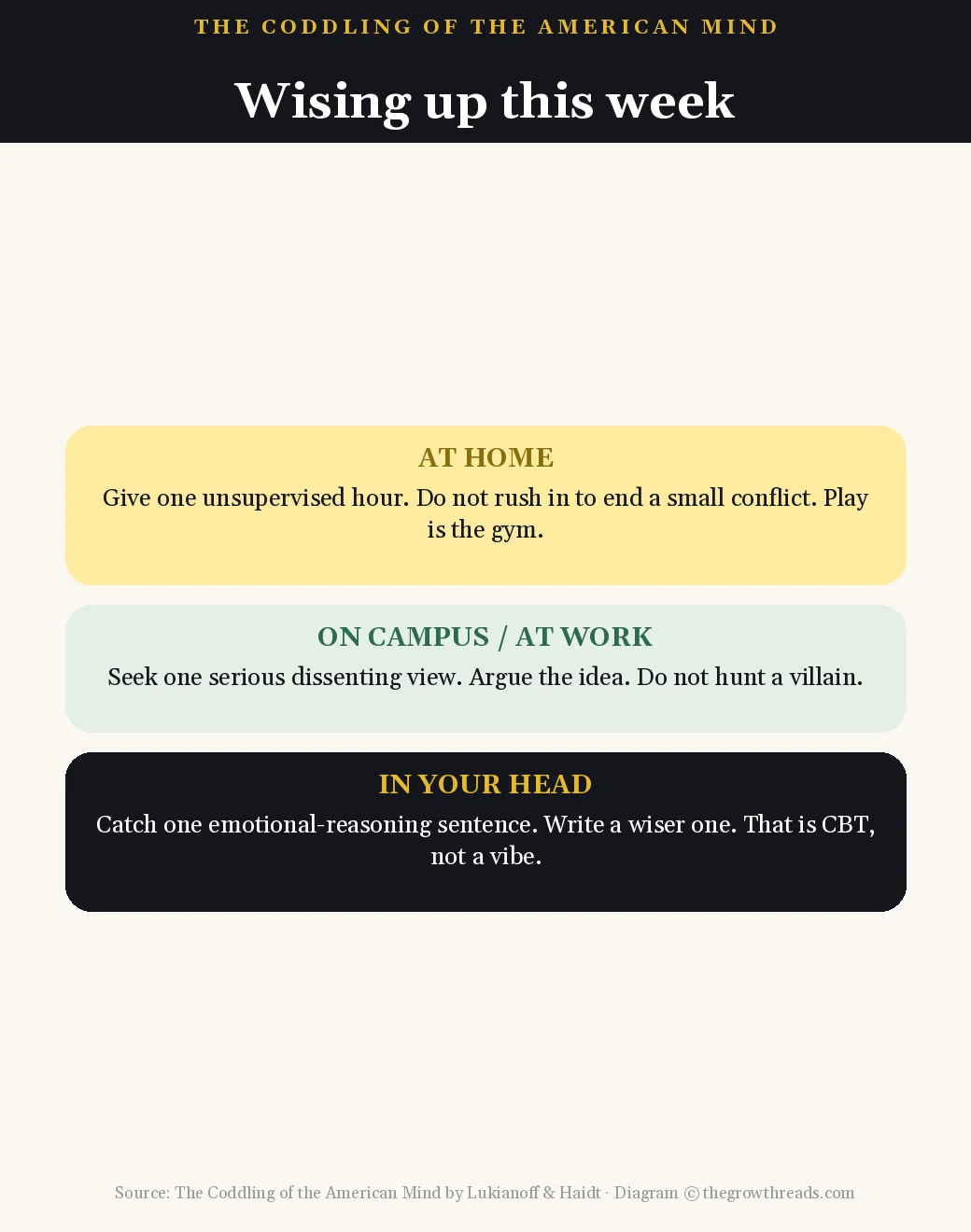
The last movement is the one you can run without a dean. For children: more unsupervised play, more walking, more chance to resolve a small conflict before an adult writes the ending. Prepare the child for the road, not the road for the child. That is not neglect. You stay nearby. You do not rush in to end the feeling. For universities and companies: viewpoint diversity as a practice — invite people who will actually disagree, and keep the argument about the idea. For the inner life: CBT on one sentence. Catch “I feel it, therefore it is true.” Write a wiser line. Test it with a small behaviour you will not cancel when it gets uncomfortable.
Intellectual humility is the adult version of play: enter a disagreement assuming you might be partly wrong. Do not pave every pebble. Do not throw anyone into traffic. Put some friction back on the calendar and keep the language honest: stress is not trauma, disagreement is not violence, a feeling is not a fact. Then leave the culture-war costume. Use the untruth you actually ran this week. Practise the opposite on a task that cannot wreck Friday.
TGR Note: If you want Haidt’s older map of getting the inner conditions right, The Happiness Hypothesis is that book. If the fear in the room is a real safety signal, not a stretched word, The Gift of Fear is de Becker on listening to the instinct that is actually about danger.
Who is The Coddling of the American Mind best for — and who should read something else first?
Best for parents who keep sweeping every pebble, teachers and managers who hear “I feel unsafe” used as a veto, and anyone who has started treating disagreement as a hunt. The Penguin paperback is a weekend. This guide is the steal: three untruths, one small stress you stop removing, one thought you check against a fact.
Read something else first if the live problem is a child and a smartphone — start with The Anxious Generation. If you want the moral-psychology engine without the campus file, The Righteous Mind. If you want the full antifragile curve, Antifragile. If you need a CBT workbook more than a cultural map, Feeling Good. If you came for two thinking systems from the lab, Thinking, Fast and Slow. This is education, not therapy or legal advice. A book cannot sit in the room when the danger is real.
Questions to reflect on
- Which of the three untruths did I actually use in the last hard conversation — weaker, feelings, or villains?
- What small stress did I remove this month that a competent person could have used as practice?
- Where did I treat a feeling as proof of a fact, and what fact would have changed the sentence?
- When did I last let a child or a colleague resolve a conflict without my script?
- Whose view am I refusing to steel-man because it would make my team less comfortable?
🔥 Ready to put some friction back without cruelty?
Get The Coddling of the American Mind and steal a Tuesday map for antifragility, honest language, and one stress you stop removing.
How to apply The Coddling of the American Mind (7-day plan)
- Day 1 — Name the untruth. Write one sentence you used this week that treated discomfort as danger. Circle weaker, feelings, or villains.
- Day 2 — Catch emotional reasoning. When a feeling arrives as a verdict, write the feeling on the left and one checkable fact on the right. Do not outsource the check to a feed.
- Day 3 — Add a small voluntary stress. A cold walk, a hard page, a workout you will not shorten. Stay with it for twenty minutes. Do not rescue yourself early.
- Day 4 — Give play or unsupervised practice an hour. If you have a child, leave a small conflict unresolved by you. If you do not, take a walk without headphones and let boredom work.
- Day 5 — Steel-man one dissenting view. Read a serious argument you dislike. Write five lines in its strongest form before you answer. No villain hunt.
- Day 6 — Have the hard conversation. Ask for a fact, not a loyalty test. If you are the adult in the room, keep the stimulus and coach the skill.
- Day 7 — Write the wiser script. One fridge sentence: I prepare the person for the road. Put the untruth you retired next to it.
Frequently asked questions
What is The Coddling of the American Mind about?
The Coddling of the American Mind is Greg Lukianoff and Jonathan Haidt’s 2018 map of how good intentions taught a generation three untruths: that what does not kill you makes you weaker, that you should always trust your feelings, and that life is a battle between good people and evil people. They argue those ideas show up as safetyism on campus and at home — trigger warnings, disinvitations, and a reflex to treat discomfort as danger. The book is not a culture-war costume. The steal for Tuesday is smaller: name the untruth in one sentence you actually used, then practise a small stress instead of removing it.
What are the Three Great Untruths?
The first untruth is “what doesn’t kill you makes you weaker” — the opposite of antifragility. Kids, immune systems, and skill all get stronger through some load; overprotection trains fragility. The second is “always trust your feelings.” That is emotional reasoning, a cognitive distortion CBT names on purpose: a feeling is data, not a verdict. The third is “life is a battle between good people and evil people.” Us-versus-them turns a disagreement into a hunt. The wiser frames are: seek some friction, check the feeling against a fact, and argue with ideas instead of villains. You do not need a campus to practise any of them this week.
What is safetyism in The Coddling of the American Mind?
Safetyism is the belief that safety — including emotional safety — is a sacred value that should trump other goods. Lukianoff and Haidt are not against keeping people out of actual danger. They are against stretching “harm” and “violence” until a hard book, a dissenting speaker, or an awkward conversation counts as an injury. Once that stretch happens, the adult job becomes removing the stimulus instead of preparing the person. The Tuesday test is crude: did you take away a small stress that a competent person could have used as practice? If yes, you just ran safetyism. Put one small stress back on the calendar and stay nearby without rescuing.
What does antifragile mean in this book?
They borrow Nassim Taleb’s word. Fragile things break under stress. Resilient things resist it. Antifragile things get stronger because of it — muscles, immune systems, a child who learns to resolve a playground fight without an adult script. The untruth “what doesn’t kill you makes you weaker” denies that third category. Overprotection is not kindness if it blocks the load the system needs. The steal is not throwing kids into traffic. It is one unsupervised hour, one hard conversation you do not interrupt, one skill practised under a little heat. If you want the full Taleb argument, read Antifragile. This book is the parenting and campus version of that curve.
Is The Coddling of the American Mind only about universities?
Campus is the loud case study — Yale’s Halloween email, Middlebury, Evergreen — because Lukianoff’s FIRE work and Haidt’s teaching made those rooms visible. The mechanisms are older and wider: paranoid parenting, the collapse of free play, phones, rising anxiety, concept creep around “trauma,” and institutions that get paid to keep everyone comfortable. Parents, managers, and team leads run the same script when they treat discomfort as danger. If you have no student in the house, steal the CBT move and the play/friction move anyway. If you came only for phones and iGen, start with The Anxious Generation and come back for the three untruths.
How is this different from The Anxious Generation?
The Anxious Generation is Haidt’s later, tighter book on the phone-based childhood: delayed smartphones, more play, less unsupervised outdoor time traded for feeds. Coddling is the earlier, wider map. It names three cognitive untruths, six cultural threads, and a campus speech problem Lukianoff had been litigating for years. Phones are one thread here, not the whole plot. Read Coddling if you want the untruths and the CBT/antifragility pair. Read Anxious Generation if the live problem is a child and a screen. They rhyme. They are not the same Tuesday. You can steal from both without turning either into a tribe costume.
How do you apply The Coddling of the American Mind this week?
Day one: write the untruth you used — weaker, feelings, or villains. Day two: catch one “I feel it, therefore it is true” sentence and write a fact next to it. Day three: add a small voluntary stress you will not rescue. Day four: one unsupervised play or walk. Day five: read one serious view you dislike and steel-man it in five lines. Day six: have the hard conversation without hunting a villain. Day seven: write the wiser script you want on the fridge. None of that requires a university. It requires one load you stop removing. That is the book, used.
Related summaries
- The Anxious Generation — Haidt’s later, tighter book on phones and play.
- The Righteous Mind — why good people divide into moral teams.
- Antifragile — Taleb’s full argument that some load makes you stronger.
- The Happiness Hypothesis — Haidt’s earlier map of getting the inner conditions right.
Browse the full list on our Best Psychology Books pillar.
How we analyze books: our summaries are built from a full read of the source text, cross-referenced against the author’s published interviews and research where relevant, and structured around practical application rather than critique. We disclose our editorial process and affiliate relationships in full. Read our full methodology.