

★★★★★ 4.7/5 — A life story that hides a practice: find a teacher, train attention, and stay useful on Tuesday.
Best for: Seekers who are full of spiritual information and thin on a daily method — and anyone who wants East and West in the same person
Reading time: ~12 hrs for the full book · ~14 min for this guide
Difficulty to apply: The method is simple; sitting still when the phone is in the other room is the work
Autobiography of a Yogi in one minute
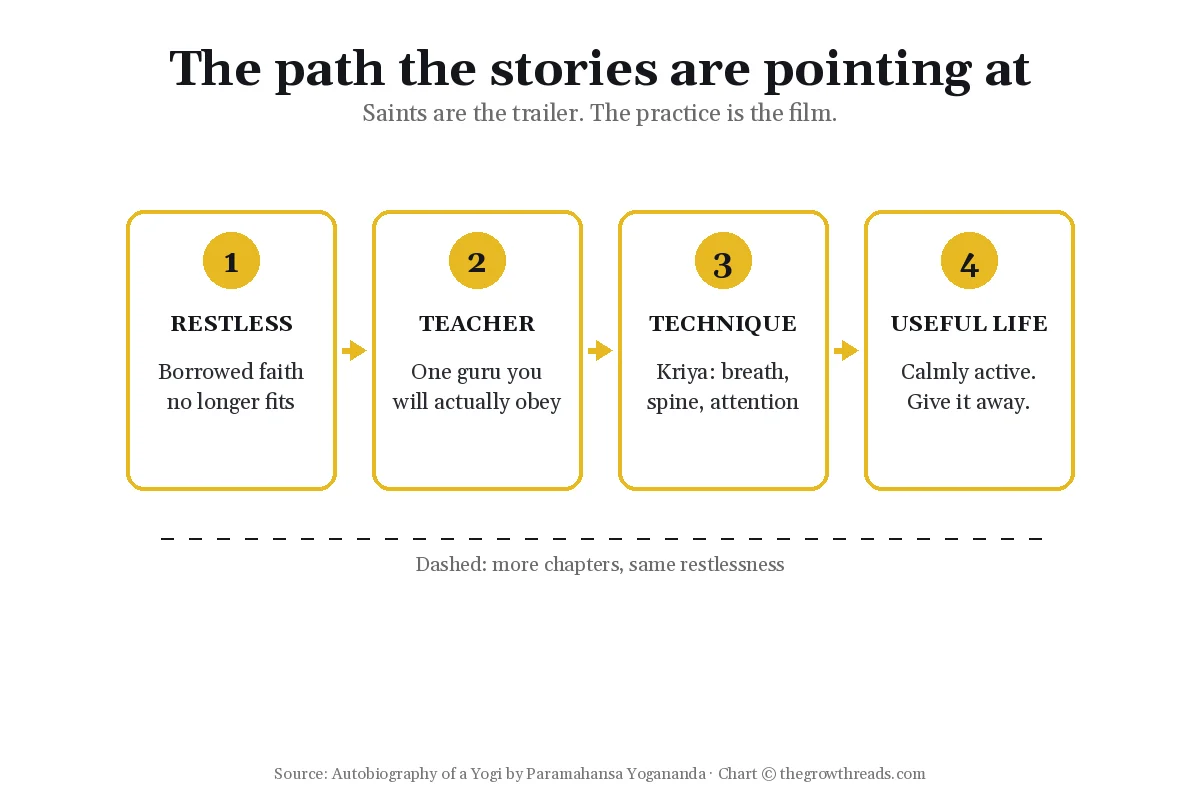
The saints are the trailer. The practice is the film. Paramahansa Yogananda’s 1946 memoir looks like a parade of wonders. Under them is a blunter assignment. A restless boy in India will not accept a second-hand faith. He finds a teacher he can obey, trains in Kriya Yoga until attention is a skill, then spends thirty years in America proving that stillness and a useful job can share one body. You need the four moves the book keeps repeating: admit the restlessness, take a teacher, do the technique, bring the result back to people who did not go to India.
Key takeaways
- Restlessness is data: The borrowed religion, the clever books, the weekend workshop — if they have not changed Tuesday, they are still entertainment.
- A guru is not a brand: Yogananda’s teacher, Sri Yukteswar, is strict, local, and unimpressed by your spiritual résumé. Obedience is the test, not vibes.
- Kriya is a technique: Breath, spine, attention. It is closer to training than to a mood board. Initiation is sacred in his lineage; the daily logic is still sit, return, repeat.
- Miracles have a law: Wonders are framed as concentrated mind. You need a mind that will stay, not a carnival.
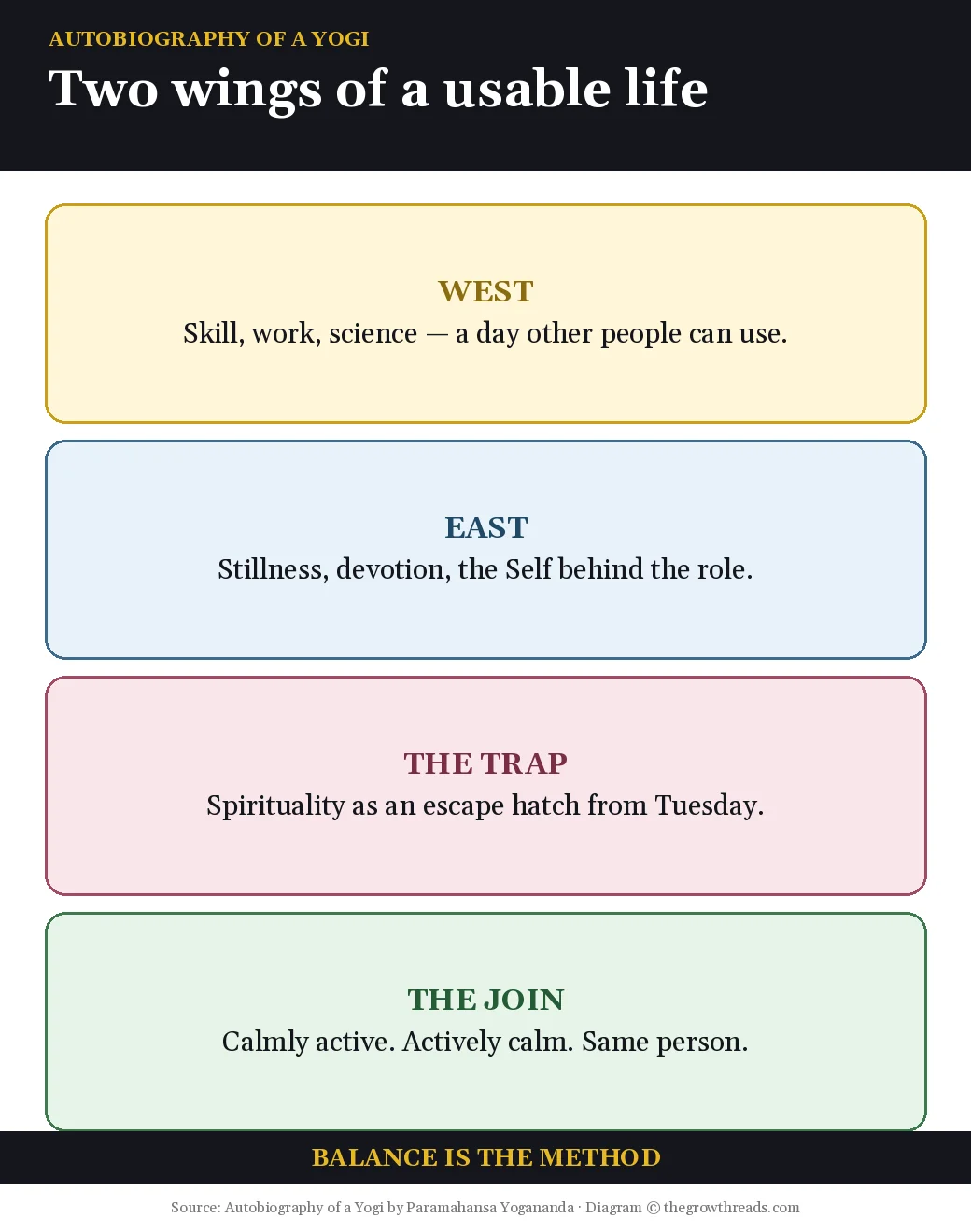
- East and West are wings: Skill without stillness is noise. Stillness that cannot hold a job is theatre.
- The hermitage is a school, not a hideout: Ten years with Yukteswar install habits. Escape is not the curriculum.
- Service is the exam: After America, the gift has to travel — classes, a fellowship, a life other people can copy without your charisma.
- Death is not the plot twist: Live so the end is not a scramble. The last chapters treat mahasamadhi as practice continued.
- Calmly active, actively calm: That is the usable sentence. Busy-nervous and holy-idle both fail the book.
- Read it as a map, not a museum: Keep the saints. Steal the sequence. Put one sit on tomorrow’s calendar.
What is Autobiography of a Yogi about?
Autobiography of a Yogi is Paramahansa Yogananda’s 1946 life story: a restless boy in India finds his guru, trains in Kriya Yoga, and spends thirty years teaching in America. It treats saints, science, and daily stillness as one path you can test on an ordinary week — not as souvenirs from someone else’s miracle.
About the author
Paramahansa Yogananda was born Mukunda Lal Ghosh in Gorakhpur, India, in 1893. After years of hunting teachers, he became a chief disciple of Swami Sri Yukteswar Giri, who sent him west. He arrived in Boston in 1920, lectured across America, and founded Self-Realization Fellowship. He was among the first Indian teachers to settle in the United States and was received at the White House by Calvin Coolidge. Los Angeles became his base; a monastic order and thousands of Kriya initiations followed. Autobiography of a Yogi (1946) made the inner method public as a life story. He died in Los Angeles in 1952. Harper later listed the book among the century’s essential spiritual titles. The through-line is practical: a Western day and an Eastern spine in one person who still does the work. Explore all Paramahansa Yogananda book summaries →
Key concepts at a glance
| Concept | What it means | Use it when |
|---|---|---|
| Restlessness | A sign that second-hand faith has expired | You have read a shelf and still cannot sit for twelve minutes |
| Guru-disciple | One living teacher you obey, not a feed of quotes | You keep collecting teachers so nobody can correct you |
| Kriya Yoga | A breath-and-attention technique, trained not admired | Spirituality has become a mood you wait to feel |
| Self-realization | Direct knowledge of the Self behind the role | Your identity is only the job, the family, the brand |
| Law behind miracles | Concentrated mind, not a loophole in physics you can shop for | You want phenomena more than a stable attention |
| East-West balance | Material skill and inner stillness as two wings | Work is frantic or retreat is an excuse |
| Calmly active | Do the duty without the inner lawsuit | Your calendar is full and your mind is louder |
| Service / SRF | The gift has to travel through a form other people can use | The insight only works when you are alone and impressive |
Part 1: The search — a boy who will not settle for borrowed faith
The early chapters are a hunt. Mukunda’s mother dies; the loss makes him impatient, not pious. Temples, clever talk, travelling sadhus — he tries them the way a modern reader tries podcasts. Some encounters are luminous. None of them is yet a life. He is willing to look foolish in public, which is how you can tell the restlessness is real. He is not collecting India. He is trying to end a private emergency.
Saints appear, and the book does not wink them away. You do not have to litigate each scene to use the spine. Information is not transformation. A boy with a spiritual appetite and no master will eat stories until he is sick of being unchanged. The failed auditions teach him what a real teacher feels like: someone who can interrupt him.
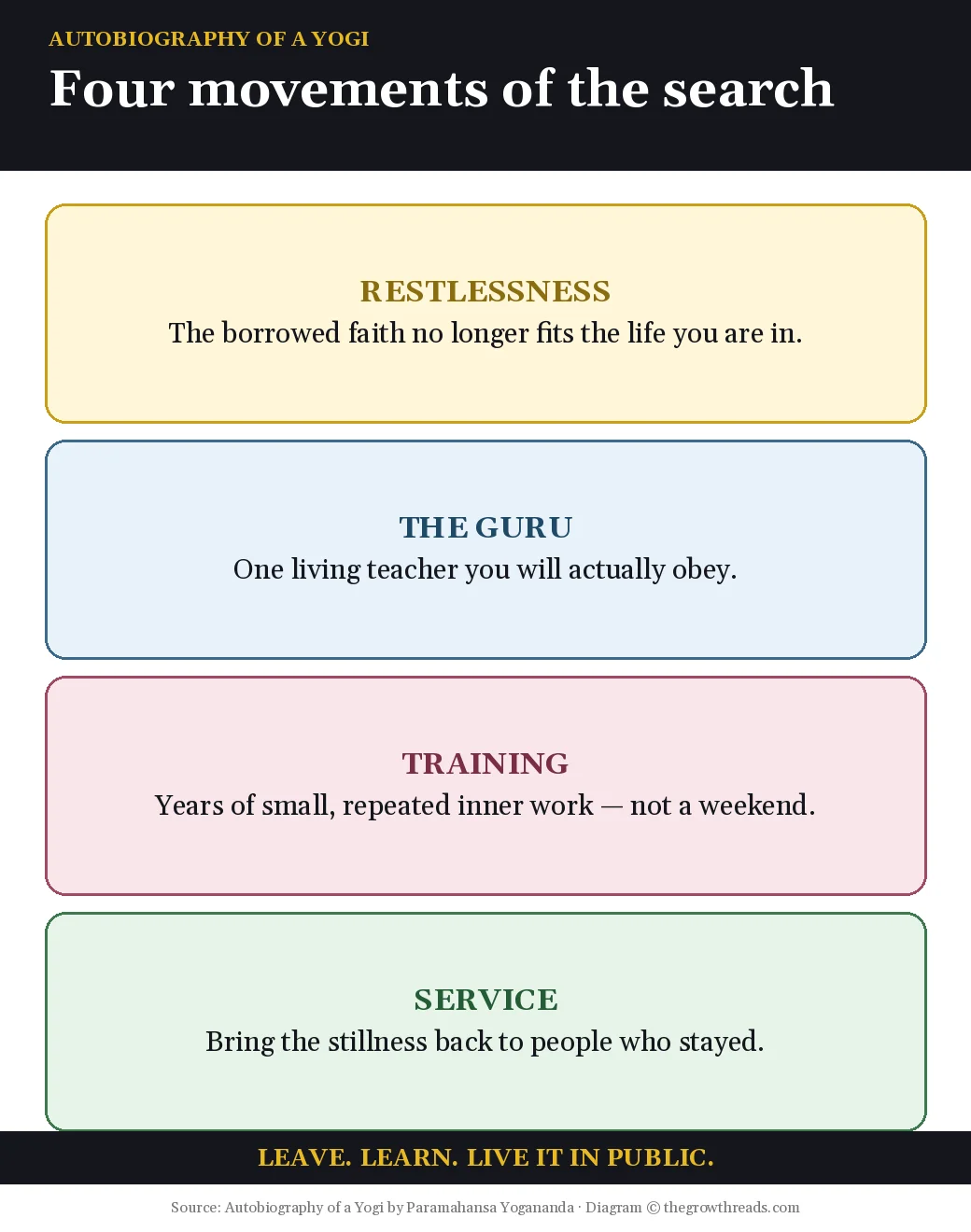
Name your current substitute. A stack of summaries. A teacher on video who cannot see you. A plan to start when work calms down. That is chapter one with a laptop. The search ends when you stop auditioning and pick a method you will still do on a dull Wednesday.
TGR Note: The Alchemist is the fable of the same hunger — Personal Legend as a call you can walk. The Hero with a Thousand Faces names the departure. Yogananda’s version is dirtier: the call is a boy who will not sit still in a borrowed pew. If you only want the mythic map, start with Campbell. If you want a life that includes a guru and a technique, stay here.
Part 2: The guru — ten years that install a teacher
Sri Yukteswar is the hinge. He is not branded, and he is not interested in Mukunda’s specialness. The hermitage is a school with chores, scripture, and a gaze that catches vanity. Ten years is the point. Modern spirituality sells the weekend; Yukteswar sells the decade. The disciple learns to carry instructions when the teacher is in another room. That is rarer than a vision.
The bond is apprenticeship, not a fan club. Kriya is given as a sacred technique in a lineage; this summary will not pretend to initiate you. Steal the shape: one teacher, one method, a long middle, no shopping. If you currently have seven mentors, you have none. Pick the living person or book you will obey for ninety days, and let the others go quiet. The West later made Yogananda a celebrity. The hermitage made him a student first. That order is the medicine.
TGR Note: A teacher you cannot disappoint is a feed. The Untethered Soul trains the witness without a Hindu cosmology; use it if guru-language makes you flinch, then come back. Mindset is the growth-language cousin: you are not finished. Yogananda’s add is relational. Someone has to be allowed to say you are still performing.
Part 3: The science — Kriya Yoga and the law behind miracles
The middle of the book is where readers split. Some stay for the miracles. Some stay for the method. Yogananda wants you to notice they are the same argument. A “miracle” in his vocabulary is mind concentrated until matter behaves differently. He writes them as reportage. You may take them as faith, as metaphor, or as a dare. The dare is the usable part. Untrained attention is the default marvel of a distracted age: whole afternoons vanish and nothing is illumined.
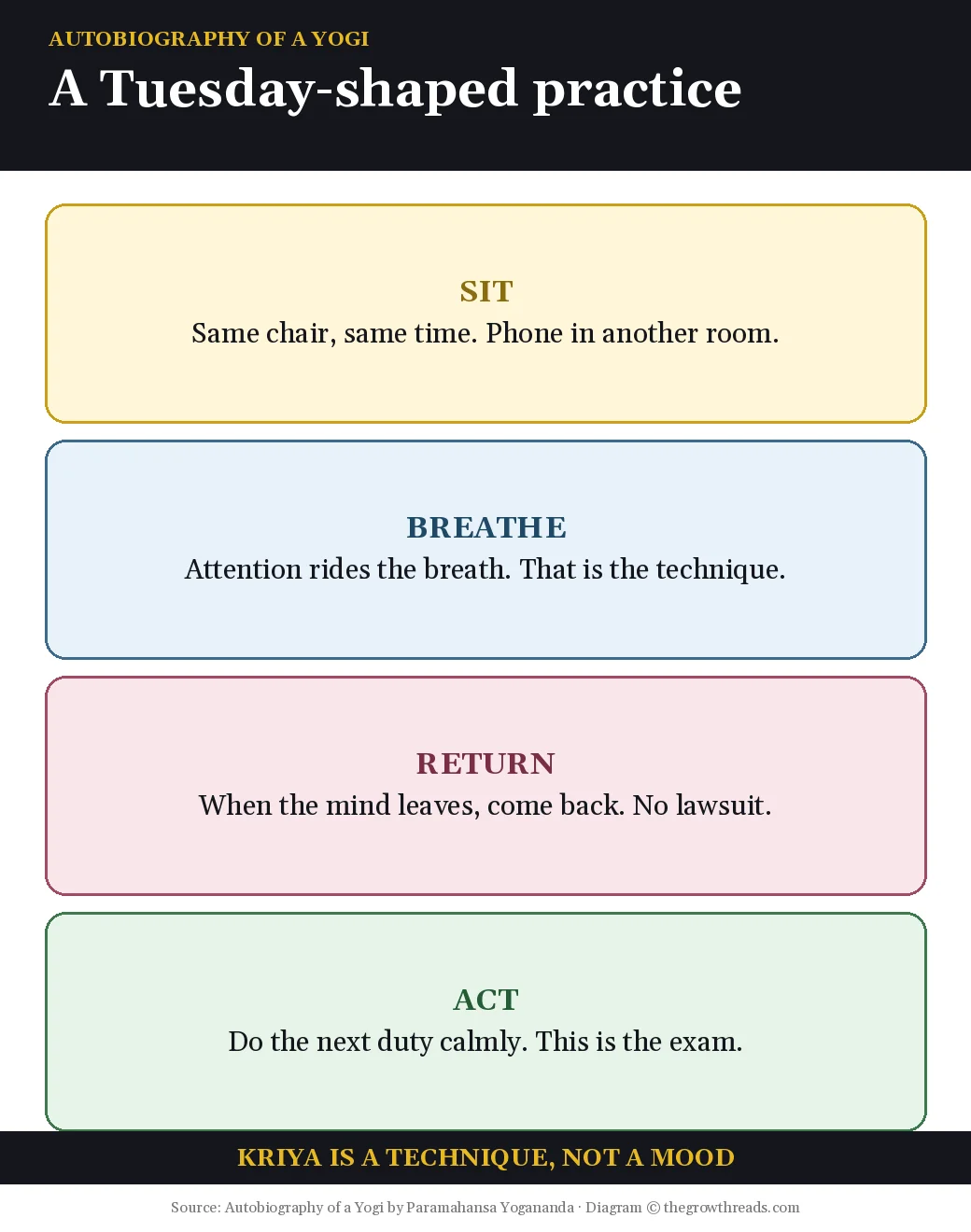
Kriya, as he describes it at a high level, works with breath and spinal attention. Lineage groups still require initiation; do not learn it from a thread. What any reader can run tomorrow is the outer form: a seat, a time, a withdrawn phone, attention on the breath, a quiet return when thought wanders, then the next duty done without the inner lawsuit. That is the attitude the technique is for. Twelve honest minutes beat a library of cosmic vocabulary. If the mind you bring to lunch is still a tyrant, you are decorating the search with Sanskrit.
TGR Note: If you want presence without yogic cosmology, The Power of Now is the shorter drill: the only time anything happens is this one. A New Earth is Tolle’s social version — ego as a collective trance. Yogananda supplies a body-based method and a teacher. Use Tolle if you cannot yet stomach gurus. Use Yogananda when you are ready for a practice that outlasts a feeling.
Part 4: The West — stay, serve, and pass the Tuesday test
In 1920 he boards a ship. The rest of the book is the exam the hermitage was for: can the stillness survive lectures, money, disciples, and California. He founds Self-Realization Fellowship. Cameos — Coolidge, Luther Burbank, Gandhi, Tagore — matter because he keeps translating them into one demand. Be in the West with an Eastern spine. Earn the day. Do not use God as an exit from people.
The late chapters treat his passing as a yogi’s last demonstration rather than a tragedy to solve. Live so the end is not a scramble of unfinished restlessness. Build a form — a class, a household rhythm — that can hold the method when you are not in the room. Celebrity is a side effect. Transmission is the job. Sit tomorrow before the phone. Do one duty without the commentary. The book fails as other people’s marvels. It works if Friday includes twelve minutes and a calmer inbox.
TGR Note: Return without presence is tourism. Flow is the research cousin of “lose the self in a task”; Yogananda wants that at the desk and on the cushion. Man’s Search for Meaning is the sterner classroom: meaning chosen under constraint. If your spirituality cannot survive a hard week, it was a hobby. His America years are the proof-test he ran on himself.
Who is Autobiography of a Yogi best for — and who should read something else first?
Best for the person whose shelf is already spiritual and whose mornings are still frantic. It is also for science-minded Westerners who can tolerate saints if the through-line is trainable attention, and for devotees who need reminding that work and a calendar are part of the path. You do not need to join SRF to use the four moves. You do need a seat and a streak.
Read something else first if you want a clinical protocol rather than a memoir — start with Feeling Good or The Happiness Trap. If guru-language is a deal-breaker, The Power of Now or The Untethered Soul. If you want mythic psychology without yogic cosmology, The Hero with a Thousand Faces. If you want a short fable of the search, The Alchemist. If you want tiny habits without metaphysics, Atomic Habits. Yogananda is a companion for a practice, not a treatment plan.
Questions to reflect on
- What borrowed faith or clever feed are you still using as a substitute for twelve minutes of stillness?
- Who, living, is allowed to correct you — and what would ninety days of obeying one method look like?
- Where does your “spirituality” currently get you out of a duty you simply do not want to do?
- On a scale from nervously busy to holy-idle, where do you sit, and what would “calmly active” change at 10 a.m.?
- If the saints were removed, what practice would still be left in your week?
🔥 Ready to train the stillness the stories point at?
Get Autobiography of a Yogi and run the four moves this week.
How to apply Autobiography of a Yogi (7-day plan)
- Day 1: Sit for twelve minutes before the phone. Same chair. When the mind leaves, return without a story. Write one line: what restlessness were you feeding with content?
- Day 2: Name the borrowed faith in one sentence (a feed, a stack, a future retreat). Put the stack in another room until the sit is done.
- Day 3: Choose one living teacher or one living book for ninety days. Unsubscribe from two extras. Obedience needs a short list.
- Day 4: Repeat the sit. Add: do the first work block of the day as “calmly active” — no extra tab, no inner lawsuit. That is the East-West drill.
- Day 5: Service in miniature. Help one person in a way that does not grow your spiritual brand. Do not post it.
- Day 6: Read one chapter of the memoir, then sit. If the chapter is a miracle, steal only the concentration it implies. No new cosmology required tonight.
- Day 7: Review. Count sits (honest ones). Circle where you used spirituality as an exit from a duty. Keep the chair time on next week’s calendar. Tell one person the four-word vow: sit, return, work, serve.
Frequently asked questions
What is Autobiography of a Yogi about?
It is Paramahansa Yogananda’s 1946 memoir of a restless Indian boy who finds his guru, trains in Kriya Yoga, and spends three decades teaching in the United States. Saints, “miracles,” Gandhi, and Luther Burbank appear, but the spine is practical: second-hand faith is not enough; a teacher and a technique are; the result has to survive an ordinary job. You finish with a four-move map — restlessness, guru, training, service — you can run without joining an ashram. The book is a life that hides a method, not a catalogue of other people’s wonders.
Do I need a guru to use this book?
Yogananda would say a realised teacher is the fastest path, and his own story is unintelligible without Sri Yukteswar. You do not have to pretend you have that relationship this month. You do have to stop collecting seven voices so that nobody can correct you. Pick one living teacher, community, or book for ninety days and let the rest go quiet. Kriya itself is still given by initiation in his lineage; this guide will not fake that. The outer vow — sit, return, do the duty calmly — is available before you ever set foot in a centre. Guru, in the usable sense, means someone who can interrupt your performance.
What is Kriya Yoga in Autobiography of a Yogi?
Kriya is the technique Yogananda presents as the scientific heart of his lineage: breath and spinal attention so the mind stops being a runaway. He treats it as sacred, not as a life-hack to publish in a thread. Self-Realization Fellowship still gives it by initiation. What any reader can practise immediately is the attitude Kriya exists for — a daily seat, attention on the breath, a quiet return when thought wanders, then a worldly task done without the inner lawsuit. If you want the full method, go to the lineage. If you want the book’s psychology, train concentration before you collect more miracles.
Are the miracle stories meant to be taken literally?
Yogananda writes them as events, not as parables he is winking through. Some readers take them on faith; some read them as concentrated-mind reports; some skip to the method. You do not have to litigate Therese Neumann to steal the claim that attention is causal. After two weeks of sitting, is your mind less of a tyrant at noon? If not, more wonder-chapters will not help. If yes, you have verified the only law the book needs you to touch this month. Leave the rest for a second pass, or for a teacher who can answer you in person.
How long does it take to read Autobiography of a Yogi?
The Self-Realization Fellowship paperback most readers buy runs about 590 pages with photographs and later-life material. Budget ten to fourteen hours, not a weekend sprint — the prose is lucid and the procession of saints is long. A sane first pass is to read for the four moves (search, guru, technique, West) and not to stop for every cameo. This guide takes about fourteen minutes and gives you the map, a Tuesday practice, and a 7-day plan. The book rewards a pencil in the hermitage and America chapters. Speed-running miracles is how it becomes a museum.
How do you apply Autobiography of a Yogi in real life?
Sit before the phone. Choose one teacher or one book for ninety days. Do the first work block calmly — that is the East-West test, not a candle. Help one person without growing a spiritual brand. Read a chapter, then practise; never the reverse as a lifestyle. If your “path” keeps getting you out of ordinary duties, you are in the trap the America chapters were written to catch. The book works when Friday includes twelve honest minutes and one duty done without the inner lawsuit. It fails as a collection of other people’s marvels you can quote at dinner. Keep the saints. Steal the sequence.
Is Autobiography of a Yogi still worth reading in 2026?
Yes, if you want a method inside a life, not another abstract mindfulness deck. Some scenes are of 1946; the four moves are why a century of seekers kept handing the book over. You do not have to accept every phenomenon. You do have to try a seat, a teacher-or-book, and a calmly active morning. If yogic cosmology leaves you cold, start with The Power of Now or The Untethered Soul and come back. If you already live on spiritual content and still cannot sit, this is the memoir that will not let information pose as a path. Stillness that cannot hold a job is still a hobby.
Related summaries
- The Power of Now — presence without a Hindu cosmology, if guru-language is a wall.
- The Untethered Soul — the voice in your head is not who you are.
- The Alchemist — a fable of the search you can actually walk.
- The Hero with a Thousand Faces — the mythic map of leaving, changing, returning.
Browse the full list on our Best Psychology Books pillar.
How we analyze books: our summaries are built from a full read of the source text, cross-referenced against the author’s published interviews and research where relevant, and structured around practical application rather than critique. We disclose our editorial process and affiliate relationships in full. Read our full methodology.