

★★★★½ 4.6/5 — stop installing Agile; change how the company decides, discovers, and delivers.
Best for: CEOs, CPOs, and executive teams whose technology group still ships other people’s roadmaps
Reading time: ~8.5 hours (Wiley hardcover, 2024, 368 pp) · this guide ~14 min
Difficulty to apply: Hard — finance, sales, and the CEO have to change how work is funded and judged
Transformed in one minute
You cannot install the product model. You have to transform to it. That is the whole argument of Transformed. Marty Cagan wrote Inspired for the product trio and Empowered for the leaders who coach them. Companies read both, renamed their squads, and stayed feature factories. This book is for the rest of the firm — the CEO, finance, sales, HR, legal — because the operating model lives outside the product org chart.
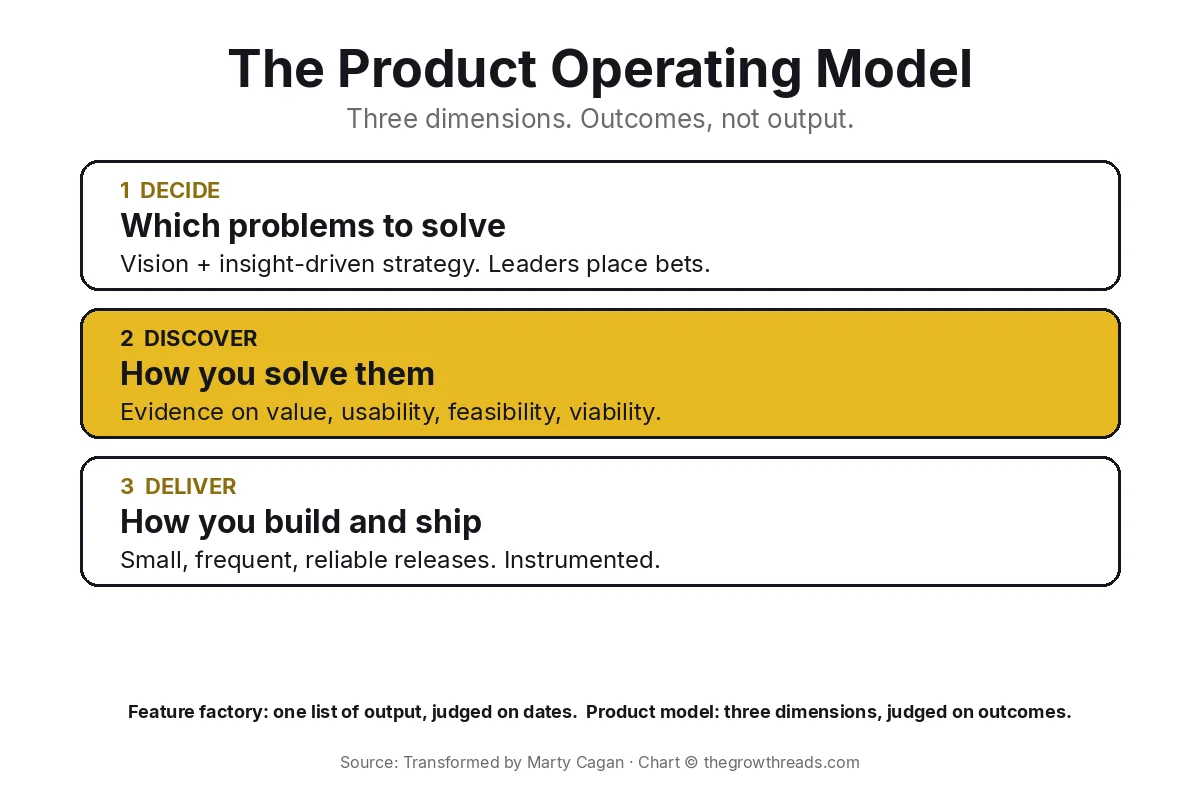
A feature factory assigns solutions and dates. A product operating model changes three dimensions: how you decide which problems to solve, how you solve them, and how you build and ship. Outcomes replace output. Pilot one real product team this quarter. If you only remember one move, take a committed feature off the roadmap and replace it with a problem the team is allowed to own.
Key takeaways
- Inspired was the team. Empowered was the coach. Transformed is the company. If only product people change, you still have an IT model with better vocabulary.
- The product operating model is not a process. It is a set of first principles about outcomes. You cannot buy it as a framework.
- Three dimensions, not one ceremony. Decide which problems to solve. Discover how to solve them. Deliver in small, frequent releases.
- Feature factories judge output. Product-model companies judge whether the customer and the business actually moved.
- Competencies before org-chart poetry. You need real product managers, designers, and engineers — not project managers renamed.
- Culture is four trades. Principles over process, trust over control, innovation over predictability, learning over failure.
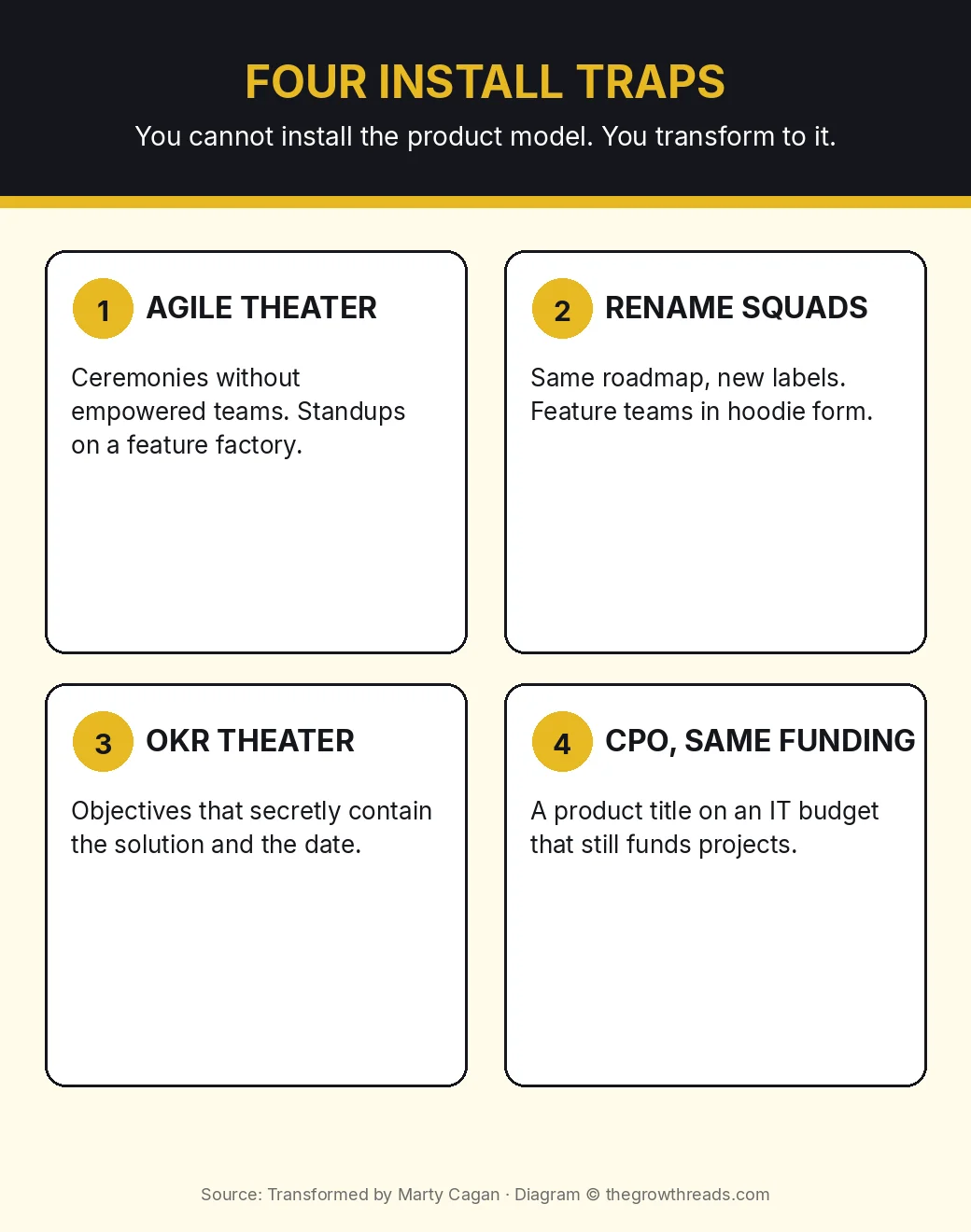
- Installation is the failure mode. Agile theater, squad labels, OKR theater, and a CPO on an IT budget all keep the factory running.
- Start with pilots, not a slide. Fund a few durable teams as product teams. Expand only when they produce outcomes.
- The CEO is in the room. Funding, promises to the board, and how sales is paid will block the model unless the top changes them.
What is Transformed about?
Transformed is Marty Cagan and the Silicon Valley Product Group’s field guide for companies stuck in a feature factory. It names the destination — the product operating model — and shows how to change how you decide, discover, and deliver so technology creates outcomes, not just output.
About the author
Marty Cagan founded Silicon Valley Product Group after leading product at eBay, Netscape, and Hewlett-Packard. Inspired taught product trios to discover before they build. Empowered taught their managers to coach for outcomes instead of assigning roadmaps. Transformed is the company-level book, written with SVPG partners Lea Hickman, Christian Idiodi, Chris Jones, and Jon Moore. They spend their weeks inside organisations that want the product model and still fund work like an IT department. Cagan’s through-line across the three books is unchanged: ordinary people, extraordinary products — if the company actually lets teams own problems instead of a stakeholder list they did not choose to build. Explore all Chris Jones book summaries →
Key concepts at a glance
| Concept | What it means | Use it when |
|---|---|---|
| Product operating model | First principles for deciding, discovering, and delivering outcomes | Agile is installed and nothing important changed |
| Feature factory | Teams get solutions, dates, and output targets | Success is ‘we shipped it’ |
| Decide | Which problems to solve — vision plus insight-driven bets | The roadmap is a stakeholder wishlist |
| Discover | Evidence on value, usability, feasibility, viability | Build starts when a slide is approved |
| Deliver | Small, frequent, instrumented releases | You ship monthly and learn in post-mortems |
| Competencies | Real PMs, designers, tech leads, and coaching leaders | Project managers wear product titles |
| Installation trap | New labels on the same funding and accountability | The CPO still runs an IT portfolio |
| Pilot teams | A few durable teams actually empowered, then scale | You are about to announce an all-hands transformation |
Part 1 — Why the feature factory cannot compete
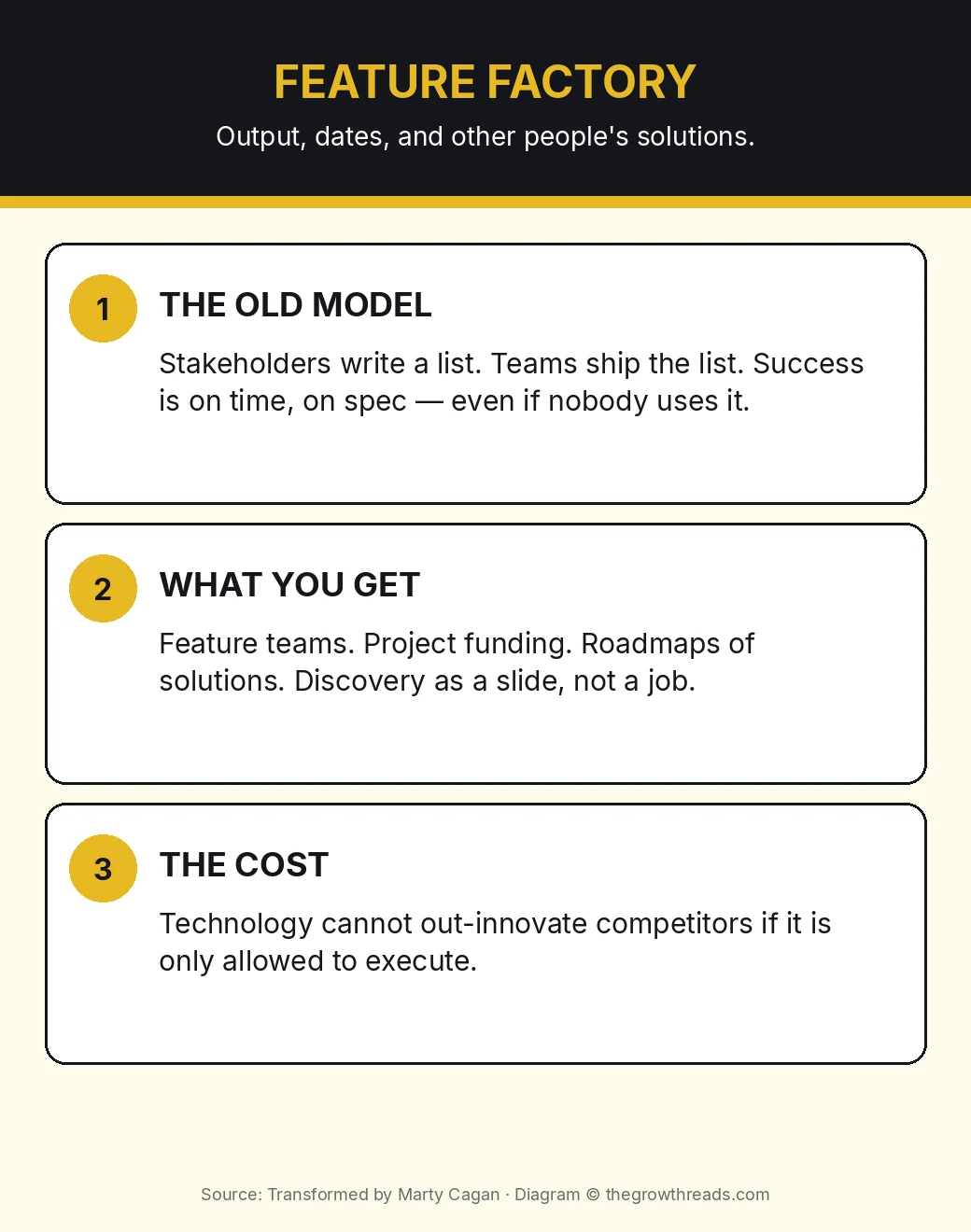
Most companies that buy this book already spend real money on technology. They have Agile coaches, design systems, and a digital slide in the annual plan. Customers still get a slow copy of what a product-model competitor shipped last year. Cagan’s diagnosis is blunt: the operating model is an IT or project model wearing product vocabulary. Stakeholders write a list of solutions. Finance funds the list as projects. Teams are staffed to finish the list on a date. When the date slips, more process is added. When the feature ships and nobody uses it, the team is told to go faster next time.
Inspired readers will recognise the feature team. Transformed zooms out. The factory is not a failed squad. It is how the company decides, pays, and promises. Sales has already sold the feature. The board has a date. HR promotes people who ‘delivered the program.’ None of that yields to a new stand-up format. The book walks through why the usual installs — Agile, Lean, Design Thinking, OKRs — leave the underlying model intact. You can run every ceremony and still assign solutions.
Enabling technology moved. Rivals in the product model can test an idea this week and kill it this month. A factory that plans in annual projects cannot match that with more headcount. The hope in the book is that the factory is a choice — but only if the people who own funding are in the room.
TGR Note: If the team has never seen discovery up close, send them to Cagan’s Inspired first — the product trio, the four risks, prototypes instead of a PRD. Transformed will bounce off a group that still thinks a PRD is the work.
Part 2 — The product operating model’s three dimensions
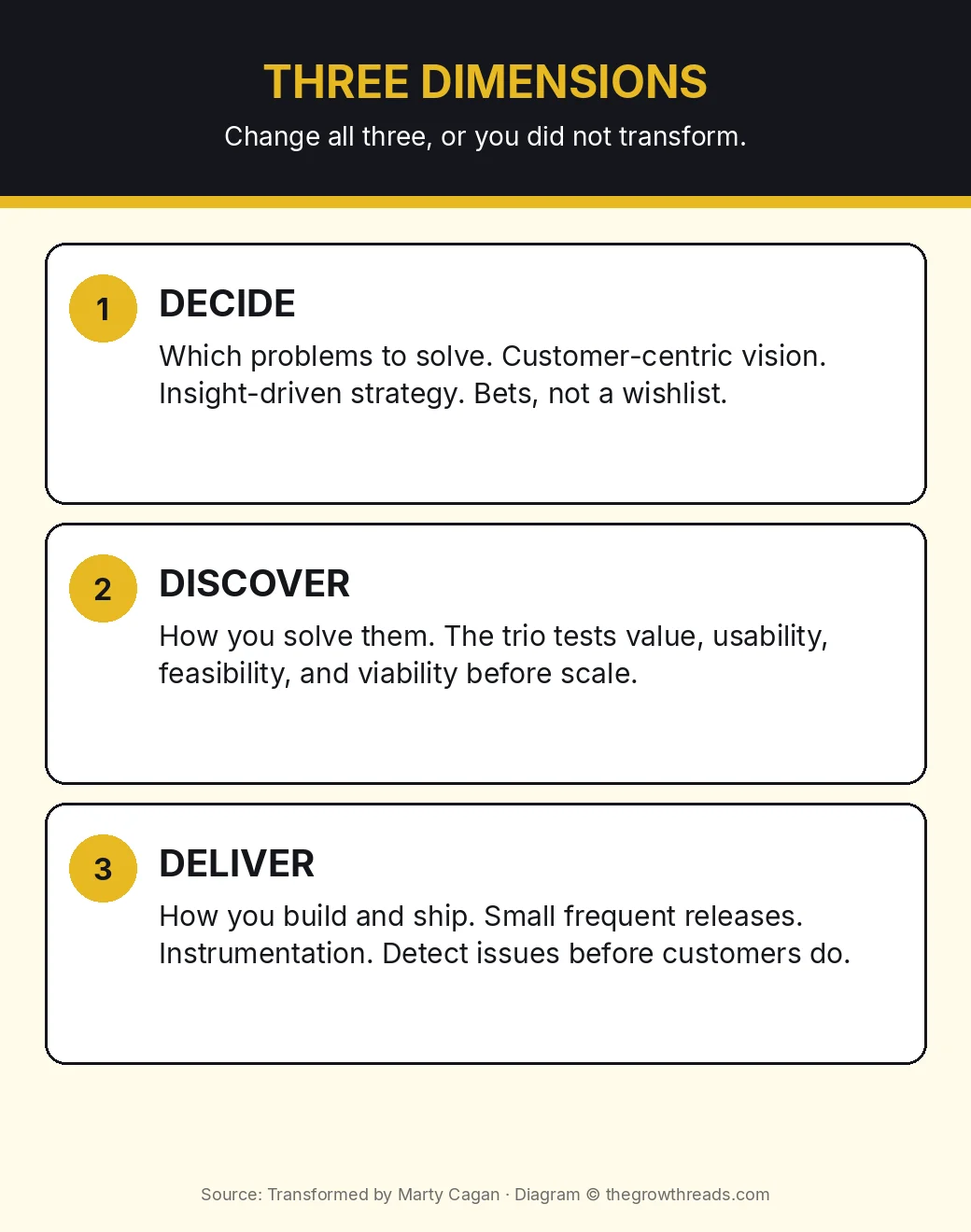
Cagan keeps repeating that the product operating model is not a process. “The product operating model is not a process, recipe or framework.” It is how a company uses talent to create technology-powered products that customers choose and that the business can run. The practical picture is three dimensions you can audit this week.
Decide which problems to solve. In the factory, every department makes its case in planning, and the loudest list wins. In the product model, product, design, and technology leaders are responsible for the bets. They owe the company a customer-centric product vision — the future you are trying to create — and an insight-driven strategy: the few problems that matter now, sourced from data, customers, enabling tech, and the market. Focus, transparency, and a portfolio of bets replace a hundred-item roadmap. Stakeholders are collaborators on constraints, not authors of the solution.
Discover how you solve them. Teams get a problem and an outcome, not a spec. The product manager, designer, and engineer look for a solution that is valuable, usable, feasible, and viable — the same four risks from Inspired, now as a company expectation rather than a heroic exception. Discovery is continuous and cheap. The single biggest reason companies fail to transform, Cagan says, is that they do not take product management seriously. An empowered team with a backlog administrator in the PM seat will recreate the factory in a week.
Deliver how you build and ship. Small, frequent, reliable releases — at worst every two weeks, ideally continuous. Instrumentation so you know if the thing is used. Monitoring so you see pain before the customer tweets it. Delivery infrastructure that can run an experiment, not a quarterly train. Speed and quality rise together when the batch size falls; the factory belief that quality requires slow gates is the expensive myth.
TGR Note: Leaders who must coach that discovery loop should keep Empowered on the desk — problems, not roadmaps. For the weekly customer habit the trio actually runs, use Continuous Discovery Habits.
Part 3 — Competencies, culture, and the principles
The model dies in hiring. Product teams in this book are cross-functional, durable, informed by strategy, empowered, and accountable for results. That requires four competencies, not four job titles. Product managers own value and viability. Product designers own usability and the experience. Tech leads own feasibility and delivery. Product leaders — the managers of those three crafts — own coaching and strategic context. If any one of those is a coordinator, the team will wait to be told the answer.
Culture is how you use talent: how you pick opportunities, make decisions, and keep promises. Four trades sit at the centre: principles over process, trust over control, innovation over predictability, and learning over failure. If the ritual fights the principle, kill the ritual.
The team principles rhyme with Empowered on purpose: empowerment, outcomes over output, a sense of ownership, collaboration across the trio. Discovery principles keep waste small and risks early. Delivery principles insist on instrumentation and a path to production that is not a religious ceremony. None of this is a checklist you laminate. The book keeps dragging you back to whether customers got a better product and the business got a better result. If those two are missing, the principles were posters.
Strategy gets its own four: focus, powered by insights, transparency, and placing bets. The honest tell is the quarterly portfolio. If every stakeholder got a slice, you did not focus. Product leaders have to explain why this problem, this quarter, in a room of people who wanted a different feature.
Part 4 — Transform. Do not install.
This is the chapter people skip because it does not flatter the program office. Transformation is not a tool rollout. Installing Scrum, renaming feature teams as squads, writing OKRs that hide a spec, or hiring a Chief Product Officer while finance still funds projects — those are installs. The factory absorbs them. People learn the new words. The roadmap stays a list of other people’s solutions. Cagan and partners argue you start with the CEO, because only the top can change how work is paid for and how promises are made to the board and to sales.
The workable path is pilots. Pick a few durable teams. Give them real product managers, designers, and engineers. Give them a problem and an outcome, customer access, and a delivery path that can release at least every two weeks. Protect them from the leftover portfolio. Coach them in the work. Measure whether the outcome moved. Only then clone the pattern. An all-hands ‘we are a product company now’ announcement without that evidence trains cynicism.
Objections are predictable: sales already promised it; compliance will not allow experiments; we cannot hire those people; the board wants the date. Compliance is a viability constraint to discover against — not a reason to skip discovery. Dates on untested work are the predictability addiction. The case studies show companies outside native tech that actually moved. They are proof the constraint is leadership, not industry.
TGR Note: If delivery is the dimension that is stuck — giant batches, heroics, and monthly trains — read The Phoenix Project alongside this, then Working Backwards for a vision written as a customer narrative before anyone funds a project.
Who is Transformed best for — and who should read something else first?
Read Transformed if you can change how work is funded or you sit next to someone who can: CEOs, CFOs, CPOs, CTOs, design leaders, and the senior stakeholders who currently author the roadmap. It is also the right book if you already run Inspired inside a team and keep hitting the rest of the company as a wall.
Read something else first if you need tactics for one team. Start with Inspired for discovery craft. Use Empowered if your job is coaching PMs, designers, and tech leads. Use Continuous Discovery Habits for the weekly interview and opportunity-solution tree. Use Shape Up if your immediate pain is six-week bets rather than company transformation. Use Sprint when you need five days of evidence under one problem.
Questions to reflect on
- On each of the three dimensions — decide, discover, deliver — are we in the product model or the factory?
- Which committed roadmap item is actually a stakeholder’s solution in disguise?
- Who funds this team: a durable product budget, or a project code that dies at go-live?
- If the evidence killed the current idea, is the team allowed to pick another solution?
- What would the CEO have to stop promising for one pilot team to be real?
🔥 Ready to leave the feature factory?
Get Transformed, then use the 7-day plan to change one dimension for one team.
How to apply Transformed (7-day plan)
- Day 1 — Name the model you are actually in. One page, three headings: Decide, Discover, Deliver. Write the honest version, not the all-hands version.
- Day 2 — Pick one durable team as the pilot. Protect their calendar from extra roadmap. If you cannot name the team, you are still in announcement mode.
- Day 3 — Swap one feature for a problem. Take a committed item off the list. Replace it with a customer problem and a measurable outcome.
- Day 4 — Sit in discovery. One hour with the trio and a customer. If there is no discovery on the calendar, that is the finding.
- Day 5 — Ask how the pilot is funded. If the answer is a project code, write the one-sentence change finance would have to make.
- Day 6 — List the three loudest objections. Sales promises, board dates, compliance. Pair each with a principle, not a slogan.
- Day 7 — Brief the CEO on one dimension. Ask for one change this quarter — not all three. Transformation starts when the top changes a rule, not a label.
Frequently asked questions
What is Transformed about in one paragraph?
Transformed is the company-level companion to Inspired and Empowered. Marty Cagan and his Silicon Valley Product Group partners wrote it for leaders who want to work like the best product companies and currently do not. The destination is the product operating model: how you decide which problems to solve, how you solve them, and how you build and ship. Most firms still live in a feature factory — stakeholders name solutions, teams ship on a date, and success is output. You cannot install Agile, OKRs, or a new title on top of that factory. You change funding, staffing, coaching, and accountability until teams own outcomes.
What does “product operating model” actually mean?
It is not a process, recipe, or framework. It is a conceptual model: a set of first principles about how technology-powered products get made. In the product model, leaders give teams problems and outcomes. The product manager, designer, and engineer discover a solution that is valuable, usable, feasible, and viable. Delivery is small, frequent, and instrumented. Strategy is a portfolio of bets, not a wishlist of features. If your operating system is still projects, dates, and other people’s solutions, you are not in the product model — even if the org chart says otherwise.
How is Transformed different from Inspired and Empowered?
Inspired is the field guide for the product trio on one team: discovery before delivery, four risks, prototypes instead of a PRD. Empowered is the field guide for the managers who coach those teams: give problems, staff for character, write vision and strategy. Transformed is the book for the rest of the company. Sales, finance, HR, legal, and the CEO have to change how they fund work, how they promise dates, and how they judge success. You can run Inspired inside a squad and still be a feature factory. This book is about moving the whole operating model.
Do we have to throw out Agile, Scrum, or OKRs to use Transformed?
No. Cagan’s argument is that those tools fail when you install them on an IT model. Standups on a feature factory are still a feature factory. OKRs that secretly contain the solution and the date are still a roadmap. Keep the ceremonies that help you release small and learn fast. Drop the ones that exist to make a stakeholder feel in control. The test is simple: is this team allowed to pick a different solution if the evidence says the original idea will not move the outcome? If not, you installed process. You did not transform.
Who should read Transformed first — the CEO or the product managers?
Start with the people who can change funding and accountability: the CEO, CFO, and the heads of product, design, and engineering. Product managers already drowning in a stakeholder roadmap will recognise every chapter and still be unable to act alone. If you are an individual contributor looking for interview scripts and prototype tactics, read Inspired and Continuous Discovery Habits first. If you lead a product org and your teams wait to be told what to build, read Empowered, then this book with your executive peers. Transformation is a company sport.
How long does a product-model transformation take?
Longer than a re-org slide. SVPG’s case studies describe years of work, usually starting with a handful of pilot teams that are truly empowered, staffed, and funded as product teams — then expanding only when those teams produce outcomes, not theatre. A quarter is enough to change one dimension for one team: replace a roadmap item with a problem, give the trio customer access, and ship on a two-week (or faster) cadence. A year is a more honest horizon for finance, sales compensation, and career paths to catch up. Anyone selling a six-week ‘Agile transformation’ is selling an install. Skip that.
Is Transformed only useful for Silicon Valley tech companies?
No. The book is aimed at companies that already spend heavily on technology and still cannot compete with product-model firms — banks, retailers, insurers, industrial firms, the public sector. The enabling technology has shown up in every industry; the operating model often has not. If your ‘digital’ group is an IT department with a product veneer, the three dimensions apply. The case studies exist to show that non-native product companies can move. The constraint is leadership willingness to stop judging technology on output, not the city on the headquarters letterhead.
Related summaries
- Inspired — the field guide for the trio this company-level book assumes you can staff.
- Empowered — coaching, staffing, vision, and strategy inside the product org.
- Continuous Discovery Habits — the weekly interview cadence discovery needs.
- Working Backwards — customer narrative before anyone funds a project.
More in this silo: best productivity books.
How we analyze books: every book on The Growth Reads is read cover to cover, summarized in thousands of words of original analysis, and rated against our five-criteria rubric (lasting impact, evidence quality, practical application, writing & originality, external consensus). Read our full methodology.