

★★★★½ 4.5/5 — A short classic on creating wealth by holding one picture and finishing today’s work.
Best for: readers who want a one-sitting method for getting rich by creating value.
Reading time: ~2 hrs, guide: 14 min
Difficulty to apply: Moderate. The picture is simple. The daily behavior is the real practice.
The Science of Getting Rich in one minute
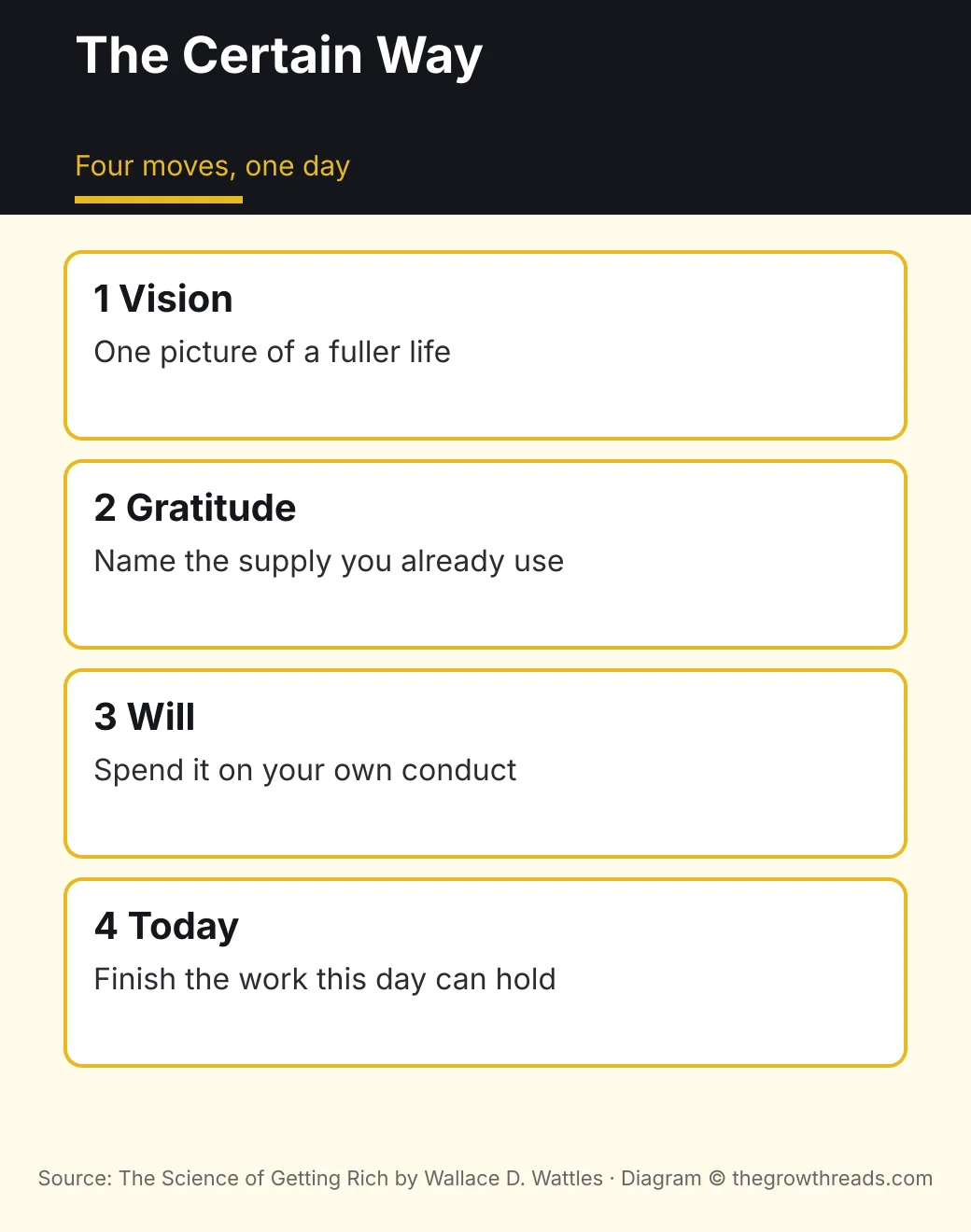
Wallace D. Wattles treats getting rich as a learnable way of thinking paired with a full day of useful work. He published this short book in 1910. The method has four moves you can name before lunch. Hold one clear picture of a fuller life. Stay grateful for the supply you already use, so complaint does not run the morning. Aim your will at your own conduct. Then do, today, every useful thing today can actually hold, and do it so the other person leaves with more than they brought.
He calls that combination the Certain Way. The book is about a hundred pages. The value is in running the sequence for a week, with one vision and one finished work list.
Key takeaways
- Riches mean a fuller life: Wattles ties money to shelter, tools, study, beauty, and the ability to help.
- Getting rich is a sequence: Learn the moves and repeat them. He treats the result as the fruit of the practice.
- Opportunity is still open: New value can be made in the business you are already near.
- Work on the creative plane: Make something that increases life for the buyer and for you.
- Hold one picture: Decide what you want to be, do, and have, and keep that single picture.
- Gratitude stays on supply: Name the tools, skills, and people you already use.
- The will is for self-command: Stay with the picture and the day’s work.
- Act where you stand: Do all that can be done today, and take one step toward the better-fit role.
- Leave an impression of increase: The other person finishes with more usefulness than they brought.
What is The Science of Getting Rich about?
The Science of Getting Rich is Wattles’ 1910 method for creating wealth: hold one clear picture of a fuller life, stay grateful, aim your will at your own conduct, and do all of today’s useful work so other people leave the exchange increased. He treats riches as something you build on a creative plane.
About the author
Wallace Delois Wattles (1860–1911) was an American New Thought writer. He was born in the United States in 1860 and published The Science of Getting Rich in 1910, the year before he died on 7 February 1911. He also wrote The Science of Being Great and The Science of Being Well, a short trio that treats wealth, ability, and health as practices a person can learn. He was not a household name in his lifetime, and he did not leave the kind of public business record later success authors built. The book outlived the man. In the 2000s, Rhonda Byrne said this 1910 volume gave her the spark for The Secret, which sent a new generation back to the original pages. Read him for the work half of that idea: a single picture, gratitude, self-command, and a day that actually gets finished. Explore all Wallace D. Wattles book summaries →
Key concepts at a glance
| Concept | What it means | Use it when |
|---|---|---|
| Certain Way | One picture, gratitude, self-command, and a finished day. | You have tactics and no operating picture. |
| Formless substance | His 1910 name for a source that takes the form you hold. | You want the premise stated, then a picture you can keep. |
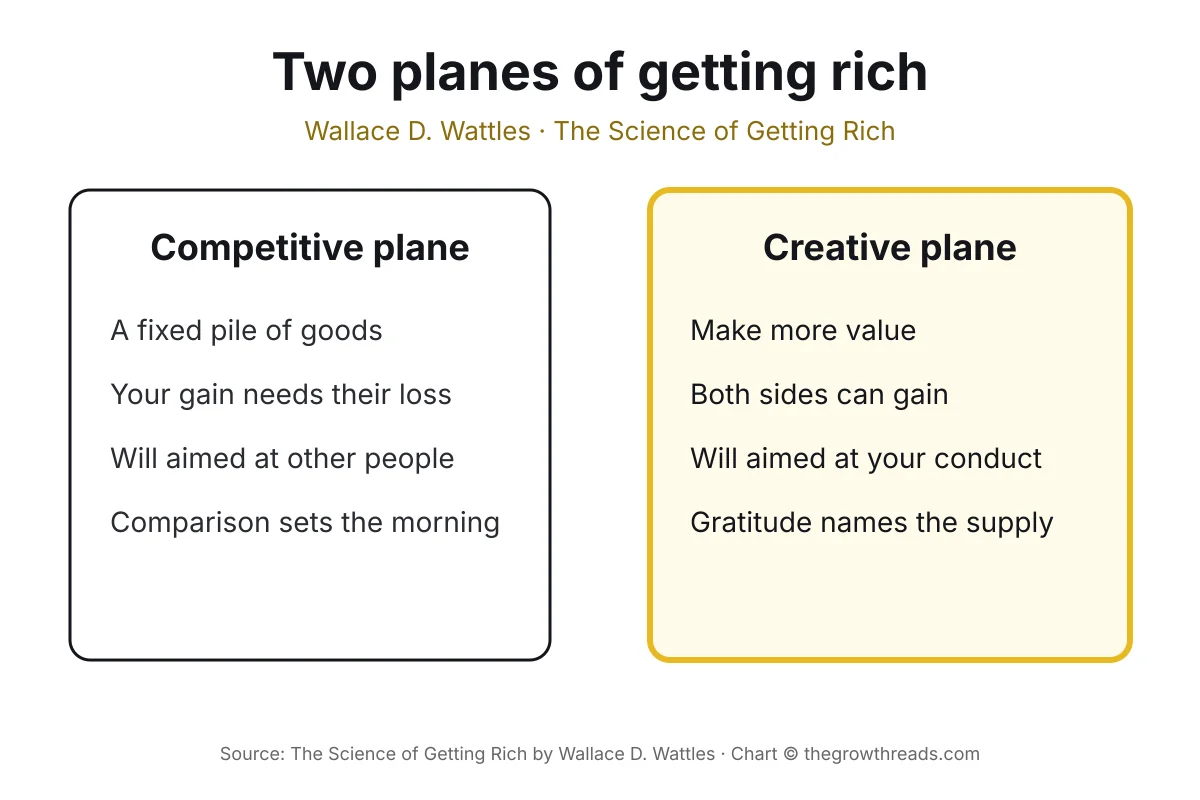
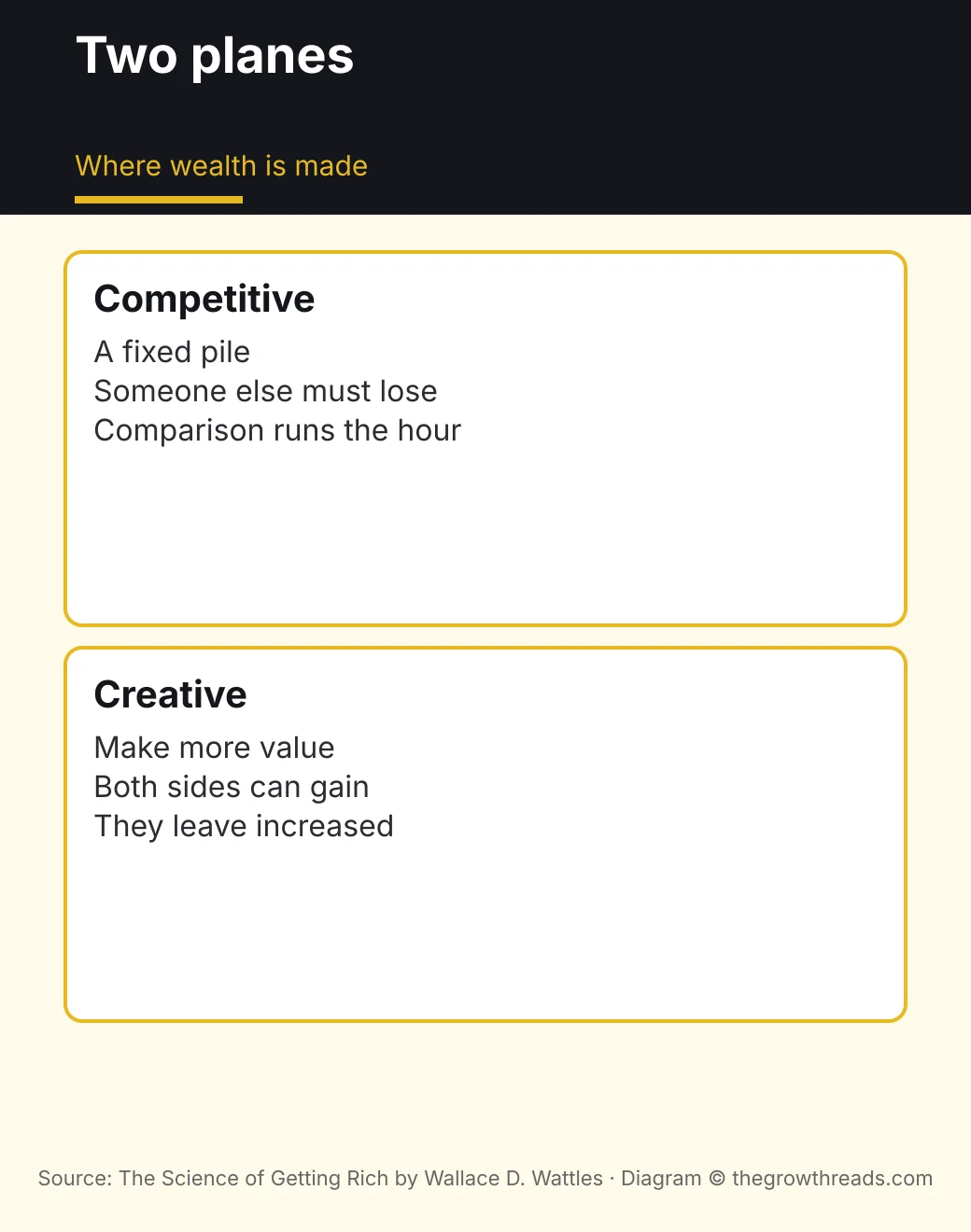
| Creative plane | Make more value so both sides of the exchange can gain. | A deal only works if someone else loses. |
| Gratitude | Attention stays on skills and people you already use. | Complaint is choosing the morning. |
| Will on yourself | Keep the picture and do the work you named. | You are pushing a customer or a colleague. |
| Efficient action | Do all that can be done today, without hurry or lag. | The list is heroic or empty. |
| Impression of increase | The other person leaves with more usefulness. | You want repeat work and trust. |
| Advancing person | A little more skill each week, picture intact. | The work has gone flat. |
The right to be rich, and the science
Wattles treats a richer life as a worthy aim. Riches, in his pages, mean more ability to live: shelter, tools, study, beauty, and enough surplus to be generous. The point is an increase of life for you and for the people your work touches.
Getting rich, he says, follows a procedure. Town, talent, and thrift are not the decisive variables. People become wealthy in ordinary places, which he takes as evidence that the way they think and act is what changes. Learn that way and you can practice it where you stand.
The premise under the procedure is New Thought metaphysics from 1910. Wattles says a formless thinking substance takes the form you hold, and a scattered mind cannot impress one form. You can use the working rule on its own: choose one picture of life and stop feeding your attention a dozen rivals.
He also says the chance has not been used up. You can still make a new service or a better delivery of an old one. That is the creative plane: more value for the buyer and for you.
Write one paragraph: what you want to do, to be, and to have, and who is increased when that picture is real. If it runs to a second page, it is still two pictures. Cut until one remains.
Gratitude, vision, and thinking in the Certain Way
Riches arrive, in his account, through ordinary channels of trade, to the person already acting in the Certain Way. The picture draws you toward the work. Customers, employers, and partners are the channel, and you meet them by doing the business in front of you at a higher standard.
Gratitude is the hinge. A grateful mind stays on the tools, the skill, and the people that already support the work, while the larger picture stays intact. Complaint and comparison pull attention onto scarcity. Gratitude is how you stay with supply and still tell the truth about what you are building.
Thinking in the Certain Way means you let the chosen picture govern the next action, including on days when the balance and the calendar still show the old story. Wattles wants that purpose held as present. A second, contradictory picture cancels the impression. Doubt, in this chapter, is that second picture.
TGR Note: Hill’s Think and Grow Rich summary inherits the picture and adds a written plan. Allen’s As a Man Thinketh summary stays on the inner standard. Wattles is the one who spends the next chapters on efficient work. Use all three when you want the picture, the plan, and today’s list.
Each morning, read the vision once and write ten concrete lines of gratitude: a tool, a person, a skill you can point at. Then start the first task before you open a feed. The Certain Way is mostly which picture gets the first ten minutes.
Use the will on yourself, then act today
Wattles will not let you aim the will at other people. The usual ambition, in his telling, is to compel a buyer, a colleague, or the week itself. He calls that competitive. His use is narrower. You apply the will to yourself: stay with the vision when the morning offers another story, and do the work you named.
Thought without today’s work is incomplete. You act inside the job you already hold. Waiting for a perfect role is a way of never starting. The present post is where the Certain Way is proved, because larger work needs a record of finished work to land on.
Efficient action is his cure for frenzy and for drift. Do, every day, all that can be done that day. That means the actions that genuinely move the work, in the hours you have, at a standard you would repeat. Hurry leaves a sloppy impression. Lag leaves the day unmoved. The middle is a finished list.
TGR Note: When the picture is sincere and the afternoon still leaks, add our Atomic Habits summary. One vision from Wattles, a visible cue and a two-minute start from Clear.
In the morning, write the largest set you can finish well today. Move next week’s work off the page. When the list is done, stop. A completed day includes an edge.
The right business and the impression of increase
Wattles wants you in work that fits your faculties. If you are in the wrong business, he tells you to move toward the right one while the present work is still done at a high standard. The current job is a stepping stone: full effort, plus one action that belongs to the next role.
The impression of increase is the chapter you can use even if you set the metaphysics aside. Deal so the other person leaves with more: a clearer decision, a better artifact, a fairer term, follow-through that happens. That impression is how customers return. It is also his ethical line. You are making something real, and the person across the table is increased by the exchange.
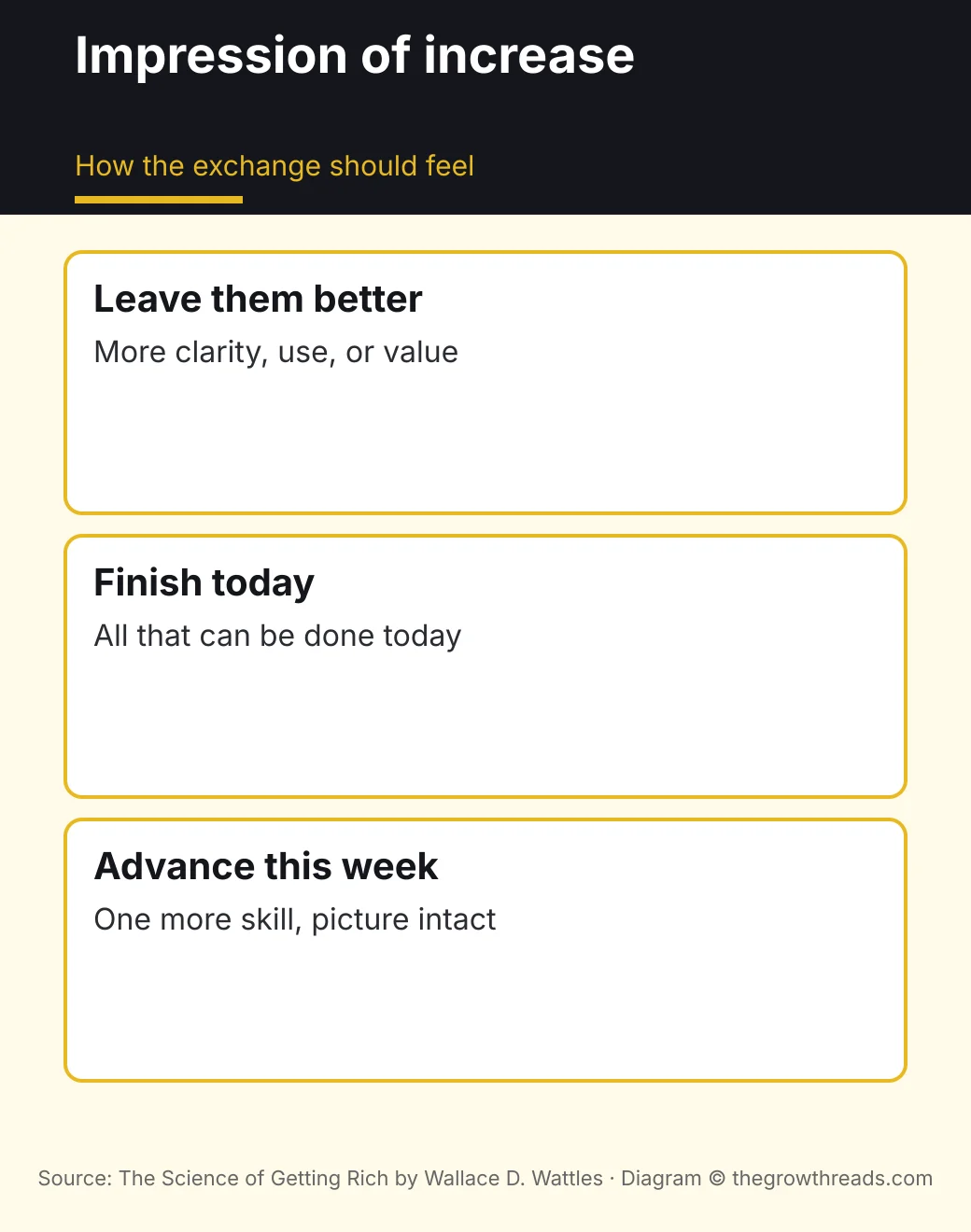
He calls this person the advancing man. The phrase is 1910. The behavior is plain: a little more skill each week, a little more usefulness than the role requires, and the same picture still intact on an ordinary Wednesday. People prefer that exchange, and Wattles treats the preference as one channel through which riches come.
His cautions sit beside the ambition. Leave other people’s wills alone. Keep the plan whole instead of offering it to every skeptic for editing. Keep the evening from turning into a rehearsal of failure. Think in the Certain Way, and act in the Certain Way. The last chapter repeats those two lines until they are one instruction.
TGR Note: Byrne’s discovery of this book sits behind our The Secret summary. Wattles spends the later chapters on efficient action. When “more” itself has become the treadmill, read Four Thousand Weeks beside him.
Who is The Science of Getting Rich best for — and who should read something else first?
Read Wattles if you want a one-evening classic that ties one picture to a finished day, and if you will practice that pair for a week in the job you already have. It fits makers and operators who have enough demand to do careful work.
Read Atomic Habits first if the vision is clear and the afternoons still dissolve. Read The Psychology of Money first if the question is how to keep money you already earn. Read Four Thousand Weeks first if “more” has become the problem. Read The Magic of Thinking Big if you want a practical mid-century voice with fewer metaphysical premises.
Questions to reflect on
- If you stopped measuring your pile against someone else’s, what would you create in the next thirty days?
- Where are you aiming your will at another person, and what self-command would you practice instead?
- What would “all that can be done today” include, and which tasks are actually next week’s work?
- Who left an exchange with you last week increased, and who left with less ease or less value?
- Is the business you are in the one your faculties fit, and what is one stepping-stone action you can take from the role you have?
🔥 Ready to create wealth the Certain Way?
Hold one picture, stay grateful, and finish today’s work so the other person leaves with more.
How to apply The Science of Getting Rich (7-day plan)
- Day 1 — One picture. Write a single paragraph: the work you do, the way the income will be used, and the person who is increased when it is real. Cut every second goal. Read it once before bed.
- Day 2 — Gratitude that you can point at. List ten specific supplies you already use: a tool, a skill, a customer, a colleague, a hour of health. Read the list before you open messages.
- Day 3 — All that can be done today. Write the finishable list. Do it at a standard you would repeat. When it is done, stop, and leave the heroic extras on next week’s page.
- Day 4 — Impression of increase. Choose one live exchange. Decide what the other person will have at the end that they did not have at the start: a clearer decision, a better artifact, a fairer term. Deliver that.
- Day 5 — Will on yourself. Name one competitive move you will not make today: checking a rival before you work, discounting out of fear, or arguing someone into a yes. Keep the will on your list.
- Day 6 — The right business, from here. Name the role your faculties actually fit. Do one stepping-stone action inside the current job: a sample, a conversation, a skill block of forty-five minutes.
- Day 7 — Keep the three that happened. Did the picture stay singular? Did today’s work get finished? Did one person leave increased? Schedule those three again for next week, and drop any extra ritual that you did not do.
Frequently asked questions
What is The Science of Getting Rich about?
It is Wallace D. Wattles’ 1910 manual for creating wealth by a repeatable sequence. You form one clear picture of a fuller life, stay grateful for the supply you already have, aim your will at your own conduct, and do the useful work the present day can hold. Riches come, he says, through ordinary business to the person who thinks and acts in that Certain Way. The Destiny Books edition is 112 pages of instruction. The practical core is creative value, self-command, and a finished day. This is a reading of a 1910 ideas book, not a personal financial plan.
Is The Science of Getting Rich the book behind The Secret?
Rhonda Byrne has said that this 1910 book gave her an early glimpse of the idea she later called The Secret. The family resemblance is the mental picture and the belief that attention helps shape what you build. Wattles goes further into conduct than the later phenomenon did. He spends chapters on efficient action, on doing all that can be done today, and on refusing to use your will to compel other people. If you only keep the picture and skip the work, you have left his method. Read our Secret summary for the later telling, and stay with Wattles when you want the original pages and the day’s list.
What does Wattles mean by the creative plane?
The creative plane is his name for making more value so that the exchange increases both sides. You build a service, a product, or a way of working that adds life, in his language, which in practice means usefulness, beauty, ease, or capability the other person did not have. The competitive plane is the scramble for a fixed pile, where your gain depends on someone else’s loss. He tells you to do business on the creative plane: fair terms, a real improvement, and an impression of increase. You can use that test on a single offer this week without adopting the rest of his cosmology.
What is “thinking in the Certain Way”?
It means holding one chosen picture of what you want to be, do, and have, and letting that picture govern the next action. Wattles pairs it with gratitude, so the mind stays on supply rather than on complaint, and with a will aimed at yourself, so you keep the picture when the day looks unchanged. He tells you to think that purpose as present even while appearances still show the old life. A second, contradictory picture, including a rehearsed story of failure, cancels the impression he wants. In practice, the Certain Way is one paragraph you can reread, followed by the first finished task.
How long does it take to read The Science of Getting Rich?
Most readers finish the book in about two hours. The Destiny Books paperback runs 112 pages, and the chapters are short enough to read one, stop, and write a line. Our summary is a fourteen-minute pass through the method: the right to a fuller life, the creative plane, gratitude, the will used on yourself, efficient action, the right business, and the impression of increase. The reading is the easy half. The seven-day plan is the actual time cost, because each day asks for a visible behavior: one picture, a gratitude list, a finishable work list, one increased person, and a stepping-stone action toward work that fits.
Is The Science of Getting Rich still useful in 2026?
The procedure still fits wherever you sell work to other people. One picture, gratitude that names real supplies, a will spent on your own list, a finished day, and an exchange that leaves the other person increased: that set does not depend on 1910 industry. The formless-substance claim is a New Thought premise from his era, a belief about reality rather than a laboratory finding. You can set that premise beside you and still run the behavior. A reading that keeps only the wish has left the book. The later chapters are about action.
Who should read a different book before this one?
Choose Atomic Habits first when the picture is clear and the cue, the craving, and the afternoon still win. Choose The Psychology of Money first when the question is behavior with money you already have: saving, compounding, and avoiding ruin. Choose Four Thousand Weeks first when the hunger for “more” has become the problem and you need a philosophy of finite time. Choose Think and Grow Rich when you want Hill’s longer checklist, a written plan, and a definite chief aim in the lineage Wattles helped feed. Wattles is the right first book when you want the short original: create, do today’s work, and leave people increased.
Related summaries
- Think and Grow Rich summary — Hill’s longer achievement system in the same lineage: desire, faith, and a definite plan.
- Outwitting the Devil summary — Hill on drifting, and how to take the next action on purpose.
- As a Man Thinketh summary — James Allen on the thought that sets the ceiling of the work.
- The Magic of Thinking Big summary — a practical mid-century voice on belief, action, and the size of the goal.
- Best productivity books — the ranked shelf this summary sits beside.