

★★★★☆ 4.4/5 — the clearest plain-English case in print that mood is not a permission slip.
Best for: Capable people who already know the work and still stall because they are waiting to feel like it
Reading time: ~6 hours (304 pages) · this guide ~12 min
Difficulty to apply: Medium — one daily non-negotiable, not a weekend install
No Excuses! in one minute
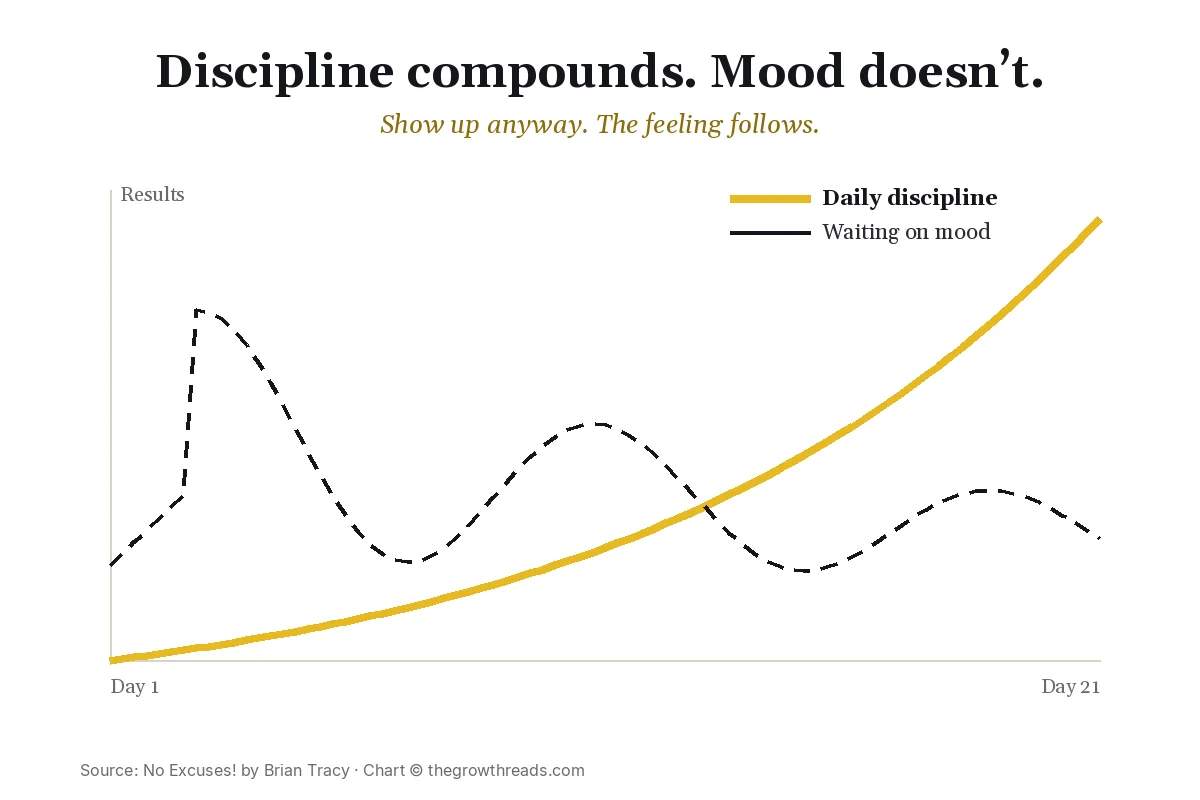
Do the work whether you feel like it. That is the whole book.
Brian Tracy’s No Excuses! The Power of Self-Discipline is a 21-chapter argument that success is not a personality type. It is a cause you can practice: do what you should do, when you should do it, even when the mood has left. Each kept promise raises self-esteem; each delay trains the opposite. He then walks that one muscle through character, written goals, time, money, health, and peace of mind. If you already own Eat That Frog!, this is the wider operating system. The frog is Tuesday morning. This book is why you still start.
Key takeaways
- Discipline is a definition, not a vibe: do what you should do, when you should do it, whether you feel like it or not.
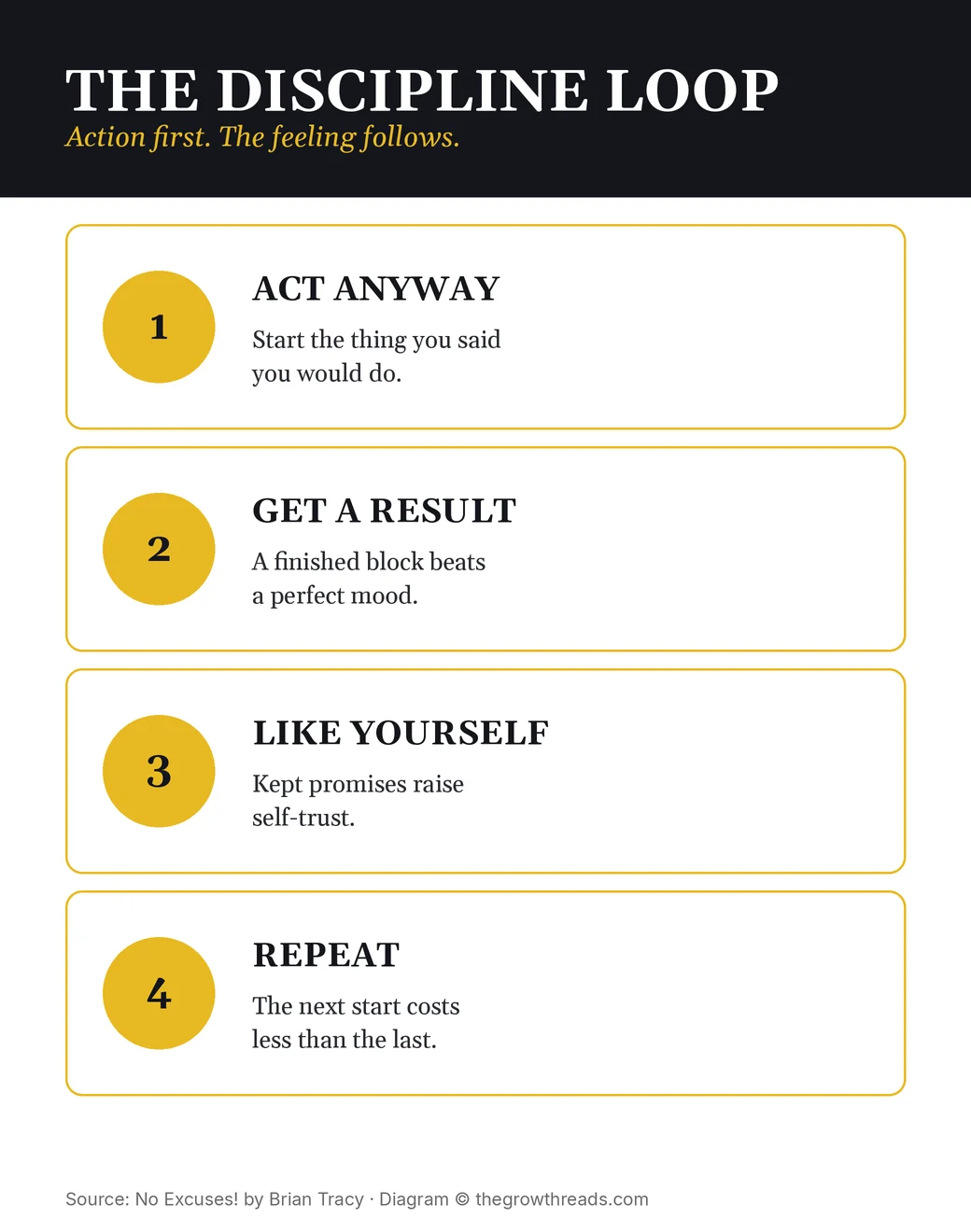
- Self-esteem is a loop: action produces a result, the result makes you like yourself, and that liking makes the next action cheaper.
- 100% responsibility: blame and delay are the same move in different clothes. The title is the instruction.
- Character is habits under pressure: you do not rise to a speech. You default to what you have repeated.
- Unwritten goals do not organize Tuesday: decide, write, date, list, sequence, start, then do something every day.
- Courage is discipline in front of fear: act first. Confidence is the souvenir, not the ticket.
- Time and money are character made visible: calendars and bank accounts keep score of the same muscle.
- Health is not a side quest: sleep, food, and training are how the brain you work with stays online.
- Peace of mind is a byproduct: a clear conscience is easier when your word to yourself still means something.
What is No Excuses! about?
No Excuses! is Brian Tracy’s 21-chapter field guide to self-discipline: do what you should do, when you should do it, whether you feel like it or not. He shows how that one muscle compounds across character, written goals, time, money, health, and peace of mind.
About the author
Brian Tracy is a Canadian-American speaker and author who has spent five decades training sales teams and executives on goals, time, and follow-through. He came up through sales himself, then turned the habits that made a quota into seminars and more than eighty books. Eat That Frog! is the short, famous one: do the ugliest task first. No Excuses! (Vanguard Press, 2010) is the wider argument — why character, written goals, money, health, and a quiet mind all run on the same muscle. He treats self-discipline as trainable, not a trait you either got at birth. Explore all Brian Tracy book summaries →
Key concepts at a glance
| Concept | What it means | Use it when |
|---|---|---|
| Self-discipline | Do what you should, when you should, whether you feel like it | You are waiting for a better mood to start |
| The self-esteem loop | Action → result → self-trust → cheaper next action | You “don’t feel motivated” after a skipped day |
| 100% responsibility | No blame story that delays the next move | The explanation is longer than the next action |
| Written goals | Decide, write, date, list, sequence, start, daily | The goal still lives only in your head |
| Courage | Discipline in the presence of fear | You want confidence before the call |
| Persistence | Discipline in the presence of delay | The result is slower than the fantasy |
| Worst first | The valuable ugly task gets the first block | Email is eating the morning again |
| Pay yourself first | Save and invest on a rule, not a leftover | The month ends before the transfer |
Part 1: The master skill is “anyway”
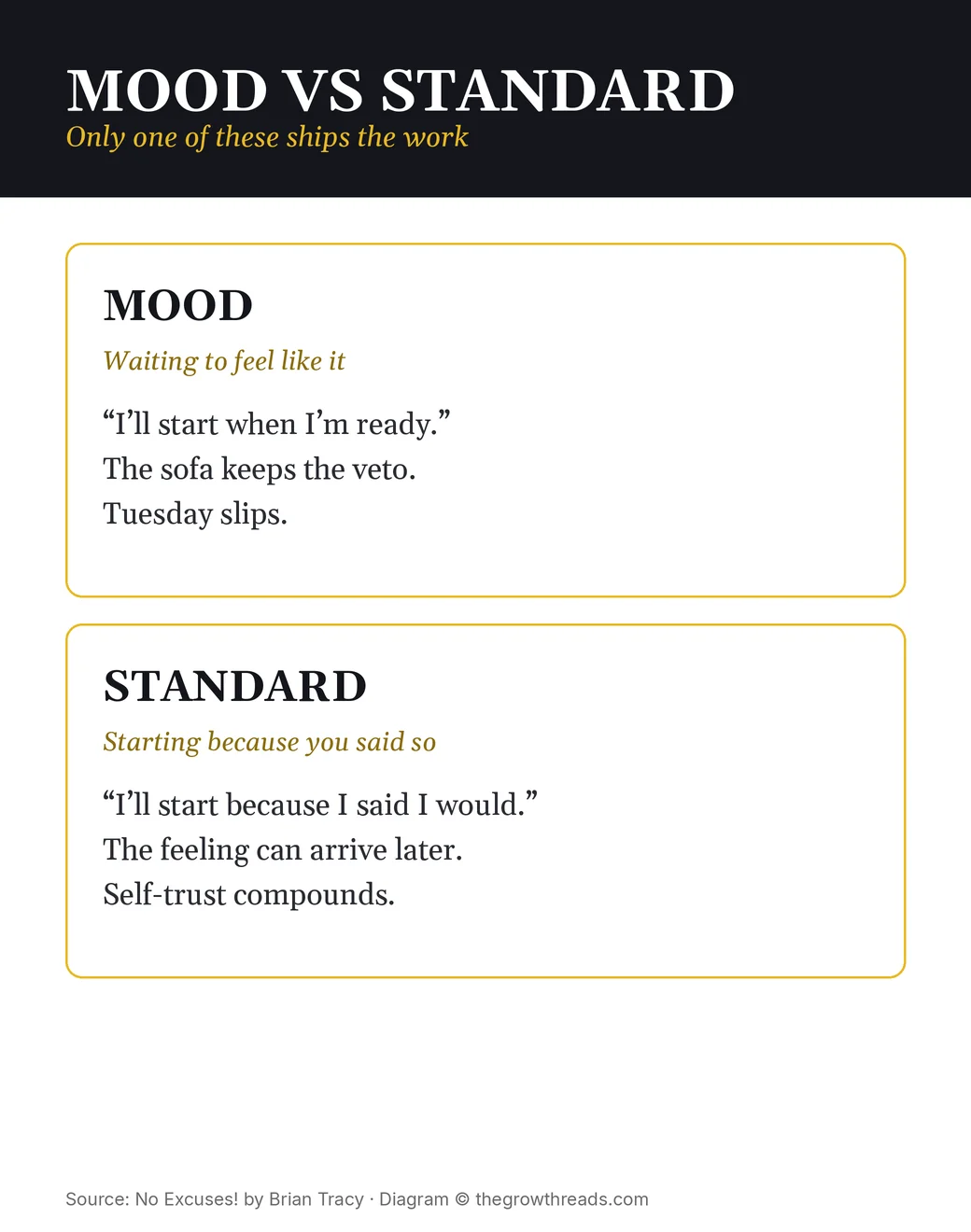
Tracy opens with a definition you can put on a card. Self-discipline is not intensity. It is not a 5 a.m. brand. It is the ability to do what you should do, when you should do it, whether you feel like it or not. That last clause is the book. Most people already know the work. They grant their mood a veto, then call the delay a mystery.
He treats success as cause and effect, not as a lottery of talent. You become the kind of person who finishes because you have a stack of finished days, not because you waited to become that person in your head. The hidden engine is self-esteem. When you keep a promise, you like yourself more, and the next start costs less. When you break it, you like yourself less, and the next start needs a speech. That is why a skipped Tuesday is expensive: you are not only missing the output. You are training a story about your own word.
The “common denominator of success” line he borrows is blunt on purpose. Successful people do not love every hard task. They are willing to do the unenjoyable parts that the other group keeps postponing. Happiness, in this framing, is not a mood you hunt. It is what shows up when your days are aimed at a standard you respect.
TGR Note: This is the same muscle as Eat That Frog!, zoomed out. Frog is the daily tactic: one ugly, valuable task before the rest of the inbox. No Excuses! is why you still sit down when the frog is ugly and you slept badly. If you only need the morning rule, start with Frog. If you keep skipping the frog because you are waiting to feel ready, you do not need another tactic. You need this definition on the desk.
Part 2: Character, responsibility, and written goals
The title is the method. An excuse is a story that delays the next action while protecting your self-image. Tracy’s 100% responsibility chapter asks you to drop the story and keep the action. Not because your circumstances are fair. Because the next move is still yours. Blame and delay wear different clothes and walk to the same stall.
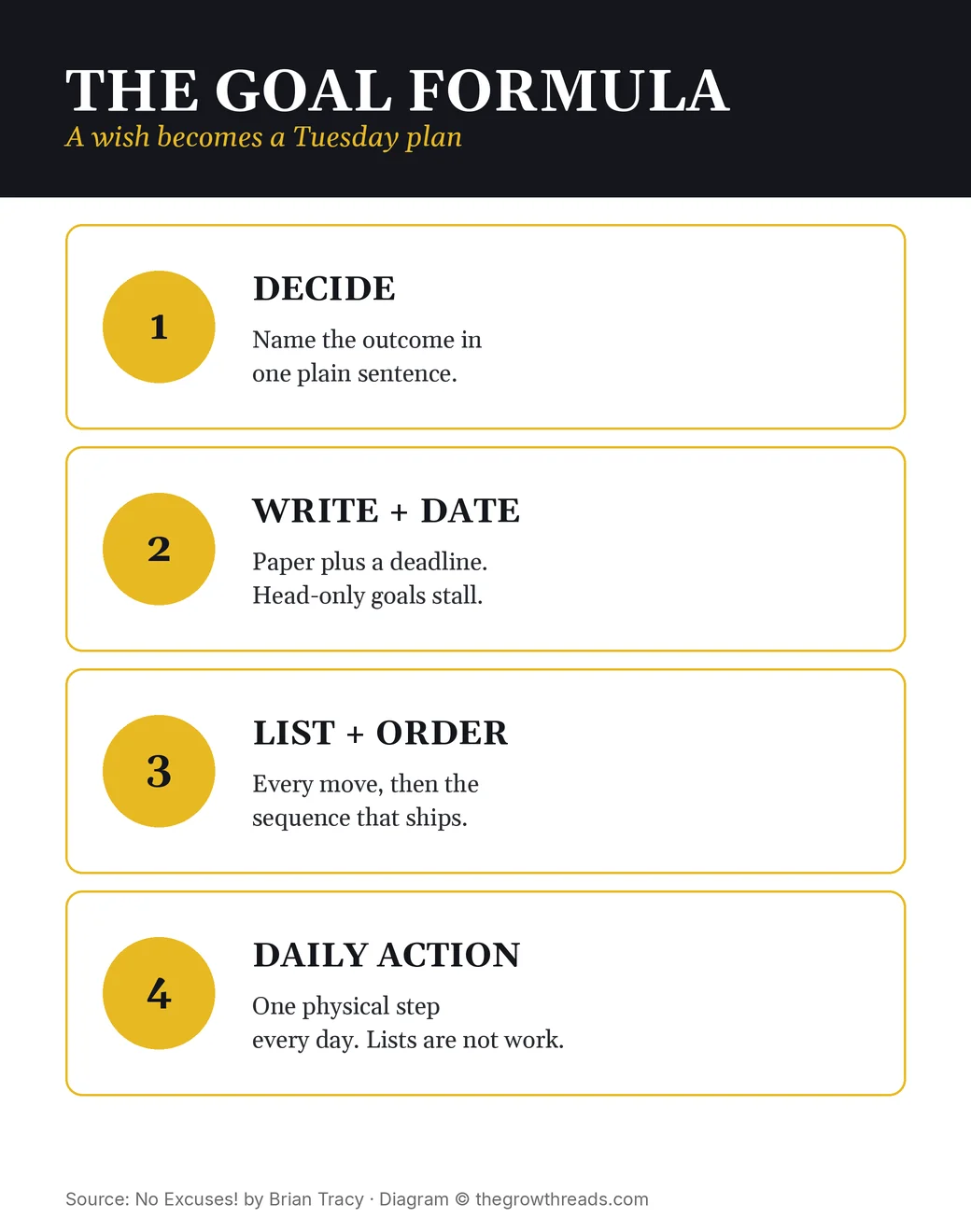
Character, here, is not a eulogy. It is what you repeat when nobody is clapping. You do not rise to a quote on the wall. You default to the habit you have been rehearsing at 4 p.m. on a boring Wednesday. That is why he spends so long on written goals. A goal that lives only in your head cannot win a fight with a sofa. His seven-step formula is old and still useful: decide exactly what you want, write it down, put a date on it, list the work, sequence the list, take the first action, then do something every day. The writing is the conversion. The daily move is the discipline. A pretty list with no calendar is still a wish.
Courage and persistence are the same skill in two weathers. Courage is starting while you are afraid. Persistence is continuing after the result is slower than the brochure. In both cases the feeling is late on purpose. You act. Then the state catches up. Waiting for confidence before the call is how the call never happens.
TGR Note: James Clear’s Atomic Habits makes the next action obvious: environment, identity, two-minute starts. Mini Habits shrinks the promise until you cannot fail it. Tracy is less interested in shrinking the door and more interested in walking through it when the door is still ordinary-sized. Use Clear or Guise when the start is too big. Use Tracy when the start is already small and you still negotiate. Stack them: make the frog easy to see, then refuse the veto.
Part 3: Time, money, and the Tuesday scoreboard
Once the definition is in place, Tracy takes it to the places that keep receipts. Time management is life management: your calendar is a character test you cannot talk your way out of. The 80/20 cut still applies — a few tasks produce most of the result — and the ugliest of those few still gets the first block. That is Eat That Frog wearing a suit. If the morning opens in email, you already voted.
Money is the same muscle with a bank logo on it. Pay yourself first. Delay the purchase that is really a mood. Debt is future hours you already spent. He is not writing a markets book. He is saying that “I’ll start saving when I feel more secure” is the same sentence as “I’ll start the report when I feel ready.” The transfer is the training. The feeling of security is what shows up after a streak of transfers, not before.
The business and sales chapters are Tracy on his home field: daily prospecting, showing up, leadership as self-mastery first. You can skip the quota examples if that is not your job and still keep the rule. A pipeline, a novel, a thesis, and a rehab plan all punish the same delay. The scoreboard is whatever you said you would ship this week.
TGR Note: The Compound Effect is the math under Tracy’s loop: ordinary daily moves, boring on Tuesday, ridiculous in a year. Discipline Equals Freedom is the same “anyway” sentence in a shorter, military voice. If Tracy’s seminar tone is not for you and you still need the veto removed, Willink is the slimmer door. If you need a full capture-and-next-action workflow rather than a character talk, go to Getting Things Done and come back.
Part 4: Health, relationships, and a quiet mind
The last third of the book is easy to treat as bonus chapters. It is not. A brain that is under-slept, under-walked, and over-sugared will not keep a sophisticated goal system. Tracy’s health and fitness chapters are the same definition applied to the body you have to bring to work. Training is not a reward for finishing the project. It is how the person who finishes the project stays in the chair.
Relationships get the same test. Listening, keeping a promise, being on time — these are disciplines, not moods. You do not wait to feel patient in order to listen. You listen, and patience has a chance to arrive. Peace of mind, in his closing, is what a clear conscience feels like from the inside. You cannot affirm your way into it while your calendar and your values are in a fight.
Used this way, No Excuses! is not a 21-chapter lecture on grit. It is a single standard, applied everywhere you already know what to do. The application plan below is one muscle for seven days, not a new personality by Friday.
Who is No Excuses! best for — and who should read something else first?
Best for capable adults who can name the work and still stall on mood. If your sentence is “I know what to do, I just don’t feel like it,” this is the map. It is also the right Tracy book if Frog already sits on the shelf and you want the rest of the life, not only the morning.
Read something else first if you want a 90-minute tactic — start with Eat That Frog!. If you need the next action to be tiny and obvious, start with Atomic Habits or Mini Habits. If you want the same “anyway” line without seminar stories, start with Discipline Equals Freedom. If you do not have a trusted list of next actions, start with Getting Things Done. Tracy will still be here when the working surface exists.
Questions to reflect on
- Where did you grant your mood a veto this week — and what was the next physical action you postponed?
- Which excuse is doing the most work in your story, and what would 100% responsibility do in the next ten minutes?
- Which goal is still unwritten, or written with no date?
- If your calendar and your bank account are character tests, what are they currently saying?
- What would “anyway” look like tomorrow morning in one sentence you could keep even on a bad night’s sleep?
🔥 Ready to stop waiting to feel like it?
Get Tracy’s self-discipline playbook, then run the 7-day plan below.
How to apply No Excuses! (7-day plan)
- Day 1 — Write the definition. Put it on a card: do what you should do, when you should do it, whether you feel like it or not. Circle tomorrow’s frog.
- Day 2 — Kill one excuse. Name the story you used this week. Rewrite it as 100% responsibility and take the next action without that sentence.
- Day 3 — Three dated goals. Write three outcomes. Give each a date. If you cannot date it, it is still a wish.
- Day 4 — Plan one, start one. For the #1 goal, list the moves, put them in order, and do the first physical action today.
- Day 5 — Worst first. Protect 90 minutes for the ugliest valuable task before email. Start it whether you feel like it or not.
- Day 6 — One body or money rule. A training session or a transfer you already decided. No mood required.
- Day 7 — Review the loop. Where did acting first change your state? Keep that one daily move for 21 days. Do not add a second identity project yet.
Frequently asked questions
What is No Excuses! about in one paragraph?
No Excuses! is Brian Tracy’s book-length case that self-discipline is the master skill under success, money, health, and peace of mind. He defines it as doing what you should do, when you should do it, whether you feel like it or not. Twenty-one chapters apply that muscle to character, 100% responsibility, written goals, courage, time, money, fitness, and a quiet conscience. It is not a new app. It is a standard you keep on ordinary Tuesdays when motivation has already left the room.
How is No Excuses! different from Eat That Frog!?
Eat That Frog! is the daily tactic: identify the ugliest, most valuable task and do it first. No Excuses! is the character layer underneath that tactic. Frog tells you which task wins the morning. This book argues why you still start when the mood has gone, and then walks the same muscle through money, health, and relationships. If you only want a 90-minute method, start with Eat That Frog!. If you keep skipping the frog because you are waiting to feel ready, this is the companion. Plenty of readers keep both on the desk: frog for 8:00 a.m., No Excuses! for the rest of the life.
Does self-discipline mean grinding with no rest?
Tracy’s standard is not a 16-hour grind. It is keeping the promise you already made — the report, the training session, the savings transfer — when a more pleasant option appears. Rest, sleep, and a weekly off-switch can be part of the plan you are disciplining yourself to keep. What he pushes against is using “I don’t feel like it” as a veto. If recovery is on the calendar, take it. If the frog is on the calendar, eat it. The enemy is not rest. The enemy is a sliding standard that quietly trains you not to trust your own word.
How long before discipline feels automatic?
Tracy often uses a 21-day window for a daily practice to start feeling normal. Later habit research (Lally and colleagues) found that real averages sit closer to two months, with a wide range. Treat 21 days as his coaching number, not a law of biology. The uncontroversial advice is the same in both places: pick one behavior, do it daily, and do not wait for a mood. If 21 days of a huge new identity fails, shrink the action until you can keep it. A kept small promise beats an abandoned heroic one.
Is this book only for salespeople and executives?
The middle chapters speak Tracy’s seminar world — sales numbers, leadership, business building — but the definition of the skill does not. Doing the thing you said you would do is the same muscle in a studio, a classroom, or a kitchen. Skip the sales-quota examples if they are not your job; keep the 100% responsibility chapter, the written-goal formula, and the health chapters. If you want zero business color, Atomic Habits or Mini Habits may feel closer. If your stall is “I know the work and I still negotiate,” this book is still aimed at you.
What is Tracy’s seven-step goal formula?
Decide exactly what you want. Write it down. Set a deadline. List everything you will have to do. Organize that list into a plan. Take action on the most important item. Do something every day that moves it. The writing is the conversion step: a goal that lives only in your head does not organize Tuesday. The daily action is the discipline step: the formula fails if you stop at a pretty list. Use it on one goal this week, not on a dozen. A single dated outcome with a daily move beats a vision board with no calendar.
Should I read Atomic Habits instead?
Read Atomic Habits if you want environment design, identity-based habits, and habit stacking — James Clear’s map for making the next action obvious. Read No Excuses! if your environment is already decent and you still grant your mood a veto. They stack: Clear makes the frog easier to start; Tracy refuses to let a bad night’s sleep cancel it. Mini Habits is the right first book if even a two-minute version feels too big. Discipline Equals Freedom is the right first book if you want the same “anyway” message in a shorter, military voice. None of them replace written goals with a date.
Related summaries
- Eat That Frog! Summary & Review
- Atomic Habits Summary & Review
- Mini Habits Summary & Review
- Discipline Equals Freedom Summary & Review
- Best Productivity Books
How we analyze books: every book on The Growth Reads is read cover to cover, summarized in thousands of words of original analysis, and rated against our five-criteria rubric (lasting impact, evidence quality, practical application, writing & originality, external consensus). Read our full methodology.