

★★★★½ 4.5/5 — the developer-side field manual for unsticking a change that currently waits on a ticket.
Best for: Engineers, eng managers, and product leads whose “small fix” still needs three other teams
Reading time: ~8 hours (352 pages) · this guide ~12 min
Difficulty to apply: Medium — the ideals are plain; collapsing a silo is the work
The Unicorn Project in one minute
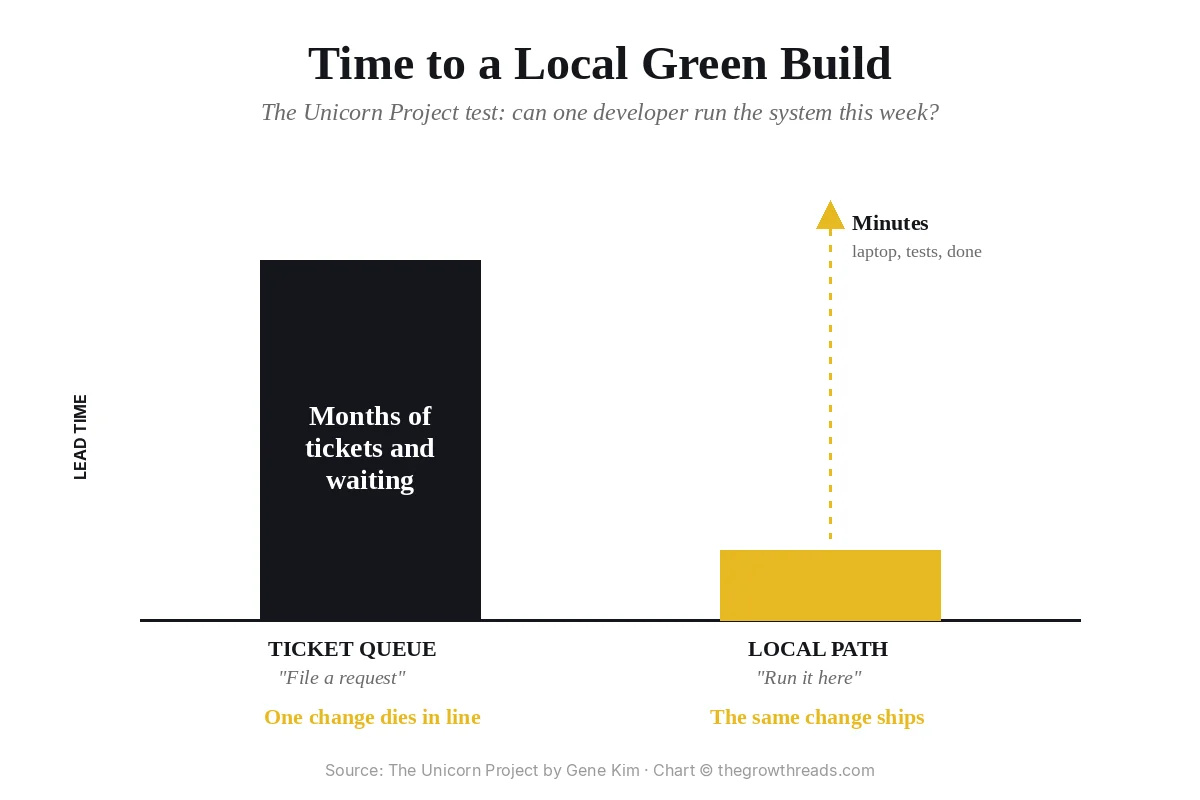
If a developer cannot build, test, and see a change without a week of tickets, the company does not own its software. It rents a queue. Gene Kim’s 2019 sequel to The Phoenix Project sits next to Maxine, a senior lead exiled to Phoenix after a payroll outage. She cannot get a working environment. Every “quick” change is a committee. A Rebellion offers five ideals — locality, flow, daily improvement, safety, customers — so the code and the customer share a room again. If you only take one move from this The Unicorn Project summary, time how long one person needs for a green local build of the thing you ship. That number is the plot.
Key takeaways
- Locality first: a change that needs a cast of thousands is already late.
- Simplicity is a feature: architecture that you cannot run on a laptop is a management problem, not a badge.
- Focus, flow, and joy: work that never finishes is not “hard.” It is broken.
- Improve daily work: keep a slice of the week for the system, or the system will eat the week.
- Psychological safety: if the truth is punished, you will debug folklore instead of code.
- Customer focus: tickets closed are not value shipped.
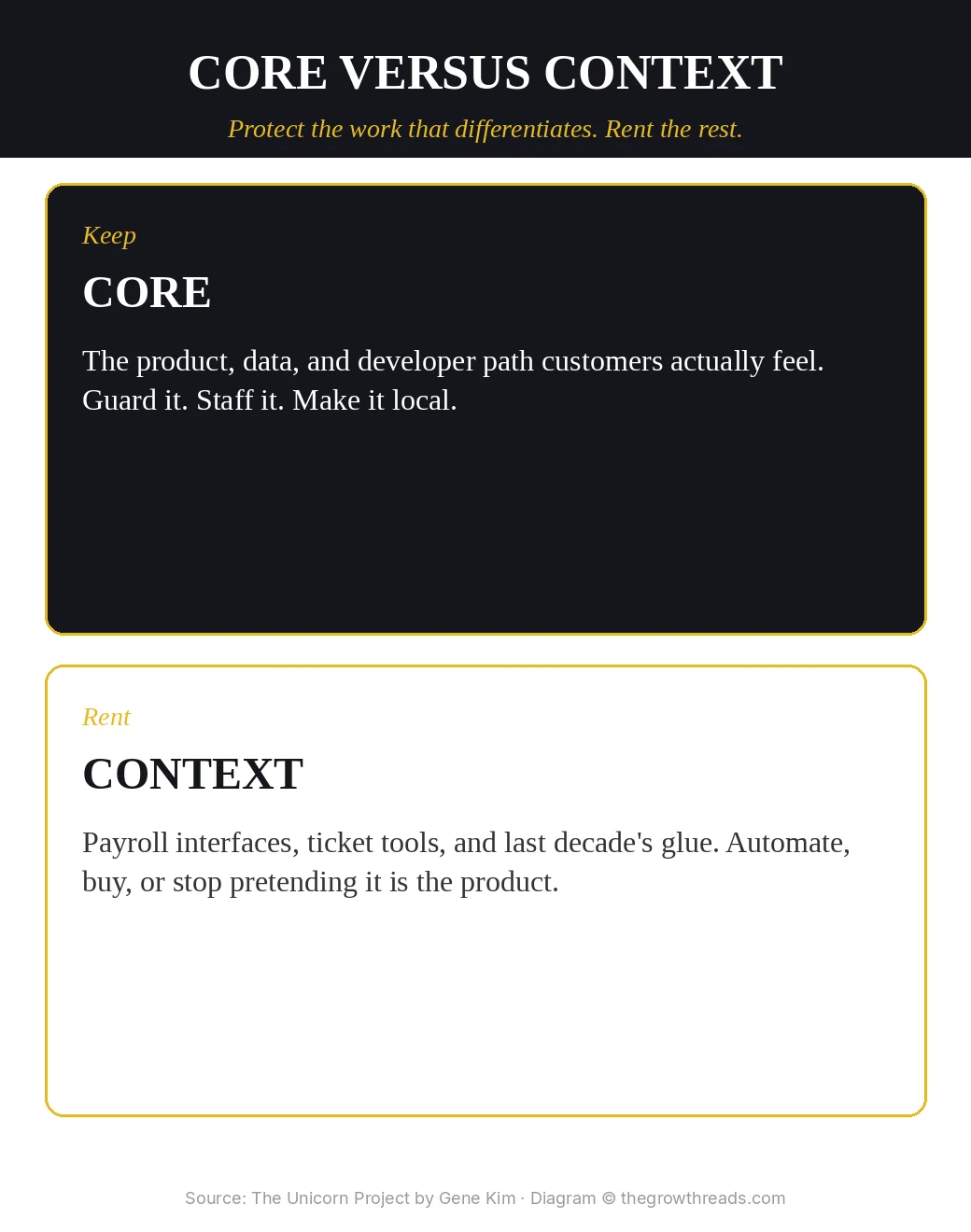
- Core vs context: protect the path customers feel; rent the glue that does not differentiate.
- Environments are the last mile: if production is a mystery, every release is a prayer.
- The queue is the outage: payroll failing was the symptom. The ticket culture was the disease.
- One local path beats a new process deck: collapse one dependency this week. Do not launch a transformation program.
What is The Unicorn Project about?
The Unicorn Project is Gene Kim’s developer-viewpoint novel of Parts Unlimited: Maxine is exiled to Phoenix, cannot run the system locally, and joins a Rebellion that replaces ticket culture with five ideals so a single change can be built, tested, and shown to a customer without a committee.
About the author
Gene Kim is a researcher and former Tripwire CTO who has spent two decades asking why some technology organizations ship while others live in war rooms. He co-wrote The Phoenix Project, later The DevOps Handbook, and helped stand up the DORA research that put deployment frequency and change-fail rate on executive dashboards. The Unicorn Project (IT Revolution, 2019) is the developer-side companion: same company, different chair. Maxine’s exile is how Kim lets you feel a ticket queue in your hands. Read Phoenix if you want the plant. Read this when the bottleneck is a laptop that cannot run the product. Explore all Gene Kim book summaries →
Key concepts at a glance
| Concept | What it means | Use it when |
|---|---|---|
| Five Ideals | Locality, flow, daily improvement, safety, customers — the Rebellion’s OS | The team has values posters and still files a ticket to compile |
| Locality and simplicity | One person can change, build, and see the result without a cast of thousands | A “small fix” needs three teams and a CAB date |
| Focus, flow, and joy | Work that can finish, in a stretch of unbroken attention | Everyone is busy and nothing ships |
| Improvement of daily work | Protect time to make tomorrow’s path shorter than today’s | The build, the data, or the environment is “someone else’s job” |
| Psychological safety | Bad news travels before the outage does | People wait to be asked, or they hide the red build |
| Customer focus | Value a user can feel, not a ticket state | The board hears “velocity” and customers hear silence |
| Core vs context | Guard the differentiating path; buy or automate the rest | Your best people are stuck on last decade’s glue |
| The Rebellion | A small group that makes one local path real instead of waiting for permission | The official program is a slide; the unofficial one actually compiles |
Part 1: Exile to Phoenix — the real outage is the queue
Maxine is very good at her job. That is why the exile stings. A payroll outage needs a villain, and a senior developer is an easy one. Kim’s joke is accurate: in a ticket culture, the people closest to the system are the ones you send away when it fails. You keep the process. You lose the understanding.
Phoenix is a desert because nothing is local. To change a line, Maxine needs an environment she cannot stand up, data she cannot see, and approvals from people who do not feel the wait. Compile is a request. Test is a request. By the time the change is allowed to exist, the original problem has grown a committee. Payroll failing is visible. A week to get a laptop-shaped copy of the product is invisible, so it becomes the water the company swims in. Heroes stay late. Tickets stay green. Customers still wait.
The practical translation is rude and useful. Pick one change that “should be small.” Write every handoff it needs before someone can say it worked. If that list has more names than the change has lines, you are already inside Phoenix. You do not need a new methodology. You need one path that does not start with a ticket.
TGR Note: The plant-floor companion is our The Phoenix Project summary. Bill learns the Three Ways — flow, then feedback, then continual learning. Maxine learns why those ways never start if a developer cannot run the system. Read Phoenix for the constraints. Read this for the laptop. Do not collect both as a way to delay timing your own local build.
Part 2: The Five Ideals — an operating system for builders
The Rebellion arrives with a code, not a canvas. Kim’s Five Ideals stay short on purpose. Locality and simplicity: change the thing without a cast of thousands. Focus, flow, and joy: the work can finish. Improvement of daily work: some of this week makes next week shorter. Psychological safety: tell the truth about the red build before it is a war room. Customer focus: a user can do something they could not do yesterday.
Nothing on the list is “more process.” The ideals are Tuesday tests. Can this team change the product without a meeting that exists to grant permission to compile? Can someone work ninety minutes without a ping that resets the stack? Did anyone spend time this week on the build or the data? Did bad news move faster than the outage? Did a customer feel it? Kim lets each ideal fail in the body first — Maxine cannot run Phoenix, cannot finish a thought, and watches improvement live on a slide — so the Rebellion is simply the group that stops treating those failures as personality.
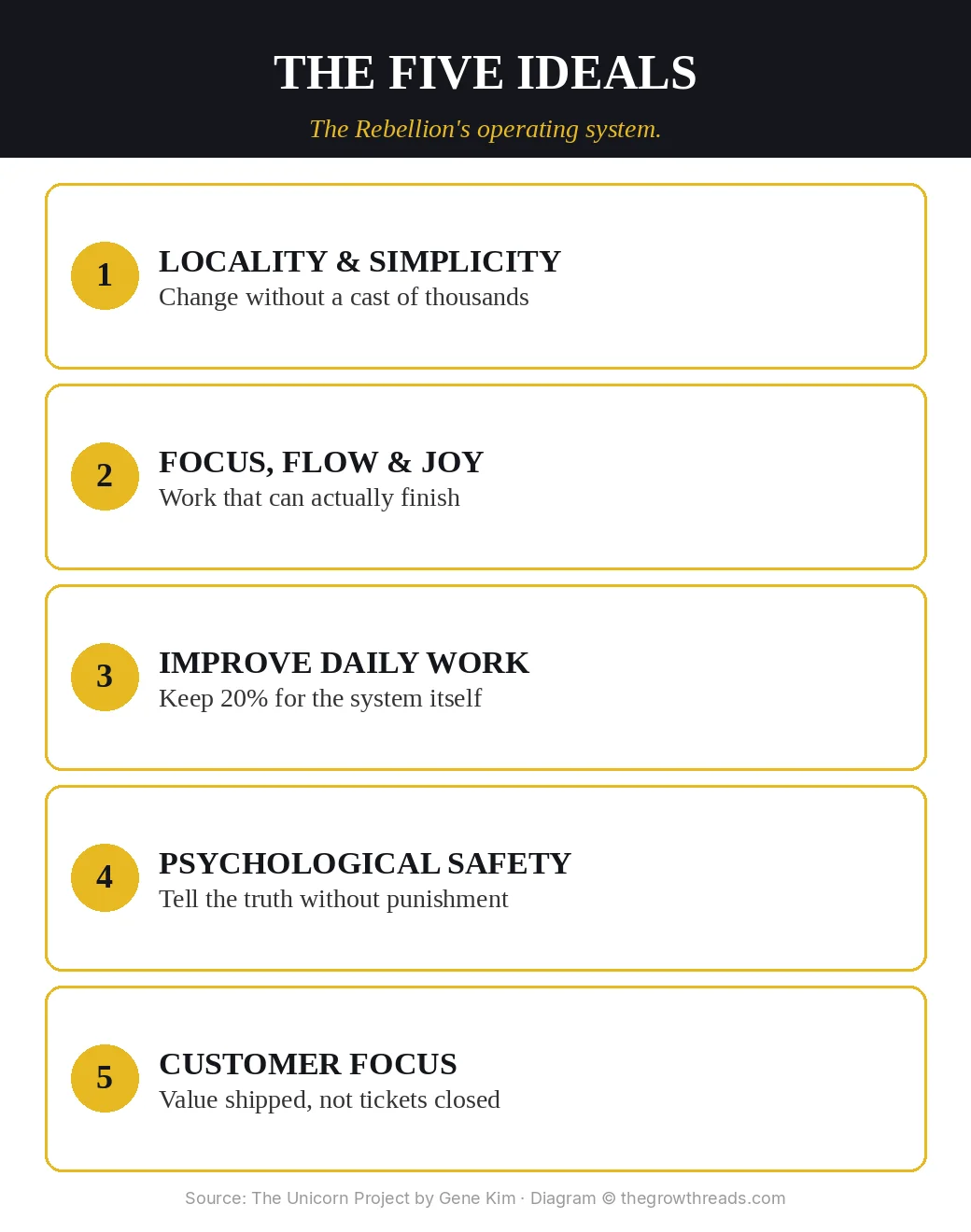
Application is smaller than the novel. Print the five as questions, not values. Put them on the team’s weekly review. If you cannot answer one of them with a time, a name, or a URL, that ideal is the week’s project. Do not launch all five. Locality is usually the bottleneck that makes the other four theoretical.
TGR Note: Kim is rewriting Goldratt for people who ship software. Our The Goal summary is the manufacturing original: find the constraint, subordinate everything else. In Unicorn the constraint is often the environment, not the coder. If you skip The Goal, still steal the move — do not optimize a stand-up while the laptop cannot run the product.
Part 3: Locality, environments, and the last mile
Locality is the novel’s engine: a gifted engineer who cannot exercise the system she is paid to change. Dependencies are not “collaboration.” They are the real architecture. If a feature needs a data team, an environment team, a change board, and a batch job whose owner left, you do not have a feature team. You have a relay race whose baton is a ticket.
Simplicity sits beside locality because complexity reproduces queues. The Rebellion’s answer is not a rewrite. It is one runnable slice: a production-like path on a laptop, shrunk data, stubbed edges. The point is a developer who can see a change before lunch. Kim also makes Moore’s core-versus-context split operational. Core is the path customers feel. Context is payroll glue and ticket tools. Companies fail both ways: they treat context as a heroic identity, or they outsource understanding of the core and then need a translator for every roadmap item.
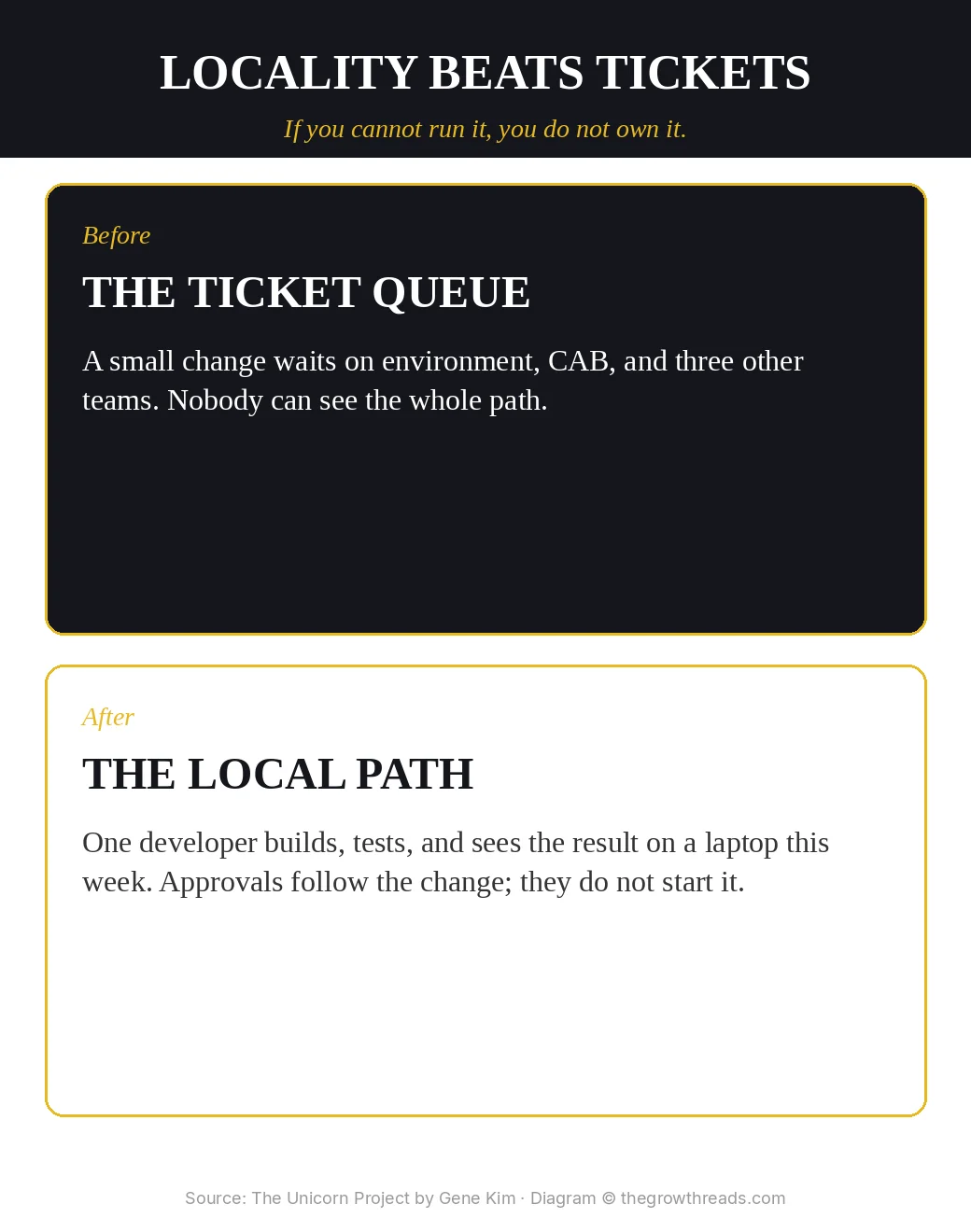
The last mile is environments and data. Executives buy platforms and still cannot answer “can a new person run this on day three?” If the answer is no, you do not have a developer-experience problem. You have a lead-time problem that shows up as missed quarters and quiet attrition. People leave because the work cannot start.
TGR Note: If your version of Phoenix is a calm company that still cannot ship, our It Doesn’t Have to Be Crazy at Work summary and Rework summary are the non-novel cousins: fewer queues, smaller batches, no hero theater. Kim gives you the DevOps plot. Fried and Hansson give you permission to stop adding process when the real fix is a shorter path.
Part 4: Safety, customers, and winning the week
Psychological safety here is not a workshop. It is whether Maxine can say “this will fail in payroll again” without becoming the next exile. A system that punishes messengers only hears good news, and good news cannot debug a batch job. Red builds, near-misses, and “I don’t know how this runs” are information. You cannot improve daily work if the daily truth is a career risk.
Customer focus keeps the other four ideals from becoming an internal hobby. A beautiful local environment that never changes what a user can do is still a queue. Kim’s rebels drag the work back to a person who is waiting. The Unicorn Project inside the novel is a bet that developers, business, and data can land one visible win faster than the old program can schedule a steering group.
Steal the sequence, not the office politics: one local path, one safe truth, one customer-visible slice, then another. That is how a Rebellion becomes a rhythm. The novel’s gift is a compile that belongs to the person who wrote the change. Keep that. Drop the vendettas.
Who is The Unicorn Project best for — and who should read something else first?
Read this if you ship software (or manage people who do) and a “small” change still needs a ticket, an environment, and a meeting. Staff engineers, eng managers, and product partners get language for a queue they already feel. The novel is a feature: you watch locality fail in a body, not a white paper.
Read something else first if you want the plant-floor Three Ways before the laptop — start with our Phoenix Project summary. Goldratt without DevOps furniture is The Goal. Execution without a parable is Making Ideas Happen. Calm operations more than build locality: Rework. If you already run the product on a laptop in minutes, steal the Five Ideals as a weekly review and skip the exile chapters.
Questions to reflect on
- How many names does a one-line change need before someone can say it worked?
- Can a new teammate get a local green build by day three — timed, not hoped?
- Which of the Five Ideals can you answer with a number this week, and which is a poster?
- What work is core (customers feel it) versus context (you are role-playing a vendor)?
- When was the last time bad news arrived before the outage, and what happened to the messenger?
🔥 Ready to unstick the build?
Get The Unicorn Project, then use the 7-day plan to give one change a local path.
How to apply The Unicorn Project (7-day plan)
- Day 1 — Name the small change. Pick one fix or slice a customer would notice. Write the handoff list it needs today. Circle every name that is not “the person doing the work.”
- Day 2 — Time the local build. Sit with one developer. Start the clock at a clean machine. Stop when they can run a test that represents the change. Write the number on the team channel. Do not argue with it.
- Day 3 — Kill one dependency. Choose the longest wait from Day 1 (environment, data, approval). Make a stub, a snapshot, or a written exception so that wait is not on the critical path this week.
- Day 4 — Protect daily improvement. Block 90 minutes for the path itself — scripts, seeds, docs — not a new feature. If the calendar refuses, you have found the real product.
- Day 5 — Tell one unsafe truth. In writing, name the thing everyone knows (the flaky job, the secret spreadsheet, the owner who left). No villain. One next check.
- Day 6 — Ship a customer-visible slice. Even if it is ugly. The ideal is not a perfect platform. It is a person who can do something new.
- Day 7 — Review the Five Ideals with times. Locality (the Day 2 number), flow (unbroken stretches), improvement (the 90 minutes), safety (whether Day 5 was punished), customer (whether Day 6 landed). Keep one metric. Drop four slogans.
Frequently asked questions
What is The Unicorn Project about in one paragraph?
The Unicorn Project is Gene Kim’s 2019 business novel — the book people mean when they search for a The Unicorn Project summary — told from the developer side of Parts Unlimited. After a payroll outage, senior engineer Maxine is exiled to Phoenix and cannot even get a local build. A Rebellion around her replaces ticket culture with five ideals: locality and simplicity; focus, flow, and joy; improvement of daily work; psychological safety; and customer focus. This TGR guide turns those ideals into a locality test you can time this week and a seven-day plan to unstick one real change without launching a transformation program.
Is The Unicorn Project still worth reading in 2026?
Yes, if your “small” change still waits on an environment, a data extract, or a committee. Cloud tickets and platform teams did not retire the plot; they often hid it behind a nicer portal. Kim’s laptop test still sorts companies: can one person run a production-like slice without a week of requests? The politics in the novel are dated in costume, not in incentive. If your team already deploys from a laptop in minutes, skim the Five Ideals as a weekly review and spend the hours on customer slices instead. If you cannot answer the laptop test with a number, the book is still a field manual, not nostalgia.
How is The Unicorn Project different from The Phoenix Project?
Same company, different chair. The Phoenix Project follows Bill on the plant floor through the Three Ways: flow of work, fast feedback, then continual learning. The Unicorn Project follows Maxine, a developer who cannot run Phoenix locally. You feel lead time in compiles and data, not in work-in-process on a factory board. Read Phoenix when the constraint is unplanned work and WIP. Read Unicorn when the constraint is locality — environments, coupling, and a ticket to do the job you were hired for. They are companions, not duplicates. If you only have time for one and you write code, start here.
What are the Five Ideals in The Unicorn Project?
Kim’s five: locality and simplicity (change without a cast of thousands); focus, flow, and joy (work that can finish); improvement of daily work (keep time for the path itself); psychological safety (truth without punishment); and customer focus (value a user can feel). They are tests, not posters. The first one is usually the bottleneck. If a developer cannot build and see a result, “flow” is a slogan and “customers” are a slide. Use them as five questions in a weekly review, each answered with a time, a name, or a URL. Retire any ideal you can only decorate.
Do I need to be a developer to use this book?
No. Product managers, data people, and eng managers are in the plot because they are in the queue. You need enough curiosity to sit through one timed local build and notice which names appear before a change can be seen. You do not need to write the code. You do need to stop treating environments as someone else’s personality. If you cannot get ninety minutes with a developer this week, read the Five Ideals, time one handoff list, and come back when you can watch a compile. The book is for people who can change the path, not only people who type it.
How long does it take to apply this without a DevOps budget?
A week of small sits beats a platform rewrite. Day 1–2 are diagnosis: one change, one timed local build. Day 3–4 remove one wait and protect ninety minutes for the path. Day 5–7 are truth, a customer-visible slice, and a five-question review. You do not need a new toolchain on day one. You need a number, a stub or snapshot, and a calendar block that is allowed to exist. If leadership will not protect the ninety minutes, the constraint is not Git. It is permission. Write that down. It is the same information Maxine gets when Phoenix will not run on her laptop.
Where should I start if I only have two hours?
Skip the office politics and run the laptop test. Pick one change. List every human it needs. Sit with someone who can type and time a local green build, even if you cheat with stubs. Two hours will not give you Unicorn’s ending. It will give you the number the novel is about. If that number is minutes, steal the Five Ideals as a review agenda. If it is days, the next meeting is not a stand-up. It is “what would make this number smaller by Friday.” That sentence is the book in working clothes.
Related summaries
- The Phoenix Project by Gene Kim, Kevin Behr & George Spafford
- The Goal by Eliyahu M. Goldratt
- Rework by Jason Fried & David Heinemeier Hansson
- Making Ideas Happen by Scott Belsky
- Best productivity books
How we analyze books: every book on The Growth Reads is read cover to cover, summarized in thousands of words of original analysis, and rated against our five-criteria rubric (lasting impact, evidence quality, practical application, writing & originality, external consensus). Read our full methodology.