

★★★★☆ 4.4/5 — a field manual for people whose piles are leaking into the workday.
Best for: anyone whose desk, closet, or kitchen counter is a stack of decisions they keep walking past
Reading time: ~5 hrs (240 pages) · this guide ~12 min
Difficulty to apply: Easy — the hard part is choosing, not folding
Outer Order, Inner Calm in one minute
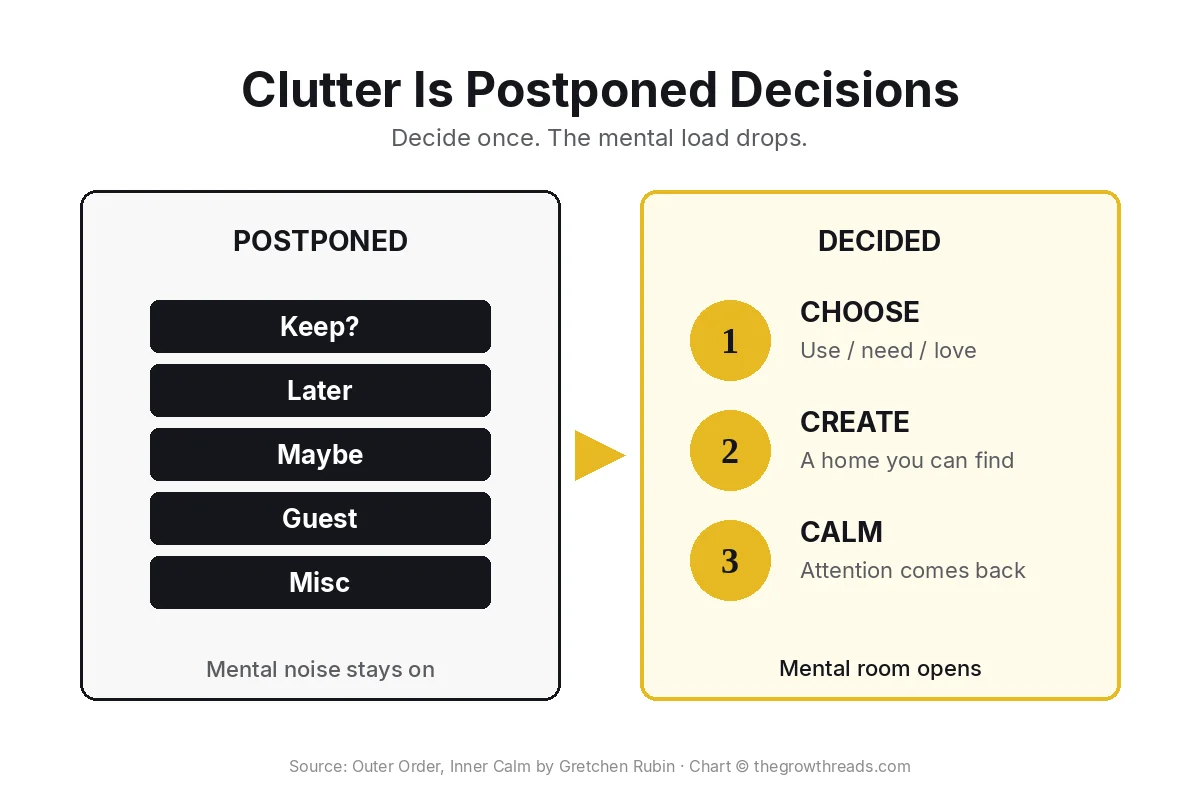
Your piles are not a storage problem. They are a decision problem. Gretchen Rubin’s Outer Order, Inner Calm is a 240-page illustrated field manual, not a religion of empty shelves. For many people, outer order contributes to inner calm because clutter is postponed choice: keep, toss, give, or wait. Each unmade choice sits in the room and in the mind. This Outer Order Inner Calm summary is for the person who buys another bin instead of answering the question. Decide what stays. Give it a home you can actually find. Keep the room with tiny resets, not a heroic weekend.
Rubin is honest about the caveat. Not everyone is soothed by a clear counter. She is writing for the rest of us — the ones who lose twenty minutes hunting a charger, then call themselves unproductive. Happiness, in her research, is not a mood you wait for. It is a set of conditions you can arrange. The apartment is one of those conditions.
Key takeaways
- Outer order contributes to inner calm: a clear surface returns attention. For many people that is cognitive relief, not vanity.
- Clutter is postponed decisions: the pile is a maybe. Maybes are expensive.
- Do not aim for minimalism: keep what you use, need, or love. Empty is not the goal.
- Do not organize first: arranging junk is still junk. Choose, then create order.
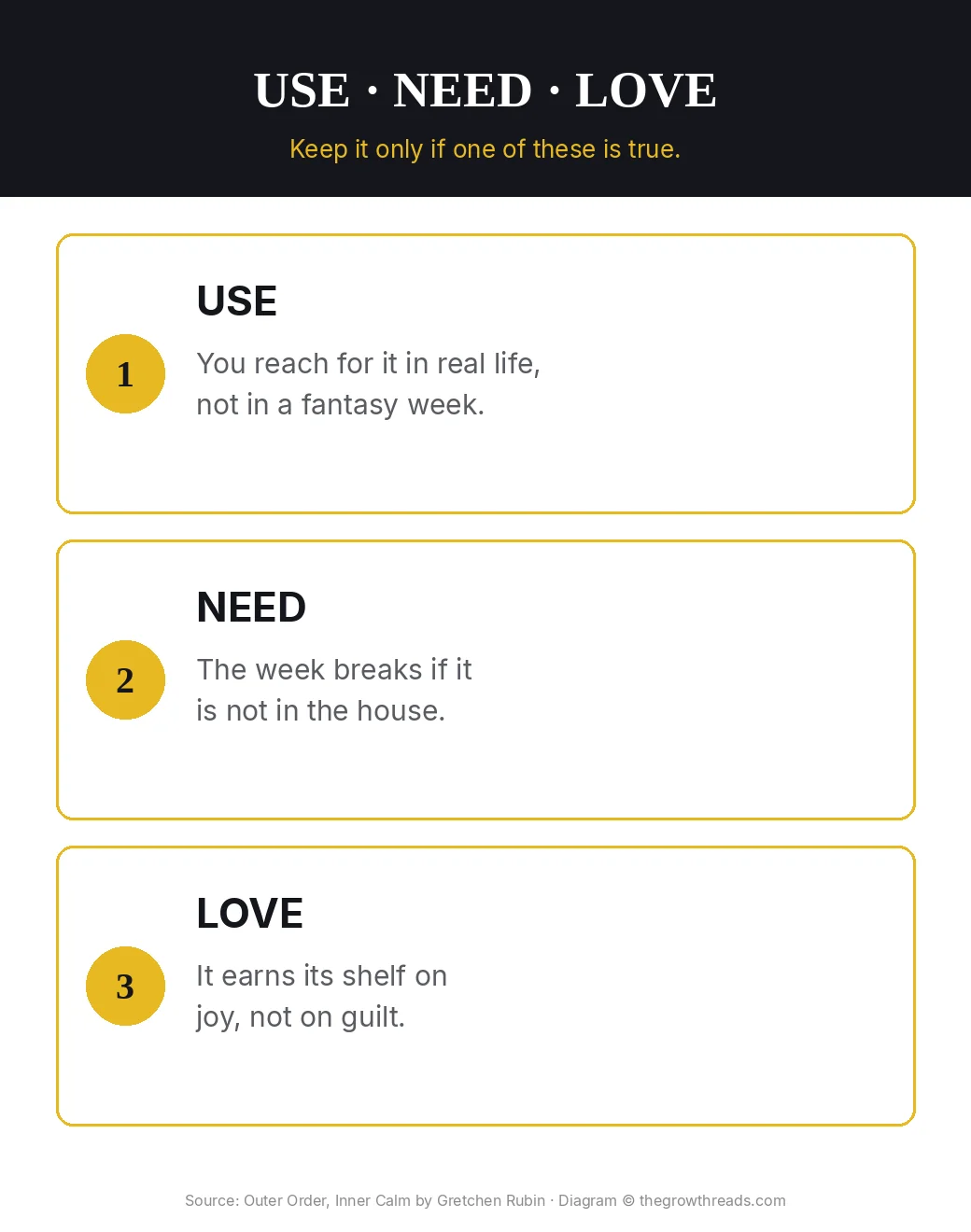
- Use / need / love: if none of the three is true, it is occupying a vote you have not cast.
- If you cannot retrieve it, you will not use it: a home that takes three boxes to open is a grave.
- Never label anything miscellaneous: that word is how decisions go to die.
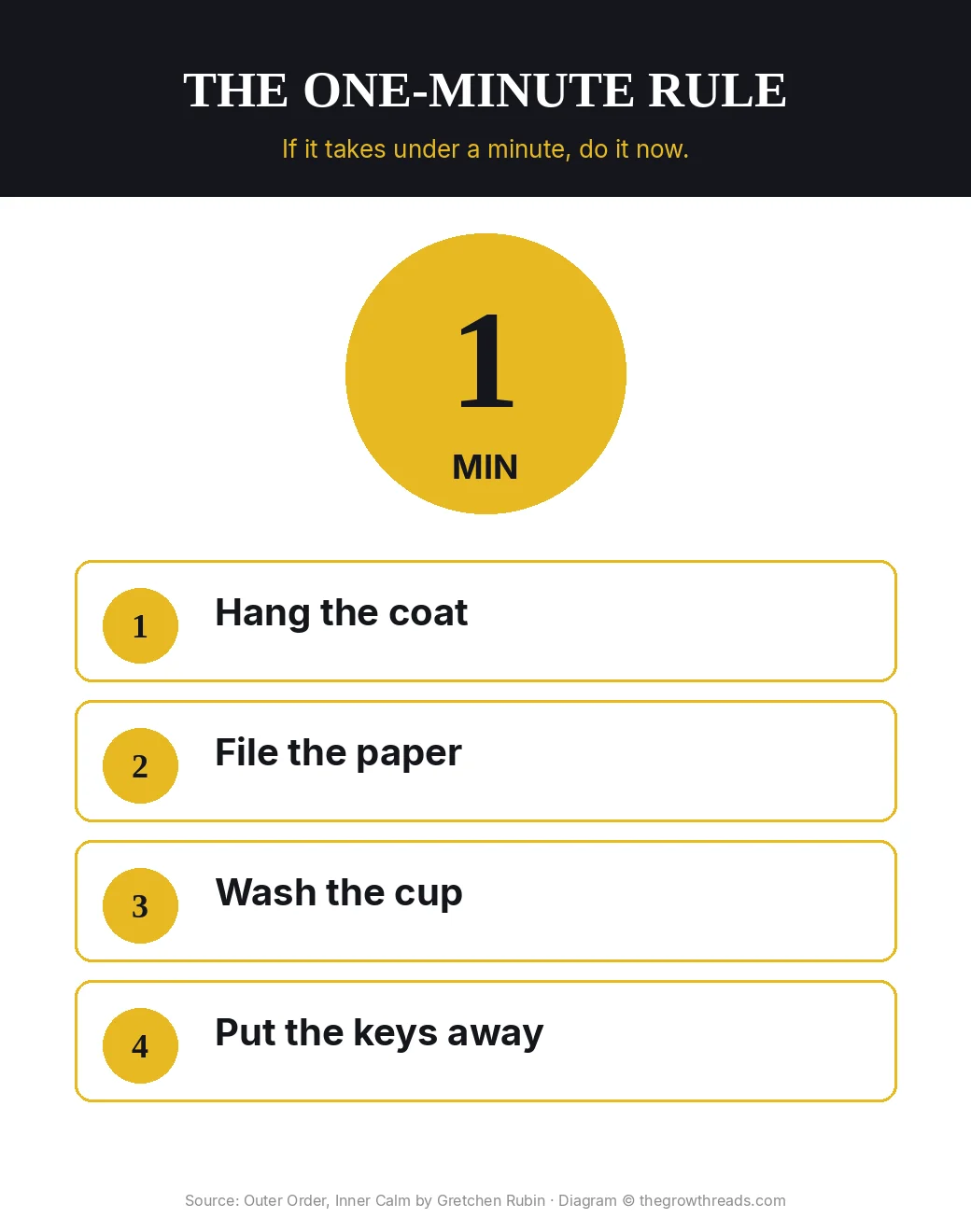
- The one-minute rule: if it takes under a minute, do it now. Coats, cups, papers, keys.
- Beware procrasticlearing: wiping a counter to avoid the real task is still avoidance.
- Know yourself: the same tidy system fails Upholders, Questioners, Obligers, and Rebels for different reasons.
What is Outer Order, Inner Calm about?
Outer Order, Inner Calm is Gretchen Rubin’s 2019 guide to clearing stuff so attention comes back. She treats clutter as postponed decisions, uses a use / need / love filter instead of a purge religion, and keeps the room with tiny habits like the one-minute rule. More room for happiness, not a perfect closet.
About the author
Gretchen Rubin trained as a lawyer — Yale College, Yale Law, a clerkship for Justice Sandra Day O’Connor — then left the path because she wanted to write. The Happiness Project made the experiment public: a year of concrete resolutions instead of waiting to feel different. Better Than Before and The Four Tendencies turned the same research toward habits. Outer Order, Inner Calm (2019, Harmony) is the environment lever of that work. She co-hosts the Happier podcast from New York. She is not a professional organizer. She is a happiness researcher who noticed that a clear surface changed the next hour. Explore all Gretchen Rubin book summaries →
Key concepts at a glance
| Concept | What it means | Use it when |
|---|---|---|
| Outer order → inner calm | A usable room returns attention. Not everyone needs this; many people do. | You lose the morning to hunting, then call it a focus problem. |
| Postponed decisions | A pile is a maybe. Maybes occupy mind and shelf. | You keep a “later” stack that is older than the project. |
| Use / need / love | Keep only if one of the three is true. Guilt is not love. | You are keeping a gift, a size, or a fantasy week. |
| Don’t organize first | Bins do not decide. Choose, then give keepers a home. | You are shopping for containers before you have culled. |
| Retrieve or you won’t use it | A home that takes a ladder and three lids is a grave. | You own the tool and still buy it again. |
| No miscellaneous | That label is how decisions disappear. | The junk drawer is a second, smaller apartment. |
| One-minute rule | If it takes under a minute, do it now. | The chair is a coat rack and the sink is a waiting room. |
| Procrasticlearing | Cleaning as a way to avoid the real task. | The desk is gleaming and the draft is still closed. |
Part 1: Why a clear room changes the next hour
Rubin opens with a claim she has tested on herself and on readers for years: for some people, outer order contributes to inner calm. She does not say it is a moral law. She says it is a pattern. When the visual field is a stack of unmade choices, the nervous system stays slightly on call. You walk into the kitchen and the counter asks a question. You sit at the desk and the pile asks another. None of those questions is the work. They still collect a tax.
The tax shows up as small losses. You cannot start the report until you find the charger. You skip a walk because the shoes are in a maybe-donate bag. Rubin treats those frictions as design, not character. If the room is fighting you, willpower is the wrong lever. Give one surface a job: this counter is for cooking, this desk is for the draft, this chair is for sitting.
She is careful about who this is not for. Some people think in a beautiful mess. The book is a permission slip for the rest of us: you can want a clear field of view without becoming a minimalist. Empty is not the point. Usable is. Creative work needs a place that does not tap you on the shoulder.
The rest of the book is how to make that sentence true on a Tuesday. Clear the postponed decisions. Watch the hour that follows.
TGR Note. Rubin already ran the year-of-resolutions version of this idea in The Happiness Project — environment as a happiness lever, not a mood you wait for. If the missing piece is the habit engine rather than the room, Better Than Before is the companion. This book is the apartment-sized slice: one surface, one decision, a quieter next hour.
Part 2: Choose — clutter is a maybe pile
The hardest move in the book is not folding. It is answering. Rubin’s definition is blunt: clutter is postponed decisions. The sweater that might fit later. The cables for a device you do not own. The gift you will not give away because the giver might visit. Each item is a question you walked past.
Her filter is three words, not a feeling. Use it in real life, not in a fantasy week. Need it because the week actually breaks without it. Love it enough that it earns the shelf on joy, not on guilt. If none of the three is true, the item is occupying a vote. You can donate, trash, or give it a deadline. What you cannot do, in her view, is keep “deciding later” as a lifestyle. Later is how the chair becomes a closet.
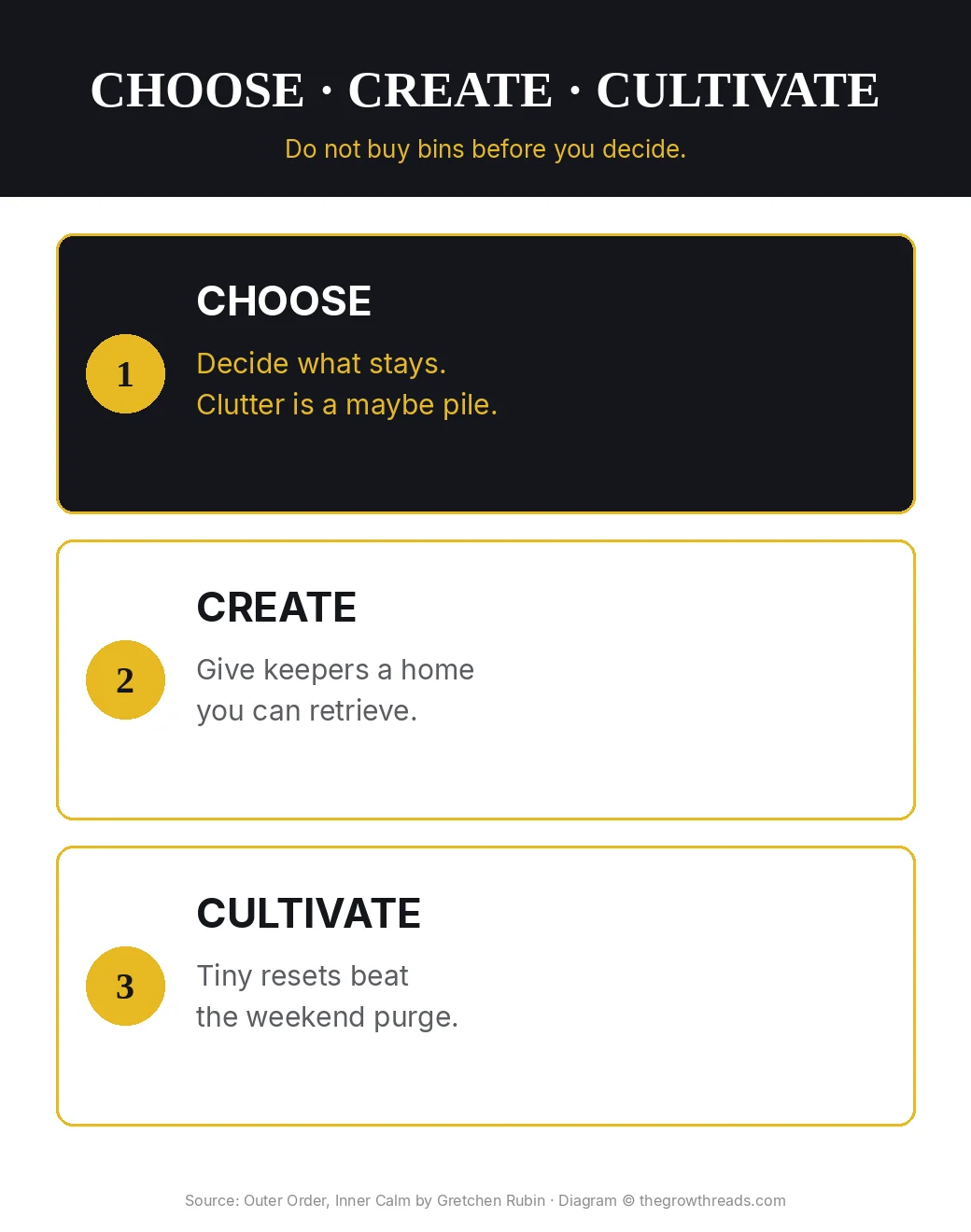
This is where she parts ways with purge-as-identity. Do not aim for minimalism. A house with the books you reread and the mug you like is allowed to look inhabited. The enemy is not possession. The enemy is ambiguity. A full shelf you open is order. A full shelf you “should” have read is clutter with a nicer spine. Buying a beautiful bin before you have chosen only puts a lid on the question. Choose first. Then create a home for what survived.
TGR Note. If you want a single dramatic purge with a joy test, that is The Life-Changing Magic of Tidying Up and the illustrated sequel Spark Joy. Rubin is milder and more stubborn about fit: keep what you use, including the ugly charger. KonMari asks whether it sparks joy. Rubin asks whether it has a job. Use both only if you like having two maps. Do not run both in the same drawer in the same hour.
Part 3: Create order you can actually retrieve
Once you have chosen, the remaining stuff still needs a home a tired person can use. Rubin’s test is retrieval. If you cannot get the item without moving three boxes, you will not use it. You will buy a second one. That is how clutter reproduces. Homes should match how you move: keys by the door you use, chargers on the desk where the laptop lives. She is allergic to miscellaneous. That label is a junk drawer with better manners. If a category cannot be named, it is several postponed decisions sharing a box.
Children’s stuff gets a current-interest rule: keep what they use, not the identity you hoped they would keep. Guest-only objects are often guilt in fabric form. Clothes should fit the body you have this season. Name the home, put the thing there, stop inventing a second home “for now.” Four named homes that work beat a catalog of systems you maintain instead of living. The room should disappear as a problem so the next hour can be the work.
TGR Note. Environment as a habit lever is the same idea Atomic Habits uses when Clear puts the guitar on a stand. Rubin is applying it to domestic friction. If the clutter is tabs, inboxes, and a second phone, Digital Minimalism is the parallel book for the screen. One surface in the room, one surface on the device. Do not clean both as a way to skip the draft.
Part 4: Cultivate — tiny resets, not a heroic weekend
Choosing once does not keep a room. Rubin’s maintenance is deliberately small. The one-minute rule is the headline: if a task takes under a minute, do it now. Hang the coat. File the paper. Wash the cup. Put the keys away. The rule is not about becoming a person who loves chores. It is about stopping the maybe pile from restarting by dinner.
An evening ten-minute reset on one surface beats the fantasy of a Saturday purge that never starts. Restore the kitchen counter every night rather than redesign the pantry twice a year. Close the desk by putting the live pile into a named home and leaving a clear rectangle for tomorrow’s first task.
Procrasticlearing is cleaning to avoid the work. A gleaming desk with an unopened draft is still avoidance. Outer order should serve the next hour, not replace it. Self-knowledge closes the loop. Upholders will follow a reset they wrote down. Questioners need a why. Obligers need outer accountability or day three dies. Rebels need identity (“I don’t live in a pile”), not a commandment. A system that ignores the Tendency is just another bin.
Who is Outer Order, Inner Calm best for — and who should read something else first?
Best for people whose workday is leaking into hunting: the charger, the form, the shoes. It is also a good fit if KonMari felt like a personality transplant and you still wanted a milder, use-based filter. Parents drowning in outgrown stuff, and anyone who keeps buying organizers instead of answering, will recognize the first twenty pages.
Read something else first if the real problem is the habit engine, not the room: start with Better Than Before or Atomic Habits. If you want one dramatic joy-based purge, start with Tidying Up. If the mess is digital, start with Digital Minimalism. If you already love a productive wreck and a clear counter would raise your pulse, this book is not the medicine — skip it without guilt. Rubin said not everyone needs this. Believe her.
Questions to reflect on
- Which pile in your life is a postponed decision, not a storage problem?
- If you moved in thirty days, what would you actually take from this room?
- Where do you “procrasticlear” instead of opening the real task?
- What one-minute action have you walked past three times today?
- Which single surface, if cleared tonight, would change tomorrow’s first hour?
🔥 Ready to clear one surface this week?
Decide what stays. The calm shows up after the decision, not before.
How to apply Outer Order, Inner Calm (7-day plan)
- Day 1 — Pick one surface. Photograph it. Write, in one sentence, the job of that surface. If you cannot name the job, the surface is still a maybe.
- Day 2 — Choose with three words. For every item on that surface, answer use, need, or love. Bag the rest the same day. Do not buy a bin.
- Day 3 — Install the one-minute rule. For twenty-four hours, anything under a minute gets done at the moment you notice it. Tally how many walk-pasts you catch.
- Day 4 — Kill miscellaneous. Open the junk drawer or “misc” box tied to that room. Name each cluster or let it go. No leftover category called leftover.
- Day 5 — The retrieve test. Put keepers in a home you can reach in thirty seconds. If it takes a ladder or three lids, it is not a home.
- Day 6 — Ten-minute evening reset. Restore that one surface before you sleep. Set a timer. When it rings, stop. Heroic extra credit is how this dies.
- Day 7 — Review, don’t shop. Look at yesterday’s photo. What did you actually miss? Write one rule you will keep next week. Do not celebrate by buying organizers.
Frequently asked questions
What is Outer Order, Inner Calm about?
Outer Order, Inner Calm is Gretchen Rubin’s 2019 illustrated guide to clearing stuff so your attention comes back. She argues that for many people, outer order contributes to inner calm because clutter is usually a pile of decisions you have not made. The book is a field manual of short tactics, not a one-method religion. You choose what stays with a use / need / love filter, give keepers a home you can actually retrieve, then keep the room with tiny habits like the one-minute rule. It is happiness research applied to drawers, desks, and the coat on the chair.
Is this just another KonMari or Tidying Up book?
No. Marie Kondo asks whether an item sparks joy and wants a full-category purge. Rubin asks whether you use it, need it, or love it, and she tells you not to aim for minimalism. An ugly charger you reach for every day stays. A beautiful object you feel guilty about can go. The Growth Reads already has Tidying Up and Spark Joy; they are different maps. Use KonMari for a dramatic reset. Use Rubin for a milder filter that still ends the maybe pile. Do not run both tests on the same drawer in the same hour.
What is the one-minute rule in Outer Order, Inner Calm?
If a task takes less than a minute, do it at the moment you notice it. Hang the coat. File the paper. Wash the cup. Put the keys on their hook. Rubin is not trying to turn you into a person who loves chores. She is trying to stop the maybe pile from restarting by dinner. Unmade one-minute tasks are how a chair becomes a closet and a sink becomes a waiting room. Pair the rule with a ten-minute evening reset on one surface. The combination is small on purpose. Heroic weekend purges fail because they require a personality you only have on Saturday mornings that never arrive.
Who should read Outer Order, Inner Calm?
Read it if your workday is leaking into hunting — charger, form, shoes — and you keep buying bins instead of answering. It is a good fit if a KonMari-level identity change felt like too much and you still wanted a use-based filter. Skip it, with Rubin’s blessing, if you already think well in a productive wreck and a clear counter would raise your pulse. If the real problem is the habit engine rather than the room, start with Better Than Before or Atomic Habits. If the mess is tabs and inboxes, start with Digital Minimalism. The book is for friction in physical space, not for every kind of stuck.
How is this different from The Happiness Project?
The Happiness Project is Rubin’s year of monthly resolutions — a memoir-meets-experiment about becoming happier on purpose. Outer Order, Inner Calm is the environment slice of that research, published later as a short illustrated manual. You do not need the year-long project to use the one-minute rule. You also do not need this book to run a happiness project. They share an author and a belief that conditions beat moods. They do not share a structure. If you want the big experiment, start with The Happiness Project. If you want the room to stop tapping you on the shoulder this week, start here and clear one surface.
Does outer order actually make you more productive?
For many people, yes — not because a tidy desk is a virtue, but because unmade choices collect a tax. Rubin’s claim is narrower than a slogan. A clear surface returns attention to the next hour. You spend less time hunting and less time answering the pile with your eyes. That is not a new time-blocking system. It is a way to stop leaking minutes into friction. Some people are more productive in a mess. She says so. If you are not one of them, treating clutter as postponed decisions is practical: decide once, then do the work instead of managing the maybe pile.
How long does it take to apply Outer Order, Inner Calm?
You can apply the core in a week if you pick one surface and refuse to expand the project. Day one names the job of the surface. Day two chooses with use / need / love. The next days install the one-minute rule, kill miscellaneous, test retrieval, and run a ten-minute evening reset. Day seven reviews the before photo and writes one rule — no shopping. The 240-page book is a menu of tactics, not a twelve-week course. Reading it takes a few evenings. The work is the daily minute, not a personality reboot. Do the whole apartment at once and you will buy a bin and call it progress.
Related summaries
- The Happiness Project — treat happiness as a project
- Better Than Before — design the habit for your Tendency
- The Life-Changing Magic of Tidying Up — the joy-test purge
- Spark Joy — the illustrated KonMari sequel
- Best productivity books — the full TGR pillar
How we analyze books: we reconstruct the argument, add original application notes, and skip chapter-by-chapter reproduction. Read our full methodology.