

★★★★☆ 4.4/5 — The illustrated KonMari field manual: keep the lift, thank the rest, give every item a home.
Best for: people who believe in sparking joy and still have a chair that eats clothes.
Reading time: ~6 hours (304 pages) · this guide ~12 min
Difficulty to apply: Medium. The first clothing pile is emotional. The method is simple.
Spark Joy in one minute
If it does not spark joy, thank it and let it go. If it does, give it a home. Spark Joy is Marie Kondo’s illustrated master class on the KonMari method — the companion to The Life-Changing Magic of Tidying Up. The first book told you to tidy once, by category, and keep only what lifts. This one shows the hands: how to fold a shirt so it stands, how to empty a kitchen drawer, how to store bags inside bags, and why sentimental items wait until last.
Write the life you want. Pile one category. Hold each item. Keep the lift. Thank the rest. Fold what remains so you can see it. Then stop buying bins until the festival is over.
Key takeaways
- Joy is a body check: Hold the item. Keep the lift. Thank the flat feeling. Guilt is not a storage plan.
- Write the life first: “A clean house” is too vague. Name the morning you want before you touch a drawer.
- Discard before you organize: Bins bought too early just file the overflow in prettier boxes.
- Category, not room: All clothes, then all books. Room-by-room tidying never finishes the same shirt.
- Clothes train the sense: Fabric is the easiest joy to feel. That is why the order starts there.
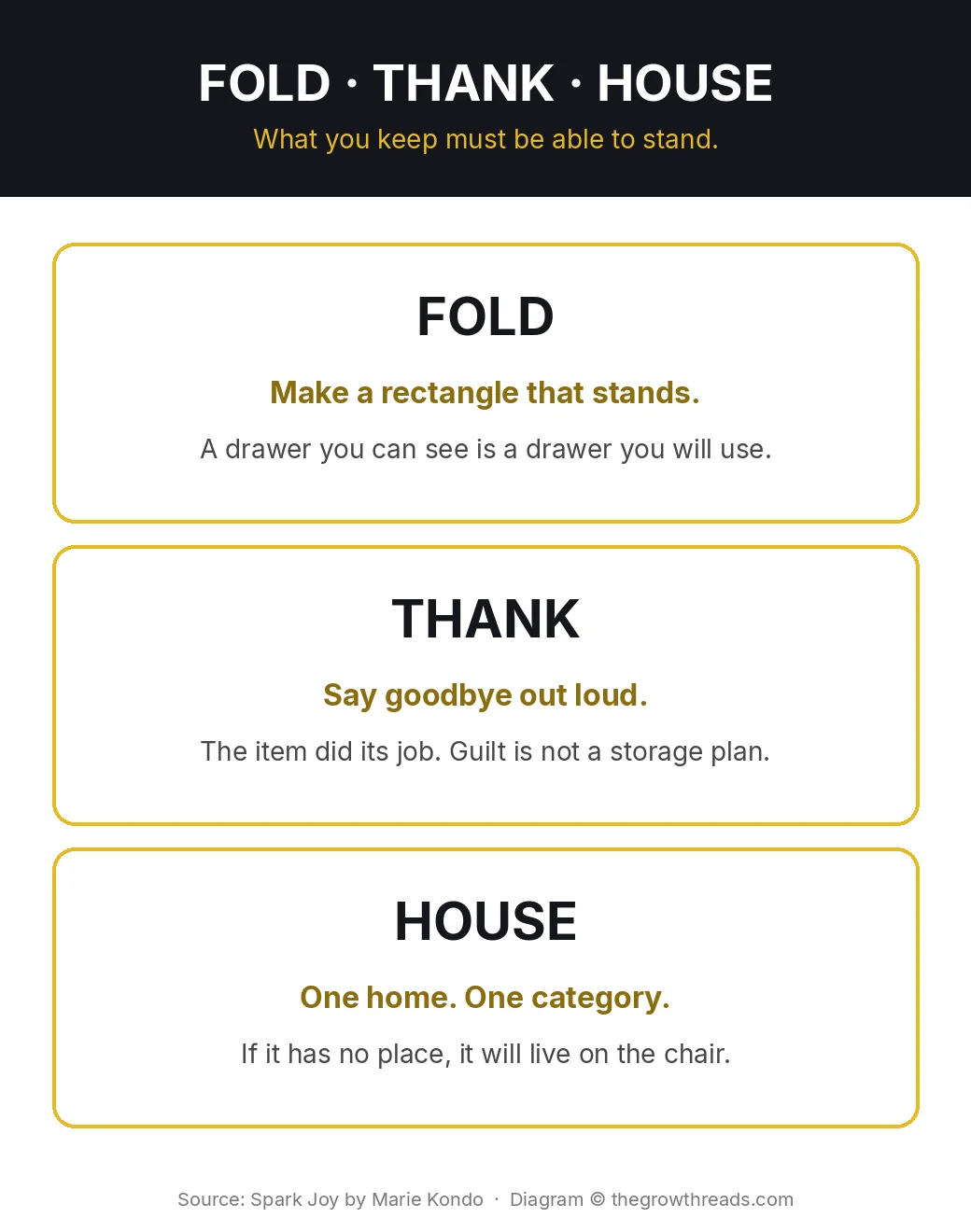
- Fold to stand: A drawer you can see is a drawer you will use. Hidden layers are a second closet.
- Komono is the long middle: Kitchen, bath, tools, hobbies. This is where the illustrated pages earn their keep.
- Sentimental last: Letters and photos wait until your joy sense is calibrated. Do not start with the childhood box.
- One home per item: If it has no place, it will live on the chair. Storage is an address, not a personality.
What is Spark Joy about?
Spark Joy is Marie Kondo’s illustrated KonMari master class. You write the life you want, then tidy by category — clothes first, sentimental last — keep only what sparks joy, fold it so it stands, and give every item one home.
About the author
Marie Kondo grew up in Tokyo folding her family’s clothes and, by nineteen, was taking paid tidying clients while still a student. The Life-Changing Magic of Tidying Up (2011 in Japan, 2014 in English) turned her KonMari method into a global phrase: keep only what sparks joy. Netflix’s Tidying Up with Marie Kondo put the clothing pile on living-room floors worldwide. Spark Joy (2016) is the illustrated field manual that followed — folding diagrams, komono maps, and the storage rules people asked for once they had the philosophy but not the hands. She later applied the same filter to desks and inboxes in Joy at Work with Scott Sonenshein. TIME named her one of the world’s most influential people. The useful fact for readers: she is a working tidying consultant first, a writer second. Explore all Marie Kondo book summaries →
Key concepts at a glance
| Concept | What it means | Use it when |
|---|---|---|
| Spark joy | A body check: keep the lift, thank the rest. | You are keeping things because they were expensive or gifted. |
| Ideal lifestyle | A written picture of the morning you want. | You start tidying with no destination. |
| Tidying festival | One complete pass, not a weekly reset forever. | You “tidy” every Sunday and the chair refills by Wednesday. |
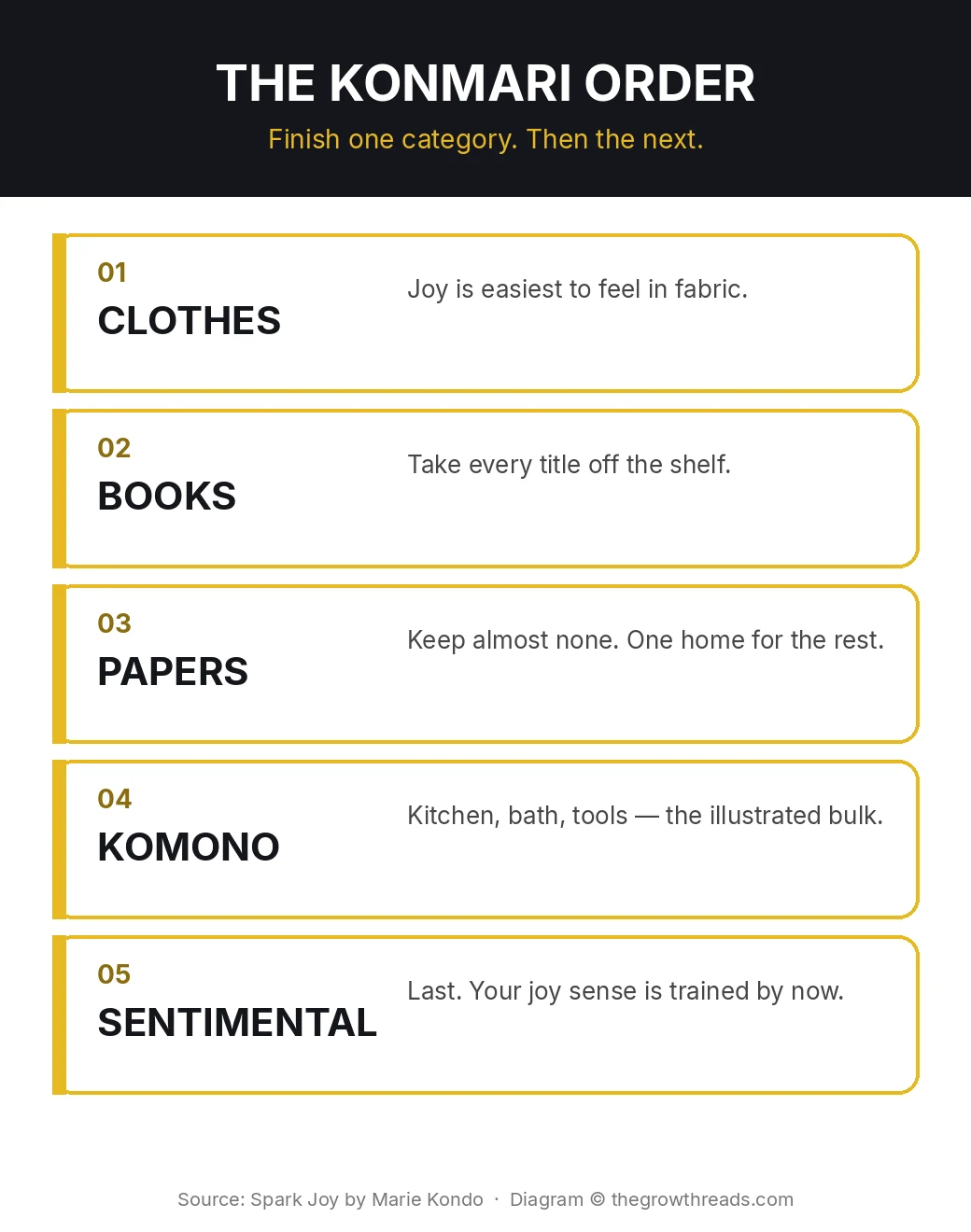
| Category order | Clothes → books → papers → komono → sentimental. | You keep starting in the spare room and never finish shirts. |
| Vertical fold | A standing rectangle so every item is visible. | Drawers are excavations. You forget what you own. |
| Komono | Everything that is not clothes, books, papers, or mementos. | The kitchen and the junk drawer feel endless. |
| Click point | After enough checks, joy is instant, not a debate. | Every object turns into a twenty-minute argument. |
| A home | One address per item, one category per place. | The same charger lives in four rooms and none of them. |
Part 1: The joy check and the six rules
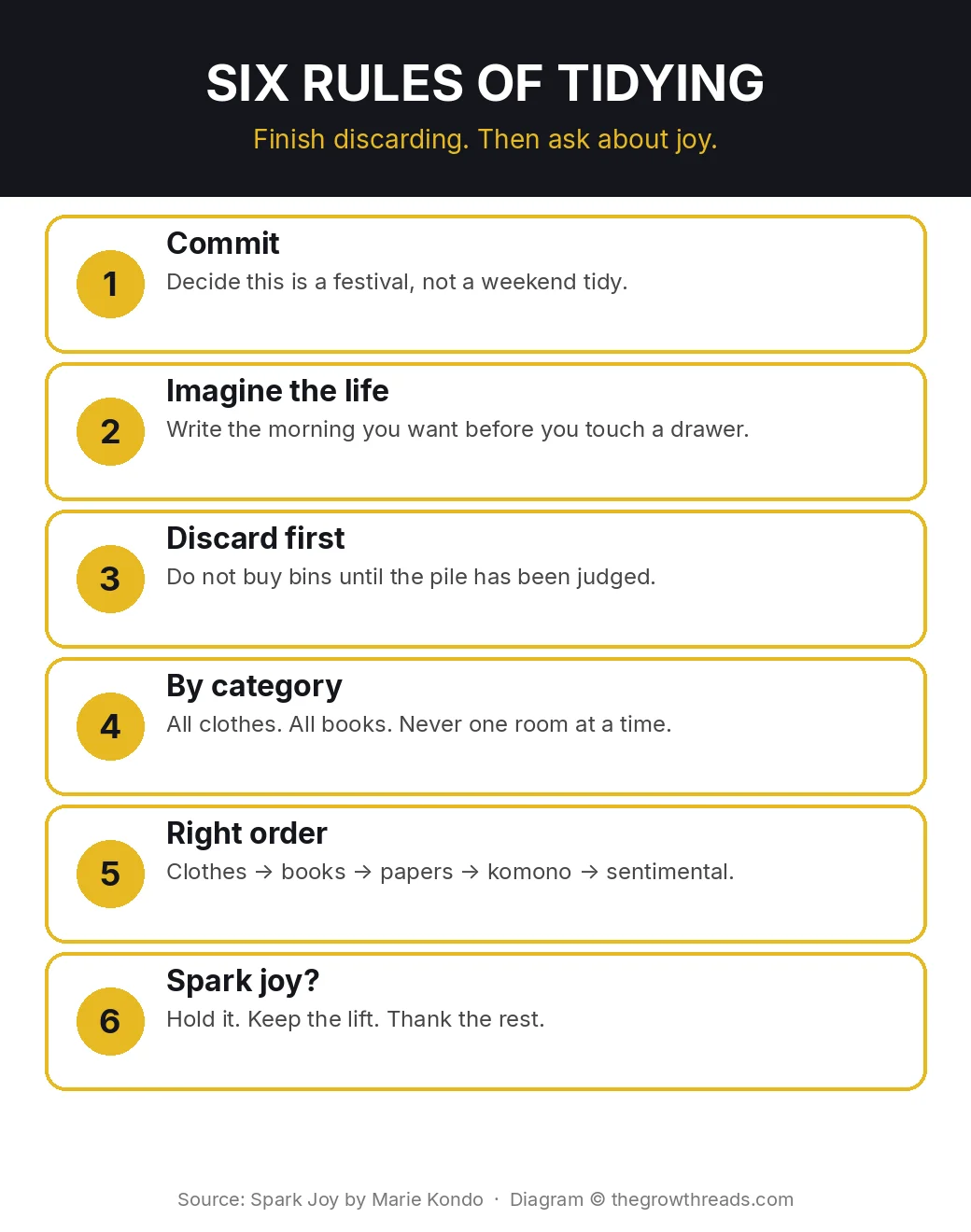
Kondo’s clients did not fail because they were messy people. They failed because they tidied a room. The same category lives in three places, so the shirt you “finished” in the bedroom is still waiting in the laundry and the hall. Room-by-room tidying is a loop that looks like progress and never quite ends. Spark Joy restates the fix as six rules, then draws them. Commit to a festival, not a mood. Write the life you want — coffee in a clear kitchen, a closet you can see — before you touch a drawer. Finish discarding before you buy a bin. Tidy by category. Follow the order. Ask, of each object, whether it sparks joy.
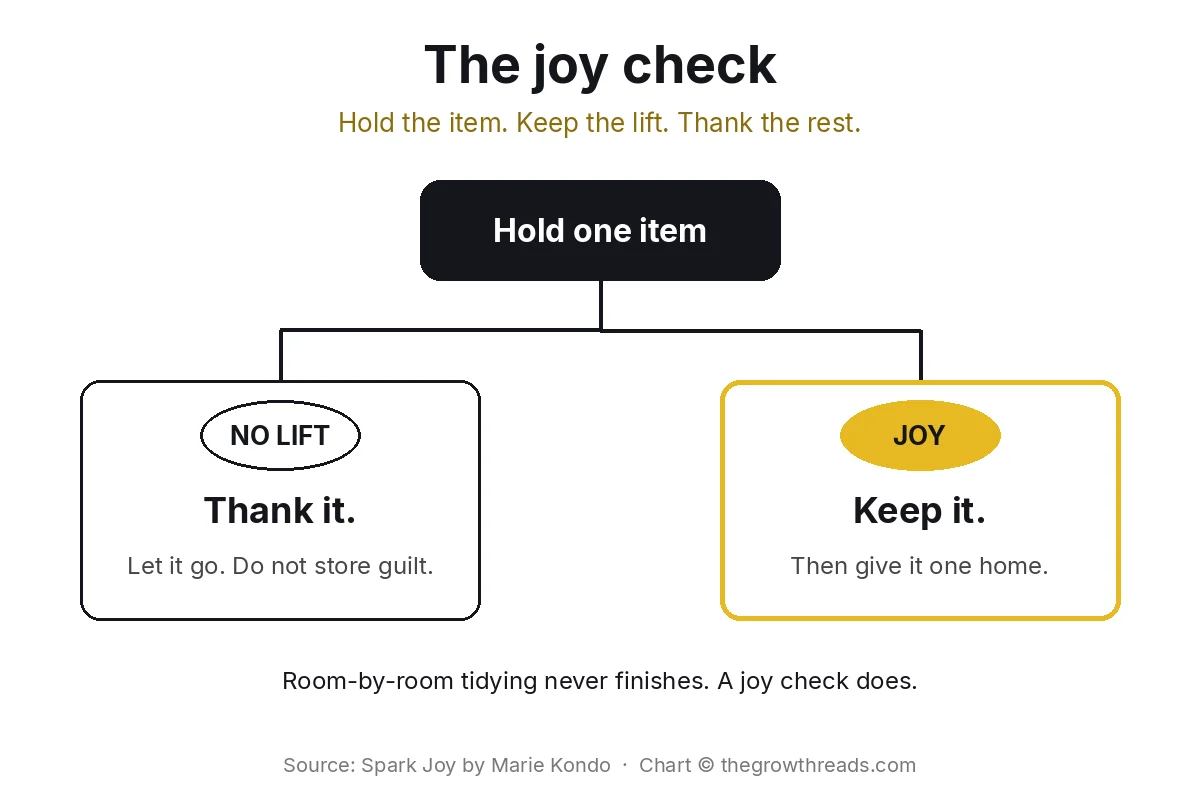
The joy check is the part people quote and the part they skip. You hold the item. You notice a lift or a flatness. The lift is keep. The flat is thank-and-let-go. It is not the same as useful, expensive, or given by someone you love. Kondo’s Shinto-inflected thank-you is a way to end the guilt story so the object can leave. After enough checks you reach what she calls a click point: you know in a second. That is the skill the rest of the book is training.
TGR Note: The conversion story still lives in The Life-Changing Magic of Tidying Up. Spark Joy is the how. If you want the same “less but better” filter without talking to your socks, Essentialism is the calendar version of a joy check. The Power of Less is the constraints version.
Part 2: Clothes, books, and papers
Clothes come first because joy is easiest to feel in fabric. You take every garment you own and put it on the floor. That pile is the point. You cannot decide about a sweater while it is still hanging next to its cousins. Hold each piece. Keep the lift. Fold what remains into a standing rectangle so the drawer opens like a file, not a compost heap. Hanging pieces run from heavy and long to light and short. The line should rise. You should see every shirt you kept. A hidden layer is a second closet you will not use.
Books come off the shelf. Unread titles that you “should” finish do not get a free pass. If a book does not spark joy now, it is not a better person later — it is furniture. Papers are the most extreme chapter. Kondo’s working rule is to keep almost none: a tiny pending pile, a tiny must-keep pile (contracts, records), and nothing that is “just in case.” One home for what remains. The paper pile is where people stall because paper feels like homework. It is still a category. Finish it before you open the kitchen.
TGR Note: Folding until the drawer is visible is a habit of environment design, the same family as Atomic Habits. If the first shirt feels too big, shrink the start with Tiny Habits — one drawer, one evening — then return to the festival. Do not turn Spark Joy into a forever Sunday chore.
Part 3: Komono — the illustrated master class
Komono is Japanese for miscellaneous, and it is most of the house: kitchen tools, bathroom bottles, cables, spare buttons, hobby supplies, linen, the garage. This is the section the first book could not hold. Spark Joy maps the subcategories and draws the folds, the wrapping, the “bags live inside one bag” rule, the way to store food so you can see the back of the cupboard. The method does not change. The pictures do. You still pile one subcategory, hold each item, keep the lift, and refuse to buy a new organizer until the discarding is done.
The kitchen is where “just in case” hides. Extra mugs, a third peeler, the appliance you used once in 2019. Kondo’s question is not whether it could be useful. It is whether it sparks joy in the life you wrote down on day one. If your ideal morning is a clear counter and a pot of coffee, the bread machine that lives on the counter is already a no, even if it still works. Visibility applies here too. A lid you cannot see is a lid you will replace. That is how kitchens grow.
TGR Note: Office komono — cables, decks, the inbox — is Joy at Work, the same filter aimed at a desk. If the pile is tabs and notifications, Digital Minimalism is the cousin. Do not run KonMari on the junk drawer and leave the phone as an infinite komono pile.
Part 4: Sentimental items, then a home for what remains
Sentimental items wait until last on purpose. Photos, letters, gifts, the childhood box — these are the slowest joy checks, and they will hijack the festival if you open them on day one. By the time you arrive, you have held hundreds of ordinary objects. You know the lift. That is when you can look at a letter without keeping the whole decade. Kondo is not asking you to become a person with no past. She is asking you to keep the few things that still speak, and to thank the rest for the years they already gave you.
Storage is the last chapter, not the first shopping trip. Everything you kept gets one home. Categories do not split across rooms if you can help it. Things stand or hang; they do not pile. Closets rise from heavy to light. You do not stuff. After the festival, daily tidying is not a new personality. It is putting objects back in the addresses you already chose. The chair stays empty because the shirt has a drawer. That is the life you wrote down, made physical.
TGR Note: If the joy language never clicks, Dana K. White’s container concept in Decluttering at the Speed of Life is the plainer cousin: the house is the limit, not your feelings. Use it when a joy check stalls. Come back to Spark Joy for the fold and the order once the volume is down.
Who is Spark Joy best for — and who should read something else first?
Best for people who already like the KonMari idea and still cannot finish a drawer: the illustrated folding, the komono maps, the storage rules. If you have never heard “spark joy,” start with The Life-Changing Magic of Tidying Up. If the clutter is a laptop, start with Joy at Work or Digital Minimalism.
Read something else first if you want less without talking to your socks. Essentialism and The Power of Less are the same instinct in calendar form. If you need a habit architecture under the festival, Atomic Habits is the install. Spark Joy assumes you are ready to hold the pile.
Questions to reflect on
- What morning did you actually write down — and which objects on the counter fight that sentence?
- Which category have you been tidying by room instead of by pile?
- What are you keeping because it was expensive, not because it lifts?
- Where do “homeless” items land in your house — chair, bag, kitchen island?
- What sentimental box have you been opening first, and what would change if it waited?
🔥 Ready to keep only what lifts?
Write the morning. Pile one category. Fold what you keep so it can stand.
How to apply Spark Joy (7-day plan)
- Day 1 — Write the morning. One page: the kitchen, the closet, the first hour. Not “be tidy.” A scene you can walk into.
- Day 2 — All tops. Every T-shirt and sweater on the floor. Joy check. Fold keepers to stand. One drawer.
- Day 3 — The rest of clothing. Bottoms, hangers, bags, shoes. Finish the category before you open a book.
- Day 4 — One shelf of books. Off the shelf, hold each, keep the lift. Unread “should” titles are not homework.
- Day 5 — Papers. Pending, must-keep, recycle. One home. No “just in case” stack on the table.
- Day 6 — One komono drawer. Kitchen utensils or the bathroom cabinet. Discard first. Do not buy a bin.
- Day 7 — Addresses. Every item you kept this week gets one home. The chair stays empty on purpose.
Frequently asked questions
What is Spark Joy about?
Spark Joy is Marie Kondo’s 2016 illustrated master class on the KonMari method. You write the life you want, tidy by category instead of by room, keep only what sparks joy, fold what you keep so it can stand, and give every item one home. The first book sold the philosophy. This one is the field manual: folding diagrams, komono maps, and storage rules for the kitchen, closet, and the box of letters you have been avoiding. It is a one-time festival, not a Sunday reset you repeat forever.
Is Spark Joy different from The Life-Changing Magic of Tidying Up?
Yes. The Life-Changing Magic of Tidying Up is the argument: tidy once, by category, and keep only what sparks joy. Spark Joy assumes you already believe that and shows the hands — how to fold a T-shirt so it stands, how to empty a kitchen drawer, how to store bags inside bags, and how to finish sentimental items last. If you want the why, start with the first book. If you have the why and still have a chair full of clothes, this is the how. Joy at Work then takes the same filter to the desk and the inbox.
What are the six rules of tidying?
Commit to tidying up as a festival, not a mood. Imagine your ideal lifestyle in writing before you touch a drawer. Finish discarding before you buy a single bin. Tidy by category, never by room. Follow the order: clothes, books, papers, komono, then sentimental items. Ask of each object, does it spark joy? Hold it. Keep the lift. Thank the rest. The order is the method. Skip it and you will be sorting the same shirts in three rooms next month.
How do you fold clothes the KonMari way?
Lay the garment flat, fold the sides into a smooth rectangle, then fold into a short packet that can stand on its edge in the drawer. You should see every item when the drawer opens — no excavating, no forgotten layer at the bottom. Hanging pieces go in the closet from heavy and long to light and short, so the line rises like a ski jump. The point is not origami. The point is visibility. A shirt you can see is a shirt you will wear.
What does “spark joy” actually mean?
Spark joy is a body check, not a slogan. You hold the item and notice whether it lifts or goes flat. The lift is keep. The flat is thank-and-let-go. It is not the same as useful, expensive, or gifted by someone you love. Kondo’s claim is that after enough checks you reach a click point — you know the feeling in a second and stop debating. If the joy language does not land, use a cousin filter: would I buy this again today? Then still give whatever you keep one home.
How long does the KonMari method take?
The book treats tidying as a festival you finish, not a lifestyle you maintain forever. A whole house often takes several months, not a weekend. Clothes can be a week. Komono is the long middle. Sentimental items are last because they are the slowest. After the festival, daily tidying is just putting things back in the homes you already chose. If you try to finish the house in seven days you will rush the joy check and keep the guilt pile. Use a week to start. Use the order to finish.
Should I read Spark Joy or Tidying Up first?
Read The Life-Changing Magic of Tidying Up first if you still think tidying means one room on a Saturday. That book is the conversion. Read Spark Joy first if you already keep only what you like and still cannot fold a drawer or finish the kitchen. Most people do the pair: philosophy, then illustrated practice. If your clutter is a laptop, skip both and start with Joy at Work or Digital Minimalism. Those are the same filter aimed at files, tabs, and meetings.
Related summaries
- The Life-Changing Magic of Tidying Up — the KonMari conversion story and the six rules in prose.
- Joy at Work — the same filter on desks, inboxes, and meetings.
- Essentialism — less but better, without the joy language.
- Atomic Habits — the habit architecture under a visible drawer.
- Best productivity books — the full Productivity silo.
How we analyze books: every book on The Growth Reads is read cover to cover, summarized in thousands of words of original analysis, and rated against our five-criteria rubric (lasting impact, evidence quality, practical application, writing & originality, external consensus). Read our full methodology.