

★★★★½ 4.5/5 — the clearest paper ritual for turning a wish into a dated goal you actually move every day.
Best for: busy people who can describe the week and still cannot name the result they want by December
Reading time: ~6 hours (289 pages) · this guide ~12 min
Difficulty to apply: Easy — Day 1 is ten lines on one page
Goals! in one minute
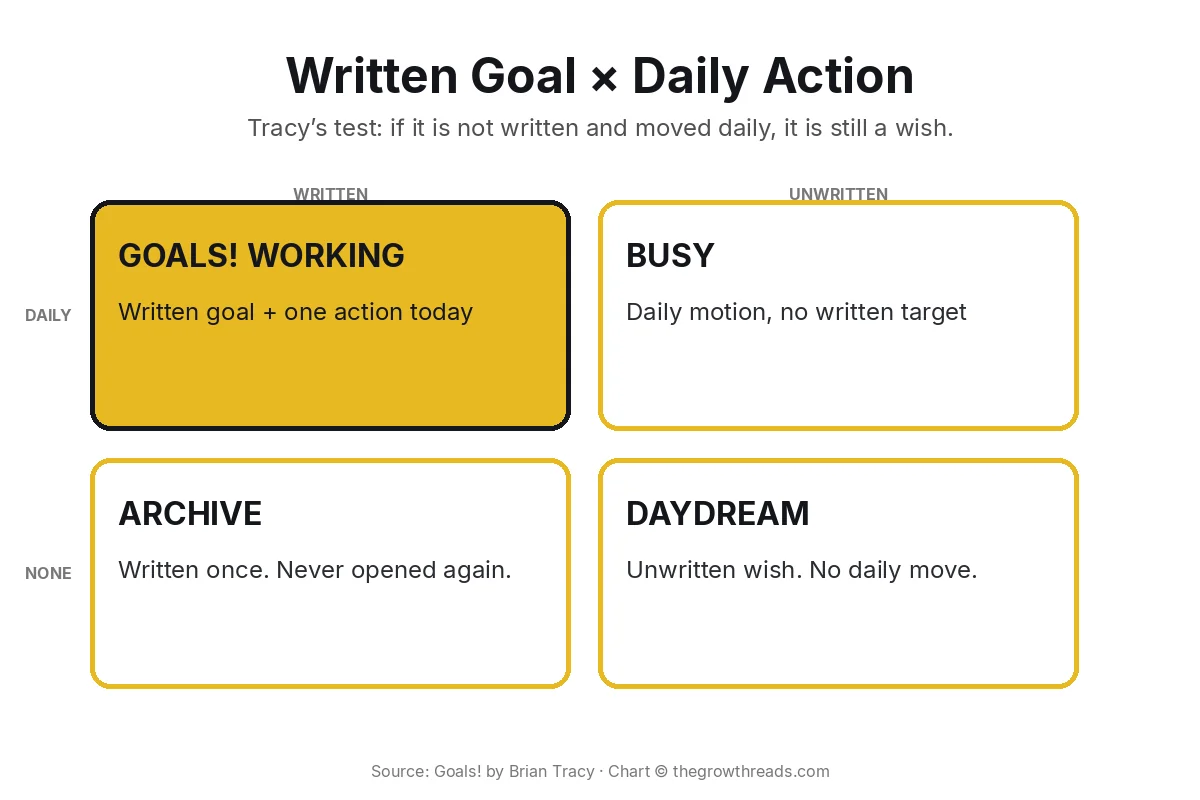
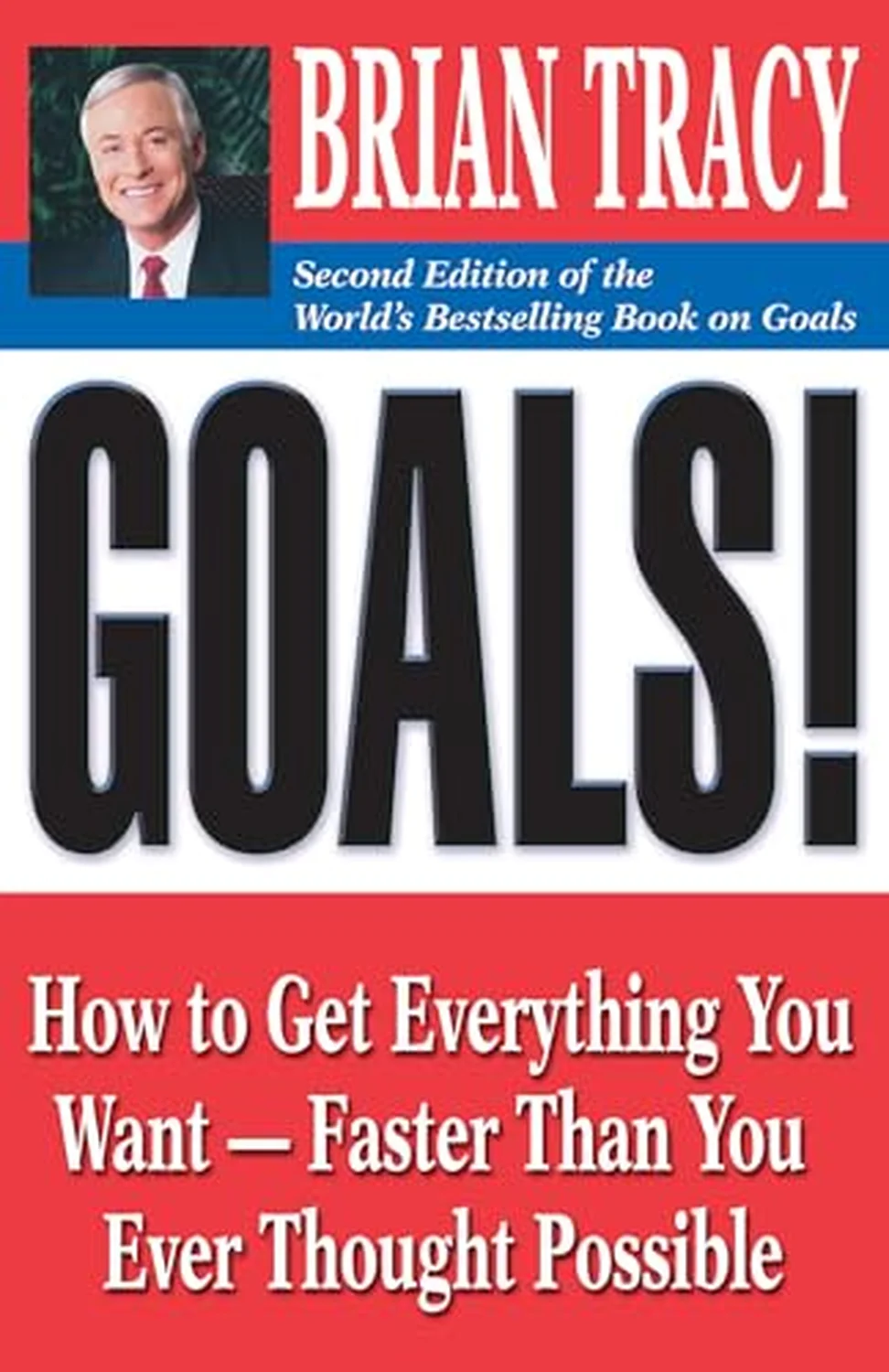
If the goal is not written, and you do not move it today, it is still a wish. Brian Tracy’s Goals!: How to Get Everything You Want — Faster Than You Ever Thought Possible is a 2003 field manual (updated 2010) for aiming. You decide exactly what you want in more than one life area, write ten goals in the present tense, circle the major definite purpose, put a date on it, list the obstacles and first actions, and do something toward that purpose before the day ends.
Later books made systems and identity famous. Tracy’s leftover is still the cheapest test: can you show the page, the date, and today’s move? This Goals Brian Tracy summary is that test, plus a week of small actions so the notebook does not become another unread plan.
Key takeaways
- Clarity before hustle: Decide the result in present tense. “Do better” is not a goal.
- Writing is the first action: A goal that stays in your head is a wish you can edit forever.
- Ten, then one: Write ten goals. Circle the one that would change the most. That is the major definite purpose.
- Dates create schedules: A deadline turns hope into a calendar block and a first call.
- List the real resistance: Obstacles, missing skills, and people you must ask. Hidden blockers stay hidden until they are named.
- Plan is an ordered list: Not a 40-page strategy. Next physical step first.
- Act before you feel ready: The first move is due the same day you write the goal.
- Daily or it dies: One action every day toward the circled purpose beats a heroic weekend.
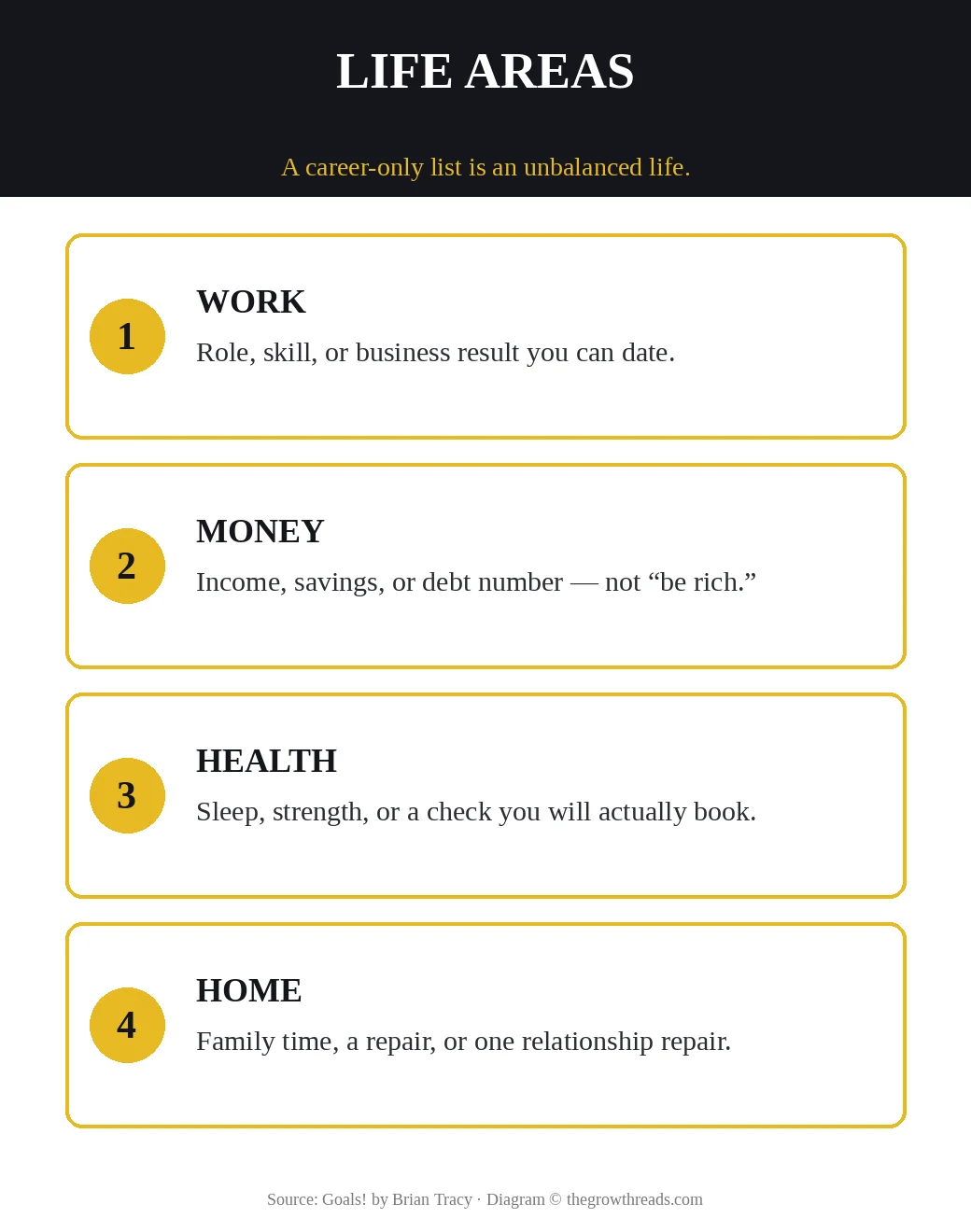
- Balance the page: Career-only lists warp the week. Keep health, money, and home on the same sheet.
What is Goals! about?
Goals! is Brian Tracy’s step-by-step method for choosing a clear result, writing it down, dating it, planning the first moves, and doing one thing toward it every day. It covers how to pick a major definite purpose from ten written goals and how to keep career, money, health, and home on the same page so the plan is a life, not only a job title.
About the author
Brian Tracy is a Canadian-American speaker and author who has spent five decades training sales teams and managers on self-discipline, time, and results. Eat That Frog! is the title most people know; Goals! is the aiming companion he wrote so readers would stop sprinting at a blur. The voice is direct, numbered, and built for a notebook, not a seminar transcript. He treats goal-setting as a teachable skill: decide, write, date, list, act, repeat. That practical stance is why the 2010 edition still earns a working week, even after newer habit books arrived. Explore all Brian Tracy book summaries →
Key concepts at a glance
| Concept | What it means | Use it when |
|---|---|---|
| Exact decision | Name the result in present tense, with a number if you can. | You only have a mood (“I should get serious”). |
| Written goal | The page is the first commitment. Memory is a draft. | The goal changes every time someone asks what you want. |
| Ten-goal list | A full page across work, money, health, and home. | You have one career target and a neglected life. |
| Major definite purpose | The circled goal that would move the rest. | Ten goals have become ten half-started projects. |
| Deadline | A date that forces the first call or draft. | The plan has a title and no calendar. |
| Obstacle list | Skills, people, money, and fear named in advance. | You stall and call it “research.” |
| Daily move | One physical action toward the circled purpose. | Weekends are heroic and Mondays reset to zero. |
Part 1: Decide exactly what you want
Tracy’s first move is almost rude in its simplicity: stop and decide. Most busy weeks are full of motion and empty of a named result. He wants the result in present tense, as if it already happened — “I earn X,” “I finish the certification,” “I walk 20 minutes after dinner” — because a future-tense wish stays optional. If you cannot say it in one sentence a stranger would understand, you do not have a goal yet. You have a vibe.
He also refuses a career-only page. Work, money, health, family, and personal growth sit on the same sheet so the plan does not steal the life it was supposed to fund. You do not need twelve perfect categories on night one. You need more than one column so the week does not collapse into inbox heroics. The decision is the work. Everything later is logistics.
A useful check: say the goal out loud to someone who will not flatter you. If you start explaining why it is complicated, you do not have the sentence yet. Cut until a colleague could repeat it. Numbers help — income, pages, sessions, a date — because they make the week measurable. If you hate numbers, use a visible finish line: the sent proposal, the booked appointment, the repaired conversation. Vague language is how a wish hides.
TGR Note. Once the result is named, Eat That Frog is the priority companion: take the ugliest slice of that result and start it. The One Thing asks a similar focusing question. Use Tracy to write the destination; use those two when the destination is clear and the calendar is still a junk drawer.
Part 2: Write it, date it, and make a plan
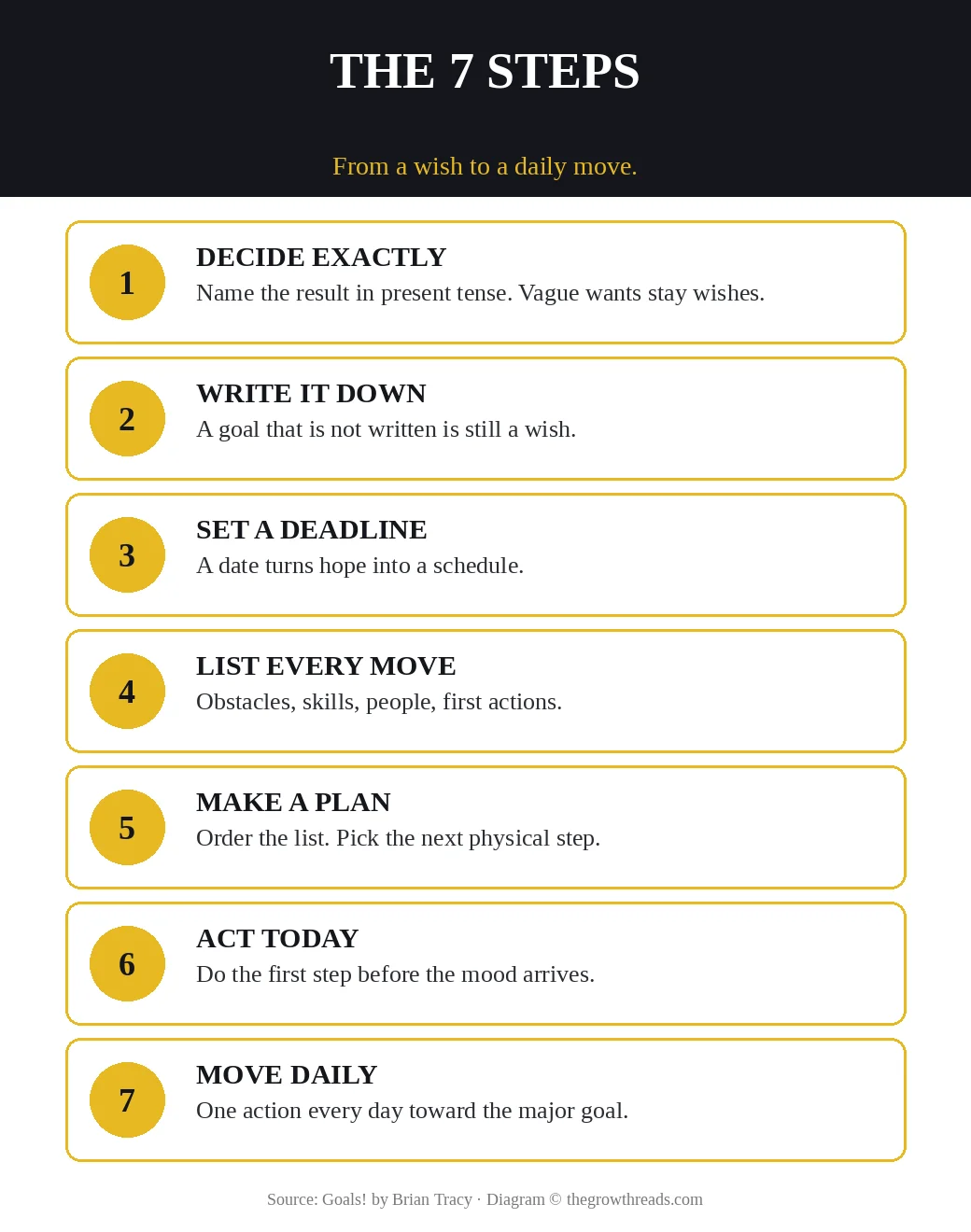
Tracy’s most quoted line in this book is also the operating rule: a goal that is not in writing is not a goal at all. It is a wish. Writing does three cheap jobs. It stops the sentence from shapeshifting. It gives you a page you can review on a tired Tuesday. And it is already an action, which matters if you have been “thinking about it” for a year.
Then come the unglamorous middle steps. Set a deadline so the goal has to meet a calendar, not a mood. List everything you can think of that might help or block you — skills to learn, people to ask, money to find, fears you keep renaming as prudence. Organize that list into a plan: sequence, not a manifesto. The first item should be a physical action you can finish without a new app. Send the email. Book the slot. Open the file and write the ugly paragraph. A plan that starts with “research options” is still a wish with bullet points.
Keep the written page ugly on purpose. Pretty templates become a delay. Tracy’s sequence is a list you can rewrite, not a brand. If you cannot do the first step today, the step is still too big — split it until it fits in half an hour. The deadline is there to force that split, not to decorate the header.
TGR Note. If your written goal keeps dying in week three, you may need a shorter horizon, not a prettier notebook. A 12-week year or a one-thing question will compress Tracy’s deadline. Habit Stacking then hangs the daily move on a cue you already finish — coffee, sit-down, lock the door — so the plan does not depend on remembering to be ambitious.
Part 3: Unlock the beliefs that cap the goal
Tracy spends real time on self-concept: you rarely outrun the story you tell about what is “like you.” If the inner caption says you are bad with money, late, or not a finisher, the written goal becomes a dare you quietly refuse. He wants that caption on the table. Replace “I am bad at this” with a practiced sentence that matches the page — then collect one piece of evidence this week. The belief does not have to feel true on Monday. It has to be specific enough to test.
He also leans on attention. Once a goal is written and dated, you start noticing the book, the person, the slot on the calendar. That is ordinary focus, not magic. The useful move is to give the mind a clean target so it has something to fetch. Visualization, in this book, is rehearsal of the finished result and the next step — not a substitute for the phone call. If you like the mental movie and skip the list, you are back in the daydream quadrant.
When an old caption fights the new page, do not argue with it for an hour. Schedule the smallest proof: one invoice sent, one workout logged, one hard conversation started. Tracy is not asking you to feel like a different person first. He is asking you to collect a week of proof that the written sentence can survive contact with Tuesday.
TGR Note. Belief work without a daily move becomes journaling. Pair this chapter with The Compound Effect or Atomic Habits if you want the environment and identity layer Tracy only sketches. The page still comes first. A new self-story that never meets a deadline is another unwritten wish.
Part 4: Do something every day
The last lock is frequency. Tracy wants one action every day toward the major definite purpose — especially on the days you would rather reorganize the list. Daily motion keeps the goal in working memory. It also surfaces the real obstacle faster than a monthly review. If you cannot name yesterday’s move, the goal has already slipped back to a wish. Put the move where the day already happens: after coffee, after the school run, before email. A daily action that needs a special mood will lose to the inbox.
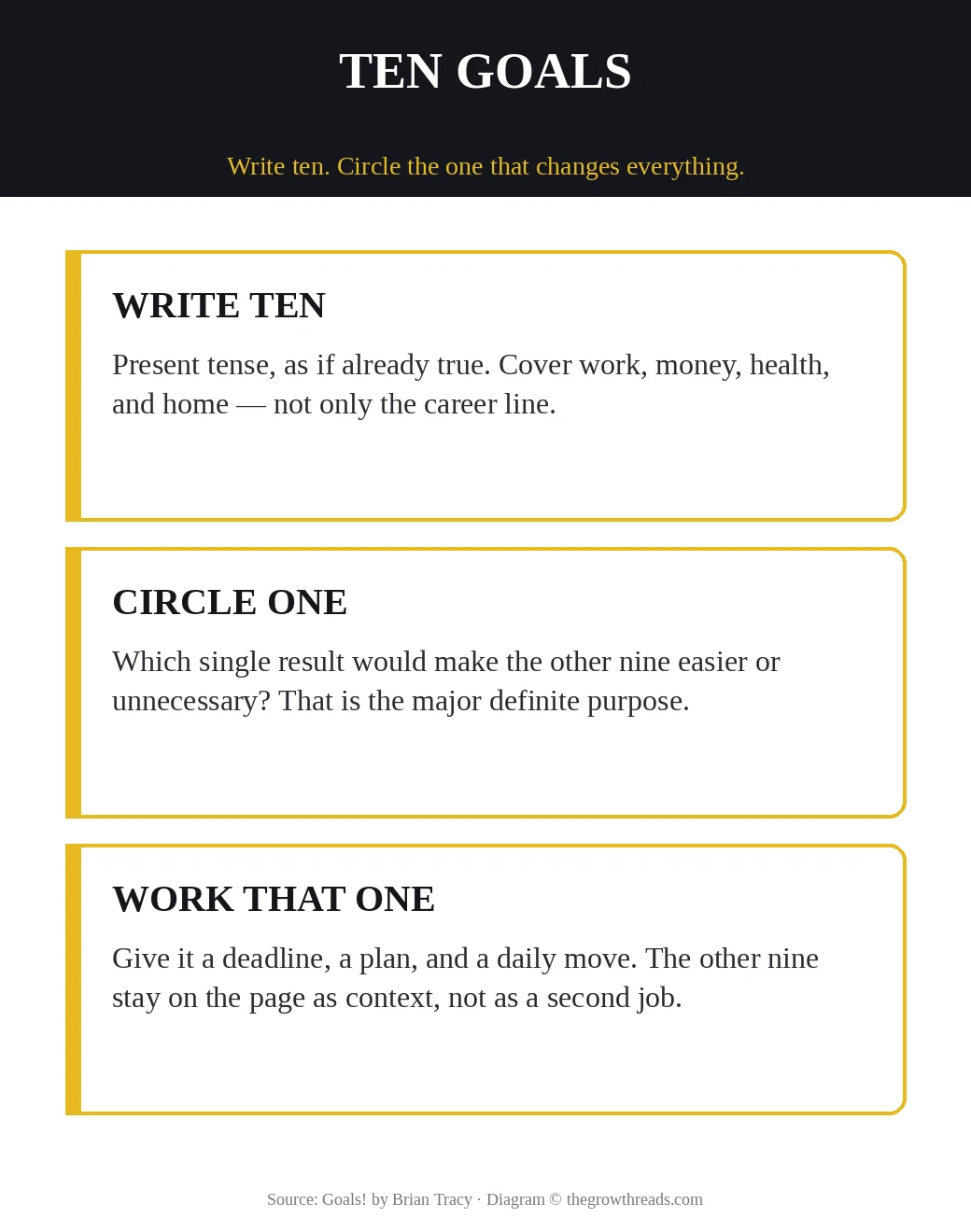
The ten-goal exercise is how he chooses what “daily” points at. Write ten. Circle the one that would create the most positive change. Give that line the deadline and the daily move. The other nine stay on the page so you do not pretend money, health, or home will wait forever — but they do not each get a heroic parallel project. Review the page weekly. Rewrite a dead line. Do not add an eleventh goal because you are avoiding the circled one.
That is the whole machine: decide, write, date, list, act, repeat. The 2010 stories show their age; the paper ritual does not. If you leave this summary with one page and one move on the calendar, you have read the book correctly.
Who is Goals! best for — and who should read something else first?
Best for managers, freelancers, and students who can narrate a busy week and still go blank when asked what they want by a real date. It is also a good first Tracy if you liked the frog metaphor and realized you were eating random frogs.
Read something else first if you already have a written goal and you stall on starting — go to Eat That Frog or Mini Habits. If you want systems more than destinations, start with Atomic Habits or The Compound Effect. If you need discipline more than aiming, No Excuses! is the closer Tracy. If you want a longer rulebook of success habits, The Success Principles covers more ground than this single-purpose manual.
Questions to reflect on
- If I had to name one result for the next 90 days in one present-tense sentence, what is it?
- Which of my current “goals” has never been written down — and what keeps changing when I say it out loud?
- If I wrote ten goals tonight, which one, if finished, would make three others easier?
- What is the first physical action I have been renaming as research?
- What did I actually do yesterday toward the thing I claim I want?
🔥 Ready to write the goal and move it today?
Use Tracy’s page: ten goals, one circled purpose, one daily action.
How to apply Goals! (7-day plan)
- Day 1 — Write ten. One page. Present tense. Include work, money, health, and home. No polishing.
- Day 2 — Circle one. Which result would change the most? That line is the major definite purpose.
- Day 3 — Date it. Put a real deadline on the circled line. If the date scares you, you are close.
- Day 4 — List resistance. Obstacles, skills, people to ask, and the fear you keep calling prudence.
- Day 5 — Order the plan. Sequence the list. Star the next physical action you can finish in 30 minutes.
- Day 6 — Do the first action. Send, book, draft, or pay. Do not add a new goal instead.
- Day 7 — Lock the daily move. Put tomorrow’s action on the calendar. Review the ten-goal page once. Rewrite only a dead line.
Frequently asked questions
What is Goals! about in one paragraph?
Goals! is Brian Tracy’s field manual for turning a wish into a written target you work every day. You decide exactly what you want in several life areas, write ten goals in the present tense, circle the one major definite purpose, set a deadline, list the obstacles and first actions, and do something toward that purpose before the day ends. This Goals Brian Tracy summary keeps the 2003/2010 edition practical: one written goal and one daily move, not a vision-board hobby.
Is Goals! still worth reading in 2026?
Yes, if your problem is vagueness, not motivation speeches. Later books added identity, systems, and environment. Tracy’s useful leftover is the paper ritual: ten goals, one circled purpose, a date, and a daily action. Read it when you have energy and still cannot name the result. Skip the urge to copy every chapter exercise in one Sunday. The 7-day plan below is the 2026 use case: one written purpose you can move tomorrow morning.
How is Goals! different from Eat That Frog?
Eat That Frog is the priority book: pick the ugliest important task and start it. Goals! is the aiming book that comes one step earlier. If you do not know which frog matters, Tracy’s ten-goal page and major-purpose circle decide the target. Then Eat That Frog tells you to start the hardest slice today. Many readers keep both on the same shelf: Goals! for the written destination, Eat That Frog for the first ugly bite.
What is a major definite purpose in this book?
It is the one goal, chosen from a list of ten, that would create the greatest positive change if you hit it. Tracy asks you to write the ten in the present tense, then circle the result that would make several of the others easier or unnecessary. That circled line gets the deadline, the obstacle list, and the daily move. The other nine stay visible so life stays balanced, but they do not get to steal the week.
How long does it take to apply Goals!?
Tracy’s useful unit is a week of writing and daily motion, not a year of visioning. Hour one is the ten-goal page. Hour two is the deadline and the first-action list for the circled purpose. The rest of the week is one physical move a day — a call, a draft, a booking, a number updated. If a goal dies, rewrite that line. Do not abandon the ritual. Day 1 in this guide is ten lines on paper. That is a complete first pass.
Who should read something else first?
If you already have a clear written goal and you still stall, start with Eat That Frog or Mini Habits and come back for the aiming chapter later. If you want systems more than destinations, Atomic Habits or The Compound Effect will feel closer. If even writing ten lines feels like a threat, shrink the first page to three goals and one circled line. Goals! is for the person who is busy and still cannot name the result.
How do I start Goals! this week?
Take one page. Write ten goals in the present tense, with numbers and dates where you can. Circle the one that would change the most. Give that line a deadline and three first actions. Do the first action before you close the notebook. Tomorrow, do the next physical move — not a replan. The 7-day plan in this Goals Brian Tracy summary is that sequence with names for each day so you do not invent a new system midweek.
Related summaries
- Eat That Frog! — start the ugliest important task
- No Excuses! — do it whether you feel like it
- The One Thing — protect the focusing question
- The Compound Effect — small daily choices
- Best productivity books — the full TGR pillar
How we analyze books: we reconstruct the argument, add original application notes, and skip chapter-by-chapter reproduction. Read our full methodology.