

★★★★☆ 4.4/5 — the most useful packing list for the phrase “habit stacking”: three tiny actions after a cue you already do.
Best for: people who believe small habits work and still do not have a written morning or shutdown checklist
Reading time: ~6 hours (330 pages) · this guide ~12 min
Difficulty to apply: Easy — Day 1 is one cue and three lines on paper
Habit Stacking in one minute
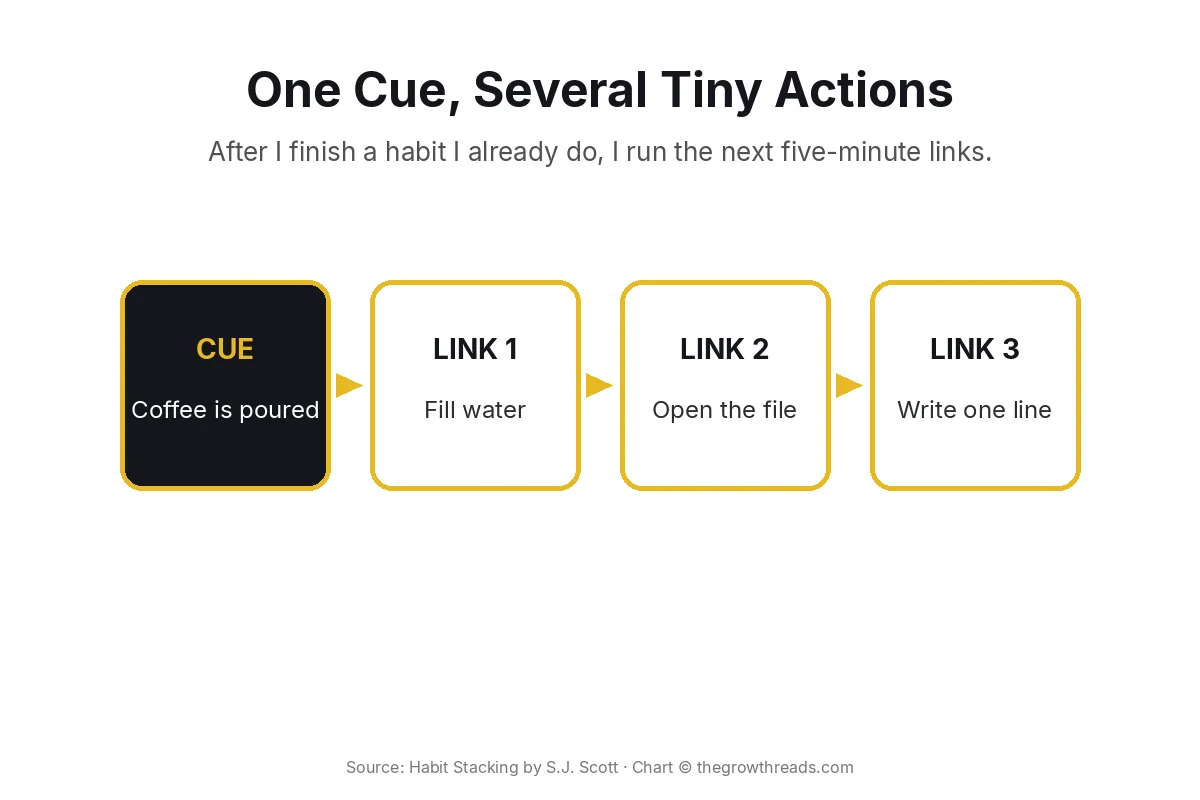
You do not need 127 new habits. You need one cue you already finish, then three actions that take five minutes or less. S.J. Scott wrote Habit Stacking as a packing list: group tiny actions into a routine, hang that routine on a trigger you already own, and tick a checklist so you do not renegotiate the morning. Keystone habits make other good actions easier. Support habits are the boring glue. Elephant habits are big outcomes cut into a first bite. The 127 items across seven life areas are a menu, not homework. If you only take one move from this Habit Stacking summary, write a three-link stack after coffee, the commute bag, or the laptop lid — and run it tomorrow before you add a fourth line.
Key takeaways
- Stack, do not sprinkle: Several five-minute actions in a fixed order beat twelve “I should” notes with no cue.
- The cue is an old habit: Coffee poured, sit down, lock the door. Do not invent a new 5 a.m. identity to start.
- Five minutes is the cap: If a link needs a bag, a commute, or a mood, it is not a stack link yet.
- Write a checklist: The stack lives on paper or a note you can tick. Memory is how links disappear on Thursday.
- Keystone, support, elephant: Mix a leverage action, a glue action, and one first bite of real work.
- One stack before two: A morning list that runs is worth more than a morning, desk, and evening list that do not.
- 127 is a catalog: Pick three. Scott’s seven areas (career, money, health, leisure, organizing, relationships, spirit) are shelves, not a race.
- Swap a dead link: If water is already handled, replace that line. Quitting the cue because one item bored you is the expensive mistake.
- Review weekly, not hourly: The stack is a process. Change the list on Sunday, not in the minute you were supposed to start.
What is Habit Stacking about?
Habit Stacking is S.J. Scott’s practical system for grouping actions that take five minutes or less into one daily routine, triggered by a habit you already finish, with a written checklist and a menu of 127 small options across seven parts of life.
About the author
S.J. Scott (Steve Scott) writes short, tactical self-help books from the site Develop Good Habits. He has published dozens of manuals on small daily actions — anti-procrastination lists, morning routines, and later collaborations in Hal Elrod’s Miracle Morning companion series. Habit Stacking is the book where he named and packed the method people now treat as common sense: do not add a new identity, attach a tiny action to something you already do. He is a writer of checklists more than a researcher. The value is the packing: a five-minute cap, a cue, a list you can tick, and permission to ignore 124 of the 127 ideas. Explore all S.J. Scott book summaries →
Key concepts at a glance
| Concept | What it means | Use it when |
|---|---|---|
| Habit stack | A fixed list of tiny actions after one cue | You have goals and no written daily sequence |
| Cue / trigger | An existing habit that starts the list | You keep waiting for a fresh burst of motivation |
| Five-minute link | One action that fits in five minutes or less | Your “habits” still look like projects |
| Keystone habit | A small action that makes other good actions easier | The day goes better when one boring thing happens first |
| Support habit | Glue: water, glance, one-line note | The stack feels like a performance instead of a path |
| Elephant habit | A big outcome cut into a first five-minute bite | The real work never fits “later tonight” |
| Checklist | The stack written where the cue happens | You “remember” the list until Thursday |
| One stack | Finish one routine before inventing a second | You have three unfinished systems and no ticks |
Part 1: Why tiny actions beat a new identity speech
Scott opens with the usual wreckage: a January list that dies by the second Monday. The diagnosis is not that you are lazy. The diagnosis is that you tried to install a new life as a single event. Success, in this book, is a process you can repeat on an ordinary Wednesday. A five-minute action is small enough that you can do it when you do not feel like becoming a new person. That is the whole argument in one line.
He is blunt about willpower. If the plan needs a hero hour, it will lose to the phone and the sink. A stack borrows the willpower you already spent on something automatic — making coffee, sitting at the desk, hanging the keys. The old habit is the engine. The new links just ride. That is why the first design question is not “What kind of person do I want to be?” It is “What do I already finish every weekday without a pep talk?”
The 127 later in the book can distract you here. Ignore them until you have a cue. A cue you already own is worth more than a beautiful list of habits you will not start. Scott’s examples stay ordinary on purpose: a glass of water, a two-minute tidy, a single sentence in a file. Ordinary is the point. If it sounds too small to count, it is small enough to survive a bad night of sleep.
TGR Note: James Clear later made the same attach-to-a-cue move famous in our Atomic Habits review. Read that when you want identity and environment. Stay here when you want the packing list. If even five minutes still feels like a threat, use Mini Habits for a one-rep start, then come back and write the three-link stack.
Part 2: The stack — trigger, five-minute links, one checklist
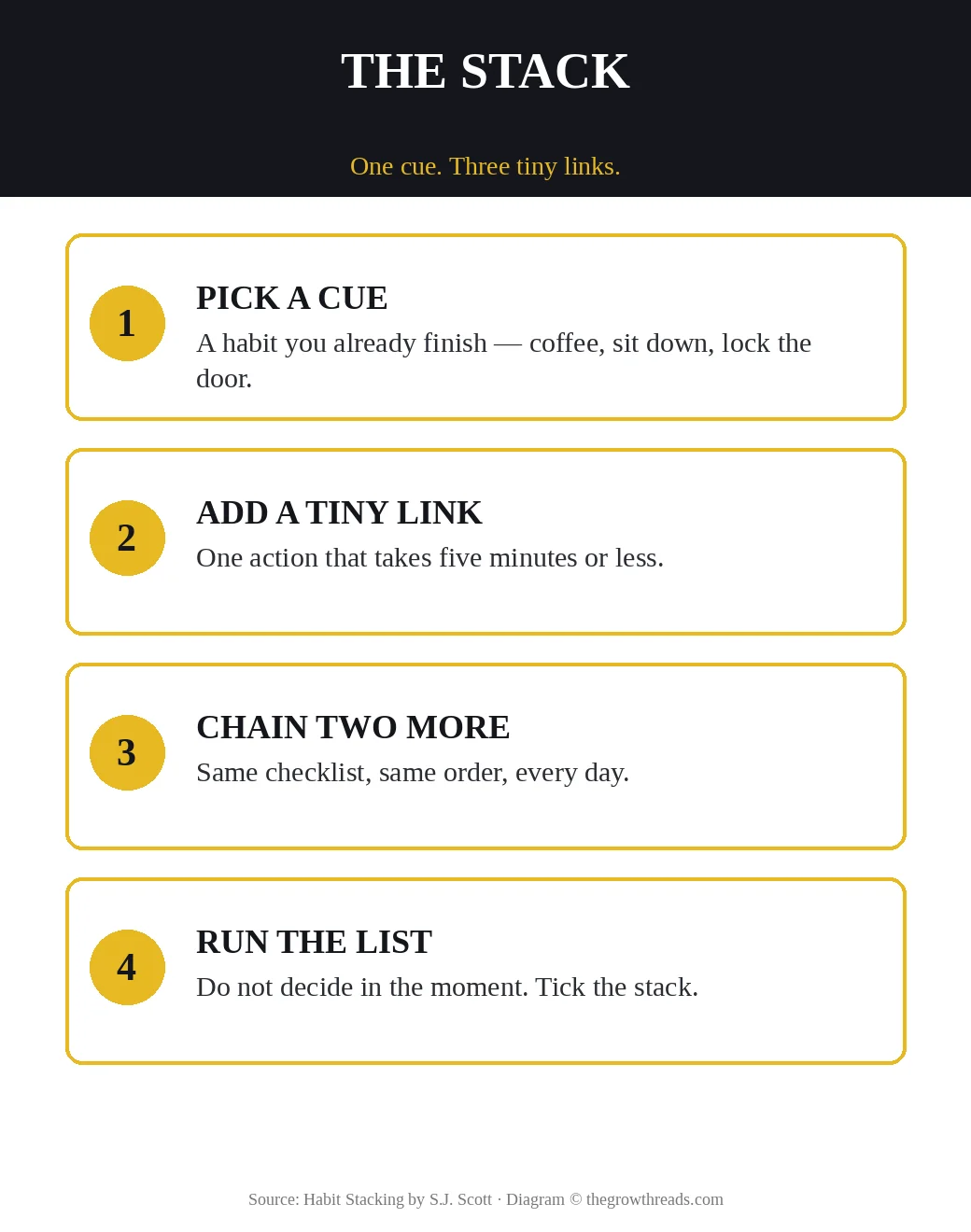
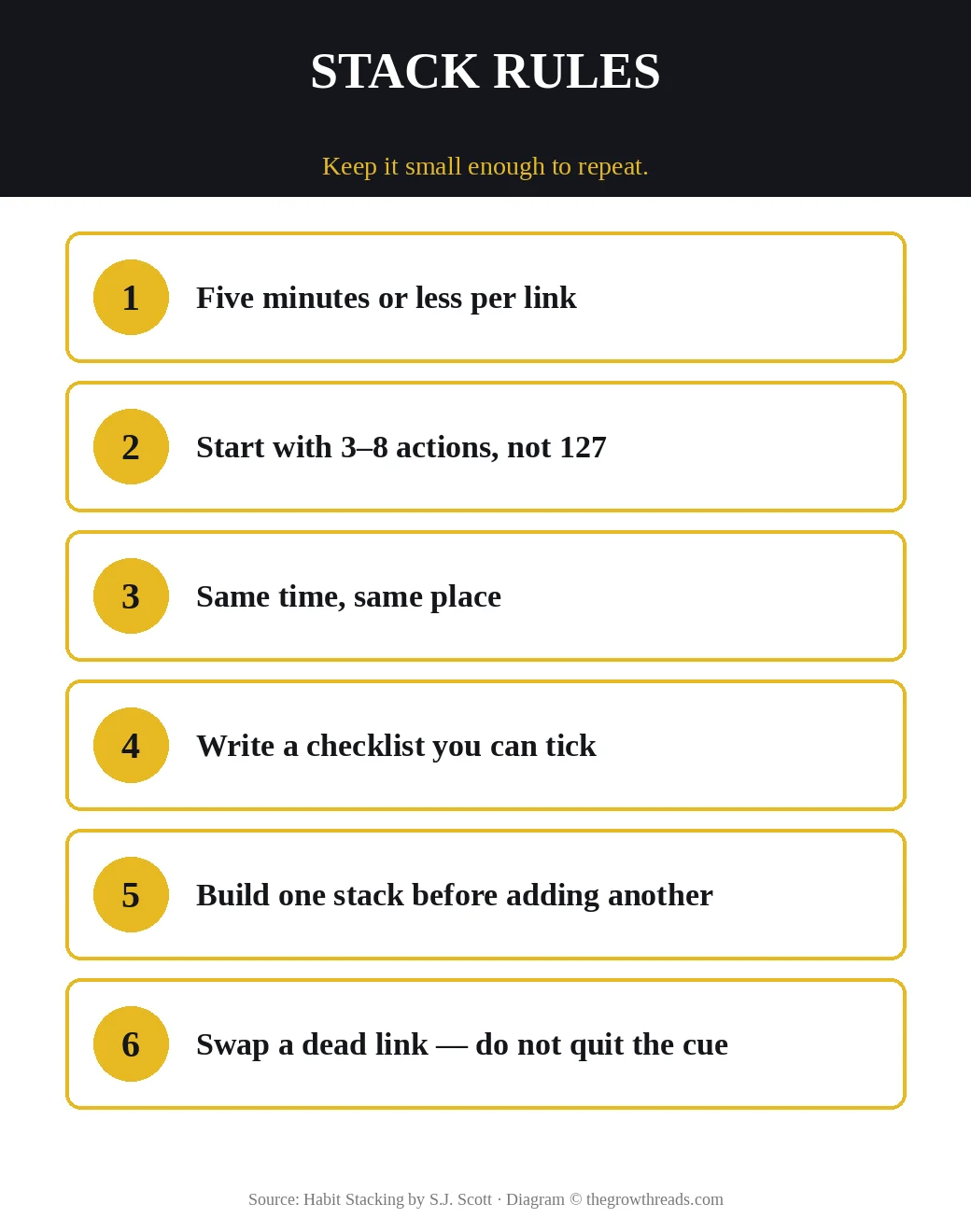
The mechanic is simple enough to write on a sticky note. After I finish [old habit], I will do [tiny 1], then [tiny 2], then [tiny 3]. Scott’s rules keep that note from swelling into a project plan. Each link is five minutes or less. The first stack has a handful of items — three to eight — not the whole catalog. Same time, same place. A checklist you can tick. One stack running before you invent a second. If a link dies, swap the line. Do not quit the cue.
The checklist is not decoration. It is how the stack stays a stack instead of a vibe. Put it where the cue happens: the kettle, the laptop, the hook by the door. Ticking is the reward. You are not waiting to feel like a disciplined person. You are closing three tiny loops in the order you already chose. That order matters. A stack that starts with the hardest elephant often never reaches the glue. Start with a keystone or a support action that gets the body in the room, then take the first bite of the real work.
Scott also asks you to schedule the stack like an appointment, not a hope. Morning stacks ride breakfast or the first sit. Shutdown stacks ride the bag or the lock. Workday stacks can ride “calendar opened.” The clock is allowed. The fantasy that you will “find a pocket” is how the list stays theoretical. If you cannot name the cue in one short clause, you do not have a stack yet. You have a wish.
TGR Note: BJ Fogg’s Tiny Habits goes even smaller and spends more time on celebration after the action. Use Fogg if the five-minute cap still feels like a demand. Use Scott when you are ready for a short written sequence. Do not run both books as a delay tactic. One cue. Three lines. Tomorrow.
Part 3: Keystone, support, and elephant habits
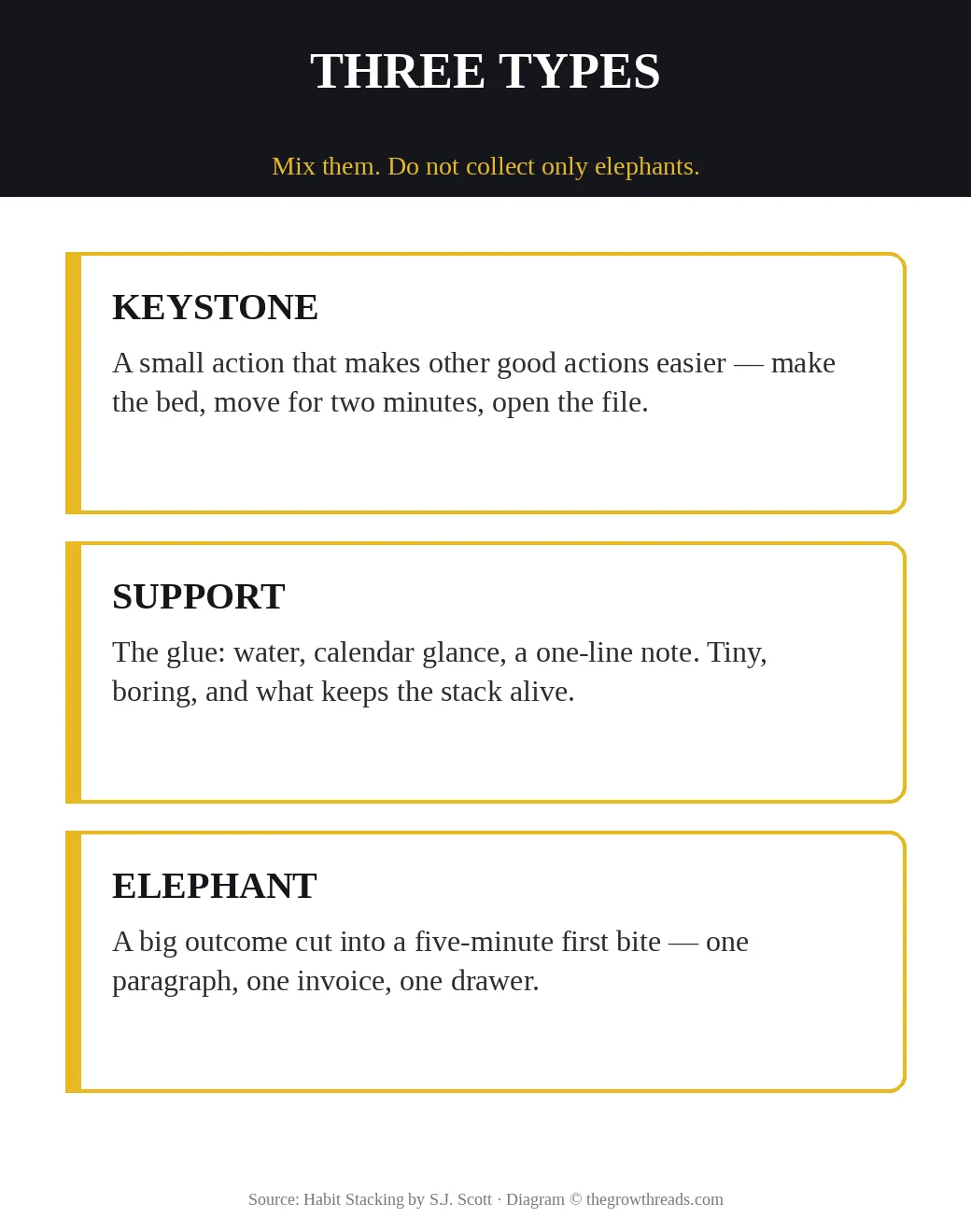
Not every five-minute action does the same job. Scott splits the menu so you stop building a stack of only “important” work you will dodge. A keystone habit is a small move that makes other good moves easier — make the bed, walk for two minutes, open the hard file. The day tends to follow. A support habit is glue: water, a calendar glance, a one-line journal. Alone it will not change a career. Missing it is how the stack starts to feel like a performance. An elephant habit is a big outcome sliced to a first bite: one paragraph, one invoice, one drawer. You are not finishing the book in the stack. You are touching the book so “later” has a handle.
A useful first stack often has one of each. Example after coffee: fill a glass (support), open the one ugly file (keystone), write one sentence (elephant). That is fifteen minutes on a slow morning and less on a practiced one. If you only stack elephants, you rebuilt your to-do list with friendlier branding. If you only stack support actions, you will feel organized and still not have moved the work that scares you. The mix is the design.
Charles Duhigg popularized “keystone habits” in a different book; Scott uses the word as a packing label. Do not pause the stack to write a term paper on the history of the idea. Ask one question: after this tiny action, are the next good actions easier? If yes, it can lead. If it only soothes you, it is support — keep it, do not let it be the whole list.
TGR Note: For the original keystone-habit stories, see our Power of Habit summary. For a personality map of which habits will stick, Better Than Before is the better first read. Come back to Scott when you already know the cue and need the written mix. Context design from Good Habits, Bad Habits pairs well once the stack is running.
Part 4: 127 options, seven areas, and a stack you will actually run
The back half of the book is a catalog: career, finance, health, leisure, organizing, relationships, spirituality. Scott lists small actions you can steal — a two-minute inbox pass, a transfer to savings, a stretch, a text that is not a scroll, a single drawer, a one-line gratitude note. Treat it like a shop, not a syllabus. The people who bounce off this book try to install an item from every aisle. The people who get value pick three that fit one cue and one room.
He also sketches sample stacks: a morning block that can grow toward 30 minutes, a work-start block, an evening shutdown. Thirty minutes is a later luxury. The first week should feel almost too short. When the three links are boring, you may add a fourth. When a link needs gear you do not have at the cue, it does not belong in that stack — put it on a different cue or cut it. A gym bag does not live on the coffee list unless the bag is already by the kettle.
Tools stay light: a paper list, a note app, a reminder that fires at the cue — not a new dashboard. Scott mentions sites and apps as helpers, not as the habit. If you spend the week choosing an app, you did not start. The review habit is weekly. Sit once, ask which line you skipped, and rewrite that line. Do not rebuild your identity. Rebuild the one sentence that failed.
Who is Habit Stacking best for — and who should read something else first?
Best for the person who already agrees that small daily actions compound and still has no written sequence after a real cue. Also good for someone leaving a year of highlighted habit books with nothing ticking. Not first if five minutes still feels like an accusation — start with Tiny Habits or Mini Habits. Not first if you want the science of loops before a list — The Power of Habit or Atomic Habits. Not first if you need to know which habits fit your tendency — Better Than Before. Scott is the packing list after you have picked a door.
Questions to reflect on
- Which habit do you already finish every weekday without a pep talk?
- If you could only attach three five-minute links to that cue, which three would move the week?
- Which item on your current “habit” list is actually a project in costume?
- Where will the checklist live so you see it when the cue happens?
- Which link died last time you tried a morning routine — and what smaller line replaces it?
🔥 Ready to run one stack tomorrow?
Get Habit Stacking, then use the 7-day plan to attach three five-minute links to a cue you already do.
How to apply Habit Stacking (7-day plan)
- Day 1 — Name the cue. Write one clause: after I ______. It must be something you already finished yesterday.
- Day 2 — Write three links. Each five minutes or less. One support, one keystone, one elephant. Put the list at the cue.
- Day 3 — Run it once. No extras. Tick the three lines. If you skip one, mark it — do not invent a fourth.
- Day 4 — Same cue, same order. Do not upgrade the list. Boredom on day four is a feature.
- Day 5 — Swap only a dead link. If one line is impossible where the cue happens, replace that line only.
- Day 6 — Keep the elephant tiny. One sentence, one invoice, one drawer. Finishing the project is not the stack.
- Day 7 — Weekly review. Which line got skipped? Rewrite that sentence. Do not add a second stack this week.
Frequently asked questions
What is Habit Stacking about in one paragraph?
Habit Stacking is S.J. Scott’s 2017 field manual for grouping actions that take five minutes or less into one daily routine. You pick a cue you already finish — coffee poured, laptop open, door locked — then run a written checklist of tiny links in the same order. The book sorts 127 options across career, money, health, leisure, organizing, relationships, and spirituality, and it names keystone, support, and elephant habits so the stack is not a random list. This Habit Stacking summary turns that menu into one three-link routine you can run this week.
Is Habit Stacking still worth reading in 2026?
Yes, if your problem is starting, not collecting frameworks. James Clear later made “habit stacking” a household phrase; Scott’s book is still the most concrete menu of five-minute links and the simplest checklist method. Read it when you want a written stack tonight, not another identity speech. Skip the urge to install all 127 items. Three links after one cue beat a highlighted copy of the table of contents. The 7-day plan below is the 2026 use case: one morning or shutdown stack you can tick without opening a new app.
How is Habit Stacking different from Atomic Habits?
Atomic Habits is the identity-and-environment book: make the cue obvious, the action easy, the reward satisfying. Habit Stacking is the packing list. Scott assumes you already have one reliable habit and shows you how to hang several five-minute actions on it with a checklist. If you want the science of why a cue works, start with our Atomic Habits review. If you already believe small actions compound and you still do not have a written morning or shutdown list, Scott is the faster apply. Many readers use both: Clear for the rule, Scott for the first three ticks.
How long does it take to build a habit stack?
Scott’s useful unit is a week of the same cue, not a 66-day myth. Write three links that each take five minutes or less. Run them after one existing habit for seven days. If a link dies, swap it — do not abandon the cue. A full 30-minute stack is optional later, after the short list is boring in a good way. The failure mode is adding twelve links on Sunday night and missing Tuesday. This guide’s Day 1 is one cue and three lines on paper. That is a complete first stack.
What is a keystone habit in this book?
A keystone habit is a small action that makes other good actions easier: making the bed, a two-minute walk, opening the hard file. Support habits are the glue — water, a calendar glance, a one-line note — that keep the stack from feeling like a performance. Elephant habits are big outcomes cut into a five-minute first bite: one paragraph, one invoice, one drawer. Scott’s point is to mix the three. A stack of only elephants is a to-do list you will dodge. A stack of only support actions never moves the work that matters.
Who should read something else first?
If even five minutes feels like a threat, start with Mini Habits or Tiny Habits and come back when a tiny action already feels safe. If you do not know which habits fit your personality, Better Than Before is the better first map. If you want the science of cue-craving-response-reward before you write a list, read The Power of Habit. Habit Stacking is for the person who already agrees that small daily actions matter and needs a written stack, not another pep talk. Do not buy it as a way to delay picking a cue.
How do I start a habit stack this week?
Pick one cue you already finish every weekday. Write three links that each take five minutes or less and that you can do in the same place. Example: after coffee is poured — fill a glass of water, open the one hard file, write one ugly sentence. Put the list where the cue happens. Run it for seven days before you add a fourth link. If one link dies, replace that line only. The 7-day plan in this Habit Stacking summary is that sequence with names for each day so you do not invent a new system midweek.
Related summaries
- Atomic Habits by James Clear
- Mini Habits by Stephen Guise
- Tiny Habits by BJ Fogg
- The Power of Habit by Charles Duhigg
- Best productivity books
How we analyze books: every book on The Growth Reads is read cover to cover, summarized in thousands of words of original analysis, and rated against our five-criteria rubric (lasting impact, evidence quality, practical application, writing & originality, external consensus). Read our full methodology.