

★★★★½ 4.5/5 — a usable stance for making things when you do not feel chosen.
Best for: Writers, makers, and professionals who stall on “I’m not a real artist yet”
Reading time: ~6 hours (276 pages) · this guide ~16 min
Difficulty to apply: Easy — the stance is simple; keeping fear out of the driver’s seat is the work
Big Magic in one minute
You do not wait to feel ready. You let fear ride along and you still make the thing. Elizabeth Gilbert’s Big Magic: Creative Living Beyond Fear (2015) is the book-length version of her TED argument that genius is a visitor, not a personality you have to be. Ideas look for partners. Curiosity is a smaller fuel than passion. Permission is something you give yourself. Persistence looks like showing up, not bleeding for the work. This summary is the application layer: the car, the living idea, the permission slip, the trickster, and a 7-day plan that fits around a job.
Key takeaways
- Ideas look for partners: Treat the work as a collaboration that can leave if you never keep the appointment.
- Fear is a companion, not a verdict: Creativity asks you to enter an uncertain outcome. Fear will always be triggered. That is not a stop sign.
- Fear rides, it does not drive: Give it a seat. Do not give it the wheel, the map, or the radio.
- Curiosity beats passion: Passion is a heavy demand. Curiosity is a question you can follow for twenty minutes.
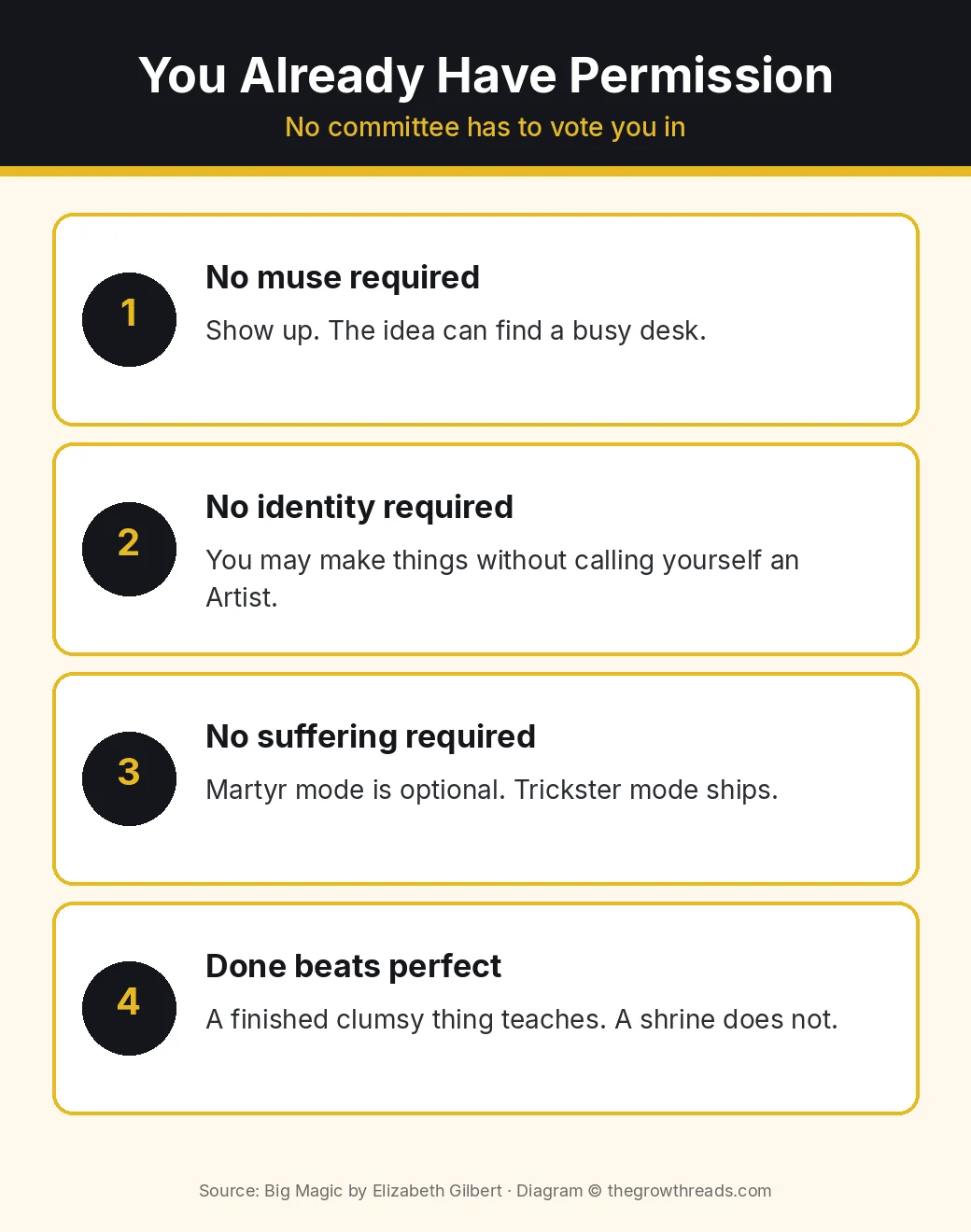
- You already have permission: No committee, spouse, or brand has to vote you into making things.
- You may make things without the identity: “Artist” is optional. The hours are not.
- Martyr mode is optional: Suffering is not proof of seriousness. Trickster mode ships.
- Done teaches; a shrine does not: A clumsy finished thing is a better teacher than a perfect unstarted one.
- Multiple jobs are allowed: Creative living does not require you to quit on Friday.
- Keep the appointment: The stance fails in the shower. It works at a desk with a timer.
What is Big Magic about?
Big Magic is Elizabeth Gilbert’s 2015 guide to making things without waiting to feel chosen. Ideas look for human partners. Fear always rides along. Curiosity beats passion as daily fuel, and permission is something you give yourself. The book is a stance you can use on a Tuesday, not a talent you must prove.
About the author
Elizabeth Gilbert grew up in Connecticut, worked as a journalist for GQ, Spin, and The New York Times Magazine, and published fiction before the memoir Eat Pray Love (2006) became a global phenomenon and a Julia Roberts film. The fame that followed is part of why Big Magic exists. She had already given a TED talk arguing that genius is a visitor, not a personality you have to perform. The 2015 book is that stance in chapters: creative living for people who will never be full-time artists and for people who already are. She writes like a generous older sister, not a guru with a scar. The point is not to become Elizabeth Gilbert. The point is to stop waiting for a feeling called ready. Explore all Elizabeth Gilbert book summaries →
Key concepts at a glance
| Concept | What it means | Use it when |
|---|---|---|
| Living ideas | Ideas visit and can leave if you never partner | You have been “meaning to” for years |
| Fear in the car | Fear may ride; it may not drive | You are waiting to feel brave before you start |
| Curiosity over passion | Follow a small question, not a calling certificate | “Find your passion” has frozen you |
| Permission | You may make things without a vote | You want a title before a first draft |
| Trickster vs martyr | Play and ship, or suffer and stall | The work has become a purity test |
| Done over shrine | A finished clumsy thing teaches | You keep polishing the unstarted file |
| Multiple jobs | Creative living fits around a paycheck | You think quitting is the only serious move |
| Enchantment | Stay available to what knocks | You only work when inspiration arrives first |
Part 1: Courage — let fear ride, not drive
Gilbert opens with courage because that is where most people stall. They treat fear as a gate. If I still feel afraid, I must not be ready. She flips the sequence. Creativity asks you to enter a realm of uncertain outcome. Fear will always be triggered by that ask. Waiting for fear to leave is waiting for the work to stop being creative. “Your fear will always be triggered by your creativity,” she writes, “because creativity asks you to enter into realms of uncertain outcome.”
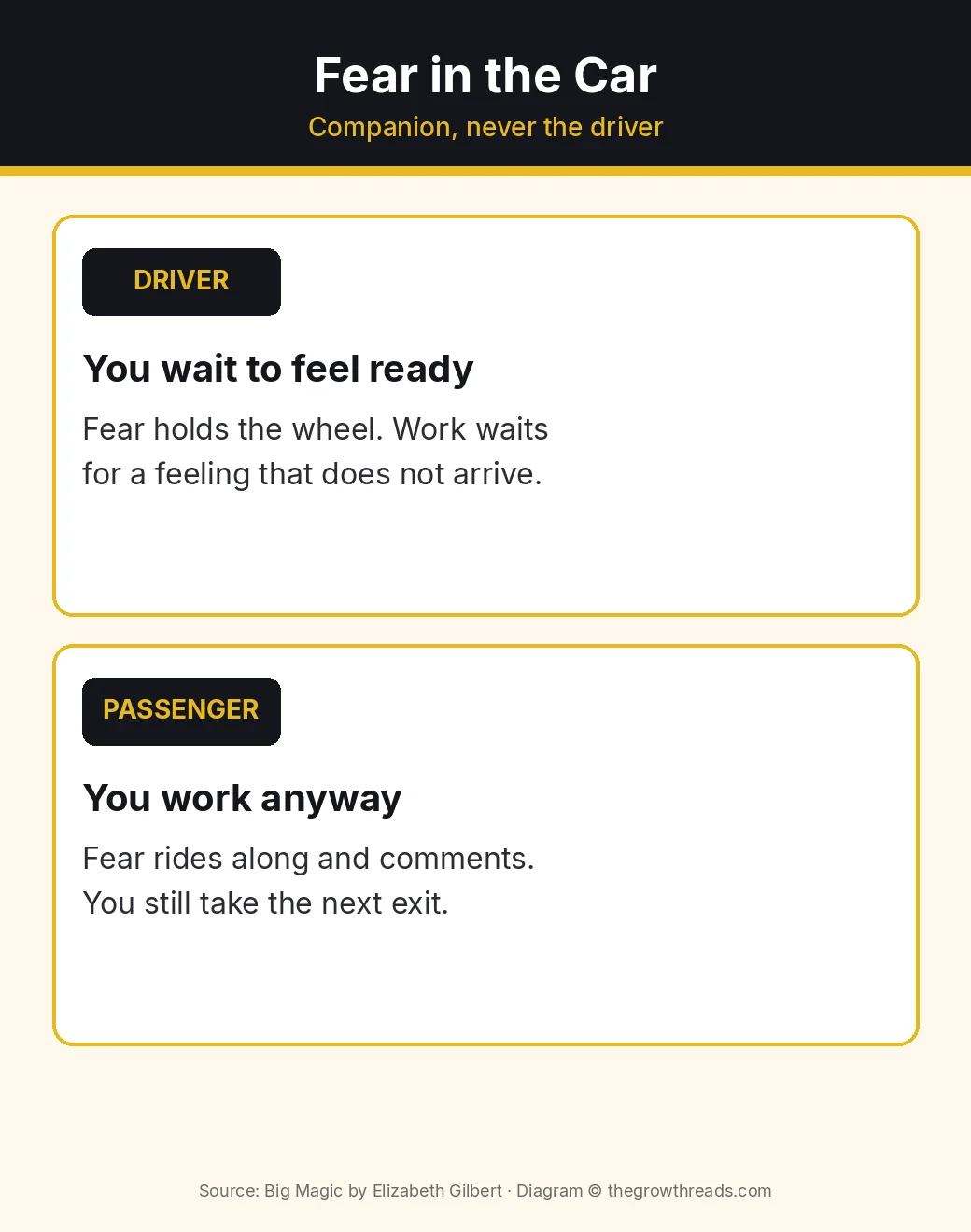
The car is the tool. You are driving. Fear may sit in the passenger seat. It does not get the wheel, the map, or the radio. It can comment. It does not choose the exit. Most stalls are a seating error: fear is driving, and you are in the back explaining why the trip is not legitimate yet.
Courage here is not fearlessness. It is contact. You start the ugly paragraph while the commentator is still talking. The feeling of readiness is not a prerequisite. It is sometimes a byproduct of having already moved.
TGR Note: If fear feels like an enemy you have to punch, start with The War of Art — Resistance is Pressfield’s name for the same Tuesday. Gilbert will not ask you to fight. She asks you to drive. If the stall is Recovery-with-a-capital-R, The Artist’s Way is the twelve-week structure this book will not give you.
Part 2: Enchantment — ideas visit; curiosity keeps them
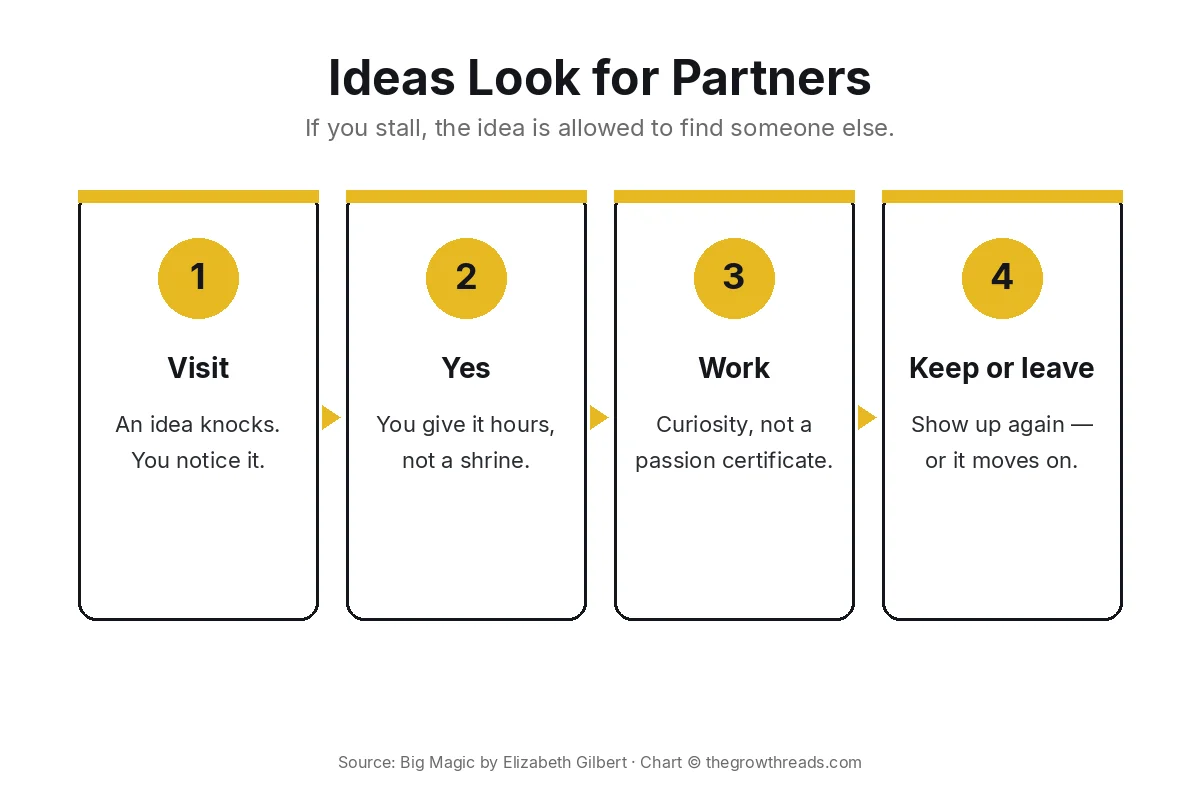
The signature idea of the book is not a productivity hack. It is a story about ideas as living things looking for human partners. They knock. You notice. You say yes with hours, or you stall, and the idea is allowed to find someone else. You do not have to believe in sprites. You have to believe that ignoring a live question for a decade is a choice with a cost.
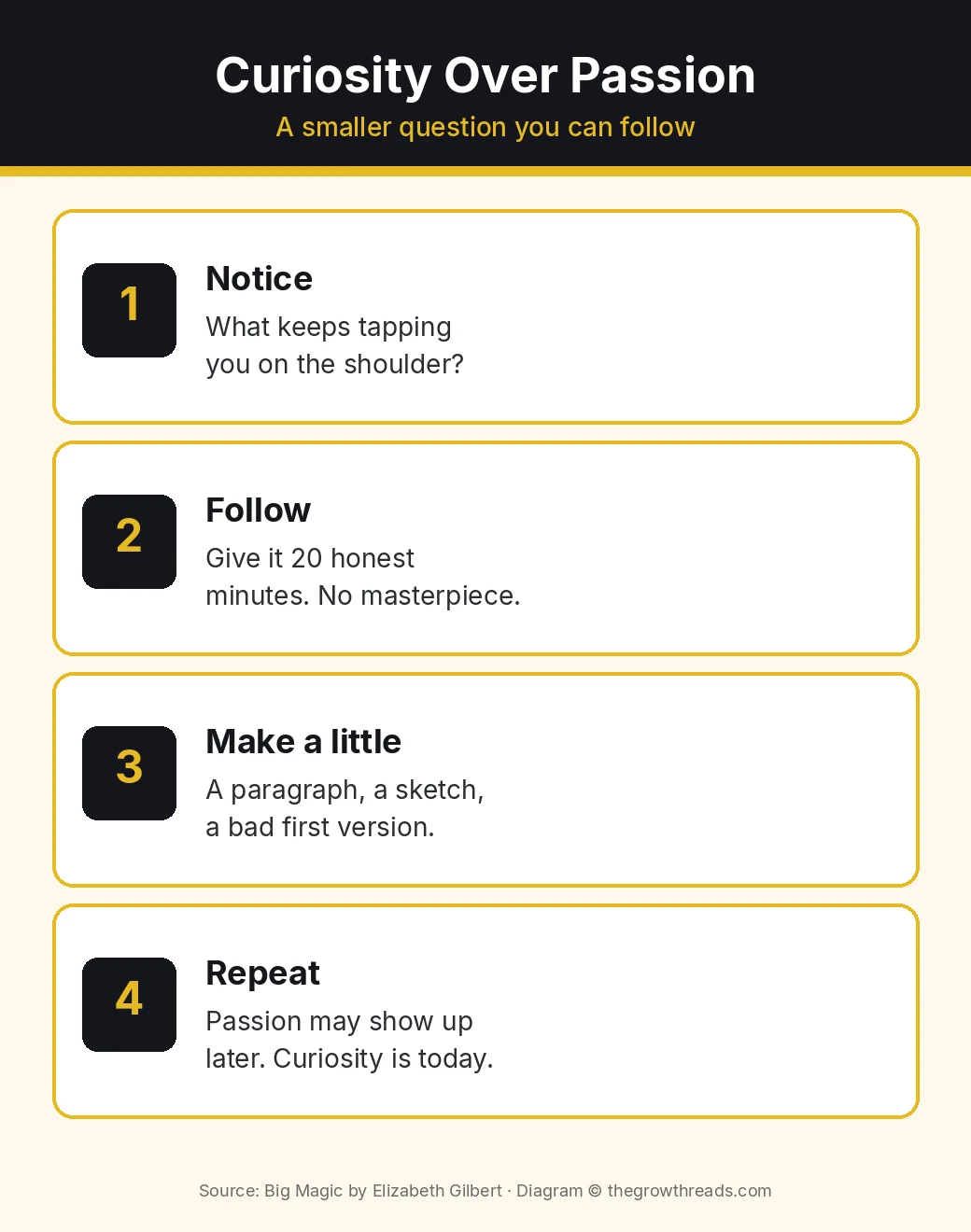
Curiosity is the handshake. Passion is a heavy noun. It asks you to know your calling before you have touched the work. Plenty of capable people freeze there and call it integrity. Gilbert would rather you follow the smaller tap. Give it twenty honest minutes. Make a little. Repeat. Passion may arrive later as a side effect of contact. It is not the ticket you buy at the door.
Enchantment also means you stay available. Inspiration is allowed to find a busy desk. It is less likely to find a shrine you never sit in. You keep the channel open by doing the next inch.
TGR Note: If you need a daily capture system so the knock does not vanish, The Practice is Seth Godin’s cousin: ship on a schedule. If you need to steal structure instead of waiting for originality, Steal Like an Artist is the honest-influence layer. Gilbert still wants the first twenty minutes to be curiosity, not a brand.
Part 3: Permission — no committee has to vote you in
Most amateurs are not blocked by a lack of tips. They are waiting to be deputized. Gilbert’s permission chapter is a refusal of that vote. You may make things because you are here and the materials are in reach. You do not need to call yourself an Artist. You do not need to quit on Friday. You do not need to suffer visibly so the work looks expensive.
She is not naive about money. She worked other jobs while she wrote. Creative living is allowed to be part-time and still count. If your stall is “I cannot start until I can do this for a living,” you have turned a payroll question into a permission question. Separate them. The twenty minutes still fit around a paycheck.
Permission also kills the fake humility that is actually fear driving. “Who am I to…?” is usually a seating-chart sentence. Who you are is a person with a desk and a question. That is enough to begin.
TGR Note: If what you actually need is to put the work where other people can find it, Show Your Work! is the sharing layer Gilbert assumes you will eventually need. If the block is “I am not original,” Kleon’s steal-and-share pair is more tactical than Big Magic. Keep Gilbert for the vote you keep waiting on.
Part 4: Persistence — trickster, not martyr
Persistence in this book is not a grind brand. It is what happens after permission: you keep the appointment when the feeling does not arrive. The martyr needs the work to hurt so it counts. The trickster treats the work as play that still ships. Martyr mode looks serious and often stalls. Trickster mode looks unserious and finishes. She wants you in the second chair.
Trust is the decision to keep partnering without a guaranteed outcome. You control the hours and the seating chart. The rest is not a personal failure. Done is the teacher. A clumsy finished thing can be improved. A perfect unstarted file cannot. If you have been polishing the idea in your head so it cannot be embarrassed, fear still has the wheel. Ship a tiny ugly version. Then you can steer.
TGR Note: If you need bird by bird instead of a metaphor, Bird by Bird is the paragraph-level persistence cousin. If you need a habit so the appointment happens without a mood, Atomic Habits is the installer. Gilbert still wants the first sit to be curiosity, not a streak you are afraid to break. The Creative Act is the quieter studio version of staying available.
Who is Big Magic best for — and who should read something else first?
Best for people who already know what they want to make and keep waiting to feel legitimate. Best for professionals with a side project that has been “almost” for two years. Best for anyone who heard “find your passion” and stopped. Run the 7-day plan on one live curiosity this week, not as a personality rebrand.
Read something else first if you need a twelve-week recovery: The Artist’s Way. If you need to fight Resistance as an enemy, The War of Art. If you need to share the work once it exists, Show Your Work!. If you need a habit installer, Atomic Habits. This one waits until the block is permission, fear, or a passion myth — and you still have a desk.
Questions to reflect on
- On the thing you want to make, who currently has the wheel — you, or fear?
- What curiosity has been tapping you that you keep calling “not a real project”?
- Whose vote are you still waiting for before you will start — and what would you make this week if that vote were illegal?
- Where have you been in martyr mode, and what would a trickster version of the same work look like by Friday?
- What appointment can you keep for twenty minutes tomorrow without quitting anything?
🔥 Ready to let fear ride and still make the thing?
Get Big Magic, then run the 7-day plan on one live curiosity this week.
How to apply Big Magic (7-day plan)
- Day 1 — Name who is driving. Write the project as one sentence. Then write whether fear currently has the wheel. If you are waiting to feel ready, fear is driving. Circle the seating chart, not your talent.
- Day 2 — Follow one curiosity. Pick the tap you have been calling trivial. Give it 20 honest minutes. A paragraph, a sketch, a bad outline. No masterpiece. If you cannot name a curiosity, you are still in the passion trap.
- Day 3 — Write yourself permission. One sentence: you may make this without a title, a follower count, or a committee. Put it above the desk. If the sentence needs someone else’s name on it, it is not permission yet.
- Day 4 — Start the unfinished thing. Open the file. Make a clumsy first inch. The shrine stays closed. If you only “think about” the project today, fear kept the wheel.
- Day 5 — Keep the appointment. Same curiosity, same desk, even if the feeling did not arrive. Twenty minutes again. Enchantment is availability, not a mood.
- Day 6 — Trickster ship. Send or finish a tiny ugly version: a draft to one person, a posted sketch, a working ugly prototype. Martyr mode is off. If it cannot be seen, it is still a shrine.
- Day 7 — Review what kept you alive. Which follow had heat? Which task was a purity test? Keep the first. Drop the shrine. Set next week’s twenty-minute slot on the calendar before you close the notebook.
Frequently asked questions
What is Big Magic about in one paragraph?
Elizabeth Gilbert’s 2015 book is a field guide for making things when you do not feel chosen. Ideas, she argues, are looking for human partners. Fear always shows up because creativity is a bet on an uncertain outcome. You do not wait until you feel brave. You give fear a seat and keep the wheel. Curiosity beats passion as daily fuel. You do not need a committee to name you an artist. Persistence looks like showing up, not suffering. This summary is the application layer: the living-idea metaphor, the car, permission, the trickster, and a 7-day plan you can run without quitting your job.
What does Big Magic mean by ideas being alive?
Gilbert treats ideas as visitors with their own will. They knock. You notice or you don’t. If you say yes, you give them hours, not a shrine. If you stall for years, the idea is allowed to find another host. You do not have to take the metaphor literally. Use it as a stance: the work is a collaboration, not a personality test. That lowers “I am not a real artist” and raises “will I keep the appointment.” Day 2 is one appointment with whatever has been tapping.
How does Gilbert treat fear and creativity?
Fear is not a bug you debug before you start. It is a companion that shows up because the outcome is unknown. Gilbert’s image is a car: you drive, fear may sit in the passenger seat, and it does not get the map, the radio, or the wheel. You do not wait to feel ready. You do not try to become fearless. You work with a commentator in the back. If fear is driving, you wait. If it is riding, you can still take the next exit. The 7-day plan starts by naming who currently has the wheel.
Is Big Magic only for artists?
No. Creative living is for people who will never be full-time artists and for people who already are. A garden, a side project, a song in a notebook — if you are making a thing that did not have to exist, you are in the book. The permission chapter is for the reader waiting for a title to vote them in. You may make things without calling yourself an Artist. If you need a 12-week recovery, start with The Artist’s Way. If you need a war on Resistance, start with The War of Art. This one is the Tuesday stance when the work is small and the fear is loud.
What is the difference between passion and curiosity in Big Magic?
Passion is a heavy demand: know your calling, feel the fire, bet the house. Plenty of people freeze there and call it integrity. Curiosity is smaller. It is the question that keeps tapping you. Follow it for twenty honest minutes. Make a little. Repeat. Passion may arrive later as a byproduct of contact. It is not the ticket you have to buy before you are allowed in the building. Gilbert would rather you be a faithful amateur than a stalled believer. If you have been waiting to “find your passion” before you start, that sentence is the trap. Day 2 asks for a twenty-minute follow, not a life overhaul.
How is Big Magic different from The War of Art and The Artist’s Way?
The War of Art names Resistance as an enemy you show up to fight. Gilbert names fear as a passenger you refuse to let drive. Same Tuesday, different metaphor. The Artist’s Way is a twelve-week recovery with morning pages — a structure for people who went numb. Big Magic will not give you that curriculum. It gives you permission, a curiosity rule, and a refusal to martyr yourself. If you need pages at dawn, Cameron. If you need to punch Resistance, Pressfield. If you already know what you want to make and keep waiting to feel legitimate, Gilbert is the shorter fuse. You can use more than one.
Is Big Magic still useful in 2026?
The fame stories aged. The stall did not. Feeds now offer infinite proof that someone else already made your idea, which makes the living-idea chapter more useful: you still have to keep the appointment. AI can draft a pretty first page while fear still holds the wheel. Passion-as-brand is louder than it was in 2015. Keep the car, the permission slip, the trickster, and a twenty-minute follow. Ignore advice that says you must quit, suffer, or wait for the algorithm. Day 1 should still name who is driving. Day 6 should still ship something small and unfinished.
Related summaries
- The Artist’s Way Summary & Review
- The War of Art Summary & Review
- Steal Like an Artist Summary & Review
- The Creative Act Summary & Review
- Best Productivity Books
How we analyze books: every book on The Growth Reads is read cover to cover, summarized in thousands of words of original analysis, and rated against our five-criteria rubric (lasting impact, evidence quality, practical application, writing & originality, external consensus). Read our full methodology.