

★★★★☆ 4.5/5 — Work with the brain you have: it wants movement, meaning, sleep, and one track at a time.
Best for: knowledge workers, teachers, and anyone whose calendar assumes a brain that never gets bored, tired, or seated for eight hours.
Reading time: ~7 hours (304 pages) · this guide ~12 min
Difficulty to apply: Medium — the rules are simple; your furniture, meetings, and late screens will argue.
Brain Rules in one minute
Your productivity system is probably designed for a brain that does not exist. John Medina, a developmental molecular biologist, wrote Brain Rules as a user’s manual: twelve things we can say with unusual confidence about how brains actually work, then the Tuesday implications. The organ in your skull evolved to solve problems on the move, outdoors, in unstable weather — not to sit still for a 90-minute deck. It pays attention in roughly ten-minute bursts, encodes what has meaning, files memories during sleep, and pays a tax for chronic stress. Multitasking is a story we tell while we switch badly. If you only keep one sentence, keep this: stop asking willpower to outrun biology. Redesign the hour.
Key takeaways
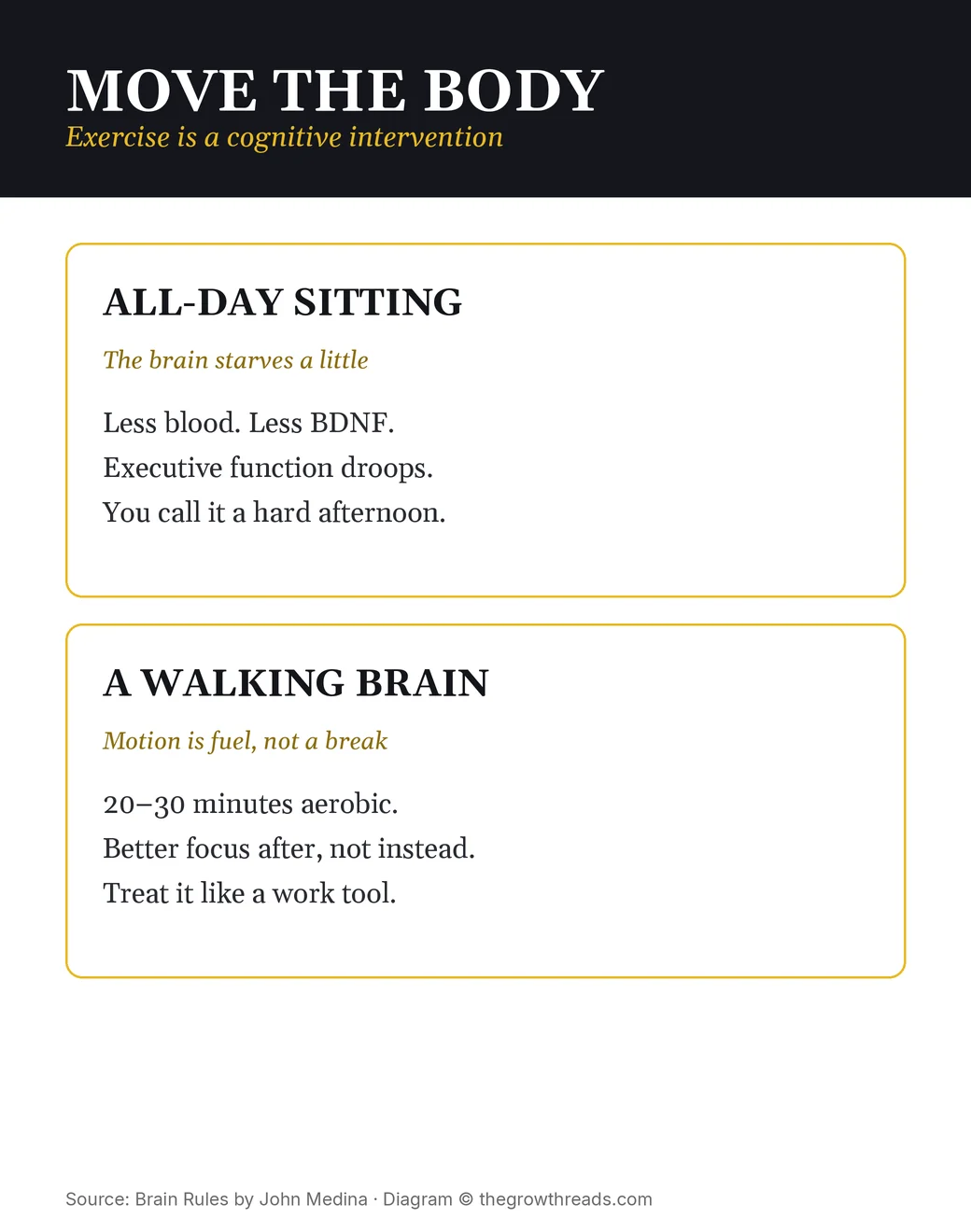
- Exercise is cognitive prep: 20–30 minutes of aerobic movement is closer to a thinking tool than a lifestyle extra.
- The brain expects motion: it evolved to solve survival problems while moving, not to thrive in a chair all day.
- Wiring is personal: experience physically changes the brain; there is no single “normal” layout to copy.
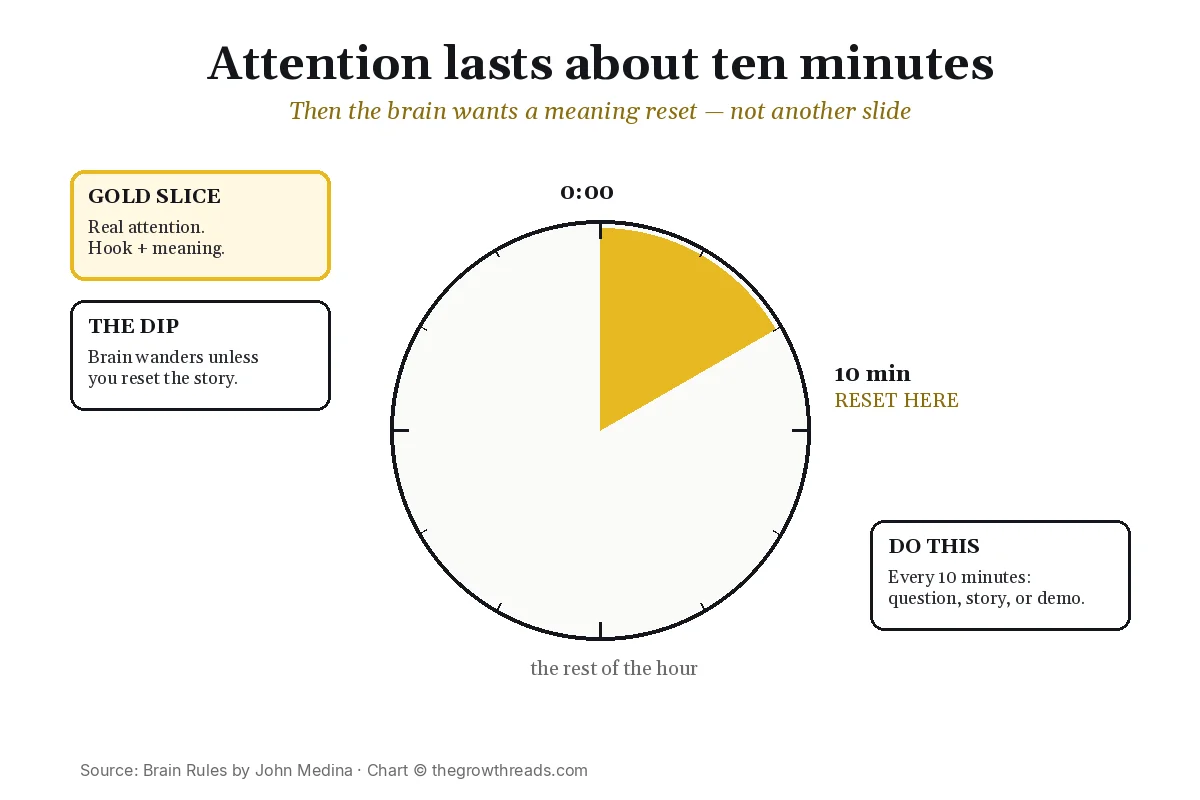
- Attention is rented in slices: you get about ten minutes, then you need a meaning reset — a story, question, or demo.
- Multitasking is a myth: you are switching, and switching has a cost you feel as “I was busy.”
- Memory is encoding plus spacing: attach meaning now; repeat later. A list is not a file.
- Sleep is a work stage: what you learned today is processed when you are off the clock.
- Chronic stress taxes learning: cortisol is useful in a sprint and expensive as a lifestyle.
- Vision and senses win: pictures and multi-sensory encoding beat another bullet slide.
- We are built to explore: curiosity is not a personality. It is what the brain does when the environment lets it.
What is Brain Rules about?
Brain Rules is John Medina’s translation of peer-reviewed brain science into twelve practical principles for work, home, and school. Each chapter states what researchers can defend, tells a human story, then asks what a classroom, office, or living room would look like if we stopped fighting the organ we actually have.
About the author
John J. Medina is a developmental molecular biologist whose research has focused on genes involved in brain development and the genetics of psychiatric disorders. He spent much of his career as a research consultant to biotech and pharma, then as founding director of Seattle’s Talaris Research Institute and director of the Brain Center for Applied Learning Research at Seattle Pacific University. He also holds a bioengineering faculty appointment at the University of Washington School of Medicine. Brain Rules (Pear Press, 2008; updated 2014) is the public version of a talk he got tired of giving: here is what we actually know, and here is why your meeting, your classroom, and your “I’ll sleep when I’m done” calendar are arguing with it. He writes like a scientist who has sat through too many decks: take a walk, then he will tell you why the walk is not a hobby. Explore all John Medina book summaries →
Key concepts at a glance
| Concept | What it means | Use it when |
|---|---|---|
| Exercise boosts brain power | Aerobic movement improves blood flow, growth factors, and executive function. | Your hardest thinking is scheduled after three seated hours. |
| Survival brain | The organ evolved for outdoor, unstable, moving problem-solving. | The workday looks like a chair, a screen, and no weather. |
| Unique wiring | Experience physically changes each brain; averages hide the person. | You are copying someone else’s system as if brains were identical. |
| Ten-minute attention | Real attention drops unless you re-hook meaning around minute ten. | You are building a 40-minute dump with no story, question, or demo. |
| No multitasking | The brain switches; it does not run two demanding tracks at once. | A second screen is open “just for reference.” |
| Repeat to remember | Working memory encodes what has meaning, not what was merely seen. | You highlight a page and call it studying. |
| Remember to repeat | Long-term memory needs spaced recall, including after sleep. | You cram once and are shocked on Thursday. |
| Sleep / stress / senses | Sleep files; chronic stress taxes; vision and multi-sense encoding win. | You cut sleep, live in cortisol, and teach with text-only slides. |
Part 1: Your brain is a survival organ that needs to move
Medina’s opening move is almost rude in its obviousness. The brain did not evolve in a climate-controlled office. It evolved to keep a body alive while that body walked, scanned, solved, and moved again. A famous line from the book is worth keeping because it is the whole thesis in one breath: the brain appears designed to solve problems related to surviving in an unstable outdoor environment, and to do so in nearly constant motion. When you seat that organ for eight hours and ask it for genius, you are not being professional. You are being historically weird.
That is why Rule 1 is not a wellness poster. Exercise boosts brain power because movement is how the system gets blood, oxygen, and the growth factors (including BDNF) that help neurons connect. Medina walks through evidence that aerobic activity is associated with better executive function, not just a better mood. The application is brutally small. You do not need a marathon plan. You need the hardest cognitive block of the day to follow a bout of real movement — a walk, a bike, stairs — so the chemistry is on your side before the spreadsheet. Sitting all day is not a neutral default. It is an intervention, just a bad one.
Rule 3 sits next to this without being a contradiction. Every brain is wired differently. Experience changes physical wiring. There is no one seating chart, one note-taking method, one “correct” hour. The survival story gives you the species; the wiring story gives you the person. Copy-paste 5 a.m. templates ignore both. Run n=1 experiments on movement and encoding, then keep what the organ rewards.
TGR Note: If you want the expertise-science next door, Peak is how skill is built in the hours; Brain Rules is the body those hours sit in. The First 20 Hours gets you usefully good. Medina tells you not to do that seated, sleep-deprived, and dual-screened.
Part 2: Attention is rented in ten-minute slices
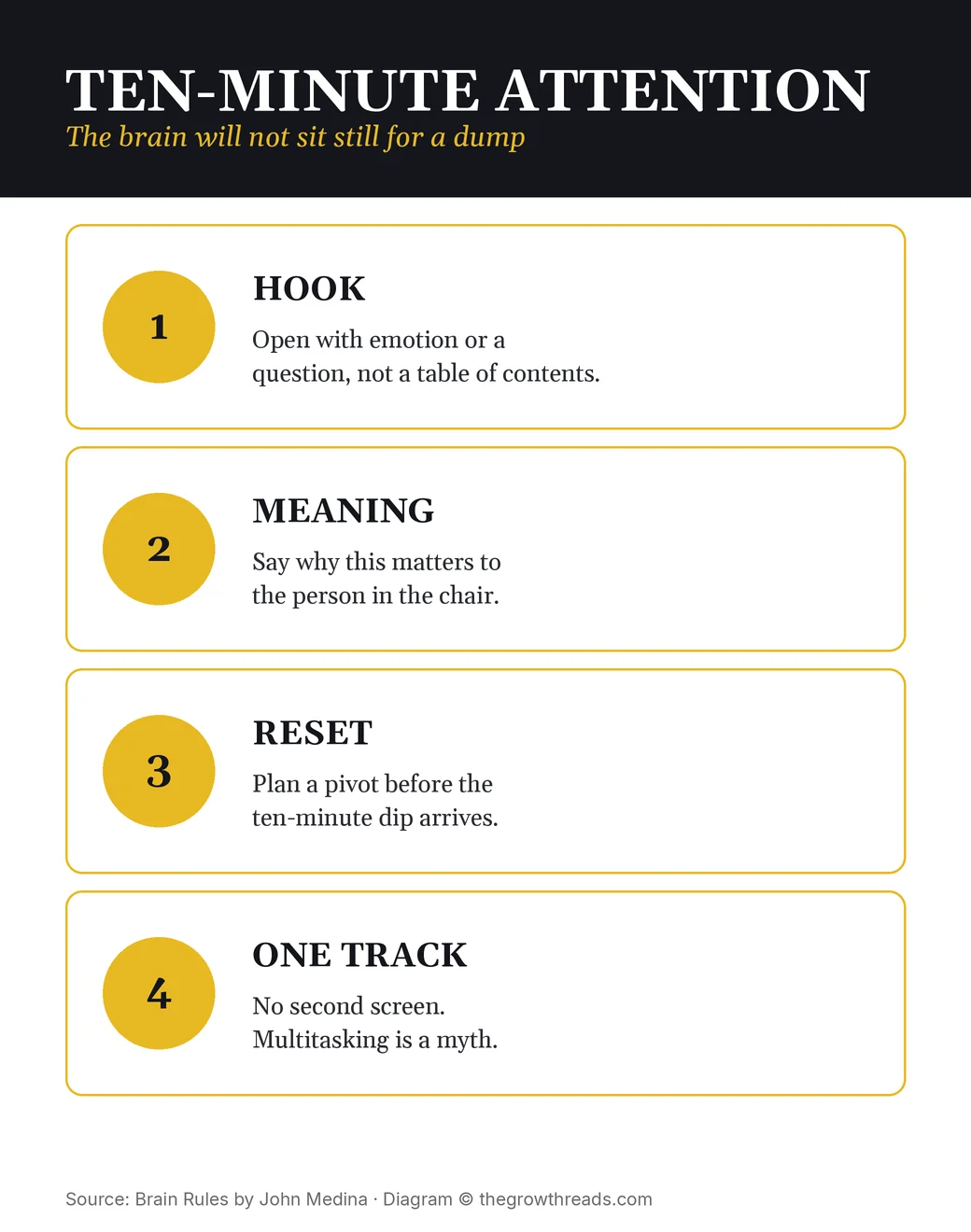
Rule 4 is the one that should rearrange every meeting you run: we don’t pay attention to boring things. That is not a moral failing in the audience. It is the filter the brain uses to stay alive. Meaning and emotion get through. Undifferentiated information does not. Medina’s practical timing is the ten-minute mark. You get a burst. Then the brain asks, silently, “why should I stay?” If you have not planned a hook — a story, a question, a demonstration, a change of frame — it will answer by checking a phone. Talking faster is not a hook. Another slide with the same shape is not a hook.
This is also where the multitasking myth gets its hearing. The brain can do automatic things in parallel (walk and talk). It cannot give two demanding, novel tracks the same high-quality attention. What we call multitasking is switching, and switching has a cost: errors, time, and the feeling of a full day with a thin residue. A second screen during a “focus block” is not a harmless convenience. It is a design that guarantees the ten-minute clock never even starts.
The office translation is almost insulting. If you present, you are in the meaning business: the first sentence has to earn the second. A 50-minute block with a mid-point question beats a three-hour “session” with Slack. Attention is the scarce input. Spend it on purpose.
TGR Note: Daniel Goleman’s Focus is the attention-as-muscle companion published after Brain Rules. Deep Work is the calendar protocol. Medina is why both of those books have to exist: the organ will not sit still for a dump, and it will not share the dump with email.
Part 3: Memory is encoding plus spaced recall
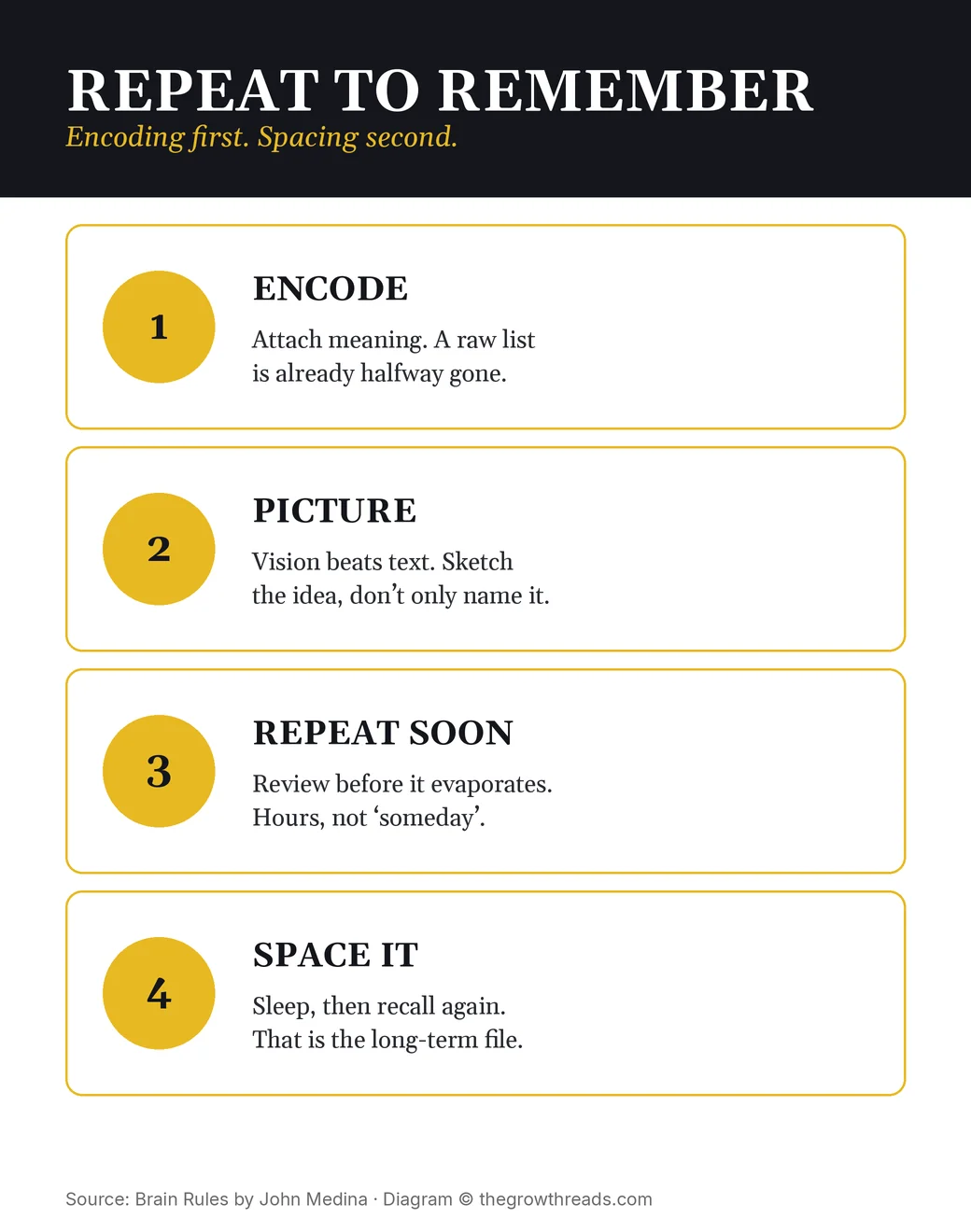
Medina splits memory into two rules that people mash together and then blame themselves. Repeat to remember is about encoding — getting the idea into a form the brain will keep. Repeat here does not mean reread. It means attach meaning. A fact with no “why,” no picture, no connection to something you already care about is a tourist. It will leave. Pictorial superiority shows up in this neighborhood: vision takes a huge share of neural real estate, so a sketch often beats a paragraph. If your notes are only words, you are fighting the sense the brain prefers.
Remember to repeat is the long-term file. Encoding is necessary and not sufficient. You have to retrieve the idea later, with time in between, including after sleep. Cramming can produce a performance the next morning and a blank the next month because you never asked the brain to reinstall the file. Teachers know this as spacing. Medina’s contribution is to stop treating it as a study trick and start treating it as biology. If you learned it today and you need it in a week, the work is not more highlighting. The work is a blank-page recall tomorrow, then again after a night’s sleep.
Put the two rules on the same desk: encode with meaning and a picture; retrieve soon; sleep; retrieve again. Presence is not encoding. Encoding is not a file. The file is recall over time. That implication is not gentle on how we run onboarding, lectures, and “quick syncs.”
TGR Note: For the denser memory playbook, Make It Stick is the book. A Mind for Numbers is the student-facing version (focused versus diffuse, recall, sleep). Medina is the biology those two are standing on. Moonwalking with Einstein is the memory-palace cousin if you want a sport, not a workday.
Part 4: Stress, sleep, and senses decide whether any of it sticks
Sleep well, think well. Medina is not poetic here. Sleep is when a lot of the filing happens. Cut it and you are asking a damaged executive-function system to do yesterday’s job plus today’s. Naps, consistent windows, and respect for circadian timing show up as tools, not as luxury branding. If your productivity system starts at 5 a.m. by stealing from sleep, you have not outworked biology. You have borrowed against tomorrow’s attention at a rotten rate.
Stressed brains don’t learn the same way. Acute stress can sharpen. Chronic stress — the unending kind with no resolution — is associated with a learning tax, including effects Medina traces through cortisol and the hippocampus. The practical read is not “never have a hard quarter.” It is: an always-on threat environment is a training environment for a worse brain. If your culture runs on permanent urgency, you are paying in encoding, not just in morale.
The remaining rules are about how information should arrive. Stimulate more of the senses. Vision trumps the others. We are powerful natural explorers if the environment lets us. Rule 11 (average sex differences) is the chapter later readers treat with the most care: group averages are not seating charts. The useful residue matches Rule 3: do not assume one template. Stop presenting as if people were text parsers. Show it. Let them try it. Exploration is how the organ prefers to learn.
TGR Note: If the real enemy is the feed, not the lecture, Stolen Focus and Digital Minimalism are the environment books. Medina still belongs first: even a clean phone will not save a sleep-deprived, seated, dual-tasked hour.
Who is Brain Rules best for — and who should read something else first?
Read this if you already care about output and you keep installing apps on top of a body that is seated, tired, and dual-screened. It is especially useful for people who run meetings, classes, or onboarding — anyone who currently “covers the material” and then wonders why nobody can retrieve it on Thursday. It is a biology primer with a calendar attached.
Read something else first if you cannot start at all — go to Atomic Habits or Mini Habits. If you need a protocol for defending long blocks, start with Deep Work. If you want a study method rather than a user’s manual, start with Make It Stick. Medina will not build your habit loop or your weekly review. He will tell you which of those systems are arguing with the organ you own.
Questions to reflect on
- When does your hardest thinking currently sit relative to movement, food, and sleep?
- In your last meeting or class, where was the ten-minute reset — or did you hope the slides would hold?
- What did you “learn” this week that you have not yet retrieved from a blank page?
- Which second screen is silently turning one hour into three switching hours?
- If chronic stress is a learning tax, what is one threat you could actually close this week instead of carrying?
🔥 Ready to stop arguing with your own brain?
Walk first. Reset at minute ten. Sleep like it is part of the job.
How to apply Brain Rules (7-day plan)
- Day 1 — Walk 20–30 minutes before your hardest cognitive block. Treat it as prep, not a break.
- Day 2 — Pick one meeting or study session. Mark a meaning reset at minute 10 and minute 20.
- Day 3 — Encode one idea with a sketch and a “why this matters” sentence. No raw bullet dump.
- Day 4 — Recall that idea with a blank page. Then check the notes. Spacing starts here.
- Day 5 — Protect a sleep window as a work tool. Cut one late screen so tomorrow’s brain exists.
- Day 6 — Run one hour with a single track — phone in another room. Notice the switching tax.
- Day 7 — Write which two Brain Rules you will keep for 30 days, and put the first instance on next week’s calendar.
Frequently asked questions
What is Brain Rules about in one paragraph?
Brain Rules is John Medina’s field guide to twelve things scientists can say with unusual confidence about the brain — and what those facts imply for work, school, and home. He is not selling a personality type. He is translating peer-reviewed biology into rules you can actually use: move before you think hard, stop pretending you can multitask, encode memories with meaning, sleep like it is part of the job, and treat chronic stress as a learning tax. The book is a user’s manual, not a neuroscience textbook.
What are the 12 Brain Rules?
Medina’s twelve: exercise boosts brain power; the brain evolved for survival in motion; every brain is wired differently; we don’t pay attention to boring things; repeat to remember; remember to repeat; sleep well, think well; stressed brains don’t learn the same way; stimulate more of the senses; vision trumps the other senses; male and female brains show average differences; and we are powerful natural explorers. You do not need to memorize the list. You need to pick the two rules your Tuesday currently violates.
Does exercise really improve thinking, or is that gym marketing?
Medina’s claim is narrower than “get abs, get smart.” Aerobic movement increases blood flow, oxygen, and growth factors that help neurons connect. People consistently perform better on attention and executive-function tasks after they move than after they sit. You do not need an athlete’s program. You need a reliable 20–30 minute bout before the work that actually requires a brain — a walk, a bike, a set of stairs. Treat it as prep, not as leftover wellness.
What is the ten-minute attention rule?
Audiences and workers give you a burst of real attention, then the brain looks for a reason to stay. Medina’s practical number is about ten minutes. After that, you need a hook: a story, a question, a demonstration, a change of frame. Dumping forty minutes of undifferentiated slides is a design that fights the organ in the room. The fix is not to talk faster. It is to plan the reset before the dip.
Is Brain Rules still accurate in 2026?
The headlines have held up: movement helps cognition, sleep is a learning stage, chronic stress is expensive, and “multitasking” is mostly rapid switching with a cost. Some examples and the gender chapter are of their moment; later work is more careful about overlap between individuals. Use the book as a bias toward biology, not as the last paper. If a rule still changes how you run a meeting or a study block, it has earned its keep. That is the test Medina would want.
How is Brain Rules different from Make It Stick or Deep Work?
Make It Stick is a memory-science manual: retrieval, spacing, interleaving. Deep Work is a protocol for protecting long, undistracted blocks. Brain Rules sits underneath both. It tells you why the block needs sleep and movement, why the lecture dies at minute eleven, and why a second screen is not harmless. Read Medina to stop fighting the hardware. Read Brown, Roediger, and McDaniel to study. Read Newport to defend the calendar.
How do I apply Brain Rules at work this week without a lab?
Pick two rules and instrument them. Walk for twenty minutes before your hardest block. Cut one meeting into ten-minute beats with a question or demo at each turn. Encode one idea with a sketch, then recall it tomorrow without notes. Put a sleep window on the calendar as if it were a client. Kill one second screen during the block. That is the whole experiment. If nothing changes, you chose decoration. If something does, keep the rule and ignore the rest of the poster.
Related summaries
- Make It Stick — retrieval, spacing, and why rereading lies to you.
- A Mind for Numbers — focused vs diffuse learning, recall, and sleep.
- Focus — Goleman on attention as a trainable muscle.
- Deep Work — the calendar protocol for undistracted blocks.
- Best productivity books — the full Productivity pillar.
How we analyze books: every book on The Growth Reads is read cover to cover, summarized in thousands of words of original analysis, and rated against our five-criteria rubric (lasting impact, evidence quality, practical application, writing & originality, external consensus). Read our full methodology.