

★★★★½ 4.4/5 — the most useful antidote to the 10,000-hour myth: a method for getting good enough to enjoy a skill before you decide whether mastery is even the point.
Best for: Anyone who keeps not-starting because “real” skill supposedly takes a decade
Reading time: ~5 hours (288 pages) · this guide ~16 min
Difficulty to apply: Medium — the steps fit on a card; the work is twenty honest hours on a clock
The First 20 Hours in one minute
You do not need 10,000 hours to start. You need twenty hours of focused practice to get usefully good. The First 20 Hours (Portfolio, 2013/2014) is Josh Kaufman’s field manual for rapid skill acquisition: one lovable project, a testable target, the few subskills that produce the result, just enough theory to self-correct, every barrier stripped out, and twenty hours on a clock. The 10,000-hour figure is a mastery requirement, not a permission slip. Most people quit in the ugly first hours — the frustration barrier — long before competence arrives. Pre-committing to twenty hours makes that clumsiness terrain you cross, not a verdict on talent.
Key takeaways
- 10,000 hours is mastery, not permission: Ericsson’s research, popularised in Outliers, describes elite performance. Kaufman wants competence you can use this month.
- The real enemy is the frustration barrier: Early practice feels clumsy. That is where almost everyone stops. Pre-commit to twenty hours so clumsiness is not a verdict.
- One lovable project at a time: Three new skills at once produce three shallow starts. Rapid skill acquisition is sequential.
- Write the target performance in one sentence: “Learn guitar” is a wish. “Play three campfire songs without stopping” is a skill.
- Deconstruct, then ignore the trivia: Most skills are bundles. Practice the 20 percent of moves that produce 80 percent of the result first.
- Learn only enough to self-correct: You need enough theory to notice a mistake and adjust — not a degree before you touch the tool.
- Barriers beat motivation: If the guitar is in a cupboard, you will not practice. Setup time and open tabs are the actual opponents.
- Practice by the clock in short bursts: Forty to ninety focused minutes. Speed in the early hours beats slow perfection.
- Honor biology: Sleep, food, and a quiet room are part of the method. A tired brain cannot log honest hours.
- Twenty hours is a floor: After twenty, keep going toward craft or keep the skill as a tool. Either beats never starting.
What is The First 20 Hours about?
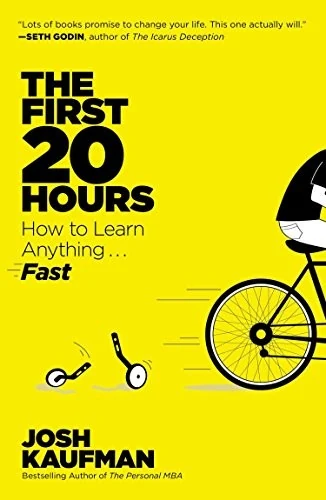
The First 20 Hours is a rapid-skill method for reaching useful competence — not world-class mastery — in about twenty hours of focused, deliberate practice. Josh Kaufman shows how to pick one project, deconstruct it, remove practice barriers, and push through the early frustration that makes most people quit.
About the author
Josh Kaufman is the author of The Personal MBA, the reading-list-turned-book that argued you can learn how business works without a two-year, six-figure programme. He worked at Procter & Gamble, then left to research independent business education from Colorado. The First 20 Hours asks the companion question: if you can skip the MBA, can you skip the decade-long apprenticeship before a skill is allowed to be useful? His 2013 TED talk — a ukulele after twenty hours of practice — is the public version. He writes as a practitioner: yoga, programming, typing, Go, ukulele, and windsurfing, with the failures left in. Explore all Josh Kaufman book summaries →
Key concepts at a glance
| Concept | What it means | Use it when |
|---|---|---|
| Rapid skill acquisition | A process for reaching useful performance fast, not elite mastery | You need the skill this quarter, not this decade |
| Target performance level | One sentence describing the exact situation you want to handle | The goal is still “get better at X” |
| Deconstruction | Splitting a skill into subskills and ranking them by payoff | The whole skill looks too big to start |
| Frustration barrier | The clumsy early hours when you feel slow and obvious | You have quit this skill before week two |
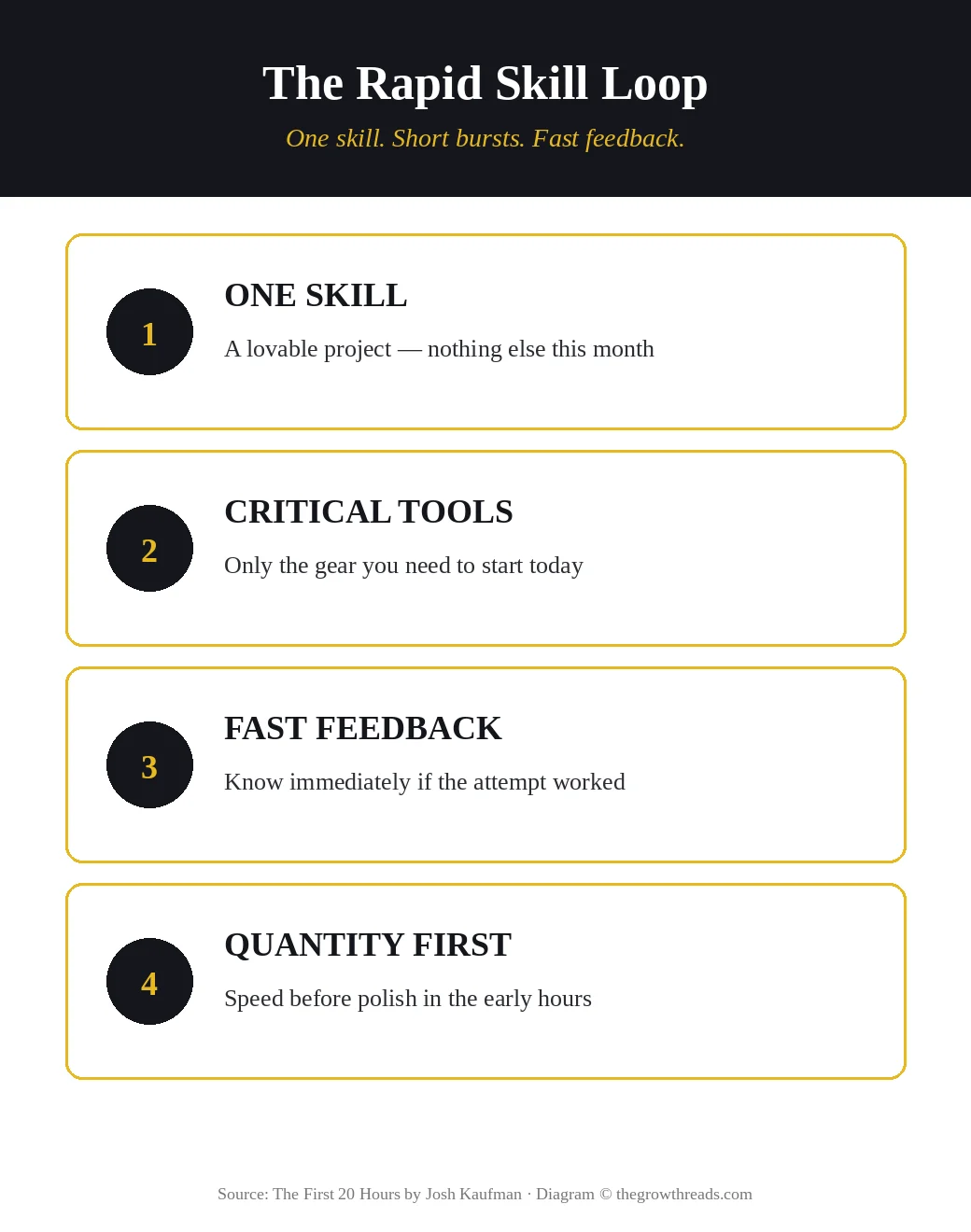
| Critical tools | The minimum kit without which practice cannot happen | You are “waiting to be ready” |
| Fast feedback | Knowing immediately whether the last attempt worked | Practice feels busy but not better |
| Practice by the clock | Timed, focused bursts instead of “when I feel like it” | Sessions dissolve into tinkering |
| Quantity and speed | Early hours favour volume over polish | You restart the same bar for forty minutes |
Part 1: Forget 10,000 hours — shoot for 20
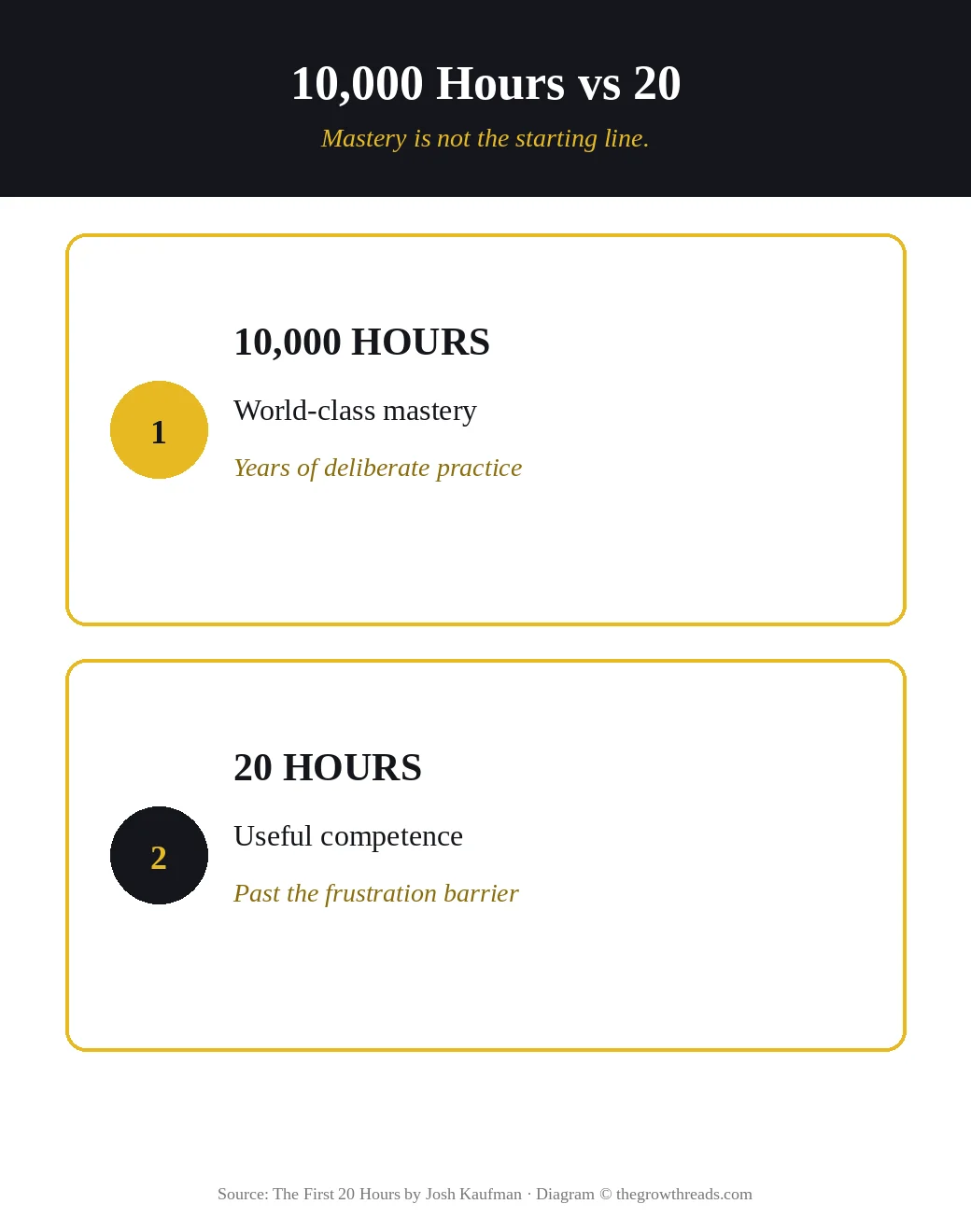
Kaufman opens by taking the 10,000-hour rule off the starting line. The figure comes from research on expert performance — violinists, chess players, athletes already inside a skill. Malcolm Gladwell’s Outliers carried it into popular culture as a story about greatness. Useful if you want world-class. Terrible if you want a basic conversation in Spanish, a small script, or three wedding songs. Those outcomes need concentrated practice past incompetence, not a decade.
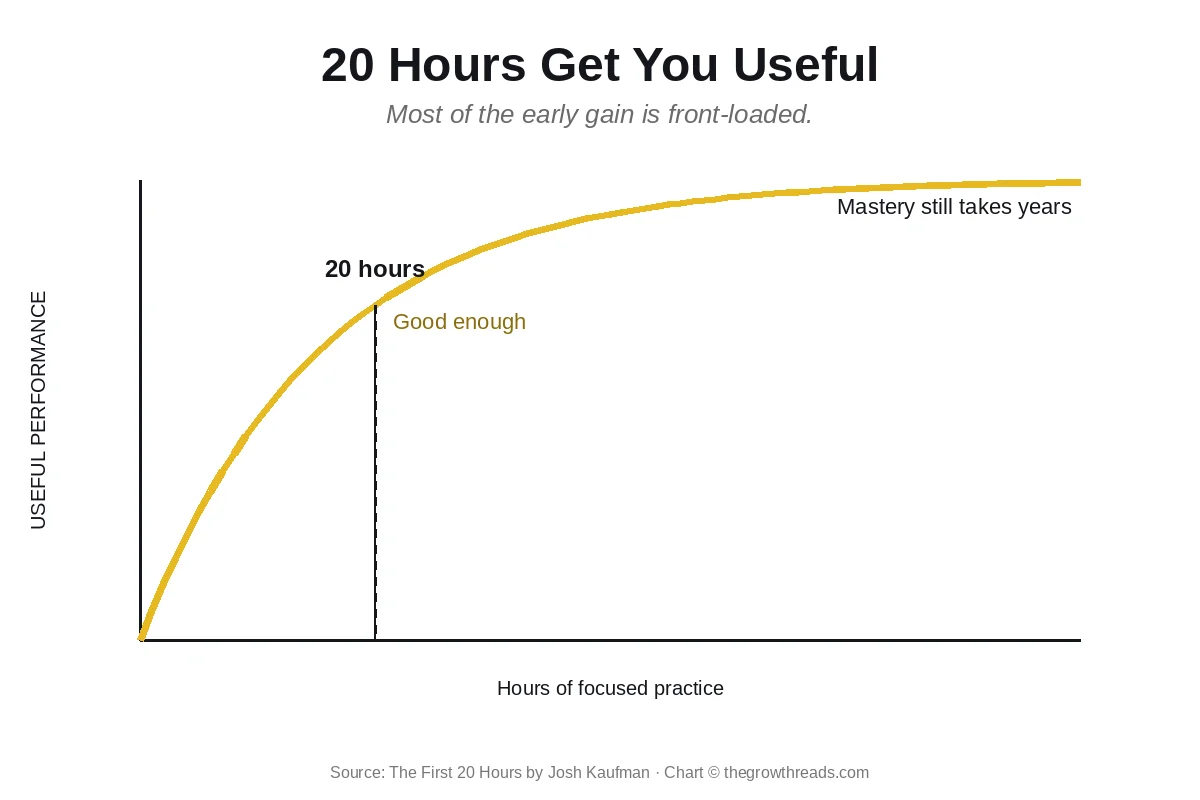
The early part of a skill is steep: nothing to “noticeably not bad” is faster than good to great. Twenty hours is long enough that you cannot fake it with a weekend binge, and short enough to schedule — about forty-five minutes a day for a month. The number is a design constraint. If you need more, you take more. Stop using “I will never be a master” as a reason to remain a beginner who has never begun.
What stops people is not hour twenty. It is hour two, when the fingers will not listen. Kaufman calls this the frustration barrier: the stretch where the only available identity is “person who is bad at this.” Pre-committing to twenty hours changes the meaning. Clumsiness is terrain you agreed to cross. You do not renegotiate because Tuesday felt stupid.
TGR Note: If you actually want elite performance, read Peak by Anders Ericsson — that is the research the 10,000-hour slogan flattened. Outliers is the culture layer. Kaufman is the on-ramp those two books assume you already have: permission to become useful before you become remarkable.
Part 2: The five-step method (and ten rapid-skill principles)
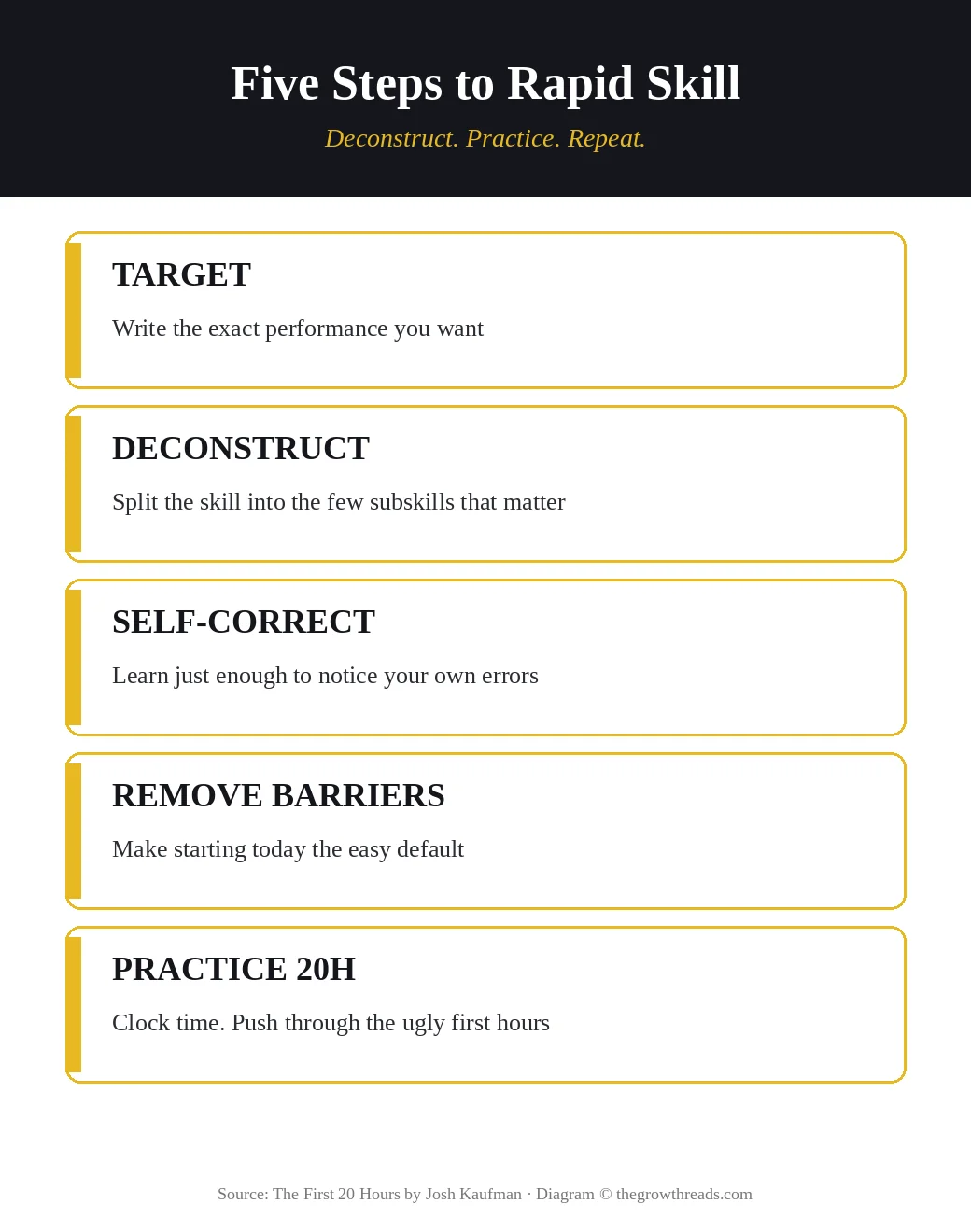
Under the TED-friendly headline is a sequence you can run on any skill. Kaufman states it as five moves, then expands it into ten operating principles. Use the five when you need a checklist. Use the ten when a step stalls.
1. Choose a lovable project. If you do not care, you will not sit down for twenty hours. Skip the “should” skill. Pick the one you will protect on a tired Thursday.
2. Focus on one skill at a time. Parallel learning feels productive and produces three shallow ruts. Finish the twenty hours before you open a second front.
3. Define your target performance level. Write one sentence a stranger could check. Not “learn to code” — “build a small app that stores my reading list.” Anything that does not serve the sentence can wait.
4. Deconstruct the skill into subskills. List the parts, rank by payoff, practise the high-payoff parts first. Trivia is what tutorials add to feel complete.
5. Obtain critical tools, then stop shopping. If a tool is required to practice, get it this week. If it is an upgrade, it is a stall.
The remaining principles protect the hours. Eliminate barriers: instrument on a stand, file already open, sites blocked. Put the hours on a calendar, not in a mood. Build fast feedback — a tuner, a test, a 30-second recording. Practice by the clock for twenty to ninety minutes of actual doing. In the early hours, quantity and speed beat polishing the second bar forever.
Kaufman’s line that sticks: the major barrier to skill acquisition is not intellectual. It is emotional. The method is how you keep sitting down after the emotion arrives.
TGR Note: Scott Young’s Ultralearning is the aggressive cousin: longer projects, public accountability, metalearning sprints. Kaufman’s twenty hours is the on-ramp you can finish without taking a sabbatical. Pair it with Make It Stick once you are in the hours — retrieval and spacing are how those repetitions survive overnight. Rapid practice without retrieval is just busy time.
Part 3: How learning actually sticks
Chapter two of the book is a second checklist: ten principles of effective learning. This is the layer people skip because it sounds like school. Skip it and you will log twenty hours of confused repetition.
Research the skill just enough to see the map, then jump in slightly over your head so a real piece of work can teach you. Attach new moves to mental models you already have. Imagine the opposite of success this week — phone on the desk, no tuner, no calendar slot — and delete those conditions. Talk to practitioners so your expectations are adult. Design the room: distraction is an environmental leak. Space the sessions instead of one heroic Saturday. Use a checklist when attention fades. Predict before you try, then check. Sleep, food, and a body that can last the session are part of the method. A depleted nervous system will not store the skill.
Self-correction is the hinge between the two checklists. You are not collecting information. You are building a loop: attempt, notice, adjust, attempt. If you cannot tell whether the last try was better, you do not yet have a skill process. You have a hobby of consuming explanations. Kaufman would rather you be slightly under-educated and over-practised than the reverse.
TGR Note: The learning-principles chapter is Kaufman overlapping his other book. The Personal MBA is the same author applying deconstruction to business instead of ukulele. If the skill you want is commercial literacy, start there. If the skill is anything you do with your hands, ears, or a compiler, stay here. A Mind for Numbers is the focused cousin for technical subjects: focused versus diffuse mode, which is Kaufman’s “honor your biology” with a study-specific map.
Part 4: Six skill labs — yoga to windsurfing
The second half is Kaufman as test subject. Do not read it as a yoga or Ruby course. Watch the checklists hit a real week: missing gear, bad advice, a body that will not cooperate, and the moment quantity beats theory.
Yoga is a short personal sequence, mat already on the floor — the barrier is changing clothes and hunting the “right” video. Programming is a small working app, not a developer identity; error messages are the teacher. Colemak typing is the dip: you get worse before you get usable, because the twenty hours are already purchased. Go warns against infinite theory — play a full game without freezing. Ukulele is four chords, a strum, three songs, instrument left out. Windsurfing is logistics: gear, wind, water. Count only hours you were actually practising. “Researching conditions” is often avoidance.
In every lab he writes the target, throws out most of the curriculum, hits a barrier, and returns to timed practice. The chapters are long. The pattern is short. Steal the pattern.
TGR Note: If your twenty hours are in a craft that rewards feel and feedback — music, sport, games — The Talent Code and The Art of Learning explain what deep practice looks like after Kaufman gets you through the door. If the skill is a career bet, So Good They Can’t Ignore You is the next question: competence is the start of career capital, not a personality type you wait to feel.
Who is The First 20 Hours best for — and who should read something else first?
Best for adults who want a new skill in the next month — a language threshold, a work tool, an instrument, a sport, a small programme — and for anyone whose story is “I am not a natural.” The book does not debate talent. It puts twenty hours on the table.
Read something else first if you already need mastery mechanics: Peak or Grit. For a full self-education system, Ultralearning. If the “skill” is a daily habit, use Mini Habits instead of a twenty-hour project. For business literacy, start with The Personal MBA. For a long-horizon craft identity, Mastery is the opposite energy.
Questions to reflect on
- Which one skill, if you were merely “good enough” at it in 30 days, would make the rest of your work or week easier?
- What is the target performance in one sentence a stranger could check yes or no?
- If you listed ten subskills, which three actually produce that sentence — and which seven are tutorial trivia?
- What is the smallest physical barrier that stopped you the last time you tried (tool in a cupboard, file not installed, no slot before 9pm)?
- If the twenty hours were already paid for, where do the first four live on this week’s calendar?
🔥 Ready to get usefully good in twenty hours?
Get Kaufman’s full checklists, the six skill labs, and the barrier-removal details — then run the 7-day plan below.
How to apply The First 20 Hours (7-day plan)
- Day 1 — Pick the lovable skill and write the target. One project. One sentence a friend could score. If you cannot test it, it is still a wish.
- Day 2 — Deconstruct on one page. List the parts. Circle the few that produce the target. Cross out “eventually.” That list protects the twenty hours.
- Day 3 — Get only the critical tools. Buy, download, or borrow what you must have to practice tomorrow. Do not upgrade. Leave the tool in the way.
- Day 4 — Delete one barrier. Find the setup step that usually kills the session. Remove it tonight so tomorrow starts with one action.
- Day 5 — Learn just enough to self-correct. One overview, one demo, one checklist, then a timed 40-minute attempt. Notice one error you can fix next time.
- Day 6 — Practice by the clock, quantity first. Another 40–90 minutes. Count minutes, not polish. Save a 30-second clip or the output so feedback is visible.
- Day 7 — Log hours and schedule the rest. Write hours done. Put remaining sessions on the calendar until twenty. Notice the frustration without renegotiating.
Frequently asked questions
What is The First 20 Hours about in one paragraph?
The First 20 Hours is Josh Kaufman’s method for reaching useful competence in a new skill without waiting for 10,000 hours of mastery. You pick one lovable project, define a testable target, break the skill into high-payoff subskills, get the minimum tools, strip out practice barriers, and log twenty hours of focused, timed practice. The early clumsiness is expected. Pre-committing to twenty hours is how you pass the frustration barrier instead of treating it as proof you should stop. It is a starter system for adults who need a skill this month.
Does The First 20 Hours replace the 10,000-hour rule?
No. Kaufman is not arguing that experts are fake or that deliberate practice is optional for world-class work. He is splitting two targets that popular culture mashed together. Ten thousand hours is a story about elite performance. Twenty hours is a story about getting good enough to use the skill, enjoy it, and decide whether to keep investing. You can do Kaufman’s twenty and then, if the skill matters enough, move to the kind of deliberate practice described in Peak. The mistake is using the mastery number as a reason never to begin.
What are the five steps of rapid skill acquisition?
Choose a project you actually care about. Focus on that one skill. Write a target performance level you can test. Deconstruct the skill and practise the subskills with the highest payoff first. Get the critical tools, then practise for at least twenty hours while you remove barriers, keep sessions on a clock, and use fast feedback. Kaufman also lists ten principles (lovable project, one skill, target, deconstruction, tools, barriers, dedicated time, feedback, short bursts, quantity and speed). The five are the spine; the ten are what you check when a step stalls.
Is twenty hours really enough to be good?
“Good” depends on the target you wrote. Twenty hours will not make you a concert pianist, a professional developer, or a competitive Go player. It will often get you to “I can do the thing I named in the sentence”: three songs, a small working programme, a short yoga flow, a playable game. Skills with heavy logistics (wind, water, access to a coach) may need more calendar time to collect twenty honest practice hours. Count the hours you were actually practising. Then decide, with evidence, whether to continue.
How do I pick which skill to learn first?
Pick the one you will protect on a tired day, not the one that looks best on a plan. Kaufman calls it a lovable project: curiosity, a person you want to play with, or a use you will have this month. If two skills are tied, choose the one whose critical tools you can get this week and whose target sentence is easiest to test. Do not start three. Sequential twenty-hour blocks beat a year of simultaneous dabbling. After twenty hours you can choose a second skill with a cleaner conscience.
How is this different from Ultralearning or Peak?
Peak is the science of expert performance and deliberate practice over years. Ultralearning is an intense self-education system: longer projects, metalearning, public accountability. The First 20 Hours is the on-ramp: a short, emotionally realistic protocol for getting through the first ugly stretch so you have a skill to intensify later. If you already practise seriously, you may find Kaufman’s labs light. If you have not started, Peak and Ultralearning can feel like being handed a marathon map when you still need shoes. Use Kaufman to begin, then graduate.
Should I read The Personal MBA or The First 20 Hours first?
Read The Personal MBA first if the skill you want is how business works — value, markets, sales, operations, finance. Read The First 20 Hours first if the skill is something you do with practice hours: an instrument, a language threshold, a tool, a sport, a small programme. They share a brain: deconstruct the domain, ignore prestige curricula, practise what pays. They do not share a target. One builds commercial literacy. The other builds a method you can reuse on the next skill for the rest of your working life.
Related summaries
- The Personal MBA Summary & Review
- Ultralearning Summary & Review
- Peak Summary & Review
- Make It Stick Summary & Review
- Best Productivity Books
How we analyze books: every book on The Growth Reads is read cover to cover, summarized in thousands of words of original analysis, and rated against our five-criteria rubric (lasting impact, evidence quality, practical application, writing & originality, external consensus). Read our full methodology.