

★★★★★ 4.7/5 — Oliver Burkeman’s follow-up to Four Thousand Weeks turns philosophy into 28 short, daily-sized meditations on finitude.
Best for: Recovering perfectionists and productivity-system veterans who’ve optimized everything except their sense of enough.
Reading time: ~5 hours (208 pages)
Difficulty to apply: Easy to start, harder to sustain — the ideas are simple, but unlearning productivity guilt takes longer than reading one book.
Meditations for Mortals in one minute
The right moment to start living the life you actually want is never going to arrive. That’s the premise Oliver Burkeman builds his second book around — a philosophy he calls imperfectionism, the idea that your limitations aren’t obstacles standing between you and a meaningful existence, but the actual material a meaningful existence gets built from. Structured as 28 short meditations meant to be read roughly one a day across four weeks, the book takes the central argument of his earlier bestseller, Four Thousand Weeks — that a finite life makes traditional productivity advice largely beside the point — and turns it into small, concrete daily practices: how to act despite never feeling fully prepared, how to handle backlogs without guilt, and how to stop treating other people’s disappointment as yours to manage.
Key takeaways
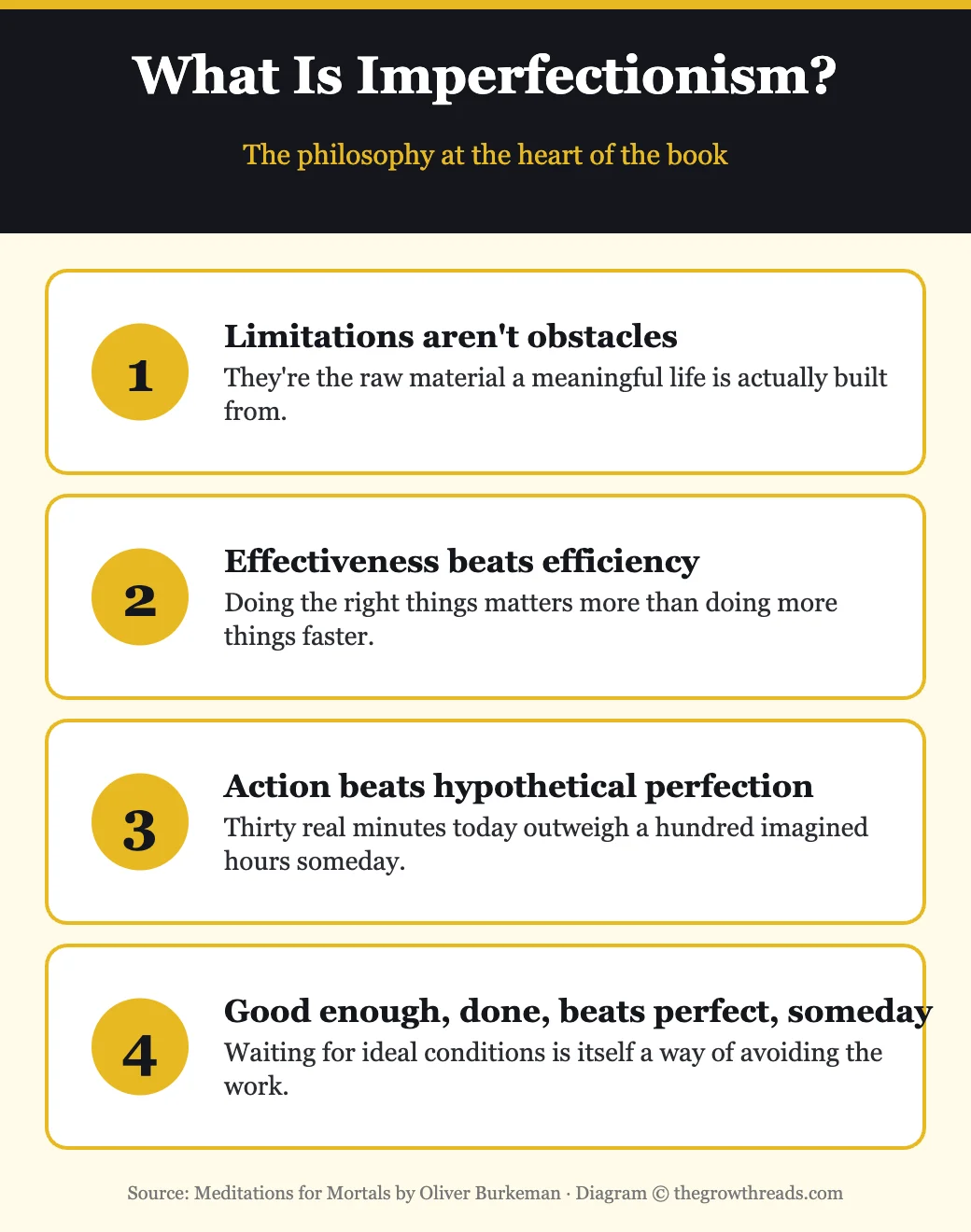
- Imperfectionism reframes limits as material, not obstacles: your finite time and energy aren’t problems to solve — they’re what a meaningful life is actually built from.
- Effectiveness beats efficiency: doing work that matters, even imperfectly, outperforms doing more things faster in a race that never ends.
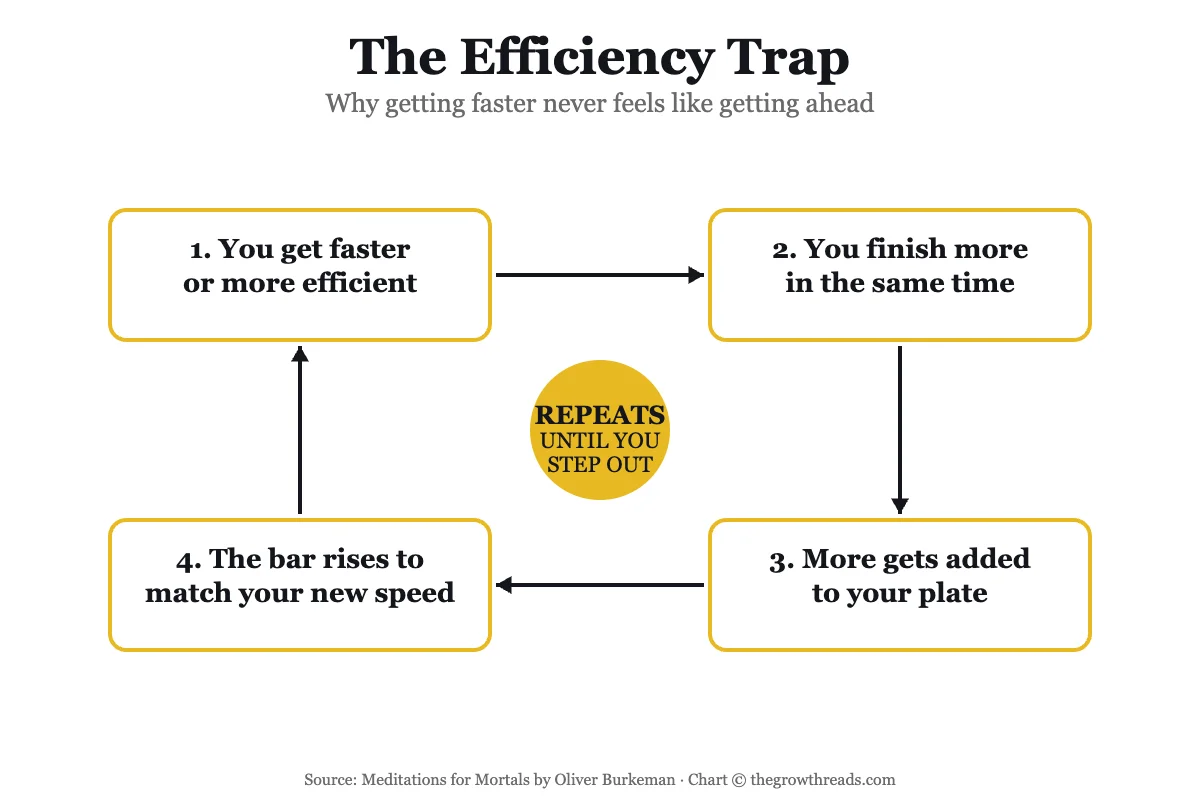
- The efficiency trap explains why speed never creates slack: freed-up capacity gets absorbed by new expectations almost as fast as you create it.
- Action beats hypothetical perfection: thirty real minutes today outweigh a hundred imagined hours you’re planning to spend once conditions improve.
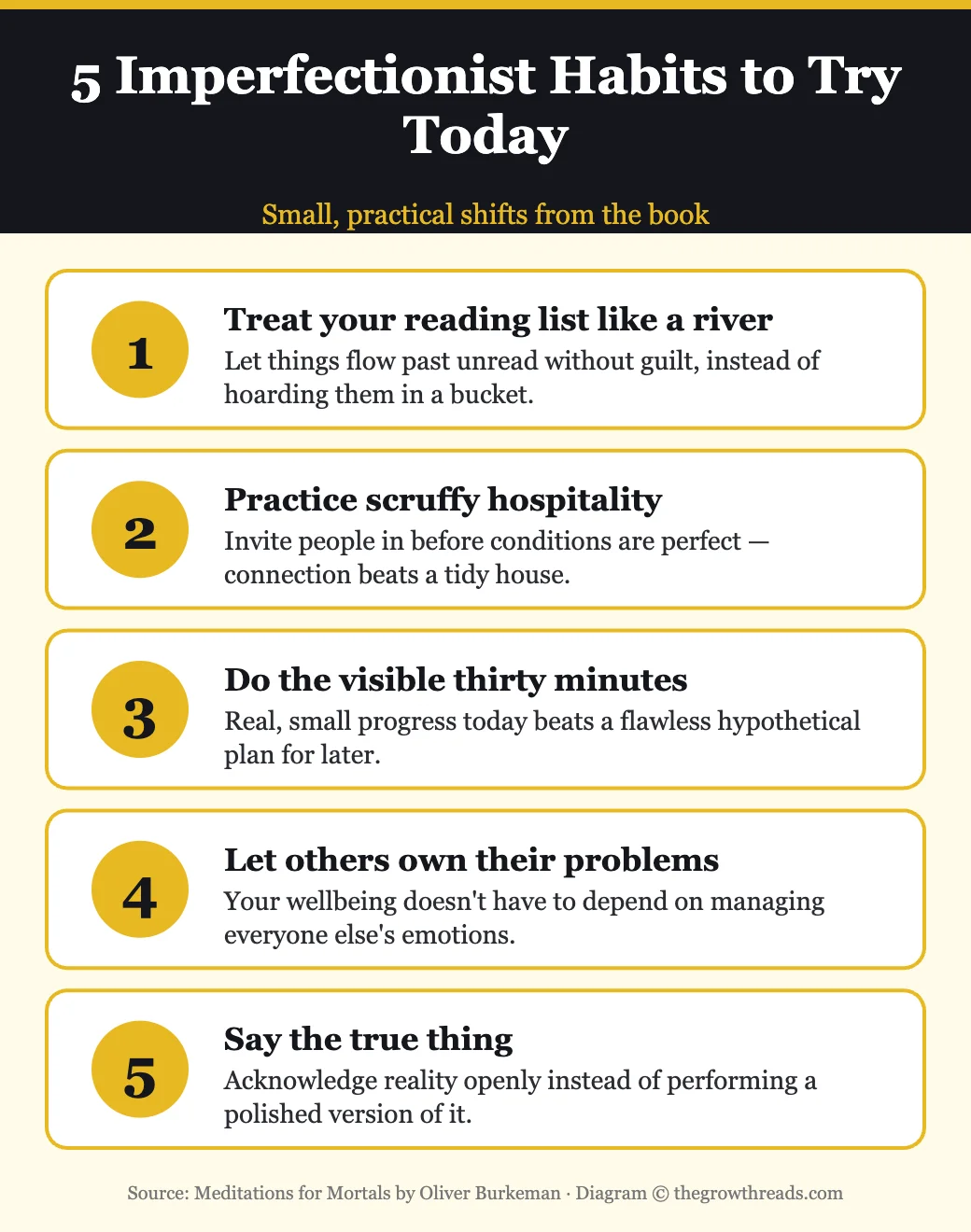
- Treat backlogs like a river, not a bucket: most of what flows past was never going to be caught, and that’s fine.
- Scruffy hospitality beats perfect conditions: inviting people in before things are ready matters more than waiting until they’re presentable.
- You can’t out-produce your way to feeling caught up: the goalpost moves every time you get closer to it.
- Other people’s problems aren’t automatically yours to fix: managing everyone’s emotional reactions to your limits is both exhausting and unnecessary.
- Authenticity beats performance: saying plainly where things stand is more sustainable than maintaining a polished front.
- The book is meant to be read slowly: one short meditation at a time, like a retreat of the mind rather than a single argument.
What is Meditations for Mortals about?
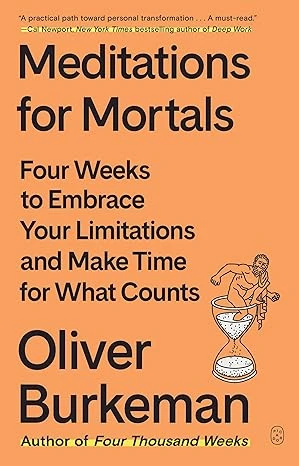
Meditations for Mortals is Oliver Burkeman’s follow-up to Four Thousand Weeks — 28 short daily meditations built around “imperfectionism,” the idea that your limitations aren’t obstacles to a meaningful life but the material it’s actually built from. It replaces productivity systems with small daily practices for acting, connecting, and resting despite never feeling fully caught up.
About the author
Oliver Burkeman spent many years as a journalist at The Guardian, where he wrote “This Column Will Change Your Life,” a popular weekly column applying psychology research to everyday problems. His first book on time and productivity, Four Thousand Weeks: Time Management for Mortals, became a New York Times bestseller by making the case that a finite life — roughly four thousand weeks long — makes traditional productivity advice largely beside the point. He’s also the author of The Antidote: Happiness for People Who Can’t Stand Positive Thinking and Help!, both applying the same skeptical, research-grounded curiosity to self-help advice. Meditations for Mortals, published in October 2025, is his most practice-oriented book yet — a daily companion designed to turn his earlier philosophy into lived habit. Explore all Oliver Burkeman book summaries →
Key concepts at a glance
| Concept | What it means | Use it when |
|---|---|---|
| Imperfectionism | Philosophy that limitations aren’t obstacles to a meaningful life | You’re stuck waiting for “the right conditions” to start |
| The efficiency trap | Getting faster raises what’s expected of you, not your slack | You wonder why optimizing never seems to create more free time |
| River, not bucket | Treating backlogs as something to let flow past, not hoard | Your reading list or inbox feels like a mounting debt |
| Scruffy hospitality | Inviting people in before things are “ready” | You keep postponing connection until conditions are perfect |
| The thirty-minute rule | Real, small, imperfect action beats a hypothetical perfect plan | You’re stalling a project waiting to feel fully prepared |
| Owning your truth | Being honest about where things actually stand | You’re tempted to perform competence instead of being straightforward |
Part 1: The efficiency trap — why getting faster never feels like getting ahead
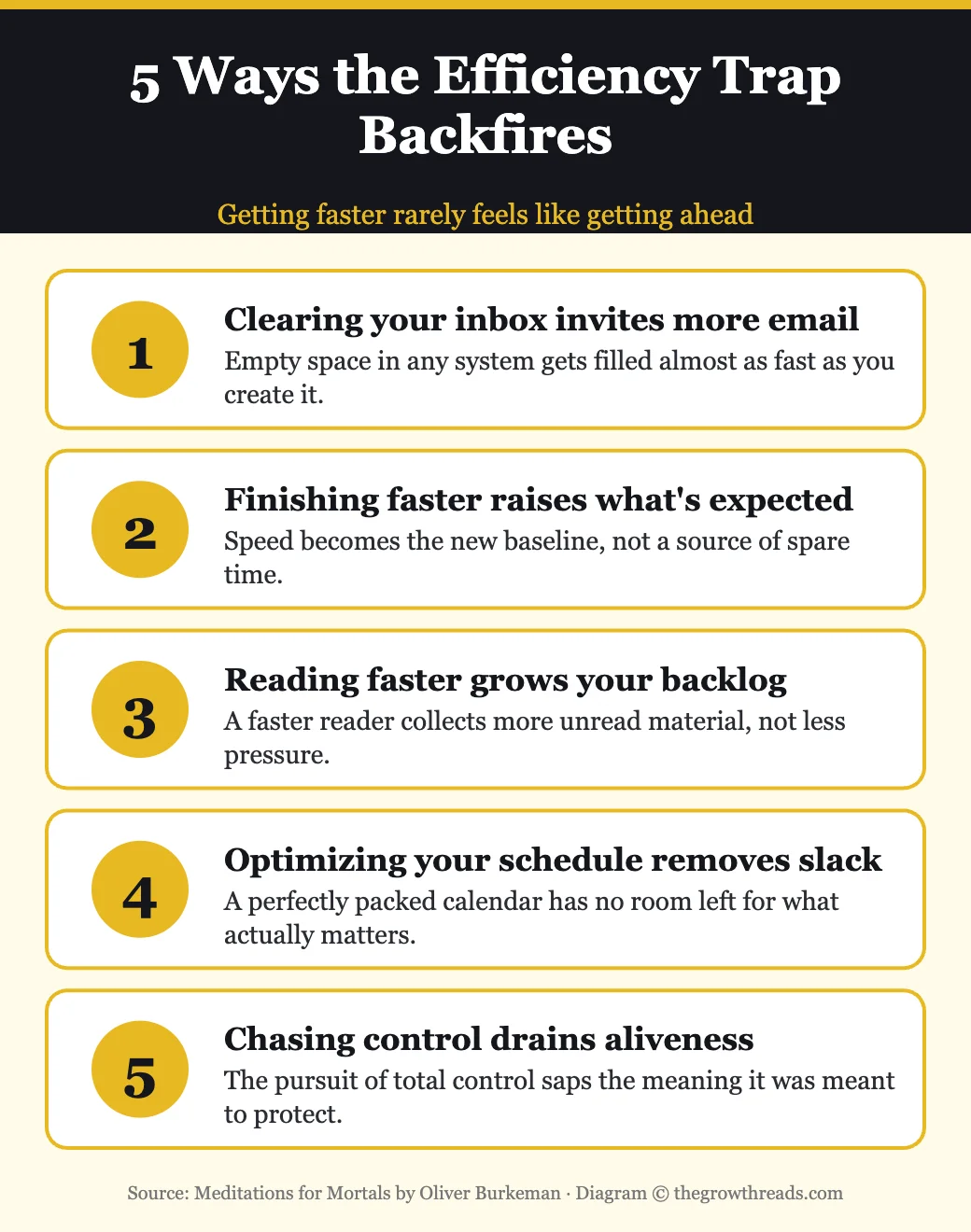
Burkeman opens with a puzzle that will be familiar to anyone who has ever cleared their inbox to zero only to watch it refill by lunchtime: why doesn’t getting faster ever create the spare time it seems like it should? His answer is what he calls the efficiency trap, and it’s less a personal failing than a structural feature of how expectations adjust to capacity. The moment you demonstrate you can do something faster, that speed becomes the new normal — for you and for everyone who depends on your output. The slack you created by working faster doesn’t sit there waiting to be enjoyed; it gets absorbed by new demands almost as quickly as it appears.
This isn’t an argument against competence or effort. It’s an argument against the specific belief that if you just get efficient enough, you’ll eventually clear enough space to relax, and the striving will stop. Burkeman’s point, building on the central thesis of Four Thousand Weeks, is that this space never arrives — not because you haven’t optimized hard enough, but because the goalpost moves every time you get closer to it. Treating productivity as a debt to be paid off keeps you on a treadmill that has no finish line by design.
The way out, he argues, isn’t a better productivity system. It’s a change in what you’re optimizing for. Effectiveness — doing work that actually matters, even imperfectly and even if some of it never gets fully “caught up” — beats efficiency, which just makes you faster at a race that was never going to end. This reframing is what he spends the rest of the book turning into daily, practical habits.
TGR Note: This is the same trap J.D. Meier tries to interrupt with fixed weekly capacity in Getting Results the Agile Way — instead of letting finished tasks create room for more, both authors argue for deciding your capacity in advance and defending it.
Part 2: Imperfectionism — a philosophy for finite people
The book’s title comes from its format — 28 short meditations meant to be read roughly one a day, across four weeks, like a retreat of the mind rather than a single argument built chapter by chapter. But its real backbone is the philosophy Burkeman calls imperfectionism: a freeing, energizing outlook built on the idea that your limitations aren’t obstacles standing between you and a meaningful existence — they’re the actual material a meaningful existence gets built from.
This is a sharper claim than it first sounds. Most self-help advice treats limitations as problems to solve: not enough time, not enough discipline, not enough system. Imperfectionism inverts that. You are always going to be finite — one person, with finite hours, finite energy, and finite control over outcomes — and no amount of optimization changes that fact. The question worth asking isn’t how to transcend your limits; it’s how to build a genuinely full life inside them, starting now, rather than waiting for a version of yourself that doesn’t have them.
Practically, this shows up as permission: permission to leave things undone, to disappoint people occasionally, to do a good-enough job instead of a perfect one, and to stop treating your to-do list as a referendum on your worth. Burkeman is careful not to frame this as lowered ambition. It’s a redirection of ambition toward things that are actually achievable by a finite person — depth in a few things instead of adequacy in everything.
TGR Note: Readers who want the fuller argument behind this idea should look at Burkeman’s earlier Four Thousand Weeks, which makes the case that a finite life is precisely what makes ruthless prioritization necessary — Meditations for Mortals is the daily-practice companion to that book’s core argument.
Part 3: Small daily practices that change how you relate to time
Because the book is built as 28 short, one-sitting meditations, its most memorable ideas tend to arrive as compact, quotable reframes rather than extended arguments — and several of them are genuinely useful on their own. One is Burkeman’s advice to treat your reading list, inbox, or any other backlog “like a river, not a bucket.” A bucket accumulates: every unread book or unanswered message sits there as evidence of falling behind, and the only way to feel caught up is to empty it completely, which never happens. A river, by contrast, is supposed to have things flow past it. Most of what passes by was never going to be read, watched, or acted on, and that’s fine — the goal was never to catch everything, just to catch what matters as it goes by.
Another is what he calls “scruffy hospitality” — the practice of inviting people into your life, your home, or your unfinished projects before conditions are ideal, rather than waiting for the version of things that’s presentable enough to share. The underlying pattern repeats across the book: waiting for the right moment is usually just a more comfortable way of avoiding the thing you actually want to do.
The book’s four-week structure isn’t arbitrary. Rather than front-loading theory and back-loading tactics, Burkeman interleaves them deliberately — a meditation on accepting a limitation might sit right next to one on taking imperfect action anyway, so the philosophy and the practice reinforce each other in the same short sitting instead of being separated into a “why” half and a “how” half. That structure is also why the book rewards being read slowly, a chapter or two at a time, rather than in one sitting: each meditation is designed to be sat with, not just consumed, and the ideas compound more when there’s a day of ordinary life between one meditation and the next to actually try them.
The most directly actionable idea is what amounts to a thirty-minute rule: thirty real, if imperfect, minutes spent actually doing a thing today are worth more than a hundred hypothetical hours you’re planning to spend on it once you finally have things figured out. Burkeman’s case is that most people already know what they’d do with a perfectly organized, unlimited-time version of their life — the actual skill worth building is starting anyway, today, with the ordinary, interrupted, imperfect time you actually have.
Part 4: Letting other people (and yourself) off the hook
The book’s final movement turns from managing your own time to managing your relationship with other people’s expectations — and here Burkeman makes a case that will read as either liberating or uncomfortable depending on how much of your current stress comes from other people’s unmet needs. His argument is that you are not responsible for managing everyone else’s emotional state, and that trying to is both exhausting and, in a subtle way, disrespectful — it treats other people as too fragile to handle their own disappointment, rather than as capable adults who can have a reaction to a boundary and survive it.
This connects back to imperfectionism’s core move: just as you can’t optimize your way out of having limits, you can’t manage your way into making everyone around you comfortable with those limits. Someone will occasionally be disappointed that you didn’t get to their email, attend their event, or take on their project. Burkeman’s case is that this is a normal, survivable cost of having a finite life with real priorities — not a problem to be solved by becoming infinitely available.
He pairs this with a related idea about authenticity: that performing competence and calm you don’t actually feel is more exhausting, long-term, than simply being honest about where things stand. Saying “I’m behind on this” or “I don’t have capacity for that right now” plainly, without over-explaining or apologizing at length, is both more respectful of other people’s time and more sustainable for you than maintaining a polished front.
The workplace version of this shows up often enough to be worth naming directly: employees who are excellent at their jobs frequently get more work rather than more trust, precisely because competence reads as capacity. Burkeman doesn’t offer a script for renegotiating this with a manager, but his underlying point applies directly — demonstrating that you can absorb more isn’t the same as agreeing that you should, and the two get conflated constantly in fast-moving teams and growing companies.
TGR Note: This idea rhymes with a theme in Four Thousand Weeks — that a finite life requires disappointing someone, somewhere, on a regular basis, and that trying to avoid all disappointment is itself a form of avoiding your actual priorities.
Who is Meditations for Mortals best for — and who should read something else first?
This book is best for readers who have already tried the productivity-system route — apps, planners, time-blocking, inbox zero — and found that optimizing harder just raised the bar rather than creating breathing room. It’s especially suited to recovering perfectionists who intellectually know they can’t do everything but still feel guilty when they don’t. Because it’s built as short daily meditations, it also works well for readers who want something they can pick up in small doses rather than a single sustained argument.
If you haven’t yet read Burkeman’s first book on this subject, Four Thousand Weeks makes the fuller philosophical case that this book assumes and builds daily practices around — it’s worth reading first if you want the “why” before the “how.” If your overload problem is more structural than psychological — you genuinely have too many external commitments, not just too much guilt about existing ones — Margin offers a more diagnostic framework for auditing exactly where your reserves are thin.
Questions to reflect on
- Where in your life have you been waiting for “the right conditions” before starting something that actually matters to you?
- What’s currently in your bucket that you’re trying to empty completely, that might work better treated as a river?
- Whose disappointment are you currently over-managing, at a cost to your own priorities?
- What would you do with thirty imperfect minutes today, if you stopped waiting for a better hundred hours later?
- Where does your pursuit of efficiency actually create more expectation rather than more slack?
🔥 Ready to embrace your limitations?
Get the book that turns imperfectionism into 28 daily-sized practices.
How to apply Meditations for Mortals (7-day plan)
- Day 1 — Name your efficiency trap. Identify one place where getting faster or better has only raised what’s expected of you, not created more slack.
- Day 2 — Do the visible thirty minutes. Pick one thing you’ve been waiting for the “right time” to start, and spend thirty imperfect minutes on it today.
- Day 3 — Turn one bucket into a river. Choose an inbox, reading list, or backlog and consciously let something go unread or unanswered without guilt.
- Day 4 — Practice scruffy hospitality. Invite someone into an unfinished project, a messy home, or an honest conversation before conditions feel ready.
- Day 5 — Say the true thing. Tell one person plainly where you actually stand on a commitment, instead of performing more capacity than you have.
- Day 6 — Let someone else’s disappointment be theirs. Hold a boundary and let the other person have their own reaction to it, without over-managing their feelings.
- Day 7 — Choose effectiveness over efficiency. Pick the one task that actually matters this week and do that, even if three faster, easier tasks stay undone.
Frequently asked questions
What is imperfectionism in Meditations for Mortals?
Imperfectionism is the philosophy Burkeman uses to organize the whole book: the idea that your limitations — finite time, finite energy, finite control over outcomes — aren’t obstacles standing between you and a meaningful life, but the actual material that life is built from. Rather than promising a system that finally lets you transcend your limits, the book argues for building a full life inside them, starting now rather than after you’ve become the more organized, more capable person you’re waiting to be. In practice, it means giving yourself permission to leave things undone and do some things merely well enough.
How is this book different from Four Thousand Weeks?
Four Thousand Weeks makes the philosophical case for why a finite life demands ruthless prioritization — its central image is that the average human life is about four thousand weeks long. Meditations for Mortals assumes that argument and turns it into practice: 28 short meditations, meant to be read roughly one per day across four weeks, each translating the same underlying philosophy into a specific daily habit. Readers who want the full argument first should start with Four Thousand Weeks; readers who already agree and want practical daily nudges can start directly with this one.
What is the “efficiency trap”?
The efficiency trap is Burkeman’s term for a specific pattern: getting faster or more efficient at something doesn’t create spare time, because the freed-up capacity gets absorbed almost immediately by new expectations. Clear your inbox and it refills; finish tasks faster and more gets assigned to you; optimize your schedule and it fills back up. The trap isn’t a personal failure to optimize hard enough — it’s a structural feature of how expectations adjust to match whatever capacity you demonstrate. Escaping it requires optimizing for effectiveness, not speed, and deliberately protecting slack rather than expecting it to appear on its own.
What does “treat your reading list like a river, not a bucket” mean?
This is Burkeman’s reframe for backlogs — reading lists, inboxes, saved articles, anything that accumulates faster than you can process it. A bucket implies you’re supposed to eventually empty it, which turns every unread item into a small source of guilt. A river implies things are supposed to flow past, and only some of it needs to be caught. Treating a backlog as a river means letting most of it pass without reading or acting on it, and trusting that what actually matters will surface again, rather than trying to process everything that ever entered your field of view.
What is “scruffy hospitality”?
Scruffy hospitality is Burkeman’s term for inviting people into your life — your home, an unfinished project, an honest conversation — before conditions are ideal, rather than waiting until things are presentable enough to share. The underlying insight is that waiting for the right moment is often a more comfortable way of avoiding connection altogether, since conditions rarely become perfect on their own. Practicing it means valuing the relationship or the shared moment over the polish of the setting, which usually matters far less to the other person than it does to you.
Is this book a productivity system?
No — and that’s largely the point. Meditations for Mortals deliberately avoids offering a step-by-step productivity system, because Burkeman’s argument is that most systems just make you a faster participant in the same unsatisfying race. Instead, the book offers a philosophy (imperfectionism) and a series of daily reframes and small practices meant to change your relationship with time, work, and other people’s expectations. Readers looking for a structured weekly planning system will get more direct tactics from a book like Getting Results the Agile Way; this book changes the thinking underneath whatever system you already use.
What should I read after Meditations for Mortals?
If you haven’t read it yet, Burkeman’s earlier Four Thousand Weeks makes the deeper philosophical case this book assumes. If your overload is more structural than psychological, Margin offers a diagnostic framework for auditing exactly which of your reserves are running low. And if you want a concrete weekly system to pair with this book’s mindset shifts, Getting Results the Agile Way is a practical next step — together, the three give you the why, the diagnosis, and the weekly system that ties it all together.
Related summaries
- Four Thousand Weeks by Oliver Burkeman — the philosophical case this book turns into daily practice.
- Margin by Richard Swenson — a diagnostic framework for restoring reserve capacity.
- Getting Results the Agile Way by J.D. Meier — a weekly system for realistic capacity.
- More Time Management book summaries
How we analyze books: every TGR summary is built from a full reading of the book, cross-referenced against the author’s other published work and independent research where relevant, then structured around the practical decisions a reader actually needs to make. We never critique an author’s ideas in a summary — our job is to help you decide whether and how to apply them. Read our full methodology.