

⭐⭐⭐⭐☆ 4.1/5 — A philosophical case for redirecting attention away from platforms and toward the people, place, and ecology already around you.
Best for: Readers who feel burned out on hustle-culture productivity advice and want a deeper, more political argument about why constant optimization is the wrong goal in the first place.
Reading time: ~6-7 hrs to read the book (guide: 14 min)
Difficulty to apply: Moderate — the ideas are more mindset shift than checklist, so translating them into daily practice takes some deliberate effort.
How to Do Nothing in one minute
“Doing nothing” here doesn’t mean laziness, a digital detox, or a productivity hack — it means refusing to let every moment of your attention be extracted, monetized, and optimized by the platforms competing for it. Jenny Odell, an artist and writer based in Oakland, argues that the antidote to the attention economy isn’t a mass exodus from social media but a redirection of attention toward what can’t be monetized: birds, neighbors, watersheds, silence, and the specific, unrepeatable place you actually live. Drawing on figures from Diogenes to Bartleby to John Cage, she builds a case for a “third space” — standing apart from a system’s demands without physically fleeing it — as a more honest and more sustainable form of resistance than either compulsive productivity or total withdrawal.
Key takeaways
- “Doing nothing” is a form of resistance, not laziness: refusing to optimize every moment is itself a political stance against a system that profits from your attention.
- The goal isn’t to quit the internet: Odell explicitly rejects the mass-exodus framing — she wants a “mass movement of attention,” not a mass deletion of accounts.
- Attention has a history of being politically contested: Odell traces this back to 19th- and 20th-century labor movements that fought over the length and control of the workday, framing today’s attention economy as a new chapter in an old struggle, not an unprecedented one.
- Context collapse flattens who you are: when every post reaches an unbounded, unknown audience at once, you lose the room to be understood differently by different people, the way you naturally are in person.
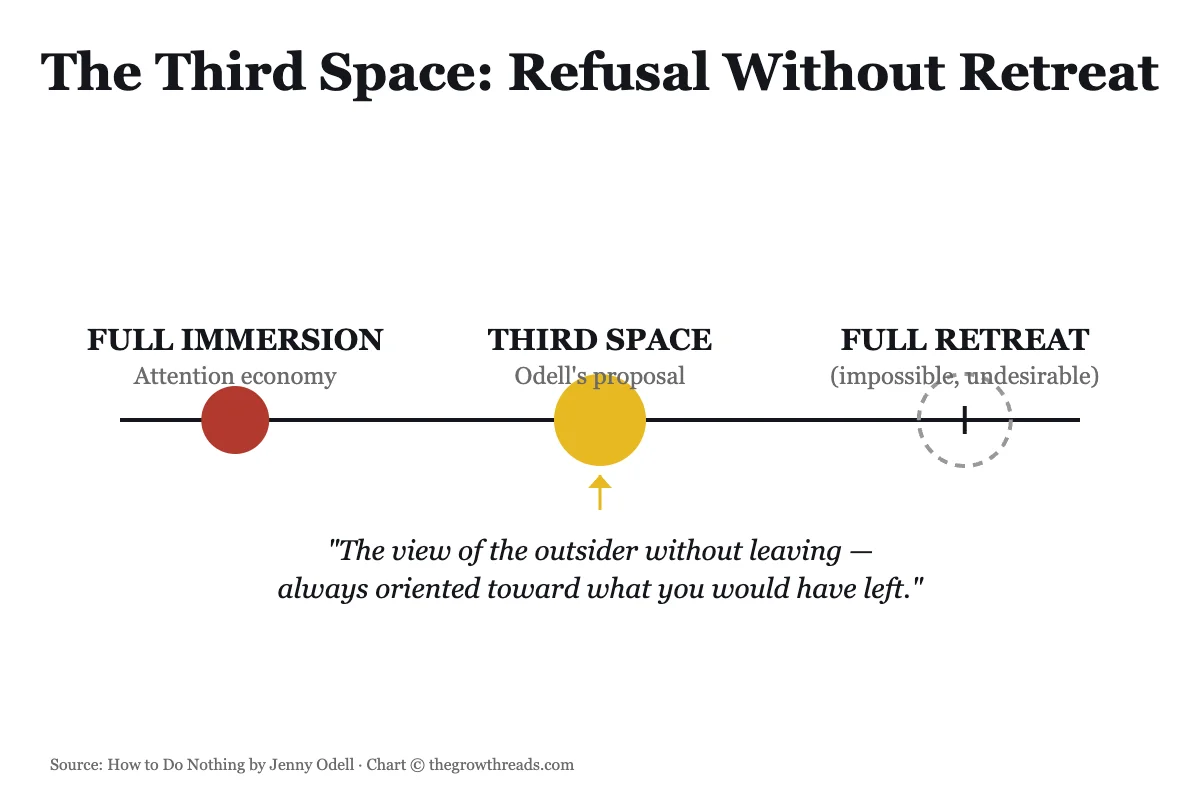
- The “third space” is refusal without retreat: modeled on Diogenes and Bartleby, it’s a stance that stays inside a system but declines to participate on the system’s terms.
- Full withdrawal doesn’t work, historically or practically: Odell examines 1960s communes and reconsiders even Epicurus’s garden, concluding that total retreat is neither achievable nor as isolating as it first appears.
- Attention is trainable, like a muscle or a skill: exercises like sustained, goal-less observation (birdwatching, walking) retrain perception away from the fragmented scroll.
- Bioregionalism grounds attention in a real place: learning the plants, water, and history of your actual neighborhood gives attention somewhere concrete to land, unlike the placeless space of an app.
- “Manifest dismantling” reframes progress: instead of more growth and more optimization, Odell proposes small acts of ecological and social repair — an inversion of “manifest destiny.”
- Strangers, human and non-human, are the basis of community: paying attention to neighbors, wildlife, and the “ecology of strangers” around you builds the kind of civic attention that platforms can’t manufacture.
- The book is philosophy, not a step-by-step system: it offers no app, no checklist — the practical work is translating its ideas into your own routines, which takes more effort than following a formula.
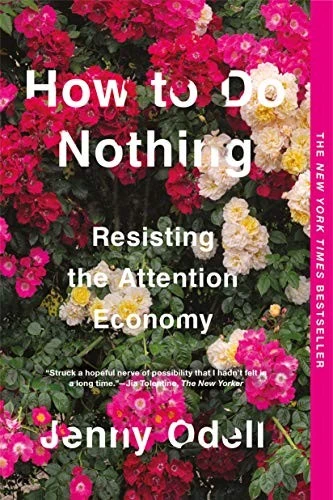
What is How to Do Nothing about?
How to Do Nothing argues that resisting the attention economy doesn’t mean quitting technology, but redirecting your attention toward the unmonetizable — nature, neighbors, place, and silence — as a form of political and personal resistance to constant optimization.
About the author
Jenny Odell is an artist, writer, and former Stanford lecturer based in Oakland, California, where much of the book’s observational material — including its recurring image of a flock of rose-ringed parakeets in her neighborhood — is drawn directly from her own life. Her visual art background shows throughout the book in its attentiveness to looking and noticing as practices in their own right, not just metaphors. How to Do Nothing: Resisting the Attention Economy, published by Melville House in 2019 (paperback 2020), grew out of a widely shared 2017 keynote and became a surprise bestseller, praised by outlets from the New York Times to Bill Gates’s annual reading list for making a philosophical, essayistic argument feel urgent and personal rather than academic. Explore all Jenny Odell book summaries →
The keynote that preceded the book, delivered at a tech-adjacent conference in 2017 and later published online, spread far beyond its original audience because it named something a lot of people were already feeling but hadn’t articulated: the sense that constant online availability was corroding their capacity to focus on anything for more than a few minutes at a time. Odell has said in interviews that she was surprised by how many readers outside the tech industry — teachers, parents, retirees — found the argument useful, which pushed her to expand the talk’s ideas into a book that draws as much on art history and ecology as it does on any critique of specific apps or platforms.
Odell’s method throughout the book is closer to an essayist’s or artist’s than a self-help author’s: she moves through historical figures, close readings of art and literature, and her own direct observation of the natural world around her, building an argument by accumulation rather than by numbered steps. That approach is part of why the book resonated as widely as it did — it doesn’t ask readers to optimize their attention more efficiently, which is the same demand the attention economy already makes, but to question the framework of optimization itself.
Key concepts at a glance
| Concept | What it means | Use it when |
|---|---|---|
| Attention economy | Platforms treat your focus as a scarce resource to extract and monetize | You want a name for why apps feel designed to be hard to put down |
| Context collapse | Posts reach unbounded, unknown audiences, flattening your different social selves into one | You feel pressure to perform one version of yourself online |
| Third space | Standing apart from a system’s norms without physically leaving it | You want to resist without quitting your job, platform, or community entirely |
| Bioregionalism | Orienting attention to your actual watershed, plants, and local history | You want a concrete alternative to placeless, generic online space |
| Manifest dismantling | Small acts of ecological and social repair, instead of pursuing more growth | You want a version of “progress” that isn’t just more output |
| Refusal | Declining to participate in a system’s terms, modeled on Diogenes and Bartleby | You need a stance short of total withdrawal or total compliance |
Part 1: The case for nothing
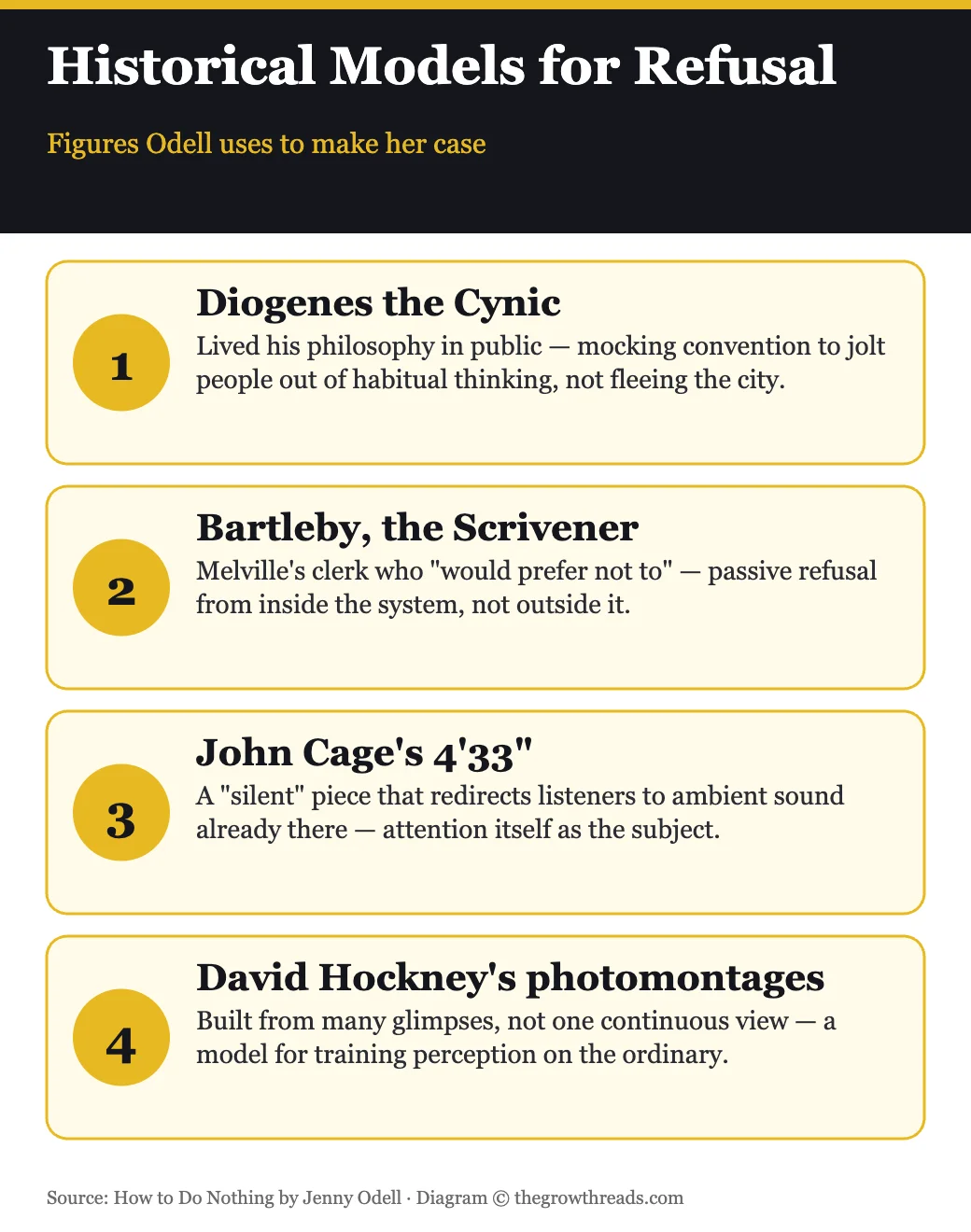
Odell opens with an unlikely pair of models for “doing nothing”: Diogenes the Cynic, who lived his philosophy as public performance — mocking social convention, walking backward through the marketplace — and John Cage’s famous 4’33”, a piece of “silence” that in practice redirects the audience’s attention to the ambient sound they’d tuned out. Neither figure is actually doing nothing; both are radically reorienting attention. That’s the book’s opening move: “nothing” isn’t absence, it’s attention pointed somewhere the attention economy doesn’t profit from.
She grounds this argument in her own habit of birdwatching in a rose garden near her home, which becomes a recurring image throughout the book. The point isn’t that birdwatching is inherently virtuous, but that sustained, goal-less observation is a skill that atrophies without practice, and that atrophy has consequences beyond just personal focus — it changes what kind of citizen and neighbor you’re capable of being.
Odell returns to this rose garden and its regular cast of birds throughout the book, not as a one-off anecdote but as a running proof of concept: the more consistently she showed up to watch without an agenda, the more detail she noticed — individual birds’ habits, seasonal patterns, the layered history of a landscape most passersby walk through without registering. That accumulation of noticed detail is her working definition of what attention restored actually looks like in practice, as opposed to the vaguer, more abstract idea of “focus” that productivity culture usually reaches for.
TGR Note: This “nothing as redirected attention, not absence” framing is close in spirit to the concept of kinetic attention in Attention Span — both books push back on the idea that unbroken focus is the only legitimate state of mind, though Odell’s argument is more political and Mark’s is more behavioral.
Part 2: The impossibility of retreat
Odell then does something unusual for a book in this genre: she argues against her own apparent thesis. She examines 1960s communal retreats and finds most of them collapsed or reproduced the very hierarchies they meant to escape. She revisits Epicurus’s garden — often cited as the model contemplative retreat — and finds that its real innovation wasn’t isolation but friendship, a network that stayed publicly influential rather than truly withdrawing. Her conclusion is blunt: full retreat from society is neither historically successful nor actually desirable, because it cuts you off from the very relationships and places worth paying attention to.
Odell is careful not to romanticize the communes she examines. Many, she notes, reproduced the same rigid hierarchies and exclusions they were meant to escape, simply relocated to a rural setting instead of a city — proof that geography alone doesn’t dissolve the social patterns a retreat is meant to interrupt. Her reading of Epicurus’s garden makes a related point from the other direction: even history’s most cited model of contemplative withdrawal turns out, on closer inspection, to have been sustained by an active network of friendship and correspondence that kept it publicly influential for centuries, not by isolation. The lesson she draws is that attention reform has to happen inside ongoing relationships and shared spaces, not by subtracting yourself from them.
This is where the book earns its “third space” argument rather than just asserting it. If neither full immersion in the attention economy nor full retreat from society actually works, the only workable position is one that stays engaged with the world while declining to accept the terms platforms set for that engagement — present but not for sale, so to speak.
Part 3: Anatomy of a refusal
The book’s most literary chapter builds its central stance from fiction and history: Melville’s Bartleby, whose flat refrain “I would prefer not to” becomes shorthand for passive resistance from inside a system rather than outside it; Thoreau, read here less as a hermit than as someone who kept walking into town; and Pilvi Takala’s performance-art piece in which she spent days at a Deloitte office doing conspicuously nothing, exposing how much of office culture is performed busyness rather than actual output. Odell also draws on the 1934 Oakland longshoremen’s strike and the earlier eight-hour-day movement’s slogan — “eight hours for what we will” — to argue that time itself has long been contested political territory, not just a personal productivity variable.
TGR Note: This “refusal from inside the system” idea is a useful complement to Time Anxiety‘s argument that urgency is often manufactured rather than real — both books treat the sense that you must always be visibly productive as a constructed pressure, not a natural law.
Part 4: Exercises in attention and the ecology of strangers
Here Odell turns from argument to practice, though still in an essayistic register rather than a checklist. She uses David Hockney’s photomontages — built from dozens of overlapping Polaroids rather than one continuous frame — as a model for how perception actually works: attention assembled from many discrete glimpses, trainable the way a photographer trains their eye. She extends this into what she calls an “ecology of strangers”: the human and non-human neighbors around you — other commuters, local wildlife, the rose-ringed parakeets that recur throughout the book as an emblem of layered, often-invisible ecological history hiding in plain sight in her own Oakland neighborhood.
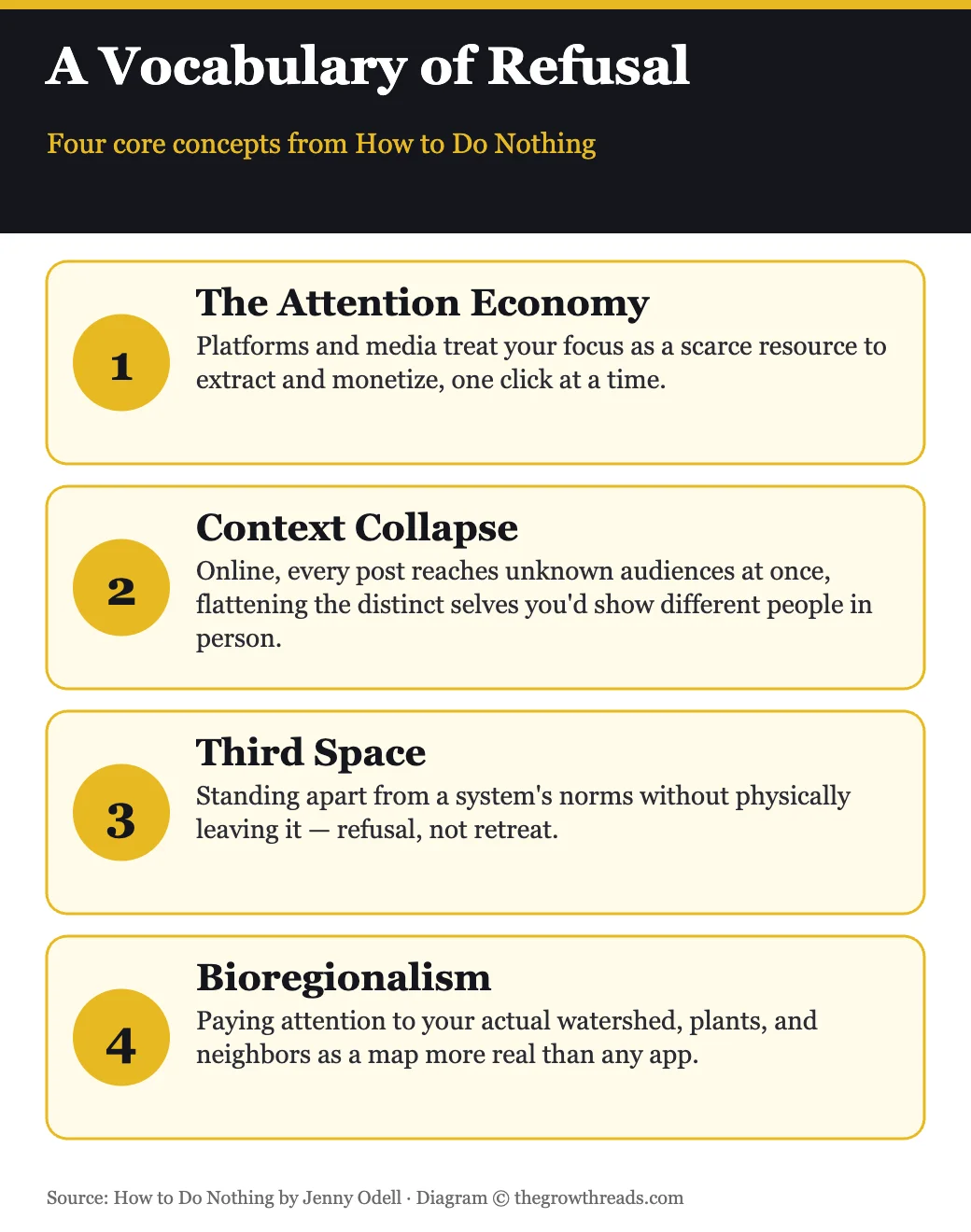
This is also where bioregionalism enters directly: attention to your actual watershed, the plants that grow there, and the history — including the displacement and development — that produced the landscape you live in now. Odell’s argument is that this kind of placed attention is a genuine alternative map to the placeless, interchangeable space of any app, because it can’t be scaled, monetized, or copy-pasted to another city.
The chapter closes by connecting this local, ecological attention back to community and eventually to what Odell calls “manifest dismantling” in the book’s conclusion — small, deliberate acts of ecological and social repair (native planting, supporting local restoration work, “do-nothing farming” that lets land recover) offered as a genuine alternative to the growth-at-all-costs logic of “manifest destiny,” rather than another form of productivity dressed up as environmentalism.
Odell is candid that this kind of attentiveness assumes some baseline stability — geographic roots, job security, unstructured time — that not every reader has in equal measure, and several reviewers have flagged this privilege tension as the book’s most legitimate limitation. It’s worth naming honestly: the exercises translate more easily for readers who already have some slack in their schedule than for someone working multiple jobs with no flexibility, though the underlying argument about attention as contested territory still applies more broadly.
Who is How to Do Nothing best for — and who should read something else first?
This book is best for readers who are tired of productivity advice that just asks them to optimize harder, and who want a genuinely different frame — political and philosophical rather than tactical — for why constant connectivity feels corrosive. It rewards patient reading; it’s closer to an extended essay than a self-help manual, and readers looking for a numbered system will find it deliberately resistant to that format.
It’s also a better fit for readers who already have some flexibility in their schedule than for someone working multiple jobs with no slack at all — a limitation Odell herself doesn’t fully resolve, and one worth naming honestly rather than glossing over. If your primary constraint is genuinely not having spare time or geographic stability, the book’s exercises will take more adaptation to apply than they would for a reader with more room to experiment. That doesn’t invalidate the underlying argument about attention as contested territory, but it does mean the practical payoff arrives more slowly for some readers than others.
If you want concrete, research-backed tactics for managing digital distraction day to day rather than a philosophical reframe, Attention Span is the more tactical companion. If your relationship to screens is more compulsive-stimulation-seeking than attention-fragmentation specifically, Dopamine Detox offers a faster, narrower reset. And if what’s driving your distraction is really anxiety about not doing enough rather than the attention economy itself, Time Anxiety addresses that underlying urgency more directly.
Questions to reflect on
- Which of your online contexts have collapsed into one audience, and is there a context you’d like to protect or keep separate?
- What does your actual bioregion look like — the plants, water, and history of the place you live — and how much of it could you name right now?
- Where in your life could you practice “third space” refusal — staying engaged but declining to perform on a system’s terms — without needing to quit entirely?
- What’s one non-monetizable activity (birdwatching, walking, noticing) that used to hold your attention easily and doesn’t anymore?
- Odell argues full retreat doesn’t work. Where have you tried to solve an attention problem by disappearing rather than by redirecting your attention?
🔥 Ready to rethink what your attention is for?
Get How to Do Nothing and start redirecting your focus toward what actually matters.
How to apply How to Do Nothing (7-day plan)
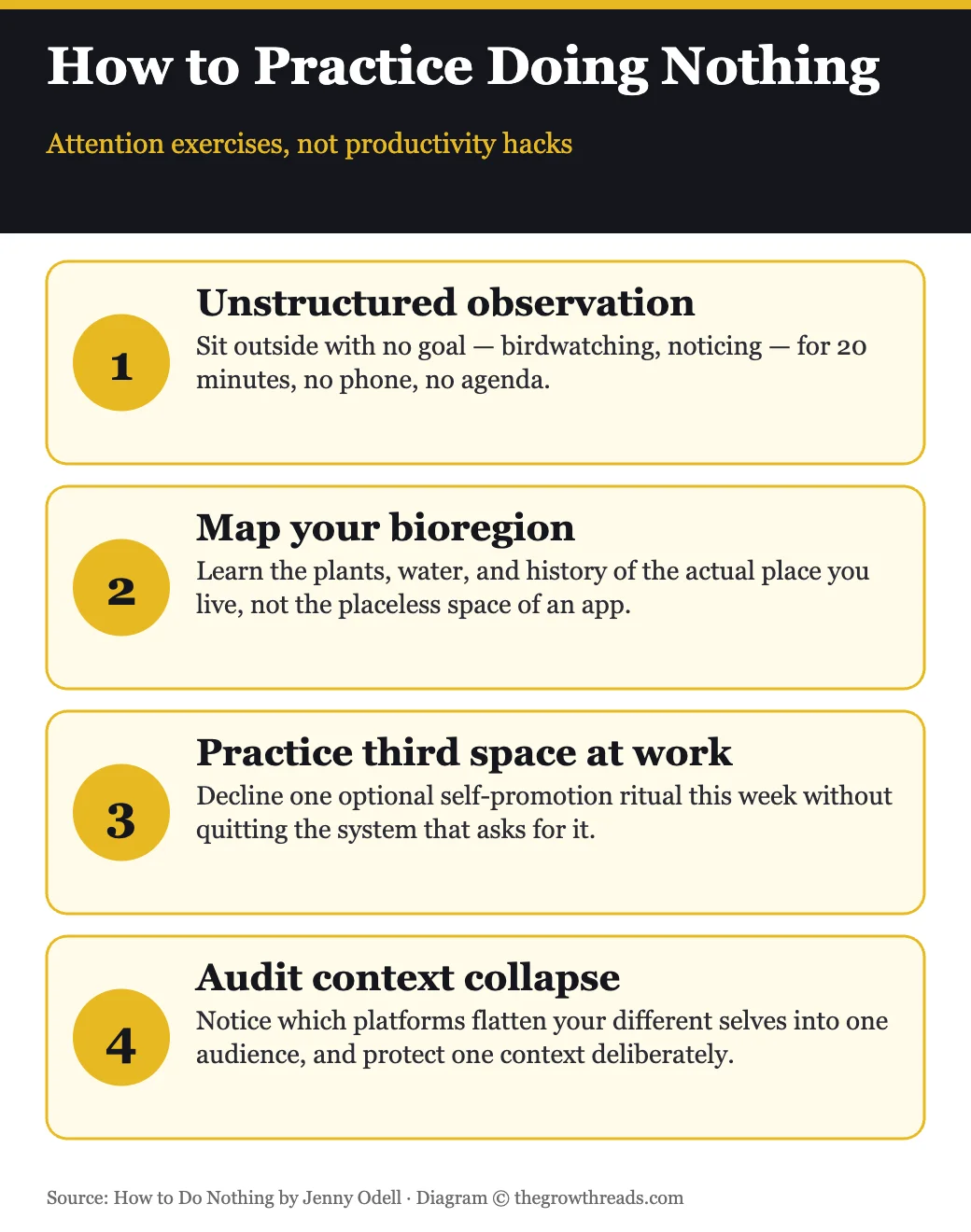
- Day 1 — Spend 20 unstructured minutes outside with no phone and no goal. Just observe — birds, people, weather, whatever’s there.
- Day 2 — Learn one real fact about your bioregion: the name of the watershed you live in, or one native plant species nearby.
- Day 3 — Audit your online contexts. Notice one platform where your different “selves” have collapsed into a single audience.
- Day 4 — Practice one small third-space refusal at work or online: decline an optional self-promotion ritual without quitting the platform.
- Day 5 — Read or reread one piece of writing slowly, with full attention, the way you’d look at a painting rather than skim a feed.
- Day 6 — Do one “manifest dismantling” micro-act: plant something native, pick up litter on a walk, or support a local restoration effort.
- Day 7 — Write down one relationship — human or non-human — in your immediate area that you’d like to pay more attention to going forward.
Frequently asked questions
What is the main argument of How to Do Nothing by Jenny Odell?
The book argues that resisting the attention economy doesn’t require quitting technology or society, but redirecting attention toward the unmonetizable — nature, neighbors, place, and silence. Odell calls this a “mass movement of attention” rather than a mass exodus from platforms, and frames it as a political stance, not a personal productivity fix. The goal is staying engaged with the world on your own terms rather than the terms platforms set for engagement.
What does “third space” mean in the book?
Third space is Odell’s term for standing apart from a system’s norms without physically leaving it — modeled on figures like Diogenes and Bartleby, who resisted from inside their societies rather than fleeing them. It’s positioned as a workable middle ground between full immersion in the attention economy and full retreat from society, which Odell argues is neither historically successful nor actually desirable, since it cuts you off from real relationships and places.
Is this book anti-technology or a call to quit social media?
No — Odell is explicit that she’s less interested in a mass exodus from platforms than in a mass redirection of attention. The book critiques the attention economy’s design and incentives rather than technology itself, and doesn’t ask readers to delete their accounts. Its practical suggestions are about awareness, redirected attention, and occasional refusal, not renunciation of digital tools altogether.
What is bioregionalism, and why does it matter in this book?
Bioregionalism is attentiveness to the actual ecological place you live — its watershed, plants, wildlife, and history — as an alternative map to the placeless, generic space of the internet. Odell uses it to ground abstract arguments about attention in something concrete and local: unlike an app, a bioregion can’t be scaled or copy-pasted elsewhere, which is part of why she treats it as a genuine counterweight to the attention economy.
Is How to Do Nothing more philosophy than self-help?
Yes, and reviewers consistently note this — the book moves between philosophy, art criticism, and personal essay rather than offering a numbered system or checklist. Readers looking for step-by-step tactics may find it more abstract than expected; readers looking for a deeper reframe of why constant optimization feels corrosive tend to find that essayistic approach to be the book’s main strength rather than a weakness.
Does the book address who can realistically practice its ideas?
Partially, and it’s a fair critique some reviewers raise: practices like sustained observation and bioregional attentiveness assume some baseline stability — time, geographic roots, and job security — that not everyone has equally. Odell doesn’t fully resolve this tension, but the book’s broader argument about attention as contested political territory, not just a personal habit, still applies even for readers without that slack in their schedule.
What should I read after How to Do Nothing?
For more tactical, research-backed strategies on managing digital distraction day to day, Attention Span by Gloria Mark is a strong pairing. If compulsive stimulation-seeking is your main pattern rather than fragmented attention generally, Dopamine Detox offers a faster, narrower reset. If underlying urgency and anxiety are driving your distraction, Time Anxiety addresses that root cause more directly.
Related summaries
Continue exploring focus and attention with Attention Span, Time Anxiety, Dopamine Detox, and Meditations for Mortals, or browse the full productivity books collection.
How we analyze books: Every summary on The Growth Reads is built from a full read of the source material, cross-checked against the author’s interviews and published research where available, and structured around practical application rather than just recap. We focus on what you can actually do differently after reading. Read our full methodology.