

★★★★☆ 4.2/5 — A crisp strategic framework for three shifts every organization is navigating right now: from human judgment to machine learning, from products to platforms, and from internal experts to open crowds.
Best for: Executives and strategists deciding where to invest in AI, platform models, or open innovation.
Reading time: ~3.5 hrs read, 12 min guide
Difficulty to apply: Moderate — the ideas require real strategic decisions, not just mindset shifts.
Machine, Platform, Crowd in one minute
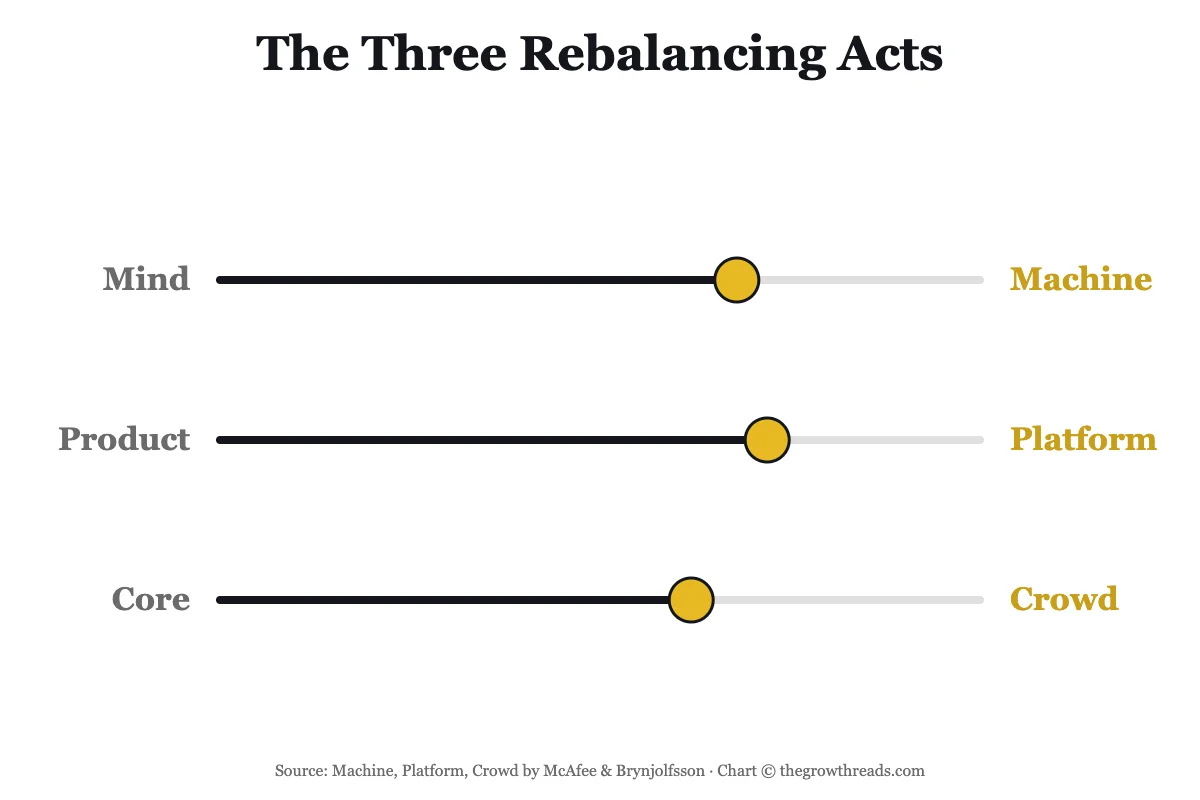
Every industry is being pulled through the same three tug-of-wars, and most leaders are only paying attention to one of them. Andrew McAfee and Erik Brynjolfsson, the MIT economists behind The Second Machine Age, argue that winning organizations are mastering three simultaneous rebalancing acts: letting machines handle more prediction and pattern-recognition while humans focus on judgment, shifting from owning assets to orchestrating platforms, and combining internal expertise with the open-ended creativity of crowds.
None of these shifts is about full replacement. Each is about finding the right new balance point, and the authors give leaders a concrete way to reason about where that point should sit in their own organization.
Key takeaways
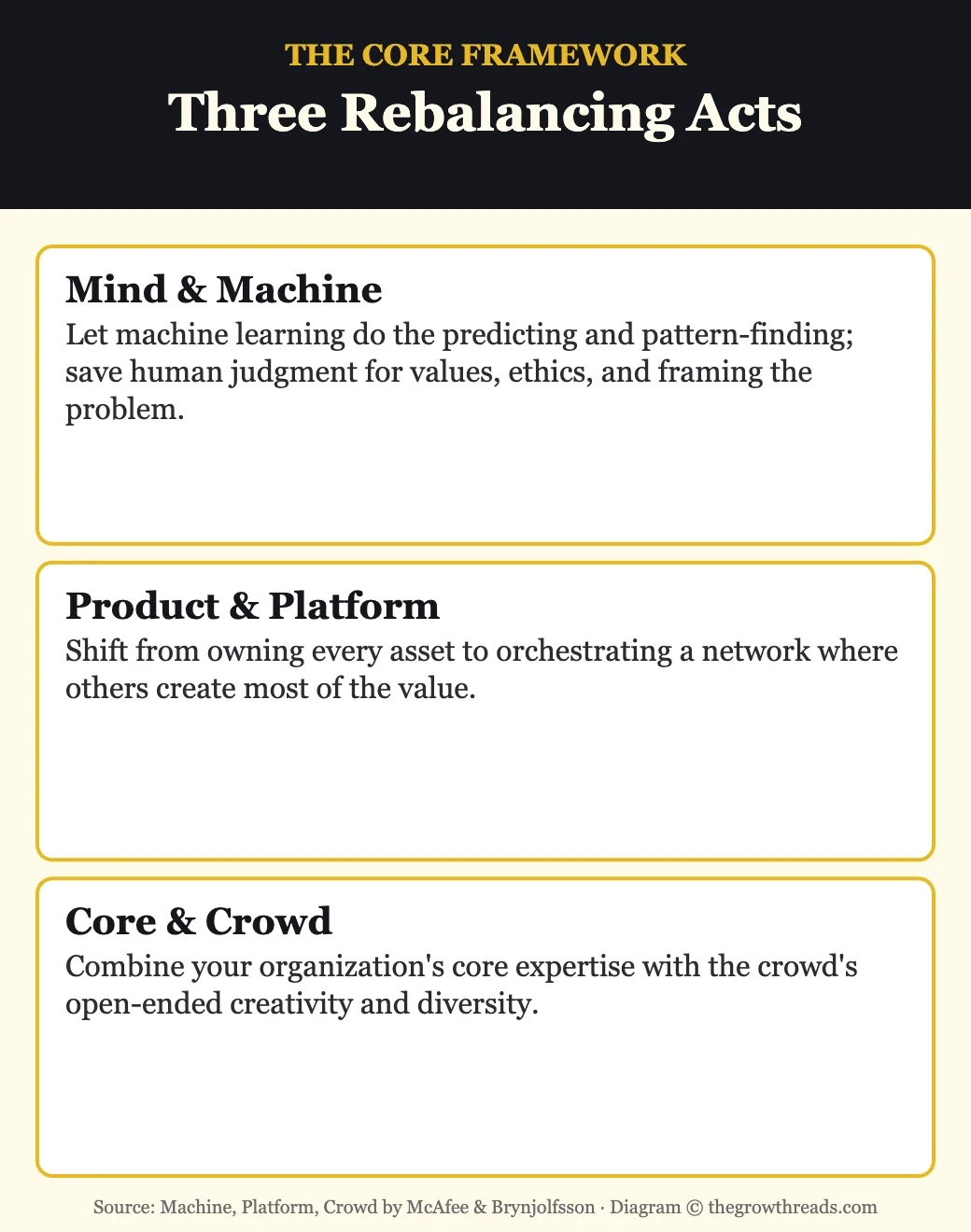
- Mind and Machine: machine learning is often a better predictor than human intuition, but framing the problem and applying values still needs a human.
- Product and Platform: platforms that orchestrate a network can grow faster and more profitably than businesses that own every asset.
- Core and Crowd: combining an organization’s core expertise with the open creativity of outside crowds often beats either alone.
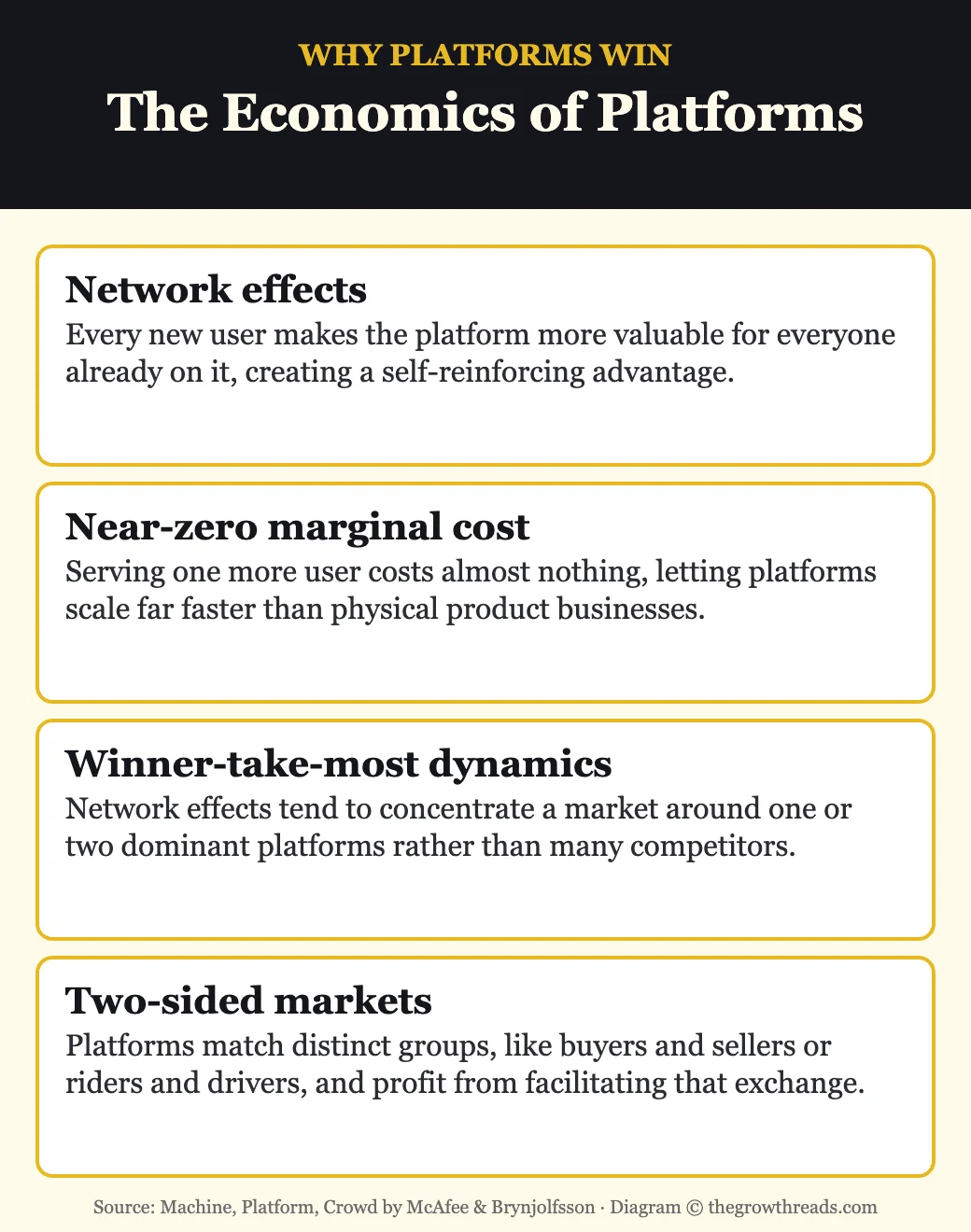
- Network effects compound: every new platform user makes the platform more valuable to everyone already on it.
- Marginal cost near zero: platforms can scale to serve millions more users at almost no additional cost.
- Winner-take-most markets: network effects tend to concentrate platform markets around one or two dominant players.
- Prediction markets and crowds often outperform individual experts by aggregating many independent judgments.
- Open innovation contests can surface solutions that internal R&D teams would never have found.
- The shift isn’t binary: most organizations need a deliberate, calibrated mix rather than an all-or-nothing bet.
- Leaders who diagnose which of the three shifts applies to their business first will out-execute those treating all three the same.
What is Machine, Platform, Crowd about?
Machine, Platform, Crowd argues that winning organizations master three simultaneous rebalancing acts: shifting prediction work from human judgment to machine learning, shifting from owning products to orchestrating platforms, and combining internal expertise with the open creativity of outside crowds, and it gives leaders a framework for finding the right balance in each.
About the authors
Andrew McAfee and Erik Brynjolfsson are both researchers at MIT, where they co-founded and co-direct the Initiative on the Digital Economy. The pair previously co-authored The Second Machine Age, which became a foundational text on how digital technologies were reshaping the economy. Brynjolfsson is an economist known for his research on productivity and information technology; McAfee, a principal research scientist, focuses on how organizations actually implement and benefit from emerging technology.
Machine, Platform, Crowd, published in 2017, extends their earlier work into a practical strategic framework, moving from diagnosing the economic shift to advising leaders on how to navigate it. Their access to Silicon Valley executives, Fortune 500 leadership, and academic research gives the book a blend of rigorous evidence and boardroom-tested advice.
Key concepts at a glance
| Concept | What it means | Use it when |
|---|---|---|
| Mind and Machine | Rebalancing prediction and pattern-recognition work between human judgment and machine learning | Deciding which decisions to automate and which to keep human |
| Product and Platform | Rebalancing between owning every asset and orchestrating a network where others create value | Evaluating whether to build, own, or orchestrate a market |
| Core and Crowd | Rebalancing between internal expertise and open, outside contribution | Deciding whether a problem is better solved in-house or opened up externally |
| Network effects | A product or platform that gets more valuable as more people use it | Assessing whether a business model can compound its advantage over time |
| Two-sided market | A platform that matches and profits from connecting two distinct groups | Analyzing marketplace or matching businesses like ride-sharing or e-commerce |
| Prediction markets | Aggregating many independent forecasts into a single, often more accurate, estimate | Improving forecasting accuracy beyond a single expert’s judgment |
Part 1: Mind and Machine
The first rebalancing act tackles the oldest and most emotionally loaded question in the book: when should a machine’s prediction override a human’s judgment? McAfee and Brynjolfsson marshal decades of research showing that simple statistical models often out-predict expert human judgment across domains from medical diagnosis to parole decisions to wine pricing, not because machines are smarter, but because they’re consistent, while humans are inconsistent in ways they don’t notice about themselves.
Their answer isn’t “replace humans with machines” but a more precise division of labor: let machine learning handle prediction, the narrow task of estimating what’s likely to happen given data, and reserve human judgment for framing the problem, weighing values, and deciding what to do about a prediction once it’s made. A model can predict which loan applicants are likely to default; a human still has to decide what fairness means for the edge cases the model is uncertain about.
The authors are careful to distinguish this from the popular fear that algorithms will simply replace workers wholesale. Their research points instead toward augmentation: radiologists paired with diagnostic models catch more early-stage cancers than either radiologists or models working alone, and loan officers paired with credit-scoring algorithms make fewer both false-positive and false-negative lending decisions than either would separately. The lesson they draw is that the highest-performing systems combine, rather than choose between, human and machine judgment, which is a more nuanced and more actionable claim than either “automation will take your job” or “humans will always be needed.”
Part 2: Product and Platform
The second rebalancing act is about business model architecture. A traditional product business owns its assets and captures value by selling units; a platform business orchestrates a network of independent participants and captures value by facilitating exchange between them. The authors use Airbnb and Marriott, or Uber and traditional taxi fleets, to make the contrast concrete: the platform businesses own comparatively little physical infrastructure yet often out-scale and out-value their asset-heavy competitors.
What makes platforms so powerful, mechanically, is a combination of network effects (every new user makes the platform more valuable to everyone else on it), near-zero marginal cost (serving one more user costs almost nothing), and winner-take-most dynamics (these effects tend to concentrate a market around one or two dominant platforms). The authors are careful to note that not every business should become a platform; the framework is for diagnosing when platform economics genuinely apply to your market, not a mandate to platform-ify everything.
Part 3: Core and Crowd
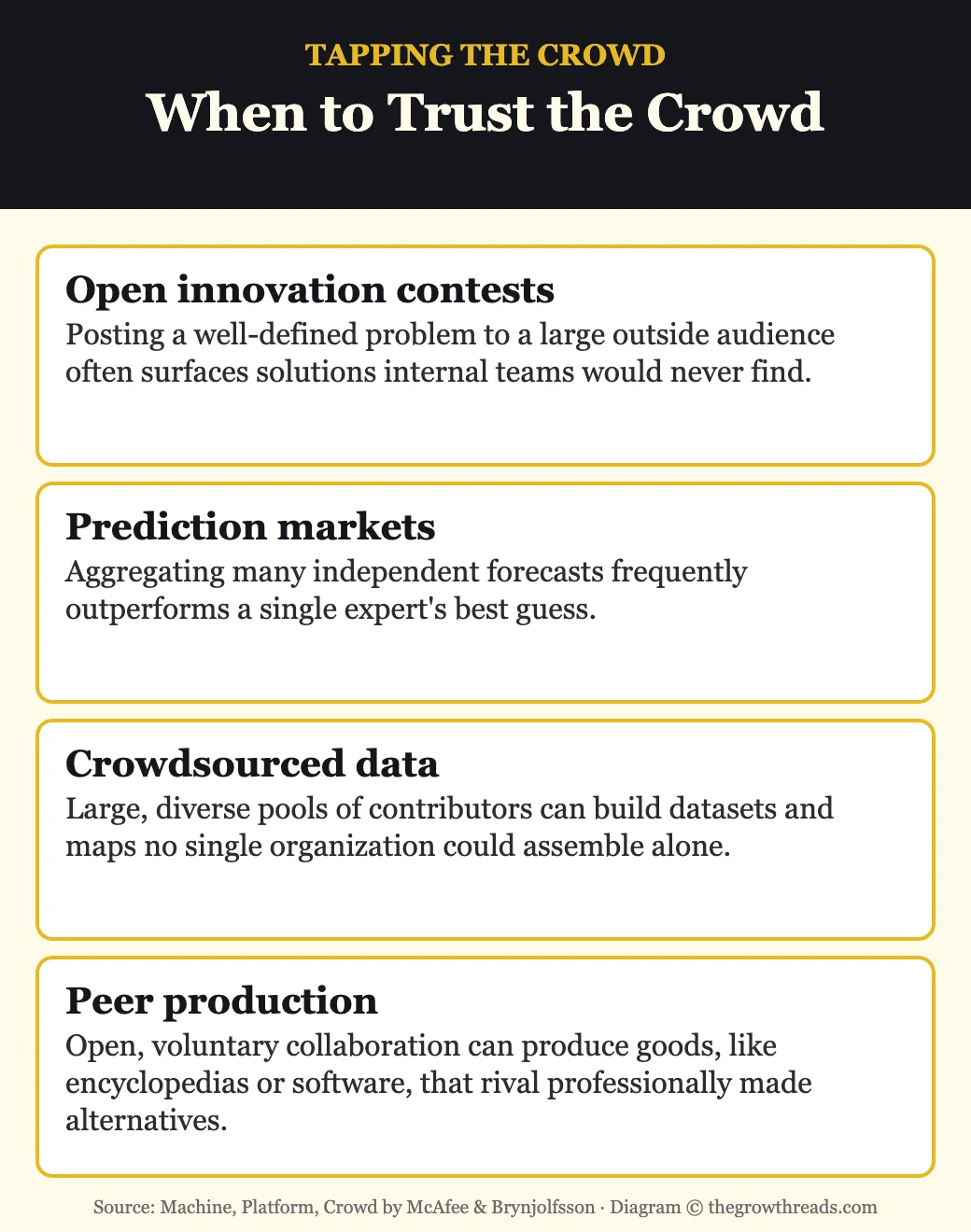
The third rebalancing act challenges a deep assumption of most organizations: that expertise and innovation are best kept close, inside a company’s walls, with trusted internal teams. McAfee and Brynjolfsson lay out a body of evidence showing that opening a well-defined problem to an outside crowd, whether through innovation contests, prediction markets, or peer production, frequently produces better solutions and forecasts than a closed internal process, because a large diverse crowd contains a wider range of expertise and unconventional angles than any single team.
The chapter is careful about the limits of this insight: crowds excel at certain kinds of problems (well-defined, decomposable, or benefiting from many independent estimates) and struggle with others (contextual judgment calls requiring deep organizational knowledge). The practical takeaway is a diagnostic one, not “outsource everything to the crowd,” but “identify which of your hardest problems are actually crowd-shaped, and open exactly those.”
One theme the authors return to repeatedly across all three rebalancing acts is that organizational culture, not just technology adoption, determines whether a shift succeeds. A company can buy the same machine learning tools, launch the same kind of platform, or run the same crowdsourcing contest as a competitor and still fail, if its incentive structures, decision rights, and internal politics haven’t adapted to the new balance point. This is why the book spends as much time on organizational design questions, who gets to override a model’s prediction, who owns platform governance decisions, how crowd-sourced input gets evaluated and integrated, as it does on the underlying technology itself.
Who is Machine, Platform, Crowd best for — and who should read something else first?
This book is best for executives and strategists actively deciding where to invest in AI, platform business models, or open innovation, and who want a rigorous framework rather than hype. If you want the more foundational economic argument behind these shifts, start with The Second Machine Age, the same authors’ earlier book. If you want a broader systems-level view of technological disruption, The Fourth Industrial Revolution is a good complement.
Questions to reflect on
- Which decisions in your organization are still made by human judgment that a well-built prediction model could likely do better?
- Does your business own too many assets it could instead orchestrate as a platform, or is it trying to platform-ify something that doesn’t fit?
- What hard problem in your work is genuinely crowd-shaped, well-defined enough to open up externally?
- Where does your organization’s core expertise add the most irreplaceable value, versus where is it just habit?
- Of the three rebalancing acts, which one is your organization furthest behind on?
🔥 Ready to master the three shifts reshaping every industry?
Grab a copy of Machine, Platform, Crowd and get the framework for deciding where to rebalance next.
How to apply Machine, Platform, Crowd (7-day plan)
- Day 1: List three recurring decisions in your work that rely on judgment where a data-driven prediction might actually do better.
- Day 2: Identify one asset your organization owns that it could instead orchestrate as a platform for others.
- Day 3: Research a competitor or peer organization that has successfully shifted from product to platform thinking.
- Day 4: Draft a well-defined problem from your work that could plausibly be opened to an outside crowd or contest.
- Day 5: Talk to a colleague about which of the three rebalancing acts, Mind/Machine, Product/Platform, Core/Crowd, matters most in your industry.
- Day 6: Identify one place your organization currently distrusts data-driven predictions for reasons that may not hold up.
- Day 7: Write a one-page diagnosis of where your organization sits today on all three rebalancing acts, and where it should move next.
Frequently asked questions
What are the three rebalancing acts in Machine, Platform, Crowd?
The three rebalancing acts are Mind and Machine (shifting prediction work from human judgment to machine learning while keeping humans for framing and values), Product and Platform (shifting from owning assets to orchestrating a network), and Core and Crowd (combining internal expertise with open, outside contribution). The authors argue winning organizations deliberately rebalance all three rather than treating any as fixed.
Does the book argue humans will be replaced by machines?
No. McAfee and Brynjolfsson are explicit that the goal is a better division of labor, not replacement: machines handle prediction and pattern-recognition at scale, while humans handle framing problems, applying values, and making judgment calls in ambiguous or high-stakes situations that data alone can’t resolve.
How is this different from The Second Machine Age, the authors’ earlier book?
The Second Machine Age diagnosed how digital technologies were reshaping the economy at a broad level. Machine, Platform, Crowd is more prescriptive, giving leaders a specific three-part strategic framework for deciding how to respond, making it a practical follow-up rather than a restatement of the earlier book.
Is this book still relevant, since it was published in 2017?
Yes. The generative AI wave, the continued dominance of platform businesses, and the rise of crowdsourced and open-source approaches to everything from data labeling to software have all made the book’s three rebalancing acts more relevant, not less, since its 2017 publication.
Is this book technical, or accessible to a general business reader?
It’s written for a general business audience rather than technologists. The authors use case studies, from Uber to Wikipedia to medical diagnosis research, to make each argument concrete, and avoid deep technical explanation of how machine learning models actually work.
Should every business try to become a platform?
No, and the authors are explicit about this. Platform economics apply best to markets with genuine network effects and low marginal costs of serving additional users. The book’s framework is meant to help leaders diagnose whether platform dynamics genuinely fit their market, not to prescribe platforms as a universal strategy.
What should I read after this book?
The Second Machine Age by the same authors is a natural companion for the underlying economic argument. For a broader systems-level view of technological disruption, The Fourth Industrial Revolution is a strong next step.
Related summaries
- The Second Machine Age by Erik Brynjolfsson & Andrew McAfee
- The Fourth Industrial Revolution by Klaus Schwab
- The Big Nine by Amy Webb
- Weapons of Math Destruction by Cathy O’Neil
See all Best Technology & AI Books →