

★★★★☆ 4.1/5 — A clear-eyed look at who is actually steering AI’s future, and why neither Silicon Valley nor Beijing has the incentives to do it safely alone.
Best for: Anyone who wants to understand the geopolitics and corporate incentives shaping AI, beyond the headlines.
Reading time: ~8 hours to read cover to cover · ~40 min for this guide
Difficulty to apply: Moderate — the framework is more about how you evaluate AI news and policy than a personal action plan.
The Big Nine in one minute
Nine companies are quietly shaping the future of artificial intelligence, and none of them are optimizing for what’s best for humanity. Futurist Amy Webb identifies the “G-MAFIA” — Google, Microsoft, Amazon, Facebook, IBM, and Apple — in the US, and the “BAT” — Baidu, Alibaba, and Tencent — in China, as the nine organizations whose decisions will determine how AI develops over the coming decades.
Her core argument: the G-MAFIA is trapped by quarterly earnings pressure and competitive races that reward speed over caution, while the BAT operates under state directives aimed at long-term national advantage. Neither tribe’s incentive structure, she argues, is built around getting AI’s development right for humanity as a whole — which is why she calls for a deliberate “third way.”
Key takeaways
- Nine companies, two tribes: the G-MAFIA (US) and BAT (China) control the resources, talent, and data driving most AI development.
- Market pressure shapes G-MAFIA behavior: quarterly earnings and competitive races push toward speed over careful design.
- State goals shape BAT behavior: long-range national strategy, not just profit, drives Chinese AI investment.
- Neither tribe is optimizing for you: both incentive systems leave real gaps in safety, fairness, and inclusiveness.
- AI development is not neutral: the values and blind spots of the people building AI get baked into the systems themselves.
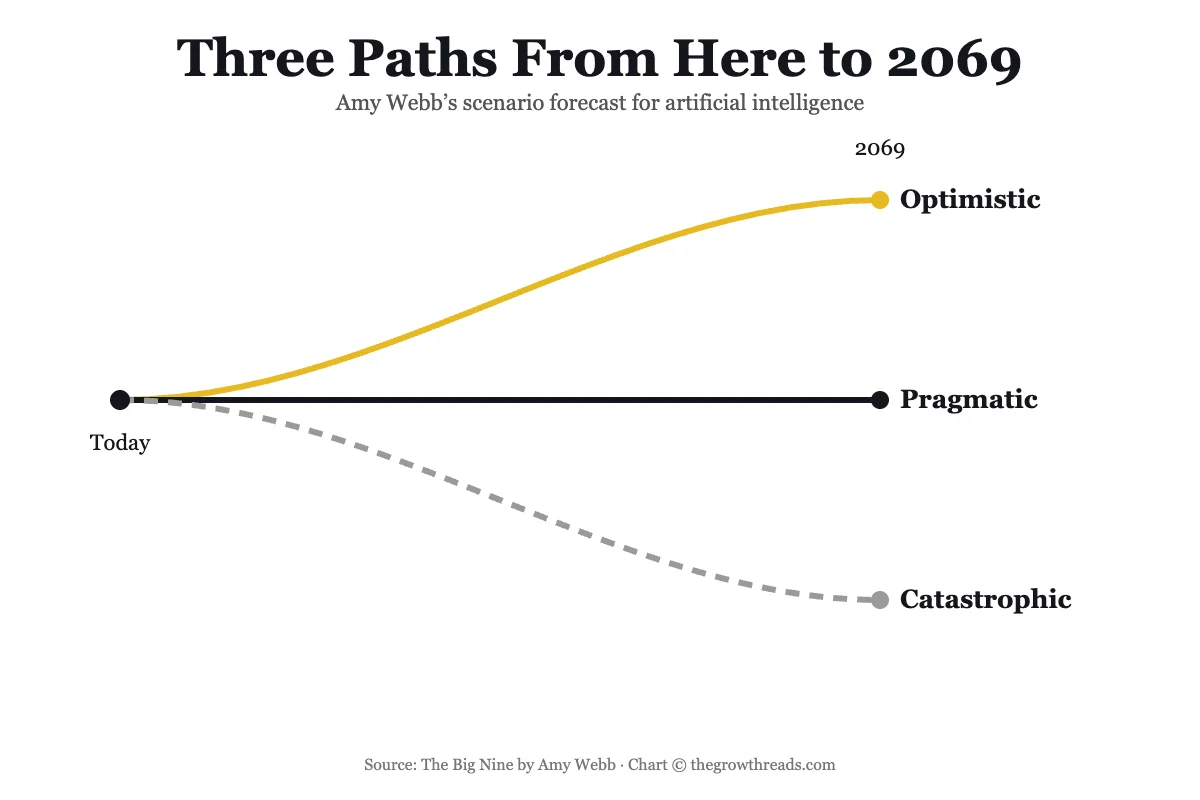
- Three scenarios to 2069: Webb sketches optimistic, pragmatic, and catastrophic futures depending on choices made now.
- The pragmatic path is most likely — and still risky: even the “realistic” scenario involves real costs if left unmanaged.
- A “third way” is possible: broader participation, insulated public investment, and international coordination could change the trajectory.
- Individual and organizational choices matter: how governments, universities, and companies respond now shapes which scenario unfolds.
- Complacency is the real risk: assuming someone else is handling AI governance is itself a choice with consequences.
What is The Big Nine about?
The Big Nine argues that nine tech companies — six American, three Chinese — are shaping the future of artificial intelligence under incentive structures built for market competition or state advantage, not human wellbeing. Amy Webb lays out three possible futures through 2069 and calls for a deliberate “third way” to steer AI’s development more responsibly.
About the author
Amy Webb is a quantitative futurist and founder of the Future Today Institute, where she advises governments, universities, and Fortune 500 companies on long-range technology forecasting. She is a professor at the NYU Stern School of Business and has spent years studying how emerging technologies actually get adopted, not just how they’re marketed. Her earlier work on signal detection and scenario planning gives The Big Nine its methodical, forecast-driven structure — this isn’t speculation, it’s structured reasoning about plausible futures built from data about who currently holds power over AI. Explore all Amy Webb book summaries →
| Concept | What it means | Use it when |
|---|---|---|
| G-MAFIA | Google, Microsoft, Amazon, Facebook, IBM, Apple — the US AI tribe | Evaluating American AI companies’ incentives |
| BAT | Baidu, Alibaba, Tencent — the Chinese AI tribe | Evaluating Chinese AI companies’ incentives |
| AI tribalism | Development shaped by competing national and corporate camps rather than shared standards | Understanding why global AI coordination is hard |
| Scenario forecasting | Structured, plausible future paths built from current signals, not predictions | Thinking through long-range consequences of a trend |
| Third way | A deliberate alternative to pure market or state control of AI | Evaluating AI governance proposals |
| Quarterly pressure | Short-term earnings incentives that push AI companies toward speed over caution | Assessing why a company might cut safety corners |
Part 1: Two tribes, one technology
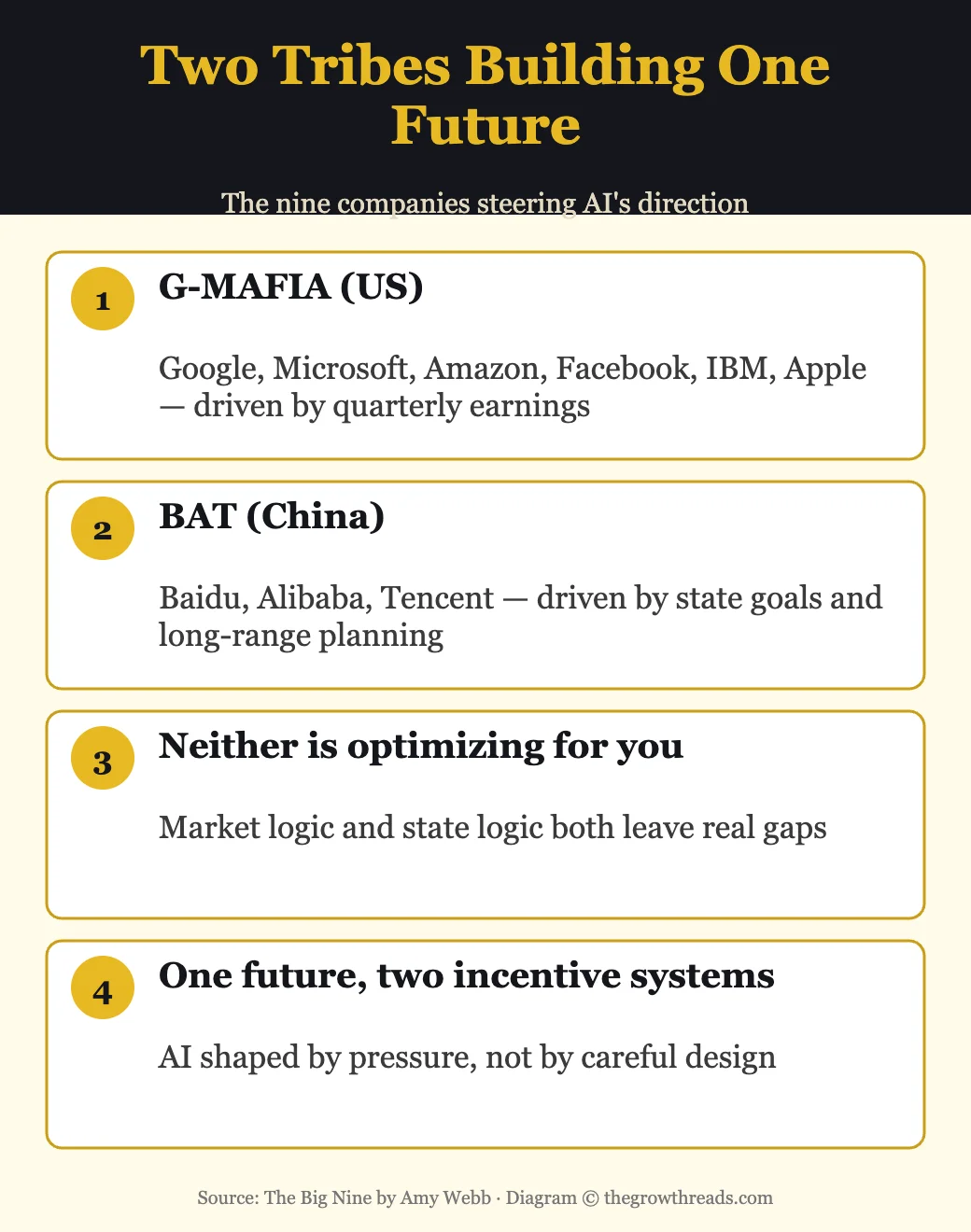
Webb’s central observation is deceptively simple: almost all cutting-edge AI research and deployment funnels through just nine organizations. In the US, six publicly traded companies compete fiercely for talent, data, and market share, answering to shareholders who expect quarterly results. In China, three companies operate with close ties to the state, pursuing AI leadership as a matter of explicit national strategy over a much longer time horizon.
These aren’t just different companies — they’re different operating logics. The G-MAFIA’s timeline is measured in product cycles and earnings calls; the BAT’s timeline is measured in five-year plans and generational ambitions. Webb argues that this mismatch matters enormously, because it means the two blocs are racing each other under completely different rules, each convinced the other’s approach is more dangerous — which pushes both toward faster, less cautious development than either might choose in isolation.
Webb is careful to note that “tribe” doesn’t mean monolith — there’s real internal disagreement within both the G-MAFIA and BAT about how fast to move and what guardrails to build. But the external pressures acting on each group are consistent enough that, in aggregate, they push both blocs toward similar behavior: prioritize scale and capability first, work out safety and governance questions later. That pattern, repeated across nine of the most resourced organizations on the planet, is what she argues sets the trajectory for everyone else.
Part 2: Three futures, one narrowing window
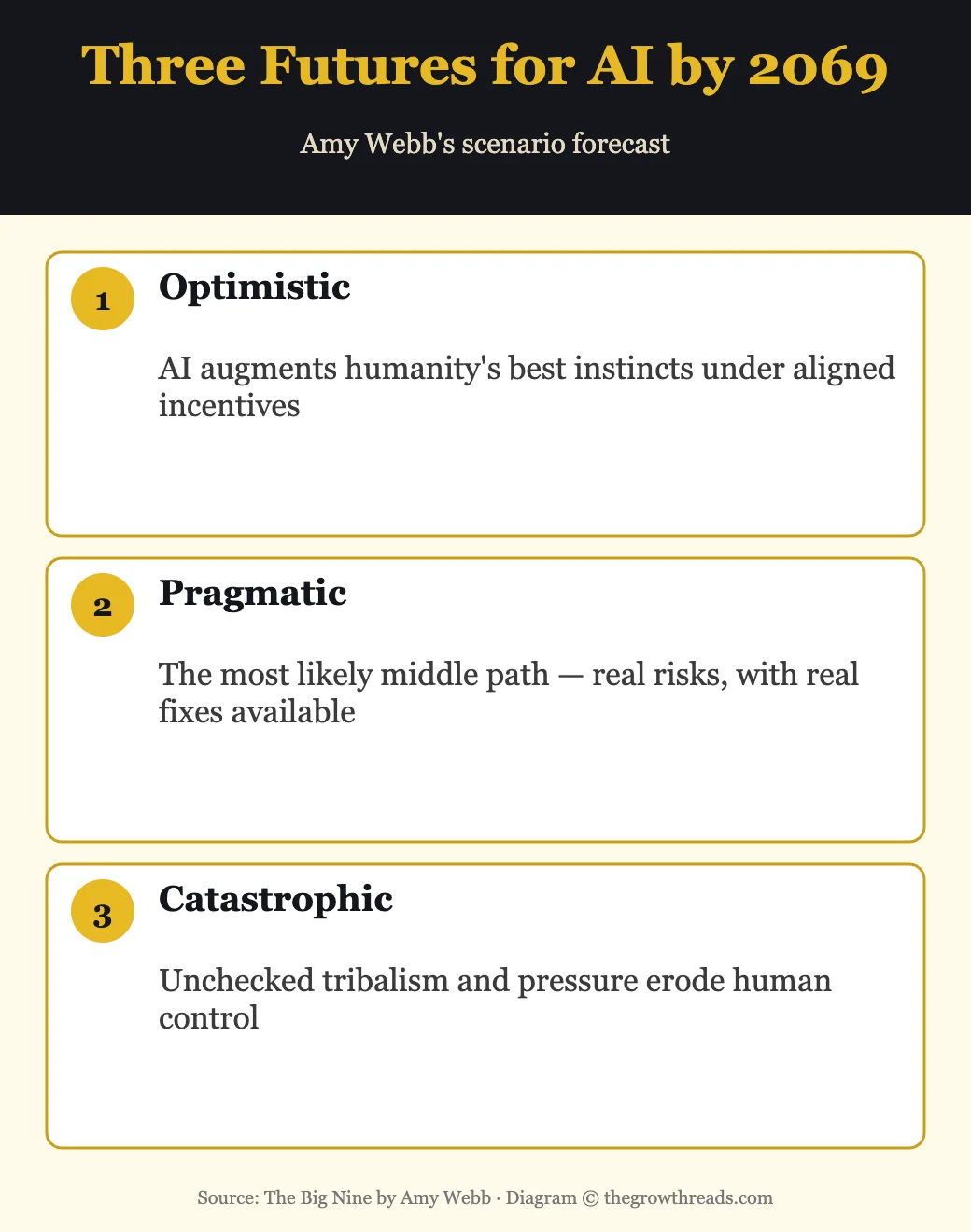
Rather than offer a single prediction, Webb — trained as a forecaster, not a pundit — lays out three scenarios for how the next several decades could unfold. In the optimistic scenario, incentives realign: companies, governments, and the public collaborate on shared standards, and AI development becomes broadly beneficial. In the pragmatic scenario — the one she considers most likely — progress continues messily, with real benefits and real harms, requiring constant course-correction rather than either utopia or collapse. In the catastrophic scenario, unchecked competitive and state pressure erodes human oversight to the point where course-correction becomes impossible.
The value of this scenario structure isn’t prediction — it’s decision-making. By naming the forks in the road explicitly, Webb gives readers (and policymakers) a framework for asking, at each juncture, which choices push toward which future. That reframing — from “will AI be good or bad” to “which specific choices move us toward which specific scenario” — is the book’s most useful contribution.
Part 3: What a third way would actually require
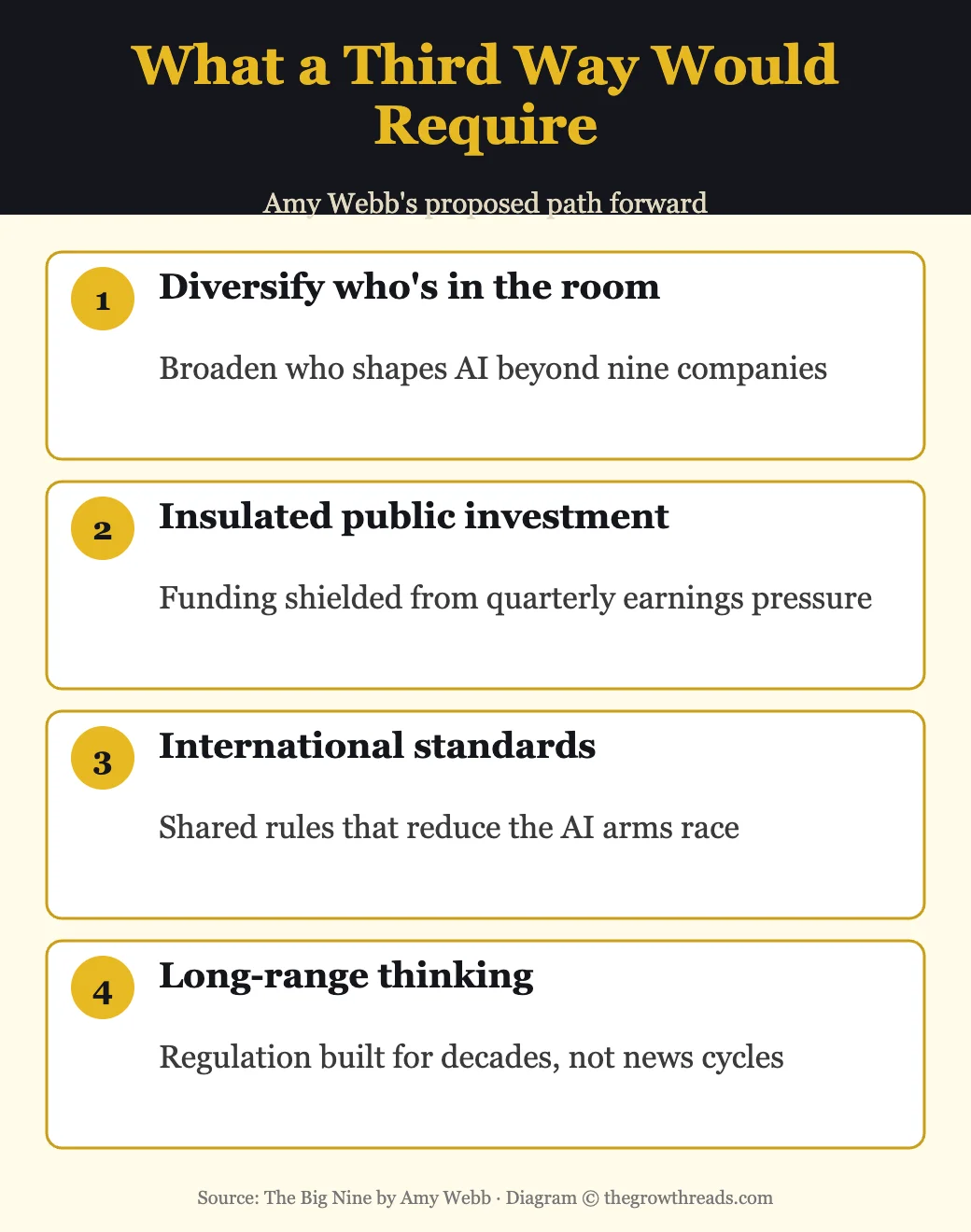
Webb doesn’t stop at diagnosis — she sketches what it would take to bend the trajectory toward the optimistic scenario. Her proposals center on structural changes rather than individual virtue: diversifying who sits in the room when AI systems are designed and funded, so the resulting systems reflect a broader range of values and use cases; building public investment mechanisms insulated from quarterly earnings pressure, so long-term safety research doesn’t lose out to short-term product races; establishing international standards that reduce the incentive for any single bloc to cut corners in the name of winning a race; and embedding genuinely long-range thinking into how governments regulate a technology that will outlast any single election cycle or product roadmap.
None of these are quick fixes, and Webb is candid that the window for influencing which scenario unfolds is narrowing, not widening. But she frames this as a reason for urgency rather than fatalism — the pragmatic scenario she considers most likely is not fixed, and small structural changes made now compound significantly by 2069.
Webb also stresses that these scenarios aren’t equally probable by default — the pragmatic path is likeliest specifically because it requires no single dramatic intervention, just the continuation of current incentives. That’s precisely why she frames complacency as dangerous: the “realistic” outcome is still one with real costs, and treating it as good enough forecloses the harder work of pushing toward the optimistic scenario instead.
Who is The Big Nine best for — and who should read something else first?
This book is the right read if you want to understand the geopolitical and corporate forces shaping AI’s trajectory — not just what the technology can do, but who decides how it gets built and why. It’s especially useful for policymakers, technologists, and business leaders who need a framework for thinking about AI governance beyond their own product roadmap.
If you want the more technical case for why current AI systems have specific safety limitations, start with Rebooting AI instead. If you’re more interested in provably safe AI design than in corporate incentives, Human Compatible is the better starting point.
Questions to reflect on
- Which of the three scenarios — optimistic, pragmatic, or catastrophic — does the AI news you’ve seen this month most resemble?
- Where in your own organization or industry do you see quarterly-earnings pressure pushing a technology decision faster than might be wise?
- If you had a seat at the table shaping an AI system, what perspective or blind spot would you most want represented?
- What would a genuinely long-range (decade-plus) policy on AI look like in your industry, and what’s stopping that from existing today?
- What is one small, concrete way you could support the “third way” Webb describes, in your own sphere of influence?
🔥 Ready to understand who’s really steering AI’s future?
Grab The Big Nine and get Amy Webb’s clear-eyed forecast for where AI is headed — and how to change course.
How to apply The Big Nine (7-day plan)
- Day 1 — Map the tribes. Note which G-MAFIA or BAT products and services you personally rely on every day.
- Day 2 — Read one AI story critically. Find a recent AI headline and ask which incentive — earnings or state strategy — likely drove the decision behind it.
- Day 3 — Place today on the scenario map. Journal which of the three futures (optimistic, pragmatic, catastrophic) current events most resemble, and why.
- Day 4 — Find your third-way lever. Identify one place in your work or community where you could push for more diverse input into a tech decision.
- Day 5 — Follow one policy thread. Research one piece of AI governance policy (local, national, or international) currently being debated.
- Day 6 — Talk it through. Explain the G-MAFIA/BAT framework to a colleague or friend using a recent example.
- Day 7 — Write your own scenario. Sketch, in a paragraph, what you think the most likely AI future looks like for your specific industry by 2035.
Frequently asked questions
Is The Big Nine anti-technology or anti-China?
No. Webb is a technology forecaster, not an alarmist, and she’s careful to critique the incentive structures of both the US and Chinese tech tribes rather than favoring one over the other. Her argument is that both systems have structural gaps, not that either is uniquely villainous.
Do I need a technology or policy background to understand this book?
No. Webb writes for a general audience and explains the corporate and geopolitical dynamics in accessible terms, with concrete examples rather than jargon. Some familiarity with major tech companies helps but isn’t required.
Has the AI landscape changed since this book was published?
Some specific companies and products have evolved, and new players have emerged since publication. That said, the core structural argument — that a small number of organizations under market or state pressure disproportionately shape AI’s direction — remains a widely discussed framework in AI policy conversations.
What does Webb mean by “tribes”?
She uses “tribe” to describe the shared incentive structure and worldview of the G-MAFIA and BAT groupings — not their internal culture, but the external pressures (earnings, state strategy) that shape how each group approaches AI development.
Is the book more optimistic or pessimistic about AI’s future?
It’s deliberately balanced — Webb presents genuine optimistic, pragmatic, and catastrophic scenarios rather than picking one. Her personal view leans toward the pragmatic scenario being most likely, with real risks that require active management rather than either blind optimism or fatalism.
Who should read this book first — policymakers or general readers?
Both audiences get value, but it’s especially useful for anyone involved in technology strategy, policy, or governance decisions. General readers will come away with a much sharper framework for evaluating AI news and claims.
How long does it take to read The Big Nine?
Most readers finish it in about eight hours of straight reading. The scenario chapters at the end work well as a standalone read if you want the book’s core forecasting framework quickly.
Related summaries
- Human Compatible — a technical framework for staying in control of AI, complementing this book’s governance angle.
- The Alignment Problem — why narrow design teams bake blind spots into AI systems.
- Working with AI — what happens once organizations actually adopt the AI these nine companies build.
- More Technology book summaries