

★★★★☆ 4.0/5 — A foundational, big-picture framing of how AI, robotics, IoT, and biotech are converging to reshape every industry at once.
Best for: Business leaders, policymakers, and anyone who wants the vocabulary and mental map for talking about large-scale technological change.
Reading time: ~3 hrs read, 12 min guide
Difficulty to apply: Easy — the ideas are strategic and conceptual rather than tactical.
The Fourth Industrial Revolution in one minute
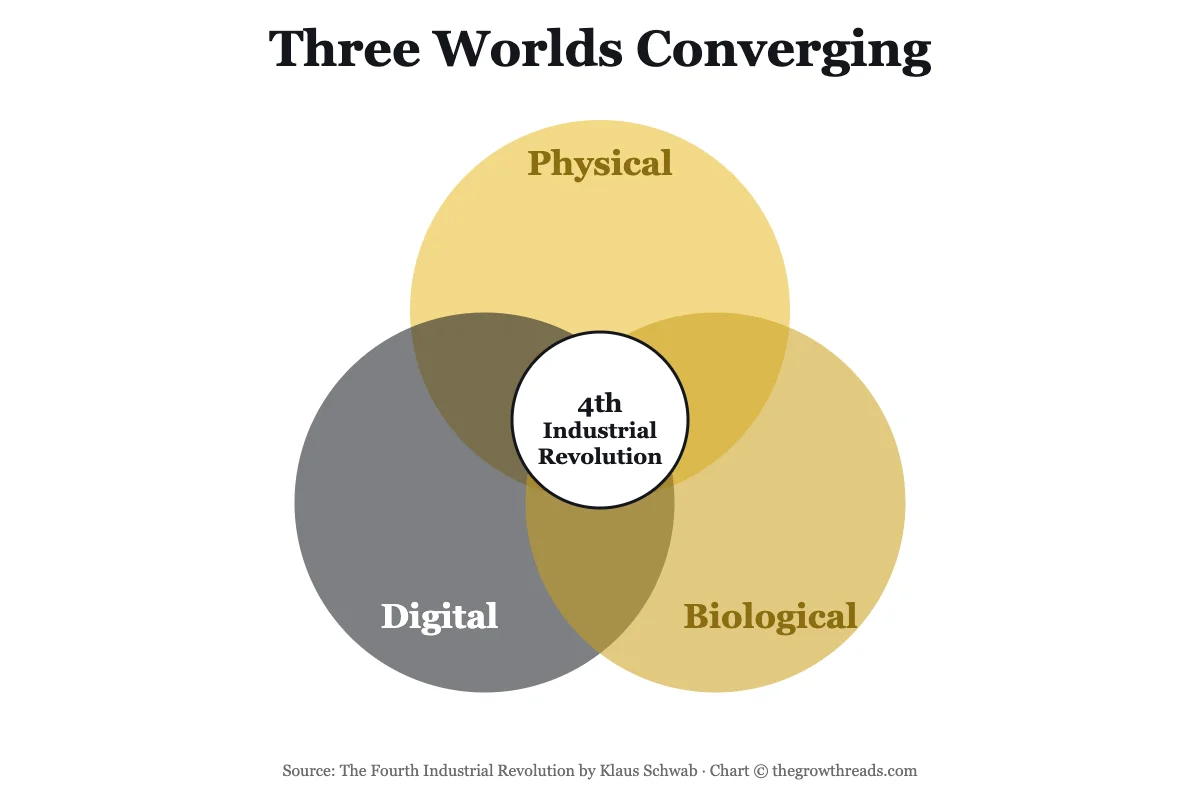
We are living through a shift as profound as the invention of steam power, and most organizations are planning for it like it’s a normal product cycle. Klaus Schwab, founder of the World Economic Forum, argues that the fusion of physical, digital, and biological technologies, AI, robotics, IoT, gene editing, isn’t just another wave of automation. It’s a change in the nature of change itself: faster, broader, and more systemically disruptive than anything that came before it.
The book isn’t a technical manual. It’s a framework for leaders to understand the scale of what’s coming, across business models, jobs, governments, and identity itself, so they can respond deliberately instead of reactively.
Key takeaways
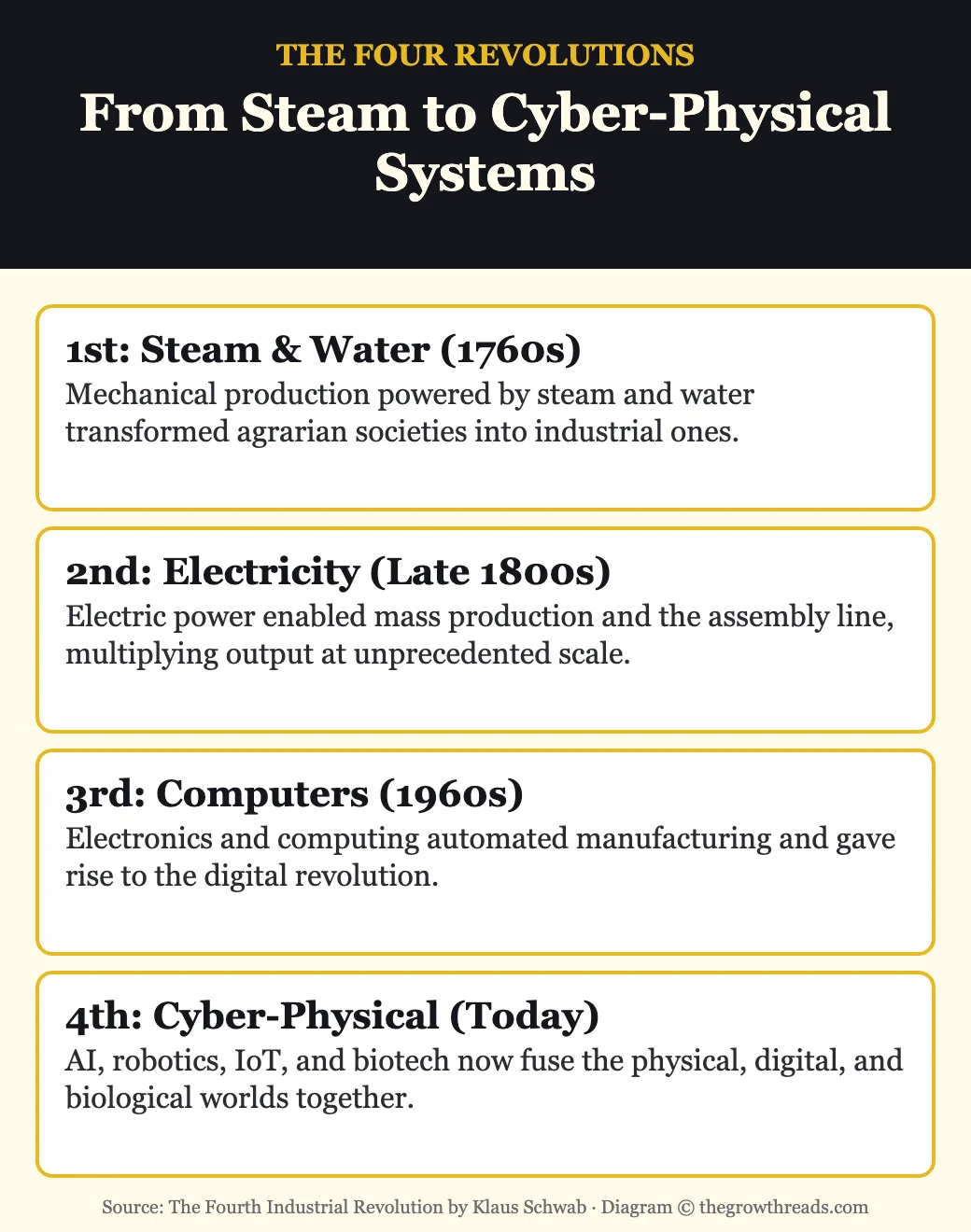
- This is the fourth distinct revolution: steam, electricity, computing, and now the fusion of physical, digital, and biological systems.
- Velocity, not just novelty, is what’s different: new technologies are scaling to billions of users in years, not decades.
- Breadth matters as much as speed: almost every industry is being disrupted simultaneously, not sequentially.
- Systems, not just products, are transforming: entire production, management, and governance systems are being rewritten.
- Physical technologies like autonomous vehicles and 3D printing are changing how things are made and moved.
- Digital technologies like IoT and blockchain are connecting billions of devices and removing intermediaries.
- Biological technologies like gene editing are giving humans direct authorship over living systems.
- Jobs will be redefined, not simply destroyed: the challenge is reskilling at a pace that matches disruption.
- Governance is structurally behind: regulatory systems built for linear change struggle with exponential change.
- Leaders who think systemically, not in silos, will navigate this transition best.
What is The Fourth Industrial Revolution about?
The Fourth Industrial Revolution argues that the fusion of AI, robotics, IoT, and biotechnology is creating a change unprecedented in speed, scope, and systemic impact, transforming production, governance, and even human identity, and it offers leaders a framework for responding deliberately rather than reactively to that shift.
About the author
Klaus Schwab is a German economist and engineer who founded the World Economic Forum in 1971 and led it for over five decades, turning the annual Davos gathering into the world’s most prominent meeting point for heads of state, CEOs, and global institutions. His vantage point atop that convening power gives the book an unusually panoramic view: few authors are positioned to see how governments, multinational corporations, and emerging technologies are reacting to one another in real time. Explore all Klaus Schwab book summaries →
Schwab holds doctorates in economics and engineering, a combination that shapes his approach throughout the book, treating technological capability and economic system design as two halves of the same problem. Published in 2016, The Fourth Industrial Revolution became one of the most cited framing documents for how governments and corporations talk about large-scale technological disruption.
Key concepts at a glance
| Concept | What it means | Use it when |
|---|---|---|
| Fourth Industrial Revolution (4IR) | The fusion of physical, digital, and biological technologies reshaping every system at once | Framing any conversation about large-scale technological change |
| Velocity | The speed at which new technologies scale from invention to mass adoption | Explaining why old planning cycles are too slow |
| Breadth and depth | How many industries and how fundamentally each one is being disrupted at once | Assessing whether a shift is incremental or systemic |
| Systems disruption | Entire production, management, or governance systems changing, not just individual products | Distinguishing a genuine paradigm shift from a new gadget |
| Physical technologies | Autonomous vehicles, robotics, 3D printing, new materials | Discussing how things are made and moved |
| Biological technologies | Genetic engineering, synthetic biology, precision medicine | Discussing changes to health, agriculture, or human biology itself |
One of Schwab’s recurring examples is the smartphone: a single device in most pockets today combines computing power that once filled entire rooms, sensors that read biological data like heart rate and sleep, and connectivity that links its owner to a global digital economy in real time. He uses this everyday convergence to make an abstract argument concrete, arguing that if a single consumer device can already fuse physical, digital, and biological functions, the same fusion is happening at industrial scale across manufacturing, healthcare, agriculture, and finance, just less visibly to the average person.
Part 1: A revolution unlike the first three
Schwab opens by placing today’s changes in historical context. The First Industrial Revolution used steam and water to mechanize production in the 1760s. The Second, arriving around the turn of the 20th century, harnessed electricity to enable mass production and the assembly line. The Third, beginning in the 1960s, used electronics and computing to automate manufacturing, effectively the digital revolution most people already recognize. He argues we are now in a Fourth, distinguished not by a single new technology but by the fusion of technologies across the physical, digital, and biological domains, arriving simultaneously and reinforcing one another.
What makes this revolution different, in Schwab’s telling, isn’t any single breakthrough but three combined qualities: velocity, breadth and depth, and systems impact. Velocity refers to the speed at which technologies now scale, years rather than decades, compared to previous revolutions. Breadth and depth refers to how many industries are being disrupted simultaneously rather than sequentially, and how fundamentally, not just incrementally, each one changes. Systems impact refers to the fact that entire systems of production, management, and governance are being transformed, not merely individual products or processes.
Part 2: Three forces fusing together
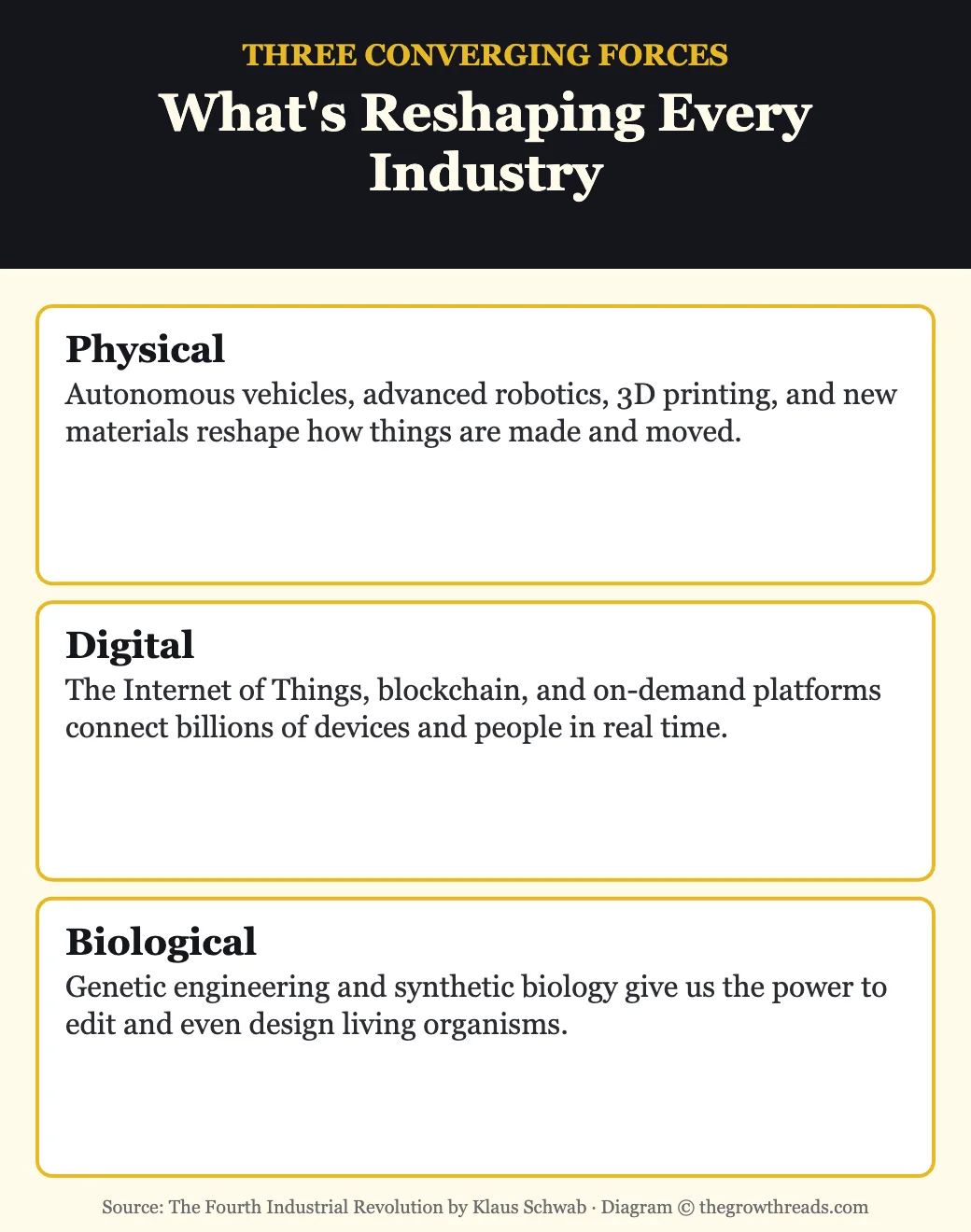
The bulk of the book walks through the three technology clusters converging to drive the Fourth Industrial Revolution. Physical technologies include autonomous vehicles, advanced robotics, new materials, and additive manufacturing (3D printing), all of which are changing how physical goods are designed, built, and moved. Digital technologies include the Internet of Things, blockchain, and on-demand economy platforms, which connect billions of devices and people while dissolving traditional intermediaries between producers and consumers.
Biological technologies, the most novel and ethically fraught of the three, include genetic engineering and synthetic biology, giving humans for the first time the ability to directly read, edit, and even author living systems. Schwab’s central claim is that no one of these forces alone would constitute a revolution, but their convergence, physical devices instrumented with sensors, feeding data to digital networks, informed by biological insight, creates feedback loops and capabilities that didn’t exist even a decade earlier.
Part 3: Leading through disruption
Having laid out the scale of the shift, Schwab turns to what leaders, in business and government alike, need to do differently. His first recommendation is systems thinking: leaders accustomed to managing within a single function or industry silo need to recognize that technology, policy, and social change are now moving together, and a decision made in one domain ripples unpredictably into the others. Treating the Fourth Industrial Revolution as a series of isolated tech upgrades, he argues, guarantees leaders are always reacting a step behind.
His second recommendation centers on people: since technology is scaling faster than most workforces can adapt, continuous reskilling becomes a competitive necessity rather than an HR nicety. Third, he calls for more agile governance, since regulatory frameworks built for a linear, predictable pace of change are structurally unsuited to exponential technologies; rigid rule-based regulation needs to give way to adaptive, principles-based oversight that can keep pace. Finally, he argues for inclusive growth as a matter of self-interest as much as ethics: automation’s gains concentrated too narrowly risk a public backlash severe enough to stall beneficial technology altogether.
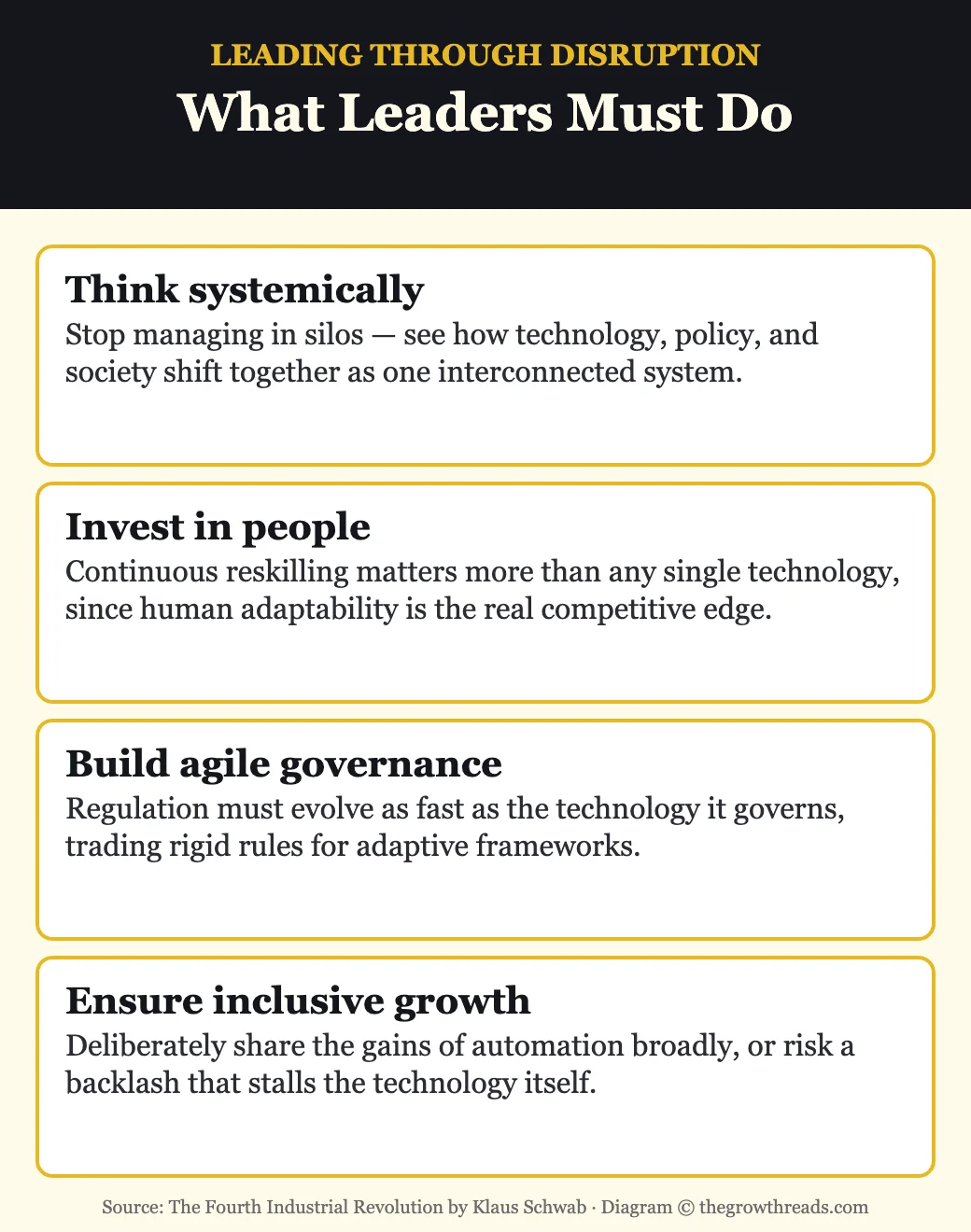
Schwab is careful to frame these four recommendations, systems thinking, workforce investment, agile governance, and inclusive growth, as mutually reinforcing rather than a checklist to work through in isolation. An organization that reskills its workforce but keeps rigid, siloed decision-making will still be caught flat-footed by cross-industry disruption; a government that regulates adaptively but ignores distributional fairness will still face public backlash. The book’s implicit argument is that half-measures on any one pillar undermine the other three, which is part of why he pushes so hard for leaders to treat this as a genuinely systemic challenge rather than four separate initiatives.
Who is The Fourth Industrial Revolution best for — and who should read something else first?
This book is best for executives, policymakers, and strategists who want the big-picture vocabulary and framework for discussing technological disruption at the systems level. If you want a more hands-on look at how AI specifically changes day-to-day work, start with Working with AI instead. If you’re more interested in the handful of companies steering this transition, The Big Nine is the better starting point.
Questions to reflect on
- Which of the three technology forces, physical, digital, or biological, is most actively reshaping your own industry right now?
- Does your organization plan for linear change or exponential change, and does that assumption still hold?
- Where in your own work do you manage in a silo that technological convergence is starting to blur?
- What reskilling would make you, personally, more resilient to the next five years of technological change?
- Who benefits most from automation gains in your industry today, and is that distribution sustainable?
🔥 Ready to make sense of the technological shift reshaping every industry?
Grab a copy of The Fourth Industrial Revolution and get the framework leaders use to talk about large-scale change.
How to apply The Fourth Industrial Revolution (7-day plan)
- Day 1: Map which of the three forces, physical, digital, biological, is most disrupting your industry today.
- Day 2: List three decisions in your organization made in a functional silo that technology is now blurring across departments.
- Day 3: Identify one skill you’d need to reskill into if your current role were 50% automated within five years.
- Day 4: Research how a competitor or peer organization is responding systemically, not just adding a single new tool.
- Day 5: Ask a colleague in a different department how the Fourth Industrial Revolution is showing up in their work.
- Day 6: Write down one governance or policy question your organization hasn’t answered about a new technology it’s already using.
- Day 7: Draft a one-page systems view of how physical, digital, and biological forces intersect in your own field.
Frequently asked questions
What is the Fourth Industrial Revolution, in simple terms?
The Fourth Industrial Revolution is Klaus Schwab’s term for the current wave of technological change driven by the fusion of physical technologies (robotics, autonomous vehicles), digital technologies (IoT, blockchain), and biological technologies (genetic engineering). What distinguishes it from past revolutions is the combination of unprecedented speed, breadth across industries, and the depth of systemic change it causes, not any single breakthrough technology.
How is this different from the Third Industrial Revolution?
The Third Industrial Revolution, starting in the 1960s, was primarily about electronics and computing automating existing processes, essentially the rise of digital technology on its own. The Fourth is distinguished by the fusion of digital technology with physical and biological systems simultaneously, creating feedback loops and capabilities, like AI-directed genetic editing, that didn’t exist when digital technology was developing in isolation.
Is this book still relevant, since it was published in 2016?
Yes, arguably more relevant, since generative AI, large-scale gene editing tools, and IoT proliferation have all accelerated significantly since 2016 in exactly the directions Schwab described. The specific examples have aged, but the framework, velocity, breadth and depth, systems impact, remains a widely used lens for discussing technological disruption at the World Economic Forum and beyond.
Does the book predict mass unemployment from automation?
Schwab is more nuanced than a simple “robots will take all the jobs” narrative. He argues jobs will be redefined rather than simply eliminated, but stresses that the pace of workforce reskilling needs to match the pace of technological disruption, and warns that failure to do so, not the technology itself, is what would cause serious social disruption.
Is this book technical or accessible to a general reader?
It’s written for a broad, non-technical audience of business leaders and policymakers rather than engineers. Schwab avoids deep technical detail in favor of conceptual framing and real-world examples, drawing on his decades convening global leaders at the World Economic Forum rather than hands-on technical expertise.
What makes Klaus Schwab qualified to write this book?
Schwab founded and led the World Economic Forum for over 50 years, giving him a uniquely broad vantage point on how governments, multinational corporations, and technologists are responding to disruption in real time. He holds doctorates in both economics and engineering, which shapes his treatment of technology and economic systems as intertwined problems.
What should I read after this book?
For a hands-on look at how AI specifically changes daily work, Working with AI is a strong next step. If you want to understand who controls the largest AI systems driving this convergence, The Big Nine covers that ground well.
Related summaries
- The Big Nine by Amy Webb
- Working with AI by Thomas Davenport & Steven Miller
- Weapons of Math Destruction by Cathy O’Neil
- Genius Makers by Cade Metz
See all Best Technology & AI Books →