

★★★★★ 4.7/5 — A grounded, recovery-informed case for small, repeatable change over dramatic overhauls.
Best for: anyone who’s tried and abandoned big, ambitious self-improvement plans and wants something that actually sticks.
Reading time: ~4.5 hrs to read · ~25 min to skim this guide
Difficulty to apply: Easy — the entire premise is starting smaller than feels necessary.
How a Little Becomes a Lot in one minute
Your mind has a mind of its own, pulling you in competing directions — and lasting change comes not from forcing that complexity into submission, but from working with it, one small choice at a time. Eric Zimmer, longtime host of the podcast The One You Feed, draws on more than a decade of interviewing behavioral scientists, Buddhist teachers, and people in recovery to build a case against the dramatic-overhaul model of self-improvement. In its place, he offers what he calls Wise Habits: practices that pair an outer behavior change with an inner attitude shift, sized small enough to survive an ordinary bad day rather than requiring a permanently good one. The book’s title captures its central mechanism directly — a little, repeated consistently, compounds into a lot, in a way that one dramatic push rarely does. Zimmer writes from direct experience with addiction recovery, where the same principle — small, sustainable steps rather than white-knuckled willpower — proved to be the difference between change that lasted and change that didn’t. He’s careful not to overstate the parallel between recovery and ordinary habit change — the stakes and mechanisms aren’t identical — but he argues the underlying lesson transfers cleanly: a change that depends on constant, effortful resistance is fragile, while one built around smaller, sustainable steps and genuine self-compassion tends to hold even when circumstances get harder.
Key takeaways
- Your mind has a mind of its own: competing impulses are normal, not a personal failure — the goal is working with that complexity, not defeating it through force.
- Wise Habits pair outer and inner change: a behavior shift alone rarely holds without an accompanying shift in self-compassion, clarity, or attitude.
- Shrink the target until it’s nearly impossible to fail: a habit sized for your worst day is more valuable than one sized for your best.
- Engineer the environment, not just willpower: reducing friction around a desired behavior works better than relying on motivation alone.
- Judge progress by consistency, not intensity: showing up in a small way repeatedly beats an occasional dramatic effort.
- Separate real values from absorbed ones: some goals are genuinely yours; others were picked up from culture or comparison, and the difference matters for what actually sustains motivation.
- Self-compassion is a change tool, not a consolation prize: treating setbacks as information rather than failure keeps a habit alive through the inevitable off days.
- Recovery principles generalize: the small-step, non-white-knuckle approach that works for addiction recovery applies just as well to ordinary habit change.
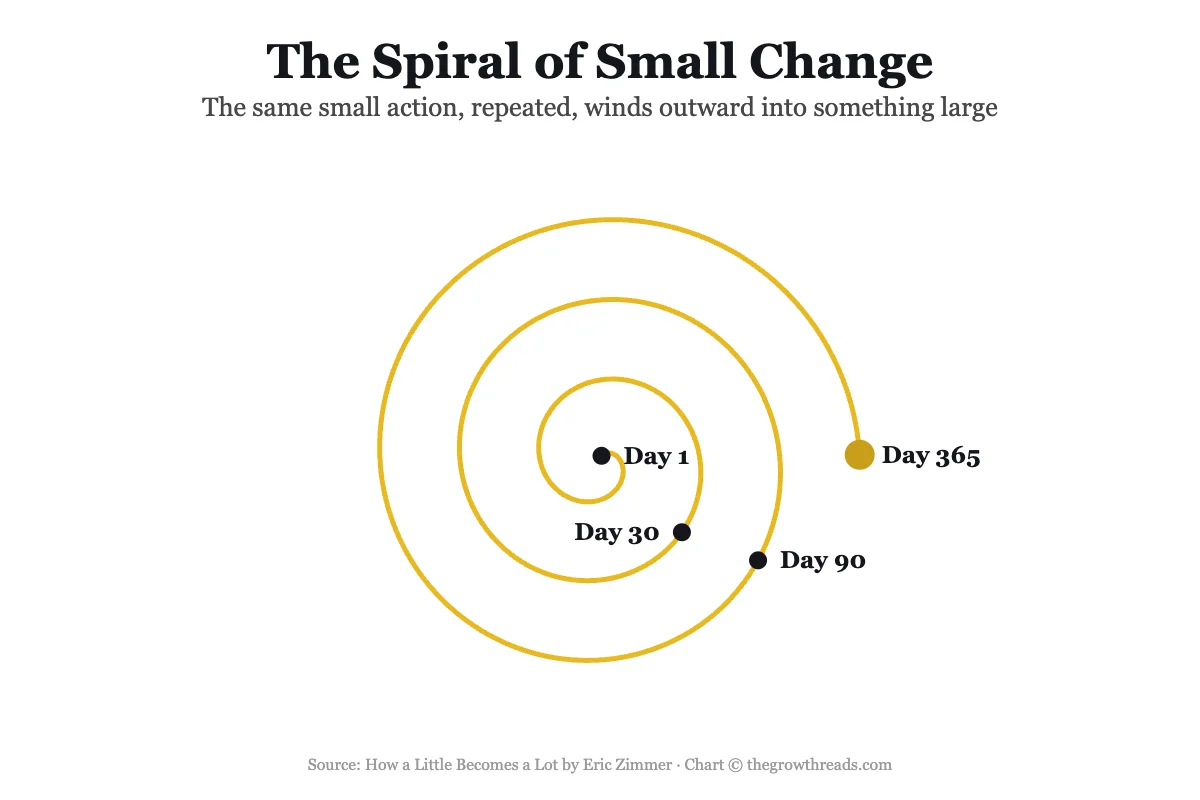
- A little becomes a lot, but only with time: the compounding effect of small, consistent action is real, but it isn’t visible in the early days — patience is part of the method. The spiral shape is apt: the early loops look barely different from where you started, and only later loops reveal how much ground has actually been covered.
What is How a Little Becomes a Lot about?
Eric Zimmer’s How a Little Becomes a Lot argues that lasting personal change comes from small, consistent choices rather than willpower-driven overhauls, introducing “Wise Habits” — practices that combine a small outer behavior with an inner shift in self-compassion and clarity — as the mechanism for sustainable transformation.
About the author
Eric Zimmer is the host of The One You Feed, a podcast he’s run for more than thirteen years, built around the parable of two wolves — one representing destructive impulses, one constructive — where the one you feed, through your daily attention and choices, is the one that grows stronger. It’s a deceptively simple image that Zimmer uses as a shorthand for the book’s more elaborate argument: which wolf grows stronger isn’t decided by any single dramatic feeding, but by the accumulated pattern of small, daily choices. Across hundreds of interviews with behavioral scientists, Buddhist teachers, psychologists, and everyday people describing their own change processes, Zimmer built both a coaching practice and a body of practical wisdom about what actually works. His own path into this material began in addiction recovery, where he learned firsthand that the sustainable route through a hard change is rarely the dramatic, willpower-driven one. How a Little Becomes a Lot, published in March 2026 by Harvest, is his first traditionally published book, and it formalizes the “Wise Habits” framework he had already been teaching through his coaching program into the more accessible form of a full-length work — a natural progression for material that had been tested and refined against real clients and podcast guests for years before reaching the page — synthesizing behavioral science and contemplative wisdom traditions rather than presenting either in isolation. The two-wolves parable that gives his podcast its name — one wolf representing destructive impulses, one constructive, with the one you feed growing stronger — runs as a throughline in the book as well, offering listeners of the show a familiar entry point into material that’s otherwise organized quite differently from a typical interview-format podcast. Explore all Eric Zimmer book summaries →
Key concepts at a glance
| Concept | What it means | Use it when |
|---|---|---|
| Wise Habits | Practices that combine a small outer behavior with an inner shift in attitude or self-compassion | A behavior-only habit keeps collapsing under stress |
| “Your mind has a mind of its own” | Competing impulses and motivations are normal, not a personal failing to overcome by force | You feel frustrated at your own inconsistency |
| Shrinking the target | Making a habit so small it’s nearly impossible to fail at, especially on hard days | An ambitious version of a habit keeps falling apart after a few weeks |
| Environmental engineering | Reducing friction and setting up cues in advance so the habit needs less willpower | You rely on motivation and it isn’t showing up reliably |
| Values clarification | Distinguishing goals that are genuinely yours from ones absorbed from culture or comparison | A goal feels like a “should” rather than something you actually want |
Part 1: Why your mind resists simple willpower
Zimmer opens with an idea he returns to throughout the book: your mind has a mind of its own. Competing impulses, contradictory motivations, and the pull toward both growth and comfort at the same time aren’t signs of weak character — they’re the normal condition of being a mind, and treating them as a problem to be defeated through sheer force tends to backfire. This reframing matters because it changes the emotional tone of the whole change process. Instead of treating a lapse as evidence of personal failure, Zimmer’s framing treats it as exactly what should be expected from a mind that was never going to move in one clean, linear direction to begin with.
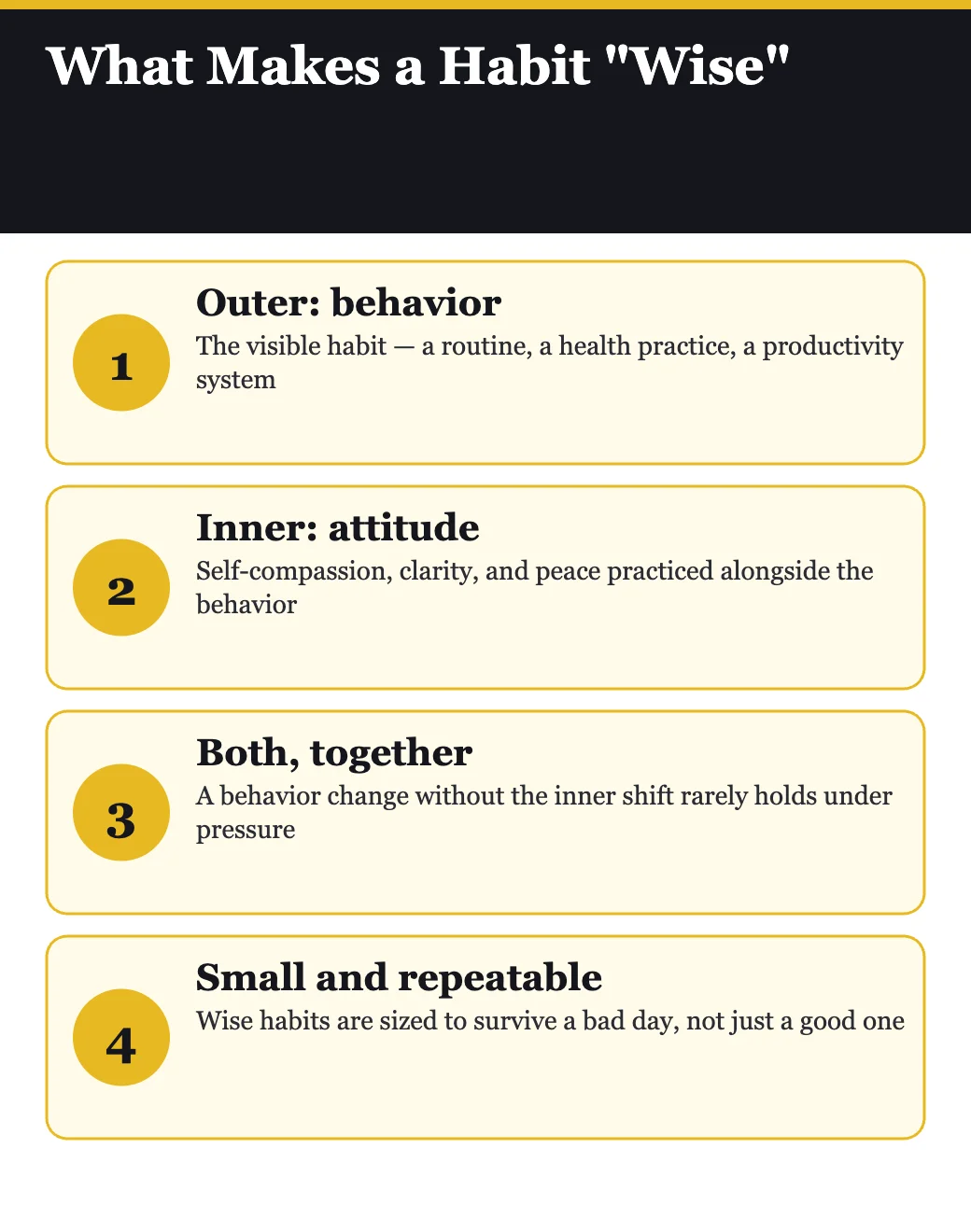
This is where the book’s central framework, Wise Habits, comes in. A Wise Habit isn’t just a behavior change — a new routine, a health practice — it’s that behavior paired with an inner shift: more self-compassion, more clarity about what you actually want, more peace with the fact that progress won’t be a straight line. A morning walk, for example, becomes a Wise Habit not simply by happening consistently, but by being paired with a genuine, non-punitive relationship to the days it doesn’t happen — the walk is the outer half; the absence of harsh self-judgment on a missed day is the inner half, and Zimmer treats both as equally load-bearing parts of the same practice. Zimmer’s argument is that behavior change attempted without the inner half tends to be brittle; it holds up during easy weeks and collapses during hard ones, precisely because the underlying relationship with yourself hasn’t changed, only the routine has. He illustrates this with a common pattern: someone forces a strict new routine through sheer determination, sustains it for a few impressive weeks, then hits a stressful stretch of life and abandons the whole thing at once — not gradually, but completely, often with a wave of self-criticism attached. The behavior itself was never the fragile part; the all-or-nothing relationship with the behavior was.
Part 2: Shrinking the target and engineering the environment
The most practical section of the book addresses a common failure pattern: habits sized for an idealized version of your life rather than your actual one. Zimmer’s fix is to shrink the target until it’s nearly impossible to fail at — not thirty minutes of meditation but three, not a full workout but a single set, not a complete decluttering session but one drawer. The smaller version isn’t a compromise; it’s the actual plan, designed from the start to survive the days when energy and motivation are both running low.
Alongside shrinking the behavior itself, Zimmer emphasizes engineering the environment rather than relying on willpower in the moment. This means reducing friction in advance — laying out tomorrow’s workout clothes tonight, keeping a journal by the bed instead of in a drawer, removing the extra steps between deciding to do something and actually doing it. He treats willpower as a limited and unreliable resource, better spent on the initial setup than on repeated, moment-to-moment resistance. This is a deliberate reallocation of effort rather than an argument against effort altogether — the work still happens, it just happens once, in advance, at a moment when energy and clarity are higher, instead of being re-litigated every single day at the exact moment willpower is lowest and temptation or inertia is strongest.
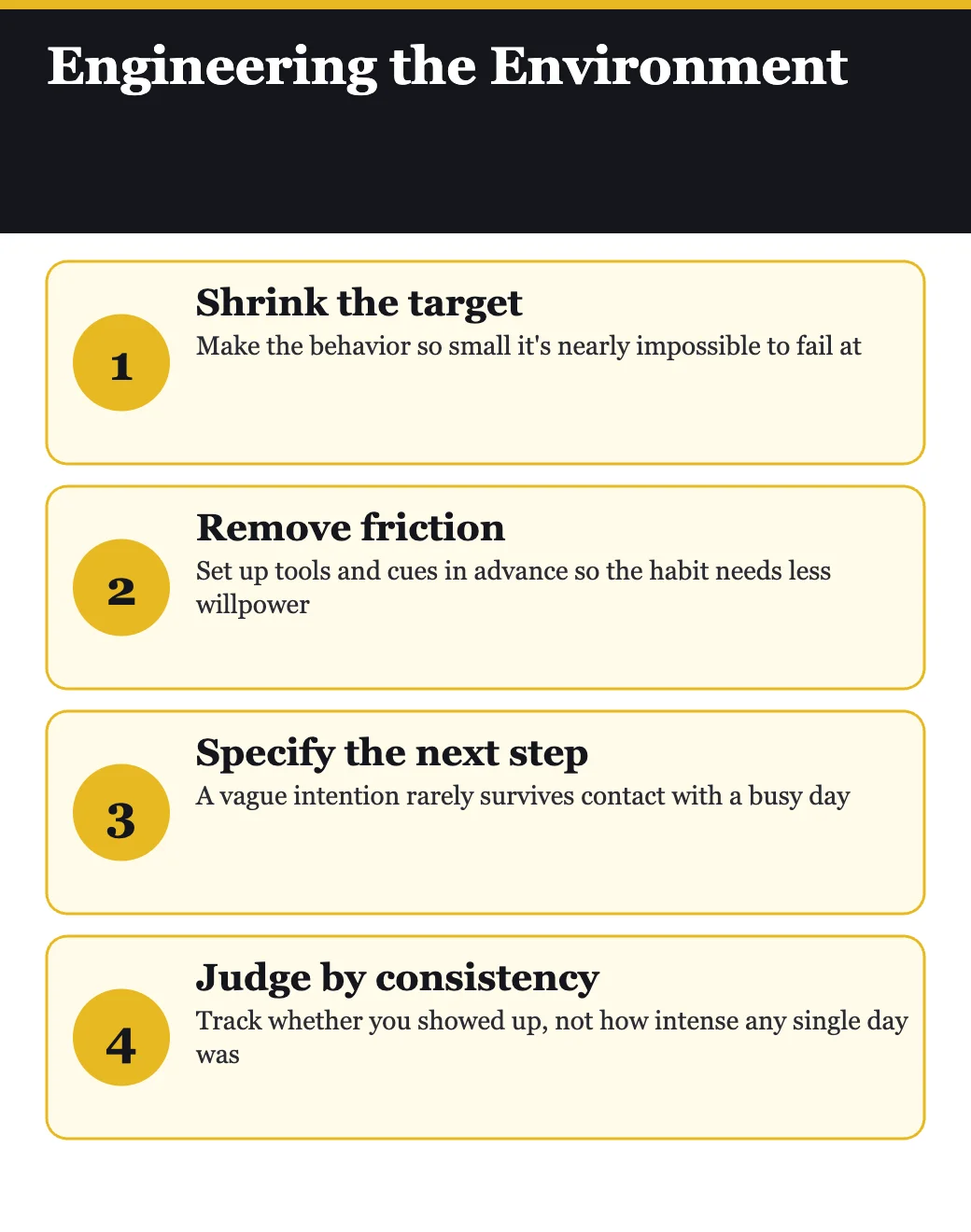
He also reframes how progress should be measured: not by the intensity of any single day, but by the consistency of showing up at all, even in the smallest possible way. A missed full workout followed by one push-up still counts, in his framework, because the habit staying technically alive matters more than any individual day looking impressive. This reframing tends to be the hardest part for readers coming from a more performance-driven background, where a diminished version of a habit can feel like giving up rather than like the plan working correctly. Zimmer addresses that resistance directly, arguing that a habit which survives a hard week in reduced form is more valuable, over a year, than one that looks perfect for a month and then disappears entirely.
Part 3: Finding the values that are actually yours
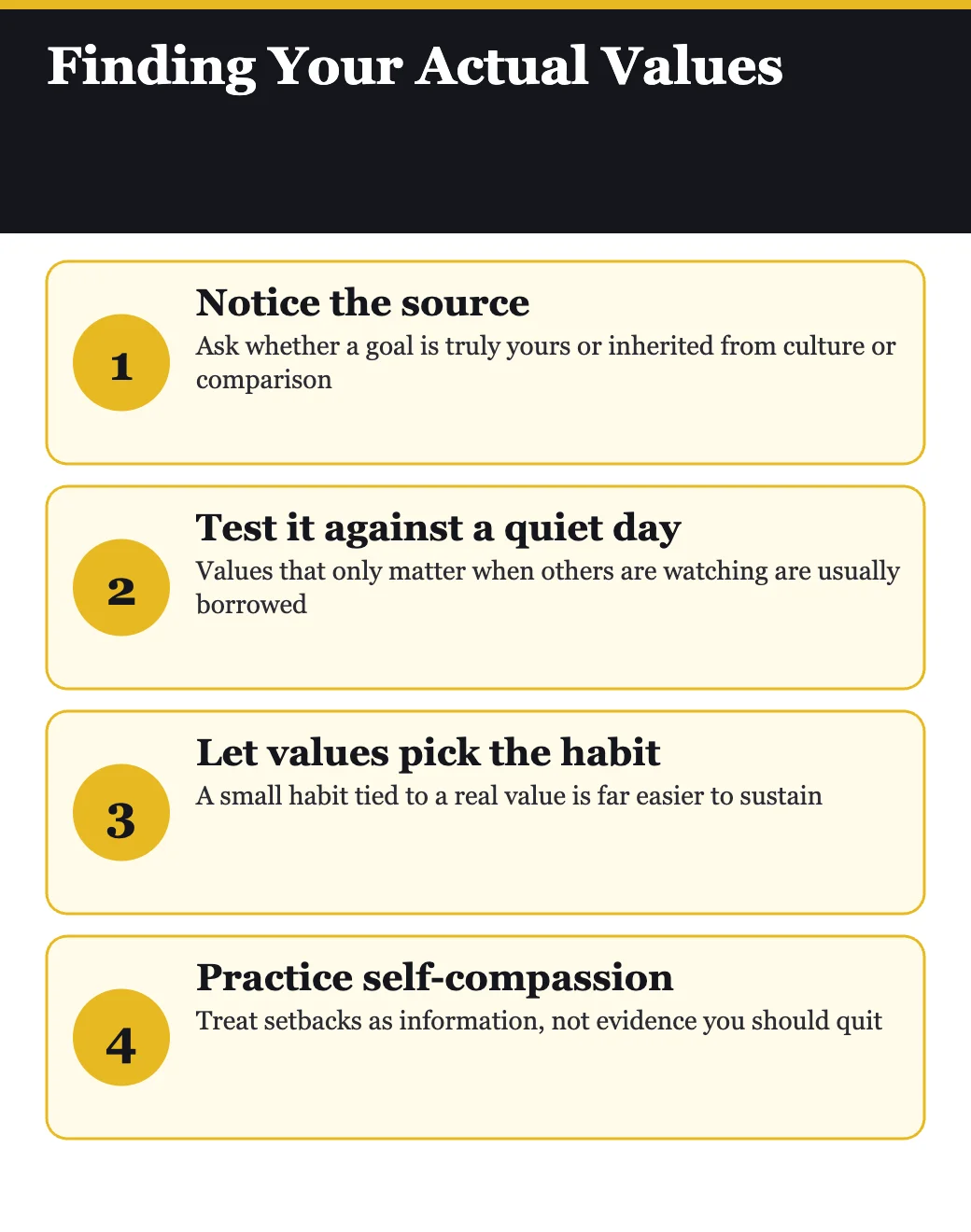
A recurring theme in the book is the distinction between values you’ve genuinely chosen and values you’ve absorbed — from family expectations, cultural pressure, or simple comparison to people around you. Zimmer argues that habits built on absorbed values tend to be fragile, because the underlying motivation isn’t really yours to draw on when things get hard; habits built on genuinely held values have a deeper well of motivation to pull from, even on difficult days.
His suggested practice for sorting the two apart is to notice the source of a goal and test it against a quiet moment — a value that only feels important when someone else is watching, or when you’re comparing yourself to a specific person, is more likely borrowed than genuinely yours. This isn’t presented as a one-time exercise but as an ongoing check, since absorbed values can be mistaken for authentic ones for years before the mismatch becomes clear. Zimmer is candid that this can be uncomfortable work — it sometimes means admitting that a goal pursued for years wasn’t ever really wanted for its own sake, only for the approval or belonging it seemed to promise. He frames that discovery as useful rather than wasted time, since redirecting effort toward a genuinely held value tends to produce more sustainable motivation than continuing to chase one that was never truly yours.
Part 4: Self-compassion, recovery, and the long view
Zimmer’s background in addiction recovery informs the book’s approach to setbacks directly. In recovery contexts, a lapse treated as total failure often triggers a much larger relapse than the lapse itself would have caused; a lapse treated as information, processed with self-compassion, is far more likely to be followed by a quick return to the habit. He generalizes this principle to ordinary habit change: berating yourself after a missed day tends to make the next missed day more likely, not less, while a compassionate, curious response — what actually happened, what would help tomorrow — tends to shorten the gap before you’re back on track. This isn’t just an emotional preference — Zimmer frames it as a practical mechanism: shame tends to trigger avoidance, and avoidance of the habit compounds a single missed day into a missed week, then a missed month, in the same way small consistent effort compounds in the opposite direction. Curiosity short-circuits that avoidance spiral before it starts, keeping the gap between a lapse and a return as small as possible.
This isn’t presented as an excuse for low effort. Zimmer is explicit that self-compassion and high standards aren’t opposites — the standard stays the goal; the tone you take with yourself while pursuing it is what changes. He draws a useful distinction here between self-compassion and self-indulgence: the former holds the standard steady while changing how failure to meet it is processed, while the latter quietly lowers the standard itself under the guise of being kind. Confusing the two, he notes, is a common reason people abandon self-compassion as a strategy after concluding it made them less disciplined, when in practice it was self-indulgence, not self-compassion, that produced the drop in standards. The book closes by returning to its title’s central image: a little, repeated with enough consistency and enough self-compassion to survive the inevitable rough days, becomes a lot — not through any single dramatic effort, but through the simple, unglamorous fact of the small choices compounding over time. It’s a deliberately unglamorous conclusion for a genre that often sells the promise of a single breakthrough moment, but it’s consistent with everything the book argues before it: the mechanism was never going to be dramatic, because dramatic effort is exactly what tends to fail to compound.
Who is How a Little Becomes a Lot best for — and who should read something else first?
This book is best suited to readers who’ve tried ambitious, all-or-nothing self-improvement plans and watched them collapse after a few weeks — the shrink-the-target approach directly addresses that failure pattern. Readers who want a more clinically structured, less recovery-flavored treatment of habit mechanics specifically may prefer starting with our Atomic Habits summary instead. If your bigger challenge is emotional permission to slow down rather than habit mechanics, Gentle is a closer match.
Questions to reflect on
- Which current habit is sized for your best day rather than your worst — and what would a nearly-impossible-to-fail version look like?
- Where in your environment could you remove friction instead of relying on willpower?
- Is there a goal you’re chasing that, if you’re honest, is more absorbed than genuinely yours?
- How do you typically respond to a missed day — with self-criticism or with curiosity about what would help tomorrow?
- What’s one small action you could repeat daily for a year, starting today, small enough that missing it would be nearly impossible?
🔥 Ready to stop starting over and start compounding?
Grab a copy and shrink one habit until it’s nearly impossible to fail at.
How to apply How a Little Becomes a Lot (7-day plan)
- Day 1: Pick one habit you’ve tried and abandoned, and shrink it to a version that’s nearly impossible to fail at.
- Day 2: Remove one piece of friction from your environment that makes that habit harder than it needs to be.
- Day 3: Write down one goal you’re chasing and ask honestly whether it’s genuinely yours or absorbed from elsewhere.
- Day 4: Practice the shrunken habit and note how it felt to do the small version instead of the ideal one.
- Day 5: If you miss a day, respond with curiosity instead of criticism — what would help tomorrow go better?
- Day 6: Add the inner half to your habit: a moment of self-compassion or clarity alongside the outer behavior.
- Day 7: Review the week and count consistency, not intensity — how many days did you show up in some form?
Frequently asked questions
What does “your mind has a mind of its own” mean?
It’s Zimmer’s way of naming the fact that competing impulses, contradictory motivations, and the pull toward both growth and comfort are a normal feature of how minds work, not a personal failing. Instead of trying to force that complexity into submission through willpower, he argues the more productive approach is learning to work with it — for example, by shrinking habits and engineering environments rather than relying on constant self-discipline.
What is a “Wise Habit”?
A Wise Habit pairs a small outer behavior change with an inner shift in attitude — more self-compassion, more clarity, more peace with imperfect progress. Zimmer’s argument is that behavior change without the inner half tends to be brittle, holding up during easy periods and collapsing under stress, since the underlying relationship with yourself hasn’t actually changed.
Is this book based on Zimmer’s podcast, The One You Feed?
Yes — the book draws on more than thirteen years of interviews Zimmer has conducted on his podcast with behavioral scientists, Buddhist teachers, psychologists, and people describing their own change processes, synthesized alongside his own coaching practice and personal recovery experience into the Wise Habits framework.
Does the book cite specific studies or researchers?
Publisher materials describe the book as drawing on behavioral science, evolutionary neuroscience, and wisdom traditions including Zen Buddhism, alongside Zimmer’s recovery experience and years of podcast interviews. Because the book is very recently published, independent critical coverage confirming its specific citations is still limited, so readers should treat detailed sourcing claims with some caution until more coverage or the book’s own notes are more widely reviewed.
How is this different from other habit books like Atomic Habits?
Both books emphasize small, consistent actions over dramatic overhauls, but Zimmer’s approach leans more heavily on the “inner half” — self-compassion, values clarification, and attitude — alongside the behavioral mechanics, informed by his background in addiction recovery and long-form interviewing. Readers who want a more purely mechanical treatment of habit formation may prefer Atomic Habits; readers interested in the emotional and identity dimension of change alongside the behavioral one may find Zimmer’s approach more complete.
Is this Zimmer’s first book?
Yes — this is his first traditionally published book, following more than a decade of building The One You Feed podcast and a coaching practice around similar material. Because it’s so recently released, extensive independent critical coverage is still limited, though early reader response has been positive.
Do I need to have listened to the podcast first?
No — the book is designed to stand alone and doesn’t assume familiarity with The One You Feed, though longtime listeners will recognize the two-wolves parable and other recurring themes from the show. It works well as either an introduction to Zimmer’s approach or a more structured companion to the podcast.
Related summaries
- Million Dollar Habits — self-concept and daily habits that compound into results
- Gentle — a sustainable alternative to hustle culture
- Decluttering at the Speed of Life — a forgiving, small-session decluttering method
- More time management book summaries