

★★★★★ 4.6/5 — A gentle, guilt-free case for 15-minute cleaning sessions over exhausting deep-clean marathons.
Best for: anyone who feels too overwhelmed by a messy home to even start, especially those who’ve given up on all-day cleaning binges.
Reading time: ~2.5 hrs to read · ~15 min to skim this guide
Difficulty to apply: Easy — every technique fits inside a single 15-minute timer.
The CHAOS Cure in one minute
A messy home isn’t a moral failing — it’s a symptom of overwhelm, and the cure isn’t a marathon deep-clean but small, timed sessions repeated consistently. Marla Cilley, widely known as “FlyLady” from her long-running home-organization website, coins the term CHAOS — Can’t Have Anyone Over Syndrome — for the specific, familiar dread of a house too messy to let anyone see. Rather than treating that dread as something to fix with a single heroic weekend of cleaning, Cilley’s cure is disarmingly modest: set a timer for fifteen minutes, tackle one room or one trouble spot, and stop when the timer rings, whatever’s left undone. The book reframes cleaning as an act of self-care rather than a performance to be judged, arguing that the emotional weight of a chaotic home — shame, avoidance, the reflex to keep people out — responds better to small, repeatable acts of care than to guilt or ambition. It’s a distillation of the broader FlyLady philosophy Cilley has taught for decades, applied specifically to the fifteen-minute format the book’s subtitle promises.
Key takeaways
- CHAOS stands for Can’t Have Anyone Over Syndrome: Cilley’s name for the specific shame and avoidance a chronically messy home produces.
- A messy home is a symptom, not a character flaw: chaos reflects overwhelm, not laziness, and the cure starts by dropping the guilt.
- The timer does the deciding, not your mood: set 15, 10, or 5 minutes, work until it rings, and stop — no matter how much is left.
- One room or one task beats a whole list: a focused, bounded target is far more achievable than an open-ended to-do list.
- Sticky notes anchor a new habit while it’s forming: a visible reminder in the right place makes a small routine easier to remember.
- There’s no such thing as behind: every session is a fresh start from wherever the house actually is today, not where it “should” be.
- Progress beats perfection: a partially cleaned room after 15 minutes is real progress, not a failed attempt at a full clean.
- Order supports calm, not appearances: the goal is a home that feels manageable, not one styled for a magazine.
- Small wins compound into a routine: a single tended task tends to make the next one easier to start.
What is The CHAOS Cure about?
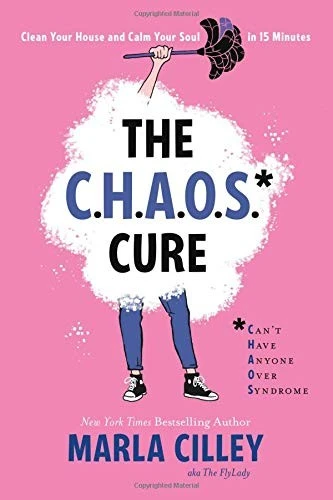
Marla Cilley’s The CHAOS Cure argues that a chronically messy home — what she calls CHAOS, or Can’t Have Anyone Over Syndrome — is best addressed not through exhausting deep-clean marathons but through short, timed 15-minute sessions that treat cleaning as self-care rather than a test of character.
About the author
Marla Cilley, known to millions of readers as “FlyLady,” built her reputation through FlyLady.net, a home-organization website and daily email system she’s run for decades, reaching a large following of people who describe themselves as chronically disorganized. She presents herself as a “reformed clutterholic” — someone who didn’t start out naturally tidy but built a workable system through years of personal trial and error rather than professional organizing credentials. That experiential, peer-to-peer voice is central to her appeal: she writes as someone who has been exactly as overwhelmed as her readers, not as an expert delivering judgment from outside the mess. This background matters for how the advice lands: readers who’ve tried professionally designed organizing systems and felt like failures when the systems didn’t stick often respond differently to a method built by someone who describes failing at those same systems herself before finding something that actually worked for her own life. The CHAOS Cure, published in December 2018 by Seal Press, distills her broader FlyLady philosophy into a focused, fifteen-minute-session format, translating decades of daily-email coaching into a single, approachable book. For readers unfamiliar with the wider FlyLady community, the book works as a self-contained introduction — the specific fifteen-minute framework doesn’t require signing up for her email list or engaging with the broader system to be useful on its own. Explore all Marla Cilley book summaries →
Key concepts at a glance
| Concept | What it means | Use it when |
|---|---|---|
| CHAOS | Can’t Have Anyone Over Syndrome — Cilley’s name for a home too messy to let visitors see | You avoid inviting people over because of how the house looks |
| The 15-minute timer | A bounded cleaning session that ends when the timer rings, regardless of progress | A task feels too big to start without a clear stopping point |
| Sticky-note prompts | A visible reminder placed where a new habit needs to happen | You keep forgetting a small routine you’re trying to build |
| “Never behind” | Every session starts fresh from today’s actual state, not where the house “should” be | Guilt about how messy things got is stopping you from starting |
| Progress, not perfection | A partially finished task still counts as real progress | An all-or-nothing mindset is keeping you from starting small tasks |
Part 1: Naming the shame — what CHAOS actually is
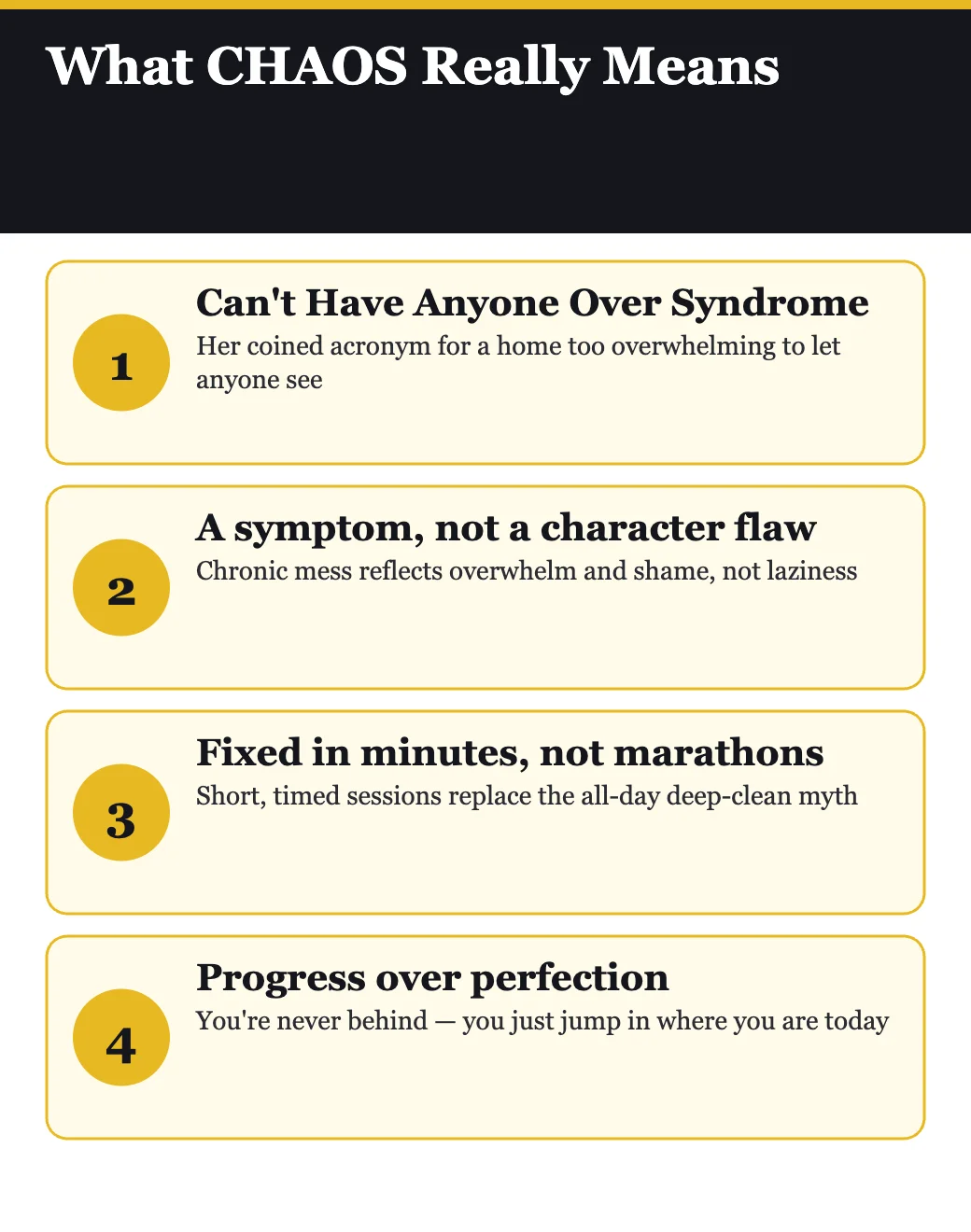
Cilley opens by giving the familiar dread a name: CHAOS, or Can’t Have Anyone Over Syndrome. It’s a deliberately memorable, slightly self-deprecating acronym for a specific and common experience — the particular anxiety of an unexpected knock at the door, the reflex to keep guests in the entryway rather than the living room, the mental math of how long it would take to make any given room presentable. By naming the pattern directly, Cilley reframes what could feel like a private, shameful secret into a recognizable, widely shared condition — one with a name, and more importantly, one with a specific antidote rather than a vague call to “get organized.” The humor in the acronym itself is deliberate — a wry, self-aware label tends to defuse shame more effectively than a clinical or judgmental description would, which fits the book’s overall register of treating a difficult, emotionally loaded problem with warmth rather than severity.
Central to her framing is the claim that a messy home is a symptom of overwhelm and shame, not evidence of laziness or moral failing. This reframing does real emotional work: it removes the assumption that the solution is simply trying harder or caring more, and replaces it with the idea that the actual barrier is the size and shapelessness of the task, not a deficit of character. Once the problem is reframed as “the task is too big and undefined,” the solution — shrinking it down to something small and bounded — becomes obvious rather than effortful. She’s careful to distinguish this from making excuses — the reframe doesn’t deny that the mess is real or that it needs attention, only that the emotional story attached to it (that it reflects a personal failing) is both inaccurate and counterproductive, since shame tends to produce avoidance rather than action.
Part 2: The timer does the deciding
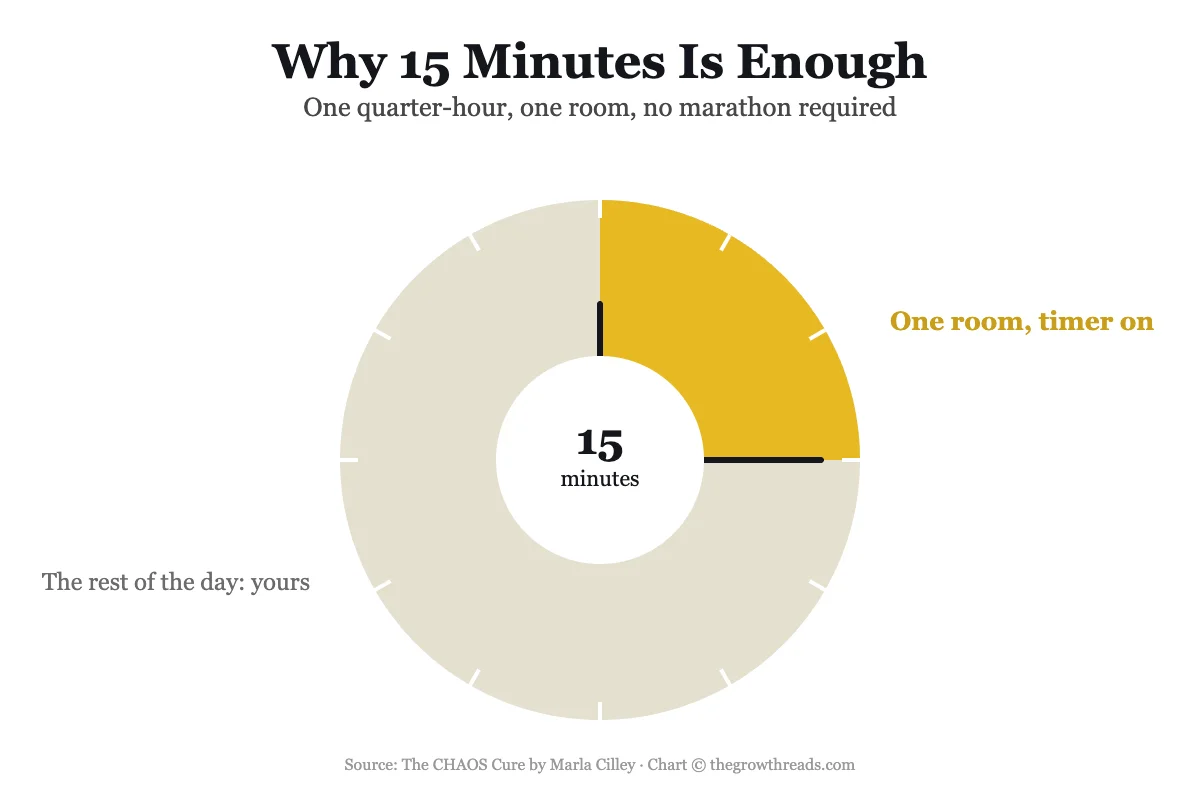
The book’s central mechanical tool is disarmingly simple: set a timer for fifteen minutes — or ten, or five, on harder days — pick one room or one specific trouble spot, and work until the timer rings. When it rings, you stop, regardless of how much is left undone. This isn’t presented as a compromise or an admission of limited ambition; it’s the actual plan, designed to remove the open-ended, exhausting quality that makes cleaning feel impossible to start in the first place.
The timer also does something subtler: it takes the stopping decision out of your hands in the moment. Without a timer, a cleaning session either drags on past the point of diminishing returns, breeding resentment toward the whole activity, or gets abandoned early out of frustration with how much remains. A fixed, external endpoint removes both failure modes — you know exactly how long the commitment is before you start, which makes starting far less daunting. There’s also a psychological effect specific to the fifteen-minute figure: it’s short enough that almost anyone can find it in a busy day, which removes the common excuse of not having enough time, while still being long enough to produce visible, satisfying progress in a single room or task.
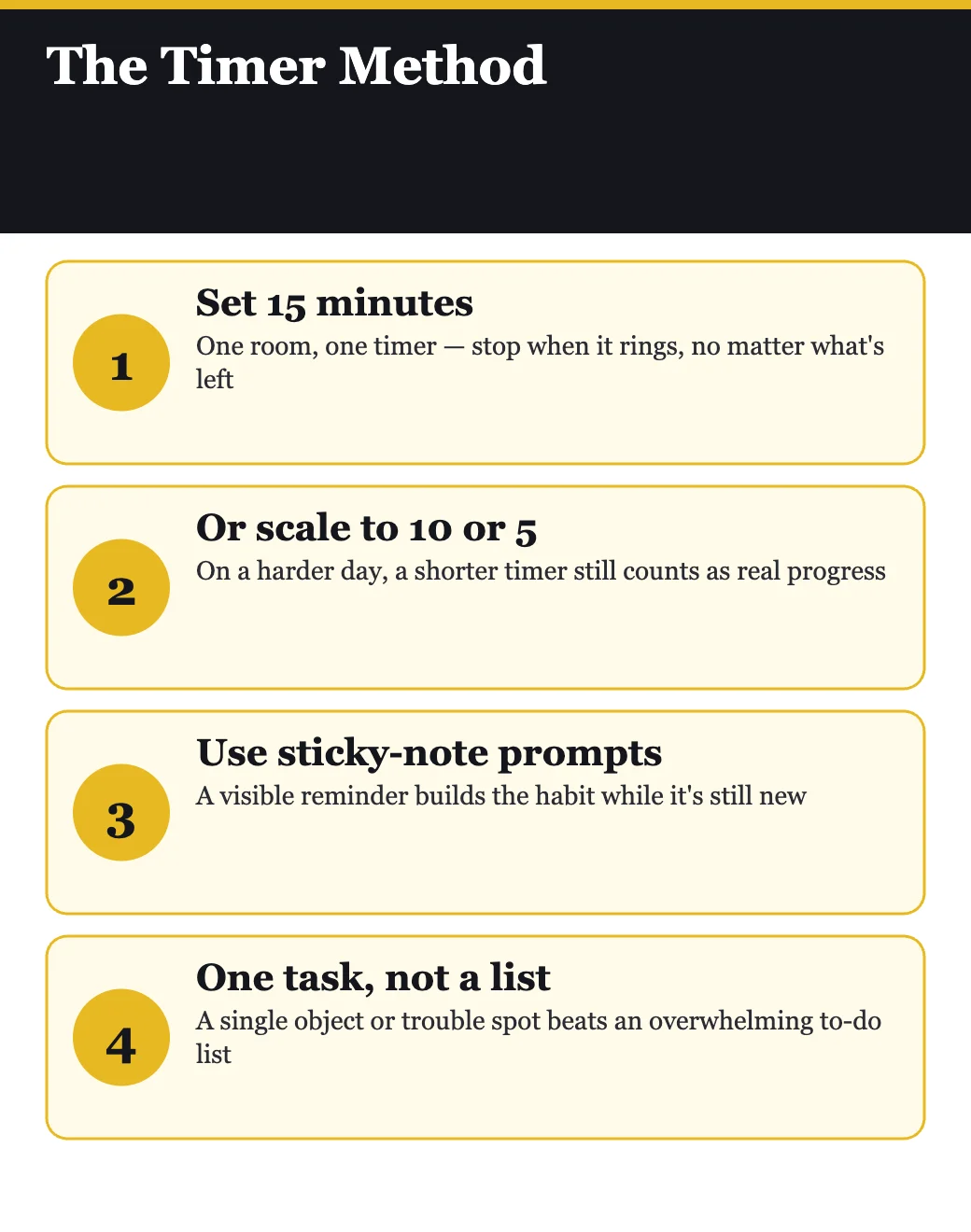
Cilley also recommends sticky-note prompts as a low-tech way to anchor a new routine while it’s still forming — a visible reminder placed exactly where the habit needs to happen, removed once the behavior no longer needs the prompt. It’s a small, practical technique, but consistent with the book’s broader instinct toward tools that reduce the amount of willpower or memory a habit requires in its early, fragile stage. She recommends placing the note somewhere it’s genuinely unavoidable — a mirror, a coffee maker, a door frequently passed — rather than somewhere it will quickly blend into the background, since a reminder that’s easy to stop noticing stops functioning as a reminder at all.
Part 3: You are never behind
One of Cilley’s more emotionally significant claims is that there’s no such thing as being behind — every session is a fresh start from wherever the house actually is today, not measured against where it “should” be if every day had gone perfectly. This matters because chronic disorganization tends to come with a running mental tally of accumulated failure — weeks or months of “should have” that make any single session feel inadequate before it even starts. That tally, in Cilley’s telling, is often the real obstacle, more so than the physical clutter itself — it’s entirely possible to have a manageable amount of actual mess and still feel completely paralyzed by the accumulated sense of having let things slide for too long to fix now. Cilley’s answer is to discard the tally entirely: today’s fifteen minutes are evaluated only against today’s starting point, not against an idealized history.
This connects directly to her broader emphasis on progress over perfection. It’s a phrase repeated often enough across her broader FlyLady materials that longtime readers of her website will recognize it immediately, but it lands with particular force in this book’s specific context of the fifteen-minute session, where “progress, not perfection” is less an abstract motto and more a literal description of what a bounded, timer-ended task can realistically produce. A room that’s forty percent cleaner after a session is a genuine win in her framework, not a failed attempt at a full clean. She’s explicit that waiting for a large enough block of time to do a “proper” job is itself one of the most common ways chronic mess perpetuates — the perfect session never arrives, so nothing happens, while a string of imperfect fifteen-minute sessions actually moves the house forward. Over a month, a series of imperfect fifteen-minute sessions typically outpaces the mythical perfect weekend anyway, simply because it actually happens. This is a pattern she says she sees constantly among readers of her broader FlyLady system: an entire weekend gets mentally reserved for “finally getting the house in order,” that weekend inevitably gets consumed by something else, and the reservation simply moves to a future weekend that never quite arrives either. Breaking the plan into sessions small enough to fit into an ordinary Tuesday removes the dependency on that mythical free weekend altogether.
Part 4: Cleaning as self-care, not a performance
Underneath the practical mechanics, Cilley’s larger argument is that home order should be pursued for the sake of the person living in the home, not for how it looks to visitors or how it measures up to some external standard. Order, in her framing, supports peace of mind — it’s not primarily an aesthetic achievement or a performance of competence. She draws a clear line between a home that looks impressive to an outside observer and a home that actually feels manageable to the person living in it — the two overlap often enough to be confused, but they aren’t the same goal, and chasing the first at the expense of the second is, in her view, a common source of the exhaustion that leads people to give up on order altogether. This distinction matters for sustainability: a cleaning practice motivated by fear of judgment tends to collapse the moment no one’s watching, while one motivated by genuine relief and calm tends to persist because the reward is felt directly and immediately. This is a practical distinction as much as a philosophical one — a habit maintained for an audience naturally weakens whenever the audience is absent, which for most people is most of the time, while a habit maintained for how it makes daily life feel has a reward built into every single occurrence of it.
She’s candid that this reframing runs against a common cultural script, where a tidy home is treated as evidence of a well-run life and a messy one as evidence of the opposite. Cilley pushes back on that judgment directly, treating a messy home as a solvable, ordinary problem rather than a referendum on someone’s worth — a stance that shows up throughout the book’s warm, encouraging tone, which some readers find genuinely comforting and others find a bit gentle for their taste, preferring blunter alternatives in the decluttering genre. Cilley seems aware of this trade-off and leans into it deliberately rather than by accident — her voice throughout reads more like a supportive friend checking in than a coach issuing directives, which is precisely the register she believes chronically overwhelmed readers need after years of feeling judged, even if it isn’t the register every reader personally prefers.
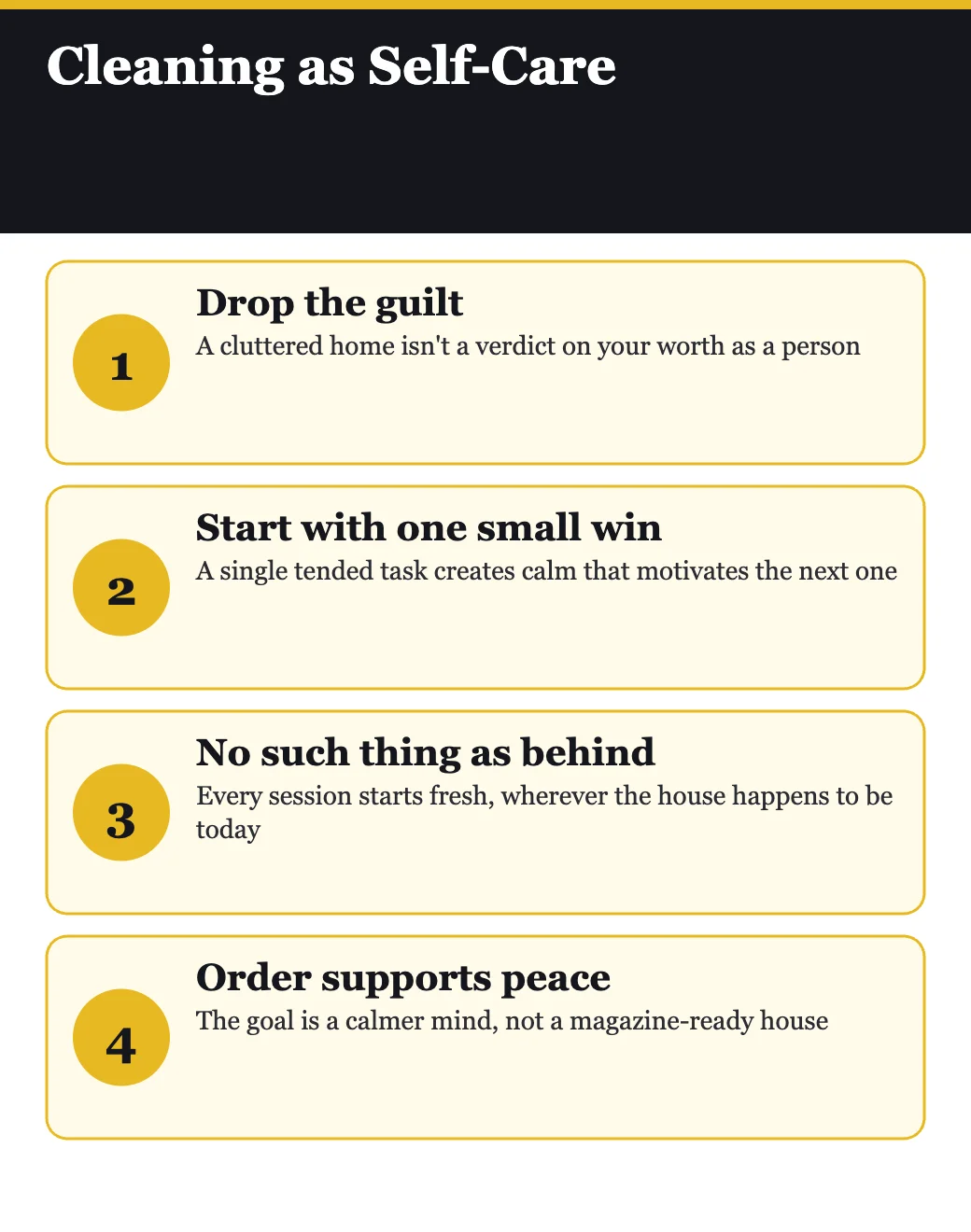
The book closes by returning to its central promise: the cure for CHAOS isn’t a single dramatic effort but a repeatable, forgiving routine small enough to survive an ordinary busy life — fifteen minutes at a time, with no session required to be perfect, and no day required to make up for the ones before it. It’s a modest-sounding promise, and Cilley seems entirely comfortable with that modesty — the book never claims a single dramatic transformation, only that a small, repeated act, done without guilt and without waiting for the perfect moment, adds up over time in a way that occasional heroic effort rarely does.
Who is The CHAOS Cure best for — and who should read something else first?
This book is best suited to readers who feel genuinely overwhelmed by household mess and have struggled to start because the task feels too large or too shame-laden to face — the fifteen-minute format and self-care framing are specifically designed for that starting point. Readers who want a more systematic, room-by-room decluttering method with specific decision rules for what to keep may prefer our Decluttering at the Speed of Life summary instead. If your challenge is more about the emotional permission to rest than the physical mess itself, Gentle is a closer match.
Questions to reflect on
- Which room would you most want to be able to invite someone into without embarrassment?
- What’s the smallest 15-minute task you could complete today without waiting for a bigger block of time?
- Where does guilt about “how behind” you are stop you from starting a small session?
- What would cleaning motivated by your own calm, rather than fear of judgment, actually look like?
- What’s one sticky-note reminder that could anchor a new small habit this week?
🔥 Ready to clean your house and calm your soul in 15 minutes?
Grab a copy and set your first timer today.
How to apply The CHAOS Cure (7-day plan)
- Day 1: Pick your most CHAOS-inducing room and set a timer for 15 minutes to work on it.
- Day 2: Choose one trouble spot (a counter, a pile, an entryway) and give it its own 15-minute session.
- Day 3: Use a sticky note to anchor a small new routine you want to build this week.
- Day 4: If today is harder, scale the timer down to 10 or even 5 minutes — and let that count fully.
- Day 5: Notice one moment of guilt about “being behind” and consciously set it aside before starting.
- Day 6: Do a 15-minute session in a second room, focused only on progress, not completion.
- Day 7: Review the week’s sessions and notice how the small, repeated effort has changed how the house feels.
Frequently asked questions
What does CHAOS stand for in this book?
CHAOS is Marla Cilley’s coined acronym for “Can’t Have Anyone Over Syndrome” — her name for the specific dread and avoidance that comes with a home too messy to let visitors see. Naming the pattern directly is meant to make it feel like a recognizable, solvable problem rather than a private, shameful secret.
Why does the book emphasize 15-minute sessions specifically?
A fixed, bounded timer removes the open-ended, exhausting quality that makes cleaning feel impossible to start. Knowing a session will end in exactly fifteen minutes — regardless of how much is finished — makes starting far less daunting than facing an undefined, potentially all-day task.
Is this the same as Marla Cilley’s FlyLady system?
This book is a focused distillation of Cilley’s broader FlyLady philosophy — built over decades through her website and daily email system — applied specifically to the fifteen-minute session format. Some of her wider system’s terminology and routines exist beyond this book, but the CHAOS acronym and timer-based approach covered here are central to this specific title.
What does “you are never behind” mean?
It means each cleaning session is evaluated against today’s actual starting point, not against an idealized history of what the house “should” look like if every day had gone perfectly. This removes the accumulated guilt that often stops people from starting a small session, since there’s no tally of past failure to catch up on.
Is the book’s tone right for everyone?
Cilley’s voice is warm, encouraging, and self-deprecating, which many readers find genuinely comforting after years of feeling judged for a messy home. Some readers have noted they prefer a blunter, less gentle tone in the decluttering genre — this is a matter of personal fit rather than a flaw in the method itself, and readers who want a more direct style may prefer a different book with a similar practical approach.
Does this book focus on decluttering or ongoing cleaning maintenance?
It leans more toward ongoing cleaning maintenance and emotional reframing than a structured decluttering decision system. Readers looking for specific rules about what to keep or discard may want to pair this book with a more decision-focused decluttering method. Used together, the two approaches complement each other well: one handles the question of what stays and what goes, the other handles the ongoing question of how to keep a home functioning day to day once the initial decluttering is done.
Do I need any special tools to start?
No — the core method requires only a timer (a phone works fine) and, optionally, sticky notes for habit reminders. The book is deliberately designed to be low-barrier, so a reader can start their first fifteen-minute session immediately after finishing a chapter.
Related summaries
- Decluttering at the Speed of Life — a forgiving, small-session decluttering method
- Gentle — a sustainable alternative to hustle culture
- How a Little Becomes a Lot — small habits that actually stick
- More time management book summaries