

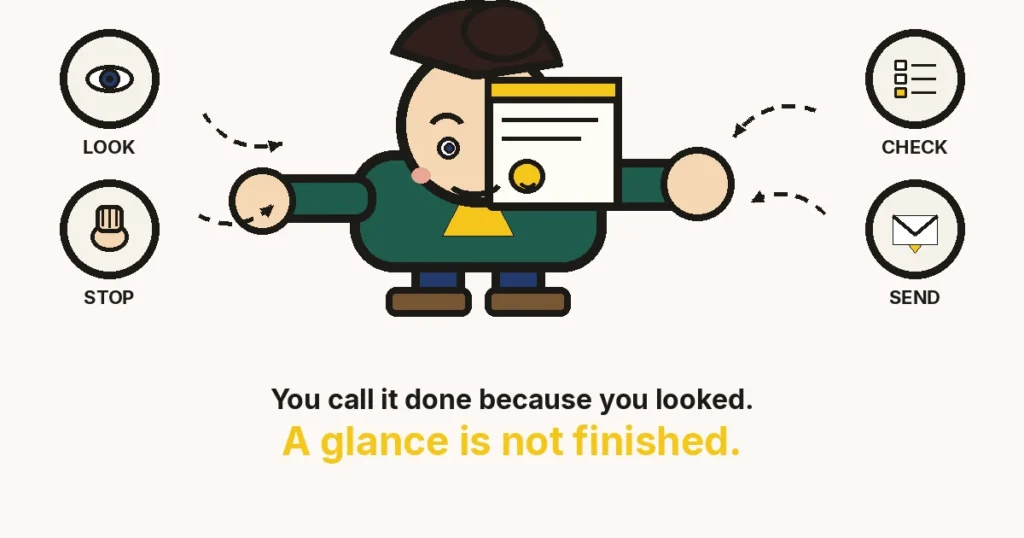
You call it done because you looked, and a glance is not a shared description of finished. The 2020 Scrum Guide calls the Definition of Done a formal description of the state of the Increment when it meets the quality measures required for the product. Write three checks before the send. A look does not count.
Key takeaways
- You call it done because you looked when the send leaves on a glance and nobody has written what finished means.
- Ken Schwaber and Jeff Sutherland, in the 2020 Scrum Guide, call the Definition of Done a formal description of the state of the Increment when it meets the quality measures required for the product.
- That guide says work cannot be considered part of an Increment unless it meets the Definition of Done.
- The same guide says that if an item does not meet the Definition of Done, it cannot be released or presented at the Sprint Review, and it returns to the Product Backlog for future consideration.
- The done note and the sentence on this page are The Growth Reads’ own script. The print book was not opened. Using one commitment outside the rest of Scrum is not Scrum.
What calling it done on a look is
You call it done because you looked when the only test is that you saw it. You are a solo founder. The file is in the tab. You scrolled. The colours match what you remember. You attach it, or you tell the client it is ready, and the first thing they meet is a price that is not the price you agreed, or a page they cannot open. You are a new manager. Someone says “it’s done” in the hallway. You open it for a second, you nod, and the missing piece travels with the send. The look felt like a check. It was a glance.
A glance is a real event. You did look. What you did not have is a description of finished that another person could apply without asking you what you meant. Ken Schwaber and Jeff Sutherland, in the 2020 Scrum Guide, give that description a name: the Definition of Done. It is the commitment attached to the Increment. This page borrows that one commitment for one send. It does not install Scrum. Their end note says that implementing only parts of Scrum is possible, and that the result is not Scrum.
Use the five-line pause when you already know the steps and one of them is still blank. Use the backbrief when they nodded and the work came back as a different job, before anyone starts. Use the time budget when the build has no appetite and the week is about to disappear. Use the candor note when you like them and the hard sentence about their behaviour never gets said. This page is the finish line. Finished has no written checks, so a look is standing in for them.
What the guide actually says
The checked copy is the 2020 Scrum Guide, not a chapter of the trade book. The HTML at scrumguides.org was read on 21 November 2026. The page says that HTML is a direct port of the November 2020 version, available as a PDF. The PDF was not opened. The guide says Schwaber and Sutherland wrote the first version in 2010, and that this document is the definition of Scrum. Penguin Random House’s page for ISBN 9780385346450, read the same day, names Jeff Sutherland and J.J. Sutherland in the byline, and its product details list Crown Currency, 30 September 2014, and 384 pages. The ISBN appears in the page title and in the cover-image path. The product-details block this run could read does not restate the ISBN. The print book was not opened. The guide does not say it is a chapter of that book. J.J. Sutherland is on the book byline. Ken Schwaber is the guide’s other author. They are not the same credit.
The guide’s sentence for the commitment is exact. “The Definition of Done is a formal description of the state of the Increment when it meets the quality measures required for the product.” The moment a Product Backlog item meets that description, an Increment is born. “Work cannot be considered part of an Increment unless it meets the Definition of Done.” If an item does not meet it, “it cannot be released or even presented at the Sprint Review. Instead, it returns to the Product Backlog for future consideration.” The description “creates transparency by providing everyone a shared understanding of what work was completed as part of the Increment.”
Two further sentences decide who writes it. “If the Definition of Done for an increment is part of the standards of the organization, all Scrum Teams must follow it as a minimum. If it is not an organizational standard, the Scrum Team must create a Definition of Done appropriate for the product.” The Developers “are required to conform to the Definition of Done.” If several Scrum Teams work on one product, “they must mutually define and comply with the same Definition of Done.” Among the Developers’ accountabilities, the guide lists “Instilling quality by adhering to a Definition of Done.”
The Increment has to be usable. “In order to provide value, the Increment must be usable.” Each Increment is “thoroughly verified,” and the Increments have to work together. An Increment may be delivered to stakeholders before the Sprint ends. “The Sprint Review should never be considered a gate to releasing value.” A product, in the guide’s words, “could be a service, a physical product, or something more abstract,” and it has a clear boundary, known stakeholders, and well-defined users or customers. The guide also says Scrum is used in many domains “beyond software product development where Scrum has its roots,” and that it uses the word developers not to exclude, but to simplify. If you get value from Scrum, it says, consider yourself included.
The same pages refuse the costume. “Changing the core design or ideas of Scrum, leaving out elements, or not following the rules of Scrum, covers up problems and limits the benefits of Scrum, potentially even rendering it useless.” The end note is plainer: “While implementing only parts of Scrum is possible, the result is not Scrum. Scrum exists only in its entirety.” A Scrum Team, in the guide, is one Scrum Master, one Product Owner, and Developers, with no sub-teams or hierarchies, “typically 10 or fewer people.” That size is the guide’s description of a Scrum Team. It is not a hiring target for a studio, and this page does not use it as one. Forecasts get more confident, the guide says, the more the Developers know their past performance, their upcoming capacity, and their Definition of Done. This page uses only the third item, as a reason to write the checks. It does not import a forecast, a Sprint, or a velocity.
The publisher’s description of the trade book, on the same Penguin Random House page, speaks of an expanded update and states a productivity figure of as much as 1,200 percent. The product details on that page still say 30 September 2014 and 384 pages. This run did not open the book, did not open a later edition, and does not use that figure. It is the publisher’s sentence. It is not a study checked for this article.
The done note
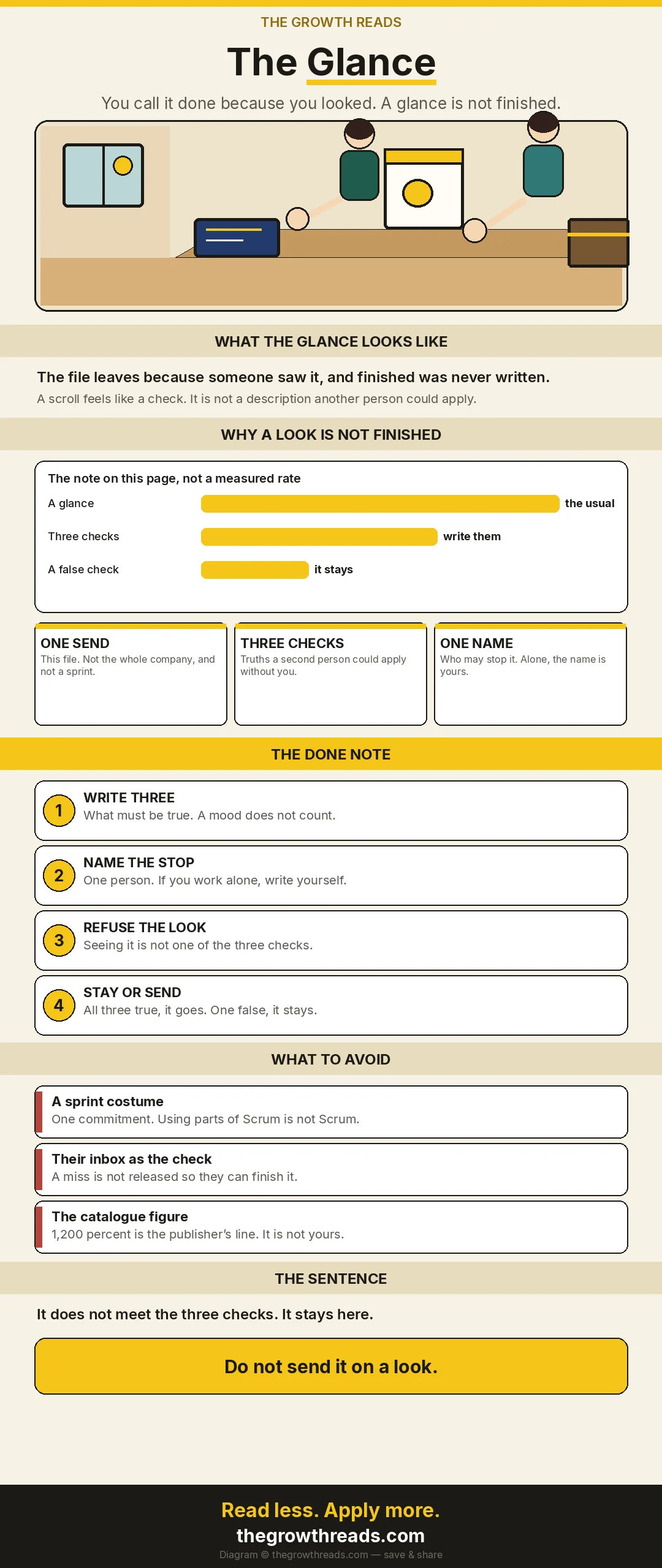
Before the next send, write four lines. If a check is false, the send stays. The four lines are this page’s script. They are not in the Scrum Guide. They turn one of its commitments, a formal description of finished, into a note you can read while the file is still in the tab. They are for one send. They are not a company standard, and they are not Scrum.
One send. Not the company. Not a sprint.
1. Checks. Three things that must be true. Write them so a second person could apply them without asking what you meant. A mood does not count.
2. Stop. One name who may say it is not done. If you work alone, the name is yours.
3. Glance. The line “A look is not a check.” If the only evidence is that someone saw it, line 1 has not been met.
4. Stay. If any check is false, it does not go. Name where it sits until the check is true: the draft, the list, or the person whose name is on line 2.
Read the three checks against the file, not from memory. Then send, or say the sentence.
Checks are the guide’s “formal description,” cut down to three truths for this send. “It looks good” is a mood. “The client can open the file, the price on the page is the price you already agreed, and the thing you said was out is not in the file” is a description. Pick the three that match this send. A proposal does not inherit a design file’s checks, and a design file does not inherit a proposal’s. If you cannot write three without using the word “fine,” you do not yet know what finished is. Looking harder will not supply the missing sentence.
Stop is the guide’s rule that the Developers must conform, translated into one name. On a Scrum Team the guide also says the people doing the work hold each other accountable as professionals. A founder with no team still needs a name, or the glance wins by default. Write your own name. A new manager writes one name, and it can be theirs. Two names who can both overrule each other is how “done” becomes a vote. The guide’s rule that several Scrum Teams on one product share one Definition of Done is for that case. A studio of two does not become those teams. What the studio does copy is the shared part: one description for this send, not two private ones.
Glance is the line that keeps the look from sneaking back in as evidence. You may still look. The look is how you notice a check failing. It is not itself a check. Stay is the guide’s “it returns,” without the Product Backlog. If you have no backlog, name the place the work actually sits. Sending it so the client can finish the missing check is how a glance leaves the building. The guide says an item that does not meet the description is not released and is not presented as the Increment. Our fourth line is that rule for one file.
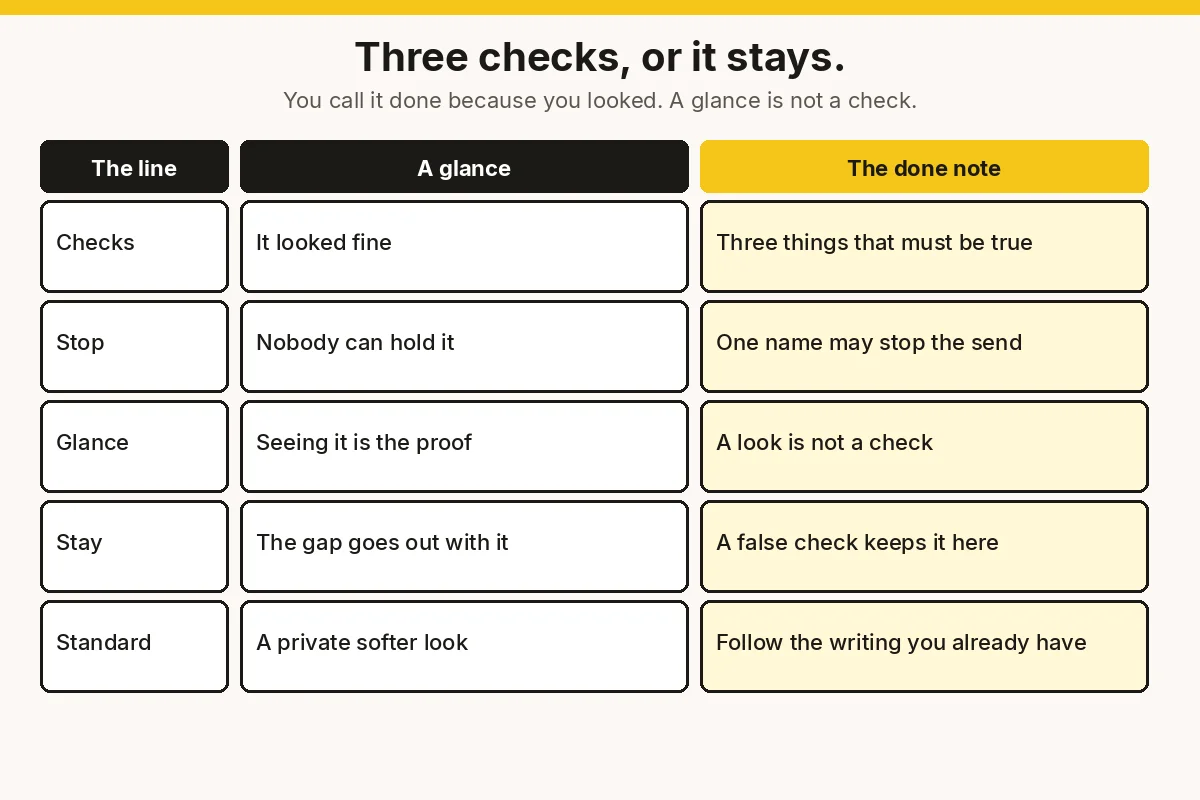
| The line | What a glance looks like | What the done note looks like |
|---|---|---|
| Checks | “It looked fine” after a scroll. | Three things that must be true, written so someone else could apply them. |
| Stop | Nobody can hold the send once you have seen it. | One name may say it is not done. Alone, the name is yours. |
| Glance | Seeing it is the proof that it is finished. | A look is not a check. The three lines are the proof. |
| Stay | It goes out, and the gap goes with it. | A false check keeps it in the draft, on the list, or with the name on line 2. |
| Already written | You draft a new private definition beside the company’s. | If a standard already exists, the guide says follow it as a minimum. Do not replace it with a glance. |
The sentence that keeps the send
When the file is about to leave on a look, say one sentence and leave it where it is. The sentence is ours. It is the spoken form of lines 1 and 4.
“It does not meet the three checks. It stays here.”
Use it when you hear “it’s done” and the evidence is that someone looked, when your own hand is on the send button and the checks are still in your head, or when a client is waiting and the kind thing seems to be to send the gap. Say which check failed if you know it. Then stop explaining. A second paragraph about how close it was is the glance, back in prose. The file stays in the place you named on line 4.
If you are the only person in the company, you say the sentence to yourself, out loud, before the message goes. If a contractor or a new report is in the room, they hear the same sentence. You do not add “but send it and we’ll tidy it there.” Tidy-it-there is a release. The guide’s bar is that it is not part of the Increment until the description is met.
The sentence is not a Sprint ceremony. The guide says the Sprint Review is not a gate to releasing value, and that an Increment may go to stakeholders before the Sprint ends. Waiting for a meeting you do not hold is not the fix. The fix is the three checks, met or not met, before this send. If they are met, send it. The sentence is only for the case where they are not.
When the note is the wrong tool
The note is the wrong tool when finished is already defined and the failure is something else. If you already know the steps and one line is blank on a send you have made before, use the five-line pause. That page is a known list with a hole. This page is the absence of the list. Writing three new checks on top of a list you are ignoring gives you two unused documents. If they nodded and then did a different job, the missing piece is their backbrief, before they start, not a finish line after the wrong job is built. If the work changed after you named the price, use the change script. A done note does not price a new outcome. If the build has no time budget, set the appetite before you design. Done does not tell you how many days the work was worth.
If the organisation, or the client’s contract, already states what finished means, the guide says that standard is the minimum. Follow it. Do not write a softer private note because the standard is annoying. The three checks are for the send that has no standard yet. If you like the person and you are avoiding a sentence about their behaviour, that is the candor note. “It does not meet the three checks” is about the file. It is not a way to avoid saying what they did.
Leave the rest of the framework where the guide put it. This page does not assign a Scrum Master, a Product Owner, or a Sprint. The guide says leaving elements out is not Scrum. Read the guide as a whole if you want the framework. One person sending client work already needs the three checks. The guide’s “typically 10 or fewer” is not the size at which a studio earns them.
Common mistakes
- Treating the scroll as the third check. You did look. The guide’s description is a state the Increment meets, and the Increment is thoroughly verified. A scroll is not that state. Put the look on line 3, where it is refused as proof.
- Writing “quality” instead of three truths. The guide says “quality measures required for the product.” It does not list yours. “High quality” is a mood in a longer coat. Name the open, the price, the thing that is out, or whatever three this send actually turns on.
- Sending the gap so they can catch it. The guide says an item that misses the description is not released and is not presented as the Increment. Their inbox is not your review. Line 4 names where it sits.
- Waiting for a meeting you do not have. The guide says the Sprint Review is not a gate, and that value may leave before the Sprint ends. The absence of a ceremony is not a reason to skip the checks, and the presence of a Thursday call is not the check.
- Replacing a standard that already exists. If the company or the contract already says what done is, the guide says follow that as a minimum. A private glance does not outrank it. The note is for the send that has no standard.
- Calling the note Scrum. The end note says that using only parts is not Scrum, and that Scrum exists only in its entirety. Say “done note.” Do not say you run Scrum because you wrote three lines.
- Borrowing the publisher’s 1,200 percent. That figure is on the Penguin Random House description of the trade book. The book was not opened. The figure is not a result you can expect from three checks, and it is not in the guide.
What the source does and does not say
| Source | What was read | What this page uses | What this page does not use |
|---|---|---|---|
| Ken Schwaber and Jeff Sutherland, The 2020 Scrum Guide, HTML port of the November 2020 version. | The HTML page, on 21 November 2026. The page calls that HTML a direct port of the PDF. The PDF was not opened. | The Definition of Done as a formal description of the Increment’s state. Work is not part of an Increment unless it meets that description. A miss is not released and returns for later consideration. An organisational standard is a minimum; otherwise the team creates one. Developers must conform. The Increment must be usable and is thoroughly verified. The Sprint Review is not a gate. Scrum beyond software, and the word developers used not to exclude. The end note that parts of Scrum are not Scrum. The remark that a Scrum Team is typically 10 or fewer, only as their description, not as our target. | The PDF. Every Sprint event, role, and artefact this page does not teach. Any claim that three checks are Scrum. The guide’s “30-plus years” as a result you can quote for your studio. A forecast, a velocity, or a team-size rule for a founder. |
| Penguin Random House’s page for ISBN 9780385346450. | The catalogue page, on 21 November 2026. | The byline Jeff Sutherland and J.J. Sutherland. Product details: Crown Currency, 30 September 2014, 384 pages. The ISBN in the page title and the cover-image path. | The print book. The description’s productivity figure of as much as 1,200 percent, and its talk of an expanded update, which this run does not reconcile with the 2014 product details. No sentence from a numbered page. J.J. Sutherland is not an author of the guide. |
The guide is written for a Scrum Team making Increments inside the rest of the framework. A founder attaching a file, or a new manager hearing “it’s done,” is close enough for the mechanism: finished is a description, and a look is not the description. It is not close enough for a claim that three lines will make the work faster, smaller, or more likely to succeed. The guide does not state a success rate. The publisher’s page states a figure this article refuses. The four lines and the sentence have not been tested on Schwaber and Sutherland’s teams. If the same send leaves on a look twice, the note is telling you the checks were never applied. That is a fact about your last two sends. It is not a finding from the guide.
Frequently asked questions
What does it mean that you call it done because you looked?
You call it done because you looked when the send leaves on a glance and nobody has written what finished means. You scrolled, the file seemed familiar, and it went. Ken Schwaber and Jeff Sutherland, in the 2020 Scrum Guide, call the Definition of Done a formal description of the state of the Increment when it meets the quality measures required for the product. They write that work is not part of an Increment unless it meets that description. This page applies that bar to one send. The done note is our script. The print book was not opened, and the note is not Scrum.
What goes on the done note?
Four lines, and they are this page’s script. Write three checks a second person could apply without asking what you meant. Name one person who may say it is not done. If you work alone, the name is yours. Write the line that a look is not a check. Name where the work sits if a check is false: the draft, the list, or that person. Read the checks against the file. The Scrum Guide requires a formal description for an Increment. It does not list these four lines. If a standard already exists, follow that standard as the guide’s minimum, and do not replace it with a softer note.
What do you say when someone wants to send it on a look?
Say: “It does not meet the three checks. It stays here.” Use it when “it’s done” means someone looked, when your own hand is on the send, or when waiting feels ruder than shipping the gap. Name the failed check if you know it. Then stop. A speech about how close it was puts the glance back in the room. The sentence is ours. It is not a line in the 2020 guide. The file stays in the place the note already named. You do not send it so they can finish the missing check in their inbox.
How is this different from a step you already know and still skip?
The five-line pause is for a send whose steps you already know, when one of those lines is blank. This note is for the send that has no description of finished, so a look is doing the job of the description. If the list exists and you are skipping a line, use that pause. Writing a second list beside an ignored one does not help. A backbrief is earlier: they restated the job before they started, and the work came back as a different job. A time budget is about how many days the build is worth. This page starts when someone is about to call it finished.
Do you need a sprint for this note to count?
No. The note is not Scrum, and it does not ask you to hold a Sprint. The 2020 guide says the Sprint Review should never be a gate to releasing value, and that an Increment may go to stakeholders before the Sprint ends. Waiting for a meeting you do not run is not a check. Skipping the description because you have no meeting is not a check either. The guide’s end note says that using only parts of Scrum is not Scrum. Call this a done note. Read the whole guide if you want the framework. This page teaches one commitment, applied to one send.
What if finished is already written down somewhere?
Follow that writing. The guide says that if the Definition of Done is an organisational standard, every Scrum Team follows it as a minimum, and that if it is not, the team creates one appropriate for the product. A contract, a house style, or a client’s acceptance list is the minimum when it already says what finished is. The three checks are for the send that has no such writing. A private “it looked fine” does not outrank a standard you found annoying. Several teams on one product, in the guide, share one definition. Two people on one file need one description for that file, not two moods.
Does this apply to a solo founder sending client work?
The mechanism does. The team chart does not. The guide says Scrum is used beyond software, that a product could be a service, and that the word developers is not meant to exclude. It also describes a Scrum Team as one Scrum Master, one Product Owner, and Developers, typically 10 or fewer people. That sentence is about a Scrum Team. A founder alone does not become one by reading it, and does not wait until they have ten people to write three checks. If you own the send, your name is the name that may stop it. The catalogue’s 1,200 percent is not your expected result.
Did this page open the Scrum book?
No. The text read on 21 November 2026 is the HTML of the 2020 Scrum Guide, which the page calls a direct port of the November 2020 PDF. The PDF was not opened. Penguin Random House’s page for ISBN 9780385346450 lists Jeff Sutherland and J.J. Sutherland, Crown Currency, 30 September 2014, 384 pages. The print book was not opened. No sentence is taken from a numbered page. The guide does not say it is a chapter of the book. J.J. Sutherland is not an author of the guide. The done note and the sentence “It does not meet the three checks. It stays here.” are our application.
Sources
- Schwaber, K., and Sutherland, J. The 2020 Scrum Guide. HTML port read on 21 November 2026 at scrumguides.org/scrum-guide.html. The page says the HTML is a direct port of the November 2020 PDF. The PDF was not opened. Used for the Definition of Done as a formal description of the Increment, the rule that work is not part of an Increment unless it meets that description, the rule that a miss is not released and returns for later consideration, the minimum of an organisational standard, the duty of Developers to conform, the usable and thoroughly verified Increment, the Sprint Review not being a gate, the note that Scrum is used beyond software, and the end note that implementing only parts of Scrum is not Scrum. The guide’s “typically 10 or fewer people” is quoted only as its description of a Scrum Team.
- Penguin Random House, catalogue page for ISBN 9780385346450, read 21 November 2026 at penguinrandomhouse.com. The byline names Jeff Sutherland and J.J. Sutherland, Scrum: The Art of Doing Twice the Work in Half the Time. The product details list Crown Currency, 30 September 2014, and 384 pages. The ISBN is in the page title and the cover-image path. The description on that page states a productivity figure of as much as 1,200 percent and speaks of an expanded update. This article does not use that figure and does not reconcile the description with the 2014 details. The print book was not opened. No sentence is taken from a numbered page. The done note is not on either page that was read.
Related reading on The Growth Reads
- One step still gets skipped — the known line that is blank on a send you have made before
- They nodded, and the work came back — the backbrief before they start
- The build has no appetite — the days the work is worth, before the design
- The work changed after the price — what moved, and the new price or the cut
- The hard sentence never gets said — the behaviour you will not name because you like them
- The direction never gets written — the what, on a page, before the hallway version drifts
- Productivity — the cluster this article sits in
- How we review — what a checked source is, and what an unread book is not
How this was checked
Who it is for. A solo founder or a new manager who is about to call a send finished because somebody looked at it.
What was read. The HTML of the 2020 Scrum Guide, on 21 November 2026. Penguin Random House’s catalogue page for ISBN 9780385346450, the same day.
What was not read. The November 2020 PDF. The print book. Any numbered page.
Limit. The four lines and the sentence are our application of one commitment. They are not Scrum. The publisher’s 1,200 percent stays unused. The guide’s team size is not a studio target.
How we work: every article on The Growth Reads is built from books we have read and from primary accounts we can check, and it is date-stamped when those sources change. Read our methodology.