

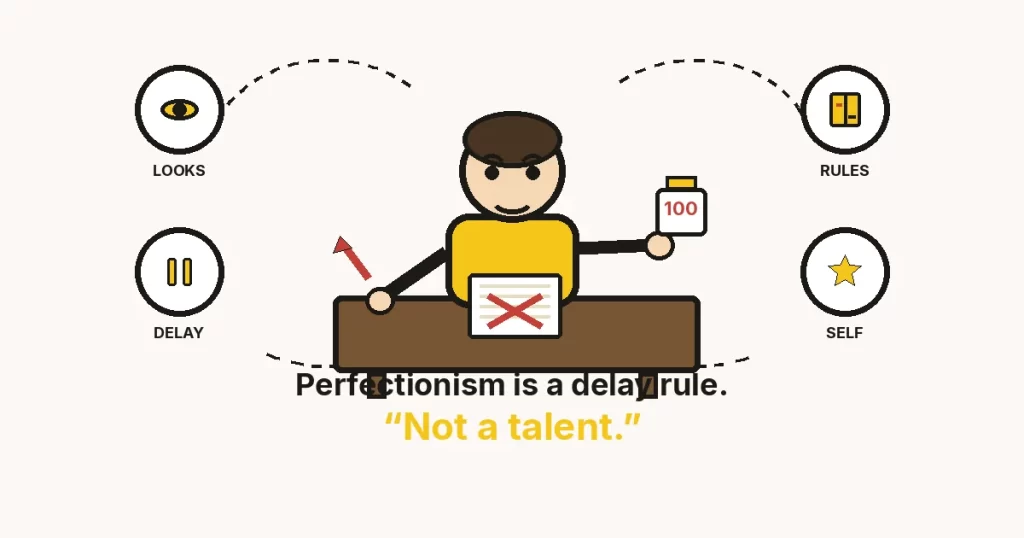
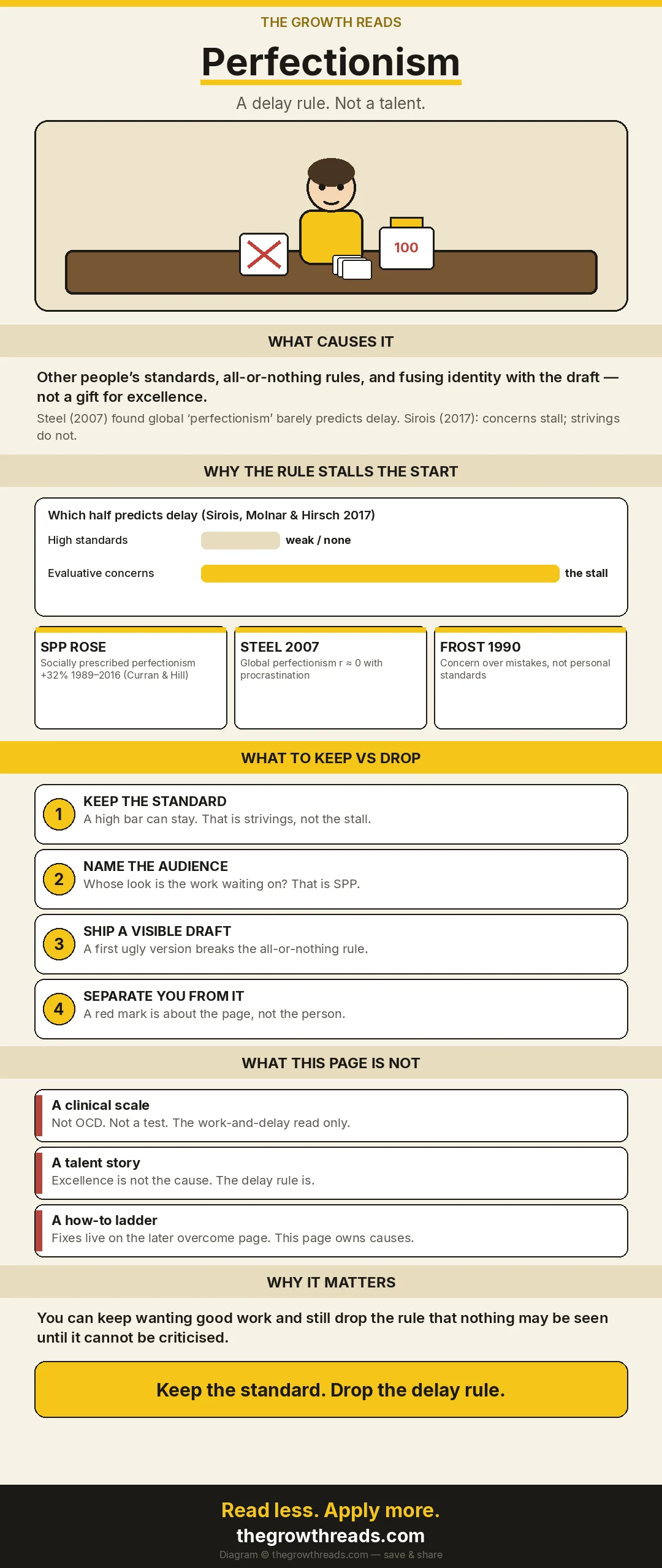
What causes perfectionism, on a work page, is not a talent for excellence — it is a delay rule that the work is worthless unless it cannot be criticised. That rule is grown by other people’s standards, all-or-nothing thinking, and fusing identity with output. High standards can stay. The stall lives in the fear of a visible mistake.
Key takeaways
- Treating perfectionism as one trait hid the delay: Piers Steel’s 2007 meta-analysis found an overall association with procrastination of r = −.03 across 24 studies and 3,884 people — near zero, and slightly the wrong direction for the folk story.
- Split the construct and the stall appears. Perfectionistic concerns correlated with trait procrastination at r = .23 (k = 43, N = 10,000; 95% CI .19 to .27); perfectionistic strivings correlated at r = −.22 (k = 38, N = 9,544; 95% CI −.26 to −.18) (Sirois, Molnar & Hirsch, 2017).
- The social cause has a name and a trend. Hewitt and Flett (1991) called it socially prescribed perfectionism — the belief that other people demand a flawless self. Curran and Hill (2019) found that dimension rose the most in 164 student samples (N = 41,641) between 1989 and 2016.
- Frost, Marten, Lahart and Rosenblate (1990) separated concern over mistakes from personal standards. The first is the stall. The second can stay without becoming a delay rule.
- Austin Kleon’s Steal Like an Artist is the folk version of the same permission: a first version is allowed to be a remix and a mess, which is why this row’s unused review is that book and not a grit speech.
What perfectionism actually is
On this page, perfectionism is a work rule: nothing may be seen until it cannot be criticised. That is a productivity claim, not a personality type and not a clinical label. The person still wants good work. The extra clause is what stalls the start — if a draft can be marked, it does not count, so the first ugly version never leaves the desk. The parent for that stall is how to overcome procrastination. This URL owns the cause. It does not own the later method page, and it does not rewrite that parent.
The folk story says the opposite. It says perfectionists delay because they care too much, and that caring is a talent. Steel’s 2007 Psychological Bulletin review is why that story fails as a one-number claim. Across 24 studies and 3,884 people, the average association between “perfectionism” treated as one thing and procrastination was r = −.03. Steel wrote that procrastinators were actually less likely, not more, to be perfectionists. If you stop there, the search query looks empty. If you keep going, the number is a warning: the word was too fat. High standards and fear of a visible error were being added together, then declared unrelated to delay.
Joachim Stoeber and Kathleen Otto (2006) had already argued for the split. They reviewed the “positive conceptions” literature and sorted the field into two higher-order dimensions that keep showing up under different scale names: perfectionistic strivings (personal standards, self-oriented excellence) and perfectionistic concerns (concern over mistakes, doubts about actions, socially prescribed demand). Strivings can travel with achievement. Concerns travel with the flinch. This page is about how those concerns get installed as a delay rule. It is not a second copy of the procrastination cycle — that sister page is the loop after the rule is already running.
What it is not
The opposite of this cause is not sloppiness, and the presence of high standards is not the diagnosis. It is not “being the careful one.” It is not a moral ranking of who cares more. It is not analysis paralysis — that page is about comparing past the point where more research would change the call. It is not OCD, not a clinical scale, and not a quiz. Bare “perfectionism” was left off this queue for that reason. If the work problem is “I will not start until the page cannot be marked,” you are in the right URL. If the problem is something a clinician should hear, this article will not list symptoms or pretend to sort it.
What causes perfectionism
What causes perfectionism as a delay rule is a stack of other people’s standards, all-or-nothing logic, and an identity that treats a red mark as a verdict. None of those require a rare temperament. They require a room where looking wrong is more expensive than being late, which is an ordinary workplace, classroom, or feed.
Paul Hewitt and Gordon Flett (1991) named three directions in the Journal of Personality and Social Psychology. Self-oriented perfectionism is the demand you put on yourself. Other-oriented is the demand you put on other people. Socially prescribed perfectionism is the belief that other people already have an unrealistic standard for you — and that their approval depends on meeting it. The third one is the social cause this page cares about. You do not need to have met the audience. You need to believe the audience is watching and will not forgive a draft. Gordon Flett, Kirk Blankstein, Hewitt and Spomenka Koledin (1992) then tested college students and found that socially prescribed scores, not the self-oriented ones, moved with procrastination. The delay was not “I want this to be excellent.” It was “they will not accept anything less.”
That social pressure has a time trend. Thomas Curran and Andrew Hill (2019) analysed 164 samples and 41,641 American, Canadian and British college students from 1989 to 2016. Self-oriented, other-oriented and socially prescribed scores all rose. The largest rise was socially prescribed perfectionism — the dimension that says the demand lives outside you. This is not a proof that “kids today” are weaker. It is evidence that the look of other people, amplified by ranking systems and feeds, became a louder cause. A page in the productivity hub can use that without turning into a culture war: the cause is a believed audience, and that audience got cheaper to imagine.
Randy Frost, Patricia Marten, Cathleen Lahart and Robin Rosenblate (1990) cut the same pie a different way. Their six dimensions included personal standards and organisation — the parts that can look like care — and concern over mistakes, doubts about actions, parental expectations and parental criticism. Concern over mistakes is the work version of the stall: a visible error is treated as a catastrophe, so the safest move is not to produce a surface that can be marked. Personal standards can sit next to that without causing it. The useful reading for a Tuesday is blunt. Wanting the memo to be good is not what delays the memo. Treating a mark as proof you should not have started is.
The four causes, in a room
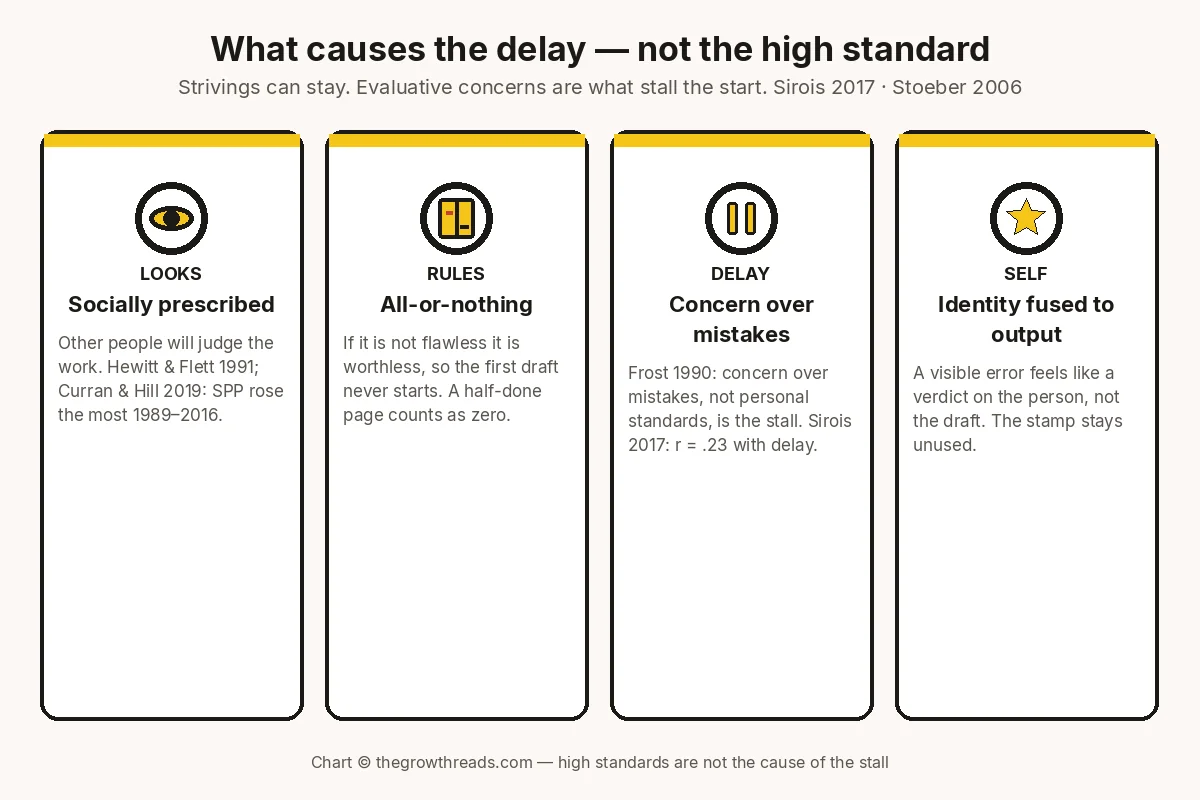
Most “I am just a perfectionist” stories fail because they name a talent instead of the cause that is in the room.
- Looks. Whose eyes is the work waiting on? If the answer is a manager, a client, a classmate, or a vague “they,” that is socially prescribed demand (Hewitt & Flett, 1991). Curran and Hill’s rise is why this feels more common than it did in a closed office.
- Rules. All-or-nothing logic: a 90% draft counts as zero, so opening the file is already a loss. There is no peer-reviewed law that says “all-or-nothing thinking causes perfectionism” as a single experiment. There is a consistent description across Frost’s concern-over-mistakes items and the folk script David Burns wrote in 1980. We treat the script as language, not as a trial.
- Delay. Concern over mistakes plus doubts about actions (Frost et al., 1990). The mechanism is avoidance of a surface that can be judged. Sirois, Molnar and Hirsch (2017) are why we can say this predicts procrastination and high standards do not.
- Self. Identity fused to output. A red mark is read as a verdict on the person. That is why the unused stamp in the drawing stays unused: stamping “100” would also stamp the self, so the page stays blank.
Austin Kleon’s Steal Like an Artist is this row’s unused down-link because it attacks the originality-and-flawless-origin story, not because it is a second experiment. Kleon’s claim is that work starts as remix and influence, not as a perfect invention. That is the folk permission this page needs: a first version is allowed to be stolen, ugly, and seen. It is not Self-Determination Theory, and it is not Frost’s scale. Use it as a pointer, then come back to the four causes, which have papers behind them.
Why the delay rule costs more than it feels like
The delay rule feels like care. The bill is the work that never gets a first surface, and the hours spent polishing a ghost. Steel’s near-zero r is the honest limit on the folk story: if you average “I have high standards” with “I cannot be seen failing,” you will conclude perfectionism does not cause delay. Sirois, Molnar and Hirsch (2017) are the cost that shows up once you split those. Concerns and procrastination moved together at r = .23 across 43 samples and 10,000 people. Strivings moved the other way at r = −.22 across 38 samples and 9,544 people. The same word, two opposite relationships. The quality you wanted from the high bar is not what you lose when you delay. You lose the bar’s chance to operate on a real draft.
Two honest limits. Both meta-analyses are correlational. They do not prove that installing a believed audience caused a specific Tuesday to slip. Sirois found that the concerns effect depended on which perfectionism measure was used; the strivings effect did not. Steel’s r = −.03 is also a real finding, not a straw man — it is what you get when the word is left fat. We keep both numbers so this page cannot pretend the debate never happened.
The cost that does not show up on a weekly scorecard is the work that stayed imaginary. You can still care. You can still want the excellent version. What leaves first is the permission to be wrong in public for twenty minutes. That is how a delay rule impersonates standards. It is also why this sits next to the procrastination cycle rather than next to a talent essay: the cycle needs a first avoidance, and concern over a visible mistake is a reliable one.
Nearby ideas that are not this cause
Several neighbouring pages share a word with this one and answer a different question. Keep them linked, not merged.
| Idea | What it actually is | What it is not |
|---|---|---|
| What causes perfectionism | A delay rule grown by looks, all-or-nothing logic, concern over mistakes, and identity fused to output | A talent, a clinical scale, or a how-to ladder |
| How to overcome procrastination | The Procrastination parent: the method for leaving the stall | A second causes page |
| Procrastination cycle | The loop after avoidance has already started | The reason the first avoidance was perfectionism |
| Productive procrastination | Delay that looks busy — the other useful work | The same as waiting for a flawless draft |
| Chronic procrastination | Delay as a stable pattern across tasks | A one-task high-bar problem |
| Analysis paralysis | Comparing past the point where more research would change the call | Refusing to start until the page cannot be marked |
| Decision paralysis | Unable to pick among options you can already name | A standards problem |
| How to stop second-guessing yourself | Reopening a call you already made | The pre-start delay rule |
| How to overcome perfectionism | The later method page in this family — not live yet, and not this URL | A second copy of these causes |
If the problem is “I only polish, I never start,” this page is the closer read. If the problem is “I start, then I bounce to easier work,” that is productive procrastination. If the problem is the loop itself, that is the cycle. The method for leaving procrastination stays on the parent.
Common mistakes
- Calling high standards the cause. Steel’s r = −.03 and Sirois’s r = −.22 on strivings are why this fails. You can keep the bar. The stall is the concern that a mark will be seen.
- Treating it as a personality you either got or missed. Hewitt and Flett described directions of demand, not a type. Change the believed audience and the all-or-nothing rule before you change the story about who you are.
- Using a clinical scale as a work quiz. Frost’s dimensions are research tools. They are not a self-test this page will hand you, and they are not a diagnosis.
- Waiting to feel ready. Readiness, under a delay rule, means “the page can no longer be criticised.” That feeling does not arrive. A first remix does. Kleon’s book is the permission, not the feeling.
- Restaging the whole procrastination method here. The parent already owns how to leave the stall. Repeating that ladder would cannibalise both URLs and would add a HowTo this play slot is not allowed to emit.
- Confusing this with analysis paralysis. More research on a decision you can already name is a different stall. A blank page you will not show is this one.
- Reading Curran and Hill as a kids-these-days lecture. The paper is a birth-cohort rise in socially prescribed scores. The useful handoff is that the believed audience got louder, not that one generation is weaker.
The evidence behind this
| Study | Design and size | Finding | What we used it for |
|---|---|---|---|
| Hewitt & Flett (1991) | Scale development, Journal of Personality and Social Psychology | Three directions: self-oriented, other-oriented, socially prescribed | The social cause — a believed audience |
| Frost, Marten, Lahart & Rosenblate (1990) | Scale development, Cognitive Therapy and Research | Concern over mistakes and doubts about actions sit apart from personal standards | Why the high bar is not the stall |
| Stoeber & Otto (2006) | Narrative review, Personality and Social Psychology Review | Strivings versus concerns as the two higher-order dimensions | The split this page is built on |
| Steel (2007) | Meta-analysis; 24 studies, N = 3,884 on the perfectionism subset | Overall perfectionism–procrastination r = −.03; SPP separately small-positive in later readings of the same literature | Why the fat word hid the delay |
| Sirois, Molnar & Hirsch (2017) | Random-effects meta-analysis; concerns k = 43, N = 10,000; strivings k = 38, N = 9,544 | Concerns r = .23 (95% CI .19–.27); strivings r = −.22 (95% CI −.26 to −.18) | The cost of the delay rule, with the opposite sign on standards |
| Flett, Blankstein, Hewitt & Koledin (1992) | College-student correlational study | Socially prescribed scores moved with procrastination; self-oriented did not in the same way | Looks, not self-demand, as the delay correlate |
| Curran & Hill (2019) | Birth-cohort meta-analysis; 164 samples, N = 41,641 students, 1989–2016 | SOP, OOP and SPP all rose; SPP rose the most | Why the believed audience got louder |
Frequently asked questions
What causes perfectionism?
On a work page, what causes perfectionism is a delay rule: the work is worthless unless it cannot be criticised. That rule is grown by a believed audience (socially prescribed demand), all-or-nothing logic, concern over mistakes, and an identity that treats a red mark as a verdict. High standards can sit beside those causes without being one of them. Steel’s 2007 near-zero r is what you get if you mash the bar and the fear into one word. Sirois, Molnar and Hirsch (2017) are what you get when you split them.
Is perfectionism the same as having high standards?
No. Stoeber and Otto (2006) sorted the literature into strivings and concerns for a reason. Personal standards and self-oriented excellence can travel with finishing. Concern over mistakes and socially prescribed demand travel with delay. Sirois’s meta-analysis put numbers on that: strivings r = −.22 with procrastination, concerns r = .23. Keeping the bar is allowed. Treating a visible mark as a catastrophe is the cause this page names. If someone only has the bar, they are not in this URL’s problem.
Why do perfectionists procrastinate?
Often they do not, if “perfectionist” means high standards. Steel (2007) found r = −.03 when the word was left fat. People delay when the evaluative half is running: a believed audience, a rule that 90% equals zero, and a self that cannot survive a mark. Flett, Blankstein, Hewitt and Koledin (1992) saw that pattern in students — socially prescribed scores moved with procrastination. The delay is avoidance of a surface that can be judged, which is why it belongs next to the procrastination cycle rather than in a talent essay.
What is socially prescribed perfectionism?
It is Hewitt and Flett’s 1991 name for the belief that other people already demand a flawless you, and that their approval depends on it. You do not have to have met those people. You have to believe they are watching. Curran and Hill (2019) found that this dimension rose the most across 164 student samples from 1989 to 2016. That is the “looks” cause on this page: the work waits on an audience that may be imaginary and still expensive. It is not the same as demanding a lot from yourself, and it is not a diagnosis.
Does perfectionism make the work better?
The high-bar half can. The delay-rule half cannot operate on a draft that does not exist. Sirois, Molnar and Hirsch (2017) found strivings associated with less procrastination and concerns with more. A standard that never touches a page is a speech. A standard that marks a real first version is a standard. This page will not claim that fear of criticism raises quality. It will claim that fear of a visible mistake predicts delay, which is a productivity cost even when the intention was excellence.
Is this about OCD or a clinical scale?
No. This is the work-and-delay read of a search that also attracts clinical pages. We will not list symptoms, will not hand you Frost’s inventory as a quiz, and will not use “perfectionism disorder.” Bare perfectionism was rejected from this queue for that reason. If the problem is broader than “I will not start until the page cannot be marked,” or it is eating every context, that is a different conversation than a productivity article. This URL stays on the delay rule and the papers that split concerns from strivings.
What is the opposite of perfectionism at work?
The opposite of the delay rule is not sloppiness. It is a first surface that is allowed to be marked. Herbert Simon’s satisficing — a good-enough bar set before you look — is the decision-science cousin, and it lives more naturally on analysis-paralysis than here. Kleon’s remix permission is the folk cousin: steal, ship a messy first version, then raise the bar on something that exists. You keep wanting good work. You drop the clause that nothing may be seen until it cannot be criticised.
How is this different from the how-to-overcome-procrastination parent?
The parent is the method for leaving a stall. This page is why one common stall gets installed: a believed audience, an all-or-nothing rule, and concern over mistakes. Play slots do not emit a HowTo ladder, and they do not rewrite a live parent. If you already know the cause and need the leaving, go up to how to overcome procrastination. If you are still calling the stall a talent, stay here until the four causes are named. The later “how to overcome perfectionism” URL, when it exists, will own the method for this family — not this article.
Sources
- Hewitt, P. L., & Flett, G. L. (1991). Perfectionism in the self and social contexts: Conceptualization, assessment, and association with psychopathology. Journal of Personality and Social Psychology, 60(3), 456–470. https://doi.org/10.1037/0022-3514.60.3.456
- Frost, R. O., Marten, P., Lahart, C., & Rosenblate, R. (1990). The dimensions of perfectionism. Cognitive Therapy and Research, 14(5), 449–468. https://doi.org/10.1007/BF01172967
- Stoeber, J., & Otto, K. (2006). Positive conceptions of perfectionism: Approaches, evidence, challenges. Personality and Social Psychology Review, 10(4), 295–319. https://doi.org/10.1207/s15327957pspr1004_2
- Steel, P. (2007). The nature of procrastination: A meta-analytic and theoretical review of quintessential self-regulatory failure. Psychological Bulletin, 133(1), 65–94. https://doi.org/10.1037/0033-2909.133.1.65
- Sirois, F. M., Molnar, D. S., & Hirsch, J. K. (2017). A meta-analytic and conceptual update on the associations between procrastination and multidimensional perfectionism. European Journal of Personality, 31(2), 137–159. https://doi.org/10.1002/per.2098
- Flett, G. L., Blankstein, K. R., Hewitt, P. L., & Koledin, S. (1992). Components of perfectionism and procrastination in college students. Social Behavior and Personality, 20(2), 85–94. https://doi.org/10.2224/sbp.1992.20.2.85
- Curran, T., & Hill, A. P. (2019). Perfectionism is increasing over time: A study of birth cohort differences from 1989 to 2016. Psychological Bulletin, 145(4), 410–429. https://doi.org/10.1037/bul0000138
Related reading on The Growth Reads
The books behind this
- Steal Like an Artist summary — Kleon on remix and a messy first version. This row’s unused down-link; folk permission, not a second experiment.
Related articles
- How to overcome procrastination — the Procrastination parent
- Procrastination cycle — the sister: the loop after the first avoidance
- Productive procrastination — delay that looks busy
- Chronic procrastination — delay as a stable pattern
- What procrastination actually means — the definition, not this cause
- The benefits of procrastination — when delay is not this rule
- Analysis paralysis — more research, not a blank page
- Decision paralysis — unable to pick
- How to stop second-guessing yourself — reopening a call
- Eat the frog method — start with the aversive task
Go deeper
How this article was researched
The Growth Reads editorial team read the primary papers behind the cause — Hewitt and Flett (1991); Frost, Marten, Lahart and Rosenblate (1990); Stoeber and Otto (2006); Steel (2007); Sirois, Molnar and Hirsch (2017); Flett, Blankstein, Hewitt and Koledin (1992); and Curran and Hill (2019) — plus Kleon’s Steal Like an Artist as the named unused review. Numbers in the takeaways and the evidence table are taken from those papers, not from secondary blog summaries. This is a causes page on the procrastination-driver read, not a how-to-overcome-perfectionism guide, not a rewrite of the live morning-routine how-to or checklist, and not a clinical article.
Limits. The meta-analyses are correlational. Sirois’s concerns effect varied by measure. Steel’s near-zero r is kept on purpose so the fat-word finding is not erased. We did not invent percentages. We did not list clinical symptoms. We did not name books that do not have a Growth Reads review, and we did not use the over-linked reviews as the down-link.
Method: primary papers and one named unused review. Last checked 13 September 2026. Play slot — no HowTo schema.