

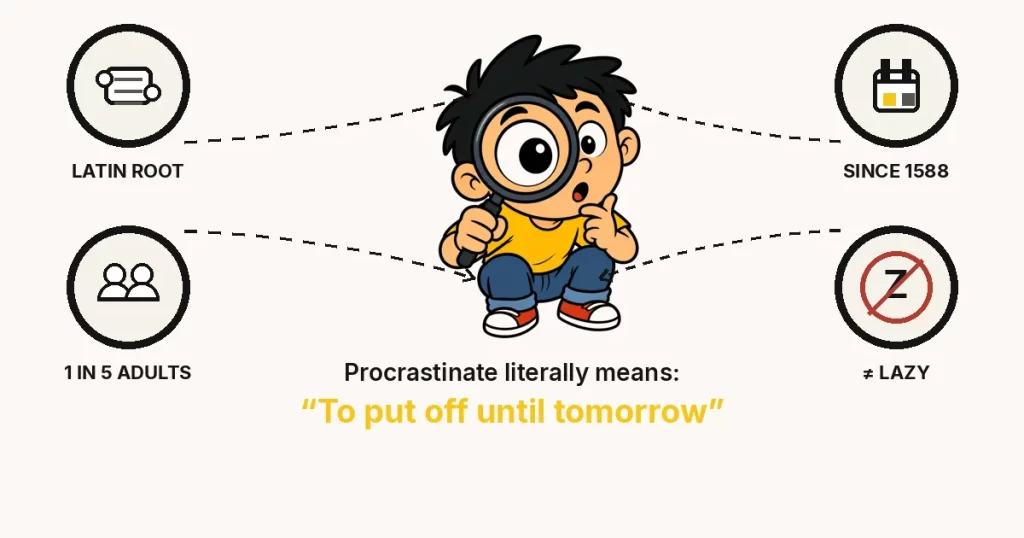
To procrastinate means to voluntarily delay an intended task despite already expecting to be worse off for it — not simply another word for lazy or busy. It comes from the Latin procrastinare, “to put off until tomorrow,” first recorded in English in 1588. Psychologists define it far more narrowly than the dictionary does.
Key takeaways
- “Procrastinate” comes from the Latin procrastinare – pro (“forward”) plus crastinus (“of tomorrow”) – and was first recorded in English in 1588 (Merriam-Webster).
- The dictionary defines it as intentionally putting off something that should be done; psychologist Piers Steel’s working definition is narrower – voluntarily delaying an intended action despite expecting to be worse off for it (Steel, 2007).
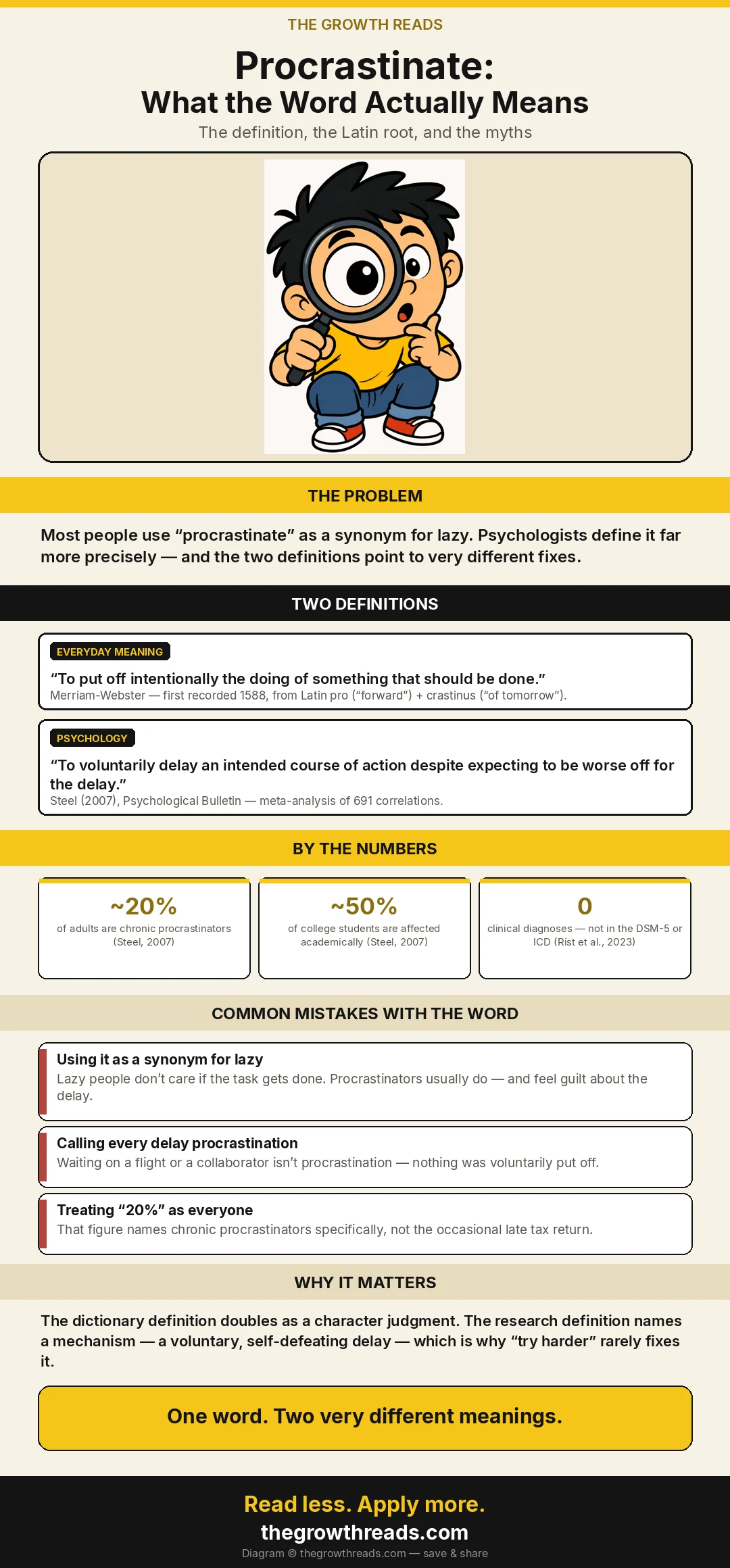
- Steel’s 2007 meta-analysis of 691 correlations found the behavior affects roughly one-fifth of adults and about half of college students.
- Procrastination is not the same as laziness – lazy people feel little conflict about not acting, while procrastinators typically care about the task and feel guilt over delaying it (Ferrari, cited in APA, 2010).
- Sirois and Pychyl’s 2013 review reframes procrastination as short-term mood repair, not a scheduling failure – people delay to escape the bad feeling a task triggers, not because they can’t manage a calendar.
What does “procrastinate” actually mean?
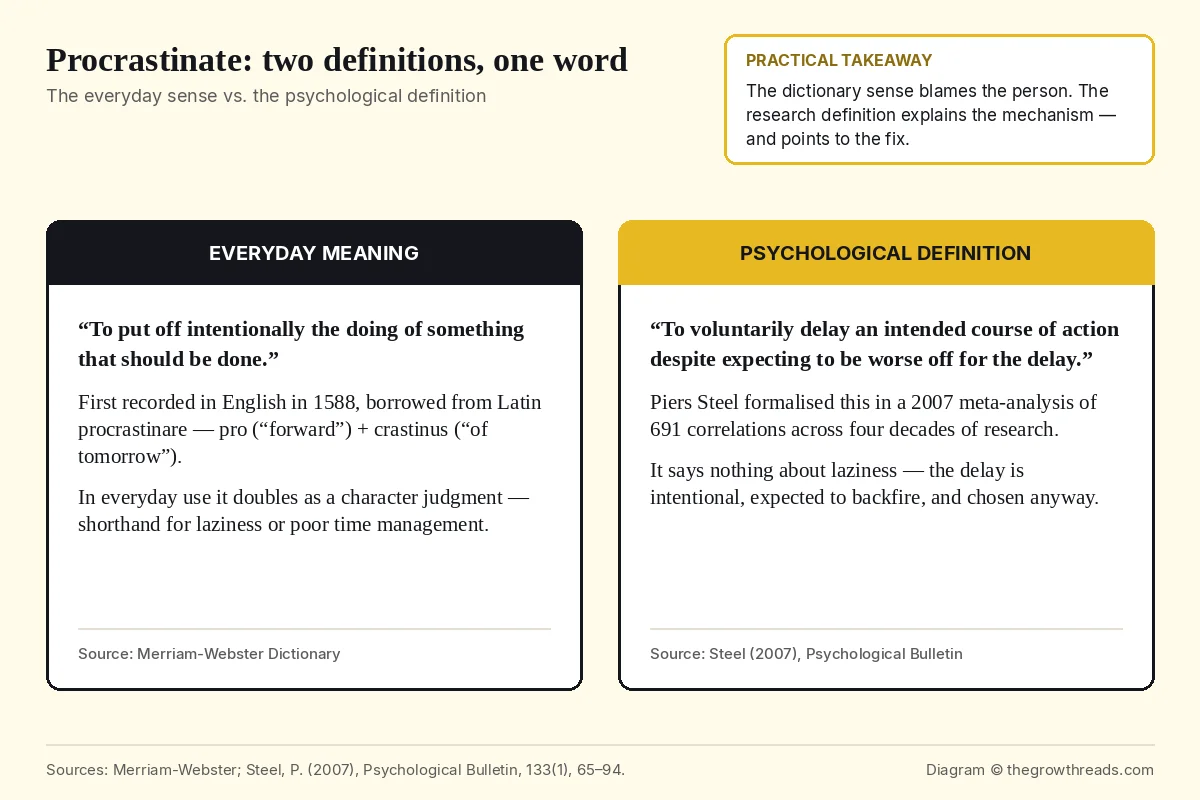
Procrastinate means to voluntarily delay a task you intend to do, despite already knowing the delay will leave you worse off. Merriam-Webster’s dictionary definition is broader – “to put off intentionally the doing of something that should be done” – and doubles, in everyday speech, as a character judgment: shorthand for laziness or not caring enough. The research definition is stricter: the delay must be voluntary, must concern something you already intend to do, and must come with an expected cost you accept anyway.
That last part separates procrastinating from simply choosing to do something else. If a task genuinely isn’t worth doing yet, waiting is a decision, not a delay – procrastination names the gap between what you intend and what you do, kept open on purpose.
Procrastinate vs. postpone: what’s the difference?
Postponing can be necessary or externally imposed; procrastinating is a self-imposed delay chosen despite expecting it to backfire. Procrastination researcher Joseph Ferrari illustrates the distinction with a delayed flight: you didn’t choose that wait, so it isn’t procrastination. Rewriting a report you already have time to start is, because the delay is chosen and you already expect it to cost you (Ferrari, cited in APA, 2010).
The confusion usually comes from treating “delay” as one thing when the research literature actually separates it into several distinct behaviors, each with a different cause and a different fix. Postponement can be entirely reasonable – waiting for a contract to be signed before you start the work it covers isn’t a character issue, it’s sequencing. Strategic delay, per Klingsieck (2013), is a deliberate pause chosen without guilt, usually to gather more information. Procrastination is the one member of this family that is voluntary, self-defeating, and chosen anyway despite the person already expecting to regret it.
Procrastinate vs. postpone vs. precrastinate, side by side
The three terms differ on exactly one axis each: who controls the delay, whether it’s expected to cost you, and which direction the timing error runs. Seeing them in one table makes the boundary easier to apply to an actual task in front of you.
| Term | Who controls the timing | Expected cost accepted? | Everyday example |
|---|---|---|---|
| Postponement | Often external (a person, a deadline, a dependency) | Not necessarily – can be neutral or sensible | Pushing a meeting because a client rescheduled |
| Strategic delay | You, deliberately, without guilt | No – the delay is expected to help, not cost | Waiting a day before sending a tense email |
| Procrastination | You, but reluctantly – the task is still intended | Yes, and you proceed with the delay anyway | Reopening social media instead of starting the report you meant to write |
| Precrastination | You, rushed – the opposite timing error | Sometimes, if rushing produces a worse result | Replying to an easy email immediately, before finishing the harder task it interrupted |
Only one row in that table describes procrastination in the strict sense this article uses. The other three are easy to mislabel as procrastination in casual speech, but each fails at least one part of Steel’s (2007) definition – either the delay wasn’t voluntary, wasn’t expected to cost anything, or there was no delay at all.
Where does the word “procrastinate” come from?
“Procrastinate” comes directly from the Latin procrastinare, built from pro (“forward”) and crastinus (“of tomorrow,” from cras, “tomorrow”). English speakers borrowed it in the 16th century, and Merriam-Webster records the earliest known written use of the verb in 1588 – a related noun form, procrastination, appears in English slightly earlier, in the 1540s. The word has stayed productive ever since: English picked up the jocular noun “tomorrower” for a habitual procrastinator around 1810, and it keeps generating playful compounds today – “procrastibaking,” “procrastinetflixing” – that say more about modern avoidance habits than about the word’s Latin bones.
Why the dictionary meaning and the psychology definition don’t quite match
The dictionary defines procrastinate broadly enough to cover almost any delay; psychology narrows it to delay that is voluntary, expected to cost you, and chosen anyway. The dictionary sense is a moral shorthand – it describes what happened and leaves the reader to infer why: lazy, disorganized, doesn’t care. The research definition, formalized by Piers Steel in a widely cited 2007 meta-analysis, describes a mechanism instead of a character flaw.
Katrin Klingsieck’s 2013 review in European Psychologist goes further, separating true procrastination from what she calls “strategic delay” – a reasonable pause chosen deliberately, without the guilt or self-sabotage that marks the dysfunctional version. Waiting for more information before starting is strategic delay. Knowing you have it, intending to start, and still not starting anyway is procrastination. The dictionary has no word for that difference; the research literature treats it as the whole point.
What research says procrastinating actually is
Four studies anchor how psychologists define and measure procrastination today.
| Study | Design & size | Finding | What we used it for |
|---|---|---|---|
| Steel (2007) | Meta-analysis, 691 correlations | Defined procrastination as voluntary, harmful delay; affects ~20% of adults, ~50% of students | The working definition this article uses |
| Klingsieck (2013) | Theoretical review, European Psychologist | Separated procrastination from “strategic delay” via seven criteria | Source for the dictionary-vs-psychology distinction |
| Sirois & Pychyl (2013) | Review, Social and Personality Psychology Compass | Procrastination prioritizes short-term mood repair over long-term goals | Explains it as emotion regulation, not time management |
| Harriott & Ferrari (1996) | Survey, 211 adults | ~20% of respondents self-identified as chronic procrastinators | Independent check on the “one-fifth of adults” figure |
None of this proves everyone who delays a task is technically “procrastinating” in the clinical sense – these are self-report surveys and correlations, not diagnostic tests, and the field has no agreed clinical threshold for where ordinary delay ends and dysfunction begins.
Common mistakes people make with the word “procrastinate”
Most misuse of “procrastinate” comes from treating it as a personality label instead of a specific, voluntary, self-defeating delay. The common versions:
- Using it as a synonym for laziness. Lazy people don’t care whether the task gets done; procrastinators usually do, which is why the delay comes with guilt attached.
- Calling every delay procrastination. A flight delay or waiting for a collaborator’s input isn’t procrastination – nothing was voluntarily put off.
- Treating “20% of adults” as if it described everyone. That figure names chronic procrastinators specifically, not the occasional late tax return.
- Assuming it’s a fixed personality flaw rather than a learned, situational pattern that responds to smaller starts, like the two-minute entry point from Atomic Habits, more than it responds to willpower.
- Reaching for a new app before the emotional trigger. Buying a planner to fix an avoidance problem is marketing wearing a productivity costume – see the shiny object tax.
- Confusing procrastination with its near-opposite, precrastination – the reflex to finish a trivial task the instant it’s possible. They are separate, only loosely related traits.
- Treating it as proof you lack discipline. Seth Godin’s “lizard brain” framing is more useful – procrastination is often the amygdala’s threat response to being seen and judged, not a character verdict. See the case for building a shipping practice instead of waiting to feel ready.
Is procrastinating the same as being lazy?
No — laziness is indifference to whether a task gets done, while procrastination is delaying a task you care about, at a cost you already expect. Joseph Ferrari, a leading procrastination researcher at DePaul University, put it in an interview with the American Psychological Association: “Everyone procrastinates, but not everyone is a procrastinator.” His research puts the share of U.S. adults who are chronic procrastinators – delaying at home, work, school, and in relationships – at about 20%.
The practical tell is the feeling attached to the delay: a lazy person who skips a task typically doesn’t feel much about it, while a procrastinator usually does. Building a system – the kind David Allen lays out in Getting Things Done – addresses that avoidance pattern in a way scolding someone for “being lazy” does not, because the two problems have different causes. Still, this is a useful mental model, not a validated clinical test: there is no diagnostic threshold in the DSM or ICD separating “procrastinator” from “lazy,” and a 2023 re-analysis by Rist and colleagues proposes research criteria precisely because none exist yet.
Sirois and Pychyl’s (2013) mood-repair account explains why the “tell” works: procrastination is triggered by how a task makes you feel right now, not by how much you value finishing it. A report you genuinely want to write can still get delayed if opening the file reliably produces anxiety or self-doubt, because closing the laptop removes that feeling immediately while the cost of the delay only arrives later. Laziness has no equivalent trigger to remove – there is no bad feeling being escaped, just an absent motivation to begin with. That difference is also why generic advice to “just push through it” tends to fail on procrastination specifically: it treats an emotional-avoidance response as a willpower shortfall.
Frequently asked questions
Is “procrastinate” the same thing as “delay”?
Not exactly. Delay is the general category; procrastination is a specific kind of delay that is voluntary, involves a task you already intend to do, and is expected to leave you worse off – and you go ahead with it anyway. A flight delay, a doctor rescheduling you, or genuinely needing more information before starting are all delays, but none of them are procrastination, because none involve choosing to put off something you meant to do despite knowing it will cost you.
Where does the word “procrastinate” come from?
It comes from the Latin verb procrastinare, formed from pro (“forward”) and crastinus (“of tomorrow”), from cras, meaning “tomorrow.” English borrowed the word in the 16th century; Merriam-Webster’s dictionary lists the first known written use of the verb as 1588, with the related noun “procrastination” appearing slightly earlier, in the 1540s. The Latin root itself is far older – Roman writers used procrastinare to describe putting off matters that should already have been settled.
What is the psychological definition of procrastination?
Psychologist Piers Steel’s widely used 2007 definition, from a meta-analysis of 691 correlations, is “the voluntary delay of an intended course of action despite expecting to be worse off for the delay.” It is stricter than the dictionary definition because it requires the delay to be chosen, to concern something you already meant to do, and to come with an expected cost you accept anyway – not just any instance of putting something off.
Is procrastination a mental disorder?
No, not currently. Procrastination is not listed as a diagnosable condition in either the DSM-5 or the ICD. A 2023 re-analysis by Fred Rist and colleagues proposed a set of research criteria for identifying “pathological” procrastination precisely because no clinical diagnostic standard yet exists, distinguishing it from milder, everyday delay. Severe, persistent procrastination can still be worth discussing with a mental health professional, particularly if it’s tied to anxiety, depression, or significant life disruption.
What percentage of people procrastinate?
Piers Steel’s 2007 meta-analysis estimates that procrastination affects roughly one-fifth of adults and about half of college students at a level significant enough to matter. A separate 1996 survey by Jesse Harriott and Joseph Ferrari found a similar figure – about 20% of a community sample of 211 adults self-identified as chronic procrastinators. Those numbers describe chronic, cross-situational procrastinators specifically, not everyone who has ever put off a task.
Is procrastinating always a bad thing?
The research behind the standard definition treats it as something you already expect to cost you, so by definition it isn’t framed as neutral or beneficial in the moment you do it. That said, some people describe short delays as useful incubation time for a decision – researchers call that “strategic delay” instead, and it’s deliberately excluded from the definition of procrastination because it isn’t chosen despite an expected cost. The distinction is about intent and expectation, not about outcome alone.
What is the opposite of procrastinate?
The closest opposite is “precrastinate” – the reflex to finish a task the instant it becomes possible, even when waiting would produce a better result. It is not simply being organized or proactive; precrastination specifically describes rushing a subtask to relieve the discomfort of holding it in mind, sometimes at the cost of the overall goal. The two traits are related but distinct, and a person can show either one depending on the task and the moment.
Why do people procrastinate on tasks they actually want to do?
Because procrastination is driven by mood in the moment, not by how much you value the task overall. Sirois and Pychyl’s 2013 review frames it as short-term mood repair: a task can trigger anxiety, boredom, or self-doubt, and delaying it removes that feeling immediately, even though you still want the outcome. That mismatch – wanting the result while avoiding the feeling the task produces – is why willpower lectures rarely help; the trigger is emotional, not motivational.
Related reading on The Growth Reads
The books this article draws on
- Atomic Habits summary & review – the two-minute entry point referenced above
- Getting Things Done summary & review – the systems-based alternative to willpower
- Eat That Frog! summary & review – the popular “just start now” framing this article narrows
- The Power of Habit summary & review – the cue-routine-reward loop behind lasting change
- The Practice summary & review – Seth Godin’s “lizard brain” account of why shipping beats waiting to feel ready
Related articles
- How to overcome procrastination: the 6-step system – the anchor this piece links up to
- What is the opposite of procrastination?
- Procrastination quotes: the real sources
- Procrastination examples: what it actually looks like – the companion piece to this definition
Go deeper
How this article was researched
The definition and prevalence figures trace to Piers Steel’s 2007 meta-analysis and Jesse Harriott and Joseph Ferrari’s 1996 survey, read in full. The etymology traces to Merriam-Webster’s dictionary entry and the Online Etymology Dictionary. The laziness distinction comes from a 2010 APA interview with Joseph Ferrari, and the diagnostic-gap claim comes from Fred Rist and colleagues’ 2023 re-analysis in Frontiers in Psychology. Every figure in this article traces to a named, dated source.
Limits: Not medical or clinical advice. The laziness-vs-procrastination distinction is a well-supported research framework, not a validated diagnostic test – there is currently no clinical threshold in the DSM or ICD that separates the two.
This article follows The Growth Reads’ EEAT methodology: primary sources and dated citations. Read our full methodology.
Sources
- Steel, P. (2007). The nature of procrastination: A meta-analytic and theoretical review of quintessential self-regulatory failure. Psychological Bulletin, 133(1), 65–94. doi:10.1037/0033-2909.133.1.65
- Klingsieck, K. B. (2013). Procrastination: When good things don’t come to those who wait. European Psychologist, 18(1), 24–34. doi:10.1027/1016-9040/a000138
- Sirois, F., & Pychyl, T. (2013). Procrastination and the priority of short-term mood regulation: Consequences for future self. Social and Personality Psychology Compass, 7(2), 115–127. doi:10.1111/spc3.12011
- Harriott, J., & Ferrari, J. R. (1996). Prevalence of procrastination among samples of adults. Psychological Reports, 78(2), 611–616. doi:10.2466/pr0.1996.78.2.611
- Rist, F., Engberding, M., Hoecker, A., Wolf-Lettmann, J., & Fischbach, E.-M. (2023). Diagnostic criteria to differentiate pathological procrastinators from common delayers: A re-analysis. Frontiers in Psychology, 14. doi:10.3389/fpsyg.2023.1147401
- Merriam-Webster. Procrastinate. Merriam-Webster.com Dictionary. merriam-webster.com/dictionary/procrastinate
- American Psychological Association (2010). Psychology of procrastination: Why people put off important tasks until the last minute [interview with Joseph Ferrari]. apa.org/news/press/releases/2010/04/procrastination