

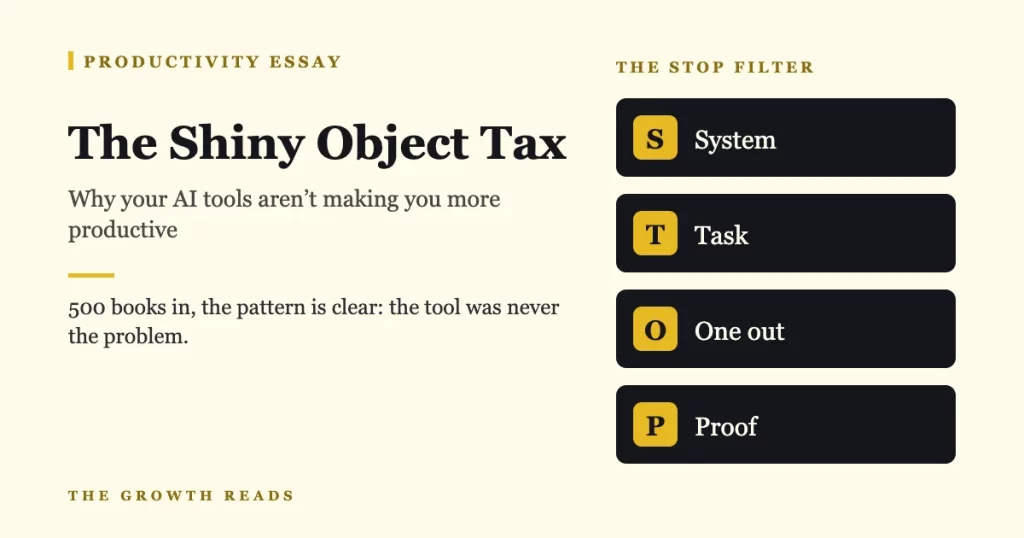
Quick answer: The gap between the AI tools you own and the output you actually get is the shiny object tax — the setup, switching and re-learning cost you pay every time you adopt something new without a system to put it in. The research now points the same way: knowledge and training gaps, not the technology, are the top barrier to getting value from AI. This is shiny object syndrome with a price tag attached. The fix is a filter, not another app. Ours has four questions — System, Task, One out, Proof — and three of them have nothing to do with technology.
The tools won. The people didn’t.
Almost everyone now has access to AI that would have looked like science fiction four years ago, and almost nobody can point to what it changed about their week. The licences got bought. The apps got installed. The demos were genuinely impressive. And then Monday arrived, looking much the same as it did before.
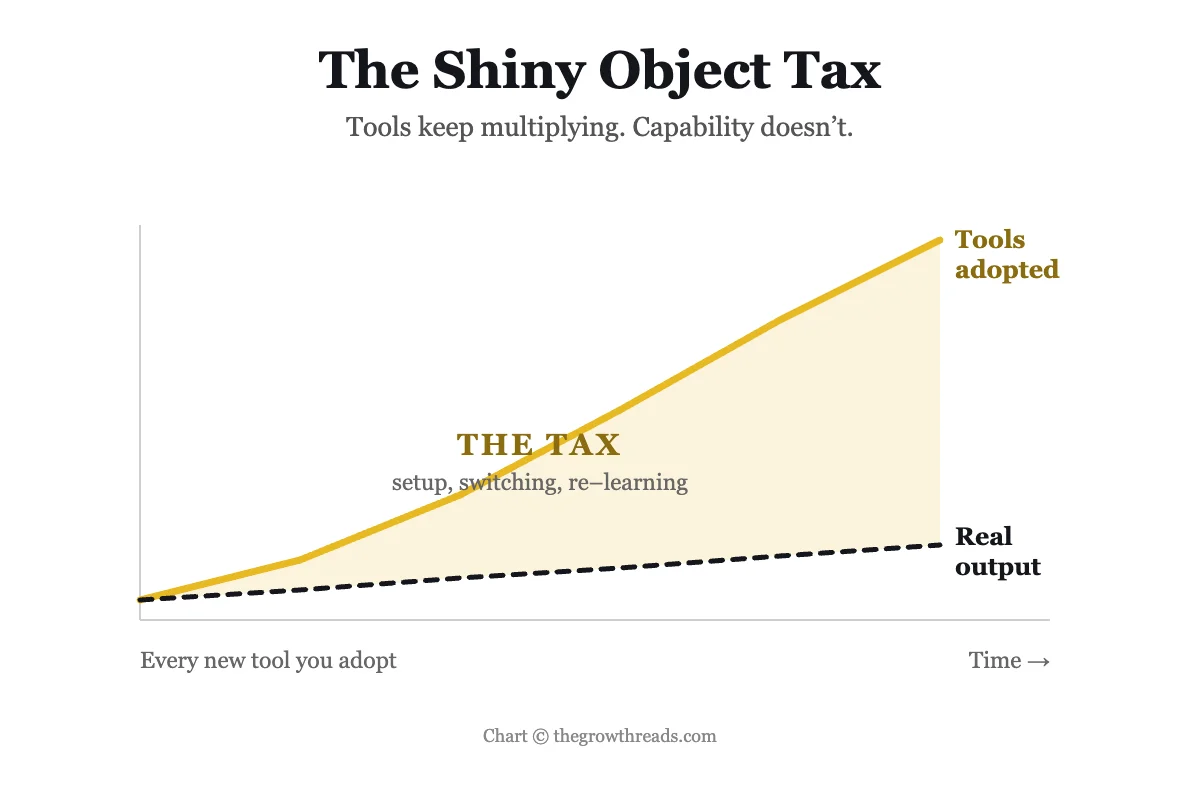
You may already know the personal version of this as shiny object syndrome — the pull toward the next new thing before the last one has paid for itself. The shiny object tax is simply what that habit costs you, measured in the gap between the tools you own and the work you finish.
This is not a story about AI being overhyped. The capability is real and it is improving quickly. It is a story about what happens when capability arrives faster than anyone’s ability to absorb it — when the rate of new tools outpaces the rate at which a human being can turn a tool into a habit.
We have spent close to 500 book summaries working through the personal growth, productivity and technology canon, and the same pattern surfaces in almost every era of it. A new capability arrives. People adopt the surface of it. The people who benefit are the ones who already had a method for the underlying work. Everyone else gets a slightly more expensive version of the problem they started with.
The bottleneck moved, and almost nobody updated their mental model
For most of the last four years the honest constraint on AI value was the technology. The models were not good enough, the integrations were clumsy, the outputs needed too much correction. That constraint has largely lifted. What has not lifted is the human side, and the data has started to say so plainly.
In McKinsey’s survey of roughly 500 organisations conducted between December 2025 and January 2026, close to 60% named knowledge and training gaps as the primary barrier to implementing AI — up from around 50% a year earlier. That number moving in the wrong direction is the whole story. The technology improved. The gap widened anyway.
Workers report the same thing from the other end. In Upwork’s study of 2,500 workers across four markets, 96% of executives expected AI to lift productivity, while 77% of employees said AI had actually increased their workload, and 47% said they simply did not know how to deliver the productivity gains now expected of them.
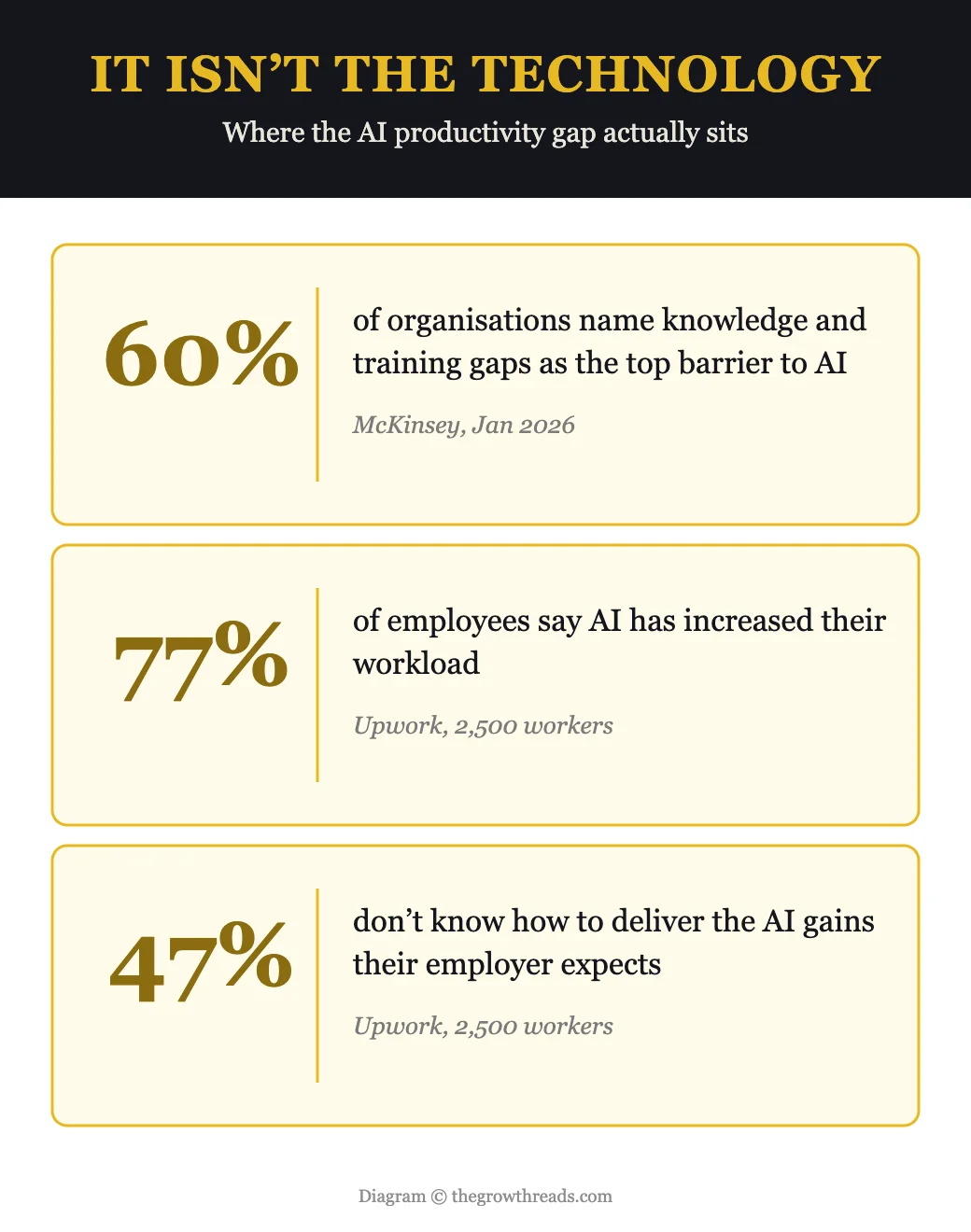
That last figure is the one worth sitting with. Nearly half of workers have been handed a mandate without a method. And the standard response to not knowing how to get value out of a tool is, reliably, to go and find a different tool.
TGR note: This is the same dynamic Cal Newport, Greg McKeown and Oliver Burkeman have each described from different angles — that the constraint is rarely capability and almost always what you are willing to leave undone. See our summaries of Essentialism and Four Thousand Weeks for the long version of that argument.
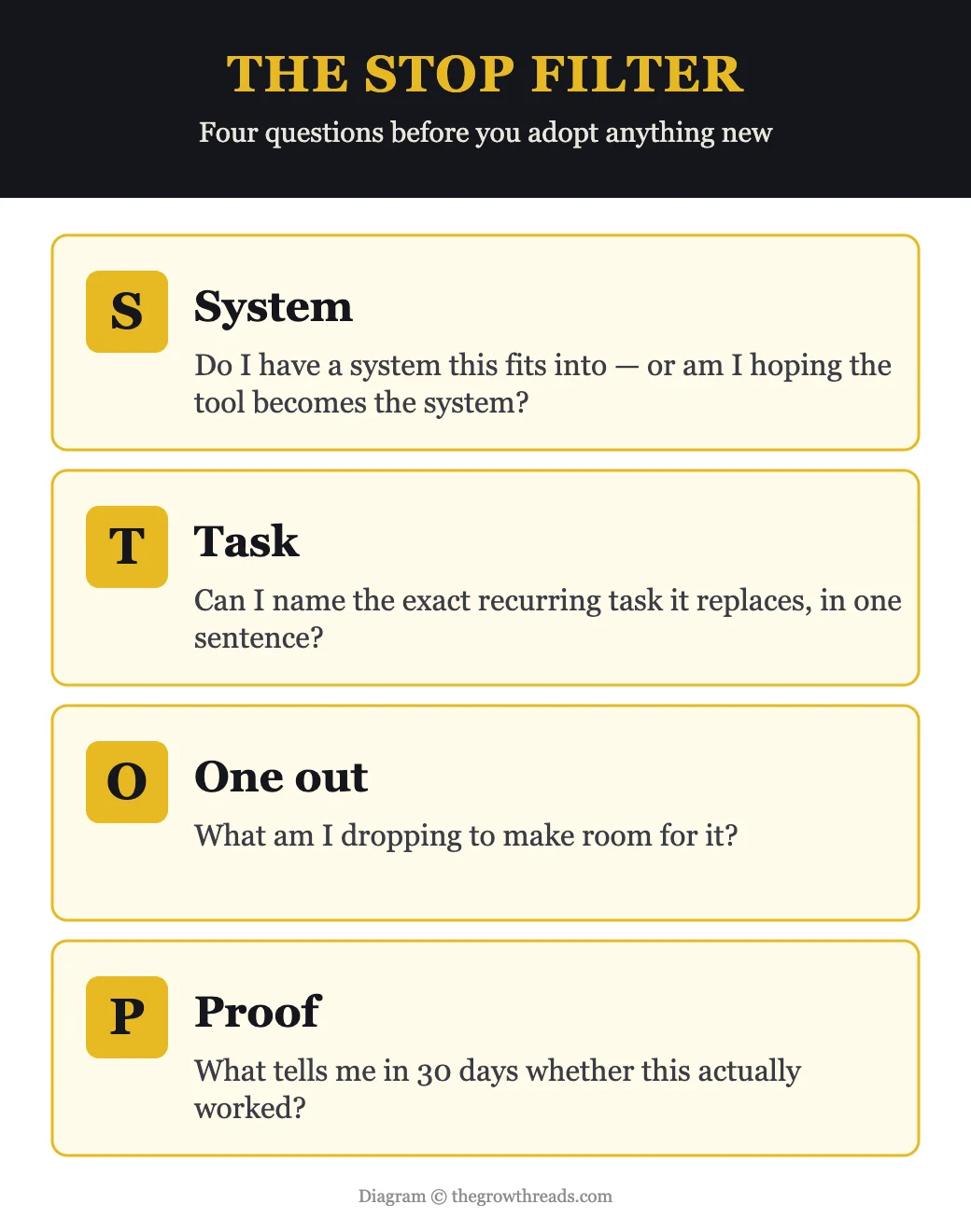
The STOP filter: four questions before you adopt anything new
What follows is not a productivity system. It is a gate you put in front of one. The point is to make adoption a decision rather than a reflex, which is the single change that separates people who compound from people who churn.
S — System
Do I already have a system this fits into, or am I hoping the tool becomes the system? This is the question that catches the most bad adoptions. Tools slot into methods; they do not create them. If your current answer to “how do I decide what to work on today” is “I look at my inbox and feel something,” a new AI assistant will not fix that. It will give the feeling a faster interface.
T — Task
Can I name, in one sentence, the specific recurring task this replaces? Notice the constraints: specific, recurring, one sentence. “Writing” is not a task, it is a category. “Turning my meeting notes into a client follow-up email, about four times a week” is a task. If the honest answer is a category, what you have is curiosity rather than need — which is fine, as long as you know which one you are acting on.
O — One out
What am I dropping to make room for this? Adoption without subtraction is how people end up with eleven apps and one unfinished project. Your attention is not elastic, and every tool you keep charges a small standing fee in the form of an extra place your work could be. If nothing is coming out, the new thing is not replacing anything — it is stacking.
P — Proof
What number or observable outcome tells me in 30 days whether this worked? Decide the metric before adoption, not after. This matters because the novelty period makes everything feel productive, and if you have not pre-committed to what success looks like, you will judge the tool on how using it felt rather than on what it produced. Feelings almost always vote to keep the tool.
What this looks like in practice
Someone runs a small consultancy and adopts an AI meeting-notes tool. Under the filter: the system exists (every client has a folder and a weekly review). The task is specific (turn call notes into a follow-up summary, three or four times a week). One out — the separate transcription service goes. The proof is that follow-ups go out same-day instead of next-day. Thirty days later there is an actual answer, not an impression.
Contrast that with the more common version: someone reads about an agent framework, signs up, spends a Saturday configuring it, uses it enthusiastically for nine days, and then quietly stops. Nothing was removed. Nothing was measured. The subscription renews. Multiply that by six tools a year and you have the tax, in full, with compound interest.
The uncomfortable part is that the second person is usually the one who reads more about productivity. Consumption of advice and application of advice are close to unrelated activities, and it is entirely possible to get very good at the first while getting no better at the second.
Why this is a personal growth problem wearing a technology costume
Three of the four STOP questions never mention technology at all. That is deliberate, and it is the argument underneath everything we publish.
AI is an amplifier, not a substitute. If your judgement is good, it makes you faster. If your judgement is vague, it makes you wrong at scale and considerably more fluently. Which means the ceiling on what AI does for you is set by things that look nothing like technology: how clearly you think, what you have decided matters, whether you finish things, and how honest you are with yourself about what is actually working.
Those are old problems. They are the subject of most of the books we review, written long before any of this arrived. The technology changed the surface of the question and left the substance completely intact.
TGR note: Ethan Mollick makes a version of this case in Co-Intelligence — that the people getting real leverage from AI are the ones who already had strong domain judgement to check the output against. The tool raises your ceiling; it does not raise your floor.
Common mistakes
- Treating trial as adoption. Trying something is free. Keeping it is not. The cost arrives quietly, in the form of one more place your work can live.
- Optimising the tool instead of the task. Two hours spent configuring is two hours not spent doing. Configuration is comfortable precisely because it feels like progress without the risk of producing something.
- Mistaking shiny object syndrome for curiosity. Curiosity has an end date and a verdict. Accumulation does not.
- Adopting because a peer did. Their system is not your system, and their bottleneck is almost certainly not yours.
- Never running a subtraction pass. Most people have never once deliberately removed a tool. Additions compound; without subtraction, so does the tax.
- Judging on novelty. Everything works in week one. The only useful question is whether it still works in week five, which is why the metric has to be set in advance.
Quick-start checklist
- List every tool and subscription you are currently paying for or logging into.
- Mark the ones you have not deliberately opened in the last two weeks.
- Remove three of them this week. Not later — this week.
- Write one sentence describing how you currently decide what to work on each day. If you cannot, that is the actual project.
- Pick the single recurring task that costs you the most time and name it precisely.
- Run only that task through the STOP filter before adopting anything to help with it.
- Set the 30-day metric in writing before you start, and put a reminder in your calendar to check it.
Frequently asked questions
What exactly is the shiny object tax?
It is the compounding cost of adopting tools you have no system for. Every new app carries a setup cost, a switching cost and a re-learning cost, and those costs are paid immediately while the promised benefit arrives later, if at all. When you adopt faster than you consolidate, the tax quietly exceeds the return. The tell is simple: your tool count keeps rising while your finished-work count stays flat. Nothing is obviously broken, which is exactly why it goes unnoticed for years.
Isn’t adopting new AI tools how you stay current?
Trying things is how you stay current. Keeping everything you try is how you get taxed. The distinction is between deliberate evaluation, which has a start date, a metric and an end date, and passive accumulation, where the tool simply joins the pile because uninstalling feels wasteful. Run experiments, keep the winners, and be ruthless about removing the rest. A person running two tools well is almost always ahead of a person running nine tools badly.
Does the STOP filter work for non-AI tools?
Yes, and that is rather the point. Three of the four questions never mention technology. The filter works the same way for a note-taking app, a project management system, a new morning routine or a productivity method borrowed from a book. Anything you are considering bolting onto your working life can be run through it. AI simply made the problem more visible, because the rate of new arrivals went up sharply while people’s capacity to absorb them stayed exactly the same.
What if I genuinely don’t have a system yet?
Then build the system first, using whatever you already own. A system does not need to be elaborate: somewhere you capture tasks, a regular time you review them, and a way of deciding what gets attention today. Once that exists, tools become genuine multipliers, because there is finally something to multiply. Adopting tools before the system exists is the most common version of this mistake, and the most expensive, because each new tool becomes a place for work to hide.
How long should I trial something before deciding?
Thirty days is usually right. It is long enough to get past the novelty period, when everything feels productive because it feels new, and short enough that you have not yet reorganised your work around something that does not deserve it. Decide the metric before you start. If you cannot name what would count as success, the trial will end with a vague feeling rather than a decision, and vague feelings almost always resolve in favour of keeping the tool.
Are books really still useful when AI can summarise anything?
Summarising was never the hard part. Deciding what deserves your hours is. A model can compress a book faultlessly and still not tell you that the author overstated a study, that a better book made the same argument a decade earlier, or that this particular book is wrong for the situation you are actually in. That judgement is the scarce thing now, and it gets more valuable as summaries get cheaper, not less.
What’s the single fastest way to reduce the tax?
Do a subtraction pass before your next addition. Open your tool list, find the three you have not deliberately used in a fortnight, and remove them this week. Most people feel an immediate improvement, not because those three tools were harmful, but because each one was a small open loop demanding a little attention. Reducing the number of places your work can live is usually worth more than any single tool you could add.
Related reading
- How to overcome procrastination: the 6-step system — the framework for when the problem is starting, not choosing tools
- Essentialism — the discipline of deciding what not to do
- Four Thousand Weeks — why doing more was never the goal
- Indistractable — controlling attention before adding tools that compete for it
- Getting Things Done — the system most tools assume you already have
- Co-Intelligence — working with AI without outsourcing your judgement
- The two-minute rule — a smaller filter, for starting rather than adopting
- The best productivity books, ranked
- The best books on AI, ranked
How we analyse books: every summary on The Growth Reads is read in full, checked against the underlying research where claims are testable, and written to help you decide whether the book deserves your hours. Read our full methodology.