

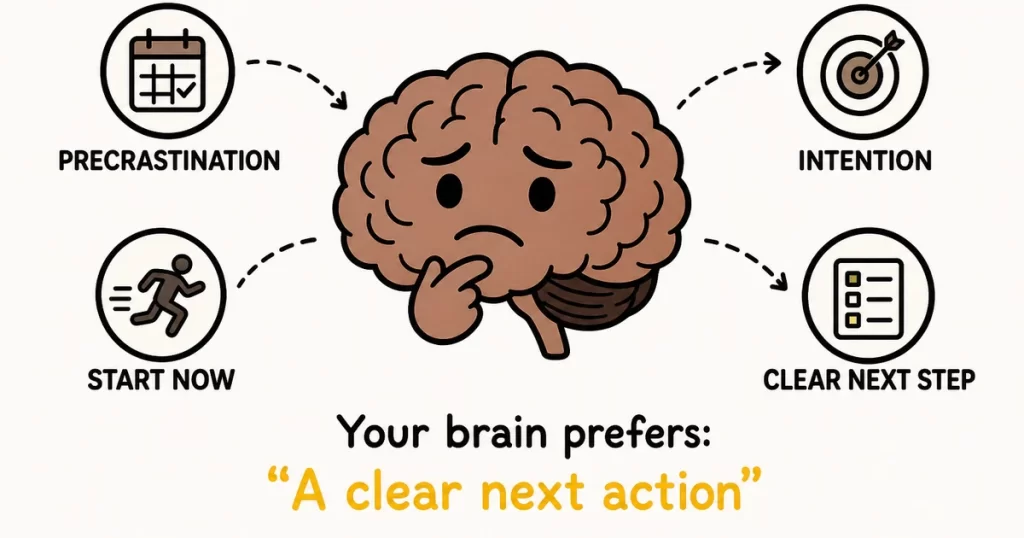
There is no single scientific opposite of procrastination, but the closest studied one is precrastination — the tendency to finish a subtask the moment it becomes possible, even at extra physical effort, purely to clear it from working memory. The healthier practical opposite is proactive coping: preparing for a demand before it turns into a deadline.
Key takeaways
- There is no single named “opposite” of procrastination in the literature — the closest studied behaviour is precrastination, not general productivity (Rosenbaum, Gong & Potts, 2014).
- In the original experiments, participants carried a bucket farther than necessary just to get it out of their hands sooner, adding effort rather than saving it (Rosenbaum, Gong & Potts, 2014).
- A concurrent memory load raised the odds of precrastinating — evidence the behaviour is about freeing memory, not urgency (Fournier et al., 2019).
- Precrastination and procrastination are separate traits that can coexist in one person — clearing trivial tasks fast doesn’t predict finishing hard ones on time.
- The practical alternative isn’t speed, it’s proactive coping: preparing for a demand before it turns urgent (Aspinwall & Taylor, 1997).
What is the opposite of procrastination?
The opposite of procrastination is starting a task before it becomes urgent, rather than delaying it despite expecting to be worse off later. Procrastination is defined in the research literature as the voluntary delay of an intended action despite knowing it will cost you. Flip that and you get voluntary promptness, taken with no pressure yet to act.
Most advice stops there — “just do it now,” or “eat the frog first,” borrowing Brian Tracy’s framing from Eat That Frog!. Researchers looking for the mirror image of delay found something stranger, covered next — plus a second answer with nothing to do with speed.
What psychology actually calls it
The term researchers use is precrastination — the tendency to complete a subgoal as soon as possible, even at the cost of extra physical or cognitive effort. Psychologist David Rosenbaum and colleagues coined it in 2014 after an accidental discovery during a walking experiment.
Students carried one of two buckets — one closer to the start, one closer to the finish — to the end of a walkway. The efficient choice is the bucket already near the finish. Instead, across nine experiments, participants grabbed the nearer bucket and carried it the whole distance, adding effort they didn’t need to, reporting only that they wanted to “get it over with.” Rosenbaum’s team traced this to a desire to clear the task off working memory, not efficiency — a bias later replicated in verbal and reaching tasks, ruling out “modern busy life” as the cause.
Why doing things faster isn’t automatically the fix
Precrastination is not “productivity done right” — acting sooner isn’t the same as a better outcome. The bucket-carriers weren’t rewarded for haste; they walked farther than they had to, the same way people pay a bill the moment it arrives instead of keeping the float, or send an email before thinking it through.
This is the counter-case worth stating plainly: nothing here shows finishing things faster makes you better off. It shows a strong, mostly unconscious pull to offload anything sitting in working memory, regardless of whether offloading it now is smart. A 2019 follow-up found a concurrent memory load raised how often people precrastinated — a lab association, not proof it improves anyone’s life outside it.
What proactive people do instead
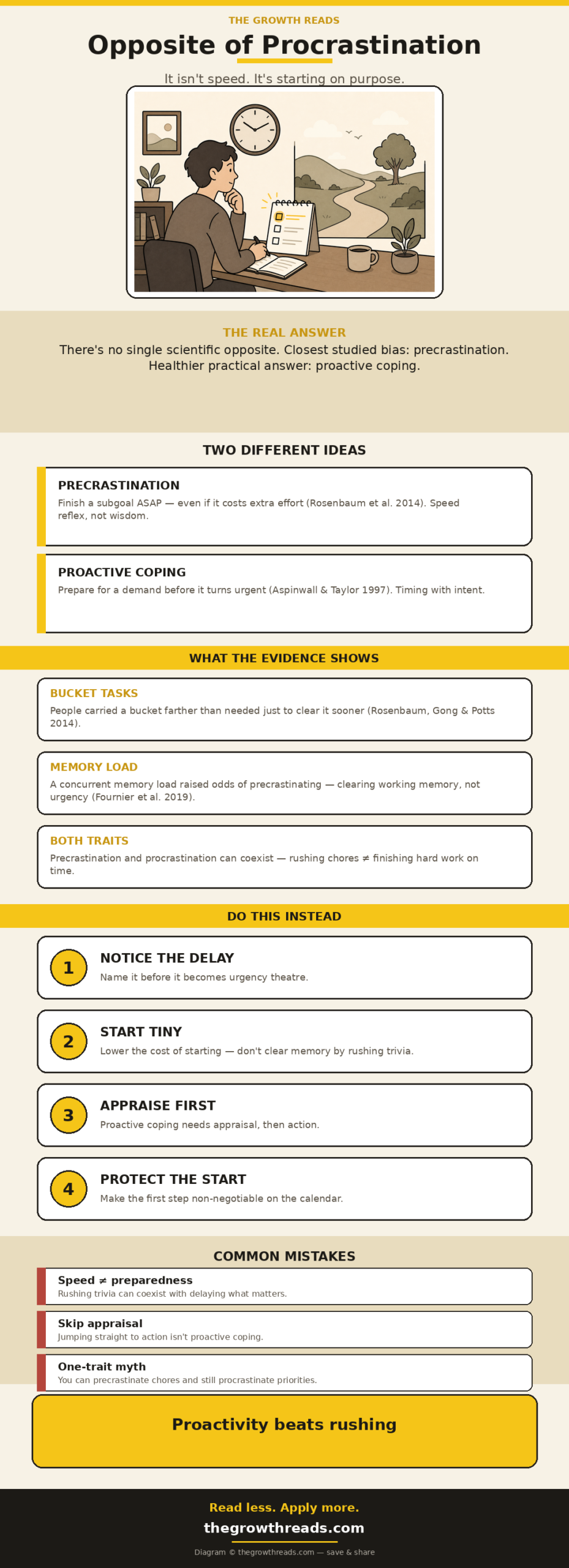
The practical, healthy opposite of procrastination is proactive coping — preparing for a demand before it turns urgent, through a deliberate process rather than a reflex. Psychologists Lisa Aspinwall and Shelley Taylor laid out the mechanics in a widely cited 1997 review: build resources in advance, notice a demand early, size it up realistically, take a considered first pass, then adjust. None of that requires rushing — only starting earlier than the deadline forces you to.
This is where the anchor guide’s two-minute entry point connects directly: a proactive-coping move, not a precrastination one — lowering the cost of starting, not clearing the task from memory by rushing it. It’s why David Allen’s Getting Things Done puts weight on capturing tasks the moment they appear: writing one down, rather than finishing it, clears memory without the wasted effort the studies documented. James Clear’s two-minute rule works the same way.
Common mistakes people make chasing the “opposite” of procrastination
Most attempts to become “the opposite of a procrastinator” mistake speed for preparedness. The common versions:
- Treating “just start now” as universal advice, when the real lever is lowering the cost of starting.
- Answering every message instantly — precrastination’s reflexive pattern, not good communication.
- Confusing “I finish early” with “I’m well-prepared,” when early finishing can add effort without value.
- Skipping the appraisal step in proactive coping, jumping straight to action.
- Assuming one trait explains both ends — someone can precrastinate on chores and still procrastinate on what matters.
- Chasing speed without the cue-routine-reward loop from The Power of Habit — it rarely survives a bad week.
The evidence behind this
Four studies anchor this article.
| Study | Design & size | Finding | What we used it for |
|---|---|---|---|
| Rosenbaum, Gong & Potts (2014) | 9 experiments, bucket-carrying & reaching tasks | Participants grabbed the nearer object and carried it farther than necessary, coining “precrastination” | Established precrastination as a real, opposite-direction bias |
| Fournier et al. (2019) | 2 experiments, task-ordering under memory load | A memory load raised the probability of precrastinating vs. no load | Shows precrastination is about clearing memory, not impatience |
| Patterson & Kahan (2020) | N = 48, bucket-carrying, varied memory-load duration | Precrastination fell when the load had to be held longer before relief | Confirms the cognitive-load-reduction mechanism |
| Aspinwall & Taylor (1997) | Theoretical & empirical review, proactive coping | Acting on anticipated demands before they escalated predicted better outcomes than waiting | Defines the healthy alternative to precrastination’s rush |
None of this is causal proof that becoming more proactive will fix a given reader’s procrastination — the literature is correlational, not experimental. Treat it as the best account of the healthy alternative, not a guarantee.
Frequently asked questions
Is there an official scientific term for the opposite of procrastination?
Not exactly. Researchers haven’t agreed on a single term for “the opposite of procrastination” the way “procrastination” has an agreed definition. The closest studied behaviour is precrastination — finishing a subtask as soon as possible, even at extra effort — but that’s a narrow reflex, not a trait of being well-organised. “Proactive coping” is the closest term for the broader, healthier pattern people usually mean.
Is being the opposite of a procrastinator always a good thing?
No. The precrastination research is explicit that acting early can waste effort or backfire — the original studies found people carrying objects farther than necessary just to get them out of their hands sooner. Timing a response to genuine deadline pressure is a different, healthier thing than reflexively clearing a task from memory the instant it becomes possible to do so.
What is precrastination, exactly?
Precrastination is the tendency to complete a task as soon as it’s possible, even when that requires more effort than waiting would. It was named by David Rosenbaum and colleagues in 2014 after experiments showing people would carry a bucket farther than necessary just to pick it up first. The leading explanation: finishing it, however small, frees working memory that was holding it in mind.
Is “proactive” the same as “opposite of procrastination”?
Close, but not identical. Being proactive — as Aspinwall and Taylor defined it in 1997 — means preparing for a demand before it becomes urgent: building resources, noticing it early, and taking a considered first pass. That’s a better answer to “what’s the opposite of procrastination” than precrastination, because it’s a deliberate process rather than a reflexive urge to finish something immediately.
Can someone be both a procrastinator and a precrastinator?
Yes, and this is one of the more counterintuitive findings in the area: precrastinating on trivial, low-stakes subtasks and procrastinating on the one task that actually matters are only loosely related tendencies, and current research treats them as distinct constructs that can coexist in the same person. Clearing your inbox instantly says very little about whether you’ll start the report that’s actually due.
What’s the fastest way to become less of a procrastinator today?
The full six-step system for overcoming procrastination covers this in depth, but the single highest-leverage move is shrinking the task down to an emotionally cheap first two minutes and writing a specific “when X happens, I will do Y” plan — rather than trying to summon general willpower or treating “just be more proactive” as a slogan on its own.
Related reading on The Growth Reads
The books this article draws on
- Atomic Habits summary & review — the two-minute rule referenced above
- Getting Things Done summary & review — precrastination’s healthy mechanism
- Eat That Frog! summary & review — the “do it now” framing this article complicates
- The Power of Habit summary & review — the loop that makes proactive timing stick
Related articles
- How to overcome procrastination: the 6-step system — the anchor this piece links up to
- The two-minute rule: how to stop procrastinating on almost anything
Go deeper
How this article was researched
Written from the primary studies — Rosenbaum’s precrastination papers, the 2019 follow-up, and Aspinwall and Taylor’s proactive-coping review — read in full or in published abstract, not secondary summaries. Every figure traces to a named, dated study, and the correlational limits of the proactive-coping research are flagged above rather than implied as settled fact.
This article follows The Growth Reads’ EEAT methodology: primary sources and dated citations. Read our full methodology.
Sources
- Rosenbaum, D. A., Gong, L., & Potts, C. A. (2014). Pre-crastination: Hastening subgoal completion at the expense of extra physical effort. Psychological Science, 25(7), 1487–1496. doi:10.1177/0956797614532657
- Fournier, L. R., Coder, E., Kogan, C., Raghunath, N., Taddese, E., & Rosenbaum, D. A. (2019). Which task will we choose first? Precrastination and cognitive load in task ordering. Attention, Perception, & Psychophysics, 81(2), 489–503. doi:10.3758/s13414-018-1633-5
- Patterson, E. E., & Kahan, T. A. (2020). Precrastination and the cognitive-load-reduction (CLEAR) hypothesis. Memory, 28(1), 107–111. doi:10.1080/09658211.2019.1690001
- Aspinwall, L. G., & Taylor, S. E. (1997). A stitch in time: Self-regulation and proactive coping. Psychological Bulletin, 121(3), 417–436. doi:10.1037/0033-2909.121.3.417
- Gollwitzer, P. M., & Sheeran, P. (2006). Implementation intentions and goal achievement: A meta-analysis of effects and processes. Advances in Experimental Social Psychology, 38, 69–119. doi:10.1016/S0065-2601(06)38002-1