

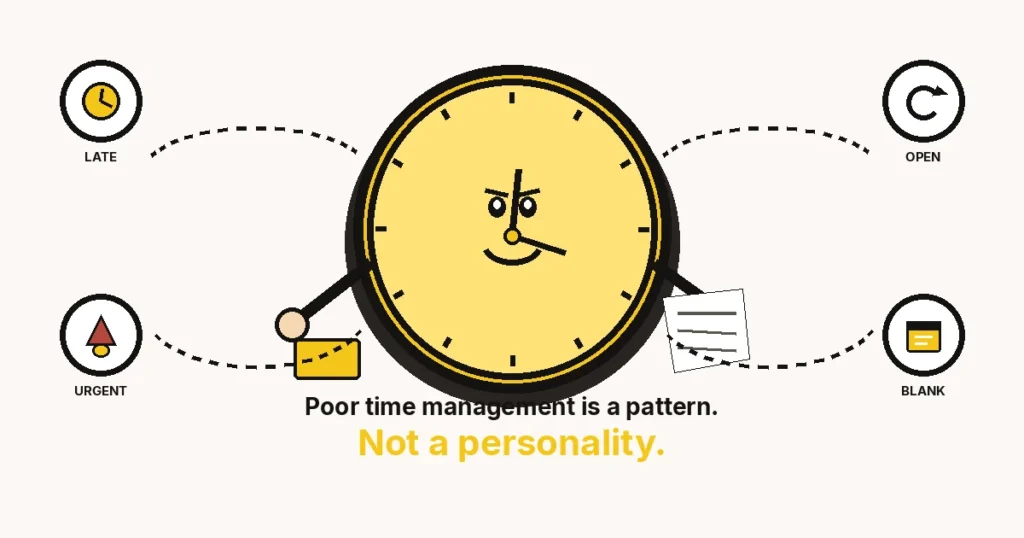
Poor time management is a pattern of calendar choices, not a personality. The signs are a late start without a first move, work with no finish line, urgency crowding the important block, and the real task sitting off the page. That is ranking and closure — not laziness, and not depletion.
Key takeaways
- Poor time management is four visible calendar signs — late start, open loop, urgent first, blank important — not a character verdict and not a health score.
- People underestimate their own completion times even when they remember that similar tasks ran long, which is the planning fallacy (Buehler, Griffin & Ross, 1994).
- Work expands to fill the time you give it; an open loop with no finish line will take the afternoon (Parkinson, 1955).
- Unfinished work leaves attention residue that taxes the next task, so a missing done line costs more than a messy desk (Leroy, 2009).
- Graham Allcott’s How to Be a Productivity Ninja treats calm and closed loops as the job — the named review for this row, not a grit speech.
What poor time management actually is
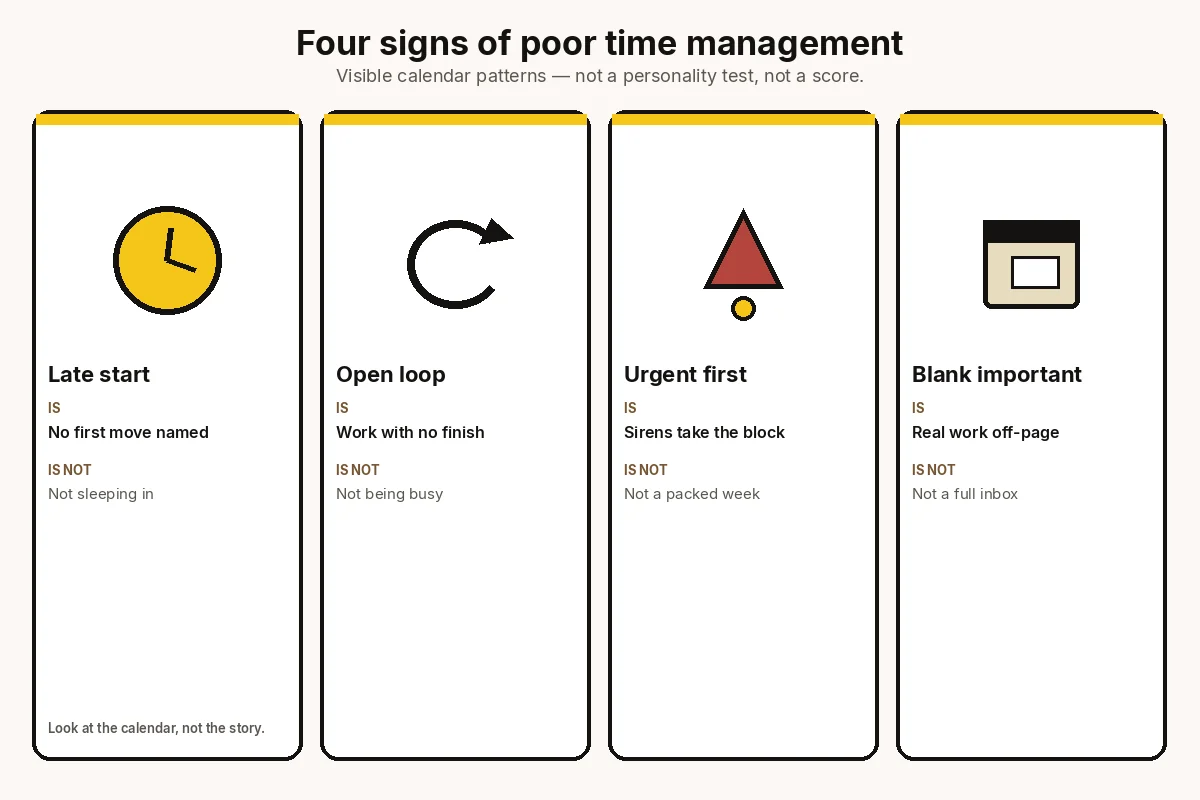
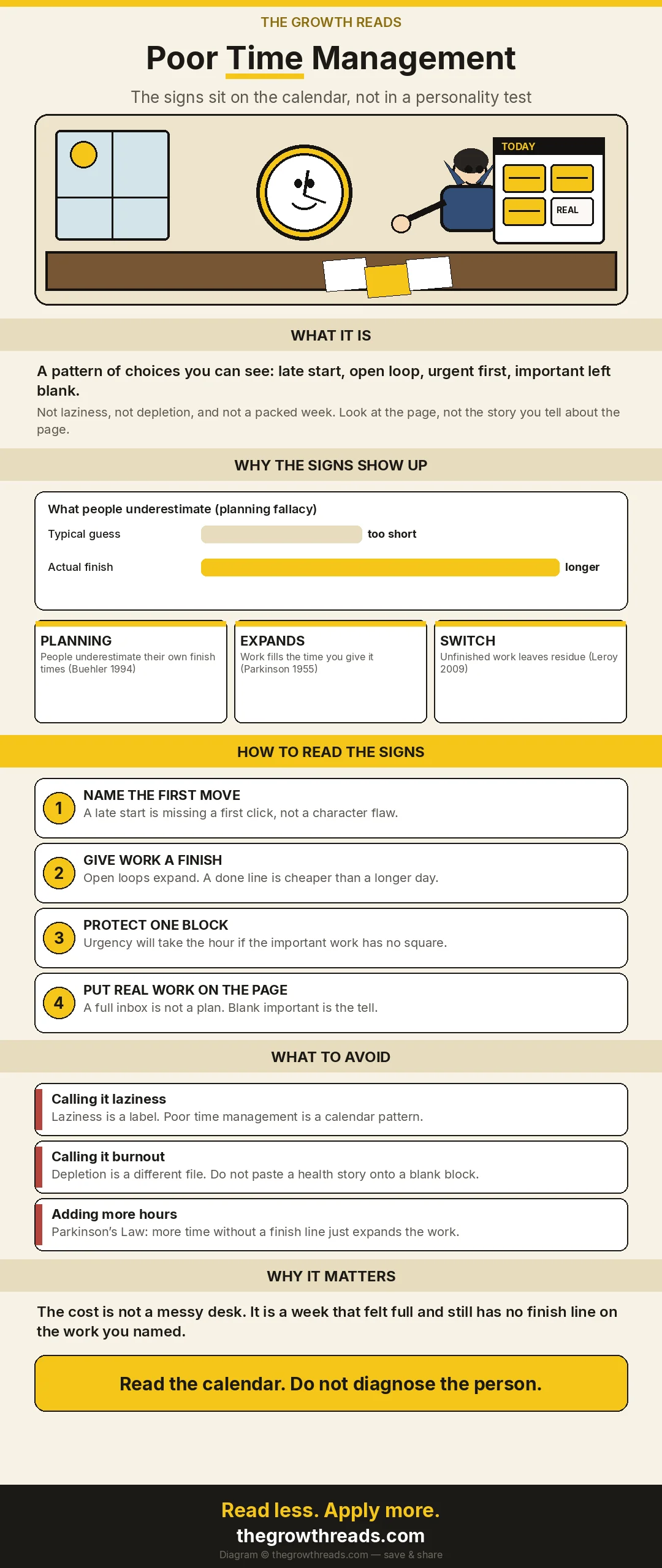
Poor time management is a pattern you can read on the calendar: late start, open loop, urgent first, and the important work left blank. It is not a personality you either have or lack. It is not a packed week. It is not a full inbox. Search treats the phrase as a character test. The useful version is four signs. If you can see the sign, you can name the file. If you cannot see a sign, you are probably holding a different problem — freeze before a choice, a missing hold, or an empty tank — and those live on other URLs.
That is why this page sits under Decisions, next to the cluster’s live parent analysis paralysis, rather than under a health silo or a motivation-hack silo. The parent owns freeze before a call. This URL owns the calendar after a call is available. The sister page is why is time management important. Same cluster. Different file. That URL owns the cost of the skill. This URL owns the signs that the skill is missing. The ranking method lives at how to prioritise tasks. Use that when you already know you must rank. Use this page when the question is whether the week is showing the pattern.
This is a work-and-habits page on the productivity library. It is not a burnout health page, not a diagnosis, and not a treatment list. It does not score your character. It does not tell you that a messy Tuesday means you have a disorder. The question is narrower: did the real work get a first move, a finish line, and a protected block. Burnout vs laziness is motivation versus depletion at work. Do not paste an empty-tank story onto a blank important square. Do not paste a laziness story onto a week that is already spent.
The named unused review on this row is Graham Allcott’s How to Be a Productivity Ninja. The book is an argument for zen-like calm and closed loops, not a trial and not a second study. Use it as the down-link for a pattern you can see, not as a personality transplant. Parkinson’s Law owns work expanding to fill the time. The time management matrix owns urgent versus important. Time management examples owns what the skill looks like when it is working. This URL owns the signs when it is not.
Poor time management vs a packed week
A packed week is hours filled. Poor time management is the important work missing a first move, a finish, or a square. They share a family resemblance from the outside. They fail in opposite directions. Fill every hour with sirens and you can still have the sign. Leave a Tuesday empty on purpose and you may not. Claessens, van Eerde, Rutte and Roe (2007) reviewed decades of time-management research and found the useful layer was behaviours and perceived control of time, not hours occupied. A busy feeling is cheap evidence. A blank important block is not.
Why the signs appear
The signs appear because people under-guess their own finish times, leave loops open, and let the loudest work take the hour — not because they lack a time-management personality. Buehler, Griffin and Ross (1994) asked students to forecast academic tasks. People underestimated their own completion times even when they knew that similar tasks had run long. Kahneman and Tversky (1979) had already named that planning fallacy. The cheap read is not “try harder.” It is: the guess in your head is not a finish line. If the guess is the plan, the week will show the late-start sign and the open-loop sign on schedule.
Parkinson (1955) then described the other half in a line that is still the cleanest in the literature: work expands to fill the time available for its completion. Give an open loop a soft afternoon and the loop takes the afternoon. That is not a moral finding. It is a container finding. Parkinson’s Law owns the expansion. This page asks whether you gave the work a container at all. König and Kleinmann (2005) added the deadline-rush version: people discount time hyperbolically, so the cheap work wins today and the real work piles up at the due date. That is the urgent-first sign with a timestamp.
Leroy (2009) then measured the leftover. Switching away from an unfinished task left attention residue that impaired the next task. Completing the first task was not even enough on its own; you also had to disengage. An open loop is therefore not only a calendar problem. It is a residue problem. The next hour pays for the missing done line. That is why “I’ll just keep it open” feels cheap and costs more than a messy desk.
The four signs
- Late start — no first move named. The work is known. The calendar has a vague “this afternoon.” There is no first click. Buehler’s group found the forecast is already short. A vague block makes it shorter. This is not sleeping in. Sleep-and-cue questions live on morning pages such as how to wake up early if you sleep late. This sign is a missing first move after you are already at the desk.
- Open loop — work with no finish. The file is open. The afternoon is open. Parkinson (1955) is why the work fills whatever you left empty. Allcott’s ninja book is the down-link against that costume: closed loops and a done line, not a longer day. A busy feeling does not close a loop.
- Urgent first — sirens take the block. The loud work is scheduled because it shouts. The important work is “later.” The time management matrix owns the grid. This URL owns the tell: the important square is empty while the sirens have ink. Aeon and Aguinis (2017) described time management as structuring, protecting, and adapting time. Urgent-first is a fail of protect.
- Blank important — the real work is off the page. The inbox is full. The chat is full. The named task never received a square. Macan (1994) found perceived control of time sat between time-management behaviours and job outcomes. You cannot perceive control of a block that does not exist. How to track productivity owns measurement. This page asks whether there is anything to measure.
Why it costs more than it feels like
The signs feel cheap because each one looks like a small delay; the bill is a week that felt full and still has no finish line on the work you named. A late start costs the first hour. An open loop costs the residue Leroy measured. Urgent-first costs the important block you will not get back. Blank important costs the story you tell on Friday — “I was busy” — which is true and still beside the point.
Britton and Tesser (1991) found that short-range planning predicted college grades better than long-range planning in their student sample. That is not a licence to skip a year-long goal. It is a caution against a vision board with no Tuesday square. Claessens and colleagues (2007) then warned that time-management findings are mixed and often self-report. The honest scrap for this page: we do not have a percentage for “how much more productive a finish line makes you.” We have a pattern you can see, and a set of studies that explain why the pattern repeats.
| Sign | What it actually is | What it costs | What it is not |
|---|---|---|---|
| Late start | No first move on the named work | The forecast was already short (Buehler et al., 1994) | Sleeping in; a morning-cue problem |
| Open loop | Work with no finish line | The work fills the afternoon (Parkinson, 1955); residue on the next task (Leroy, 2009) | Being busy; keeping options open on purpose |
| Urgent first | Sirens take the protected block | The important square never existed (Aeon & Aguinis, 2017) | A packed week; a real emergency |
| Blank important | The real task is off the page | No perceived control to measure (Macan, 1994) | A full inbox; a personality deficit |
Two honest caveats. Buehler’s planning-fallacy studies are mostly academic tasks and self-forecasts, not a universal minutes-lost number. Claessens’s review is clear that time-management evidence is mixed and often correlational. Parkinson (1955) is an essay, not a trial. This page does not invent a percentage for “how much poor time management costs,” and it does not treat a messy week as a diagnosis.
Allcott’s book is the organisational-feeling version of the same cheap layer: close the loop, protect attention, keep the week calm enough to see the page. That is not peer-reviewed. Pair it with the parent analysis paralysis if the missing piece is a call, and with why is time management important if the missing piece is why the skill is worth a square. A sign is not a personality upgrade. It is a file you can see.
Common mistakes
- Calling the pattern laziness. Laziness is a label. The signs are a page. If you cannot point to late start, open loop, urgent first, or blank important, you are still in the story.
- Calling the pattern burnout. Burnout vs laziness is motivation versus depletion. Do not diagnose it. Do not treat it. Do not add a longer ranking list to an empty week.
- Treating busy as control. Claessens et al. (2007) is why hours filled are weak evidence. A full chat log is not a finish line.
- Trusting the guess. Buehler, Griffin and Ross (1994) found the guess is short even when memory says otherwise. Write a done line. Do not write a vibe.
- Giving the loop a soft afternoon. Parkinson (1955) is why the work expands. Parkinson’s Law owns the expansion. This page asks whether you left the container empty.
- Protecting nothing. Aeon and Aguinis (2017) split the job into structure, protect, adapt. Urgent-first is a protect fail. The matrix page owns the grid.
- Buying a new system before reading the signs. Allcott is the down-link for closed loops, not for a third app. Name the sign first. Then open the matching method page.
When it is more than a habit
A workplace pattern of late starts and blank important blocks is a routine question; a pattern that takes over sleep, money, or safety is a different conversation and this page is not that conversation. The poor-time-management frame is for ordinary work: the afternoon that never starts, the loop that never closes, the sirens that eat the block, the real task that never received a square. It is not a diagnosis, not a treatment list, and not a stand-in for help with compulsive use or anything that is harming health or relationships.
If you can name the next move and put it on the page, this URL applies. If weeks stay impossible after the signs are split and written down, stop asking this page for a laziness test, a burnout score, or a tighter system. The honest next step is a qualified person, not a louder calendar. This article does not diagnose, does not treat, and does not list clinical symptoms.
The evidence behind this
The usable evidence is a planning-fallacy forecast error, work expanding to fill an empty container, attention residue on unfinished tasks, and a time-management literature that is mixed — not a minutes-lost score and not a personality test.
| Study | Design and size | Finding | What we used it for |
|---|---|---|---|
| Buehler, Griffin & Ross (1994) | Students forecasting academic tasks; several studies | People underestimated their own completion times even when similar tasks had run long | Late start and open loop are forecast errors, not a character verdict |
| Kahneman & Tversky (1979) | Essay on intuitive prediction | Named the planning fallacy: plans ignore distributional evidence | The guess in your head is not a finish line |
| Parkinson (1955) | Essay in The Economist | Work expands to fill the time available for its completion | An open loop with a soft afternoon takes the afternoon. Not a trial |
| König & Kleinmann (2005) | Model plus student data on deadline rush | People discount time hyperbolically; work piles up at the due date | Urgent-first has a timestamp. Not proof of laziness |
| Leroy (2009) | Lab; task switching with unfinished work | Unfinished work left attention residue that impaired the next task | A missing done line costs the next hour, not only the current one |
| Macan (1994) | Survey process model of time-management behaviours | Perceived control of time sat between behaviours and job outcomes | Blank important means there is no block to control |
| Claessens, van Eerde, Rutte & Roe (2007) | Narrative review of time-management research | Useful layer is behaviours and perceived control; findings are mixed and often self-report | Busy is weak evidence. No invented productivity percentage |
| Aeon & Aguinis (2017) | Review and conceptual paper | Time management as structuring, protecting, and adapting time | Urgent-first is a protect fail. Packed is not the same file |
| Britton & Tesser (1991) | Students; time-management questionnaire and GPA | Short-range planning predicted grades better than long-range planning | A Tuesday square beats a vision with no block. Student sample, not a law |
Frequently asked questions
What are the signs of poor time management?
The signs sit on the calendar: a late start with no first move named, work that never gets a finish line, urgency taking the hour that should have held the important block, and the real task sitting off the page. A packed week is not the same file. A full inbox is not a plan. Poor time management is that pattern of choices, not a personality. If the tank is empty, that is motivation versus depletion on burnout vs laziness — a different URL, and not a health page. This article does not diagnose and does not treat.
Is poor time management the same as laziness?
No. Laziness is a label people paste on a blank afternoon. Poor time management is a visible pattern: late start, open loop, urgent first, important left blank. You can look busy all week and still have the sign. You can rest on purpose and not have it. Buehler, Griffin and Ross (1994) found people underestimate their own finish times — that is a forecast error, not a moral one. Do not use this page as a character test. Do not use it as a diagnosis. If the week is spent, open burnout vs laziness for the motivation-versus-depletion split, not a treatment list.
Is poor time management the same as burnout?
No. Burnout vs laziness on this site is motivation versus depletion at work — not a health page, not a diagnosis, and not a treatment list. Poor time management is the calendar pattern after a choice is still available: you can name a first move and you have not put it on the page. If the week is already spent, a longer ranking list is the wrong layer. Do not paste a depletion story onto a blank important block. Do not paste a laziness story onto an empty tank. Name the file, then open the matching URL.
Why do I keep underestimating how long work will take?
Buehler, Griffin and Ross (1994) called this the planning fallacy: people underestimate their own completion times even when they remember that similar tasks ran long. Kahneman and Tversky (1979) named the bias. The cheap read for this page is not “try harder.” It is: your guess is not a finish line. Parkinson (1955) then described the other half — work expands to fill the time you give it. An open loop with a soft afternoon will take the afternoon. Give the work a done line, or the sign stays.
Does being busy mean I manage time well?
No. Busy is a feeling. Poor time management is a page. Claessens, van Eerde, Rutte and Roe (2007) reviewed time-management research and found the useful layer was behaviours and perceived control, not hours filled. A week of sirens can look like control from the outside and still leave the important square blank. How to prioritise tasks owns ranking. The time management matrix owns urgent-versus-important. This URL owns the signs that those pages do not have to list. A full inbox is not a plan.
How is this different from analysis paralysis?
Analysis paralysis is freeze before a choice — too many similar options, no call. That is this cluster’s parent. Poor time management starts after a choice is available: you know the work, and the calendar still shows late start, open loop, urgent first, or blank important. If you cannot pick among options, open the parent. If you picked and the page is still empty of a finish line, you are on this URL. Why is time management important owns the cost of the skill. This page owns the signs that the skill is missing.
What should I look at first if my week feels messy?
Look at the four signs before you add a system. Is there a first move on the real task. Does that task have a finish line. Did urgency take the block. Is the important work even on the page. Macan (1994) found perceived control of time sat between time-management behaviours and how people felt about the job. Control starts with a named block, not a new app. How to be a Productivity Ninja is the down-link for closed loops and calm, not for a personality upgrade. This page does not ship a how-to ladder.
When is a messy calendar more than a habit?
A workplace pattern of late starts and blank important blocks is a routine question. A pattern that takes over sleep, money, or safety is a different conversation, and this page is not that conversation. This article does not diagnose, does not treat, and does not list clinical symptoms. If you can name the next move and put it on the page, this URL applies. If weeks stay impossible after the signs are split and written down, stop asking this page for a laziness test or a burnout score. The honest next step is a qualified person, not a louder calendar.
Sources
- Buehler, R., Griffin, D., & Ross, M. (1994). Exploring the “planning fallacy”: Why people underestimate their task completion times. Journal of Personality and Social Psychology, 67(3), 366–381. doi:10.1037/0022-3514.67.3.366
- Kahneman, D., & Tversky, A. (1979). Intuitive prediction: Biases and corrective procedures. TIMS Studies in Management Science, 12, 313–327.
- Parkinson, C. N. (1955, 19 November). Parkinson’s Law. The Economist.
- König, C. J., & Kleinmann, M. (2005). Deadline rush: A time management phenomenon and its mathematical description. The Journal of Psychology, 139(1), 33–45. doi:10.3200/JRLP.139.1.33-45
- Leroy, S. (2009). Why is it so hard to do my work? The challenge of attention residue when switching between work tasks. Organizational Behavior and Human Decision Processes, 109(2), 168–181. doi:10.1016/j.obhdp.2009.04.002
- Macan, T. H. (1994). Time management: Test of a process model. Journal of Applied Psychology, 79(3), 381–391. doi:10.1037/0021-9010.79.3.381
- Claessens, B. J. C., van Eerde, W., Rutte, C. G., & Roe, R. A. (2007). A review of the time management literature. Personnel Review, 36(2), 255–276. doi:10.1108/00483480710726136
- Aeon, B., & Aguinis, H. (2017). It’s about time: New perspectives and insights on time management. Academy of Management Perspectives, 31(4), 309–330. doi:10.5465/amp.2016.0166
- Britton, B. K., & Tesser, A. (1991). Effects of time-management practices on college grades. Journal of Educational Psychology, 83(3), 405–410. doi:10.1037/0022-0663.83.3.405
Related reading on The Growth Reads
The books this page draws on
- How to Be a Productivity Ninja summary — closed loops and calm, not a personality upgrade
Related articles
- Analysis paralysis — this cluster’s parent: freeze before a choice
- Why is time management important — the sister: the cost of the skill, not the signs
- How to prioritise tasks — ranking once you already know you must rank
- The time management matrix — urgent versus important
- Parkinson’s Law — work expands to fill the time
- Time management examples — what the skill looks like when it is working
- Burnout vs laziness — motivation versus depletion, not this pattern
Go deeper
How this article was researched
The Growth Reads editorial team writes from primary sources: the books themselves and the peer-reviewed literature behind the claims. Every study cited above was read in the original publication or its published abstract, and every figure is quoted with its design, sample and effect so you can judge its weight rather than take ours. Where a finding is a review, an essay, a student field sample, or mixed evidence, we say so in the body rather than in a footnote. This page does not invent a minutes-lost score for poor time management, because none of the cited papers measured one.
How we work: every article on The Growth Reads is built from the books in our library plus the research they rest on, and is reviewed and date-stamped when the evidence changes. Read our full methodology.