

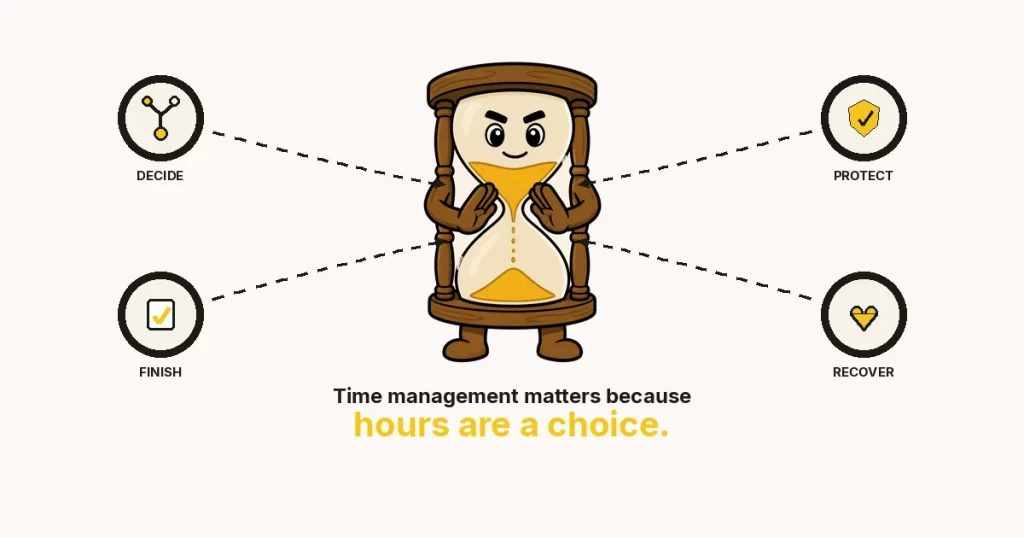
Time management is important because it is how you decide what a finite day is for, and those decisions show up in work, grades, and — more strongly — wellbeing. Aeon, Faber and Panaccio’s 2021 meta-analysis of 158 studies found moderate links with job performance and academic achievement (both r = .26) and a stronger link with wellbeing (r = .31).
Key takeaways
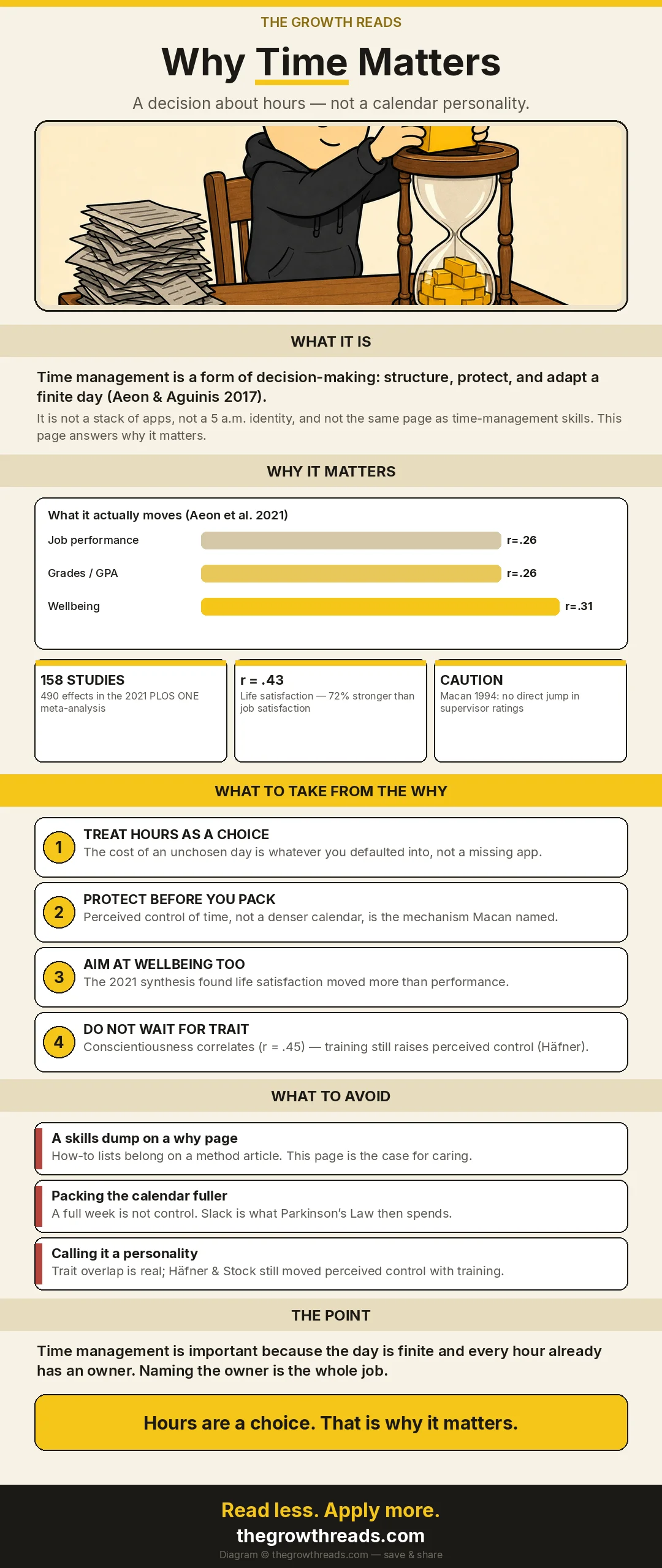
- Time management is a form of decision-making used to structure, protect, and adapt a finite day — not a personality, and not a stack of calendar apps (Aeon & Aguinis, 2017).
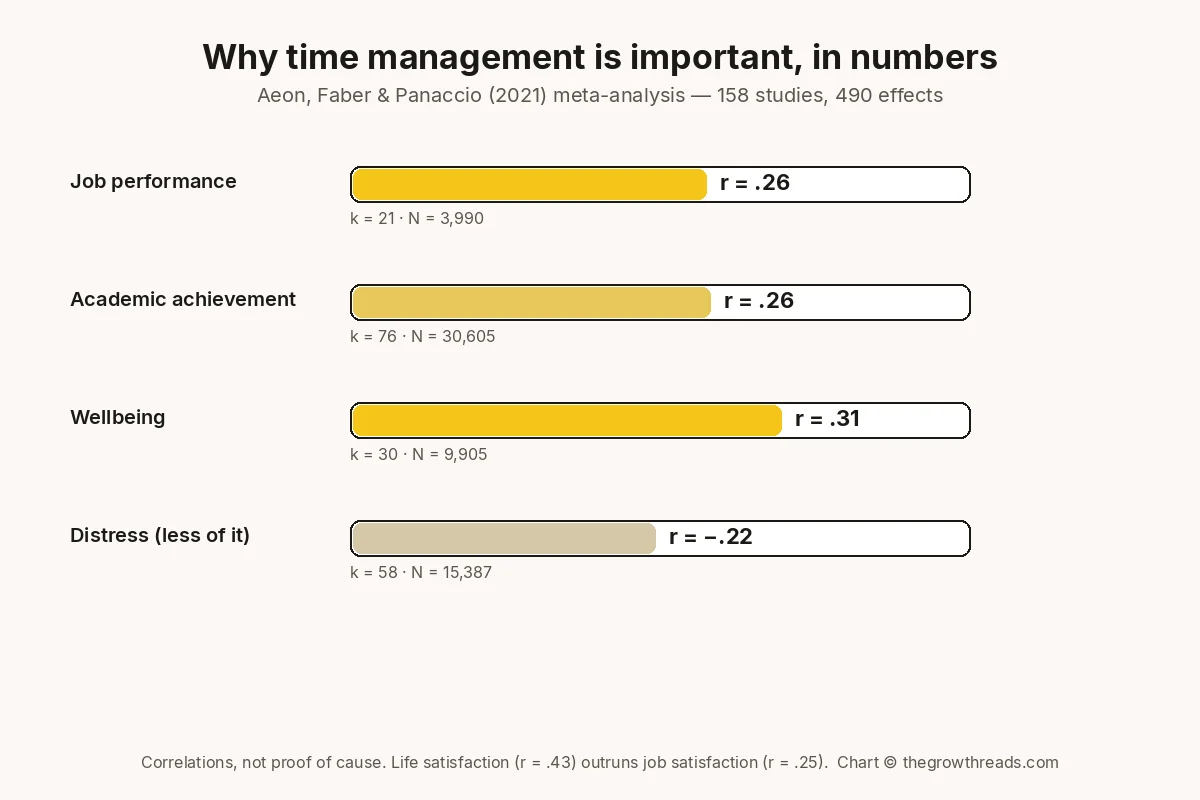
- Across 158 studies, time management is moderately related to job performance (r = .26, k = 21) and academic achievement (r = .26, k = 76), and slightly more strongly related to wellbeing (r = .31, k = 30) (Aeon, Faber & Panaccio, 2021).
- Life satisfaction (r = .43) outruns job satisfaction (r = .25) in that synthesis — the common story that time management matters first for output, with feeling better as a side effect, is backwards.
- The mechanism that keeps showing up is perceived control of time: planning and protecting hours changes how controllable the day feels, which then tracks tension and satisfaction more reliably than raw output (Macan, 1994; Claessens, van Eerde, Rutte & Roe, 2004).
- Training can raise that sense of control and lower stress without automatically lifting supervisor ratings — Häfner and Stock (2010) found exactly that split in 71 employees, which is why this page answers why, not a twelve-step skills dump.
What time management actually is
Time management is a form of decision-making used to structure, protect, and adapt your hours as conditions change — not a talent you either inherited or missed. That definition is Brad Aeon and Herman Aguinis’s 2017 synthesis in Academy of Management Perspectives, and it is the one later research keeps using. Three verbs do the work: structure (the day has a shape), protect (something is allowed to interrupt, and something is not), and adapt (the plan is revised when the week moves). A colour-coded calendar with no decisions inside it is interior design. A decision about which hours are for the work that still matters next month is time management.
This page sits in the Decisions cluster for that reason. The stall most people feel at 9:14 a.m. is not a missing template. It is an unmade call about what the next hour is for, which is why it neighbours analysis paralysis — stuck before the job is chosen — rather than a generic “be more organised” tip list. The rest of the productivity library covers methods. This article covers the case for caring.
Stephen Covey put the same idea in plainer clothes as Habit 3, Put First Things First: the important-but-not-urgent work loses unless someone decides it owns a block of the day. The unused review for this row is our 7 Habits of Highly Effective People summary — Quadrant II is the popular name for the same decision. It is not a skills curriculum, and it is not a claim that a leather planner will raise your output by a round number.
What this is not
This is not a time-management-skills page, not a personality diagnosis, and not a packing list for a fuller calendar. “Time management skills” is a different search and a different article. So is a walkthrough of any one method — Ivy Lee, ABCDE, 1-3-5, a time audit. Those answer how. The question here is why the how is worth the friction. Treating the two as the same page is how a why-article turns into a recycled list of hacks, and how a skills article forgets to say what is actually at stake.
Why time management is important
Time management is important because a day already has owners — default ones, if you do not pick — and the research says those ownership decisions track performance, grades, distress, and, more than any of those, how liveable the week feels. Aeon, Aïda Faber and Alexandra Panaccio gathered 158 studies and 490 effect sizes in a 2021 PLOS ONE meta-analysis built to answer a blunt question: does time management work? The short version is yes, moderately, and not where the posters say.
Job performance overall came in at r = .26 (k = 21 studies, N = 3,990). Academic achievement overall sat in the same band: r = .26 (k = 76, N = 30,605), with GPA itself at r = .21 (k = 57). Those are real associations. They are not transformations. A correlation of .26 is the difference between a useful lever and a miracle cure, and the paper is honest about that. Behaviour-based performance at work (motivation, involvement, proactiveness) ran a little higher than results-based ratings, but the difference was not statistically significant. In schools, behaviour-based outcomes (r = .43) ran well ahead of test scores and GPA. Showing up as the kind of student who plans is more tightly tied to time management than a single exam mark is.
Wellbeing is the result most people still treat as a bonus. Overall wellbeing was r = .31 (k = 30, N = 9,905). Life satisfaction was r = .43 (k = 9, N = 2,855) — seventy-two percent stronger than job satisfaction (r = .25). Distress ran the other way: overall r = −.22 (k = 58, N = 15,387), with a sharper mark on psychological distress (r = −.36 in the narrower cluster). The authors’ own reading is the one this page is built on: time management seems to enhance wellbeing, especially life satisfaction, to a greater extent than it does performance. The poster version — first you get more done, then you feel better — is the wrong order.
Two caveats belong next to those numbers, not in a footnote. First, a meta-analysis of mostly correlational studies is not a proof that picking a planner caused the raise. People who already feel in control of the week may both manage time and report higher satisfaction. Second, time management overlaps a lot with conscientiousness (r = .45, k = 15, N = 5,159). Some of what looks like a “time-management effect” is organised people being organised. Aeon, Faber and Panaccio say so. They also note that training studies still find people can get better at the behaviours, which is the opposite of a you-have-it-or-you-don’t story. Hold both facts at once.
The four outcomes the evidence actually supports
The case for caring compresses to four outcomes, not twelve life areas.
- Work that other people can see. Supervisor ratings and similar results-based measures move with time management (r = .22). Not a leap. Not zero. In the same paper, the link with job performance has been getting stronger over the decades (B = .0106 per year, p < .01) — possibly because more jobs now ask people to steer their own hours.
- School that compounds. Britton and Tesser (1991) followed 90 college students for four years. Two time-management components predicted cumulative GPA (R² = .21) and accounted for more extra variance than SAT scores did (increment in R² = .05). It is a small sample and it is not a randomised trial. It is also one of the cleaner prospective tests we have, and it pointed at short-range planning and time attitudes, not at a heroic morning routine.
- A week that feels less like it is happening to you. Macan’s 1994 process model put perceived control of time in the middle: goals, lists, and a preference for organisation feed a sense that the day is steerable, and that sense then tracks job satisfaction and tension. Direct paths to supervisor-rated performance were not the story. Claessens, van Eerde, Rutte and Roe (2004) found partial rather than full mediation once workload and autonomy were in the model — control of time still mattered; it was not the only lever.
- Less of the bill that never hits a timesheet. Distress, stress, and work-life conflict all run negative with time management in the 2021 synthesis. Häfner and Stock (2010) randomly assigned 71 employees to training or a wait-list: perceived control of time went up, perceived stress went down, and performance indicators did not move. That split is not a failure of the why. It is the why. The first thing time management reliably buys is a less hunted nervous system. Output, when it comes, is downstream and noisier.
Why skipping it costs more than it feels like
An unmanaged day does not stay empty — it fills, and the fill is almost never the work you would have named at 8 a.m. That is the quiet cost. You still look busy. Email still gets a reply. The week still ends. What disappeared is the hours that only exist if someone protects them: the draft, the hard conversation, the study block, the evening that was supposed to be an evening. Covey called those Quadrant II. Parkinson observed the other half of the trap: once a box of time exists, work expands to fill it, which we unpacked in Parkinson’s Law. Skip the decision about what the box is for, and slack spends itself on whoever shouted last.
Macan, Shahani, Dipboye and Phillips (1990) had already watched this in students: time-management behaviours tracked academic performance and stress together, not as two separate hobbies. Claessens, van Eerde, Rutte and Roe’s 2007 review of 32 empirical studies — the best map before the 2021 meta-analysis — said the same in review language. Time management related positively to perceived control of time, job satisfaction, and health, and negatively to stress. The link with work and academic performance was “not clear.” Fourteen years later, Aeon, Faber and Panaccio made it clearer and still modest. The honest cost of skipping time management is therefore not “you will fail the review.” It is that you will run a week that feels like weather, then wonder why the important work only happens in emergencies.
The counter-case, named. Macan (1994) did not find that time-management behaviours lifted supervisor ratings, and her training condition did not look effective. Häfner and Stock (2010) raised perceived control and cut stress without moving performance. If someone promises that a new system will show up in this quarter’s numbers, they are selling past the evidence. The evidence is stronger on “the week becomes more liveable” than on “the dashboard jumps.” That is still a reason to manage time. It is a different reason than the one on the poster.
There is a second, smaller cost that only shows up in the overlap with personality. Because conscientiousness and time management share so much variance (r = .45), people who already plan get credited for “being good at time,” and people who do not plan get told they lack character. The training result cuts against that sermon. Behaviours can move even when the trait sits still. The cost of skipping time management, for the less naturally organised, is not a moral verdict. It is leaving a trainable lever on the floor because it was sold as a personality.
Time management vs nearby ideas
Most confusion on this keyword is a category error: a why-page getting asked to do a how-page’s job, or a ranking method getting asked to explain why hours matter at all. Keep the neighbours in their lanes.
| Idea | Question it answers | Why it is not this page |
|---|---|---|
| Time management (this page) | Why a finite day needs an owner | The case for caring — structure, protect, adapt (Aeon & Aguinis, 2017) |
| Parkinson’s Law | Why work expands to fill leftover time | A mechanism that starts after a box of time exists; not the reason to create the box |
| How to prioritise tasks | Which task wins inside the box | A ranking method. Important, and a different URL |
| Time audit | Where the last week actually went | Measurement. You audit after you care, not instead of caring |
| ABCDE / 1-3-5 / Ivy Lee | How to cap and order today’s list | How-to systems. They assume you already believe the list is worth protecting |
If the itch is “tell me what to do at 9 a.m.,” leave this page and open a method. If the itch is “I already know the methods and I still cannot see why I should defend an hour,” stay. The 2021 numbers are for that second itch.
Common mistakes
- Treating time management as a skills dump. A why-page that turns into fourteen tips has abandoned its keyword. Skills belong on a method article. This one is the case for caring.
- Packing the calendar until it looks responsible. A full week is not perceived control of time. It is a week with no slack, which Parkinson’s Law will then spend on whoever arrives with extra scope.
- Calling it a personality. Conscientiousness correlates (r = .45). Häfner and Stock still moved perceived control with a training group of 35. Trait overlap is not a life sentence.
- Buying the output poster and ignoring wellbeing. Life satisfaction moved more than job satisfaction in the 2021 synthesis. If the only scoreboard you watch is throughput, you will quit a working practice because the dashboard did not jump.
- Confusing busyness with Put First Things First. Covey’s Quadrant II work is the important-but-not-urgent block. Answering everything that pings is Quadrant III wearing a productivity hat. The 7 Habits summary is the place to sit with that distinction.
- Skipping the decision and hoping a tool will make it. Apps structure what you already chose. They do not choose. Unmade calls leak into analysis paralysis at the start of the job and into whatever shouted last by 4 p.m.
- Judging a week only by the review meeting. Macan (1994) and Häfner and Stock (2010) both failed to move performance ratings while still moving the thing underneath — control, tension, stress. Score the week on whether the important hours had an owner, not only on whether someone else noticed.
The evidence behind this
Every figure on this page traces to a named paper. Here is the short ledger — what each study can support, and what it cannot.
| Study | Design & size | What it found | Used here for |
|---|---|---|---|
| Aeon, Faber & Panaccio (2021), PLOS ONE | Meta-analysis, 158 studies, 490 effects | Moderate links with job performance (r = .26), academic achievement (r = .26), wellbeing (r = .31); distress r = −.22; life satisfaction stronger than job satisfaction; conscientiousness r = .45 | The core “why it matters” numbers, including the wellbeing surprise |
| Aeon & Aguinis (2017), Academy of Management Perspectives | Conceptual synthesis | Time management as decision-making: structure, protect, adapt | The definition this page uses |
| Macan (1994), Journal of Applied Psychology | Survey of employees; supervisor ratings; training test | Behaviours → perceived control of time → satisfaction and tension; no direct lift in rated performance; training not shown effective | The mechanism, and the main counter-case on output |
| Claessens, van Eerde, Rutte & Roe (2004), Journal of Organizational Behavior | Two-wave employee questionnaires; SEM | Perceived control of time partially mediates planning → strain/satisfaction/performance; workload and autonomy also matter | Why “control of time” is not the only lever at work |
| Claessens, van Eerde, Rutte & Roe (2007), Personnel Review | Narrative review, 32 empirical studies (1982–2004) | Positive links with perceived control, satisfaction, health; negative with stress; performance link unclear | The pre-2021 map, and why the later meta-analysis was needed |
| Britton & Tesser (1991), Journal of Educational Psychology | Prospective, n = 90 college students, four years | Time-management components predicted GPA (R² = .21), more extra variance than SAT (ΔR² = .05) | Why it matters for students, with the small-n limit named |
| Macan, Shahani, Dipboye & Phillips (1990), Journal of Educational Psychology | Student sample; TMBS scale | Time-management behaviours correlate with academic performance and stress; perceived control of time is a central factor | The student-side version of Macan’s later process model |
| Häfner & Stock (2010), The Journal of Psychology | Field experiment, 71 employees (35 training / 36 wait-list) | Training raised perceived control of time and lowered stress; no movement on performance indicators | Proof that the why can be trained, and that output is the noisy outcome |
Frequently asked questions
Why is time management important at work?
Time management is important at work because it is how you decide which hours are for the work that still matters next month, instead of letting the inbox assign the day. Aeon, Faber and Panaccio (2021) found a moderate link with job performance (r = .26 across 21 studies). That is not a promise your review score jumps next quarter — Macan (1994) and Häfner and Stock (2010) both failed to move supervisor-style performance while still moving perceived control and stress. The workplace case is a more steerable week and a less hunted nervous system, with output as a noisier downstream effect.
Why is time management important for students?
Time management is important for students because the term is long and the work compounds, so an unowned week quietly spends itself on whatever is due tonight. Britton and Tesser (1991) found two time-management components predicted four-year cumulative GPA (R² = .21) and added more extra variance than SAT scores (ΔR² = .05) in 90 college students. The 2021 meta-analysis put overall academic achievement at r = .26 across 76 studies. Treat that as a real, moderate association — not a guarantee a planner raises a single exam mark — and as a better explanation than “try harder in the library.”
Does time management actually improve performance?
Sometimes, moderately, and less cleanly than the posters claim. The 2021 meta-analysis found r = .26 with job performance and r = .26 with academic achievement. Those are associations pooled across many designs, not a single experiment proving cause. Macan (1994) found no direct path to supervisor ratings. Häfner and Stock (2010) trained 71 employees and did not move performance indicators, even though perceived control of time rose and stress fell. If performance is your only scoreboard, the evidence will look disappointing. If a liveable week counts, it will not.
Why does time management help wellbeing more than output?
Because the mechanism that keeps replicating is perceived control of time — the feeling that the day is steerable — and that feeling sits closer to tension, satisfaction, and distress than to someone else’s rating of your output. Aeon, Faber and Panaccio (2021) found wellbeing at r = .31 and life satisfaction at r = .43, against job satisfaction at r = .25 and job performance at r = .26. Häfner and Stock (2010) moved control and stress without moving performance. Feeling less hunted is not a consolation prize. In the data, it is the main effect.
Is time management just being organised?
No. Organisation is one input. Aeon and Aguinis (2017) define time management as decision-making used to structure, protect, and adapt time. A tidy desk with no protected hours is organisation without a decision. Macan’s factors include goals and priorities, mechanics (lists, schedules), and a preference for organisation, all feeding perceived control of time. You can be neat and still spend the week on other people’s priorities. You can also be messy on the surface and still have named, defended blocks. The tell is ownership of hours, not matching stationery.
Can you learn time management if you are not conscientious?
Yes, within limits. Time management and conscientiousness overlap a lot (r = .45 in the 2021 synthesis), so naturally organised people have a head start. That is not the same as a locked trait. Häfner and Stock (2010) randomly assigned employees to a psychology-based training or a wait-list; the training group gained perceived control of time and lost perceived stress. Claessens and colleagues (2007) had already noted that training tends to raise time-management behaviours without automatically transferring to performance. Learn the behaviours for the week you want. Do not wait to become a different person first.
Why is time management important if the job is chaotic?
It is more important, not less, because chaos is what happens when nobody names an owner for the next hour and every ping is treated as a one-way door. Claessens, van Eerde, Rutte and Roe (2004) found that workload and job autonomy sit alongside perceived control of time — the job can fight you. Time management does not cancel a bad role. It decides which hours you will still protect inside it. In a chaotic week the cost of skipping that decision is not a messy list. It is a week that felt busy and produced none of the work you would have chosen at 8 a.m.
Is time management the same as time-management skills?
No. “Why is time management important” is the case for caring. “Time management skills” is a method list: how to plan, protect, and adapt once you already believe the hours are worth defending. Mixing them produces a page that ranks for neither. This article stays on the why — definition, mechanism, evidence, and the wellbeing surprise in Aeon, Faber and Panaccio (2021). For ranking rules and caps, use the method neighbours: how to prioritise, ABCDE, 1-3-5, Ivy Lee, a time audit. For the Covey version of “important versus urgent,” use the 7 Habits summary.
Sources
- Aeon, B., Faber, A., & Panaccio, A. (2021). Does time management work? A meta-analysis. PLOS ONE, 16(1), e0245066. https://doi.org/10.1371/journal.pone.0245066
- Aeon, B., & Aguinis, H. (2017). It’s about time: New perspectives and insights on time management. Academy of Management Perspectives, 31(4), 309–330. https://doi.org/10.5465/amp.2016.0166
- Macan, T. H. (1994). Time management: Test of a process model. Journal of Applied Psychology, 79(3), 381–391. https://doi.org/10.1037/0021-9010.79.3.381
- Claessens, B. J. C., van Eerde, W., Rutte, C. G., & Roe, R. A. (2004). Planning behavior and perceived control of time at work. Journal of Organizational Behavior, 25(8), 937–950. https://doi.org/10.1002/job.292
- Claessens, B. J. C., van Eerde, W., Rutte, C. G., & Roe, R. A. (2007). A review of the time management literature. Personnel Review, 36(2), 255–276. https://doi.org/10.1108/00483480710726136
- Britton, B. K., & Tesser, A. (1991). Effects of time-management practices on college grades. Journal of Educational Psychology, 83(3), 405–410. https://doi.org/10.1037/0022-0663.83.3.405
- Macan, T. H., Shahani, C., Dipboye, R. L., & Phillips, A. P. (1990). College students’ time management: Correlations with academic performance and stress. Journal of Educational Psychology, 82(4), 760–768. https://doi.org/10.1037/0022-0663.82.4.760
- Häfner, A., & Stock, A. (2010). Time management training and perceived control of time at work. The Journal of Psychology, 144(5), 429–447. https://doi.org/10.1080/00223980.2010.496647
Related reading on The Growth Reads
The book behind this.
- The 7 Habits of Highly Effective People summary — Covey’s Put First Things First, the unused down-link for this row
Related articles.
- Analysis paralysis — the Decisions parent: stuck before the job is chosen
- Parkinson’s Law — why work expands once a box of time exists
- How to prioritise tasks — which task wins inside the box
- How to run a time audit — where the week actually went
- The ABCDE method — a ranking rule, not a substitute for the why
- The 1-3-5 rule — a daily cap once you already believe the hours are worth defending
- The Ivy Lee method — six items, in order, one at a time
Go deeper.
How this article was researched
We started from the 2021 Aeon, Faber and Panaccio meta-analysis because it is the quantitative answer to “does time management work?”, then read back to the definition paper (Aeon & Aguinis, 2017), Macan’s process model, the Claessens reviews, the Britton and Tesser prospective GPA study, and Häfner and Stock’s training experiment. Every correlation, sample size, and DOI on this page was checked against the paper or its DOI record before it went in. We did not treat a famous finding as settled when a later study contradicted the poster version of it.
Limits. Most of the 2021 effects are correlational. Conscientiousness shares a large overlap with time-management scores. Macan (1994) and Häfner and Stock (2010) are the named counter-cases on job performance. Britton and Tesser (1991) is n = 90. This is a why-page, not a clinical page and not a skills curriculum.
Methodology: 8 peer-reviewed sources, 1 book. Last checked against the cited DOIs on 8 September 2026. Read less. Apply more.