

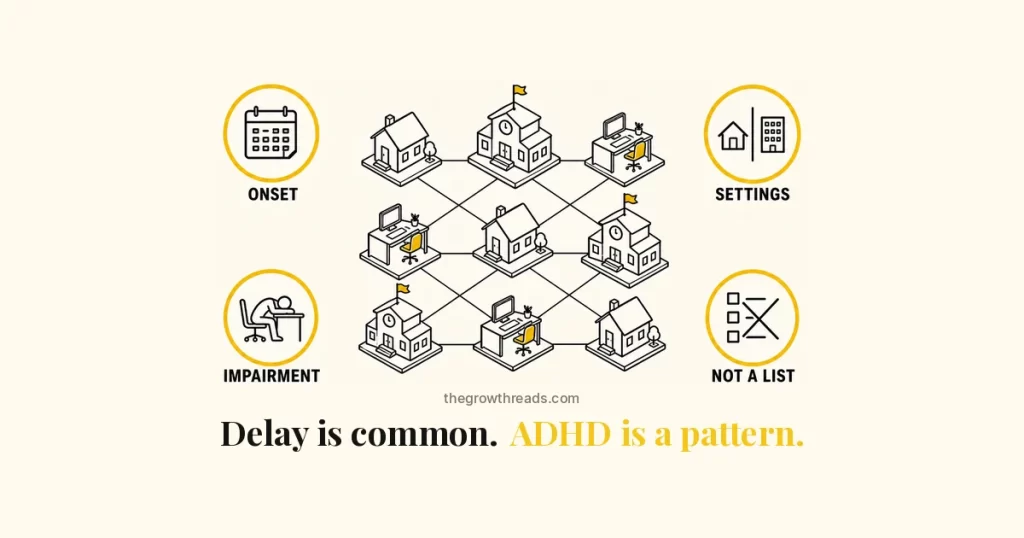
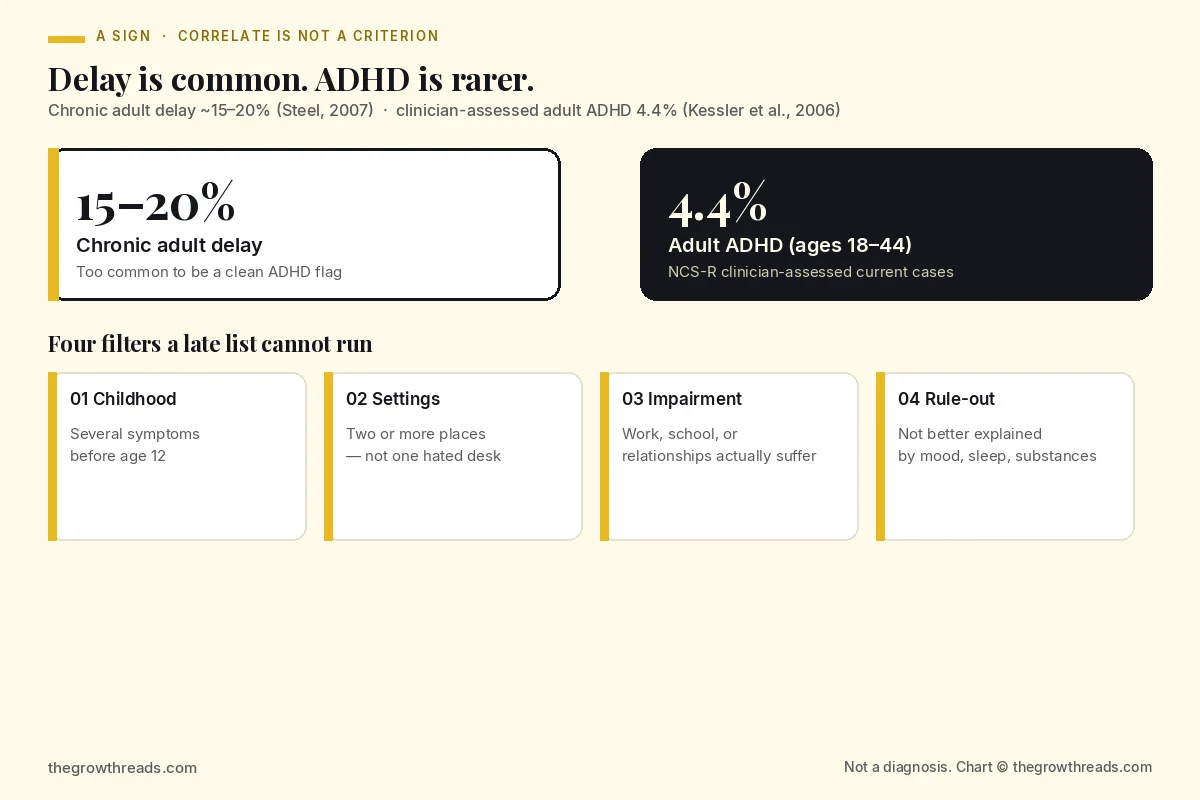
Procrastination is not, on its own, a sign of ADHD. About 15–20% of adults delay chronically (Steel, 2007); clinician-assessed adult ADHD in a US survey was 4.4% (Kessler et al., 2006). Overlap is real. Diagnosis still needs childhood-onset symptoms, more than one setting, and clear impairment — not a late list.
Key takeaways
- Steel’s 2007 review of 691 correlations put chronic adult procrastination at about 15–20% of adults — common enough that delay alone cannot be a reliable ADHD flag.
- Kessler and colleagues (2006) estimated clinician-assessed current adult ADHD at 4.4% (SE 0.6) in a US household sample of 18–44-year-olds, after a screen of 3,199 people and 154 blinded clinical reappraisals.
- The CDC is explicit that there is no single test for ADHD, and that sleep problems, anxiety, depression, and some learning disabilities can look similar.
- In 54 undergraduates, inattention still tracked everyday delay after hyperactivity was partialled out (PPS r = 0.51; partial r = 0.43) — a correlate in an analogue sample, not a diagnosis (Niermann & Scheres, 2014).
- Among 239 youths followed from about age 10 to 24 without childhood ADHD, about 95% of people who screened positive for late-onset ADHD were excluded after a full assessment (Sibley et al., 2018).
What “a sign of ADHD” actually means
A sign, in the clinical sense, is a finding that raises the odds of a diagnosis — not a behaviour that settles it. Procrastination fails that test on its own. Steel (2007) defined it as voluntarily delaying an intended action despite expecting to be worse off, and put chronic adult rates at about 15–20%. Kessler, Adler, Barkley and colleagues (2006) estimated current adult ADHD at 4.4% among US 18–44-year-olds, from a screen of 3,199 people and 154 blinded clinical follow-ups. A behaviour several times more common than the disorder cannot be a clean sign of it. Most chronic delayers are people delaying, not people with missed ADHD.
The overlap is still real. It is a base-rate problem, not proof. The six-step system in the procrastination anchor still covers ordinary delay. This page answers a narrower question: when is the delay a reason to seek an assessment, and when is it a reason not to self-diagnose from a to-do list?
How is a correlate different from a criterion?
A correlate moves with a trait in a sample; a criterion is one of the rules a clinician must meet before naming the trait a disorder. Niermann and Scheres (2014) found that self-reported inattention tracked everyday delay in 54 students. That is a correlate. DSM-5 still does not list “procrastination” as a named ADHD criterion. The closest inattention item is avoiding, disliking, or being reluctant to do tasks that need sustained mental effort — which overlaps with delay without being identical to it. One item, in one setting, this semester, is not a disorder. The CDC’s shortened DSM-5 summary still requires a persistent pattern, a count of symptoms (five or more for ages 17+), several of them present before age 12, two or more settings, impairment, and a check that something else does not explain the picture better.
Why delay and ADHD overlap without being the same thing
They share machinery — inattention, a weak sense of later, and a taste for short-term relief — without sharing a diagnostic identity. The mechanism page is ADHD procrastination; this page will not re-teach it. Ferrari and Sanders (2006) found more decisional and behavioural delay in 29 adults from an ADHD support group than in a community comparison. That is a clue they travel together. It is a pilot, not a population rate, and it does not classify your delay.
Ordinary delay already has mapped causes. Steel (2007) found the strongest predictors were task aversiveness, impulsiveness, and low self-efficacy — levers that show up in ADHD and on a boring Tuesday. Sirois and Pychyl (2013) described delay as short-term mood repair. Nir Eyal’s internal-trigger framing in Indistractable and Chris Bailey’s attention case in Hyperfocus make the same practical point: scarce attention and an uncomfortable feeling are not, by themselves, ADHD.
Why treating delay as a diagnosis costs more than it feels like
The cost is not “taking ADHD seriously.” The cost is skipping the checks that keep the label honest. Sibley, Rohde, Swanson and the MTA group (2018) followed 239 comparison youths without childhood ADHD across eight assessments from about age 10 to 24. About 95% of people who screened positive for late-onset ADHD on symptom checklists were excluded after a full look at impairment, settings, substance use, and other disorders. The most common exclusion among impairing late-onset cases was that the picture occurred only in heavy substance use. The paper found no evidence of adult-onset ADHD independent of a complex psychiatric history.
That is the honest counter-case. A quiz that scores “you might have ADHD” because email is late is doing Sibley’s first, wide-net step and none of the second. False positives send people looking for stimulant-shaped answers to a mood, sleep, or substance problem, and they make later assessment harder to trust.
Two limits on the numbers themselves. Kessler’s 4.4% is for ages 18–44 in a 2006 DSM-IV-era household survey, not a 2026 census of every adult. Steel’s 15–20% rests on earlier adult samples (Harriott & Ferrari, 1996, among them), not a single national diagnostic interview. Use both as order-of-magnitude facts: chronic delay is common; clinical ADHD is less common. Do not treat either figure as your personal probability.
What clinicians actually check — and what a late list cannot
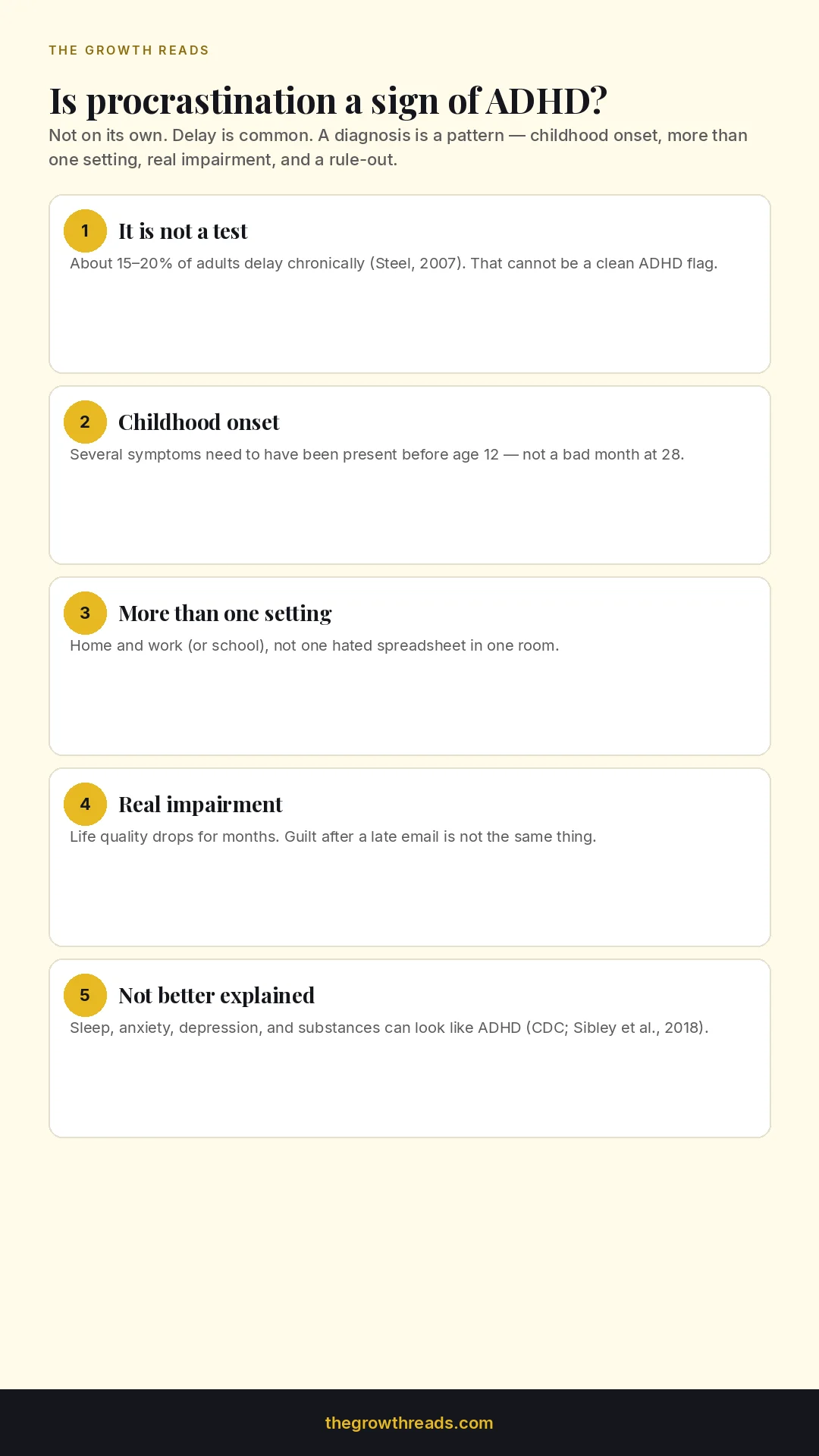
Clinicians do not diagnose from a personality test or a week of missed deadlines. They reconstruct a pattern. The CDC’s DSM-5 summary and NIMH’s 2024 guide use the same filters: for ages 17+, at least five inattention and/or five hyperactivity-impulsivity symptoms lasting six months; several present before age 12; several in two or more settings; clear interference with social, school, or work life; and a picture not better explained by another disorder. NIMH’s practical point: ADHD can be diagnosed at any age, but the symptoms still have to have begun in childhood.
| Check | What common delay often looks like | What an ADHD diagnosis still requires |
|---|---|---|
| Onset | Gets bad with a new job, a hard course, a baby, or a phone habit | Several inattentive or hyperactive-impulsive symptoms present before age 12 (CDC / DSM-5) |
| Settings | Worst at one desk, one class, or one app you hate | Several symptoms in two or more settings (home, school or work, friends) |
| Impairment | Annoying, guilt-heavy, still mostly functioning | Clear reduction in the quality of social, school, or work life, lasting months |
| Better explanation | Sleep debt, anxiety, low mood, an aversive task, a far deadline | Not better explained by another disorder or by substance use (Sibley et al., 2018; CDC) |
While those checks are someone else’s job, the delay is still yours. Shrinking the start with James Clear’s two-minute version in Atomic Habits and getting the next action out of working memory with David Allen’s capture habit in Getting Things Done do not require a diagnosis. They also do not replace one. The two-minute rule and an accountability partner are start-cost tools. Use them. Do not use them as a home kit for DSM-5.
Common mistakes people make with this question
Most errors here are category errors: treating a common behaviour as a rare diagnosis, or treating a real diagnosis as a morale problem.
- Reading a correlate as a criterion. Niermann and Scheres (2014) is a student-sample correlation, not a warrant to diagnose from a delay scale.
- Treating adult-onset delay as adult-onset ADHD. Sibley et al. (2018) is the paper that should slow that leap.
- Taking a two-minute quiz as an assessment. Quizzes skip childhood informants, second settings, and rule-outs. The CDC’s first line is still: talk to a healthcare provider; there is no single test.
- Confusing “I cannot focus in this room” with inattentive ADHD. Environment load can wreck a well-functioning attention system without being a developmental disorder.
- Using the label to stop start-cost tools — or to skip mood, sleep, and substance questions, the checks that collapsed most late-onset screens in Sibley’s sample. Skills and assessment can run in parallel.
When delay is more than a habit
Seek a qualified assessment if delay is one piece of a long, cross-setting pattern of inattention or hyperactivity with childhood roots and real impairment — not if you had a bad month with a hated task. NIMH notes that some adults were missed in childhood because the presentation was quieter or well-scaffolded until adult demands rose. That is late-identified ADHD, still supposed to have begun before 12 — not “I started putting things off at 28.” The CDC’s diagnosing page and the NIMH 2024 guide are the public starting points. This article will not rank you or prescribe.
If work, study, or relationships are buckling, or mood, sleep, or substance use are in the mix, start with a clinician rather than another productivity system. Proactive coping — preparing before a demand turns into a crisis — is still the healthier opposite of delay while you wait.
What the evidence says
Four facts are enough to answer the search query: delay is common, clinical ADHD is less common, the overlap is correlational, and late-onset screens are mostly not ADHD once you look carefully.
| Study | Design & size | Finding | What we used it for |
|---|---|---|---|
| Steel (2007) | Meta-analytic review; 691 correlations | Chronic adult procrastination ~15–20%; strongest predictors include aversiveness, impulsiveness, low self-efficacy | Base rate: delay is too common to be a clean ADHD sign |
| Kessler et al. (2006) | NCS-R probability screen n=3,199 (ages 18–44) + 154 blinded clinical reappraisals | Clinician-assessed current adult ADHD 4.4% (SE 0.6) | Base rate: clinical ADHD is much less common than chronic delay |
| Niermann & Scheres (2014) | Cross-sectional; 54 undergraduates; self-report ADHD behaviours | Inattention–PPS r = 0.51 (partial r = 0.43); hyperactivity/impulsivity partials n.s. | Overlap exists; analogue sample, not a diagnosis |
| Sibley et al. (2018) | Longitudinal; MTA local normative comparison, N=239; eight assessments, ~age 10 to 24 | ~95% of late-onset symptom-checklist positives excluded; no adult-onset ADHD independent of a complex psychiatric history | Why a new delay habit is a poor stand-in for late-onset ADHD |
Ferrari and Sanders (2006) adds a small diagnosed-vs-community gap. The CDC and NIMH add the rule-set a quiz cannot run. None of these let a reader diagnose from a list of undone tasks.
Frequently asked questions
Is procrastination a sign of ADHD?
Procrastination is a common behaviour, not a diagnostic test. Steel’s 2007 review put chronic adult delay around 15–20%. Kessler and colleagues estimated clinician-assessed adult ADHD at 4.4% among US 18–44-year-olds. Those two numbers cannot name the same group. Delay can sit inside ADHD, especially as the DSM inattention item about avoiding effortful work. It can also be mood repair, sleep debt, or an aversive task. A sign would be a long, cross-setting pattern with childhood roots — and even then, a clinician decides, not a to-do list.
Can you develop ADHD as an adult if you only started delaying recently?
ADHD can be diagnosed in adulthood, but NIMH is explicit that symptoms must have begun before age 12. Newly intense delay after a promotion, a baby, or a phone habit is a poor match on its own. Sibley et al. (2018) followed 239 comparison youths from about age 10 to 24: about 95% of people who screened positive for late-onset ADHD were excluded after full assessment. The usual better explanations were substance use or another mental disorder. Recent delay is a reason to look — not a reason to skip that look.
If I avoid hard work, is that the ADHD inattention symptom?
One DSM-5 inattention item is avoiding or disliking tasks that need sustained mental effort. That overlaps with procrastination without being identical to it. The item has to travel with other inattention or hyperactivity symptoms, last at least six months, show up in more than one setting, and impair life. Avoiding one hated spreadsheet is ordinary. Avoiding effortful work across school, home, and jobs since childhood is closer to the clinical pattern. The CDC still says there is no single test.
Could it be anxiety or depression instead of ADHD?
Yes, and that is one of the required rule-outs. The CDC lists sleep disorders, anxiety, depression, and learning disabilities as problems that can look like ADHD. NIMH says stress and other physical conditions can too. Sibley et al. found other psychiatric disorders and heavy substance use were the main reasons late-onset screens failed. Anxiety delay often looks like rumination and fear of getting it wrong. Depression delay often looks like low energy and anhedonia. Both deserve their own evaluation rather than an ADHD label by default.
Are online ADHD quizzes useful?
They can name a feeling. They cannot complete DSM-5 criteria. Quizzes rarely collect childhood history from a second informant, rarely check two settings, and never rule out sleep, mood, or substances. Sibley et al. showed how often a positive screen collapsed under those checks. Use a quiz as a prompt to book a clinician, not as a diagnosis to post. If a quiz tells you what you already feared, that is still not the same as an assessment.
What should I do while I wait for an assessment?
Keep using the delay tools that work for non-ADHD procrastination: shrink the start, capture the next action, and get the task out of working memory. The two-minute rule, an accountability partner, and the six-step system on this site do not require a diagnosis to try. They also do not treat ADHD. If delay sits inside a long, cross-setting pattern with childhood roots, book the assessment rather than collecting more productivity apps. Skills can run in parallel with care. They are not a substitute for it.
Related reading on The Growth Reads
The books this article draws on
- Hyperfocus summary & review — attention as a scarce resource, not a personality type
- Indistractable summary & review — internal triggers versus a missing diagnosis
- Atomic Habits summary & review — shrinking the start while you wait
- Getting Things Done summary & review — capture so working memory can let go
Related articles
- How to overcome procrastination: the 6-step system — the A1 anchor this spoke links up to
- ADHD procrastination — the mechanism sibling: why delay hits harder when ADHD is already in the picture
- The two-minute rule
- Accountability partner
- What is the opposite of procrastination?
Go deeper: Productivity hub · Best productivity books
How this article was researched
Written from the primary papers and official summaries named below — Steel’s 2007 review; Kessler et al. 2006 (PMC full text); Niermann & Scheres 2014; Sibley et al. 2018 (author manuscript); Ferrari & Sanders 2006 as cited in the sibling spoke and secondary reports; Sirois & Pychyl 2013; plus the CDC diagnosing and clinical-care pages and NIMH’s 2024 ADHD guide. Sample sizes, the 4.4% estimate, the 15–20% chronic-delay band, the Niermann coefficients, and Sibley’s ~95% late-onset exclusion are taken from those reports, not from secondary blogs. Analogue samples, the 18–44 age band, the Ferrari pilot, and the fact that this page is not an assessment are stated in the body rather than smoothed over.
This article follows The Growth Reads’ EEAT methodology: primary sources and dated citations. Read our full methodology.
Sources
- Steel, P. (2007). The nature of procrastination: A meta-analytic and theoretical review of quintessential self-regulatory failure. Psychological Bulletin, 133(1), 65–94. https://doi.org/10.1037/0033-2909.133.1.65
- Kessler, R. C., Adler, L., Barkley, R., Biederman, J., Conners, C. K., Demler, O., … Zaslavsky, A. M. (2006). The prevalence and correlates of adult ADHD in the United States: Results from the National Comorbidity Survey Replication. American Journal of Psychiatry, 163(4), 716–723. https://doi.org/10.1176/ajp.2006.163.4.716
- Niermann, H. C. M., & Scheres, A. (2014). The relation between procrastination and symptoms of attention-deficit hyperactivity disorder (ADHD) in undergraduate students. International Journal of Methods in Psychiatric Research, 23(4), 411–421. https://doi.org/10.1002/mpr.1440
- Sibley, M. H., Rohde, L. A., Swanson, J. M., Hechtman, L. T., Molina, B. S. G., Mitchell, J. T., … Stehli, A., for the MTA Cooperative Group. (2018). Late-onset ADHD reconsidered with comprehensive repeated assessments between ages 10 and 25. American Journal of Psychiatry, 175(2), 140–149. https://doi.org/10.1176/appi.ajp.2017.17030298
- Centers for Disease Control and Prevention. (2024, updated 2026). Diagnosing ADHD. https://www.cdc.gov/adhd/diagnosis/index.html · Clinical care of ADHD in children (DSM-5 criteria summary). https://www.cdc.gov/adhd/hcp/clinical-care/index.html
- National Institute of Mental Health. (2024). Attention-deficit/hyperactivity disorder: What you need to know (NIH Publication No. 24-MH-8300). https://www.nimh.nih.gov/health/publications/attention-deficit-hyperactivity-disorder-what-you-need-to-know
- Sirois, F., & Pychyl, T. (2013). Procrastination and the priority of short-term mood regulation: Consequences for future self. Social and Personality Psychology Compass, 7(2), 115–127. https://doi.org/10.1111/spc3.12011
- Ferrari, J. R., & Sanders, S. E. (2006). Procrastination rates among adults with and without AD/HD: A pilot study. Counseling and Clinical Psychology Journal, 3, 2–9.