

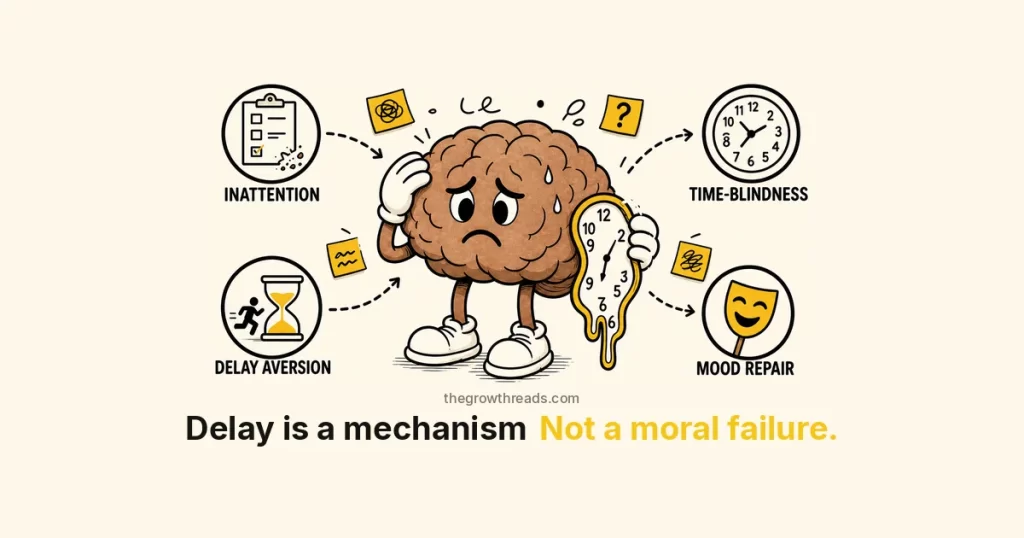
ADHD procrastination is delay driven more by inattention, time-blindness, and short-term mood relief than by laziness. In a student sample, inattention still tracked everyday delay after hyperactivity was partialled out (Niermann & Scheres, 2014). It is not a DSM criterion on its own, and this page is not a diagnosis. Shrinking the start cost helps; willpower lectures usually do not.
Key takeaways
- In 54 undergraduates, inattention correlated with Steel’s Pure Procrastination Scale at r = 0.51 (partial r = 0.43); hyperactivity/impulsivity partials were not significant (Niermann & Scheres, 2014).
- Steel’s 2007 meta-analysis of 691 correlations found delay is predicted most consistently by impulsiveness, task aversiveness, and low self-efficacy — levers ADHD already stresses.
- In a 2006 pilot, 29 adults from an ADHD support group reported more decisional and behavioural procrastination than a community comparison (Ferrari & Sanders, 2006).
- Among 114 undergraduates, executive functions — especially time management and organisation — mediated the link between delay and ADHD symptoms (Bolden & Fillauer, 2020).
- A 12-week metacognitive group on time, organisation, and planning beat supportive therapy for adult inattention (N = 88; odds ratio 5.41) — skills, not slogans (Solanto et al., 2010).
What is ADHD procrastination?
ADHD procrastination is the same voluntary delay researchers already study — putting off an intended action despite expecting to be worse off — sitting on top of ADHD-related inattention, time-blindness, and emotion. Steel (2007) defined procrastination that way across 216 works. ADHD does not rewrite the definition; it changes how often the delay shows up and how hard it is to restart.
Procrastination is not listed as a core ADHD symptom in DSM-5-TR. What is listed, under inattention, is avoiding or reluctantly doing tasks that need sustained mental effort. That overlap is real and easy to over-read. Plenty of people delay without ADHD; plenty of people with ADHD also delay for ordinary reasons — aversive work, unclear next steps, a noisy phone. The six-step system in the procrastination anchor still applies. This spoke is about the extra weight ADHD can add, not a separate disease called “ADHD procrastination.”
Why does ADHD procrastination happen?
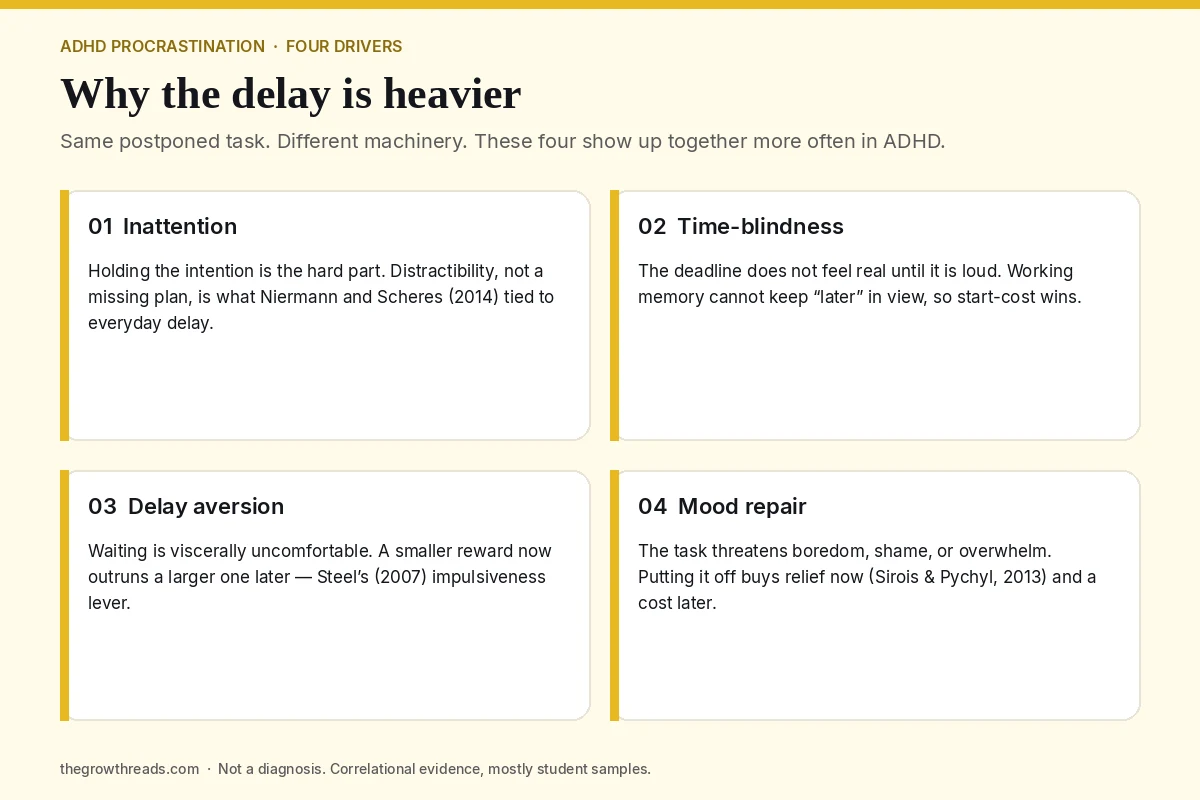
The delay is usually a stack: inattention drops the intention, time-blindness makes “later” feel unreal, delay aversion makes waiting hurt, and mood repair makes putting it off feel like relief. Niermann and Scheres (2014) expected impulsivity to be the main correlate. In 54 students with a spread of self-reported ADHD behaviours, only inattention stayed tied to general procrastination once the other domains were partialled out (PPS r = 0.51; partial r = 0.43). Hyperactivity/impulsivity partials were not significant. Academic questionnaire delay and an observed math-task delay did not track ADHD scores in that sample — a useful limit, not a footnote to hide.
That pattern fits Steel’s (2007) temporal motivation picture: utility falls as delay grows and impulsiveness rises. ADHD time-blindness — Barkley’s clinical description of a weak sense of future time — is not itself a numbered experiment in that meta-analysis. Treat it as a clinical frame, not a lab result. What is measured: prospective memory, the ability to remember to act later, partly mediated the ADHD–procrastination link in a mixed adult sample (Altgassen et al., 2019). Executive ratings of time management and organisation did the same in 114 undergraduates (Bolden & Fillauer, 2020), though that study’s cross-section cannot prove direction, and ADHD was modelled as an outcome — theoretically backwards for a childhood-onset condition.
Mood is the fourth gear. Sirois and Pychyl (2013) reviewed procrastination as short-term mood repair: you borrow calm now and pay interest later. For an aversive, effortful task, ADHD emotion intensity can make that bargain look rational for ten minutes. Chris Bailey’s attention-management framing in Hyperfocus is useful here: the problem is often where attention goes, not a missing calendar.
Why does ADHD procrastination cost more than it feels like?
The bill is not just a late file — it is extra shame, broken trust, and a smaller window to use skills that actually work. Ferrari and Sanders (2006) compared 29 medicated adults from an ADHD support group with a community sample at a procrastination talk. The ADHD group reported more decisional and behavioural delay. It is a pilot: small, convenience, not a random population draw. It still contradicts the folk story that “everyone puts things off this much.”
Steel (2007) already tied delay to worse performance and more distress across hundreds of correlations. Layer ADHD working-memory limits on top and the same missed start becomes a longer restart. The finding that keeps repeating is narrower: inattention, not “trying harder,” is the domain that tracks everyday delay (Niermann & Scheres, 2014).
What actually helps ADHD procrastination?
What moves the needle is lowering the start cost and externalising time and next actions — the same skills Solanto’s group taught — not a personality transplant. Solanto and colleagues (2010) randomised 88 adults with DSM-IV ADHD to 12 weeks of metacognitive group treatment (time, organisation, planning, plus the thoughts that sabotage those skills) or supportive group therapy. Inattention improved more with the skills group (+5.0 vs +2.3 points on the inattention rating; response odds ratio 5.41, 95% CI 1.77–16.55). The trial did not use a procrastination scale as the primary outcome. Do not pretend it did. It does show that time and organisation skills can move adult inattention more than support alone.
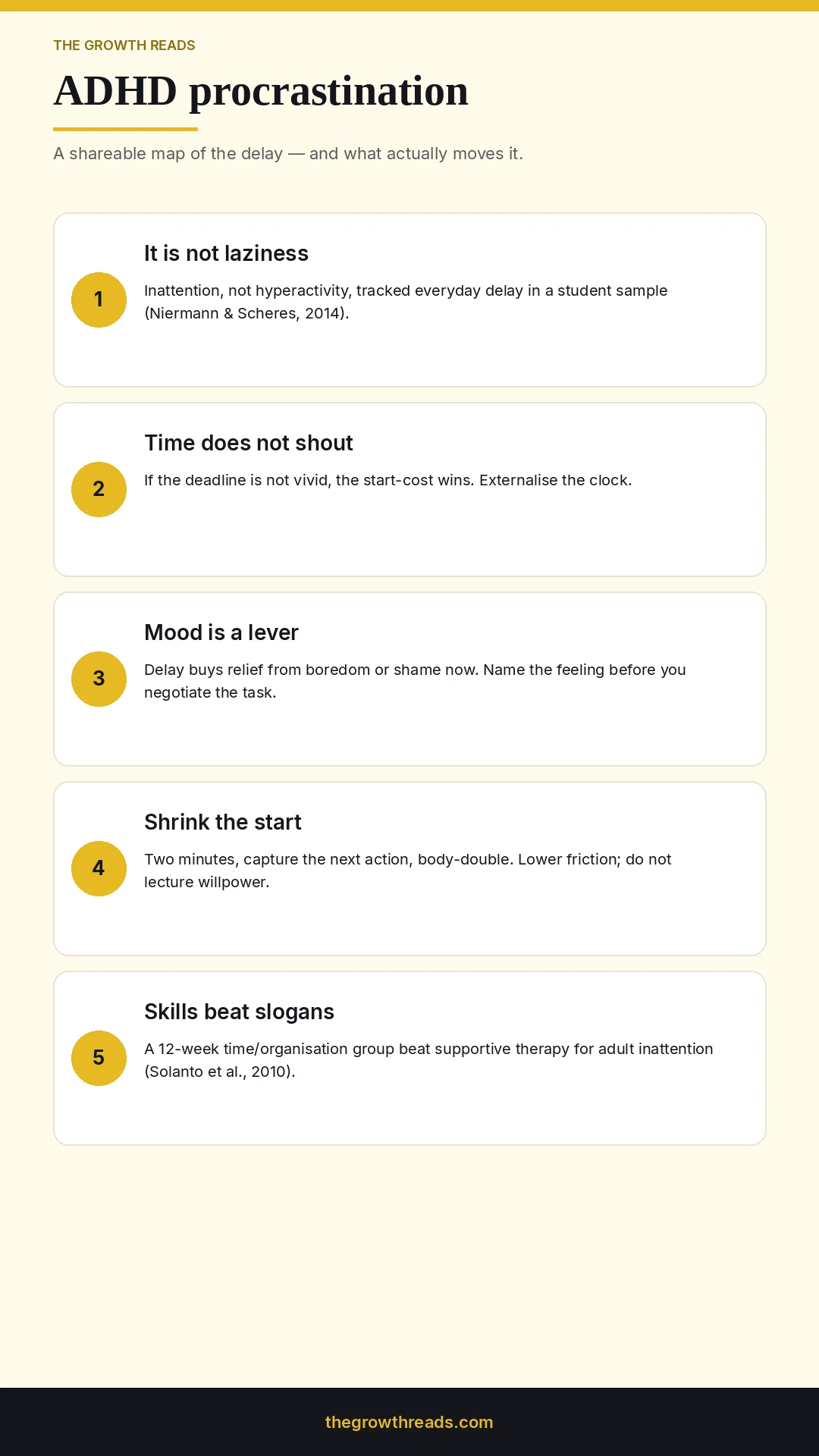
Practically, that maps onto tools already on this site. The two-minute rule and James Clear’s two-minute version in Atomic Habits shrink the emotional price of starting. David Allen’s capture habit in Getting Things Done gets the intention out of working memory so it does not have to be held. A body-double or accountability partner supplies the external cue ADHD brains often fail to generate internally. None of this replaces assessment or medication decisions; those belong with a clinician.
What mistakes make ADHD procrastination worse?
The usual productivity advice, applied without the mechanism, often raises the start cost instead of lowering it.
- Treating delay as laziness. Inattention, not a missing lecture, is what tracked everyday delay in Niermann and Scheres (2014).
- “Eat the frog first” on a frozen nervous system. Tracy’s hardest-first rule in Eat That Frog! helps when activation is already there. When the task is aversive and working memory is full, the hardest frog can deepen freeze. Start with the smallest honest action instead.
- Relying on a future feeling of urgency. Time-blindness means that feeling arrives too late.
- Building a perfect system before sending the email. That is analysis paralysis wearing a productivity costume.
- Using an accountability partner as a shame machine. Shared progress beats private tracking; humiliation does not.
- Self-diagnosing from a delay list. Overlap is not identity. A later spoke in this cluster covers “is procrastination a sign of ADHD” as its own question.
When is ADHD procrastination more than a habit?
If delay is one piece of a long, cross-setting pattern of inattention or hyperactivity with childhood roots and real impairment, that is a clinical question — not a blog-post question. The CDC’s ADHD overview is explicit: diagnosis is a professional judgement across settings, not a quiz. Medication, therapy, and coaching are outside this article’s job. If work, study, or relationships are buckling, see a qualified clinician. This page will not rank you.
The honest counter-case: most evidence below is analogue or convenience (students, a support group, cross-sectional mediation). Solanto’s trial is stronger, and it still is not a procrastination RCT. Correlation is not a diagnosis, and a useful skill is not a cure.
What does the evidence say?
Four studies plus Steel’s meta-analysis are enough to say inattention and executive time skills matter; they are not enough to say every late start is ADHD.
| Study | Design & size | Finding | What we used it for |
|---|---|---|---|
| Niermann & Scheres (2014) | Cross-sectional; 54 undergraduates; self-report ADHD behaviours | Inattention–PPS r = 0.51 (partial r = 0.43); hyperactivity/impulsivity partials n.s.; academic and observed delay not related | Mechanism: inattention, with a clear analogue-sample limit |
| Ferrari & Sanders (2006) | Pilot comparison; 29 adults in an ADHD support group vs community sample | Higher decisional and behavioural procrastination in the ADHD group | Shows the gap is not “everyone does this”; not a population estimate |
| Bolden & Fillauer (2020) | Cross-sectional mediation; 114 undergraduates | Executive functions mediated delay–ADHD symptom links; time management and organisation were the specific paths | Points at skills to train; cannot prove causality |
| Solanto et al. (2010) | RCT; 88 adults with DSM-IV ADHD; 12-week metacognitive group vs supportive group | Larger inattention gains; response OR = 5.41 (95% CI 1.77–16.55) | Skills in time/organisation/planning can move inattention; not a procrastination scale |
Steel (2007) supplies the wider map (691 correlations; impulsiveness, aversiveness, self-efficacy). Sirois and Pychyl (2013) supply the mood-repair account. Altgassen et al. (2019) add prospective memory as a partial bridge. None of these let a reader diagnose from a to-do list.
Frequently asked questions
Is ADHD procrastination just laziness?
No. Laziness is a moral story; ADHD procrastination is a mechanism story. In Niermann and Scheres (2014), inattention — not hyperactivity — stayed correlated with everyday delay after the other ADHD domains were partialled out. Steel (2007) already showed delay tracks impulsiveness and task aversiveness in the general literature. Shame is a common after-effect. It is a poor explanation of why the start never happened.
Is procrastination a symptom of ADHD?
Not as a standalone DSM-5-TR criterion. Avoiding effortful tasks sits under inattention, which overlaps with delay without being identical to it. Ferrari and Sanders (2006) found more procrastination in a small ADHD support-group sample than in a community comparison, which is a clue, not a rule. Plenty of delay has nothing to do with ADHD. A clinician looks at childhood history, multiple settings, and impairment — not one late essay.
Why start easy tasks and freeze on important ones?
Important tasks are usually more aversive, more ambiguous, and more loaded with shame if they go badly — exactly the conditions Sirois and Pychyl (2013) describe as mood-repair delay. Easy tasks clear working memory fast. ADHD inattention makes the costly task easier to drop. The fix is a smaller first action, not a scolding about priorities. Proactive coping is the healthier opposite of delay, not speed for its own sake.
Does the two-minute rule help ADHD procrastination?
It helps when the bottleneck is start-cost, which it often is. Two minutes is a door, not the whole house: capture the next action, then stop or continue. That matches Solanto’s emphasis on planning and organisation, and the two-minute rule article on this site. It will not treat ADHD. If two minutes still feels impossible, shrink further or add a body-double rather than raising the bar.
Should you eat the frog first if you have ADHD?
Only if you can actually start the frog. Hardest-first works when activation is available. When the task is aversive and the nervous system is in freeze, the biggest frog raises delay aversion. Steel (2007) put aversiveness among the strongest predictors of delay. Start with an emotionally cheap first move, then use the opened door to step toward the frog — the order the procrastination anchor already recommends.
When should someone see a clinician instead of a productivity article?
When delay sits inside a long pattern of inattention or hyperactivity across work, home, or study, with childhood roots and real impairment — or when mood, sleep, or substance use are in the mix. The CDC is clear that ADHD is a clinical diagnosis. This article is a map of delay, not an assessment. Skills from Solanto’s trial can still be practised while you wait for care. They are not a substitute for it.
Related reading on The Growth Reads
The books this article draws on
- Atomic Habits summary & review — shrinking the start
- Getting Things Done summary & review — capture so working memory can let go
- Hyperfocus summary & review — attention as the scarce resource
- Eat That Frog! summary & review — hardest-first, and when it backfires
Related articles
- How to overcome procrastination: the 6-step system — the A1 anchor this spoke links up to
- The two-minute rule
- Accountability partner
- What is the opposite of procrastination?
Go deeper: Productivity hub · Best productivity books
How this article was researched
Written from the primary papers named below — abstracts plus full text where openly available (Niermann & Scheres; Solanto et al. PMC; Steel’s 2007 review; Bolden & Fillauer abstract; Sirois & Pychyl review). Sample sizes, coefficients, and the Solanto odds ratio are taken from those reports, not from secondary blogs. Analogue samples, the Ferrari pilot, and the fact that Solanto did not use a procrastination primary outcome are stated in the body rather than smoothed over.
This article follows The Growth Reads’ EEAT methodology: primary sources and dated citations. Read our full methodology.
Sources
- Steel, P. (2007). The nature of procrastination: A meta-analytic and theoretical review of quintessential self-regulatory failure. Psychological Bulletin, 133(1), 65–94. https://doi.org/10.1037/0033-2909.133.1.65
- Niermann, H. C. M., & Scheres, A. (2014). The relation between procrastination and symptoms of attention-deficit hyperactivity disorder (ADHD) in undergraduate students. International Journal of Methods in Psychiatric Research, 23(4), 411–421. https://doi.org/10.1002/mpr.1440
- Ferrari, J. R., & Sanders, S. E. (2006). Procrastination rates among adults with and without AD/HD: A pilot study. Counseling and Clinical Psychology Journal, 3, 2–9.
- Bolden, J., & Fillauer, J. P. (2020). “Tomorrow is the busiest day of the week”: Executive functions mediate the relation between procrastination and attention problems. Journal of American College Health, 68(8), 854–863. https://doi.org/10.1080/07448481.2019.1626399
- Solanto, M. V., Marks, D. J., Wasserstein, J., Mitchell, K., Abikoff, H., Alvir, J. M. J., & Kofman, M. D. (2010). Efficacy of meta-cognitive therapy for adult ADHD. American Journal of Psychiatry, 167(8), 958–968. https://doi.org/10.1176/appi.ajp.2009.09081123
- Sirois, F., & Pychyl, T. (2013). Procrastination and the priority of short-term mood regulation: Consequences for future self. Social and Personality Psychology Compass, 7(2), 115–127. https://doi.org/10.1111/spc3.12011
- Altgassen, M., Scheres, A., & Edel, M.-A. (2019). Prospective memory (partially) mediates the link between ADHD symptoms and procrastination. ADHD Attention Deficit and Hyperactivity Disorders, 11, 59–71. https://doi.org/10.1007/s12402-018-0273-x