


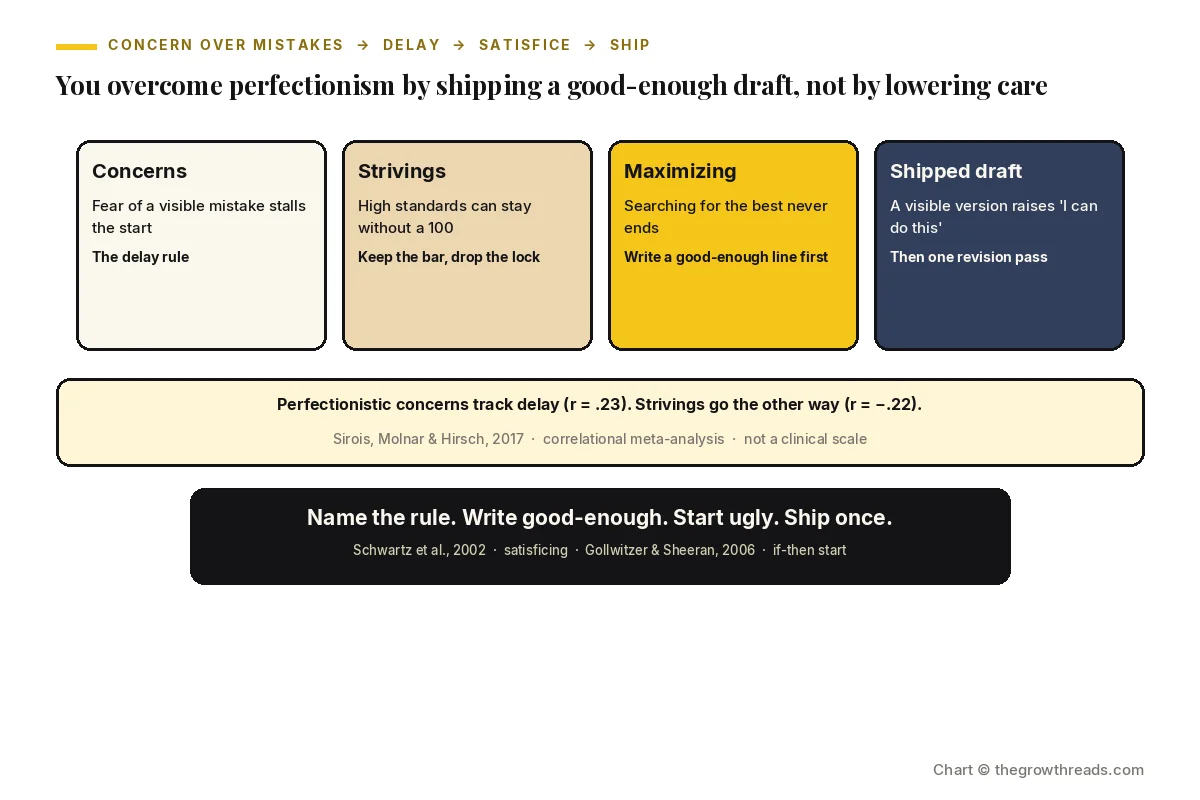
How to overcome perfectionism at work is to keep the standard and drop the delay rule: write what good-enough looks like, start an ugly draft, then ship it to one real next step. Sirois, Molnar and Hirsch (2017) found concern over mistakes tracks stalling; high standards do not. The 100 can wait.
Key takeaways
- Steel’s 2007 meta-analysis treated perfectionism as one trait and found almost no link with procrastination (r = −.03 across 24 studies, N = 3,884) — the folk story that “perfectionists always delay” is the wrong unit of analysis.
- Split the construct and the stall appears. Perfectionistic concerns correlated with trait procrastination at r = .23 (k = 43, N = 10,000); perfectionistic strivings correlated at r = −.22 (k = 38, N = 9,544) (Sirois, Molnar & Hirsch, 2017).
- Frost, Marten, Lahart and Rosenblate (1990) separated concern over mistakes from personal standards. Keep the second. The first is the delay rule this page ships against.
- Schwartz, Ward, Monterosso, Lyubomirsky, White and Lehman (2002) found maximizers — people hunting the best option — scored higher on perfectionism and regret. Write a good-enough line before you start, so the search has an end.
- Gollwitzer and Sheeran (2006) showed if-then plans raise goal attainment versus mere intention. The start is “If it is 10:00, then I open the ugly file,” not “I will do it properly this week.”
What overcoming perfectionism actually is (and what it isn’t)
How to overcome perfectionism, on this page, is a work habit: keep the standard you actually care about, write a good-enough definition the draft can meet, start an ugly version, and ship it to a real next step. It is not becoming careless. It is not a personality transplant. It is not a clinical scale, an OCD protocol, or a quiz that tells you which type you are. Frost et al. (1990) already split concern over mistakes from personal standards. The sister page, what causes perfectionism, owns why the delay rule grows. This page owns the ship.
That job is narrower than “stop caring.” Sirois, Molnar and Hirsch (2017) are why we refuse that slogan: strivings went with less delay, not more. The stall sits in the concerns — the belief that a visible mistake makes the work worthless. Steel (2007) is why a one-trait story hid that. Treat this URL as a calendar habit for the next draft, not a verdict on your character.
How is this different from the causes page, mood-repair, or a delay equation?
This page ships the draft; what causes perfectionism names the delay rule; the parent how to overcome procrastination repairs mood; how to beat procrastination changes the delay equation. Four jobs. Four pages. If the stall is “I feel better not starting,” use the parent. If the stall is “the work is worthless unless it cannot be criticised,” stay here. If you are still comparing past the point where more research would change the call, that is how to stop overthinking — park the decision, then leave it. This page ends when a version exists in someone else’s hands, or in a folder that counts as sent.
Why the delay rule wins
The delay rule wins because a blank page cannot be criticised, a maximising search has no end, and an all-or-nothing plan makes a two-hour first version look like failure. Frost’s concern-over-mistakes is the first motor: the mistake is treated as a verdict. Schwartz et al. (2002) is the second: maximizers hunt the best option, score higher on perfectionism and regret, and stay less satisfied with what they chose. That paper is correlational, and it mixed consumer and life measures — it is not a trial of “write good-enough.” It is still why this page writes the bar before the draft, so the search can stop.
The third motor is a missing specific end. Locke and Latham (2002) showed specific, challenging goals beat vague “do your best” instructions. “Make it perfect” is as vague as “do your best,” just louder. A two-hour first version is a specific goal. A masterpiece is not. Gollwitzer and Sheeran (2006) is why the start is an if-then: the situation is named, the ugly action is named, and the delay has nowhere polite to sit. If the stall is actually mood, that is already on the parent. If the stall is still “I do not know why I do this,” go back to what causes perfectionism and then return for the ship.
The four triggers, in the order you can actually pull them
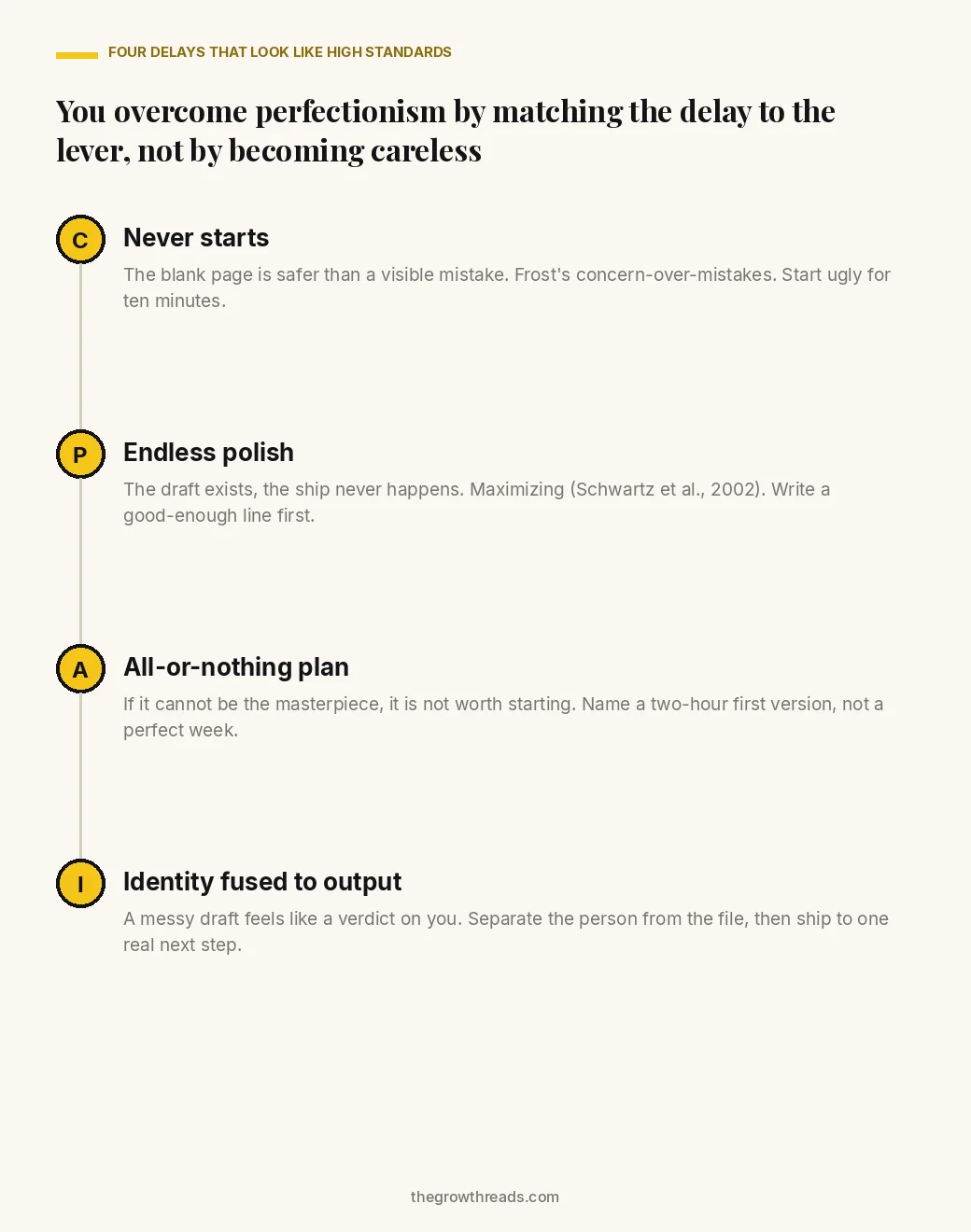
- Never starts. The blank page is safer than a visible mistake. Frost’s concern over mistakes. Step 3 is ten ugly minutes, not a pep talk.
- Endless polish. A draft exists; the ship never happens. Schwartz’s maximizer. Step 2 writes the good-enough line so polish has a stop.
- All-or-nothing plan. If it cannot be the masterpiece this week, it is not worth starting. Locke and Latham’s specific end. Step 4 is a calendar close, not a quality close.
- Identity fused to output. A messy file feels like a verdict on you. The sister page named that fusion. This page separates the person from the file, then ships to one real next step. Rick Rubin’s The Creative Act is the book for that failure mode: you are not the masterpiece. You are the person who sends the work.
Why the stall costs more than it feels like
The stall feels like care, and it is often a missing version: Sirois, Molnar and Hirsch (2017) is why the bill is delay from concerns, not from having a bar. Steel (2007) hid that bill by averaging the two together. A week of “I am still researching” can be work that never becomes a file. Burnam, Komarraju, Hamel and Nadler (2014) found, in 393 undergraduates, that concern over mistakes and doubts about action predicted treating procrastination as a problem, while organisation and personal standards went the other way. College sample. Correlational. Not a trial of this habit. What it kills is the slogan that the stall is the same thing as high standards.
Maximising has a similar invoice. Schwartz et al. (2002) tied the hunt for the best option to more regret and less satisfaction with the choice. You do not need their consumer studies to moralise every option. You need a written stop so the draft can leave the desk. Seo (2008) is the honest other side: in 692 Korean college students, self-oriented perfectionism tracked less academic delay, fully mediated by self-efficacy. A later conceptual replication found a much smaller indirect effect. Read Seo as a reminder that a visible start which raises “I can do this” is the lever — not a reason to raise the 100. If the real stall is mood, use how to overcome procrastination. If the real stall is not knowing which frog to eat, that is the eat-the-frog method. This page is only the draft that is not allowed to stay private.
The honest limit: there is no randomised trial of this exact six-step sequence. Sirois is a meta-analysis of correlations. Schwartz is not a writing experiment. Gollwitzer’s if-then effects vary by domain. Treat the steps as a well-motivated shipping habit, not a promise you will never polish too long. Related reading on productivity systems and summaries helps because no single cue owns every stall, and how to stop second-guessing yourself is the cousin page when the issue is the commit after the draft, not the ship of the draft.
The four delays — and the fix for each
Most “just lower your standards” speeches fail because they pull the wrong lever. Match the delay to the trigger that is winning, then pull that one.
| Pattern | What it looks like | The trigger that is winning | The fix that works |
|---|---|---|---|
| Never starts | Research, outlines, and a blank file; nothing a stranger could mark | Concern over mistakes — Frost et al. (1990) | Ten ugly minutes (Step 3). A visible file beats a perfect plan |
| Endless polish | Version 14, still “not ready”; the send button is the threat | Maximizing — Schwartz et al. (2002) | Write the good-enough line first (Step 2). One checklist pass, then ship (Steps 5–6) |
| All-or-nothing plan | “If I cannot do it properly this week, I will wait until I can.” | A vague perfect end — Locke & Latham (2002) inverted | A calendar close on the first version (Step 4). Not a quality close |
| Identity fused to output | A messy draft feels like a verdict on you, so it stays private | Person = file — the sister page’s fusion, Rubin’s receiver | Ship to one real next step (Step 5). You are not the masterpiece |
How to overcome perfectionism: the 6-step system
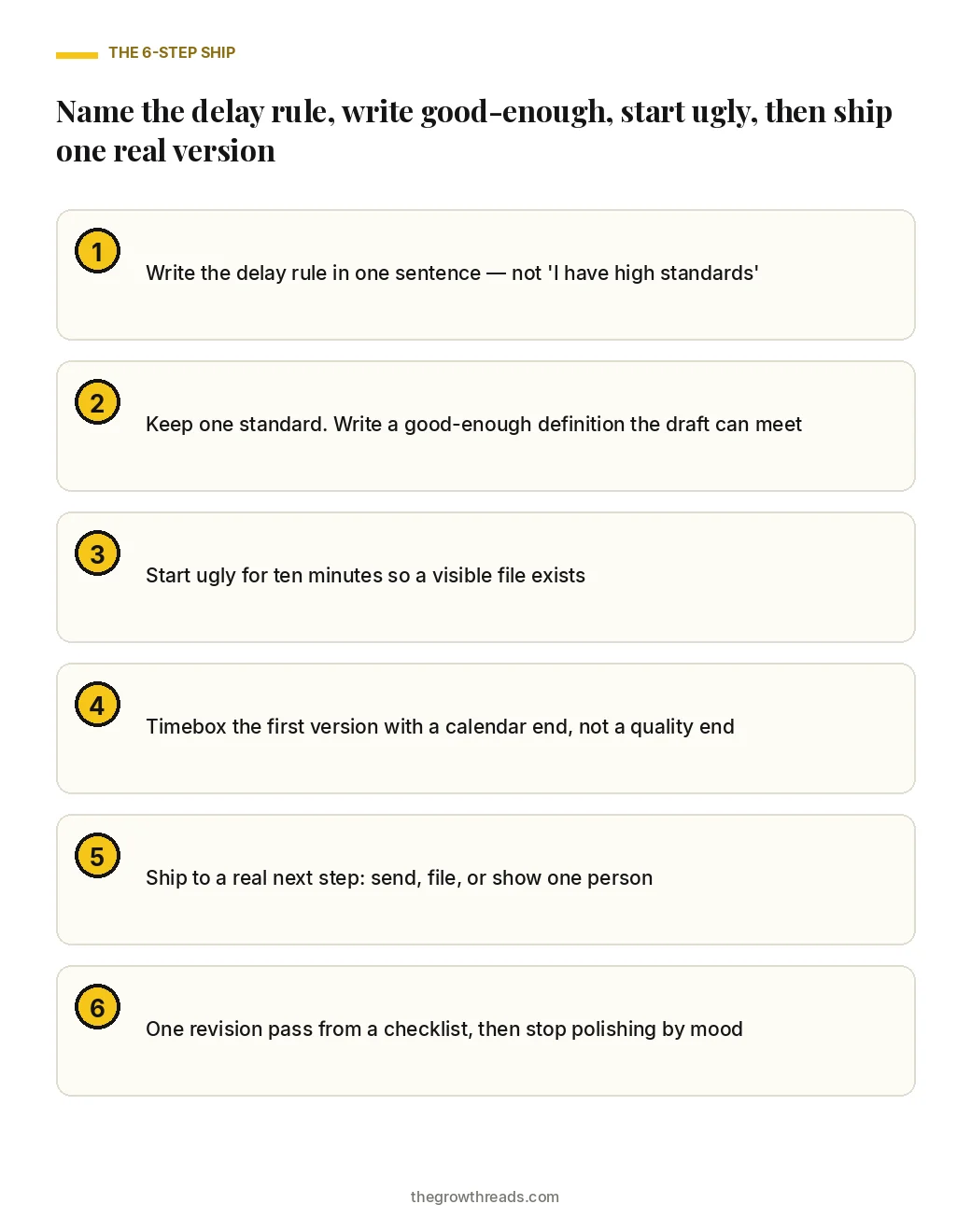
Overcome perfectionism by naming the delay rule, writing a good-enough definition, starting ugly, timeboxing the first version, shipping to a real next step, and allowing one checklist revision — then stopping. Do not start by becoming a sloppier person. Do not wait for a week with no other work. Do not mash this with the parent’s mood-repair, or with how to beat procrastination’s delay equation. Those pages still apply when the stall is mood or expectancy. This sequence is for when the work is sitting there, and the 100 is the lock.
Step 1 — Write the delay rule in one sentence — not “I have high standards”
On paper, write the rule a stranger could score: “This draft is worthless unless it cannot be criticised,” not “I care a lot.” If the sentence still sounds like a virtue, you have not named the delay. Frost et al. (1990) is the test: concern over mistakes, or personal standards? The sister page, what causes perfectionism, is the longer diagnosis. This step is one line, dated, next to the file name. If the stall is mood, stop and use how to overcome procrastination instead of collecting another insight. One sentence. Then the bar.
Step 2 — Keep one standard. Write a good-enough definition the draft can meet
Keep the standard you actually mean — accurate, shipped, readable — and write three checks the first version must pass. That is satisficing, not lowering care. Schwartz et al. (2002) is why the hunt for the best option has no natural end. Locke and Latham (2002) is why the checks are specific: “covers the brief, has a title, is sent by 16:00” beats “is excellent.” Burnam et al. (2014) is the reminder that personal standards and organisation tracked less problematic delay in students, while concern over mistakes went the other way. Do not throw the bar out. Write it so a draft can win. If you cannot name three checks, you are still maximising. Sit on Step 2 until the line is boring.
Step 3 — Start ugly for ten minutes so a visible file exists
Open the file and produce a version a stranger could mark — bullets, a bad paragraph, a sketch with labels. Ten minutes on a timer. The point is not quality. The point is a file that can be criticised, which is exactly what concern-over-mistakes was avoiding. Seo (2008) is why a visible start can raise “I can do this”; treat that as a hint, not a law, because the finding is correlational and a later replication was weaker. Gollwitzer and Sheeran (2006) is the form: If it is 10:00, then I open the ugly file for ten minutes. If you use the ten minutes to research, you did not start. If starting the hard thing is the whole problem, eat the frog is the sister move. This step is only the ugly version.
Step 4 — Timebox the first version with a calendar end, not a quality end
Write a close: “First version at 16:00 Thursday,” not “when it is ready.” Locke and Latham (2002) is the specific end. An all-or-nothing week is how this step dies. If the calendar is already a mess, a time audit is how you see where the two hours actually are. Do not add a second project as a warm-up; that is productive procrastination, and it still leaves this draft private. When the clock hits the close, you have a first version even if it is ugly. Quality is Step 6’s job, once, from a list.
Step 5 — Ship to a real next step: send, file, or show one person
The draft leaves private land. Send it, file it in the place that counts as done, or show one person who can mark it. Rick Rubin’s The Creative Act is the practice-facing version: you are a receiver, not the masterpiece, and over-polishing is a way of not finishing. “Ship” is not a product launch. It is a next step a stranger could see. If accountability is the missing piece, how to take accountability is the scorecard. If you are still second-guessing the send, that is how to stop second-guessing yourself after this step, not instead of it. Do not ship a plan to yourself in a notes app and call it done.
Step 6 — One revision pass from a checklist, then stop polishing by mood
After the ship, or immediately before it if the next step requires a clean file, run the three checks from Step 2 once. Fix only what fails a check. Then stop. Endless polish is maximizing with a cursor. How to learn new skills is the cousin page when the next pass is feedback on a rep, not a feeling. If you rewrite the bar during the pass, you are back at Step 2. Write the miss on the checklist for the next version. Do not hold a committee with your taste. When 23:40 offers “just one more pass,” read the slip. The file already shipped, or it ships now.
What to do when you are already behind
When the deadline is tomorrow and the file is still a private masterpiece-in-waiting, do not restart from a blank page: ship the current version as a dated first draft, run one checklist pass, and send it. A new outline at 23:00 is how concern-over-mistakes gets a second vote. You are allowed to be embarrassed. You are not required to found a new document.
If you have not started at all, do Step 3 for ten minutes and skip the poetry. If the stall is mood, that is the parent, not a sixth insight. If the stall is a ritual you cannot choose to skip, that is the next section, not a 16:00 timebox. Do not borrow a “just be confident” speech. This page’s job that afternoon is only: a visible file, the three checks, and a send.
Common mistakes
- Calling the delay “high standards.” Steel (2007) hid the stall in a one-trait average. Frost and Sirois are why we split it. Name the delay rule, not the virtue.
- Lowering care instead of lowering the 100. Strivings went with less delay (Sirois et al., 2017). Keep the bar. Write good-enough.
- Restarting from a blank page when you are behind. That is concern-over-mistakes with a new filename. Ship the current version.
- Waiting for a perfect week. Locke and Latham (2002) want a specific end. A calendar close beats a mythical clear calendar.
- Mashing this with mood-repair. The parent how to overcome procrastination is for “I feel better not starting.” This page is for the 100.
- Using research as the work. If more comparison would not change the call, that is how to stop overthinking. Park it. Then ship.
- Treating this URL as a diagnosis. It is not OCD, not a clinical scale, and not a quiz. The work version is a shipped draft.
When it is more than a habit
A six-step ship will not fix a stall you cannot choose to skip, a night that is standing in for a conversation about the job, or a scale you are using as a self-diagnosis — those are different problems, and this page is the wrong tool for them. If the delay is mood-repair, use the parent. If the delay is chronic and nothing on this site has ever moved a file, chronic procrastination is the naming page, not a treatment. If you cannot drop a ritual even when you want to, that is outside a productivity how-to. We will not list signs, name a disorder, or walk a clinical scale. Bare “perfectionism” was left off this queue for that reason. Talk to a clinician rather than adding an eighth step. This article does not treat a picky draft as a diagnosis, and it does not ask you to become careless.
The evidence behind this system
There is no randomised trial of this exact six-step sequence. The studies below are the perfectionism, maximizing, goal, and plan literature that makes a written bar plus an ugly start a reasonable ship — and that also shows where the evidence is thinner than a listicle would like.
| Study | Design & size | Finding | What we used it for |
|---|---|---|---|
| Steel (2007), Psychological Bulletin | Meta-analysis of procrastination correlates; perfectionism subset 24 studies, N = 3,884 | Treated as one trait, perfectionism was near-zero with procrastination (r = −.03) | Why we refuse the folk story, and why this page splits the construct |
| Sirois, Molnar & Hirsch (2017), European Journal of Personality | Random-effects meta-analysis; concerns k = 43, N = 10,000; strivings k = 38, N = 9,544 | Concerns r = .23 with trait procrastination; strivings r = −.22; both held after semi-partials | The delay rule versus the bar you can keep; correlational, not a trial of shipping |
| Frost, Marten, Lahart & Rosenblate (1990), Cognitive Therapy and Research | Scale development; concern over mistakes vs personal standards (and other facets) | Perfectionism is multidimensional; concern over mistakes is not the same as high standards | Step 1’s one-sentence rule, and the warning not to throw the bar out |
| Schwartz, Ward, Monterosso, Lyubomirsky, White & Lehman (2002), Journal of Personality and Social Psychology | Maximization Scale across seven samples (N = 1,747 for the core scales) plus decision studies | Maximizing correlated with perfectionism and regret, and with less satisfaction with choices | Step 2’s good-enough line, and the endless-polish row; not a writing RCT |
| Gollwitzer & Sheeran (2006), Advances in Experimental Social Psychology | Meta-analysis of implementation-intention (if-then) studies | If-then plans raise goal attainment relative to mere intention, with effects that vary by domain | Step 3’s ugly start as an if-then, not a wish |
| Locke & Latham (2002), American Psychologist | Narrative review of decades of goal-setting evidence | Specific, challenging goals outperform vague “do your best” goals | Steps 2 and 4: a written bar and a calendar close beat “make it perfect” |
| Seo (2008), Social Behavior and Personality | SEM; 692 Korean college students | Self-oriented perfectionism tracked less academic procrastination, fully mediated by self-efficacy | Step 3’s visible start; honest limit that a later replication was weaker |
| Burnam, Komarraju, Hamel & Nadler (2014), Learning and Individual Differences | 393 undergraduates; hierarchical regression on PASS facets | Concern over mistakes and doubts predicted seeing procrastination as a problem; organisation and personal standards went the other way | Keep the standard, drop the delay; student sample, correlational |
Frequently asked questions
How do you overcome perfectionism at work this week?
Write the delay rule in one sentence a stranger could score, then write three checks the first version must pass. Open an ugly file for ten minutes so something exists that can be marked. Close that first version on a calendar time, not when it feels ready. Ship it to a real next step: send, file, or show one person. Run the three checks once. Stop polishing by mood. Sirois, Molnar and Hirsch found concern over mistakes tracks delay and high standards do not. A heroic silent week is not a system. A shipped draft is.
Is overcoming perfectionism the same as lowering your standards?
No. Sirois, Molnar and Hirsch found perfectionistic strivings went with less trait procrastination, not more. Frost, Marten, Lahart and Rosenblate already separated personal standards from concern over mistakes. This page keeps the bar you actually mean and drops the rule that the work is worthless unless it cannot be criticised. Schwartz et al. is why we write a good-enough line: maximizers hunt the best option and stay less satisfied. Careless work is a different failure. A shipped, specific draft is the point. You can still care. You cannot keep the 100 as a lock.
Why do high standards not cause the stall?
Because the folk story used the wrong unit. Steel’s 2007 meta-analysis treated perfectionism as one trait and found almost no link with procrastination. Split the construct, as Sirois, Molnar and Hirsch did, and concerns track delay while strivings go the other way. Burnam et al. saw the same split in 393 students: concern over mistakes and doubts looked like a problem; organisation and personal standards did not. That is correlational. It is still why this how-to keeps a written bar. The stall is the delay rule, not the existence of a standard.
What if I never start?
Then the blank page is doing its job: it cannot be criticised. Frost’s concern-over-mistakes is the usual trigger. Step 3 is ten ugly minutes on a timer, written as an if-then, which is Gollwitzer and Sheeran’s form. If you use the ten minutes to research, you did not start. If the stall is mood-repair — you feel better not opening the file — that is the parent page on overcoming procrastination, not a longer insight. If the hard thing is simply first, eat-the-frog is the sister move. This step only creates a file a stranger could mark.
What if I polish forever and never ship?
Then you are maximising. Schwartz, Ward, Monterosso, Lyubomirsky, White and Lehman found maximizers scored higher on perfectionism and regret, and were less satisfied with what they chose. Write the good-enough line before the next pass so the search has an end. Ship to a real next step, then allow one checklist revision. Endless polish is not care. It is a draft that never leaves private land. Rick Rubin’s The Creative Act is the book for that failure mode: you are not the masterpiece. You are the person who sends the work. A fourteenth silent version is not a system.
Is this the same as overcoming procrastination?
No. The parent page, how to overcome procrastination, is mood-repair: you delay because avoiding the task repairs a feeling. How to beat procrastination is the delay equation: expectancy, value, delay, impulsiveness. This page is one driver inside that family — the rule that the work is worthless unless it cannot be criticised. You can need all three in one month. You should not mash them into one “just start” speech. If you do not know which stall you have, read the sister page on what causes perfectionism, then come back here for the ship. The test is a draft that left your desk.
Is this OCD, and should I use a clinical scale?
No. This is a productivity how-to for a delay rule at work. It is not a diagnosis, not a symptom list, and not a clinical scale. Bare “perfectionism” was left off this queue because that SERP is OCD, anxiety and scales. If you cannot choose to skip a ritual even when you want to, this page is the wrong tool — talk to a clinician rather than adding an eighth step. We will not list signs. High standards plus a shipped draft is the work version. A scale you found at 1 a.m. is not a system, and it is not ours to interpret.
Will this six-step system fix perfectionism for good?
No, and the evidence does not say it will. The studies on this page map a correlational split, a maximizing style, goal specificity, and if-then plans. They are not a trial of this sequence. Seo is one student SEM with a weaker later replication. Schwartz is not a writing experiment. A ship is a bout. Next week needs the same good-enough line, or a new one if the brief changed. Use it for the next draft. Do not use it as a promise that you will never polish too long, and do not use it as a medical protocol.
Related reading on The Growth Reads
The book behind the ship
- The Creative Act summary & review — Rick Rubin on making without needing to be the masterpiece; the ship cousin of a good-enough draft, not a clinical manual
Related articles
- How to overcome procrastination
- What causes perfectionism
- How to beat procrastination
- How to stop overthinking
- How to stop second-guessing yourself
- The eat-the-frog method
- How to take accountability
- How to learn new skills
Go deeper
How this article was researched
The Growth Reads editorial team writes from primary sources: the books themselves, the authors’ published essays and interviews, and the peer-reviewed literature behind the claims. Every study cited above was read in the original publication or its published abstract, and every figure is quoted with its design, sample and effect so you can judge its weight rather than take ours. Where a finding is limited — a correlational meta-analysis, a student sample, a maximizing scale that is not a writing trial, or a six-step habit with no trial of its own — we say so directly.
How we work: every article on The Growth Reads is built from the books in our library plus the research they rest on, and is reviewed and date-stamped when the evidence changes. Read our full methodology.
Sources
- Steel, P. (2007). The nature of procrastination: A meta-analytic and theoretical review of quintessential self-regulatory failure. Psychological Bulletin, 133(1), 65–94. doi:10.1037/0033-2909.133.1.65
- Sirois, F. M., Molnar, D. S., & Hirsch, J. K. (2017). A meta-analytic and conceptual update on the associations between procrastination and multidimensional perfectionism. European Journal of Personality, 31(2), 137–159. doi:10.1002/per.2098
- Frost, R. O., Marten, P., Lahart, C., & Rosenblate, R. (1990). The dimensions of perfectionism. Cognitive Therapy and Research, 14(5), 449–468. doi:10.1007/BF01172967
- Schwartz, B., Ward, A., Monterosso, J., Lyubomirsky, S., White, K., & Lehman, D. R. (2002). Maximizing versus satisficing: Happiness is a matter of choice. Journal of Personality and Social Psychology, 83(5), 1178–1197. doi:10.1037/0022-3514.83.5.1178
- Gollwitzer, P. M., & Sheeran, P. (2006). Implementation intentions and goal achievement: A meta-analysis of effects and processes. Advances in Experimental Social Psychology, 38, 69–119. doi:10.1016/S0065-2601(06)38002-1
- Locke, E. A., & Latham, G. P. (2002). Building a practically useful theory of goal setting and task motivation: A 35-year odyssey. American Psychologist, 57(9), 705–717. doi:10.1037/0003-066X.57.9.705
- Seo, E. H. (2008). Self-efficacy as a mediator in the relationship between self-oriented perfectionism and academic procrastination. Social Behavior and Personality, 36(6), 753–764. doi:10.2224/sbp.2008.36.6.753
- Burnam, A., Komarraju, M., Hamel, R., & Nadler, D. R. (2014). Do adaptive perfectionism and self-determined motivation reduce academic procrastination? Learning and Individual Differences, 36, 165–172. doi:10.1016/j.lindif.2014.10.009