

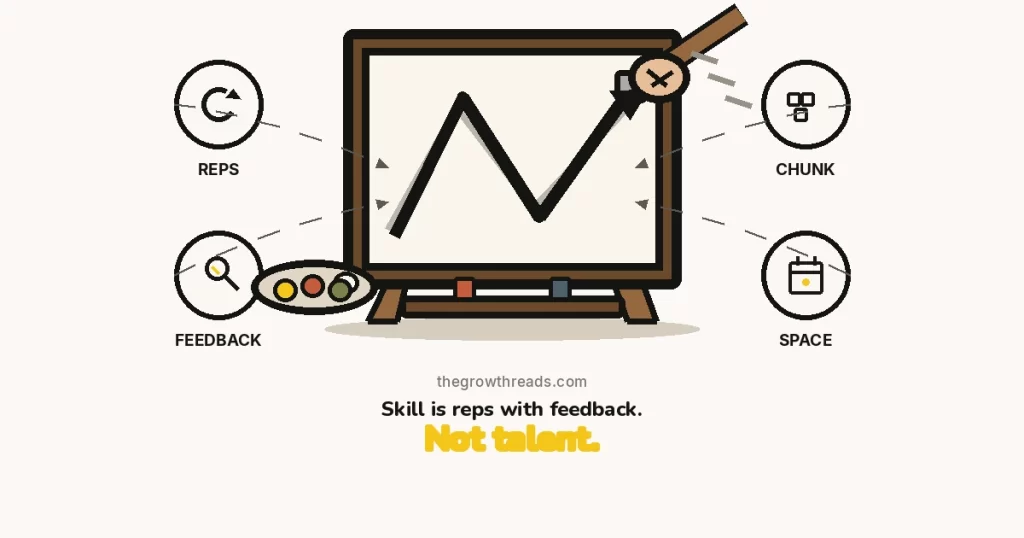
To learn a new skill fast, replace unstructured repetition with four specific mechanisms: chunk the skill into its weakest sub-part, build a feedback loop before you practice, work at the edge of your ability, and space your sessions instead of blocking them. Deliberate, feedback-checked practice builds skill; comfortable repetition mostly builds comfort.
Key takeaways
- Elite violinists in the landmark study on expert performance had accumulated roughly 10,000 hours of solitary, goal-directed practice by age 20, versus about 8,000 for the next tier and 4,000 for the least accomplished group — the hours were structured and feedback-checked, not casual playing (Ericsson, Krampe & Tesch-Römer, 1993).
- A meta-analysis pooling dozens of studies found deliberate practice explains only around 12% of the variance in performance on average across domains — roughly 26% in games, but closer to 1% in professions — meaning practice matters enormously without being the whole story of who gets good (Macnamara, Hambrick & Oswald, 2014).
- Students who studied examples from different painting styles interleaved together scored higher on a later categorization test than students who studied one style at a time in a block — even though the interleaved group rated their own learning as worse while it was happening (Kornell & Bjork, 2008).
- Feedback carries one of the largest average effect sizes ever measured on learning, roughly double that of typical teaching interventions — but only when it targets the task and the process, not the person delivering or receiving it (Hattie & Timperley, 2007).
- All 120 world-class performers studied by Benjamin Bloom’s research team — concert pianists, Olympic swimmers, research mathematicians — had gone through years of escalating, coached practice; early “giftedness” alone rarely explained who reached the top (Bloom, 1985).
What deliberate practice actually is (and why reps alone aren’t it)
Deliberate practice is a specific, narrow activity — drilling one weak sub-part of a skill at the edge of your current ability, against a clear standard, with feedback that tells you whether the last attempt was actually better than the one before it. That definition rules out most of what people call “practicing.” Playing a full round of golf, running through a song start to finish, or doing another hour of casual coding is repetition. It can be enjoyable and it isn’t wasted, but it mostly reinforces whatever level you’re already at, because nothing in the activity forces a correction.
K. Anders Ericsson, Ralf Krampe and Clemens Tesch-Römer coined the term studying violin students at Berlin’s Universität der Künste, and their central finding is usually flattened into “10,000 hours” when the more useful detail is what filled those hours: solitary, effortful drilling of specific technical weaknesses, tracked against a standard, not rehearsal or performance. The best students in their sample had logged roughly 10,000 hours of that specific kind of practice by age 20; the next tier had about 8,000; the least accomplished group had about 4,000. The hours predicted skill only because of what kind of hours they were.
What’s the actual difference between practice and deliberate practice?
Ordinary practice repeats a skill you can already mostly do; deliberate practice isolates the specific part you can’t yet do and drills that part against a standard until it improves. A basketball player shooting 200 free throws from the line is practicing. A basketball player who tracks a form flaw in their release, drills that single motion in isolation, and checks make-percentage against last week’s number is doing deliberate practice. Both look like “shooting hoops” from across the gym. Only one of them is structured to produce a measurable change.
Why most practice stops producing gains
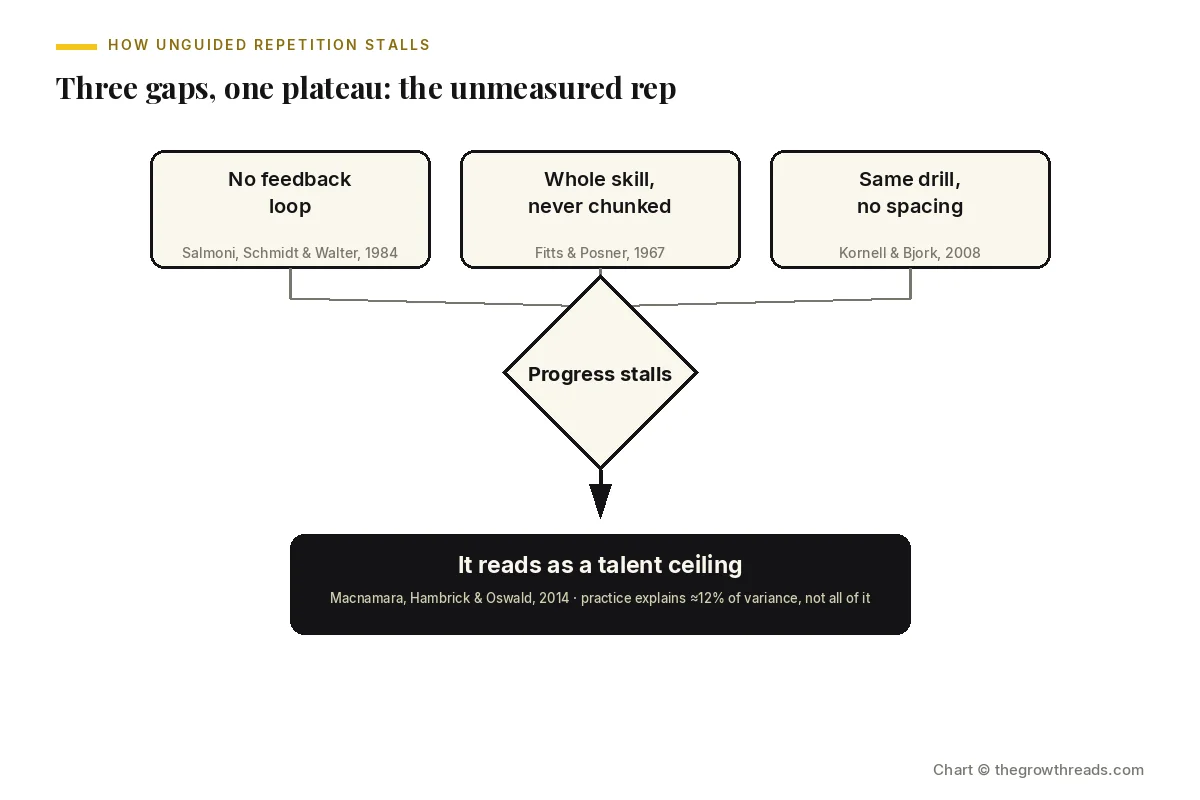
Practice plateaus for three specific, fixable reasons — there’s no feedback loop telling you whether an attempt actually improved, the whole skill gets rehearsed as one unbroken unit instead of its weakest parts, and the same drill repeats at the same time instead of being spaced and mixed with others. None of the three require less talent to explain. They’re structural gaps in how the practice session is built, and all three are fixable without changing who’s doing the practicing.
It’s worth naming the honest limit here too. Deliberate practice explains real variance in performance, but Brooke Macnamara and colleagues’ 2014 meta-analysis found it accounts for only about 12% of the difference between performers on average — more in some domains, far less in others. Practice is necessary almost everywhere it’s been studied. It is rarely sufficient on its own, and the size of the gap it can’t explain gets smaller as the domain gets more predictable and larger as it gets less predictable.
The three things that reliably stall a skill curve
- There’s no feedback loop. Alan Salmoni, Richard Schmidt and Charles Walter’s classic review of motor-learning research found that knowledge of results shapes performance directly — but only when it’s actually present. Practice with no comparison point (no score, no recording, no coach) leaves the brain nothing to correct against, so an attempt can be worse than the last one and feel identical.
- The whole skill is rehearsed as one unit. Paul Fitts and Michael Posner’s three-stage model of skill acquisition — cognitive, associative, autonomous — describes how a skill becomes automatic precisely because its components stop needing separate attention. Practicing the whole thing every time skips the stage where the weak sub-part gets isolated and corrected before it’s allowed to become automatic in its flawed form.
- The drill never moves or spreads out. Nate Kornell and Robert Bjork’s research on spacing and interleaving found that mixing related material, or spacing sessions apart instead of massing them together, produces better long-term learning than the blocked, back-to-back repetition that feels more productive in the moment. The version that feels smoother while you’re doing it is often the version that teaches less.
Why a stalled skill costs more than it feels like
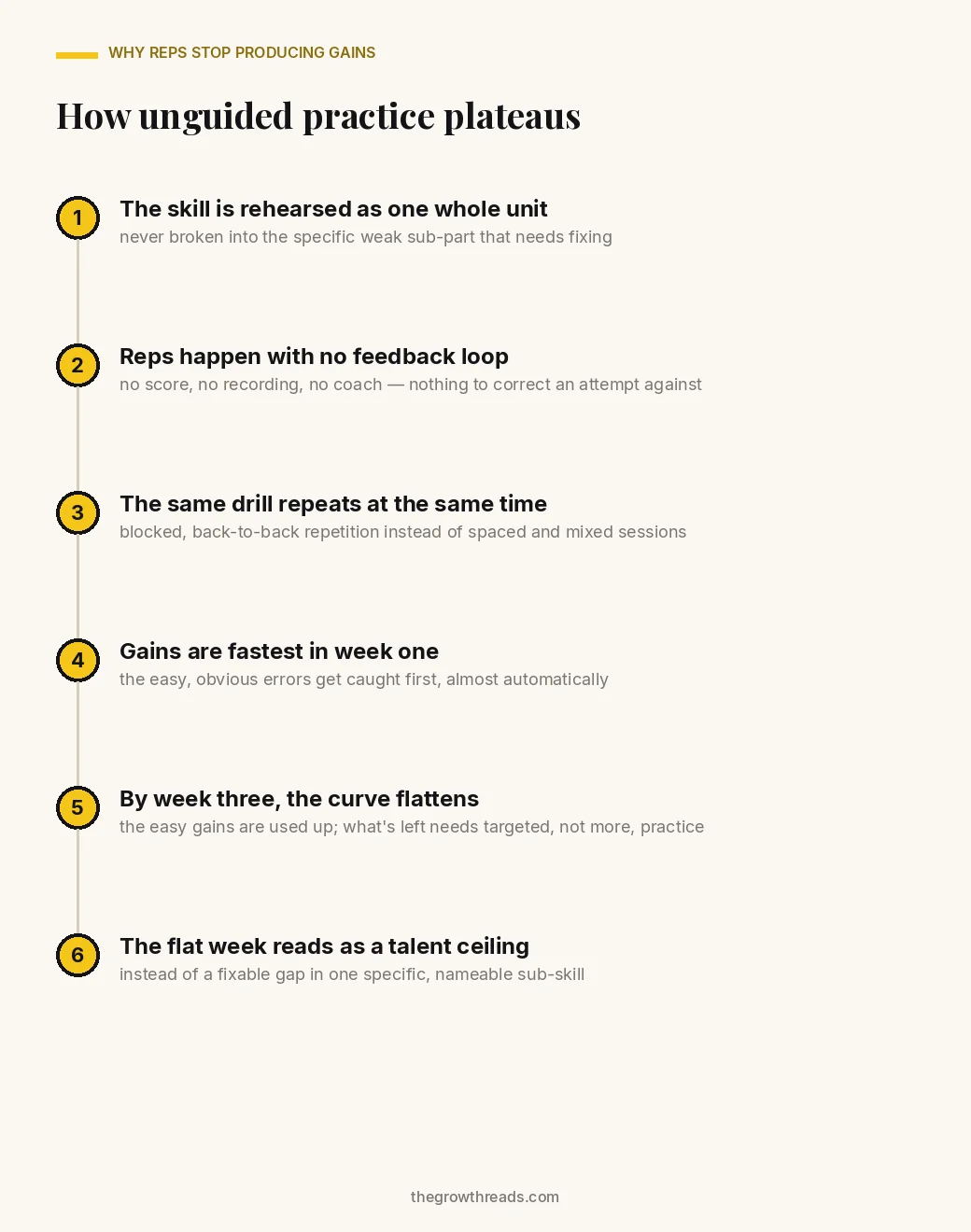
A plateau doesn’t just slow progress — it gets misread as a ceiling on ability, which is a far more expensive mistake than a slow week, because a perceived talent ceiling is what actually makes people quit a skill they could still improve at. The cost isn’t the missed practice session. It’s the false conclusion drawn from it.
Fitts and Posner’s stage model explains why the misreading is so easy to make: gains are fastest in the earliest, cognitive stage of learning a skill, when almost anything corrects an obvious error, and they slow naturally as a skill moves toward the associative and autonomous stages. A learner who doesn’t know this timeline experiences the same slowdown as evidence that they’ve hit their limit, when it’s actually evidence that the easy gains are used up and the practice needs to get more targeted, not that it needs to stop.
Hattie and Timperley’s feedback research adds the second cost. Their review found feedback’s effect on learning is large on average but wildly inconsistent depending on what kind of feedback it is — task-focused feedback (“this specific motion is off”) produces much larger gains than person-focused feedback (“you’re a natural” or “you’re just not good at this”). A plateau interpreted through person-focused feedback reads as an identity verdict. The same plateau, described as a fixable gap in one specific sub-skill, is just information.
An honest caveat. Murre and Dros’s 2015 replication of Hermann Ebbinghaus’s forgetting curve is a genuinely small-scale study — largely a single researcher re-running Ebbinghaus’s own 1885 nonsense-syllable memorization protocol on himself. It replicated the classic curve closely, including the benefit of spaced review, but it’s rote verbal memory, not a complex motor or cognitive skill. Treat the spacing lesson as well-supported for what to review and when, not as proof that every detail of memory research transfers directly to learning a sport, an instrument or a language.
The four mistakes that flatten a skill curve — and the fix for each
Because the underlying cause determines the fix, generic advice (“just practice more”) fails differently depending on which of these four is actually running. Diagnose the pattern before adding more hours.
| Pattern | What it looks like | The mechanism underneath | The fix that works |
|---|---|---|---|
| The Whole-Skill Rep | Running the entire skill start to finish every session, never isolating the weak part | Skips the stage where a specific sub-skill gets corrected before it hardens into an automatic habit (Fitts & Posner, 1967) | Name the single weakest component and drill only that for the session |
| The Feedback-Free Rep | Practicing with no score, recording, or outside check — just a felt sense of “that seemed fine” | Knowledge of results is what lets an attempt be compared to the last one; without it, correction has nothing to work from (Salmoni, Schmidt & Walter, 1984) | Record, score, or time every attempt before judging whether it improved |
| The Blocked Drill | The same single drill, same order, back-to-back, session after session | Blocked repetition feels more fluent in the moment but produces weaker long-term learning than spaced, interleaved practice (Kornell & Bjork, 2008) | Mix two or three related sub-skills in one session instead of one at a time |
| The Identity Read | A flat week gets explained as “I’m just not talented at this,” and effort quietly drops | Person-focused feedback and self-attributions have far weaker (sometimes negative) effects on subsequent learning than task-focused feedback (Hattie & Timperley, 2007) | Rewrite the flat week as a specific, nameable sub-skill that hasn’t been isolated yet |
Most learners run more than one of these at once — the Whole-Skill Rep and the Feedback-Free Rep tend to travel together, because without feedback there’s no obvious sub-part to isolate in the first place.
How to learn a new skill fast: the 6-step system
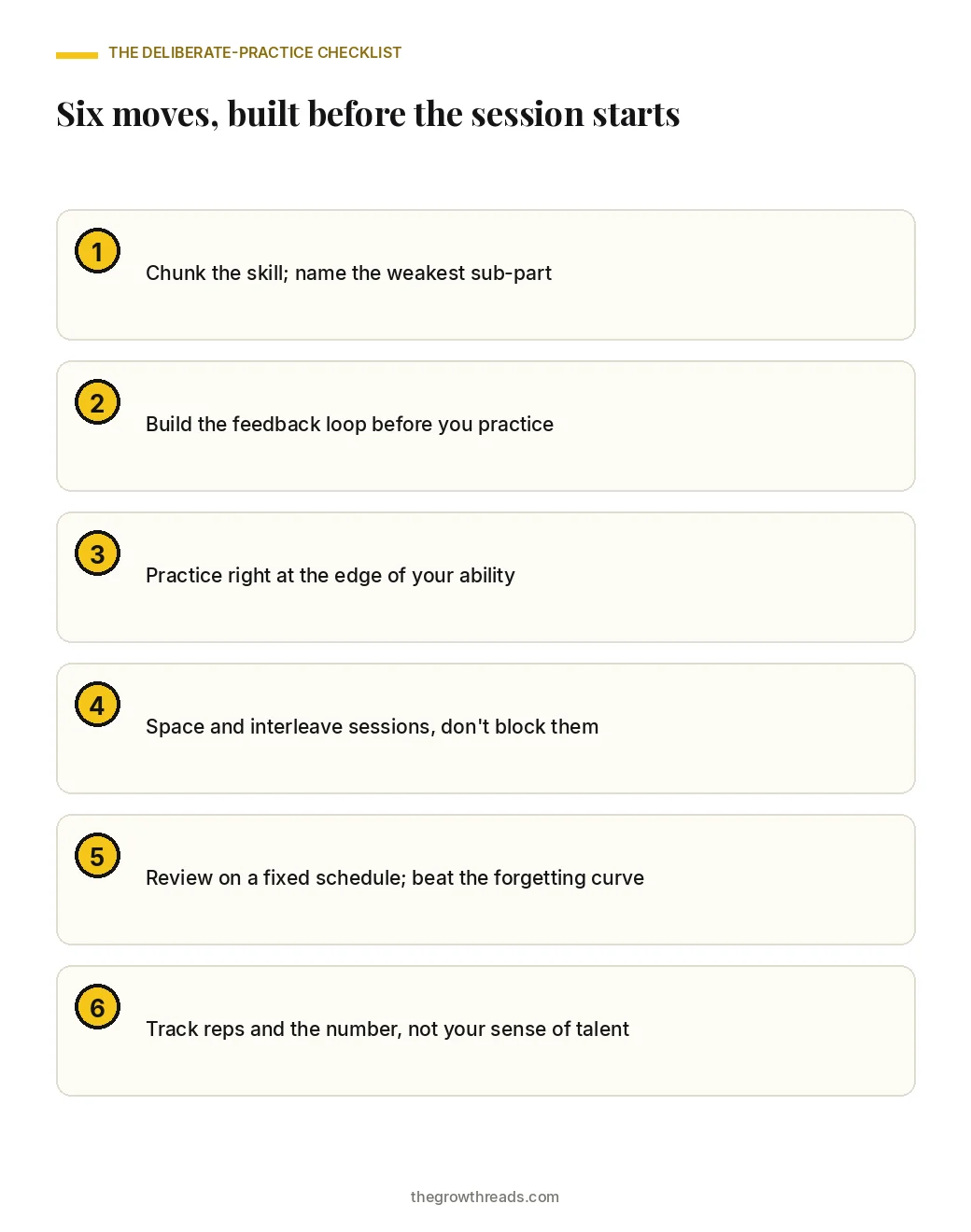
To learn a new skill fast, isolate its weakest sub-part, build a feedback loop before you start, practice at the edge of your current ability, space and mix your sessions, review on a fixed schedule, and track the reps instead of your sense of talent. The first three steps turn a practice session into deliberate practice. The last three are what keeps the gains from evaporating between sessions.
Step 1 — Chunk the skill and name the weakest sub-part
Before the next session, write down the one component of the skill that’s currently holding everything else back — not the whole skill, one identifiable piece of it: the backhand, not “tennis”; the left-hand shift, not “guitar.” Fitts and Posner’s three-stage model is the reason this matters: skills become automatic by consolidating their parts, and a part practiced with an error baked in becomes an automatic error just as reliably as a part practiced correctly. How to focus while studying covers the same chunking logic for study material — smaller, well-defined units are what focused attention can actually improve.
Step 2 — Build the feedback loop before you practice, not after
Decide, before the session starts, exactly how you’ll know whether an attempt was better or worse than the last one — a recording to review, a score, a coach’s cue, a timer. Salmoni, Schmidt and Walter’s review of the motor-learning literature is unambiguous that knowledge of results shapes what gets learned; practice without it isn’t a weaker version of deliberate practice, it’s a different activity that happens to look similar from the outside.
Step 3 — Practice at the edge of your current ability
Choose the version of the drill that’s uncomfortable but not impossible — hard enough that most attempts aren’t clean successes, easy enough that you can tell what went wrong when they fail. Ericsson, Krampe and Tesch-Römer’s violin study found this edge is what separated the top performers’ hours from everyone else’s: solitary practice specifically aimed at material just beyond current ability, not rehearsal of material already mastered.
Step 4 — Space and interleave your sessions instead of blocking them
Split practice into shorter sessions spread across more days, and mix two or three related sub-skills inside each session instead of drilling one to exhaustion. Kornell and Bjork’s research found interleaved, spaced practice produced better performance on a later test than massed, blocked practice — even though the people doing the interleaved version rated it as less effective while they were doing it. Trust the later test result over the in-session feeling.
Step 5 — Review on a fixed schedule to beat the forgetting curve
Put a specific day on the calendar to revisit material or motions from earlier sessions, rather than assuming they’ll stay learned on their own. Murre and Dros’s replication of Ebbinghaus’s forgetting curve found the same rapid early decay Ebbinghaus documented in 1885, and the same result: spaced review measurably slows that decay compared with no review at all. A skill drilled once and never revisited decays on the same curve as a memorized list of nonsense syllables.
Step 6 — Track the reps and the number, not your sense of talent
Log what was drilled and what the feedback said each session, and read a flat week off that log instead of off how the session felt. Benjamin Bloom’s study of 120 world-class performers found that early recognition of talent explained far less of their trajectory than years of structured, escalating coached practice did — the log is what lets a flat week get read as “this sub-skill needs another two weeks” instead of “I’ve hit my ceiling.”
What to do when progress stalls for weeks, not days
When a plateau lasts several weeks rather than one flat session, the fix is usually to shrink the sub-skill being drilled, not to add more hours to the same drill. Adding volume to a drill that’s already stopped producing feedback-visible gains just repeats the Whole-Skill Rep or Feedback-Free Rep pattern at a larger scale.
Two adjustments handle a multi-week stall better than pushing harder. First, split the stuck sub-skill into something smaller and more specific — if “backhand” has stalled, isolate just the follow-through, or just the footwork before contact. Fitts and Posner’s model predicts exactly this kind of stall: a component can plateau while still embedded inside a larger unit that never gets broken down further. Second, get an outside pair of eyes on the feedback loop itself. Salmoni, Schmidt and Walter’s review found that self-generated feedback is a weaker substitute for external knowledge of results — a coach, a more advanced peer, or even video comparison against a model performance often surfaces the specific error that weeks of self-assessment missed.
Common mistakes that stall skill acquisition
- Treating “put in the hours” as the whole strategy. Ericsson, Krampe and Tesch-Römer’s own study is specific that the hours predicted skill only because of how they were structured — solitary, effortful, and aimed at a weak point, not volume for its own sake.
- Practicing only what already feels good. The edge of current ability is uncomfortable by definition; a drill that feels smooth and satisfying every time is very likely below that edge, not at it.
- Blocking every session on one drill because it feels more productive. Kornell and Bjork’s finding runs directly against the feeling in the room — the version that feels less organized on the day often teaches more by the later test.
- Skipping the log because “I’ll remember how it went.” A memory of a session is exactly what the forgetting-curve research says decays fastest and least reliably — see Step 6 and Murre and Dros’s replication. A quick end-of-week scan, the same instinct behind a weekly review, catches a drift the felt sense of “it went fine” won’t.
- Reading a plateau as a talent verdict. Bloom’s research on world-class performers found structured practice, not early giftedness, explained most of the difference between who reached the top and who didn’t.
- Trying to build the whole skill and the habit of practicing it at the same time. Consistency covers the separate discipline of just showing up on the same small cue every day — get that running first, then apply this system to what happens once you sit down.
The evidence behind this system
Every figure quoted above traces to a specific published study, with what it actually found — and what it doesn’t prove.
| Study | Design & size | What it found | Used here for |
|---|---|---|---|
| Ericsson, Krampe & Tesch-Römer (1993), Psychological Review | Comparative study of violin students at a German music academy | Top performers had logged roughly 10,000 hours of solitary, goal-directed practice by age 20, versus about 8,000 and 4,000 for lower tiers | Step 3, and the honest version of the “10,000-hour rule” |
| Macnamara, Hambrick & Oswald (2014), Psychological Science | Meta-analysis pooling dozens of studies across domains | Deliberate practice explained roughly 12% of performance variance on average, ranging from about 26% in games to about 1% in professions | The honest caveat that practice matters but isn’t the whole explanation |
| Fitts & Posner (1967), Human Performance | Foundational theoretical model of motor skill acquisition | Skill acquisition moves through cognitive, associative and autonomous stages, with gains naturally slowing as a skill automates | The plateau explanation, Step 1, and the multi-week stall section |
| Salmoni, Schmidt & Walter (1984), Psychological Bulletin | Critical review of decades of motor-learning experiments | Knowledge of results shapes motor learning directly; its absence, timing and frequency all change what actually gets learned | Step 2, the Feedback-Free Rep pattern, and the multi-week stall fix |
| Kornell & Bjork (2008), Psychological Science | Lab experiment, category-learning task using painting styles | Interleaved, spaced study outperformed blocked study on a later test, despite learners rating the blocked method as more effective | Step 4 and the Blocked Drill pattern |
| Murre & Dros (2015), PLOS ONE | Single-subject replication of Ebbinghaus’s 1885 forgetting-curve experiment | Closely replicated the original rapid-decay curve; spaced review measurably slowed the rate of forgetting | Step 5 and the honest small-sample caveat on generalizing beyond rote memorization |
| Hattie & Timperley (2007), Review of Educational Research | Synthesis of meta-analyses on feedback and learning | Feedback carries a large average effect on learning, but task-focused feedback outperforms person-focused feedback by a wide margin | The Identity Read pattern and the “why it costs more” section |
| Bloom (1985), Developing Talent in Young People | Case-study research on 120 world-class performers across six fields | All 120 had gone through years of escalating, coached practice; early giftedness alone rarely explained their trajectory | Step 6 and the closing case against reading a plateau as a talent ceiling |
Frequently asked questions
How long does it actually take to learn a new skill?
It depends heavily on the skill and the standard you’re aiming for, but the more useful question is what kind of hours you’re logging. Ericsson, Krampe and Tesch-Römer’s violin study found the top performers’ advantage came from roughly 10,000 hours of deliberate, feedback-checked practice by age 20 — not from talent alone, and not from casual playing at any volume. A beginner using the 6-step system above will typically see visible gains in weeks, well before reaching anything close to expert-level hours.
Is the 10,000-hour rule real?
The number is real for the specific study it came from, but the popular version strips out the part that mattered most. Ericsson and colleagues’ research was about the type of practice — solitary, effortful, aimed at a weak point, checked against feedback — not a magic threshold that applies identically to every skill and every person. Macnamara and colleagues’ 2014 meta-analysis found deliberate practice explains only about 12% of performance variance on average, so 10,000 unstructured hours would not produce the same result as 10,000 hours built the way this article describes.
What’s the fastest way to learn a new skill as an adult?
Chunk the skill into its weakest sub-part, build a feedback loop before you practice, work right at the edge of your current ability, and space your sessions instead of massing them together. Adults often have less free time than the study populations behind most deliberate-practice research, which makes the feedback-loop and edge-of-ability steps more important, not less — every hour has to count, and unstructured repetition wastes more of an adult’s limited practice time than a beginner’s.
Do I need a coach or teacher to get good at something?
Not always, but Salmoni, Schmidt and Walter’s review of feedback research found that external knowledge of results is a more reliable feedback source than self-assessment, especially once a plateau sets in. A coach isn’t required for every skill, but some outside check — a recording, a more advanced peer, a measurable score — needs to replace the coach’s role if one isn’t available.
Why does my skill plateau even when I keep practicing?
Usually because the practice has stopped being deliberate without anyone noticing the shift. Fitts and Posner’s stage model predicts this directly: gains are fastest early on and slow naturally as a skill automates, which is exactly the point where continuing the same unchunked, unmeasured practice stops producing visible change. The fix in Step 1 is to isolate a smaller sub-part again, the same move that produced the early gains.
What’s the real difference between practice and deliberate practice?
Ordinary practice repeats a skill you can already mostly do. Deliberate practice isolates the specific part you can’t yet do, drills it at the edge of your ability, and checks the result against a standard. Both can look identical from across a room; only one of them is structured to produce a measurable change in ability.
Can you learn a skill without natural talent?
The evidence says talent explains much less than it feels like it should. Bloom’s study of 120 world-class performers found structured, escalating coached practice across years, not early giftedness, was what distinguished who reached the top. Macnamara and colleagues’ meta-analysis reaches a similarly humbling conclusion from the other direction: even at its strongest, deliberate practice explains a meaningful share of performance, not all of it — which cuts against both “talent is everything” and “practice is everything.”
How many hours a day should I practice a new skill?
Shorter, more frequent sessions generally beat one long session, per Kornell and Bjork’s research on spacing. A session that stays inside the edge-of-ability zone described in Step 3 — challenging enough to require real feedback, short enough to sustain focus — will produce more learning per hour than a longer session that drifts into comfortable repetition once fatigue sets in.
Related reading on The Growth Reads
The books this system draws on
- Ultralearning summary & review — Scott Young’s self-directed, intensive approach to skill acquisition, and the source of the “meta-learn before you learn” idea behind chunking a skill before drilling it
- Grit summary & review — Angela Duckworth’s research on sustained deliberate effort over years, the timeline this system assumes once the weekly system is running
Related articles
- Keystone habits: the one habit that pulls others with it
- Consistency: why it’s the same small day, not a harder one
- How to start a reading habit
- How to focus while studying
- How to build discipline: the 6-step system that doesn’t depend on willpower
Go deeper
How this article was researched
The Growth Reads editorial team writes from primary sources: the books themselves, the authors’ published essays and interviews, and the peer-reviewed literature behind the claims. Every study cited above was read in the original publication or its published abstract, and every figure is quoted with its design, sample and effect so you can judge its weight rather than take ours. Where a finding is genuinely limited — the single-subject forgetting-curve replication, or the modest share of performance variance deliberate practice actually explains — we say so directly, rather than quietly using only the version of the finding that supports the advice.
This article contains no medical advice and makes no claims about clinical learning disorders. A plateau that persists for months despite chunking, feedback, spacing and review is a coaching or program-design question, not something this article’s general system can diagnose on its own.
How we work: every article on The Growth Reads is built from the books in our library plus the research they rest on, and is reviewed and date-stamped when the evidence changes. Read our full methodology.
Sources
- Ericsson, K. A., Krampe, R. T., & Tesch-Römer, C. (1993). The role of deliberate practice in the acquisition of expert performance. Psychological Review, 100(3), 363–406. doi:10.1037/0033-295X.100.3.363
- Macnamara, B. N., Hambrick, D. Z., & Oswald, F. L. (2014). Deliberate practice and performance in music, games, sports, education, and professions: A meta-analysis. Psychological Science, 25(8), 1608–1618. doi:10.1177/0956797614535810
- Fitts, P. M., & Posner, M. I. (1967). Human Performance. Brooks/Cole Publishing.
- Salmoni, A. W., Schmidt, R. A., & Walter, C. B. (1984). Knowledge of results and motor learning: A review and critical reappraisal. Psychological Bulletin, 95(3), 355–386. doi:10.1037/0033-2909.95.3.355
- Kornell, N., & Bjork, R. A. (2008). Learning concepts and categories: Is spacing the “enemy of induction”? Psychological Science, 19(6), 585–592. doi:10.1111/j.1467-9280.2008.02127.x
- Murre, J. M. J., & Dros, J. (2015). Replication and analysis of Ebbinghaus’ forgetting curve. PLOS ONE, 10(7), e0120644. doi:10.1371/journal.pone.0120644
- Hattie, J., & Timperley, H. (2007). The power of feedback. Review of Educational Research, 77(1), 81–112. doi:10.3102/003465430298487
- Bloom, B. S. (Ed.). (1985). Developing Talent in Young People. Ballantine Books.